
The Mathematical Dialogue Between Cultures: The Journey of Zero from India to the World


Welcome to Ancient India History, where we embark on a fascinating journey through the vibrant tapestry of India's past! Here, we delve into the remarkable contributions of ancient Indian civilizations, from the innovative minds of the Indus Valley to the intellectual brilliance of the Gupta Empire. In our featured article, "The Mathematical Dialogue Between Cultures: The Journey of Zero from India to the World," we explore the profound impact of the history of zero in India—a concept that revolutionized mathematics and transcended borders.
Prepare to uncover the hidden stories and cultural exchanges that shaped our understanding of mathematics as we know it today. Join us as we unravel the threads of history and ignite your curiosity!
Introduction to the History of Zero in India
The history of zero in India is not just a story of a number; it represents a profound cultural and mathematical evolution that has influenced civilizations worldwide. The concept of zero, often symbolized as "0," originated in ancient India and marks a critical turning point in mathematical thought. This numerical innovation emerged during a period of rich intellectual activity, particularly between the 5th and 7th centuries CE, during the Gupta Empire — a time known for its advancements in science, art, and philosophy.
Zero was not merely a placeholder or a symbol for nothingness; it represented an idea that encapsulated the essence of absence and presence, a concept that bridged the gap between the physical and metaphysical realms. The development of zero paved the way for complex calculations, enabling the formulation of advanced mathematical theories and practices.
As we delve deeper into the journey of zero, we will explore its origins, the pivotal texts that documented its use, and how this seemingly simple concept transformed into a cornerstone of mathematics, influencing cultures beyond India's borders. The significance of zero stretches far beyond arithmetic; it has shaped our understanding of mathematics, science, and philosophy, making it an essential subject for exploration.
Importance of Zero in Mathematics and Culture
Zero holds a unique position in both mathematics and culture. Its introduction revolutionized the way calculations were performed, allowing for the development of algebra, calculus, and more. Here are some key points highlighting its importance:
- Mathematical Operations: Zero serves as an identity element for addition, meaning that any number added to zero remains unchanged. Additionally, it acts as a crucial component in subtraction and multiplication.
- Place Value System: The incorporation of zero into the decimal system allowed for the representation of large numbers and more complex mathematical concepts. This place value system is fundamental to modern mathematics.
- Cultural Significance: Beyond mathematics, zero has philosophical implications. It embodies the concept of emptiness and fullness, often reflected in various Indian philosophies and spiritual traditions.
- Global Influence: The journey of zero did not end in India. As it traveled to the Arab world and later to Europe, it played a vital role in the development of Western mathematics, becoming an integral part of global educational curricula.
The history of zero in India is a testament to the ingenuity of ancient Indian scholars and their contributions to mathematics. As we continue to explore this fascinating subject, we will uncover the intricate dialogue between cultures that allowed the concept of zero to flourish and ultimately reshape the world of mathematics.
- What is the significance of the history of zero in India?
- How did zero travel from India to other cultures?
- Who were the key figures in the development of zero in ancient India?
- Why is the invention of zero considered a major contribution to mathematics?
- How did the mathematical dialogue between cultures influence the understanding of zero?
The Origins of Zero in Ancient India

The Concept of Nothingness in Indian Philosophy
The philosophical roots of zero in India can be traced back to ancient Indian thought, where the concept of nothingness was not merely an absence but held profound significance. In Indian philosophy, particularly in schools such as Buddhism and Jainism, the notion of śūnyatā (emptiness) emerged, reflecting a deep understanding of void and the transient nature of existence. This philosophical discourse laid the groundwork for the mathematical abstraction of zero.
- Philosophical Underpinnings:
- The idea of nothingness was integral to various philosophical debates, exploring the nature of reality and existence.
- The Buddhist perspective emphasized the impermanence of all things, aligning with the notion that zero represents the absence of quantity.
- Cultural Interpretations:
- Texts like the Upanishads and the Brahma Sutras often allude to the void, suggesting that the ultimate reality transcends all forms and concepts, including numerical representations.
- Such interpretations contributed to a cultural environment wherein zero could be embraced not only as a number but also as a philosophical concept.
The acceptance of nothingness in philosophical discussions made it easier for mathematicians to incorporate zero into their calculations, ultimately leading to its development as a numerical symbol.
Early Uses of Zero in Indian Mathematics
Zero's formal introduction into mathematics in India was a groundbreaking development that transformed numerical systems worldwide. The earliest recorded uses of zero can be traced back to the 5th century CE, with significant contributions from scholars such as Aryabhata and Brahmagupta.
- Aryabhata's Contributions:
- Aryabhata's seminal work, the Aryabhatiya, presented a positional numeral system that utilized zero as a placeholder. This was crucial for distinguishing between numbers like 205 and 25.
- His innovative approach allowed for more complex calculations and laid the foundation for arithmetic methods that included zero.
- Brahmagupta's Rules:
- In the 7th century, Brahmagupta expanded on Aryabhata’s ideas in his text, Brahmasphutasiddhanta. He formulated specific rules for calculations involving zero, such as:
- Adding zero to any number yields the number itself.
- Subtracting a number from itself results in zero.
- Multiplying any number by zero results in zero.
- In the 7th century, Brahmagupta expanded on Aryabhata’s ideas in his text, Brahmasphutasiddhanta. He formulated specific rules for calculations involving zero, such as:
- The Bakhshali Manuscript:
- This ancient Indian mathematical treatise, dated between the 3rd and 4th centuries CE, contains one of the earliest recorded uses of a symbol for zero. The manuscript showcases various arithmetic operations and includes a placeholder for zero in calculations.
The evolution of zero as both a concept and a tool in mathematics exemplifies the innovative spirit of ancient Indian scholars. These foundational contributions not only influenced subsequent mathematical developments in India but also laid the groundwork for the introduction of zero into the broader mathematical canon, impacting civilizations around the globe.
The Development of Zero in Indian Civilization

The concept of zero, as a numerical entity, has its roots deeply embedded in the intellectual tradition of ancient Indian civilization. The development of zero is not merely a mathematical innovation but a profound philosophical and cultural evolution that reshaped the understanding of mathematics globally.
Contributions of the Gupta Empire to Mathematical Innovations
The Gupta Empire, which flourished between approximately 320 to 550 CE, marked a golden age in the history of Indian mathematics. During this period, significant advancements were made that would later influence mathematicians across the world.
-
Invention of the Place Value System:
The development of the place value system was one of the most critical contributions during the Gupta period. This system allowed for the representation of numbers using a base-10 format, where the position of a digit determines its value. For example, in the number 205, the '2' represents two hundred because of its position.
-
Formalization of Zero:
The mathematicians of the Gupta Empire began to use a symbol for zero (shunya) and recognized it as a number in its own right. This was revolutionary, as it provided a means to perform calculations more efficiently and paved the way for the development of algebra.
-
Aryabhata's Contributions:
Aryabhata, one of the most prominent mathematicians of the Gupta Empire, made significant contributions to the understanding of zero. In his work "Aryabhatiya," he introduced the concept of zero as a placeholder and discussed its operational rules. His insights laid the groundwork for future mathematical explorations.
-
Mathematical Texts:
Texts such as "Lilavati" and "Bijaganita" by Bhaskara II further elaborated on the use of zero and its applications in arithmetic and algebra. These texts highlight the practical uses of zero in calculations and its theoretical implications in mathematics.
The Role of Indian Scholars in the Advancement of Zero
Indian scholars played an indispensable role in the propagation and refinement of the concept of zero, transforming it into a universal mathematical tool.
-
Influence of Brahmagupta:
Brahmagupta, a 7th-century mathematician, was one of the first to provide rules for arithmetic operations involving zero. His work "Brahmasphutasiddhanta" included guidelines for addition, subtraction, and division by zero, thus establishing foundational principles that would be referenced in mathematical discourse for centuries.
-
Integration into Global Mathematics:
The knowledge and understanding of zero traveled from India to the Islamic world and then to Europe. Scholars like Al-Khwarizmi and Fibonacci later built upon these concepts, which led to the incorporation of zero into Western mathematics.
-
Cultural and Philosophical Aspects:
The concept of zero also resonated with the philosophical ideas prevalent in Indian thought, particularly in relation to the void (shunya) and creation. This cultural context enriched the understanding of zero, making it not just a mathematical concept but a symbol of potentiality and infinity.
-
Legacy of Indian Mathematics:
The innovations surrounding zero have left an indelible mark on mathematics worldwide. The transition from a numeral system without zero to one that embraces it has transformed calculations, enabling advancements in science, engineering, and technology.
The journey of zero from its inception in ancient Indian civilization through the contributions of the Gupta Empire and the scholarly work of mathematicians is a testament to the profound impact of Indian intellectual heritage on the global stage. The history of zero in India is not just a story of numbers; it is a narrative woven with cultural, philosophical, and mathematical threads that continue to influence contemporary thought.
The Mathematical Dialogue: How Zero Spread Beyond India

The journey of zero from India to the wider world is a fascinating narrative that exemplifies the interconnectedness of cultures and the evolution of mathematical thought. The concept of zero, originating from ancient Indian mathematicians, did not remain confined to its region of birth; instead, it embarked on a transformative journey that would eventually influence mathematical practices globally. This mathematical dialogue between cultures underscores the significance of zero not only as a numeral but also as a foundational concept in mathematics.
The Transmission of Zero to the Arab World
The transmission of zero from India to the Arab world is intricately linked to trade routes and scholarly exchanges that flourished during the medieval period. Indian traders and scholars traveled westward, bringing with them not only goods but also knowledge. The mathematical treatise "Bakhshali Manuscript," believed to date back to the 7th century, is one of the earliest documents showcasing the use of zero in India.
- Key Events in Transmission:
- The translation of Indian mathematical texts into Arabic during the 8th century.
- The establishment of centers of learning in cities like Baghdad, where scholars from various backgrounds convened.
- The adoption of the Indian numeral system, including zero, by prominent mathematicians such as Al-Khwarizmi and Al-Kindi.
- Impact of Trade Routes:
- Trade routes facilitated not only the exchange of goods but also ideas.
- The Silk Road and maritime routes served as conduits for the dissemination of mathematical knowledge.
The incorporation of zero into Arabic mathematics revolutionized calculations, leading to advancements in fields such as astronomy, commerce, and engineering. Scholars recognized zero as a placeholder, which significantly simplified arithmetic operations.
The Influence of Arabic Mathematics on European Mathematics
As the knowledge of mathematics, including the concept of zero, spread from the Arab world to Europe, it catalyzed a transformation in mathematical practices across the continent. This influence can be traced through several pivotal developments:
- Introduction of Arabic Numerals:
- The translation of Arabic texts into Latin during the 12th century introduced European scholars to the decimal system.
- Figures such as Fibonacci played a crucial role in promoting these numerals in his work "Liber Abaci."
- Shift from Roman Numerals:
- The adoption of Arabic numerals, including zero, facilitated more complex calculations, overshadowing the limitations of Roman numerals.
- The efficiency of the decimal system made it easier to perform arithmetic operations, which was essential for trade and commerce.
- Impact on Scientific Advancements:
- The use of zero and the decimal system laid the groundwork for significant scientific advancements during the Renaissance.
- The foundations of calculus and algebra owe much to the earlier developments in Arabic mathematics.
The journey of zero from India to the world is a testament to the rich tapestry of cultural exchange and intellectual collaboration. The history of zero in India is not just a tale of a numeral; it is a narrative of how ideas transcend borders, reshaping civilizations and paving the way for future innovations in mathematics and beyond.
The Impact of Zero on Global Mathematics

Zero's Role in Modern Numeral Systems
The introduction of zero as a numerical concept revolutionized mathematics and paved the way for the modern numeral systems we use today. Before zero became widely accepted, numeral systems struggled with representing large numbers and performing arithmetic operations efficiently. The numeral systems used in ancient civilizations, such as the Roman numeral system, lacked a symbol for zero, making calculations tedious and often inaccurate.
The Indian numeral system, which incorporated zero, emerged around the 5th century CE, transforming mathematical practices. The symbol for zero (0) served not only as a placeholder but also as a number in its own right, allowing for the representation of values in a positional context. This innovation was crucial for simplifying complex calculations and for the development of algebra.
The Influence of Indian Mathematics on the Global Stage
The mathematical innovations from India, particularly the concept of zero, spread to other cultures through trade and scholarly exchanges. Notably, during the 7th century, Indian mathematicians like Brahmagupta articulated the rules for arithmetic with zero, significantly influencing scholars in the Middle East. The work of Al-Khwarizmi in the 9th century, who translated and built upon Indian texts, helped disseminate these ideas throughout the Islamic world and eventually into Europe.
The acceptance of zero in Europe was gradual, facing resistance due to cultural and religious biases. However, as European scholars began to appreciate the utility of zero in calculations, it became an integral part of the numeric system, leading to advancements in mathematics, science, and engineering. The adoption of the decimal system, which is fundamentally reliant on the concept of zero, marked a significant milestone in the history of mathematics.
The Transformation of Mathematics with the Introduction of Zero
The introduction of zero not only enhanced calculation techniques but also transformed mathematical theory. With zero as a number, concepts such as negative numbers and the idea of infinity became more comprehensible. This led to the development of algebra and calculus, fields that underpin modern mathematics.
- Algebraic Advancements: The ability to perform operations with zero allowed mathematicians to formulate equations that could represent a broader range of problems. For instance, the equation \( x + 0 = x \) illustrates the identity property of zero, which is foundational for algebraic theory.
- Calculus and Beyond: Zero's role in limits and derivatives in calculus is paramount. The concept of approaching zero helps in defining instantaneous rates of change, a core principle in this field. The mathematical notation for limits, such as \( \lim_{x \to 0} f(x) \), showcases the critical function of zero in advanced mathematics.
- Computational Efficiency: Zero's placeholding ability in positional numeral systems allows for efficient computations. It enables simplifications in arithmetic, making it possible to express and manipulate large numbers without cumbersome calculations.
The history of zero in India is not merely an isolated story of mathematical innovation; it is a narrative that illustrates the profound impact of cultural exchanges on the development of global mathematics. From its origins in ancient India to its adoption in modern numeral systems, zero has fundamentally reshaped our understanding and practice of mathematics across civilizations.
Cultural Significance of Zero in Indian and Global Contexts

The concept of zero, originating from ancient India, holds profound cultural significance that transcends mere numerical value. In India, zero was not just a placeholder but a symbol of the void and the infinite, embodying deep philosophical ideas about existence and non-existence. This duality reflects the broader cultural context of Indian civilization, where mathematics, philosophy, and spirituality intertwine seamlessly.
Globally, the introduction of zero transformed mathematical practices and facilitated advancements in various fields. Its adoption in different cultures signifies not only a mathematical revolution but also a shift in the way societies conceptualized and articulated their understanding of the world. The journey of zero is emblematic of the rich dialogues that occur between cultures, showcasing the interconnectedness of human thought.
Zero in Art and Literature in Ancient India
In ancient India, zero manifested itself not only in mathematics but also in art and literature. The aesthetic representation of zero can be seen in various forms, including architecture and symbolic motifs in sculptures.
- Artistic Representations:
- In temple architecture, intricate carvings and designs often included circular motifs that can be interpreted as representations of the concept of zero, symbolizing the cosmos and the cycle of life.
- Examples: The ancient temples of Khajuraho and Hampi display geometric patterns where the essence of zero can be felt through symmetry and balance.
- Literary References:
- Ancient Indian texts, such as the Brahmasphutasiddhanta by Brahmagupta, not only introduced the concept of zero but also discussed its implications in poetic forms.
- The use of zero in literature often mirrors the philosophical inquiry into the nature of existence, reflecting ideas of emptiness and fullness.
The interplay of zero in these cultural artifacts illustrates how mathematics is deeply rooted in the cultural and spiritual fabric of ancient Indian society.
The Philosophical Implications of Zero Across Cultures
The philosophical implications of zero extend beyond its mathematical utility, influencing diverse cultures in profound ways.
- Indian Philosophy:
- In Indian thought, zero symbolizes the concept of śūnyatā (emptiness), a foundational idea in both Buddhism and Jainism. This notion encourages contemplation of the nature of reality and the illusion of permanence.
- It challenges the binary thinking of existence versus non-existence, opening avenues for deeper philosophical discourse.
- Global Perspectives:
- In Western thought, the acceptance of zero was initially met with resistance, viewed as a representation of nothingness. However, as it became integrated into European mathematics during the Middle Ages, it catalyzed significant advancements in algebra and calculus.
- Cultural Dialogue: The introduction of zero into Islamic mathematics played a crucial role in bridging Eastern and Western mathematical traditions, leading to innovations that shaped modern mathematics.
The philosophical discourse surrounding zero reflects the universal quest for understanding the nature of reality. As a concept that embodies both absence and potential, zero invites a myriad of interpretations, enriching the intellectual heritage of the cultures it touches.
The significance of zero in both Indian and global contexts underscores its role as a catalyst for cultural exchange and intellectual growth, marking a pivotal moment in the history of mathematics and human thought.
Conclusion: The Legacy of Zero from India to the World
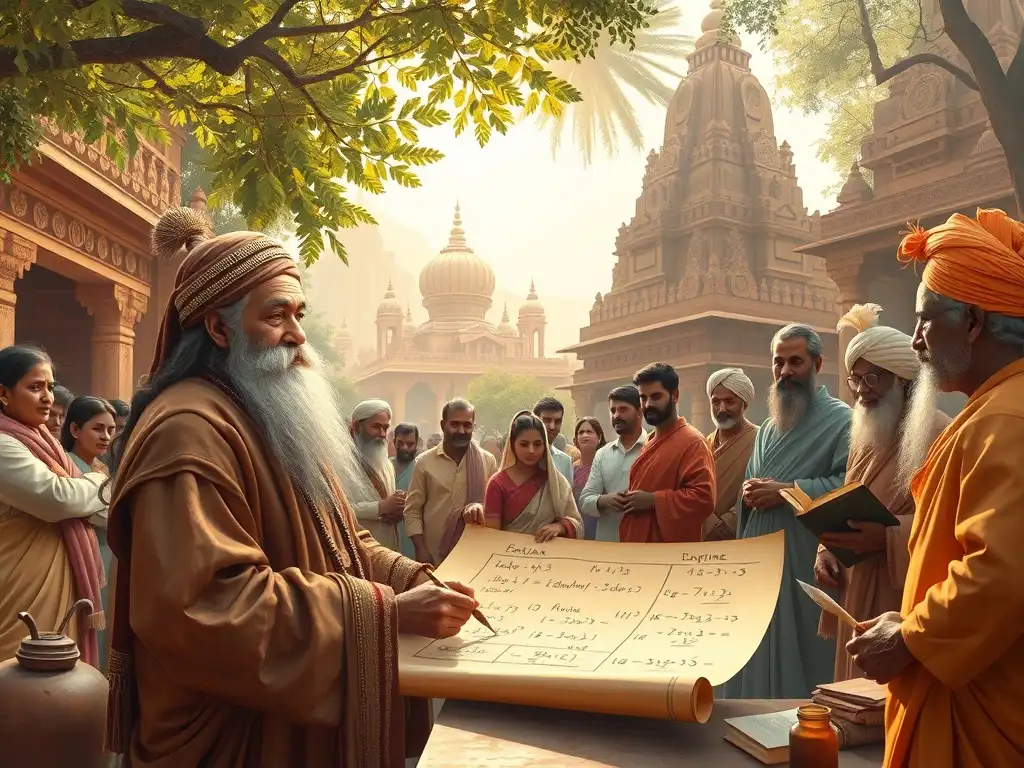
The history of zero in India is not just a narrative of a number; it is a profound journey that reflects the philosophical and mathematical advancements of ancient Indian civilizations. The concept of zero, originating from the ancient Indian numeral system, has left an indelible mark on mathematics and science globally.
Zero, represented by the symbol '0', was first documented in Indian texts around the 5th century CE, notably in the work of the mathematician Aryabhata. This revolutionary concept was not merely a placeholder but came to signify the absence of quantity, thus transforming numerical systems and calculations. The introduction of zero allowed for the development of a positional number system, which is foundational to modern mathematics.
The legacy of zero extends beyond mathematics; it is intertwined with the cultural and intellectual heritage of India. The transmission of this concept through trade routes to the Arab world and subsequently to Europe highlights the interconnectedness of civilizations. The adoption and adaptation of zero by various cultures underscore its universal importance and versatility.
The Continued Relevance of Zero in Contemporary Mathematics
In contemporary mathematics, zero serves as a cornerstone for various theories and calculations. Here are some ways zero continues to play a crucial role in modern mathematics:
- Place Value System: The positional system of numeration, which relies heavily on zero, allows for the efficient representation of large numbers. For example, in the number 205, the zero indicates the absence of tens, demonstrating how zero provides clarity in numerical representation.
- Algebra and Calculus: Zero is integral in equations and functions. For instance, in algebra, the concept of solving for x when f(x) = 0—finding the roots of a function—is fundamental. In calculus, the limit approaches zero, which is vital for defining derivatives and integrals.
- Computer Science: In the realm of technology, binary code, the fundamental language of computers, uses only two digits: 0 and 1. This underscores the importance of zero not just in mathematics, but also in the development of modern computing.
- Physics and Engineering: Zero plays a critical role in various scientific equations, including those in physics that describe motion, forces, and energy. The concept of a 'zero point' can indicate a state of equilibrium or null value, essential in engineering designs and analyses.
Future Perspectives on the Legacy of Indian Mathematics
The legacy of Indian mathematics, particularly the history of zero in India, continues to inspire mathematicians and educators worldwide. Future perspectives on this legacy encompass several exciting avenues:
- Research and Development: Ongoing research into ancient Indian mathematical texts can yield new insights into mathematical theories and practices that may have been overlooked or underappreciated. Scholars are increasingly engaging with historical documents to uncover forgotten methods and ideas.
- Educational Reform: Integrating the history of zero and other mathematical concepts from ancient India into contemporary curricula can enrich students' understanding of mathematics. By recognizing the cultural origins of mathematical principles, educators can foster a more inclusive and global perspective.
- Interdisciplinary Studies: The intersection of mathematics with history, philosophy, and culture presents a fertile ground for interdisciplinary studies. This approach can lead to a deeper appreciation of mathematics as a human endeavor, shaped by diverse cultures and ideas.
- Mathematics and Technology: As technology continues to evolve, the principles underlying zero will remain pivotal. Innovations in artificial intelligence, data science, and mathematical modeling will rely on the foundational concepts established by ancient Indian mathematicians.
The history of zero in India is a testament to the ingenuity and creativity of ancient civilizations. As we move forward, it is essential to acknowledge and celebrate this legacy, ensuring that the contributions of ancient Indian mathematicians continue to inspire and influence future generations.
Frequently Asked Questions
What is the significance of the history of zero in India?
The history of zero in India is crucial as it represents the invention of a symbol that allows for mathematical calculations and serves as a foundation for modern mathematics.
How did zero travel from India to other cultures?
The concept of zero was introduced to the Islamic world through translations of Indian texts, eventually spreading to Europe, where it transformed mathematical practices.
Who were the key figures in the development of zero in ancient India?
Prominent mathematicians like Brahmagupta and Aryabhata significantly contributed to the formalization and use of zero in mathematical equations and calculations.
Why is the invention of zero considered a major contribution to mathematics?
The invention of zero allowed for place value notation, which simplified calculations and led to advancements in algebra and arithmetic, impacting various fields.
How did the mathematical dialogue between cultures influence the understanding of zero?
The mathematical dialogue facilitated the exchange of ideas, leading to the refinement and adoption of zero in different cultures, ultimately enhancing global mathematical knowledge.
Final Reflection: The Journey of Zero and Its Cultural Significance
The journey of zero from India to the world exemplifies the profound interconnectedness of cultures and ideas in shaping our understanding of mathematics today. In a world increasingly defined by globalization, the historical significance of zero transcends mere numerical value; it symbolizes the power of knowledge exchange and the collaborative spirit that drives human progress. The story of zero is not just a tale of mathematical innovation; it is a testament to how ideas can traverse borders and transform societies.
Cultures have always influenced one another, and the introduction of zero into the global mathematical lexicon is a prime example of this dynamic interplay. The legacy of zero has not only revolutionized mathematics but has also permeated various aspects of our daily lives, from technology to economics. As we reflect on this journey, we are reminded of the words of the mathematician Carl Friedrich Gauss: Mathematics is the queen of the sciences and number theory is its crown.
This highlights the essential role that foundational concepts like zero play in the broader landscape of knowledge.
As we conclude this exploration of the history of zero in India, I invite you to consider how the lessons from this mathematical journey can inspire your own life. Reflect on the importance of embracing diverse perspectives and the value of collaboration in your personal and professional endeavors. Just as zero bridged cultures and transformed mathematics, let us strive to connect with others and foster an environment where ideas can flourish, paving the way for innovation and understanding in our ever-evolving world.
Embrace the Legacy: Act Now to Unveil the Power of Zero!
Thank you for exploring the fascinating journey of zero and its significant impact on cultures around the world! By diving into this rich history, you’ve gained insight into how mathematics transcends boundaries and connects civilizations. Now, let’s turn that knowledge into action!
Here are some engaging steps you can take to further explore this captivating narrative:
- Dive deeper into historical texts or documentaries related to the evolution of mathematics in ancient cultures; you might discover intriguing connections you never knew existed!
- Share this article with friends or on social media to spark conversations about the importance of zero in our lives and encourage others to explore the mathematical heritage of various civilizations.
- Join an online forum or community focused on ancient mathematics to connect with like-minded enthusiasts and exchange unique perspectives.
What do you think is the most important lesson we can learn from the journey of zero as it traveled across different cultures?