
How Ancient Indian Mathematicians Addressed the Challenges of Measurement


Welcome to Ancient India History, where we embark on a captivating journey through the rich tapestry of India's past. Today, we delve into the fascinating world of ancient Indian mathematics contributions, uncovering how brilliant minds tackled the complexities of measurement. What innovative techniques did these mathematicians employ, and how did their groundbreaking work influence civilizations beyond their time? Join us as we explore these intriguing questions and more, igniting your curiosity about the profound legacy of ancient Indian scholars. Read on to discover the extraordinary achievements that laid the foundation for modern mathematics!
- Introduction to Ancient Indian Mathematics Contributions
- Historical Context of Measurement in Ancient India
- Key Challenges in Measurement Faced by Ancient Indian Mathematicians
- Innovative Solutions Developed by Ancient Indian Mathematicians
- Notable Ancient Indian Mathematicians and Their Contributions
- The Influence of Ancient Indian Measurement Techniques on Later Cultures
- Conclusion: The Enduring Legacy of Ancient Indian Mathematics Contributions
-
Frequently Asked Questions
- What were the main contributions of ancient Indian mathematicians to measurement?
- How did ancient Indian mathematicians influence modern mathematics?
- What role did the Indus Valley civilization play in early mathematics?
- How did the Gupta Empire contribute to advancements in mathematics?
- What challenges did ancient Indian mathematicians face in their studies?
- Final Reflection: The Enduring Legacy of Ancient Indian Mathematics
- ⭐ Unleash Your Curiosity: Dive into the World of Ancient Indian Mathematics!
Introduction to Ancient Indian Mathematics Contributions
Ancient Indian mathematics is a fascinating and essential aspect of the rich tapestry of India’s historical contributions to the world. From the sophisticated numerical systems of the Indus Valley Civilization to the groundbreaking work of mathematicians during the Gupta Empire, the evolution of mathematical thought in ancient India showcases a remarkable journey of intellectual achievement.
Exploring ancient Indian mathematics contributions reveals not only the technical prowess of these early civilizations but also their profound understanding of measurement, which was crucial for various applications in trade, astronomy, and architecture. This article delves into how ancient Indian mathematicians addressed the challenges of measurement, highlighting their innovative methods and the lasting impact of their contributions.
Overview of Ancient Indian Mathematical Achievements
Ancient India produced a plethora of mathematicians whose work laid the groundwork for various mathematical concepts still in use today. Key figures such as Aryabhata, Brahmagupta, and Bhaskara significantly advanced mathematics. Some of their notable achievements include:
- The Concept of Zero: One of the most revolutionary contributions was the introduction of the concept of zero as a numeral and its role in place-value notation.
- Decimal System: The development of the decimal system allowed for more complex calculations and was fundamental in facilitating trade and commerce.
- Geometry and Trigonometry: Ancient Indian mathematicians made significant advancements in geometry and trigonometry, contributing to fields such as astronomy and architecture.
- Mathematical Texts: Texts like the Aryabhatiya and Brahmasphutasiddhanta served as comprehensive resources for mathematics and astronomy, spreading knowledge across regions and influencing later scholars.
These accomplishments reflect a profound understanding of numerical systems and measurement, illustrating how ancient Indian mathematicians approached mathematical challenges with creativity and analytical thinking.
Importance of Measurement in Ancient Civilizations
Measurement was a critical component of daily life in ancient civilizations, serving various practical purposes that went beyond mere numbers. In ancient India, measurement played a vital role in:
- Agriculture: Accurate measurement of land and yields was crucial for farming, impacting food production and trade.
- Architecture: The construction of temples, palaces, and cities required precise measurements to ensure structural integrity and aesthetic appeal.
- Astronomy: Ancient Indian astronomers relied heavily on measurements to track celestial bodies, facilitating calendar systems and navigation.
- Trade and Commerce: Standardized measurements were essential for fair trade practices, ensuring that goods were evaluated and exchanged equitably.
The ability to measure accurately not only reflected the mathematical sophistication of ancient Indian civilizations but also highlighted their capacity to integrate mathematics into various aspects of life, contributing to the overall advancement of society.
Historical Context of Measurement in Ancient India

The evolution of measurement in ancient India reflects the civilization's ingenuity and practicality in addressing various challenges. Measurement practices were essential for trade, agriculture, construction, and astronomical observations. As early as the Indus Valley Civilization, people understood the need for standardization in measurements, which laid the groundwork for future developments in ancient Indian mathematics contributions.
Measurement Practices in the Indus Valley Civilization
The Indus Valley Civilization (c. 3300–1300 BCE) is one of the earliest examples of advanced urban planning and architecture in ancient India. The inhabitants of this civilization showcased remarkable skill in measurement, which can be observed through the following practices:
- Standard Units: Archaeological findings suggest that the Indus Valley people utilized standardized units of measurement, specifically for length and weight. Evidence indicates that they may have used a unit equivalent to approximately 13 inches, as seen in the uniformity of bricks used in construction.
- Weights and Balances: Excavations have uncovered a variety of weights made from stone, along with balance scales. These artifacts signify that the society engaged in trade that required accurate weight measurement, promoting fairness and efficiency in commercial transactions.
- Urban Planning: The layout of cities such as Mohenjo-Daro and Harappa demonstrates advanced knowledge of geometry. Streets were laid out in a grid pattern, and buildings were constructed with precise measurements, indicating the use of basic surveying techniques.
The significance of these practices extended beyond mere functionality; they reflected a sophisticated understanding of mathematics that would influence subsequent civilizations in India.
The Role of Measurement in Vedic Literature
The Vedic period (c. 1500–500 BCE) marked a significant transition in the mathematical landscape of ancient India. Measurement gained prominence not only in practical applications but also in spiritual and astronomical contexts. Key aspects include:
- Sutra Literature: The Vedic texts, particularly the Sulbasutras, contain detailed instructions on constructing altars for rituals. These texts present geometric principles and mathematical calculations necessary for creating precise shapes, such as squares and circles, underscoring the integration of mathematics in religious practices.
- Astronomical Calculations: Vedic scholars also employed measurement to track celestial bodies. They developed methods for calculating time, which were crucial for determining the timing of rituals and agricultural activities. The concept of a year was defined based on lunar cycles, leading to the establishment of calendars.
- Metrology: The Vedic literature reflects an early understanding of metrology, where various units of measurement, including length, area, and volume, were defined. This foundational work in measurement contributed to the advancements seen in later mathematical texts and practices.
The role of measurement in Vedic literature indicates a sophisticated approach to both practical and spiritual dimensions of life in ancient India, showcasing the contributions of ancient Indian mathematics that would lay the groundwork for future advancements in the field.
Key Challenges in Measurement Faced by Ancient Indian Mathematicians
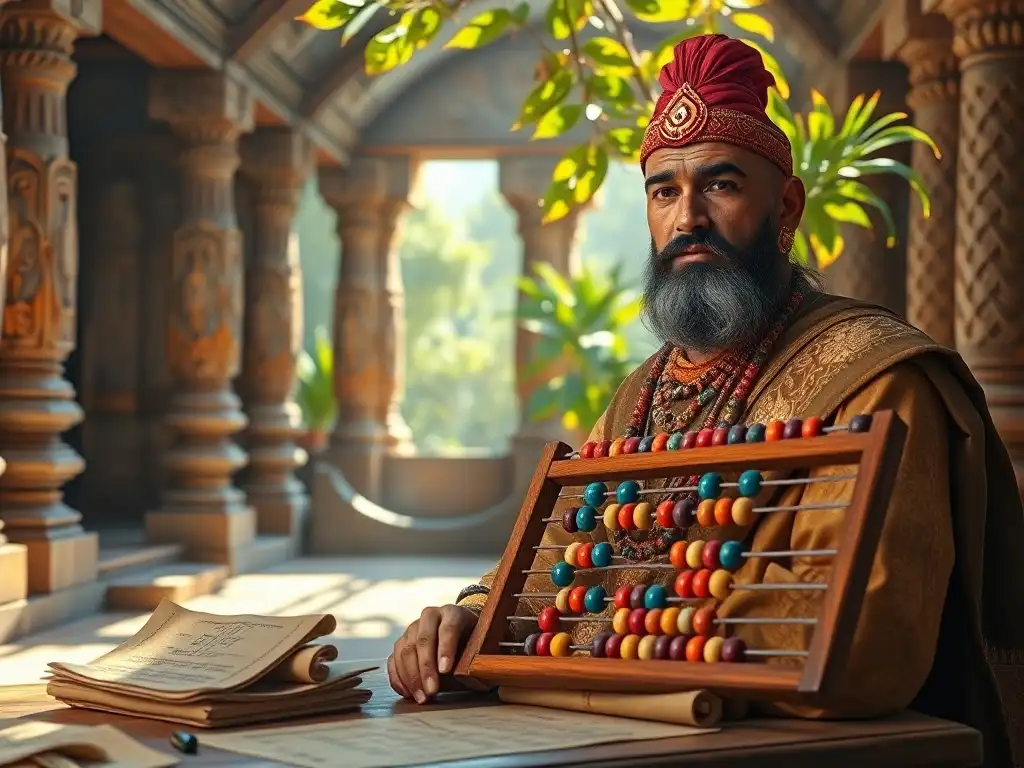
Inaccuracy in Measuring Length and Area
Ancient Indian mathematicians confronted significant challenges in measuring length and area, primarily due to the limitations of the tools and methodologies available to them. The absence of standardized units of measurement led to inconsistencies, making it difficult to ensure accuracy across various applications, such as trade, land surveying, and construction.
To address these issues, ancient mathematicians developed several techniques and tools. For instance, they utilized:
- Measuring Rods: Often made from bamboo or wood, these rods provided a basic means of measuring length. The lengths were typically based on common body parts (like the cubit or foot), leading to variability.
- Geometric Formulas: Ancient texts, such as the Shulba Sutras, outlined geometric principles that aided in calculating areas. For example, the area of rectangles and triangles was calculated using basic formulas, allowing for more reliable estimations.
By refining these tools and formulas, ancient Indian mathematicians made strides towards improved accuracy, which was essential for agriculture, architecture, and urban planning.
Difficulties in Time Measurement and Calendrical Systems
Time measurement presented another intricate challenge for ancient Indian mathematicians. The complexities of celestial movements necessitated precise methods for tracking time, which was vital for agricultural cycles and religious observances.
Key methods employed included:
- Sundials: These devices harnessed the sun's shadow to gauge the time of day. While effective, sundials depended on sunlight and were less reliable during overcast conditions.
- Water Clocks ( Ghati): Water clocks were utilized to measure time intervals. They functioned based on the steady flow of water from one container to another, marking time through the volume of water that passed.
Moreover, the development of intricate calendrical systems, such as the lunar and solar calendars, showcased the mathematicians' understanding of celestial cycles. Texts like the Aryabhatiya by Aryabhata demonstrated sophisticated methods of calculating time, including the length of a year and the cycles of the moon.
Challenges in Volume and Weight Measurement
Measuring volume and weight posed unique challenges that ancient Indian mathematicians had to navigate, especially in contexts such as trade and agriculture. The variability in material density and the lack of standardized weights made it challenging to ensure fairness in transactions.
To tackle these challenges, ancient scholars devised various approaches:
- Balance Scales: The use of balance scales allowed for the comparison of weights. These scales were crucial for trade, ensuring that commodities were weighed accurately against standard weights.
- Standard Units: Different regions developed their own units for measuring volume (like kharva for grains) and weight (such as dharma). While this localized approach facilitated trade within communities, it complicated inter-regional transactions.
Ancient texts, including the Bakhshali Manuscript, provided insights into sophisticated methods for calculating volume through geometric principles. The mathematicians' ability to adapt their methodologies based on existing challenges highlights their innovative spirit and substantial contributions to ancient Indian mathematics.
Innovative Solutions Developed by Ancient Indian Mathematicians

Introduction of Standardized Units of Measurement
Ancient Indian mathematicians made significant strides in the development of standardized units of measurement, which facilitated trade, architecture, and scientific inquiry. These standardized units emerged around 1500 BCE with the growing complexities of societal needs, particularly in urban centers like the Indus Valley Civilization.
- Units of Length: The ancient Indians utilized a system of standardized measurements that included units such as the angula (approximately 1.8 cm) and the danda (approximately 1.5 meters). These units were critical for construction and land measurement, allowing for consistency across various projects.
- Units of Weight: Similarly, units like the shataka (a weight of about 11.66 grams) were established to provide a uniform basis for trade. This standardization minimized disputes and promoted economic stability.
- Mathematical Texts: The Sulba Sutras, dating back to 800 BCE, provide detailed instructions on constructing altars and other structures, showcasing the application of these standardized units in practical geometry.
These innovations in measurement were pivotal not only for economic transactions but also for the advancement of architecture and engineering in ancient India, laying the groundwork for future developments in mathematics.
Development of Advanced Geometric Techniques
The contributions of ancient Indian mathematicians to geometry were groundbreaking. They developed advanced geometric techniques that addressed various measurement challenges, particularly in construction and astronomy.
- Rectangular Geometry: The Sulba Sutras describe methods for constructing right angles using ropes and pegs, a technique that was crucial for building precise structures like temples and altars.
- Circle and Area Calculations: Ancient Indian scholars, including mathematicians like Aryabhata, explored the properties of circles, developing formulas for calculating areas. Aryabhata's work suggested that the area of a circle could be approximated with the formula \(\pi r^2\), demonstrating an early understanding of \(\pi\).
- Pythagorean Theorem: The ancient Indians also recognized the Pythagorean theorem long before it was formally documented in the West. The Sulba Sutras provide various proofs and applications of this theorem, particularly in the context of altar construction.
These geometric advancements not only facilitated architectural achievements but also laid a solid foundation for future mathematical exploration, influencing both contemporaneous and subsequent civilizations.
Use of Algebraic Methods for Measurement Problems
Algebra played a crucial role in how ancient Indian mathematicians approached measurement problems. They developed innovative algebraic methods that allowed for the resolution of complex calculations effectively.
- Linear Equations: The mathematicians of ancient India, such as Brahmagupta, introduced systematic methods for solving linear equations. His seminal work, Brahmasphutasiddhanta, provided rules for handling equations with one or more variables, significantly enhancing computational efficiency.
- Quadratic Equations: Ancient texts also explored the solutions to quadratic equations, with Brahmagupta outlining methods to find roots in the context of practical problems like calculating areas and determining dimensions of fields.
- Application in Astronomy: Algebraic techniques were applied in astronomy to predict celestial events and calculate time. The use of algebra allowed for the formulation of precise predictions, demonstrating the interplay between measurement and celestial observation.
These algebraic methods not only addressed practical challenges in measurement but also contributed to the broader field of mathematics, marking ancient Indian mathematics as a key player in the evolution of mathematical thought globally.
Notable Ancient Indian Mathematicians and Their Contributions

Aryabhata: Innovations in Astronomy and Measurement
Aryabhata, one of the earliest mathematicians and astronomers of ancient India, made significant contributions to the field of mathematics and measurement around the 5th century CE. His seminal work, the Aryabhatiya, serves as a cornerstone in the study of ancient Indian mathematics contributions. Aryabhata introduced several mathematical concepts, including:
- Place Value System: Aryabhata is credited with the use of a positional numeral system, which laid the groundwork for the decimal system.
- Decimal Representation: He utilized decimals and fractions, which were revolutionary at the time. His approach facilitated more accurate calculations.
- Trigonometry and Sine Functions: Aryabhata was one of the first to define sine functions, providing a foundation for future developments in trigonometry.
Aryabhata's work in astronomy is equally remarkable. He accurately calculated the length of the solar year as 365.358 days, which is astonishingly close to the modern value. His methods for determining the positions of celestial bodies were groundbreaking, showcasing how mathematics could solve real-world problems in measurement.
Brahmagupta: Contributions to Arithmetic and Geometry
Brahmagupta, an influential mathematician from the 7th century CE, expanded upon Aryabhata's work and made substantial advancements in both arithmetic and geometry. His treatise, the Brahmasphutasiddhanta, is noted for several key contributions:
- Rules for Zero: Brahmagupta was among the first to treat zero as a number, providing rules for arithmetic operations that included zero. This shifted the understanding of numbers and laid a critical foundation for future mathematical exploration.
- Negative Numbers: He introduced the concept of negative numbers and their operational rules, which was revolutionary for his time. This duality in numbers enhanced the understanding of algebra.
- Quadratic Equations: Brahmagupta provided methods for solving quadratic equations, demonstrating a sophisticated understanding of algebraic principles. His solutions were not only theoretical but also practical, applicable to real-life situations such as land measurement.
Brahmagupta's work significantly influenced later mathematicians, and his systematic approach to arithmetic remains relevant in modern mathematics.
Bhaskara I and II: Advancements in Calculating Techniques
The contributions of Bhaskara I and Bhaskara II in the realm of ancient Indian mathematics are noteworthy, particularly in the development of calculating techniques.
Bhaskara I
Active in the 7th century CE, Bhaskara I was a prominent mathematician and astronomer known for his commentary on Aryabhata's works. His contributions include:
- Sine Table: He developed a sine table that included values for angles, which was instrumental for astronomical calculations.
- Interpolation Methods: Bhaskara I introduced interpolation techniques to improve the accuracy of calculations, particularly in astronomical contexts.
Bhaskara II
Living in the 12th century CE, Bhaskara II, also known as Bhaskara the Great, further advanced the field with his influential text, the Lilavati. His notable contributions include:
- Advanced Arithmetic: Bhaskara II elaborated on various arithmetic operations and introduced innovative approaches to problem-solving, making mathematics accessible to a wider audience.
- Calculus Concepts: He touched upon concepts related to calculus, including the notion of derivatives and rates of change, showcasing a profound understanding that predated Western developments in calculus by centuries.
- Practical Applications: His work included numerous real-world problems, emphasizing practical applications of mathematics in areas such as commerce, agriculture, and engineering.
The legacies of Bhaskara I and II highlight the rich tradition of mathematical inquiry in ancient India, showcasing how their contributions significantly shaped the evolution of mathematical thought and practice.
The Influence of Ancient Indian Measurement Techniques on Later Cultures

The measurement techniques developed by ancient Indian mathematicians had profound influences on various cultures around the world, shaping their approaches to mathematics, architecture, and science. The meticulous attention to measurement in areas such as lengths, weights, and time not only served practical purposes but also fostered a rich theoretical framework that would later be adopted and adapted by other civilizations.
The system of measurements used in ancient India included standardized units that were crucial for trade, construction, and astronomy. For instance, the "angula" (finger breadth) and "hasta" (cubit) were common units for measuring lengths, while weights were often calibrated using gold and silver coins. These standards facilitated commerce and ensured that architectural projects adhered to precise specifications.
Moreover, ancient Indian texts such as the "Surya Siddhanta" outlined methods for measuring celestial bodies, influencing both astronomical practices and the development of mathematical principles related to geometry and trigonometry. These contributions would eventually permeate through various cultures, laying the groundwork for advances in mathematics that spanned centuries.
Cross-Cultural Exchanges with Ancient Greece and the Middle East
The exchange of knowledge between ancient Indian mathematicians and other cultures, particularly the Greeks and those in the Middle East, led to significant advancements in mathematical techniques. Historical accounts suggest that scholars traveled along trade routes, bringing mathematical texts and ideas that were instrumental in shaping the understanding of measurement.
- Influence on Greek Mathematics:
- Ancient Indian mathematical concepts, particularly those related to geometry and arithmetic, found their way into Greek mathematical thought. The Greeks, notably figures like Euclid, integrated these ideas into their own works, enhancing their geometric proofs and theories.
- Transmission to the Islamic World:
- As the Islamic Golden Age blossomed, scholars translated Indian mathematical texts into Arabic. This transmission included the Indian numeral system, which was adopted and further developed by Islamic mathematicians. The significance of zero and the decimal system, foundational elements of ancient Indian mathematics, became cornerstones of mathematical practice in the Muslim world.
- Cultural Synthesis:
- The cross-cultural exchanges led to a synthesis of ideas, where Indian measurement techniques were melded with Greek and Middle Eastern principles, resulting in more sophisticated methods of calculation. This collaboration fostered a broader understanding of mathematics that influenced subsequent generations.
Lasting Impact on Mathematical Principles in the Islamic Golden Age
The impact of ancient Indian mathematics was particularly evident during the Islamic Golden Age, where scholars made groundbreaking advancements based on earlier Indian contributions. The integration of Indian measurement techniques and numeral systems significantly transformed mathematical practices.
-
The Introduction of the Decimal System:
The decimal system, which included concepts like place value and zero, revolutionized calculations. Prominent mathematicians such as Al-Khwarizmi, who is often referred to as the "father of algebra," utilized these principles, which were rooted in earlier Indian practices.
-
Advancements in Algebra and Trigonometry:
The methodologies for solving equations and understanding trigonometric concepts were heavily influenced by Indian mathematicians. The work of Al-Battani, for example, showcased the application of sine and cosine functions, integrating concepts that can be traced back to ancient Indian texts.
-
Influence on European Mathematics:
The knowledge acquired during the Islamic Golden Age eventually found its way to Europe during the Renaissance, leading to significant developments in mathematics. The introduction of the numeral system and algebraic principles transformed European mathematical thought and practice, showcasing the enduring legacy of ancient Indian contributions.
The measurement techniques and mathematical principles developed by ancient Indian mathematicians not only addressed the challenges of their time but also laid a foundation that would influence numerous cultures across the globe. Their contributions remain a pivotal part of the history of mathematics, illustrating the interconnectedness of human knowledge and the importance of cross-cultural exchanges.
Conclusion: The Enduring Legacy of Ancient Indian Mathematics Contributions
The legacy of ancient Indian mathematics contributions is profound and far-reaching, influencing not only the subcontinent but also the global mathematical landscape. The remarkable innovations in measurement techniques developed by ancient Indian mathematicians laid the groundwork for future advancements in various fields, including astronomy, engineering, and commerce. Their meticulous approach to measurement addressed practical challenges faced by society, thereby enhancing the efficiency of agricultural practices, architectural designs, and trade.
The contributions of mathematicians such as Aryabhata, Brahmagupta, and Bhaskara highlight an era characterized by intellectual curiosity and analytical thinking. These scholars developed sophisticated methods for calculating area, volume, and even the celestial distances, showcasing their remarkable grasp of geometry and arithmetic. Their works not only provided valuable solutions to contemporary problems but also established foundational principles that would influence generations of mathematicians worldwide.
Summary of Measurement Innovations
Ancient Indian mathematicians introduced several key innovations in measurement, including:
- Units of Measurement:
- The development of standardized units such as angula (finger-width) and danda (staff) for length.
- Innovations in volume measurement, utilizing units like praman (cubic measure).
- Geometric Techniques:
- Pioneering the calculation of areas, especially in the context of land measurement, using formulas that are still recognized today.
- The use of shulba sutras, which outlined geometric principles essential for constructing altars and other structures.
- Astronomical Measurements:
- Aryabhata's methods for calculating the circumference of the Earth, which were impressively accurate for his time.
- The introduction of sine and cosine functions for astronomical calculations, which greatly improved navigation and timekeeping.
Overall, these innovations not only addressed the practical needs of ancient Indian society but also set a precedent for systematic mathematical inquiry that resonates through the ages.
Reflections on the Importance of Ancient Knowledge in Modern Mathematics
The study of ancient Indian mathematics contributions reveals critical insights into the evolution of mathematical thought. Modern mathematicians and scholars often revisit these early works to uncover techniques and concepts that may have been overlooked or underappreciated in contemporary curricula. The use of algorithms, geometric constructions, and numerical systems established by ancient mathematicians continues to be relevant, serving as both inspiration and practical application in today’s mathematical practices.
Furthermore, the emphasis on rigorous proof and logical reasoning found in ancient texts reinforces the importance of foundational knowledge in mathematics. As we navigate complex mathematical concepts in modern education, the works of ancient Indian mathematicians serve not just as historical artifacts but as vital resources for enhancing our understanding of mathematics as a discipline.
The enduring legacy of ancient Indian mathematics contributions is a testament to the ingenuity and creativity of a civilization that sought to understand and quantify the world around them. Their innovations in measurement and numerical systems not only shaped their society but also laid the groundwork for future generations, ensuring that their intellectual achievements remain influential in our contemporary mathematical landscape.
Frequently Asked Questions
What were the main contributions of ancient Indian mathematicians to measurement?
Ancient Indian mathematicians made significant contributions in areas like geometry, algebra, and trigonometry, which helped address challenges in land measurement and astronomy.
How did ancient Indian mathematicians influence modern mathematics?
The concepts of zero and the decimal system originated from ancient India, profoundly influencing modern mathematics and laying the groundwork for future mathematical innovations.
What role did the Indus Valley civilization play in early mathematics?
The Indus Valley civilization showcased advanced measurement techniques in urban planning, with evidence of standardized weights and sophisticated architectural designs.
How did the Gupta Empire contribute to advancements in mathematics?
During the Gupta Empire, mathematicians like Aryabhata and Brahmagupta developed important theories in arithmetic and geometry, significantly enhancing the field of mathematics in ancient India.
What challenges did ancient Indian mathematicians face in their studies?
Ancient Indian mathematicians had to overcome challenges related to practical applications of mathematics, such as precise calculations for land surveying and astronomical observations.
Final Reflection: The Enduring Legacy of Ancient Indian Mathematics
The contributions of ancient Indian mathematicians to measurement and mathematics are not just historical footnotes; they are foundational pillars that continue to shape our understanding of the world today. As we navigate an increasingly complex landscape of technology and data, the principles established by these scholars remind us of the timelessness of their insights. Their innovative approaches to measurement and calculation resonate with the challenges we face in contemporary society, emphasizing the importance of precision and creativity in problem-solving.
The influence of ancient Indian mathematics extends far beyond the confines of history; it permeates our modern cultural and social landscape. From the algorithms that power our digital devices to the mathematical principles that underpin scientific research, the legacy of these mathematicians is woven into the very fabric of our daily lives.
As the mathematician and philosopher Srinivasa Ramanujan once said, "> An equation for me has no meaning unless it represents a thought of God." This sentiment captures the profound connection between mathematics and the universe, a connection that ancient Indian scholars understood deeply and which continues to inspire generations of thinkers and innovators.
As we reflect on the remarkable achievements of ancient Indian mathematicians, let us embrace the lessons they imparted and apply them in our own lives. Consider how you can incorporate their spirit of inquiry and innovation into your daily challenges.
Whether you are tackling a complex problem at work, pursuing a personal project, or simply seeking to understand the world around you, remember that the wisdom of the past can illuminate the path forward. Embrace the curiosity and creativity that defined these ancient scholars, and let their legacy inspire you to explore the endless possibilities that mathematics offers in shaping our future.
⭐ Unleash Your Curiosity: Dive into the World of Ancient Indian Mathematics!
Thank you for exploring the fascinating journey of ancient Indian mathematicians with us! You've uncovered the remarkable ways these pioneers shaped measurement and mathematics, igniting a passion for knowledge. Now, it's time to take that inspiration further!
Here are some actionable steps you can take:
- Reflect on Measurement: Consider a measurement challenge you face in your daily life. How can you apply an ancient method to solve it?
- Join the Discussion: Share your thoughts on how these ancient techniques resonate in today’s world within our community forum. Your insights can inspire others!
- Explore More: Engage with additional resources such as books or documentaries that highlight the contributions of ancient Indian scholars to science and mathematics. Uncover their timeless wisdom!
What measurement challenge have you taken on today, and how can ancient strategies assist you in addressing it? Let's discuss!