
The Mathematical Techniques Used in Ancient Indian Agriculture


Welcome to Ancient India History, where we embark on a fascinating journey through the rich tapestry of ancient Indian civilizations. Today, we delve into the intricate world of ancient Indian agricultural techniques, revealing the mathematical ingenuity that fueled these remarkable societies. What if we told you that the foundations of modern agriculture are deeply rooted in the wisdom of the past?
Join us as we explore how these ancient methods not only transformed the landscape but also contributed significantly to the field of mathematics. Curious to learn more? Let’s uncover the secrets behind these pioneering techniques and their lasting impact!
- Introduction to Ancient Indian Agricultural Techniques
- Historical Context of Agriculture in Ancient India
- Mathematical Principles in Ancient Indian Agriculture
- Notable Mathematicians and Their Contributions to Agriculture
- Techniques and Tools Derived from Mathematics
- Case Studies of Ancient Indian Agricultural Practices
- Legacy of Ancient Indian Agricultural Techniques
- Conclusion
-
Frequently Asked Questions
- What were some key agricultural techniques used in ancient India?
- How did mathematics influence ancient Indian agriculture?
- What role did the Indus Valley Civilization play in agricultural development?
- Were there any significant crops cultivated in ancient India?
- How did the Gupta Empire contribute to agricultural advancements?
- Final Reflection: The Enduring Legacy of Ancient Indian Agricultural Techniques
- Unlock the Secrets of Ancient Indian Agriculture!
Introduction to Ancient Indian Agricultural Techniques
Agriculture has been a cornerstone of civilization since ancient times, and in India, it has a rich history intertwined with mathematical innovation. The ancient Indian agricultural techniques were not only practical but also deeply rooted in mathematical principles that facilitated efficient farming practices.
From the sophisticated irrigation systems of the Indus Valley Civilization to the crop rotation methods and land measurement techniques developed during the Gupta Empire, ancient Indian farmers relied on a variety of mathematical strategies to enhance productivity and manage resources. This article explores the mathematical techniques utilized in ancient Indian agriculture, shedding light on how these methods contributed to the overall development of agricultural practices and the economy.
Overview of Agriculture in Ancient India
Agriculture in ancient India revolved around the cultivation of staple crops such as rice, wheat, barley, and pulses. The early agrarian societies were largely dependent on seasonal monsoons, which dictated planting and harvesting cycles. Key features of ancient Indian agriculture included:
- Irrigation Systems:
- The Indus Valley Civilization (c. 3300–1300 BCE) showcased advanced irrigation techniques using canals and reservoirs.
- The construction of stepwells and tanks helped in water conservation.
- Crop Rotation and Diversity:
- Farmers practiced crop rotation to maintain soil fertility and reduce pest infestations.
- Diverse crops were planted to ensure food security and adaptability to changing climates.
- Land Measurement:
- Ancient texts like the Arthashastra by Kautilya emphasize the importance of land measurement for taxation and agricultural planning.
The innovative agricultural practices laid the foundation for a thriving economy and influenced societal structures across various regions of ancient India.
Importance of Mathematics in Agriculture
Mathematics played a crucial role in enhancing agricultural productivity in ancient India. Farmers employed numerous mathematical techniques to solve practical problems, which included:
- Land Measurement:
- Geometry was used to calculate land area, ensuring fair taxation and efficient land use.
- The use of specific units like "bigha" and "katha" helped standardize land transactions.
- Irrigation Planning:
- Mathematical models were utilized to design irrigation systems that maximized water distribution.
- Understanding slope and gradient facilitated the construction of canals that directed water flow effectively.
- Crop Calculation:
- Ancient Indian farmers used arithmetic to estimate yields and determine the optimum planting density for various crops.
- Seasonal cycles were analyzed mathematically to predict the best times for planting and harvesting.
The integration of mathematical techniques into agriculture not only improved efficiency and productivity but also laid the groundwork for future advancements in agricultural science. The legacy of these ancient practices continues to influence modern agricultural methodologies in India and beyond.
Historical Context of Agriculture in Ancient India

Agriculture in ancient India has its roots in the prehistoric era, evolving significantly over thousands of years. The fertile plains of the Indus River Valley provided the ideal conditions for early agricultural practices, with evidence of crop cultivation dating back to around 7000 BCE. This early agricultural society became a cornerstone of civilization, leading to the establishment of cities, trade, and complex social structures.
The Evolution of Agricultural Practices
The evolution of agricultural practices in ancient India can be categorized into several key phases:
- Early Agricultural Societies (7000 BCE - 3000 BCE):
- The domestication of plants such as wheat, barley, and peas marked the beginning of agriculture.
- Evidence from sites like Mehrgarh showcases advanced techniques, including irrigation and storage of surplus grains.
- Indus Valley Civilization (3000 BCE - 1500 BCE):
- The Indus Valley Civilization is renowned for its sophisticated urban planning and agricultural innovations.
- They implemented advanced irrigation systems, including canals and reservoirs, to manage water resources efficiently.
- Crop rotation and the use of plows were also documented, significantly increasing yield.
- Vedic Period (1500 BCE - 500 BCE):
- The transition from the urbanized Indus Valley Civilization to the agrarian-focused Vedic society saw the integration of spirituality with farming practices.
- Texts like the Rigveda mention various agricultural techniques and the importance of monsoons, indicating a deep understanding of seasonal cycles.
- Maurya and Gupta Empires (322 BCE - 550 CE):
- During this period, agriculture flourished further, supported by advancements in mathematics and science.
- Notable mathematicians, such as Aryabhata, contributed to agricultural techniques through mathematical formulas for land measurement and crop yield estimation.
- The introduction of new crops, such as rice and cotton, and improved irrigation methods played a significant role in enhancing productivity.
Major Civilizations Contributing to Agricultural Techniques
Several civilizations in ancient India made substantial contributions to agricultural techniques. Each civilization brought unique innovations that shaped agricultural practices:
- Indus Valley Civilization:
- Pioneered urban agriculture with advanced irrigation systems.
- Developed standardized weights and measures for trade in agricultural produce.
- Vedic Civilization:
- Integrated religious practices with agriculture, leading to the development of rituals that coincided with agricultural cycles.
- Emphasized the significance of the monsoon rains for successful farming.
- Maurya Empire:
- Introduced organizational structures for agriculture, including state-controlled granaries and distribution systems.
- Promoted the use of manure and crop rotation to enhance soil fertility.
- Gupta Empire:
- Marked a golden age of scientific advancement, where mathematicians contributed significantly to the precision of farming techniques.
- Innovations in water management, including wells and tanks, increased agricultural output.
The interplay of these civilizations highlights the rich tapestry of ancient Indian agricultural techniques, showcasing their ingenuity and adaptability in harnessing the land's resources. The mathematical methods developed during this period laid the groundwork for systematic agriculture, significantly influencing food production and economic stability in ancient India.
Mathematical Principles in Ancient Indian Agriculture

Ancient Indian agriculture was marked by the application of sophisticated mathematical principles that played a crucial role in enhancing productivity and efficiency. These mathematical techniques were not merely theoretical; they stemmed from practical needs in daily farming activities. The mathematical knowledge of ancient Indian civilizations, particularly in areas like measurement, geometry, and algebra, significantly contributed to their agricultural advancements.
Measurement Techniques Used in Ancient Farming
Measurement in ancient Indian agriculture was fundamental to managing the land and crops effectively. Farmers utilized various units of measurement, such as bigha and katha, to quantify land area. Understanding the dimensions of their fields allowed farmers to optimize planting strategies and resource allocation.
- Land Measurement: Farmers employed simple tools for measuring land, often using a rope or string to delineate boundaries. This practice ensured that each plot was accurately assessed for productivity.
- Water Measurement: The management of irrigation systems necessitated precise measurement of water supply. Ancient texts mention the use of ghat (water gauge) to monitor water levels in canals and reservoirs, enabling farmers to regulate irrigation efficiently.
The importance of measurement in farming cannot be overstated, as it laid the groundwork for other mathematical applications in agriculture.
Geometry in Land Division and Irrigation Systems
Geometry played a vital role in the organization of agricultural land and the construction of irrigation systems. The ancient Indians demonstrated a profound understanding of geometric principles, which they applied to enhance agricultural practices.
- Land Division Techniques: Ancient texts, such as the Arthashastra, reveal that farmers used geometric shapes to divide land into plots. For instance, fields were often divided into rectangular or square shapes, optimizing space and facilitating crop rotation.
- Irrigation Layouts: The construction of canals and irrigation systems required geometric planning. Engineers used geometric principles to design waterways that maximized water flow while minimizing erosion. The alignment of canals was crucial for ensuring even water distribution across fields.
This geometric approach not only improved agricultural efficiency but also contributed to the sustainable management of water resources, which is vital in a predominantly agrarian society.
Use of Algebraic Concepts in Crop Planning
Algebraic concepts were integral to ancient Indian agricultural practices, particularly in crop planning and yield prediction. Farmers relied on these concepts to make informed decisions regarding planting and harvesting.
- Crop Rotation Models: Ancient Indian agronomists developed models for crop rotation based on algebraic reasoning. They understood the importance of alternating crops to maintain soil fertility and optimize outputs. For example, rotating legumes with cereal crops helped in nitrogen fixation, enhancing soil quality.
- Yield Calculations: Farmers employed basic algebraic formulas to estimate crop yields based on land area and crop type. This predictive capability allowed them to plan for market demands and allocate resources accordingly.
These algebraic techniques illustrate the advanced level of mathematical understanding present in ancient Indian agricultural practices, which ultimately contributed to the civilization's resilience and prosperity.
The mathematical techniques used in ancient Indian agriculture reveal a sophisticated understanding of measurement, geometry, and algebra that was critical to the development and sustainability of agricultural practices. The interplay of these mathematical principles fostered a thriving agricultural economy that underpinned the broader social and cultural achievements of ancient Indian civilization.
Notable Mathematicians and Their Contributions to Agriculture
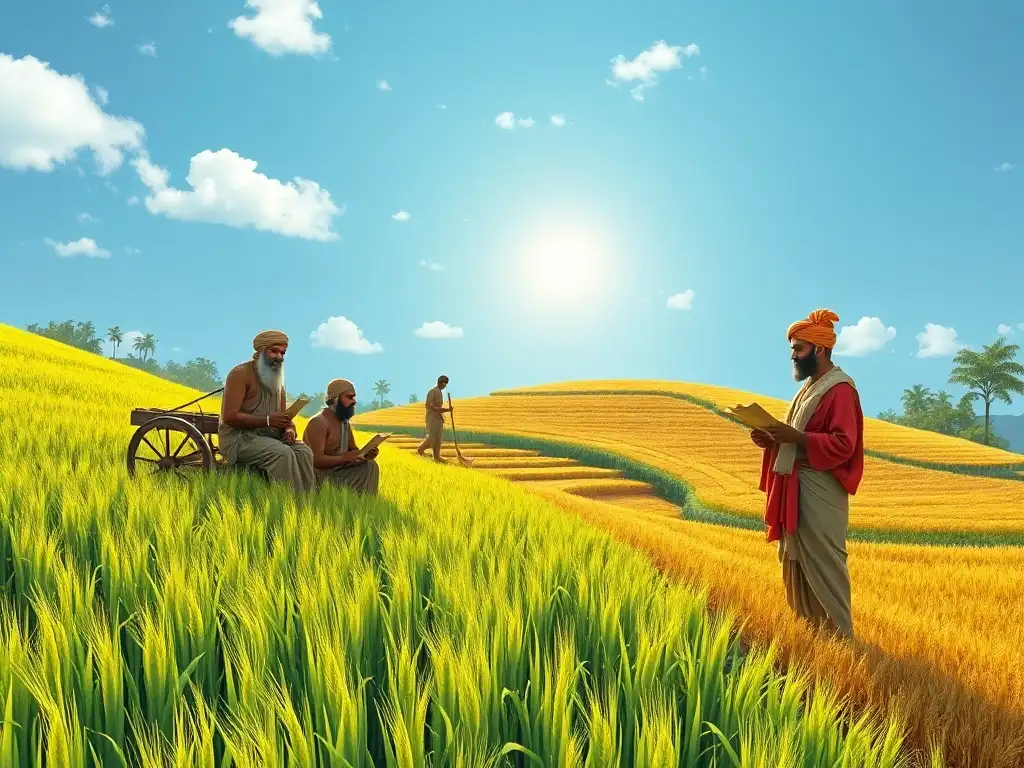
Aryabhata: Innovations in Agricultural Calculations
Aryabhata, one of the most renowned mathematicians of ancient India, made significant contributions that extended into the realm of agriculture. His seminal work, the Aryabhatiya, laid the groundwork for various mathematical techniques that could be applied to agricultural practices, particularly concerning land measurement and crop yield estimation.
- Land Measurement: Aryabhata introduced methods for calculating the area of various geometric shapes. This was crucial for farmers who needed to determine the size of their fields to optimize planting strategies. For instance, his formulas for calculating the area of a triangle and a circle enabled farmers to assess their land more accurately.
- Crop Yield Prediction: Through the application of arithmetic and geometric progressions, Aryabhata devised methods to estimate the potential yield of crops based on previous harvests. This predictive technique allowed farmers to make informed decisions about planting and resource allocation.
Aryabhata's mathematical innovations not only facilitated effective agricultural practices but also underscored the importance of integrating mathematics into everyday life in ancient India.
Brahmagupta: Agricultural Theorems and Techniques
Brahmagupta, another pivotal figure in ancient Indian mathematics, expanded on Aryabhata's work and introduced crucial agricultural theorems that enhanced farming techniques. His treatise, the Brahmasphutasiddhanta, contains valuable insights related to agriculture, particularly in the fields of land taxation and crop management.
- Zero and Negative Numbers: Brahmagupta was one of the first to treat zero as a number, which had profound implications for agricultural calculations. This concept allowed for more sophisticated accounting methods regarding crop yields, expenses, and profits, enabling farmers to keep accurate records.
- Rules for Inheritance and Land Division: His work included rules for dividing land among heirs, which was essential for maintaining agricultural productivity within families. This mathematical framework ensured that land was apportioned fairly, supporting sustainable farming practices.
- Mathematical Models for Crop Rotation: Brahmagupta also explored the use of mathematical models to optimize crop rotation schedules, thus enhancing soil fertility and maximizing yields over time. His work emphasized the importance of understanding the cyclical nature of agriculture.
Through Brahmagupta's theorems and techniques, ancient Indian farmers were able to apply mathematics to improve their agricultural productivity significantly.
Bhaskara II: Advanced Mathematical Applications in Farming
Bhaskara II, known for his comprehensive work Lilavati, made groundbreaking advancements in mathematics that directly impacted agricultural practices. His contributions were particularly notable in the fields of calculus and arithmetic, which provided new tools for farmers.
- Calculation of Areas and Volumes: Bhaskara II developed formulas for calculating the area of irregular fields and the volume of storage structures, such as granaries. These calculations were essential for maximizing the efficiency of land use and storage capacity.
- Time and Motion Problems: His exploration of time and motion, particularly in the context of agricultural tasks, allowed farmers to optimize labor and resource allocation. For instance, by understanding the relationship between planting times and seasonal changes, farmers could enhance their crop cycles.
- Fertilizer Application: Bhaskara II also introduced mathematical models to determine the optimal amount of fertilizer needed per unit area, which helped in increasing crop yields. His analysis of ratios and proportions guided farmers in balancing soil nutrients effectively.
Bhaskara II's advanced mathematical applications provided farmers with the necessary tools to refine their agricultural methods, leading to increased efficiency and productivity in ancient Indian agriculture.
By integrating these notable mathematicians into the agricultural practices of ancient India, we can see how mathematics was not merely an abstract discipline but a practical tool that transformed farming into a more systematic and productive endeavor.
Techniques and Tools Derived from Mathematics
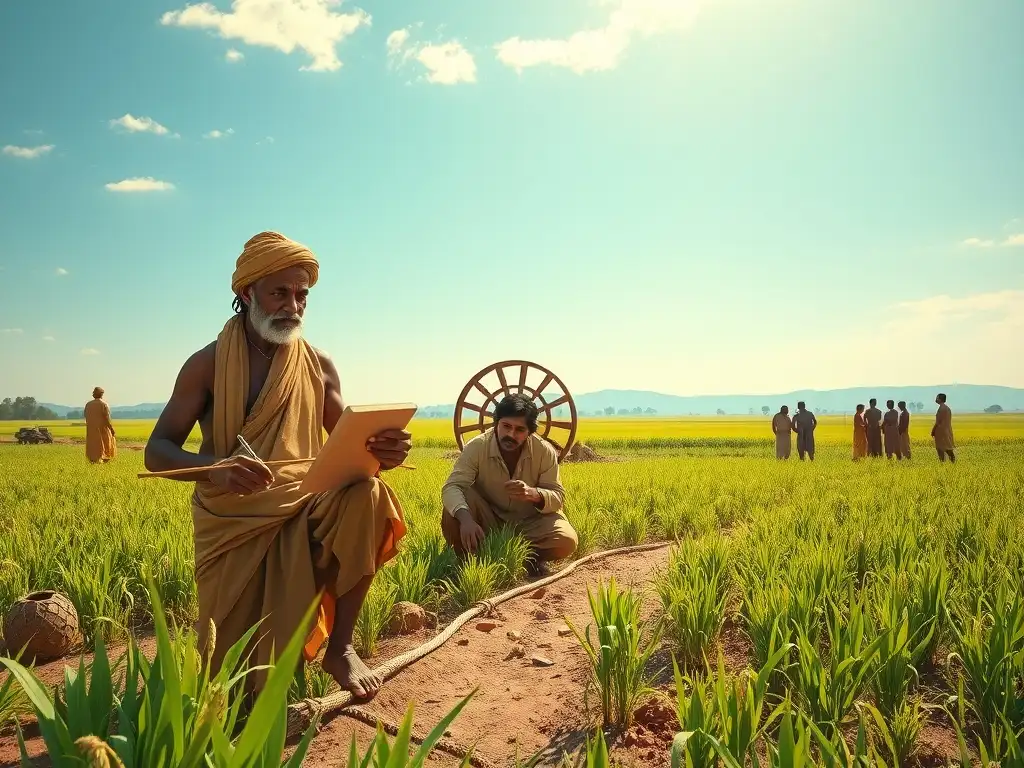
The advanced agricultural techniques developed in ancient India were heavily influenced by mathematical principles, showcasing the ingenuity of ancient Indian civilizations. These techniques not only improved agricultural productivity but also reflected a sophisticated understanding of mathematical concepts. This section explores the key mathematical tools and techniques that were integral to ancient Indian agricultural practices.
Mathematical Tools for Land Surveying
Land surveying was a crucial aspect of agricultural planning in ancient India. Mathematicians and surveyors employed various techniques to measure land and divide it effectively for cultivation, ensuring optimal use of resources.
- Geometry and Measurement: Ancient texts such as the Shulba Sutras, attributed to Baudhayana and other mathematicians, describe the geometric principles used for land measurement. These texts detail methods to construct precise geometric shapes, such as squares and rectangles, which were essential for delineating fields.
- Use of the Rod: The bamboo rod (or danda) was a standard instrument for measurement. Surveyors would utilize it to measure distances and calculate areas, relying on simple mathematical calculations, often based on the Pythagorean theorem, to ensure accurate mapping of land.
- Circle and Area Calculation: The ancient Indians were adept at calculating the area of circular fields, a technique that facilitated the optimal planting of crops. The approximation of π (pi) was known, allowing for effective calculations in land management.
Crop Rotation and Yield Prediction Models
Ancient Indian farmers employed mathematical models to enhance crop yields through systematic crop rotation. This method not only prevented soil depletion but also maximized agricultural output.
- Cycle of Cultivation: The concept of rotating crops was underpinned by mathematical planning. Farmers would use cyclic patterns to determine which crops to plant in succession, ensuring that soil nutrients were replenished over time.
- Yield Prediction: By analyzing historical data on crop yields and environmental conditions, ancient Indian agriculturalists developed predictive models. They utilized statistical methods to estimate the expected yield based on previous harvests, rainfall patterns, and soil fertility.
- Ratio and Proportion: Farmers applied the principles of ratio and proportion to allocate resources efficiently. For instance, the ratio of seeds to land area was calculated to optimize planting density, leading to improved crop yields.
Water Management Techniques Based on Mathematical Principles
Water management was vital for agriculture in ancient India, particularly given the varying climatic conditions across the subcontinent. Mathematical techniques played a key role in developing effective irrigation systems.
- Irrigation Planning: Ancient texts, such as the Arthashastra by Kautilya, emphasized the importance of strategic planning for irrigation. Engineers used mathematical calculations to design canals and reservoirs, determining the optimal dimensions and slopes to facilitate water flow.
- Hydraulic Geometry: The study of fluid dynamics, although primitive, was practiced in ancient India. Farmers and engineers used principles of geometry to calculate the volume of water needed for irrigation, ensuring that crops received adequate hydration.
- Rainwater Harvesting: Techniques for capturing and storing rainwater were informed by mathematical assessments of rainfall patterns and water needs for crops. Systems of tanks and ponds were designed based on calculations that maximized water retention and minimized evaporation.
The integration of mathematical techniques into ancient Indian agricultural practices not only highlights the advanced understanding of mathematics in this civilization but also underscores the significance of these contributions to agricultural efficiency and sustainability. The innovative approaches to land surveying, crop rotation, and water management laid a strong foundation for future agricultural advancements, illustrating the enduring legacy of ancient Indian agricultural techniques.
Case Studies of Ancient Indian Agricultural Practices

The Indus Valley Civilization: Early Agricultural Techniques
The Indus Valley Civilization, flourishing around 2500 BCE, is one of the earliest known urban cultures in the world. This civilization showcased remarkable mathematical techniques that significantly contributed to agricultural practices. The inhabitants of the Indus Valley, primarily located in present-day Pakistan and northwest India, developed advanced methods for irrigation, land measurement, and crop management.
Land Measurement and Planning
The Indus Valley people utilized a sophisticated system of weights and measures, which was integral to their agricultural planning. Evidence suggests that they employed a grid-like layout for their cities, which indicates an understanding of land division and property rights. This grid system was crucial for:
- Efficient Land Use: Farmers could accurately allocate plots for cultivation, ensuring optimal use of arable land.
- Crop Rotation: By measuring land precisely, farmers could implement crop rotation systems to maintain soil fertility.
Irrigation Techniques
Irrigation played a pivotal role in the agricultural success of the Indus Valley. The civilization developed extensive canal systems that diverted water from rivers to fields. This innovation allowed for:
- Increased Crop Yields: With a reliable water supply, crops such as wheat, barley, and cotton thrived.
- Sustainable Practices: The ability to irrigate fields transformed farming from subsistence to a more sustainable model, enabling surplus production.
Mathematical Applications in Agriculture
Mathematics was intricately woven into the agricultural practices of the Indus Valley. The application of basic arithmetic in land measurement and crop distribution ensured:
- Optimal Use of Resources: Farmers could calculate the amount of seed required per hectare based on crop type and soil quality.
- Record Keeping: The use of seals and inscriptions indicates a system for tracking agricultural yields, trade, and resource allocation.
The agricultural techniques of the Indus Valley Civilization laid a strong foundation for the evolution of farming practices in ancient India, showcasing an impressive blend of mathematics and agriculture.
The Gupta Empire: Advanced Farming Methods and Mathematics
The Gupta Empire, which thrived from approximately 320 to 550 CE, is often referred to as the "Golden Age" of India. This era witnessed significant advancements in various fields, including agriculture, where mathematical techniques were applied to enhance farming efficiency and output.
Innovations in Crop Management
During the Gupta period, innovative crop management techniques emerged, driven by mathematical principles. Farmers began to:
- Calculate Optimal Planting Times: By observing lunar cycles and seasonal patterns, they devised calendars that helped in predicting the best times for sowing and harvesting.
- Implement Crop Diversification: Knowledge of different crop cycles allowed farmers to plant various species, reducing risk and increasing food security.
Agricultural Texts and Mathematical Formulas
Scholars like Varahamihira and Kautilya contributed significantly to agricultural science during the Gupta Empire. Their works included mathematical formulas for:
- Irrigation Planning: Formulas to determine the necessary water supply based on crop types and area, which helped in the design and construction of more efficient irrigation systems.
- Yield Estimation: Mathematical models to estimate potential yields based on soil quality and weather conditions, enabling better resource management.
Economic Impact and Trade
The mathematical techniques applied in agriculture during the Gupta Empire not only improved local food production but also enhanced trade. The surplus generated from advanced agricultural practices allowed:
- Market Expansion: Increased agricultural output led to more goods available for trade, stimulating economic growth.
- Cultural Exchange: The prosperity of the Gupta Empire facilitated cultural and technological exchanges with neighboring regions, further enhancing agricultural practices.
The mathematical techniques used in ancient Indian agricultural practices, particularly during the Indus Valley Civilization and the Gupta Empire, showcase a profound understanding of both mathematics and agriculture. These techniques not only improved farming efficiency but also laid the groundwork for future advancements in the field.
Legacy of Ancient Indian Agricultural Techniques

The legacy of ancient Indian agricultural techniques is profound, showcasing a blend of innovative methodologies and mathematical principles that have influenced agricultural practices for centuries. Central to these techniques was the application of mathematical concepts to enhance crop yields, manage resources effectively, and sustain agricultural productivity. Ancient Indian agronomists and mathematicians developed systems that not only maximized land usage but also integrated seasonal cycles and environmental considerations into their farming practices.
Influence on Modern Agricultural Practices
The impact of ancient Indian agricultural techniques can be seen in various modern agricultural practices. Many principles rooted in ancient methodologies continue to resonate today, particularly in sustainable farming and resource management. Key influences include:
- Crop Rotation: Ancient Indians practiced crop rotation to maintain soil fertility, a technique still widely adopted in modern agriculture to prevent nutrient depletion.
- Irrigation Techniques: The sophisticated irrigation methods developed during ancient times, including the use of canals and water conservation techniques, are echoed in today’s focus on efficient water usage in farming.
- Mathematical Models: The use of geometry in land measurement and the calculation of area for optimal planting has been foundational in developing agricultural models today. For example, the ancient practice of measuring land using geometric principles has evolved into modern surveying techniques.
- Sustainable Practices: The emphasis on organic fertilizers, such as cow dung and compost, reflects an understanding of ecological balance that modern agriculture is increasingly prioritizing.
The integration of these ancient practices not only showcases the advanced understanding of agriculture in ancient India but also highlights the continuity of knowledge that informs current agricultural strategies.
Preservation of Mathematical Knowledge in Agriculture
The preservation of mathematical knowledge in agriculture from ancient India has been a crucial aspect of its agricultural legacy. Texts such as the "Aryabhatiya" by Aryabhata and "Bakhshali Manuscript" illustrate the mathematical sophistication embedded in agricultural practices. These works contributed significantly to the understanding of:
- Measurement and Calculation: Ancient Indian mathematicians devised methods for calculating land area, crop yield, and resource allocation, which were essential for successful farming. The use of fractions and decimals in these calculations laid the groundwork for more advanced mathematical applications.
- Agricultural Texts: Treatises like "Krishi Parashara" compiled agricultural wisdom, including mathematical techniques for estimating crop production and understanding seasonal variations. These texts served as educational resources for generations of farmers.
- Cultural Transmission: The knowledge was preserved and transmitted through oral traditions, scriptures, and community practices, ensuring that mathematical techniques in agriculture remained relevant over centuries.
The enduring legacy of these mathematical techniques not only exemplifies the ingenuity of ancient Indian civilizations but also illustrates how their agricultural practices have shaped modern methodologies. The study and appreciation of ancient Indian agricultural techniques continue to inspire contemporary agriculturalists and mathematicians alike.
Conclusion
Summary of Mathematical Techniques in Ancient Indian Agriculture
Ancient Indian agricultural techniques were deeply rooted in mathematical principles that contributed significantly to crop management, irrigation, and land measurement. This integration of mathematics into agriculture is perhaps best exemplified by the renowned mathematicians and scholars of the time. Below are some of the critical techniques used:
- Land Measurement: Ancient Indians utilized geometric principles for land surveying. They developed methods for determining area using shapes like triangles and rectangles, often employing the formula for calculating the area of a triangle (Area = 1/2 × base × height) to divide land accurately.
- Irrigation Systems: The construction of irrigation canals and wells was carefully planned using mathematical calculations to ensure optimal water distribution. The use of ratios and proportions helped in designing canals that could efficiently channel water to crops.
- Crop Rotation and Planning: Farmers applied arithmetic and geometric sequences to optimize planting schedules. By calculating the best intervals for crop rotation, they enhanced soil fertility and maximized yield.
- Harvest Predictions: Ancient texts contain references to statistical methods for predicting yields based on historical data, allowing farmers to plan economically for harvest seasons.
The application of these techniques demonstrates a sophisticated understanding of mathematics, showcasing how ancient Indian civilizations expertly combined scientific thought with agricultural practices.
The Lasting Impact of Ancient Indian Agricultural Innovations on Modern Society
The agricultural techniques developed in ancient India laid the groundwork for many modern practices still in use today. Their influence can be observed in several key areas:
- Sustainable Farming: The principles of crop rotation and soil management introduced by ancient Indian farmers are foundational to sustainable agriculture practices today. Modern agronomists often revisit these methods to promote environmental health.
- Water Management: The advanced irrigation systems of ancient India are echoed in contemporary water conservation techniques. The emphasis on efficient water distribution remains critical in addressing current global challenges such as drought and water scarcity.
- Mathematical Applications: The mathematical concepts used in ancient agriculture continue to inform modern agricultural science, particularly in fields like agronomy and environmental modeling. Techniques in geometry and statistics are integral to developing new agricultural technologies and improving crop yields.
- Cultural Heritage: The rich history of agricultural practices in ancient India contributes to the cultural identity of the region. Understanding these techniques fosters appreciation for traditional farming methods and encourages their preservation.
The mathematical techniques employed in ancient Indian agriculture not only shaped the agricultural landscape of the time but also left a lasting legacy that continues to influence modern agricultural practices and mathematical applications today. The interplay between mathematics and agriculture reflects the ingenuity of ancient civilizations and their contributions to sustainable human development.
Frequently Asked Questions
What were some key agricultural techniques used in ancient India?
Ancient Indian farmers employed irrigation, crop rotation, and intercropping methods to enhance productivity and sustain their crops effectively.
How did mathematics influence ancient Indian agriculture?
Mathematics played a crucial role in land measurement, crop planning, and irrigation management, enabling farmers to optimize yields and resources.
What role did the Indus Valley Civilization play in agricultural development?
The Indus Valley Civilization is known for its advanced drainage systems and granaries, showcasing early examples of organized agricultural practices.
Were there any significant crops cultivated in ancient India?
Yes, ancient Indian agriculture was diverse, with significant crops such as rice, wheat, barley, and millets being cultivated, which formed the backbone of the economy.
How did the Gupta Empire contribute to agricultural advancements?
The Gupta Empire is noted for its promotion of agricultural innovations and textile production, leading to increased trade and prosperity in ancient Indian society.
Final Reflection: The Enduring Legacy of Ancient Indian Agricultural Techniques
The mathematical techniques used in ancient Indian agriculture are not just relics of the past; they are a testament to the ingenuity and foresight of our ancestors. Today, as we face challenges like climate change and food security, the wisdom embedded in these ancient practices offers invaluable insights into sustainable farming. The intricate relationship between mathematics and agriculture in ancient India reveals a profound understanding of nature that is still relevant in our modern quest for efficiency and sustainability.
The influence of these ancient techniques extends far beyond their historical context; they continue to shape our cultural and social landscapes. The principles of crop rotation, irrigation, and land management that were meticulously developed centuries ago resonate with contemporary agricultural practices. As we increasingly recognize the importance of sustainability, we can draw inspiration from the past. To forget the past is to lose the future.
This quote encapsulates the essence of how ancient knowledge can guide us in creating a more sustainable future.
As we reflect on the lessons learned from ancient Indian agricultural techniques, I invite you to consider how these insights can be applied in your own life and community. What sustainable practices can you adopt, inspired by the wisdom of our ancestors? By embracing these time-tested techniques, we not only honor our heritage but also contribute to a more sustainable and resilient future for generations to come. Let us cultivate a deeper appreciation for the past as we sow the seeds of tomorrow.
Unlock the Secrets of Ancient Indian Agriculture!
Thank you for taking the time to explore the fascinating mathematical techniques that ancient Indians employed in agriculture. You've uncovered valuable insights that showcase the brilliance of their innovations. Now, it's time to put this knowledge into action!
Here are some simple steps you can take to deepen your understanding and appreciation of this rich history:
- Dive deeper: Explore additional resources or scholarly articles about ancient Indian agricultural methods. This exploration could reveal surprising techniques and their relevance in today's agricultural practices.
- Engage with your community: Share your newfound knowledge with friends or fellow history enthusiasts. Consider organizing a discussion or a small gathering to exchange ideas and insights.
- Experiment: Implement a traditional technique in your own gardening or farming practices. Even a small-scale trial can yield remarkable insights and foster a deeper connection to these historical methods!
What aspects of ancient Indian agricultural mathematics resonate with you the most, and how do you envision these techniques influencing modern practices?