
The Contributions of Ancient Indian Scholars to Mathematical Logic


Welcome to Ancient India History, where we delve into the fascinating tapestry of India's rich and diverse past. In this journey, we explore the profound contributions of ancient Indian scholars, particularly in the realm of mathematics. Have you ever wondered how these brilliant minds shaped the very foundations of mathematical logic?
Our featured article, The Contributions of Ancient Indian Scholars to Mathematical Logic, invites you to uncover the innovative ideas and techniques that emerged from the corridors of ancient universities. Join us as we unravel the mysteries of a civilization that not only calculated numbers but also laid the groundwork for future generations. Your adventure into the extraordinary world of ancient Indian mathematics begins here!
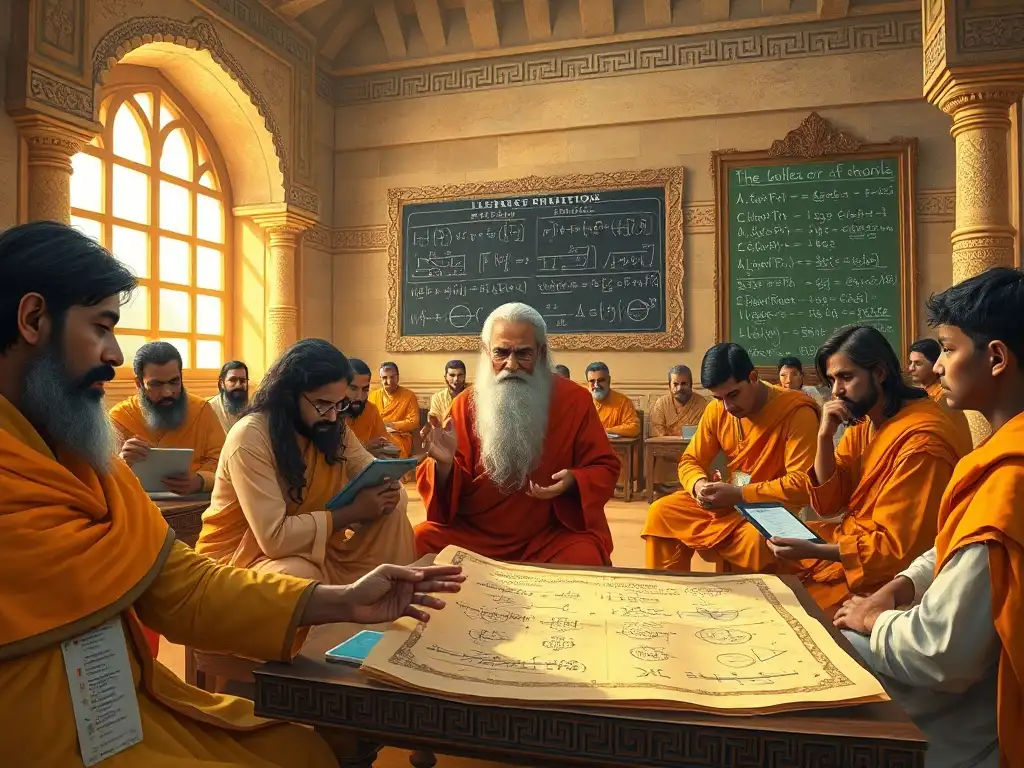
Introduction to Ancient Indian Scholars and Mathematics
Ancient India has a rich and vibrant history of mathematical thought that has significantly shaped the development of mathematics worldwide. The contributions made by ancient Indian scholars in the field of mathematics, particularly in mathematical logic, are profound and far-reaching. This article delves into the remarkable achievements and innovations of these scholars, exploring their methodologies and the impact of their work on modern mathematics. From the sophisticated number systems to the early foundations of algebra and geometry, the mathematical contributions of ancient Indian scholars provide a testament to their intellectual prowess and creativity.
Overview of Ancient Indian Contributions to Mathematics
The mathematical traditions of ancient India can be traced back to the Indus Valley Civilization, where early forms of counting and measurement were utilized. However, it was during the Gupta Empire (approximately 320 to 550 CE) that mathematics flourished, leading to groundbreaking advancements. Key developments during this era included:
- The decimal system: Ancient Indian mathematicians were among the first to use a base-10 numeral system, which is foundational to modern mathematics.
- Zero as a concept: The introduction of zero as a numeral revolutionized calculations and is a critical element in mathematics today.
- Algebra and Arithmetic: Scholars such as Brahmagupta made substantial contributions to arithmetic and algebra, laying the groundwork for future generations.
These contributions reflect a systematic approach to mathematical reasoning that emphasized logical deductions and rigorous proofs.
Importance of Mathematical Logic in Ancient India
Mathematical logic played a crucial role in the development of mathematical theories in ancient India. Scholars applied logical reasoning to solve complex problems, which not only advanced mathematics but also influenced philosophy and science. The use of formal logic allowed mathematicians to:
- Develop algorithms: Ancient texts describe algorithms for arithmetic operations and solving equations, showcasing an early understanding of systematic problem-solving.
- Establish proofs: The emphasis on logical proofs ensured the validity of mathematical statements, paving the way for future mathematical rigor.
- Influence other disciplines: The principles of mathematical logic were not confined to mathematics alone; they also impacted astronomy, architecture, and engineering, demonstrating a holistic approach to knowledge.
Key Ancient Indian Scholars in Mathematics
Brahmagupta: The Pioneer of Arithmetic and Algebra
Brahmagupta (598–668 CE) is often regarded as one of the foremost mathematicians of ancient India. His seminal work, Brahmasphutasiddhanta, laid down the rules for arithmetic, including operations with zero and negative numbers. Key contributions include:
- Rules for calculations: Brahmagupta provided rules for addition, subtraction, multiplication, and division, which were pivotal in the evolution of arithmetic.
- Algebraic concepts: He introduced solutions to quadratic equations and provided methods for solving linear equations, making significant strides in algebra.
Bhaskara I: Contributions to Trigonometry
Bhaskara I (c. 600 CE) made notable contributions to trigonometry, particularly through his work on sine functions. His achievements include:
- Sine table: He created one of the earliest sine tables, which facilitated calculations in astronomy and navigation.
- Trigonometric identities: Bhaskara I developed important trigonometric identities that are still in use today.
Aryabhata: Innovations in Number Theory and Place Value
Aryabhata (476–550 CE), one of the most celebrated ancient Indian mathematicians, made groundbreaking contributions that laid the foundation for modern mathematics. His work includes:
- Place value system: Aryabhata's introduction of the place value system revolutionized numerical representation and calculations.
- Number theory: He explored the properties of numbers and provided algorithms for arithmetic operations, enhancing the understanding of number theory.
The legacy of these ancient Indian scholars is a testament to their remarkable intellectual contributions, which continue to influence contemporary mathematics.
The Development of Mathematical Logic in Ancient India
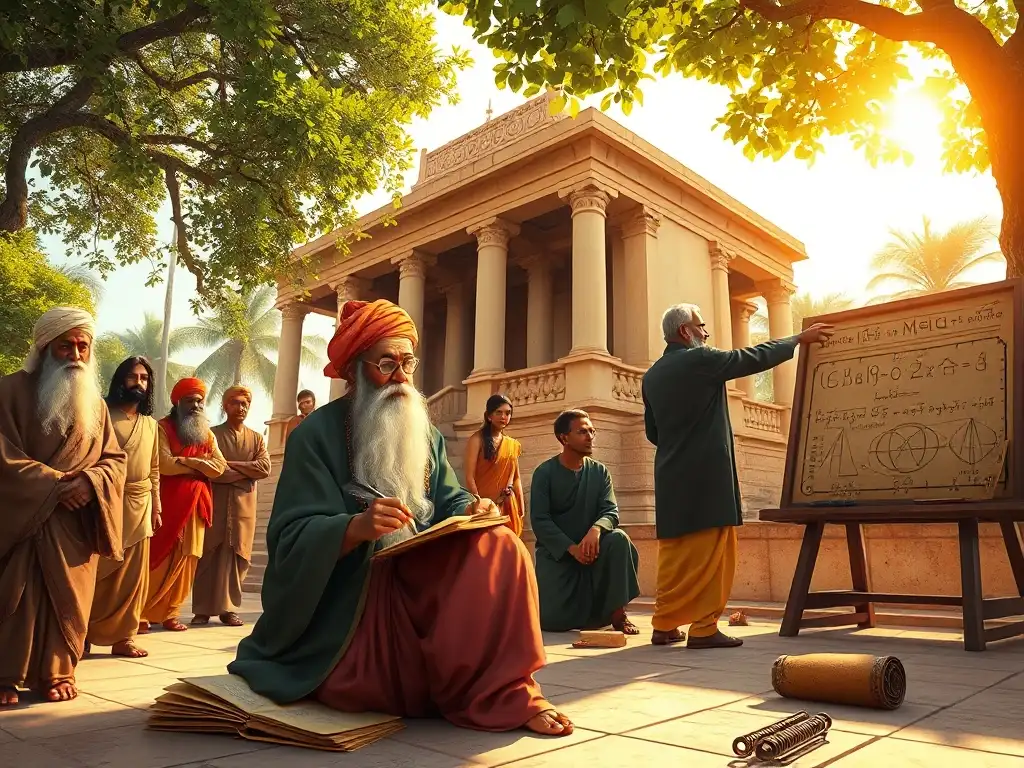
The development of mathematical logic in ancient India is a remarkable chapter in the history of mathematics, showcasing the intellectual prowess of Indian scholars. Ancient Indian mathematicians not only made significant contributions to arithmetic and geometry but also laid the groundwork for formal logical reasoning. This development can be traced back through various texts and treatises that demonstrate the use of logical principles in problem-solving and mathematical proofs.
Mathematical logic in ancient India was characterized by a systematic approach to reasoning, where scholars used deductive reasoning to derive conclusions from established premises. This method was essential in advancing mathematics, as it allowed for the formulation of theorems and proofs that remain influential to this day. The logical frameworks established by these scholars have had lasting impacts on both Eastern and Western mathematical traditions.
Furthermore, the integration of logic with mathematics in ancient Indian texts indicates a sophisticated understanding of abstraction and formalism. Scholars like Aryabhata, Brahmagupta, and Bhaskara II not only contributed to mathematical theory but also emphasized the importance of logical reasoning in their works. This unique blend of mathematics and logic has positioned ancient Indian scholars as pivotal figures in the history of mathematical thought.
Definition and Significance of Mathematical Logic
Mathematical logic can be defined as the study of formal systems in relation to the way we reason mathematically. It involves the use of symbols and structured language to represent mathematical statements and to systematically explore their relationships and implications. The significance of mathematical logic lies in its ability to provide a foundation for mathematical reasoning, thereby ensuring clarity and precision in mathematical discourse.
In the context of ancient Indian scholarship, mathematical logic played a crucial role in elevating mathematics to a more rigorous discipline. By establishing rules of inference and methods for constructing valid arguments, ancient Indian scholars were able to solve complex mathematical problems with greater accuracy and reliability. This logical approach not only enhanced their own mathematical practices but also contributed to the global development of logic as a discipline.
The legacy of mathematical logic from ancient India continues to influence modern mathematics and philosophy, evidencing the timelessness and relevance of these early contributions.
Historical Context: Mathematics in Ancient Indian Texts
The historical context of mathematics in ancient India is rich and varied, with numerous texts that illustrate the mathematical knowledge and logical reasoning of the time. From the early Vedic period through the classical era, Indian mathematicians made substantial advancements in various mathematical fields, including arithmetic, algebra, geometry, and astronomy.
One of the earliest texts, the Sulbasutras, dating back to around 800 BCE, provides insights into geometric principles and constructions used in religious rituals. These texts not only contain mathematical principles but also exhibit the application of logical reasoning in problem-solving.
As time progressed, notable mathematicians like Aryabhata and Brahmagupta emerged, producing seminal works that combined mathematics and logic. Their contributions were not isolated; they were part of a broader intellectual tradition that emphasized the importance of logical reasoning in mathematical inquiry. This historical context highlights how mathematical logic was nurtured within the rich tapestry of ancient Indian scholarly activity, paving the way for future advancements.
Major Texts and Treatises on Mathematical Logic
Ancient Indian scholars produced several major texts and treatises that contributed significantly to the field of mathematical logic. These works not only encapsulated the mathematical knowledge of their time but also reflected a deep understanding of logical reasoning.
The Aryabhatiya: Aryabhata's Influential Work
The Aryabhatiya, authored by Aryabhata in the 5th century CE, is one of the most influential texts in the history of Indian mathematics. In this work, Aryabhata introduces various mathematical concepts, including the place value system, zero, and methods for arithmetic operations.
Importantly, Aryabhata’s approach to problem-solving is deeply rooted in logical reasoning. He emphasizes the need for clear definitions and systematic methods to arrive at solutions, showcasing an early form of mathematical logic. The Aryabhatiya's impact on both Indian and global mathematics is profound, influencing later mathematicians and establishing a framework for future mathematical inquiry.
Brahmagupta's Brahmasphutasiddhanta: A Groundbreaking Text
Brahmagupta's Brahmasphutasiddhanta, written in 628 CE, represents a groundbreaking advancement in mathematical logic and procedures. This text is notable for its systematic treatment of arithmetic and algebra, including rules for solving quadratic equations and the manipulation of fractions.
Brahmagupta's work also introduces the concept of 'negative numbers' and provides rules for their usage, reflecting a sophisticated understanding of mathematical logic. His discussions on the importance of reasoning in mathematics underscore the necessity for logical foundations in problem-solving. The Brahmasphutasiddhanta served as a comprehensive guide for future mathematicians and is still regarded as a significant contribution to mathematical logic.
The Siddhanta Shiromani: Bhaskara II’s Contributions
The Siddhanta Shiromani, authored by Bhaskara II in the 12th century CE, further exemplifies the integration of mathematical logic within Indian mathematics. This influential work is divided into four parts: Lilavati, Bijaganita, Grahaganita, and Karanakutuhala, each addressing different mathematical topics.
Bhaskara II's approach to problem-solving demonstrates a clear application of logical reasoning, particularly in his treatment of algebra and the rules governing calculations. His innovative methods, along with the logical explanations provided, highlight the importance of clarity and rigor in mathematical reasoning. The Siddhanta Shiromani not only solidified Bhaskara II's place in the history of mathematics but also enriched the tradition of mathematical logic within ancient Indian scholarship.
Concepts and Theories Introduced by Ancient Indian Scholars
Ancient Indian scholars made significant contributions to mathematical logic, influencing not only their own society but also laying foundations that would resonate through the ages. The rich tapestry of their work includes innovative concepts and theories that advanced the field of mathematics. These scholars approached mathematical problems not merely as abstract puzzles but as logical challenges that required systematic reasoning. Their contributions can be seen as precursors to modern mathematical thought, incorporating both theoretical frameworks and practical applications.
The Concept of Zero: A Revolutionary Idea in Mathematics
One of the most groundbreaking contributions of ancient Indian scholars was the introduction of the concept of zero. The mathematician Brahmagupta, in the 7th century, articulated rules for arithmetic involving zero, treating it as a number in its own right. This was revolutionary because it allowed for the development of a place-value system, which is fundamental to modern mathematics. By recognizing zero as a placeholder and a concept representing 'nothingness,' Indian mathematicians paved the way for advanced calculations and mathematical expressions. This innovation not only simplified calculations but also facilitated the development of algebra and calculus in later centuries.
The Use of Algorithms in Problem Solving
Ancient Indian scholars were also pioneers in the development of algorithms, a structured method of solving mathematical problems. The work of Aryabhata in the 5th century and later mathematicians like Bhaskara II illustrated the systematic approaches they took to solve problems in arithmetic, geometry, and astronomy. The algorithms formulated by these scholars often included step-by-step procedures for computations, which can be seen as early forms of algorithmic thinking. This structured approach helped lay the groundwork for both theoretical mathematics and practical problem-solving techniques that are still in use today.
Mathematical Riddles and Their Logical Implications
Mathematical riddles, or samskrtik prashnas, were not just entertainment but served a deeper purpose in ancient Indian culture. Scholars like Jayadeva and later mathematicians incorporated riddles into their work, using them to challenge and hone logical reasoning skills. These riddles often involved intricate patterns and required innovative thinking to solve. By engaging with these riddles, scholars developed a form of logical reasoning that was crucial for advancing mathematical thought. Through these intellectual exercises, they explored the boundaries of mathematical concepts, fostering a culture of inquiry and critical thinking.
Comparative Analysis: Ancient Indian Scholars vs. Contemporary Mathematicians
The innovations of ancient Indian scholars can be compared to the work of contemporary mathematicians, highlighting both unique approaches and shared goals in the pursuit of mathematical knowledge. While modern mathematics has evolved with the aid of technological advancements and a more formalized structure, the foundational principles established by ancient scholars continue to underpin much of today’s mathematical thought.
Unique Approaches to Mathematical Logic
Ancient Indian scholars often employed a holistic approach to mathematics, integrating philosophical and logical principles into their mathematical explorations. Unlike contemporary mathematicians, who may focus on specialized fields, ancient mathematicians sought to understand the interconnectedness of various mathematical concepts. This integrative approach fostered a profound understanding of mathematics as a universal language, emphasizing the importance of logical reasoning and philosophical inquiry in mathematical pursuits. Their works were often imbued with cultural and spiritual significance, reflecting a worldview that viewed mathematics as a pathway to understanding the universe.
Influence on Global Mathematics: Cross-Cultural Exchanges
The contributions of ancient Indian scholars to mathematics were not confined to the subcontinent; they significantly influenced mathematical development across the globe. The transmission of Indian mathematical concepts, particularly during the medieval period, through trade routes and cultural exchanges, showcased the interconnectedness of human knowledge. Concepts such as the decimal system and the rules of arithmetic were adopted and adapted by scholars in the Islamic Golden Age and later in Europe. This cross-pollination of ideas illustrates the lasting legacy of ancient Indian mathematics, demonstrating how the innovations of these scholars contributed to a broader global mathematical discourse.
Legacy of Ancient Indian Scholars in Mathematics
The legacy of ancient Indian scholars in mathematics is profound and multifaceted, shaping the foundations of mathematical thought that reverberate through time. From the meticulous calculations of the Indus Valley Civilization to the sophisticated treatises of later mathematicians, Indian scholars made significant advancements in various fields of mathematics, including arithmetic, geometry, algebra, and mathematical logic.
Prominent figures such as Aryabhata, Brahmagupta, and Bhaskara II contributed to the development of concepts like zero, the decimal system, and algebraic methods. Their works laid the groundwork for future generations, influencing not only their contemporaries but also scholars across the globe. The systematic approach to mathematical problems and the emphasis on logical reasoning found in ancient Indian texts underscore the critical role these scholars played in the evolution of mathematics as a discipline.
Additionally, the integration of mathematics with astronomy, as seen in Aryabhata's treatises, exemplifies the interdisciplinary nature of ancient Indian scholarship. This tradition of linking mathematics with practical applications, particularly in agriculture and trade, further highlights the enduring legacy of these scholars in the broader context of human knowledge.
Lasting Impact on Modern Mathematical Logic
Ancient Indian scholars have had a lasting impact on modern mathematical logic, with their contributions extending beyond mere arithmetic and geometric calculations. The work of thinkers such as the philosopher and mathematician Gaṅgeśa Upādhyāya laid the foundations for the development of formal logic within the Indian philosophical tradition. His exploration of the nature of reasoning and inference established a framework that parallels contemporary logical systems.
Moreover, the concept of "Nyāya," which refers to the rules of inference and reasoning, has deeply influenced the study of logical validity. The rigorous analytical methods developed by ancient Indian scholars can be seen as precursors to modern symbolic logic. This legacy is not only limited to the philosophical realms but also permeates into computational logic, where the principles of reasoning and deduction remain vital.
The systematic categorization of problems and the use of algorithms in ancient Indian mathematical texts foreshadowed the principles of modern algorithmic thinking. The innovative techniques for solving equations and the focus on proving mathematical statements reflect a sophisticated understanding of logic that resonates with current mathematical practices.
Recognition in Global Mathematical History
The contributions of ancient Indian scholars to mathematics have been increasingly recognized in global mathematical history. Despite the historical dominance of European narratives, numerous scholars and mathematicians have acknowledged the pivotal role played by their Indian counterparts. The introduction of the decimal numeral system, including the concept of zero, is one of the most significant legacies that has transformed mathematical calculations worldwide.
During the medieval period, texts such as Brahmagupta's "Brahmasphutasiddhanta" and Bhaskara II's "Lilavati" were translated and disseminated across the Islamic world, influencing mathematicians like Al-Khwarizmi. The ripple effects of these translations helped integrate Indian mathematical concepts into the broader mathematical discourse of the time, leading to advancements in algebra and arithmetic in the Middle East and Europe.
In contemporary discussions on the history of mathematics, scholars are increasingly acknowledging the depth and sophistication of ancient Indian mathematics. This recognition highlights the need to reassess historical narratives and appreciate the contributions of diverse cultures in shaping modern mathematical thought.
Conclusion: The Enduring Contributions of Ancient Indian Scholars
The contributions of ancient Indian scholars to mathematics, particularly in the realm of mathematical logic, remain a testament to their intellectual prowess and innovative spirit. Their work not only contributed to the field of mathematics but also laid the groundwork for future explorations in logic, reasoning, and problem-solving.
Summary of Key Contributions to Mathematical Logic
To summarize, the key contributions of ancient Indian scholars to mathematical logic include:
- The introduction of the decimal system and the concept of zero.
- The development of formal systems of inference, notably articulated in the Nyāya school of philosophy.
- Contributions to algebra and arithmetic that laid the groundwork for future mathematical explorations.
- The influence on global mathematical practices through translations and the dissemination of their works.
These elements collectively underscore the significance of ancient Indian mathematics in the broader context of global mathematical history.
Call to Further Explore Ancient Indian Mathematics
For those intrigued by the rich tapestry of ancient Indian mathematics, a deeper exploration is highly encouraged. Engaging with primary texts, such as those written by Aryabhata, Brahmagupta, and Bhaskara II, can provide invaluable insights into the methodologies and thought processes of these pioneering scholars.
Additionally, delving into the historical context of these contributions can illuminate the interconnectedness of cultures in the development of mathematical ideas. By recognizing and appreciating the depth of ancient Indian mathematics, we not only honor these scholars' legacies but also enrich our understanding of the universal language of mathematics that transcends time and borders.
References and Further Reading on Ancient Indian Mathematics
Exploring the contributions of ancient Indian scholars to mathematical logic unveils a rich tapestry of knowledge that has shaped mathematical thought across the globe. To delve deeper into this fascinating subject, a variety of resources are available, ranging from academic texts to online platforms that provide insights into the lives and works of these influential mathematicians.
Recommended Books and Articles
-
"Mathematics in India" by Kim Plofker
This book explores the development of mathematics in ancient India, focusing on both its historical context and its profound influences on modern mathematical concepts.
-
"The History of Mathematics: A Brief Course" by Roger L. Cooke
Cooke's work includes sections dedicated to Indian mathematicians, highlighting their contributions in various fields including arithmetic, geometry, and algebra.
-
"A History of Indian Mathematics" by C. N. Srinivasiengar
This comprehensive text covers the evolution of mathematical ideas from the Vedic period through to the medieval era, providing an in-depth analysis of key figures and their innovations.
-
"The Nine Chapters on the Mathematical Art" (translated by Liu Hong)
Although primarily a Chinese text, this work shows the exchange of mathematical ideas between cultures, including references to Indian mathematics.
-
"Ancient Indian Mathematics: A Brief Overview" by Dinesh Kumar
This article provides a succinct overview of significant contributions made by Indian scholars, making it an excellent starting point for understanding the subject.
Online Resources for Understanding Ancient Indian Contributions
-
The Indian Mathematical Society
This website offers a plethora of articles, research papers, and historical documents concerning the contributions of Indian mathematicians.
-
Digital Library of India
A treasure trove of texts and manuscripts, this resource includes digitized versions of historical works by Indian scholars, allowing for direct access to primary sources.
-
Math History: Indian Mathematics
This online repository includes comprehensive articles discussing ancient Indian mathematics, including biographical sketches of notable mathematicians and their contributions.
-
Khan Academy: The History of Mathematics
Although not exclusively focused on Indian mathematics, this platform offers segments that cover the significant contributions of Indian scholars within the broader context of mathematical history.
-
YouTube Channels
Channels like TED-Ed and History of Mathematics provide engaging visual content that explores the lives and works of ancient Indian mathematicians, making complex ideas accessible to a wider audience.
These resources will not only enhance your understanding of ancient Indian scholars in mathematics but also provide context for their enduring impact on contemporary mathematical thought.
- Introduction to Ancient Indian Scholars and Mathematics
- Overview of Ancient Indian Contributions to Mathematics
- Importance of Mathematical Logic in Ancient India
- Key Ancient Indian Scholars in Mathematics
- The Development of Mathematical Logic in Ancient India
- Major Texts and Treatises on Mathematical Logic
- Concepts and Theories Introduced by Ancient Indian Scholars
- Comparative Analysis: Ancient Indian Scholars vs. Contemporary Mathematicians
- Legacy of Ancient Indian Scholars in Mathematics
- Conclusion: The Enduring Contributions of Ancient Indian Scholars
- References and Further Reading on Ancient Indian Mathematics
- What were the major contributions of ancient Indian scholars to mathematics?
- Who is considered the most influential ancient Indian mathematician?
- How did ancient Indian scholars influence modern mathematics?
- What role did religious texts play in the development of mathematics in ancient India?
- Are there any notable mathematical texts from ancient India?
Frequently Asked Questions
What were the major contributions of ancient Indian scholars to mathematics?
Ancient Indian scholars made significant contributions to mathematical logic, including the development of zero as a number, advancements in algebra, and the introduction of the decimal system.
Who is considered the most influential ancient Indian mathematician?
Aryabhata is often regarded as the most influential ancient Indian mathematician, known for his work in trigonometry and the approximation of π (pi), which laid the groundwork for future mathematical studies.
How did ancient Indian scholars influence modern mathematics?
The concepts and methods developed by ancient Indian scholars in mathematics, such as the use of algorithms and the place value system, have profoundly shaped modern mathematical practices and education.
What role did religious texts play in the development of mathematics in ancient India?
Many religious texts in ancient India contained mathematical concepts and problems, which were often used for astronomical calculations and ritualistic purposes, thereby fostering the growth of mathematical knowledge.
Are there any notable mathematical texts from ancient India?
Yes, notable texts include the "Aryabhatiya" by Aryabhata and the "Bakhshali Manuscript," both of which contain pioneering theories and practical applications of mathematics, greatly influencing subsequent generations.
Final Reflection: The Enduring Legacy of Ancient Indian Scholars in Mathematics
The contributions of ancient Indian scholars to mathematics are not just historical footnotes; they are foundational pillars that continue to shape modern mathematical thought. Today, as we navigate an increasingly complex world driven by data and technology, the insights and methodologies developed by these scholars resonate more than ever. Their pioneering work in mathematical logic laid the groundwork for advancements that have propelled humanity forward, reminding us that the quest for knowledge knows no temporal boundaries.
The influence of ancient Indian mathematicians extends far beyond the confines of their time, permeating various aspects of contemporary culture and academia. Their innovative approaches to problem-solving and logical reasoning have inspired generations of thinkers and continue to be relevant in modern mathematical discourse. As the renowned mathematician Carl Friedrich Gauss once said, "> Mathematics is the queen of the sciences and number theory is the queen of mathematics." This sentiment echoes the profound impact of the ancient Indian scholars who meticulously explored the realms of numbers and logic, establishing a legacy that still informs our understanding today.
As we reflect on the remarkable achievements of these ancient scholars, let us be inspired to embrace the spirit of inquiry and innovation they exemplified. Consider how you can incorporate their lessons into your own life—whether through fostering a love for mathematics, engaging in critical thinking, or appreciating the interconnectedness of knowledge across cultures. The journey of learning is ongoing, and by honoring the contributions of those who came before us, we can pave the way for future discoveries that will enrich our understanding of the world.
Unveil the Legacy of Ancient Indian Logic!
Thank you for exploring the remarkable contributions of ancient Indian scholars! We hope you found inspiration in their groundbreaking insights into mathematical logic and the profound impact this knowledge has on our understanding today. Now, it’s time to take your newfound appreciation a step further.
Here are some engaging actions you can embark on:
- Explore further! Delve into the works of ancient Indian mathematicians like **Aryabhata** and **Brahmagupta** by visiting your local library or discovering online resources that highlight their contributions.
- Share your knowledge. Discuss what you’ve learned with peers or on social media to spark a wider conversation about ancient Indian logic.
- Connect with the community. Join online forums or local interest groups focused on the history of mathematics to exchange ideas and learn more about this fascinating subject.
What aspect of ancient Indian mathematical logic do you find most intriguing, and how do you think it has influenced modern mathematics? We encourage you to reflect on its lasting legacy and share your thoughts!