
Tracing the Roots of Algebra: Contributions of Ancient Indian Scholars

Welcome to Ancient India History, where we embark on a fascinating journey through the rich tapestry of India's past. In this exploration, we delve into the intriguing contributions of ancient Indian scholars to algebra, illuminating how their groundbreaking ideas shaped the very foundations of mathematics as we know it today. Prepare to uncover the secrets of ancient mathematical genius, and discover how these innovations continue to influence our world.
Join us as we trace the roots of algebra and reveal the remarkable legacy left by civilizations that once thrived along the banks of the Indus and beyond. Your adventure into the depths of history awaits!
The history of mathematics is a complex tapestry woven with the contributions of numerous civilizations, each adding their unique threads to the fabric of mathematical thought. Among these, ancient Indian contributions to algebra stand out for their depth, ingenuity, and lasting impact on the field. From the sophisticated calculations of the Indus Valley Civilization to the profound insights of scholars during the Gupta Empire, India has been a cradle of mathematical innovation. This article aims to explore the significant contributions of ancient Indian scholars, highlighting their groundbreaking work and its relevance in the evolution of algebra.
The journey into the realm of ancient Indian mathematics reveals a rich legacy of knowledge that not only laid the groundwork for algebraic concepts but also influenced mathematicians across the globe. Key figures such as Brahmagupta and Bhaskara II, among others, played pivotal roles in developing early algebraic methods and principles that would resonate through the ages. By delving into their lives and works, we uncover the intricate connections between their discoveries and the broader narrative of mathematical advancement.
In the sections that follow, we will examine specific contributions made by these ancient scholars, their methodologies, and the cultural context that nurtured such intellectual achievements. This exploration will not only shed light on the historical significance of their work but also inspire appreciation for the foundational concepts of algebra that continue to shape modern mathematics.
- Introduction to Ancient Indian Contributions to Algebra
- Historical Context of Algebra in Ancient India
- Notable Ancient Indian Scholars and Their Contributions to Algebra
- Key Concepts in Ancient Indian Algebra
- The Influence of Ancient Indian Algebra on Global Mathematics
- Conclusion: Legacy of Ancient Indian Contributions to Algebra
- References and Further Reading
-
Frequently Asked Questions
- What were some key contributions of ancient Indian scholars to algebra?
- How did the Indus Valley Civilization influence algebra?
- Who are some notable ancient Indian mathematicians recognized for their work in algebra?
- What role did Indian texts play in the development of algebra?
- How did ancient Indian contributions to algebra impact global mathematics?
- Final Reflection: Celebrating the Legacy of Ancient Indian Contributions to Algebra
- Unveil the Legacy of Ancient Indian Algebra!
Introduction to Ancient Indian Contributions to Algebra
Algebra, as a mathematical discipline, has roots that extend deep into the fabric of ancient civilizations. Among these, ancient India holds a significant place, showcasing a rich tradition of mathematical inquiry and innovation. The contributions of ancient Indian scholars to algebra are not only remarkable but also foundational, influencing mathematical thought across the globe. This section delves into the key aspects of algebra's evolution in ancient India, highlighting the scholars whose work laid the groundwork for future advancements in mathematics.
Overview of Algebra in Ancient Civilizations
Algebra, derived from the Arabic term "al-jabr," which means "reunion of broken parts," is a branch of mathematics dealing with symbols and the rules for manipulating those symbols. However, long before the term was coined, ancient civilizations were already engaging in algebraic concepts and practices.
- Mesopotamia: The earliest recorded uses of algebraic methods can be traced back to the Babylonians around 2000 BCE, who employed methods to solve linear and quadratic equations.
- Egypt: Ancient Egyptians used a form of algebraic reasoning in their calculation methods, primarily for practical purposes like land measurement and taxation.
- Ancient Greece: Greek mathematicians, such as Euclid and Diophantus, made significant strides in algebraic thought, introducing geometric methods and symbolic notation.
In contrast to these civilizations, ancient Indian mathematicians developed a unique approach to algebra, characterized by their use of sanskrit texts and a systematic methodology that combined both abstract and practical elements.
Importance of Ancient Indian Mathematicians in Algebra Development
The contributions of ancient Indian mathematicians to algebra are profound and varied. Notable figures include:
- Brahmagupta (598–668 CE): Often regarded as one of the first mathematicians to treat zero as a number, Brahmagupta's work, Brahmasphutasiddhanta, laid down rules for arithmetic operations involving zero and negative numbers. His rules for solving quadratic equations were groundbreaking, presenting solutions in a systematic manner that paved the way for future algebraic concepts.
- Aryabhata (476–550 CE): In his seminal work, Aryabhatiya, Aryabhata introduced several innovations in mathematics, including the concept of place value and the use of letters to represent unknowns in equations. His approach to solving algebraic equations showcased a blend of arithmetic and geometric reasoning.
- Bhaskara I (c. 600–680 CE): Following in the footsteps of Aryabhata, Bhaskara I made significant contributions to the understanding of sine functions and their applications, which indirectly influenced algebraic techniques in trigonometry.
- Bhaskara II (1114–1185 CE): Also known as Bhaskara the Great, he expanded the work of his predecessors in his book Lilavati, where he provided methods for solving various types of equations, including indeterminate equations, further enriching the field of algebra.
These scholars not only advanced algebraic thought but also influenced later Islamic mathematicians, who translated and built upon their work. The systematic methods and logical reasoning established by these ancient Indian mathematicians laid a strong foundation for the evolution of algebra, making significant strides toward what would eventually develop into modern algebraic theory.
The contributions of ancient Indian scholars to algebra are a testament to their profound understanding of mathematical concepts. Their innovative approaches and systematic methodologies have left an indelible mark on the history of mathematics, highlighting the rich legacy of ancient Indian contributions to algebra.
Historical Context of Algebra in Ancient India
The Emergence of Mathematical Thought in Ancient India
The roots of algebra in ancient India can be traced back to the early civilizations that flourished along the Indus Valley around 2500 BCE. The people of this era exhibited a sophisticated understanding of measurements and weights, which laid the groundwork for future mathematical developments. Evidence of uniform weights and standardized measurements suggests that commerce and trade were significant activities, necessitating a numerical system for transactions and record-keeping.
As time progressed, the mathematical thought in ancient India evolved significantly, leading to a deeper understanding of arithmetic and geometry. By the time of the Vedic texts (approximately 1500-500 BCE), mathematics became intertwined with religious rituals and astronomy. The Vedic mathematicians made substantial contributions to mathematical concepts, which would later influence the development of algebra.
Key Periods of Mathematical Advancement
The history of algebra in ancient India can be divided into several key periods, each contributing unique insights and methodologies that shaped the mathematical landscape.
Vedic Period
During the Vedic period, mathematics was largely practical and closely linked to rituals. The Sulba Sutras, dating back to around 800 BCE, are among the earliest texts that provide insight into ancient Indian geometry and algebra. These texts contained rules for constructing altars with specific shapes and sizes, demonstrating an understanding of geometric principles.
The Sulba Sutras introduced concepts such as:
- Pythagorean triples: The relationship between the sides of a right triangle.
- Area calculations: Techniques for determining the area of various geometric shapes.
- Exact measurements: The use of precise calculations for construction purposes.
These early contributions laid the foundation for the evolution of algebraic thought in subsequent periods.
Post-Vedic Period
The post-Vedic period saw a significant expansion in mathematical knowledge, particularly with the emergence of the Aryabhata in the 5th century CE. Aryabhata's work, particularly his treatise Aryabhatiya, encompassed both arithmetic and algebraic concepts. He introduced methods for solving indeterminate equations and emphasized the importance of zero as a placeholder, which was revolutionary for the development of algebra.
Key advancements during this period included:
- Place value system: A decimal system that allowed for the representation of large numbers and complex calculations.
- Algebraic identities: Early formulations of algebraic identities and equations, paving the way for future mathematicians.
The contributions of scholars during the post-Vedic period significantly influenced the mathematical practices of later civilizations, including those in the Islamic world and Europe.
Gupta Empire
The Gupta Empire (approximately 320-550 CE) is often referred to as the "Golden Age" of ancient Indian mathematics. Mathematicians like Brahmagupta and Bhaskara I made substantial contributions to algebra and number theory.
Brahmagupta's seminal work, Brahmasphutasiddhanta, provided comprehensive rules for dealing with positive and negative numbers, as well as methods for solving quadratic equations. His approach to algebra was systematic, allowing for the manipulation of equations in ways that were not previously documented.
Key highlights of the Gupta period include:
- Algebraic rules: Establishing rules for calculations involving fractions and roots, which were crucial for solving more complex algebraic problems.
- Practical applications: The application of algebra in astronomy and astrology, further showcasing the relevance of mathematical concepts in daily life.
Overall, the contributions of ancient Indian scholars during the Gupta Empire significantly advanced the field of algebra, influencing subsequent generations of mathematicians around the world.
The historical context of algebra in ancient India reflects a rich tapestry of mathematical thought that evolved through various periods, each contributing uniquely to the field. The Vedic period laid the groundwork, the post-Vedic era expanded upon these ideas, and the Gupta Empire solidified India's legacy as a crucial contributor to the development of algebra.
Notable Ancient Indian Scholars and Their Contributions to Algebra

Brahmagupta: The Father of Algebra
Brahmagupta, an eminent mathematician and astronomer from the 7th century CE, is often referred to as the "Father of Algebra" due to his influential works that laid the groundwork for algebraic thought in ancient India. His seminal text, the Brahmasphutasiddhanta, not only addressed mathematical concepts but also integrated astronomical calculations, showcasing the interrelation between these disciplines.
Brahmagupta's Treatises on Algebra
In his Brahmasphutasiddhanta, Brahmagupta introduced various algebraic operations, including rules for manipulating positive and negative numbers. He was one of the first to present a systematic method for solving quadratic equations, presenting solutions for equations of the form:
\[
x^2 + bx = c
\]
His treatise was groundbreaking as it provided a comprehensive approach to algebra, emphasizing the importance of zero as both a number and a placeholder, which was pivotal for the development of algebraic notation.
Key Theorems and Innovations in Algebra
Brahmagupta's contributions to algebra include several key theorems that have had lasting impacts on mathematics. Some of his notable innovations are:
- Rules for Zero: Brahmagupta articulated rules for arithmetic involving zero, clarifying operations such as addition, subtraction, and division.
- Quadratic Equations: He devised methods for solving quadratic equations, including cases with two distinct roots and repeated roots.
- Indeterminate Equations: Brahmagupta explored solutions to indeterminate equations, particularly linear equations in two variables, which would later influence algebraic theory.
Bhaskara I: The Pioneer of Indian Algebra
Bhaskara I, living in the 7th century CE, was another significant figure in the landscape of ancient Indian contributions to algebra. His work, particularly on the text Lilavati, extended Brahmagupta's ideas and introduced innovations that emphasized practical applications of algebra.
Contributions to Mathematical Notation
Bhaskara I was instrumental in developing a more concise mathematical notation. He implemented symbols to represent mathematical operations, thereby streamlining the processes involved in calculations. This innovation in notation allowed for greater flexibility and efficiency in solving equations, setting the stage for future mathematicians to build upon his work.
Some of his contributions include:
- Symbolic Representation: Introduced symbols for operations, which simplified the expression of mathematical problems.
- Algebraic Techniques: Developed techniques for simplifying algebraic expressions, making it easier to handle complex calculations.
Impact on Future Generations of Mathematicians
The influence of Bhaskara I extended far beyond his lifetime, shaping the methodologies adopted by subsequent mathematicians. His works were studied extensively, and his algebraic techniques were incorporated into later texts, influencing scholars such as Bhaskara II and other mathematicians in both India and the Islamic Golden Age.
- Legacy of Algebra: His innovations contributed to a rich tradition of algebraic thought in India, and his texts became foundational in the study of mathematics.
- Cross-Cultural Influence: Bhaskara I's works were translated into Arabic, facilitating the exchange of knowledge between cultures and enriching the global mathematical landscape.
Through their groundbreaking contributions, Brahmagupta and Bhaskara I played pivotal roles in the evolution of algebra, ensuring that ancient Indian contributions to algebra remain a vital part of mathematical history. Their works not only advanced mathematical thought but also established a framework that would inspire generations of scholars worldwide.
Bhaskara II: Advancements in Algebraic Concepts
Bhaskara II, also known as Bhaskara Acharya, was a prominent 12th-century mathematician and astronomer whose work significantly advanced the field of algebra in ancient India. His most notable contribution, the Siddhanta Shiromani, is a comprehensive treatise that encompasses various mathematical disciplines, including algebra. Bhaskara's approach to algebra was innovative, as he integrated both practical applications and theoretical frameworks, laying the foundation for future developments in the field.
One of the key advancements made by Bhaskara II was his systematic treatment of equations. He introduced methods for solving linear and quadratic equations, which were groundbreaking for his time. His work emphasized the importance of understanding relationships between variables, an essential concept in algebra. Bhaskara's emphasis on the practical utility of algebraic methods helped to establish algebra not just as a theoretical discipline but also as an essential tool for solving real-world problems.
Moreover, Bhaskara II's influence extended beyond India, impacting the mathematical traditions of the Islamic world and later European mathematicians. His work exemplified the rich tradition of mathematical inquiry in ancient India, showcasing how scholars were not only concerned with abstract concepts but also aimed to apply their knowledge to practical situations.
The Siddhanta Shiromani and Its Influence
The Siddhanta Shiromani is divided into four parts: Lilavati, Bijaganita, Grahaganita, and Goladhyaya. Each section addresses different aspects of mathematics, but it is the Bijaganita that focuses primarily on algebra. In this section, Bhaskara II elaborates on the methods of solving equations and gives detailed explanations of algebraic operations.
The Lilavati, often considered one of the first texts on arithmetic, complements the Bijaganita by providing a foundation for understanding numbers and their manipulations. Together, these works offer a holistic view of mathematics, where arithmetic and algebra are intertwined. The Siddhanta Shiromani not only served as a textbook for students but also as a reference for mathematicians in later centuries.
The influence of Bhaskara II's work can be seen in various subsequent mathematical texts. Scholars from different cultures, particularly in the Islamic Golden Age, incorporated his methods and ideas into their own works. The transmission of his knowledge through translations and adaptations significantly contributed to the global development of algebra, demonstrating the pivotal role of ancient Indian contributions to the field.
Bhaskara II's Algebraic Techniques
Bhaskara II's algebraic techniques are characterized by their clarity and systematic approach. He employed a variety of methods for solving quadratic equations, including completing the square, which is a fundamental technique still taught in modern algebra courses. His work included numerous examples and problems that illustrated his methods, making complex ideas accessible to his audience.
In addition to quadratic equations, Bhaskara II also explored more complex algebraic structures, such as polynomial equations. He categorized equations based on their degrees and provided systematic approaches for solving them. This classification laid the groundwork for later developments in algebra and influenced mathematicians who followed him.
One of the most remarkable aspects of Bhaskara's algebra is his ability to articulate problems in a way that emphasizes logical reasoning. He often posed problems in real-life contexts, encouraging students to apply their algebraic skills practically. This approach not only made mathematics relatable but also highlighted the relevance of algebra in everyday life.
Bhaskara II's contributions to algebra through the Siddhanta Shiromani and his innovative techniques have had a lasting impact on the field, underscoring the significance of ancient Indian contributions to algebra. His work continues to resonate in contemporary mathematics, showcasing the enduring legacy of ancient Indian scholars.
Key Concepts in Ancient Indian Algebra
The Concept of Zero and Its Algebraic Relevance
One of the most significant contributions of ancient Indian scholars to algebra is the concept of zero. The introduction of zero not only revolutionized mathematics but also laid the foundation for algebraic operations. In ancient Indian texts, particularly in the Brahmasphutasiddhanta by Brahmagupta (7th century CE), zero is treated as a number in its own right, with its own set of rules for arithmetic operations.
- Representation: Zero was represented by a dot or a small circle, signifying the absence of a quantity. This was a radical departure from earlier numeral systems, which lacked a symbol for nothingness.
- Mathematical Operations: Brahmagupta's rules for handling zero included:
- Adding zero to a number yields the number itself.
- Subtracting a number from itself results in zero.
- Multiplying any number by zero results in zero, which is a fundamental principle in algebra today.
The implication of zero in equations was profound, allowing for the formulation of polynomial equations and their solutions. As a placeholder, zero enabled the development of positional notation, making calculations more efficient and expanding the scope of algebraic expressions.
The Use of Negative Numbers in Ancient Indian Mathematics
Negative numbers were another revolutionary concept introduced by ancient Indian mathematicians, enhancing the understanding of algebraic structures. The use of negative numbers can be traced back to the works of Brahmagupta, who not only acknowledged their existence but also provided rules for their operations.
- Understanding of Debt: In Brahmagupta's framework, negative numbers were often interpreted as debts or deficits. This practical application provided a tangible understanding of negative values in real-world contexts, making the concept more accessible.
- Rules for Operations: Brahmagupta outlined specific rules for arithmetic involving negative numbers, such as:
- The sum of a positive and a negative number is the difference between their absolute values, with the sign determined by the larger absolute value.
- Multiplying two negative numbers results in a positive number, which was a crucial insight for algebraic equations.
These advancements facilitated more complex algebraic manipulations, allowing mathematicians to solve equations that represented real-world scenarios, such as trade and finance.
Algebraic Equations and Their Solutions in Ancient Texts
The formulation and solution of algebraic equations were significantly advanced in ancient Indian mathematics. Texts such as the Aryabhatiya by Aryabhata (5th century CE) and the Brahmasphutasiddhanta detailed methods for solving various types of equations.
- Types of Equations: Ancient Indian scholars categorized equations into different types, including linear equations, quadratic equations, and indeterminate equations. Each category had specific rules for finding solutions.
- Techniques for Solutions:
- Completion of squares: This method, evident in Brahmagupta's work, was used to solve quadratic equations, demonstrating a sophisticated understanding of algebraic manipulation.
- Kuttaka method: Aryabhata described a systematic approach for solving linear equations, which involved iterative calculations to arrive at the solution.
The solutions provided in these texts not only highlight the mathematical prowess of ancient Indian scholars but also their ability to apply algebraic principles to solve practical problems. The detailed methodologies documented in these texts underscore the significance of ancient Indian contributions to algebra, influencing later mathematical developments across cultures.
The rich legacy of ancient Indian contributions to algebra, particularly through the concepts of zero, negative numbers, and algebraic equations, showcases a deep understanding of mathematical principles that continue to resonate in modern algebraic practices.
The Influence of Ancient Indian Algebra on Global Mathematics
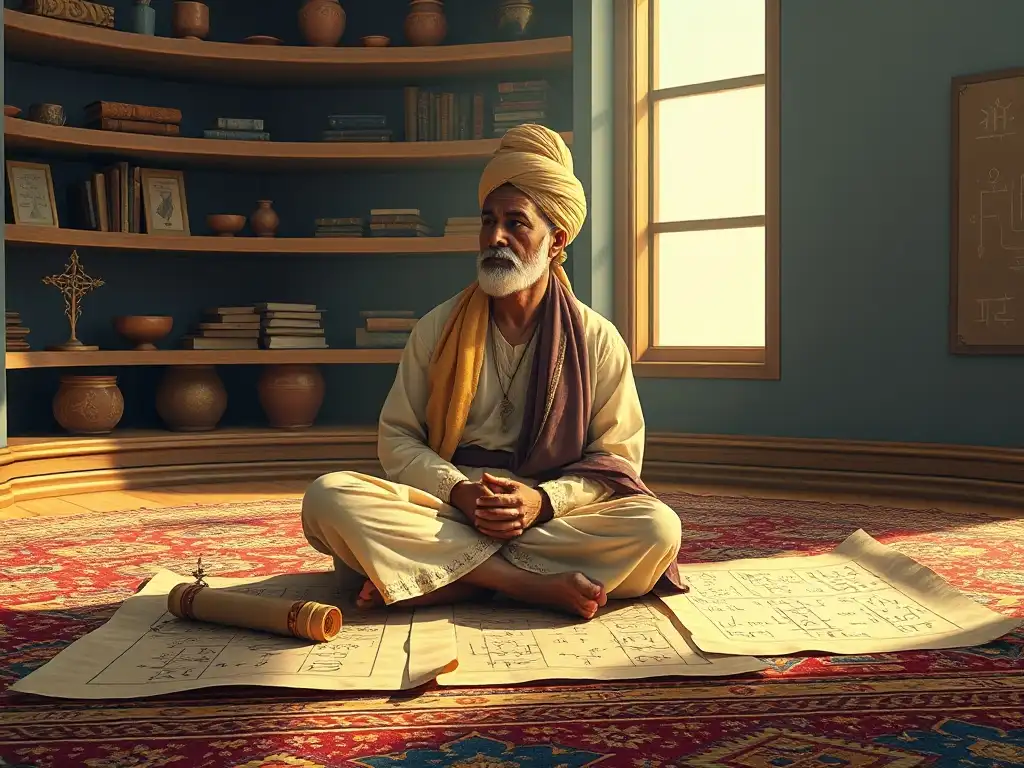
The rich tradition of algebra in ancient India has had a profound influence on the development of mathematical thought across the globe. Scholars from ancient Indian civilizations made significant contributions that not only advanced algebraic concepts but also laid the groundwork for future generations of mathematicians. This influence can be observed in various cultural contexts, especially through the transmission of knowledge to the Islamic world and the subsequent impact on European mathematics during the Renaissance.
Transmission of Knowledge to the Islamic World
The transfer of mathematical knowledge from ancient India to the Islamic world was facilitated by trade routes and cultural exchanges. During the 7th to 12th centuries, Indian scholars such as Brahmagupta and Bhaskara I developed algebraic techniques that were documented in texts like the Brahmasphutasiddhanta and Lilavati. These works were translated into Arabic, allowing Islamic mathematicians to access and build upon these concepts.
- Key Contributions:
- Brahmagupta's rules for solving quadratic equations.
- Introduction of zero as a numeral and its use in calculations.
- Methods for handling negative numbers and debts, which were revolutionary for their time.
The Islamic mathematicians, such as Al-Khwarizmi, who is often referred to as the "father of algebra," incorporated these Indian techniques into their own works. Al-Khwarizmi’s book, Al-Kitab al-Mukhtasar fi Hisab al-Jabr wal-Muqabala, drew heavily from Indian mathematical concepts, ultimately leading to the term "algebra" itself, derived from the word al-jabr in the title. This integration of ancient Indian algebra into Islamic mathematics played a crucial role in preserving and expanding mathematical knowledge during the Middle Ages.
The Impact on European Mathematics During the Renaissance
The ripple effects of ancient Indian contributions to algebra reached Europe during the Renaissance, particularly through the translation of Arabic texts into Latin. As European scholars began to explore the works of Islamic mathematicians, they encountered Indian algebraic concepts that had been integrated into Arab scholarship.
- Key Developments:
- The introduction of the decimal system and positional notation, which revolutionized arithmetic operations.
- The adoption of algebraic symbols and terminology that can be traced back to Indian roots.
- Influential figures such as Fibonacci, whose Liber Abaci introduced Hindu-Arabic numerals to Europe, demonstrating the practical applications of Indian algebra.
The mathematical frameworks established by ancient Indian scholars provided the foundations for modern algebra. Their methods of presenting and solving equations paved the way for future innovations, ultimately influencing the development of algebraic notation and theory in Europe.
The ancient Indian contributions to algebra not only shaped the mathematical landscape of their own time but also transmitted vital knowledge that would propel advancements in both the Islamic world and Europe. The legacy of these early scholars continues to resonate in contemporary mathematics, highlighting the interconnectedness of global mathematical heritage.
Conclusion: Legacy of Ancient Indian Contributions to Algebra
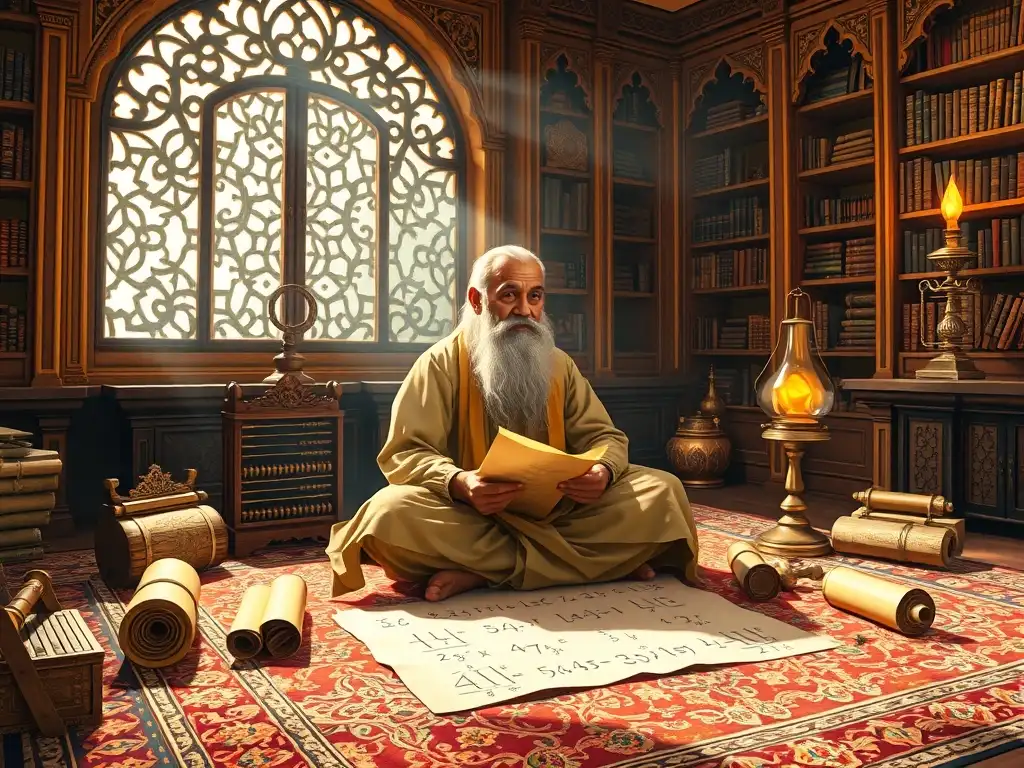
The legacy of ancient Indian contributions to algebra is profound and multifaceted, echoing through the corridors of mathematical history. Scholars from ancient India laid the groundwork for many fundamental concepts and techniques that continue to influence contemporary mathematics. Their work, characterized by innovation and depth, not only advanced the discipline of algebra but also integrated it with other fields such as astronomy, philosophy, and commerce.
One of the hallmark achievements of ancient Indian mathematicians is the development of the decimal number system, which included the concept of zero as a placeholder. This revolutionary idea provided a framework for expressing large numbers and performing complex calculations, fundamentally transforming mathematics. The contributions of figures like Brahmagupta and Bhaskara II, who tackled problems related to quadratic equations and introduced rules for arithmetic operations involving negative numbers, showcase the sophistication of their algebraic understanding.
The influence of these scholars extended beyond their immediate geographical boundaries, as their texts were translated and disseminated through the Islamic Golden Age into Europe, impacting the mathematical landscape of the Western world. Thus, the contributions of ancient Indian scholars not only enriched their own culture but also sowed the seeds for future mathematical advancements globally.
Reflection on the Importance of Ancient Indian Scholars
Ancient Indian scholars were pioneers in the field of mathematics, and their work reflects a deep understanding of algebraic principles that were ahead of their time. The significance of their contributions is encapsulated in several key areas:
- Introduction of Symbolism: Indian mathematicians were among the first to use symbols to denote unknowns and operations, laying the foundation for modern algebraic notation.
- Equations and Solutions: They formulated rules for solving different types of equations, including linear and quadratic equations, which are foundational to algebra.
- Textual Heritage: Treatises such as "Aryabhatiya" by Aryabhata and "Brahmasphutasiddhanta" by Brahmagupta provided systematic approaches to mathematical problems and preserved knowledge for future generations.
The intellectual rigor and creativity displayed by these scholars reflect not only their mathematical prowess but also their philosophical insights, as they often intertwined mathematics with cosmology and ethics. Their approaches to problem-solving emphasized logical reasoning, a trait that remains central in mathematics today.
The Continuing Relevance of Their Work in Modern Mathematics
The contributions of ancient Indian scholars remain profoundly relevant in modern mathematics, influencing various branches of the field. Here are a few ways their work continues to resonate:
- Algebraic Foundations:
- Modern algebra owes much to the techniques developed by ancient Indian mathematicians. Their methods for solving equations are still taught in classrooms around the world.
- Computational Techniques:
- Techniques for performing calculations, such as the use of algorithms for arithmetic operations, can be traced back to their innovations. The efficiency in computation that they achieved is mirrored in today’s computational methods.
- Cultural Exchange:
- The transmission of mathematical knowledge across cultures, particularly from India to the Islamic world and then to Europe, highlights the importance of cross-cultural collaboration in the advancement of mathematics.
- Mathematical Philosophy:
- The philosophical approach to mathematics embraced by ancient Indian scholars encourages a holistic view of the discipline, promoting interdisciplinary studies that include science, philosophy, and the arts.
The contributions of ancient Indian scholars to algebra are not merely historical footnotes but are integral to the fabric of modern mathematics. Their legacy continues to inspire and inform contemporary mathematical thought, reflecting a rich tradition of inquiry that transcends time and geography.
References and Further Reading
Suggested Texts on Ancient Indian Mathematics
To delve deeper into the contributions of ancient Indian scholars to algebra, the following texts serve as essential resources:
- "The History of Mathematics: A Brief Course" by Roger L. Cooke
- This book provides an overview of the historical development of mathematics, including significant contributions from ancient India. Cooke discusses prominent mathematicians and their groundbreaking work in algebra.
- "Mathematics in Ancient India" by Kim Plofker
- Plofker's comprehensive examination of ancient Indian mathematics highlights the evolution of mathematical concepts in the subcontinent. The book provides detailed insights into the contributions of mathematicians like Aryabhata and Brahmagupta.
- "A History of Indian Mathematics" by C. N. Srinivasiengar
- This classic work elaborates on the mathematical achievements of ancient India. It emphasizes the algebraic advancements made by scholars and their impact on subsequent mathematical developments.
- "Algebra in Ancient and Pre-modern Times" by J. B. Fraleigh
- Though not exclusively focused on India, this text offers a comparative look at algebra's evolution, including significant sections on ancient Indian practices and theories.
- "The Legacy of Indian Mathematics: A Historical Perspective" by R. C. Gupta
- Gupta's work investigates the lasting impact of ancient Indian mathematics on global mathematical practices, particularly in algebra.
These texts provide a blend of historical context and technical analysis, making them invaluable for anyone seeking to understand the depth of ancient Indian contributions to algebra.
Online Resources for Exploring Ancient Indian Contributions to Algebra
The digital age has made a wealth of information available at our fingertips. Here are some excellent online resources that explore ancient Indian contributions to algebra:
- The MacTutor History of Mathematics Archive
- A resourceful website that offers biographies of mathematicians, including those from ancient India. The archive covers the work of significant figures such as Aryabhata and Brahmagupta, along with their contributions to algebra.
- Indian Mathematical Society
- This society's website provides various articles and papers on the history of mathematics in India. The focus on algebraic innovations will be particularly beneficial for understanding ancient contributions.
- The Digital South Asia Library
- A comprehensive resource that includes digitized texts, manuscripts, and historical documents related to mathematics in ancient India. Researchers can access primary sources that shed light on algebraic concepts.
- YouTube Educational Channels
- Channels like "Numberphile" and "3Blue1Brown" occasionally feature videos on historical mathematics, including segments dedicated to ancient Indian contributions. These videos can provide visual learners with engaging content on the topic.
- ResearchGate
- A platform where researchers can share papers and articles. Searching for "ancient Indian algebra" will yield numerous academic works that explore the subject in depth.
These resources are excellent starting points for anyone interested in furthering their understanding of the significant role that ancient Indian scholars played in the development of algebra.
Frequently Asked Questions
What were some key contributions of ancient Indian scholars to algebra?
Ancient Indian scholars made significant advancements in algebra, including the development of algebraic notation and systems for solving equations, which laid the groundwork for modern mathematics.
How did the Indus Valley Civilization influence algebra?
The Indus Valley Civilization showcased early mathematical practices, including the use of weights and measures, which were essential for trade and may have contributed to early algebraic concepts.
Who are some notable ancient Indian mathematicians recognized for their work in algebra?
Brahmagupta and Bhaskara II are among the most notable mathematicians whose works, such as Brahmasphutasiddhanta, significantly advanced the field of algebra in ancient India.
What role did Indian texts play in the development of algebra?
Ancient Indian texts, such as the Aryabhatiya and Brahmasphutasiddhanta, contained theoretical frameworks and practical applications of algebra that influenced later mathematicians across the world.
How did ancient Indian contributions to algebra impact global mathematics?
The algebraic concepts developed by ancient Indian scholars were transmitted to the Islamic world and later to Europe, significantly impacting the evolution of mathematics globally.
Final Reflection: Celebrating the Legacy of Ancient Indian Contributions to Algebra
The exploration of ancient Indian contributions to algebra is not merely a historical inquiry; it is a testament to the enduring impact of these scholars on modern mathematics. Today, as we navigate a world increasingly driven by data and technology, the foundational principles laid by ancient Indian mathematicians resonate profoundly. Their innovative approaches to problem-solving and abstraction continue to shape the way we understand and apply mathematical concepts in our daily lives.
The influence of these ancient scholars extends far beyond the confines of history; it permeates our cultural and educational landscapes. From the algorithms we use to solve complex equations to the very structure of mathematical education, the legacy of Indian mathematicians like Brahmagupta and Bhaskara is evident. Their work not only advanced the field of algebra but also fostered a spirit of inquiry and intellectual curiosity that inspires generations. Mathematics is the language in which God has written the universe.
– Galileo Galilei. This quote underscores the universal significance of mathematics, a language that ancient Indian scholars eloquently spoke and enriched.
As we reflect on the remarkable contributions of these ancient scholars, let us invite ourselves to embrace the lessons they imparted. Consider how you can apply their spirit of innovation and inquiry in your own life. Whether through a deeper engagement with mathematics or an appreciation for the diverse cultural narratives that shape our understanding of the world, each of us has the potential to contribute to the ongoing story of knowledge. Let us honor the legacy of ancient Indian contributions to algebra by fostering a love for learning and a commitment to intellectual exploration in our own journeys.
Unveil the Legacy of Ancient Indian Algebra!
Thank you for diving into the rich history of algebra and the remarkable contributions of ancient Indian scholars! You’ve gained a deeper understanding of how their insights have shaped the world of mathematics today. Are you ready to take the next step and explore this fascinating legacy further?
Here are some actions you can take right now:
- Dive deeper into research: Explore books or articles that highlight the works of ancient Indian mathematicians such as Aryabhata and Brahmagupta.
- Share your insights: Discuss what you've learned with friends or on social media—perhaps even start a conversation using the hashtag #AncientAlgebra!
- Engage with the community: Join online forums or groups dedicated to the history of mathematics to connect with others who share your passion.
What aspect of ancient Indian mathematics inspires you the most, and how do you think it can influence our modern understanding of math?