
From Nothing to Everything: The Journey of Zero in Ancient Indian Mathematics


Welcome to Ancient India History, where we invite you to embark on a fascinating journey through the rich tapestry of ancient Indian civilizations. In today’s featured article, “From Nothing to Everything: The Journey of Zero in Ancient Indian Mathematics,” we delve into the profound impact of the history of zero in India—a concept that revolutionized mathematics and science across the globe.
Discover how this seemingly simple numeral emerged from the depths of ancient thought, reshaping our understanding of numbers and calculations. Prepare to be captivated by the stories of innovation and intellect that defined an era, and let your curiosity guide you as you explore the remarkable contributions of ancient India!
- Introduction to the History of Zero in India
- The Origins of Zero in Ancient India
- The Development of Zero as a Number
- The Mathematical Revolution: The Gupta Empire
- The Symbolism of Zero in Ancient Indian Texts
- The Spread of Zero Beyond India
- The Impact of Zero on Modern Mathematics
- Conclusion: The Journey of Zero in Ancient Indian Mathematics
-
Frequently Asked Questions
- What is the significance of the history of zero in India?
- Who were the key figures in the development of zero in ancient India?
- How did zero impact mathematics in ancient civilizations?
- What contributions did the Gupta Empire make to the concept of zero?
- Is the concept of zero unique to Indian civilization?
- Final Reflection: The Transformative Power of Zero in Our Lives
- Embrace the Legacy: Take Action in Your Mathematical Journey!
Introduction to the History of Zero in India
The history of zero in India is a fascinating narrative that reflects the profound impact of ancient Indian mathematicians on the development of mathematical concepts. Zero, as a symbol and a concept, revolutionized mathematics and paved the way for modern numerical systems. Its journey from a mere placeholder in the numeral system to a fundamental building block in mathematics illustrates the innovative spirit of ancient Indian scholars. This article delves into the historical timeline and significance of zero, highlighting its origins, evolution, and the crucial role it played in the advancement of mathematics in ancient India.
Overview of Zero in Mathematics
Zero is not just a number; it represents a concept that fundamentally transformed mathematical thought. In ancient times, civilizations like the Babylonians and Greeks used various methods to express the absence of quantity, but it was in India that zero was conceptualized as a numeral.
- Origins of Zero: The earliest recorded use of zero can be traced back to the Indus Valley Civilization (circa 2500 BCE), where the concept of emptiness was acknowledged. However, it was during the Gupta Empire (circa 320-550 CE) that zero was formally recognized as a number and a crucial part of the decimal system.
- Notational Developments: Ancient Indian mathematicians, such as Brahmagupta, were instrumental in developing a notation for zero. Brahmagupta's work, the Brahmasphutasiddhanta, outlines rules for arithmetic operations involving zero, marking a significant advancement in mathematical literature.
- Global Influence: The introduction of zero into the number system not only influenced Indian mathematics but also laid the groundwork for mathematical practices in other parts of the world, particularly when the numeral system spread to the Middle East and eventually Europe.
Importance of Zero in Ancient Indian Mathematics
The significance of zero in ancient Indian mathematics extends beyond its utility as a numeral. It represents a philosophical and conceptual milestone that changed how mathematicians approached calculations and problem-solving.
- Facilitating Complex Calculations: The inclusion of zero allowed for the simplification of calculations, enabling more complex arithmetic operations. This was essential for advancements in algebra and geometry, where the concept of 'nothingness' became crucial in formulating equations.
- Cultural and Philosophical Perspectives: In addition to its mathematical significance, zero held philosophical implications in Indian culture. It was seen as a symbol of potential and infinity, embodying the idea of the void and the cyclical nature of existence.
- Legacy in Modern Mathematics: The legacy of zero is evident in contemporary mathematics. The decimal system, which revolves around the use of zero, is the foundation of modern arithmetic, computer science, and various fields of engineering.
The journey of zero in ancient Indian mathematics is a testament to the ingenuity of Indian scholars and their lasting contributions to the mathematical world. As we explore the rich tapestry of its history, we gain insight into how this simple yet profound concept has shaped not only mathematics but also the way we perceive quantities and calculations to this day.
The Origins of Zero in Ancient India

The concept of zero as a numerical value, rather than merely a placeholder, is one of the most significant contributions of ancient Indian mathematics. Its origins trace back to several ancient civilizations, but it was in India that the notion evolved into a formal mathematical concept. The journey of zero illustrates how abstract ideas can transition into vital components of mathematical systems, influencing cultures worldwide.
Early Concepts of Nothingness
The idea of "nothingness" has deep philosophical roots in Indian thought. Ancient texts, such as the Upanishads, explored concepts of emptiness and void, which laid the groundwork for later mathematical interpretations. This philosophical groundwork was crucial in fostering an environment where the abstraction of zero could flourish.
- Philosophical Foundations:
- The Ajivika and Buddhist schools of thought emphasized concepts of void and impermanence, which resonated with the idea of zero.
- The Samkhya philosophy presented a dualistic view of existence, where the concept of non-being (or nothingness) could be acknowledged alongside being.
- Numerical Representation:
- The Brahmi numerals, which date back to the 3rd century BCE, included symbols that hinted at the concept of zero. Although these symbols were not yet fully developed, they represented an acknowledgment of the absence of quantity.
- Place Value System:
- The development of the place value system was a significant step toward recognizing zero as a number. The earliest records of this system can be traced to the Indus Valley Civilization, where the use of a placeholder in calculations was evident.
The transition from philosophical abstraction to mathematical utility was gradual but crucial for the eventual acceptance and formalization of zero in mathematics.
Influence of Ancient Philosophies on the Concept of Zero
The philosophical landscape of ancient India played a pivotal role in shaping the concept of zero. Various schools of thought contributed to a broader understanding of the significance of "nothing" in both philosophical and mathematical contexts.
- Influence of Indian Mathematics:
- Mathematicians like Aryabhata and Brahmagupta were instrumental in formalizing the concept of zero. Aryabhata's work, Aryabhatiya, discussed the use of zero in calculations and laid the foundation for arithmetic operations involving zero.
- Brahmagupta's Brahmasphutasiddhanta (7th century CE) is one of the earliest texts to provide rules for arithmetic operations, including addition, subtraction, and division involving zero.
- Cultural Acceptance:
- The acceptance of zero was not merely a mathematical evolution but also a cultural one. The integration of zero into Hindu, Buddhist, and Jain thought helped solidify its importance. Texts from these traditions frequently referenced concepts related to void and emptiness, thereby enriching the understanding of zero as a number.
- Mathematics and Astronomy:
- The intersection of mathematics and astronomy in ancient India further propelled the concept of zero. Astronomers required precise calculations for timekeeping and celestial events, which necessitated a robust numerical system, including the use of zero.
The history of zero in India showcases a remarkable convergence of philosophy, culture, and mathematics. The ancient Indian perspective on nothingness not only influenced the development of mathematics in India but also laid the groundwork for the global acceptance of zero as an essential element of numerical systems.
The Development of Zero as a Number
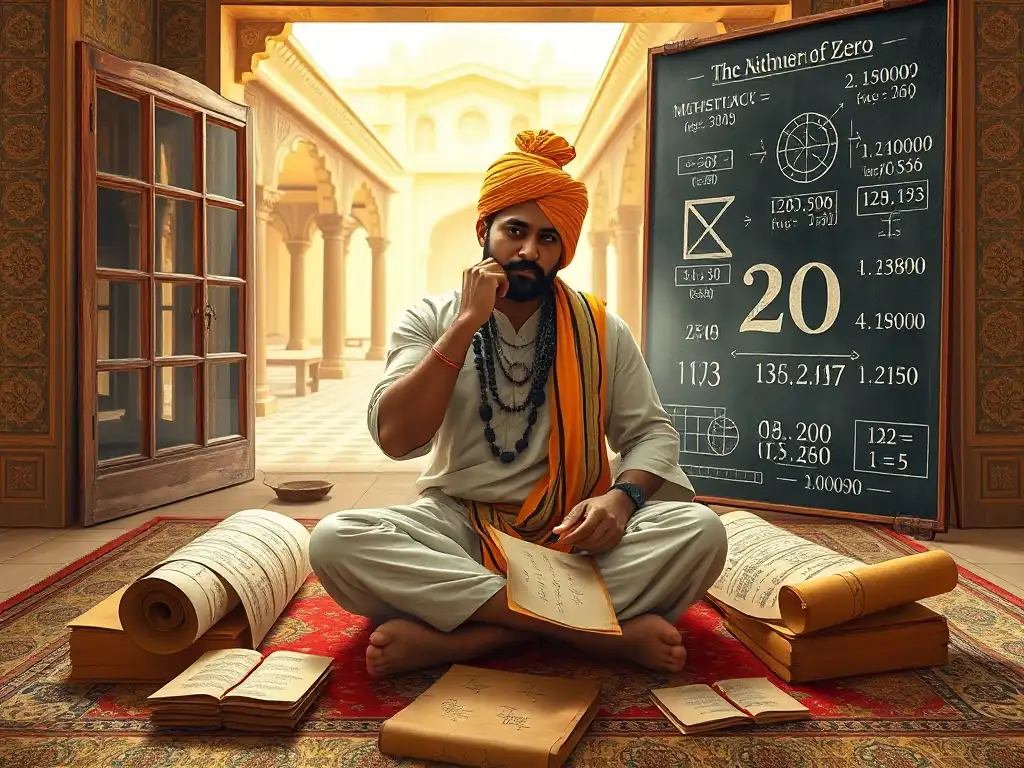
The development of zero as a number represents one of the most significant advancements in mathematics, particularly within the context of ancient Indian civilizations. The concept of zero transcends mere numerical representation; it embodies a philosophical understanding of absence and the potential for infinite possibilities. This section delves into the evolution of zero in ancient India, highlighting its cultural and mathematical significance.
Zero was not merely a placeholder in the numeral system; it evolved into a concept that facilitated complex calculations and mathematical operations. The initial representation of zero can be traced back to the ancient Indian numeral system, where it was symbolized by a dot or a small circle. This simple yet profound symbol laid the groundwork for more advanced mathematical theories.
The acceptance of zero as a number was a gradual process. Early mathematicians recognized its utility in arithmetic operations, enabling them to perform additions, subtractions, and even multiplications with greater efficiency. The transition from viewing zero as an absence to recognizing it as a value in its own right marked a pivotal moment in the history of mathematics.
The Role of the Indus Valley Civilization
The Indus Valley Civilization, flourishing around 2500 BCE, is often credited with early mathematical practices that laid the foundation for the later development of zero. Archaeological evidence suggests that the inhabitants engaged in various mathematical activities, including trade and measurement, which required a system of counting and recording.
- Weight and Measurement Systems: The Indus Valley people used standardized weights and measures, indicating an understanding of the need for precision in trade. This practical application of mathematics hints at an early awareness of numerical concepts, potentially including the idea of zero as a means to signify nothing or absence in trade balances.
- Urban Planning: The systematic layout of cities like Mohenjo-Daro and Harappa reflects an advanced understanding of geometry and spatial planning. The need to calculate areas and distances may have necessitated the use of a placeholder for large numbers, leading to the conceptualization of zero.
While direct evidence linking the Indus Valley Civilization to the formal use of zero is still a subject of scholarly debate, the foundational concepts of mathematics they employed undoubtedly influenced subsequent cultures in India.
Contributions from Vedic Mathematics
Vedic Mathematics, which emerged later around 1500 BCE during the Vedic period, significantly advanced the concept of zero and its applications in mathematics. The ancient texts known as the Vedas provide insights into the mathematical practices of this era, showcasing the philosophical depth and complexity of numerical concepts.
- Philosophical Underpinnings: Vedic texts often linked mathematics with cosmology and philosophy, suggesting that the concept of zero was intertwined with spiritual beliefs about the universe and existence. This philosophical approach helped elevate zero from a mere mathematical symbol to a concept of profound significance.
- Mathematical Techniques: The Vedic mathematicians developed various techniques for calculations, including the use of zero in operations such as multiplication and division. The introduction of sutras (aphorisms) for mathematical operations likely incorporated zero, allowing for simpler computations and problem-solving.
- Decimal System: The adoption of the decimal system during this period further facilitated the use of zero. As numbers grew larger, the need for a symbol to denote empty places became essential, solidifying zero's role in arithmetic and paving the way for more sophisticated mathematical operations.
The contributions of Vedic Mathematics to the history of zero in India are substantial, as they not only refined the concept but also integrated it into a broader philosophical and mathematical framework. This rich tapestry of ideas and practices ultimately positioned ancient India as a pivotal player in the development of zero as a foundational element of mathematics.
The Mathematical Revolution: The Gupta Empire

The Gupta Empire, often referred to as the Golden Age of India, was a period marked by extraordinary advancements in various fields, including mathematics. From approximately 320 to 550 CE, this era witnessed a transformation in mathematical thought and practice, laying the foundational concepts that would influence future generations. The Gupta mathematicians made significant strides in the understanding and application of the number system, particularly the concept of zero and its role in mathematics.
The era's mathematicians not only preserved the knowledge from earlier civilizations, such as the Indus Valley and the Vedic period, but they also innovated and expanded upon it. The integration of zero into mathematical calculations allowed for more complex problem-solving and paved the way for algebra and calculus.
The contributions made during the Gupta period were pivotal in establishing a base for mathematical concepts that are still in use today. This revolution in mathematics was characterized by a systematic approach to calculations and an emphasis on the importance of numerical representation.
Key Mathematicians of the Gupta Period
The Gupta period was home to several renowned mathematicians whose works have been influential in the history of mathematics. Here are some of the key figures:
- Aryabhata (476–550 CE):
- Often considered the first major mathematician of the Gupta period, Aryabhata made groundbreaking contributions to both mathematics and astronomy.
- He introduced the concept of zero as a placeholder and developed the place value system, which was revolutionary for its time. Aryabhata's work, Aryabhatiya, includes detailed discussions on arithmetic, algebra, and geometry.
- Brahmagupta (598–668 CE):
- Brahmagupta's influential text, Brahmasphutasiddhanta, expanded on Aryabhata's ideas and provided rules for arithmetic operations involving zero.
- He is credited with formalizing the rules for the addition and subtraction of zero and negative numbers, significantly advancing mathematical thought.
- Bhaskara I (600–680 CE):
- A notable follower of Aryabhata, Bhaskara I is known for his works in astronomy and mathematics, particularly for translating Aryabhata's works into Sanskrit.
- His commentaries provided insights into Aryabhata's methods, further disseminating knowledge of zero and place value.
The contributions of these mathematicians were instrumental in shaping the understanding of the history of zero in India, emphasizing its importance in mathematical calculations.
Innovations in Numerals and the Place Value System
The Gupta Empire's most significant mathematical innovation was the establishment of the numeral system that we use today, which includes the concept of zero. This numeral system was based on a base-10, or decimal, approach that allowed for efficient calculations and record-keeping. Here are the key innovations:
- Introduction of Zero:
- Zero was not just a symbol but a concept that represented the absence of quantity. This understanding allowed for a more sophisticated approach to arithmetic and algebra.
- Place Value System:
- The place value system enabled numbers to be represented in a way that their value depends on their position within a number. For example, in the number 205, the '2' represents two hundreds, while the '0' indicates the absence of tens.
- Numerical Notation:
- The symbols we associate with numbers today were refined during this period. The development of these symbols facilitated more straightforward calculations and record-keeping.
- Arithmetic Operations:
- The Gupta mathematicians documented rules for various arithmetic operations, including addition, subtraction, multiplication, and division, which were crucial for trade and commerce.
This mathematical innovation not only impacted Indian civilization but also laid the groundwork for future mathematical developments worldwide, showcasing the profound influence of the history of zero in India on global mathematics.
The Symbolism of Zero in Ancient Indian Texts

Zero, a concept that revolutionized mathematics across the globe, finds its profound roots in ancient Indian texts. In these texts, the symbolism of zero transcends mere numerical representation, embodying philosophical and cosmological implications that reflect the intellectual depth of Indian civilization.
References in Aryabhata's Works
Aryabhata, one of the earliest mathematicians and astronomers in India, made significant contributions that highlight the importance of zero. In his seminal work, the Aryabhatiya, composed in 499 CE, Aryabhata employs a positional numeral system, where the use of zero as a placeholder is crucial.
- Positional Value: Aryabhata's system indicates that the place of a digit in a number determines its value, and zero serves as an essential marker to denote absence. For example, in the number 205, the '0' signifies that there are no tens, thereby illustrating the concept of nullity in a profound mathematical context.
- Zero in Calculation: Aryabhata also recognized the utility of zero in arithmetic operations, showcasing its role in calculations involving large numbers. His work laid a foundation for future mathematicians to explore operations that could incorporate zero without ambiguity.
- Philosophical Nuances: Beyond arithmetic, Aryabhata's use of zero hints at deeper philosophical ideas. He connects the concept of zero with the infinite, suggesting a relationship between the void and the cosmos, which reflects the ancient Indian worldview where nothingness can lead to creation.
Insights from Brahmagupta's Treatises
Brahmagupta, another towering figure in ancient Indian mathematics, elaborated on the concept of zero in his works, particularly in the Brahmasphutasiddhanta written in 628 CE. His insights further cemented the significance of zero in mathematical discourse.
- Arithmetic Rules: Brahmagupta laid down rules for arithmetic operations involving zero, including how to handle addition and subtraction. He stated that:
- Adding zero to a number yields the number itself.
- Subtracting a number from itself results in zero.
- Importantly, he also addressed the notion of division by zero, although his conclusions were limited due to the mathematical understanding of his time.
- Equations and Zero: He introduced the concept of equations where zero could serve as a solution. This was a groundbreaking realization that expanded the boundaries of algebraic thought, allowing mathematicians to explore equations with unknowns that could equal zero.
- Cosmological Context: Brahmagupta also contextualizes zero within the framework of time and motion. He posits that just as zero denotes absence, the transition between states (such as day and night) can also be viewed through the lens of zero, emphasizing the cyclical nature of time in ancient Indian philosophy.
The symbolism of zero in ancient Indian texts is not merely a mathematical innovation but a profound concept intertwined with philosophical thought and cosmological understanding. The works of Aryabhata and Brahmagupta illuminate the journey of zero from a simple placeholder to a fundamental element of mathematics, showcasing the rich intellectual legacy of ancient Indian civilization.
The Spread of Zero Beyond India

Transmission to the Islamic World
The journey of zero from India to the Islamic world represents a pivotal chapter in the history of zero in India. The transmission occurred primarily during the 7th century, when Indian mathematicians had begun to formalize the concept of zero as a numeral. This concept caught the attention of traders and scholars who traveled along the Silk Road and maritime routes, facilitating cultural and intellectual exchanges.
One of the key figures in this transmission was the Persian mathematician Al-Khwarizmi. His works, particularly Al-Kitab al-Mukhtasar fi Hisab al-Jabr wal-Muqabala (The Compendious Book on Calculation by Completion and Balancing), incorporated the Indian numeral system, including zero. Al-Khwarizmi's texts were translated into Latin in the 12th century, making them widely available to European scholars.
The adoption of zero in the Islamic Golden Age significantly influenced various mathematical disciplines:
- Arithmetic: Zero enabled simpler calculations and the development of algorithms.
- Algebra: The introduction of zero allowed for the solution of equations that had previously been unsolvable.
- Astronomy: Scholars utilized zero for precise calculations related to celestial movements.
Furthermore, the Islamic scholars not only preserved these mathematical concepts but also expanded upon them, creating a rich tapestry of mathematical knowledge that blended Greek, Indian, and Islamic thought.
Influence on European Mathematics
The influence of zero on European mathematics can be traced back to the translations of Arabic texts in the 12th century. This period marked a significant cultural and intellectual exchange, leading to a revolution in mathematical thought across Europe.
The introduction of the Hindu-Arabic numeral system, including zero, transformed arithmetic and mathematics in Europe. Notable developments include:
- The Fibonacci Sequence: In 1202, Leonardo of Pisa, known as Fibonacci, introduced this sequence in his work Liber Abaci. It highlighted the practical applications of zero in commerce and trade.
- Calculating Techniques: The use of zero allowed for more complex calculations, which were essential for advancements in navigation, finance, and engineering.
The adoption of zero was not without resistance. Many European scholars initially favored the Roman numeral system, which lacked a placeholder for zero. However, as trade expanded and the need for efficient calculation grew, the advantages of the Hindu-Arabic system became undeniable.
The eventual acceptance of zero and the Hindu-Arabic numeral system laid the groundwork for the mathematical advancements of the Renaissance and beyond. By the end of the 15th century, zero had firmly established its place in the mathematical canon, illustrating the profound impact of ancient Indian contributions to mathematics on global knowledge.
The journey of zero from ancient India to the broader world is a testament to the interconnectedness of human knowledge and the importance of cultural exchange in the advancement of mathematics.
The Impact of Zero on Modern Mathematics
The introduction of zero as a numerical concept has had a profound impact on the development of modern mathematics. While it originated in ancient India, the implications of this seemingly simple digit extend far beyond its historical context, fundamentally changing the way we approach mathematics today. The history of zero in India is not merely an academic curiosity; it represents a turning point that paved the way for various mathematical advancements that we now take for granted.
Zero's Role in Calculus and Algebra
Zero plays an essential role in both calculus and algebra, serving as a pivotal element in various mathematical operations and theories.
- Algebraic Foundations:
- Zero is crucial in defining various algebraic structures, including groups, rings, and fields. The existence of an additive identity (zero) allows for the formulation of equations and the simplification of expressions.
- In algebra, zero is used to denote the absence of quantity. For example, solving for
xin the equation \(x + 0 = x\) illustrates zero's role as the additive identity.
- Limits and Continuity in Calculus:
- In calculus, zero is integral to the concepts of limits and continuity. For example, the limit of a function as it approaches zero can reveal critical information about the behavior of the function.
- The derivative, defined as the limit of the average rate of change of a function, often involves expressions that approach zero. This is crucial in understanding instantaneous rates of change—a fundamental concept in calculus.
- Solving Equations:
- The introduction of zero allows for the formulation of equations that can be solved easily. For instance, the equation \(x^2 - 4 = 0\) can be solved by factoring to find the roots, \(x = 2\) and \(x = -2\).
- The use of zero also simplifies complex equations, allowing mathematicians to manipulate and solve them more efficiently.
The Legacy of Zero in Contemporary Math
The legacy of zero transcends its historical origins, as it continues to influence contemporary mathematical practices and theories.
- Digital Revolution: The binary system, which underpins modern computing, relies on zero and one as its fundamental digits. This system is essential for programming and digital communication, showcasing how the history of zero in India has shaped technological advancements.
- Mathematical Notation: The use of zero in mathematical notation has simplified many concepts. For example, the decimal system relies on zero to indicate place value, allowing for clearer representation of numbers. This system is a direct descendant of ancient Indian numerical practices.
- Economic Models: In economics, zero plays a vital role in various models, such as zero-sum games, where the gain of one participant equates to the loss of another. This concept is indispensable in game theory and decision-making processes.
- Philosophical Implications: The concept of zero has philosophical implications as well, challenging notions of existence and nothingness. This duality influences various disciplines, including logic, metaphysics, and even religious studies.
The history of zero in India is not just a tale of innovation but a foundational element that continues to shape the landscape of modern mathematics. Its influence extends from algebra and calculus to contemporary applications in technology, economics, and beyond, marking its significance as one of the greatest contributions to mathematics from ancient civilizations.
Conclusion: The Journey of Zero in Ancient Indian Mathematics
Summary of Key Contributions
The history of zero in India is marked by profound contributions that reshaped mathematical thought and practice. The concept of zero as a numeral was not merely an abstract idea but rather a revolutionary advancement that emerged during the Gupta period (approximately 320–550 CE). This era is often referred to as the Golden Age of India, where significant strides were made in various fields, including mathematics.
- Brahmagupta's Treatise: The mathematician Brahmagupta, in his seminal work "Brahmasphutasiddhanta" (628 CE), provided one of the earliest known descriptions of zero. He defined it as the result of subtracting a number from itself and outlined rules for arithmetic operations involving zero, such as addition and subtraction.
- The Concept of Place Value: Ancient Indian scholars developed a place-value system that incorporated zero, allowing for greater numerical representation and calculation efficiency. This system facilitated complex calculations, making it easier to express large numbers, which was critical for trade, astronomy, and other sciences.
- Influence on Global Mathematics: The introduction and use of zero in mathematical equations extended beyond India, influencing Islamic mathematicians and later European scholars. Notably, the transmission of Indian numerals, including zero, played a crucial role in the evolution of mathematics globally.
Final Thoughts on the Importance of Zero in History
The history of zero in India is not just an account of a numeral; it is a narrative of intellectual evolution and cultural exchange. The acceptance and integration of zero into the mathematical lexicon signify a shift in human thought, where abstract concepts began to find tangible expression.
- Cultural Significance: The development of zero illustrates how ancient Indian civilizations contributed to a universal understanding of mathematics, emphasizing the interconnectedness of cultures. It serves as a reminder of the innovative spirit of Indian scholars who were not afraid to challenge conventional thinking.
- Mathematical Revolution: Zero's introduction led to a mathematical revolution, paving the way for modern mathematics as we know it today. The ability to perform calculations with zero laid the groundwork for advancements in calculus, algebra, and computer science.
- Legacy: The legacy of zero continues to influence contemporary mathematics and technology. It remains a fundamental concept that underpins various disciplines, from computer programming to physics, demonstrating its enduring relevance in our modern world.
The journey of zero in ancient Indian mathematics reflects a remarkable chapter in the history of human thought and innovation. Its evolution from a mere concept to an essential mathematical tool showcases the brilliance of ancient Indian scholars and their lasting impact on the world.
Frequently Asked Questions
What is the significance of the history of zero in India?
The history of zero in India is crucial as it represents a groundbreaking advancement in mathematics, allowing for the development of place value systems and complex calculations.
Who were the key figures in the development of zero in ancient India?
Prominent mathematicians such as Brahmagupta and Aryabhata played vital roles in formalizing the concept of zero, significantly influencing mathematical thought.
How did zero impact mathematics in ancient civilizations?
The introduction of zero allowed for the expression of large numbers, simplified calculations, and contributed to the evolution of algebra and geometry.
What contributions did the Gupta Empire make to the concept of zero?
During the Gupta Empire, mathematicians refined the use of zero and established a clear notation system, which paved the way for modern arithmetic.
Is the concept of zero unique to Indian civilization?
While other cultures had symbols for absence, the Indian concept of zero as a number and its mathematical properties were unique and revolutionary, influencing mathematics across the globe.
Final Reflection: The Transformative Power of Zero in Our Lives
The journey of zero from its humble beginnings in ancient Indian mathematics to its pivotal role in modern society underscores the profound impact of this concept on our daily lives. Today, as we navigate a world driven by technology and data, the significance of zero transcends mere numerical value; it symbolizes the potential for innovation and creativity. The history of zero in India is not just a tale of mathematical evolution but a testament to how a single idea can reshape civilizations.
The influence of zero extends beyond mathematics into various facets of culture, philosophy, and science. It has become a cornerstone of our understanding of the universe, enabling advancements in fields as diverse as computer science, economics, and even art. The legacy of this concept reminds us that great transformations often stem from the simplest ideas. The greatest discoveries are often the simplest.
This quote encapsulates the essence of zero's journey, highlighting how something that was once considered nothing can lead to everything.
As we reflect on the lessons from the history of zero in India, let us embrace the idea that every small contribution can lead to monumental change. I invite you to consider how you can apply the principles of innovation and creativity in your own life. Whether in your career, personal projects, or community initiatives, remember that even the smallest idea has the potential to grow into something extraordinary. Let the journey of zero inspire you to explore the infinite possibilities that lie within your reach.
Embrace the Legacy: Take Action in Your Mathematical Journey!
Thank you for exploring the fascinating journey of zero in ancient Indian mathematics! You've discovered how this incredible concept transformed our understanding of the universe. Now, it's time to channel that inspiration into action.
Here are a few steps you can take to deepen your connection with this remarkable legacy:
- Dive deeper into the world of ancient mathematics by reading more about its key figures and groundbreaking discoveries.
- Share your insights with friends and family—start a conversation about the influence of mathematics in our everyday lives.
- Join a community of math enthusiasts or engage in online discussions—your perspectives and experiences can inspire others!
What does the concept of zero mean to you in today’s world? Share your thoughts and let’s keep the conversation alive!