
How Ancient Indian Mathematicians Developed the Concept of Infinity


Welcome to Ancient India History, where we embark on a fascinating journey through the rich tapestry of India's past. In this exploration, we shine a spotlight on the remarkable contributions of ancient Indian mathematicians and their groundbreaking ideas on infinity. Did you know that the concept of infinity as we understand it today was significantly shaped by these brilliant minds? Prepare to be captivated as we delve into the profound insights and innovations that emerged from this vibrant civilization. Join us as we unravel the mysteries and marvels of ancient Indian mathematics, igniting your curiosity to discover more!
- Introduction to Ancient Indian Mathematicians and Infinity
- Historical Context of Mathematics in Ancient India
- Significant Ancient Indian Mathematicians and Their Contributions
- The Philosophical Underpinnings of Infinity in Ancient India
- Mathematical Texts and Their Role in Understanding Infinity
- The Legacy of Ancient Indian Mathematicians on Infinity
- Conclusion
- References
-
Frequently Asked Questions
- What is the significance of ancient Indian mathematicians in the concept of infinity?
- Which ancient Indian text first introduced the concept of infinity?
- How did ancient Indian mathematicians approach calculations involving infinity?
- Who were some key figures among ancient Indian mathematicians?
- How did the concept of infinity in ancient India influence modern mathematics?
- Final Reflection: Embracing the Infinite Wisdom of Ancient Indian Mathematicians
- Unveil the Infinite Wisdom of Ancient Mathematicians!
Introduction to Ancient Indian Mathematicians and Infinity
The journey of mathematical thought in ancient India is a remarkable story of innovation and intellectual achievement. Among the many contributions of ancient Indian mathematicians, the concept of infinity stands out as a profound idea that has shaped the course of mathematics not only in India but across the globe. This article explores how these mathematicians, through their groundbreaking work, developed the notion of infinity, an idea that challenges conventional boundaries and has far-reaching implications in various fields of study.
As we delve into the rich legacy of ancient Indian mathematics, we will uncover the historical context, key figures, and the philosophical underpinnings that led to the establishment of this pivotal concept. Understanding the contributions of these mathematicians provides us with a deeper appreciation for their role in the evolution of mathematical thought and its lasting impact on future generations.
Overview of Ancient Indian Mathematics
Ancient Indian mathematicians made significant strides in various mathematical fields, including arithmetic, geometry, and astronomy. Notably, texts such as the Sulba Sutras and the Aryabhatiya illustrate the advanced understanding of mathematical concepts in ancient India.
- Key Contributions:
- Decimal System: The development of the decimal number system, including the concept of zero, revolutionized mathematics.
- Astronomical Calculations: Mathematicians like Aryabhata and Brahmagupta formulated algorithms for calculating celestial events, which required advanced understanding of large numbers and infinity.
- Geometric Principles: The Sulba Sutras provided rules for constructing altars and other geometric shapes, showcasing the application of mathematical principles in religious contexts.
The exploration of infinity, however, emerged from a unique philosophical perspective, intertwining mathematical rigor with metaphysical pondering.
Importance of Infinity in Mathematical Concepts
The concept of infinity is crucial in various branches of mathematics, including calculus, number theory, and set theory. Ancient Indian mathematicians were among the first to grapple with the idea of the infinite, which they expressed through various philosophical and mathematical frameworks.
- Significance of Infinity:
- Philosophical Implications: Infinity was not merely a mathematical abstraction; it was a subject of philosophical inquiry, reflecting the limitless nature of the universe and existence.
- Mathematical Foundations: The recognition of different sizes and types of infinity laid groundwork for future mathematical theories, influencing both Eastern and Western thought.
- Practical Applications: Concepts of infinity found practical applications in calculations involving large numbers, limits, and even in the formulation of mathematical series.
The exploration of infinity by ancient Indian mathematicians exemplifies their innovative spirit and intellectual depth, making their contributions essential to our understanding of mathematics as a whole.
Historical Context of Mathematics in Ancient India
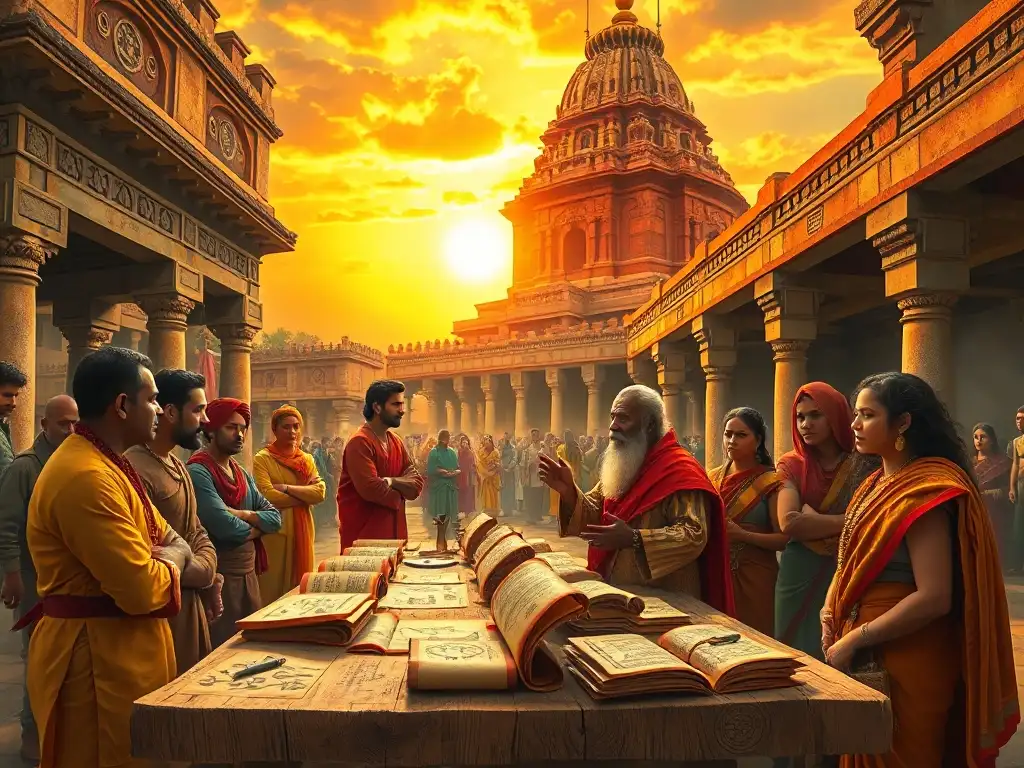
Mathematics in ancient India is a rich tapestry woven through centuries, marked by profound philosophical thought and practical applications. The historical context reveals a civilization that not only valued mathematical knowledge but also integrated it into various aspects of daily life, including trade, astronomy, and architecture.
The earliest records of mathematical concepts in India can be traced back to the Indus Valley Civilization (circa 3300–1300 BCE), where evidence of standardized weights and measures indicates a sophisticated understanding of geometry and arithmetic. However, the most significant developments emerged between the Vedic period (circa 1500 BCE) and the Gupta Empire (circa 320–550 CE). During this time, mathematicians began to explore and formalize concepts that would later influence both Eastern and Western mathematical traditions.
The Evolution of Mathematical Thought in Ancient India
The evolution of mathematical thought in ancient India can be categorized into several key phases:
- Vedic Mathematics: The earliest texts, such as the Sulbasutras, introduced geometric principles for constructing altars and rituals. These texts emphasized practical applications of mathematics, including the Pythagorean theorem long before it was formally recognized in the West.
- Philosophical Insights: Indian mathematicians were deeply influenced by philosophical questions about the nature of the universe. This led to abstract thinking about numbers, particularly the concept of infinity, which was explored in texts such as the Aryabhatiya by Aryabhata.
- Decimal System and Zero: The introduction of the decimal numeral system and the concept of zero were revolutionary. Brahmagupta's Brahmasphutasiddhanta provided rules for arithmetic operations with zero, laying the groundwork for future mathematical developments.
- Trigonometry and Astronomy: As the need for astronomical calculations grew, mathematicians like Bhaskara II advanced trigonometric concepts, including sine and cosine, which were crucial for understanding celestial movements.
The culmination of these developments established a unique mathematical framework that incorporated both practical and theoretical dimensions.
Key Civilizations Contributing to Mathematical Advancements
Several key civilizations in ancient India significantly contributed to mathematical advancements, particularly in the context of the concept of infinity:
- Indus Valley Civilization: Early geometry and measurements indicate a foundational understanding of spatial relationships, which are essential for later mathematical developments.
- Vedic Scholars: The scholars of the Vedic period not only laid the groundwork for mathematics through geometry but also initiated philosophical discussions that would lead to the contemplation of infinity.
- Mauryan Empire: Under the Mauryan rule, the pursuit of knowledge was encouraged, leading to advancements in various fields, including mathematics. The mathematicians of this era began to formalize concepts related to infinity in the context of cosmology and philosophy.
- Gupta Empire: Often referred to as the "Golden Age" of India, this period saw the flourishing of mathematics. Mathematicians like Aryabhata and Brahmagupta made significant contributions, particularly in understanding the infinite processes in astronomy and the implications of infinite series.
The contributions of ancient Indian mathematicians to the concept of infinity were deeply rooted in a rich historical context that combined practical needs with philosophical inquiry. This unique blend not only advanced mathematical thought but also influenced cultures beyond the Indian subcontinent.
Significant Ancient Indian Mathematicians and Their Contributions

Aryabhata and His Work on Infinity
Aryabhata (476–550 CE) is one of the most celebrated ancient Indian mathematicians and astronomers. His groundbreaking contributions to mathematics, particularly in the context of infinity, laid the foundation for future developments in this field. Aryabhata's seminal work, the "Aryabhatiya," encompasses various mathematical concepts, including the treatment of large numbers and the conceptualization of infinity.
Aryabhata's Theories on Numbers and Infinity
In the "Aryabhatiya," Aryabhata introduced a novel approach to the notion of numbers and their infinite nature. He recognized that numbers could extend indefinitely, which is a vital aspect of understanding infinity. His unique notation for large numbers involved the use of place value, which allowed for the representation of vast quantities. For instance, he articulated methods for calculating squares and cubes of numbers, extending these concepts to larger figures, paving the way for future mathematicians to explore infinity more rigorously.
Moreover, Aryabhata's work included the formulation of algorithms, which provided a systematic way to approach calculations involving large values. One of his notable contributions is the approximation of π (pi), which he calculated as 3.1416, showcasing his understanding of the infinite nature of decimals and fractions. This was a significant step toward comprehending irrational numbers and their implications for infinity.
Influence of Aryabhata on Later Mathematicians
Aryabhata's influence on subsequent generations of mathematicians cannot be overstated. His ideas on the infinite nature of numbers inspired notable figures such as Brahmagupta and Bhaskara. The principles he introduced laid the groundwork for the mathematical evolution in India and beyond.
His impact is evident in the adoption of his numeral system, which influenced the development of mathematics in various cultures. Aryabhata's work resonated throughout history, with scholars referencing his theories on infinity as they advanced mathematical understanding in the centuries that followed.
Brahmagupta's Innovations in Mathematical Concepts
Brahmagupta (598–668 CE) was another pivotal figure in ancient Indian mathematics, known for his innovative ideas concerning the concept of zero and its relation to infinity. His influential text, the "Brahmasphutasiddhanta," contains significant advancements in mathematics and astronomy, highlighting his contributions to the understanding of infinity.
Brahmagupta's Approach to Zero and Infinity
Brahmagupta's introduction of the concept of zero was revolutionary, as it served as a powerful tool for numerous mathematical operations. He articulated rules for arithmetic operations involving zero, including its role in calculating with infinity. For example, he proposed that subtracting a number from zero yields the negative of that number, and he explored the implications of these operations when coupled with infinity.
His insights allowed for a more comprehensive understanding of infinity, particularly in contexts such as division by zero, which posed philosophical and practical challenges. Brahmagupta's ideas prompted further exploration of how infinity interacts with various mathematical operations, setting the stage for future inquiries.
The Role of Brahmagupta in Expanding Mathematical Boundaries
Brahmagupta's work significantly expanded the boundaries of mathematical thought during his time. His engagement with infinite concepts not only advanced mathematical theory but also contributed to astronomical calculations and predictions. By incorporating zero into arithmetic and discussing its relationship with infinity, he opened new avenues for mathematical exploration.
Brahmagupta's contributions influenced later mathematicians, including Mahāvīra and Bhaskara II, who built upon his ideas to further advance the understanding of infinity and mathematical principles. His legacy endures as a testament to the profound impact ancient Indian mathematicians had on the development of mathematics as we know it today.
Bhaskara II and the Concept of Infinity
Bhaskara II, also known as Bhaskara Acharya, was a prominent mathematician and astronomer from the 12th century in India. His groundbreaking work laid the foundation for various mathematical concepts, including the concept of infinity. Bhaskara's treatise, Lilavati, is one of the most celebrated works in Sanskrit literature, encompassing arithmetic, geometry, and algebra. His innovative approaches and insightful observations on mathematical principles have had a lasting impact on both Indian and global mathematics.
One of the most remarkable aspects of Bhaskara II's contributions is his exploration of the notion of infinity, particularly in the context of calculations involving large numbers. He utilized the term "ananta," translating to "infinite" or "endless," in his discussions, indicating a sophisticated understanding of the concept. Through his work, Bhaskara II illustrated how infinity could be applied to various mathematical operations, effectively paving the way for future scholars to delve deeper into this abstract idea.
Bhaskara II's Contributions to Arithmetic and Geometry
Bhaskara II made significant advancements in both arithmetic and geometry, showcasing his diverse mathematical expertise. In Lilavati, he presented a wide array of problems that involved practical applications of mathematics, emphasizing the importance of arithmetic in everyday life. His methods included:
- Fractions and Ratios: Bhaskara introduced innovative techniques for simplifying fractions and understanding ratios, which were crucial for trade and commerce during his time.
- Algebraic Techniques: He further developed algebraic methods, allowing for the systematic solving of equations and problems that included unknowns.
- Geometric Insights: In geometry, Bhaskara's work included the calculation of areas and volumes of various shapes, along with the application of trigonometric principles.
These contributions not only illustrated Bhaskara's prowess as a mathematician but also demonstrated how he incorporated practical knowledge into his theoretical work, making mathematics accessible and applicable to a broader audience.
Understanding Infinity Through Bhaskara's Work
Bhaskara II’s engagement with the concept of infinity can primarily be observed in his exploration of cyclic numbers and the use of large values in calculations. He introduced the idea that numbers can extend indefinitely and that certain mathematical operations can yield results that approach infinity.
In his work, Bhaskara provided examples that involved:
- Cyclic Processes: He illustrated how repeating processes could lead to infinite results, akin to modern concepts of limits in calculus.
- Infinite Series: Although not formalized in the same way as contemporary mathematics, Bhaskara hinted at the notion of infinite series, where he discussed the sum of an infinite number of terms.
Bhaskara's insights on infinity were not merely theoretical; they were tied to practical applications in astronomy and calculations for celestial movements, showcasing his deep understanding of both mathematics and its real-world implications. His pioneering spirit laid the groundwork for future mathematicians and philosophers to further explore the concept of infinity, making him a vital figure in the history of mathematics.
The Philosophical Underpinnings of Infinity in Ancient India
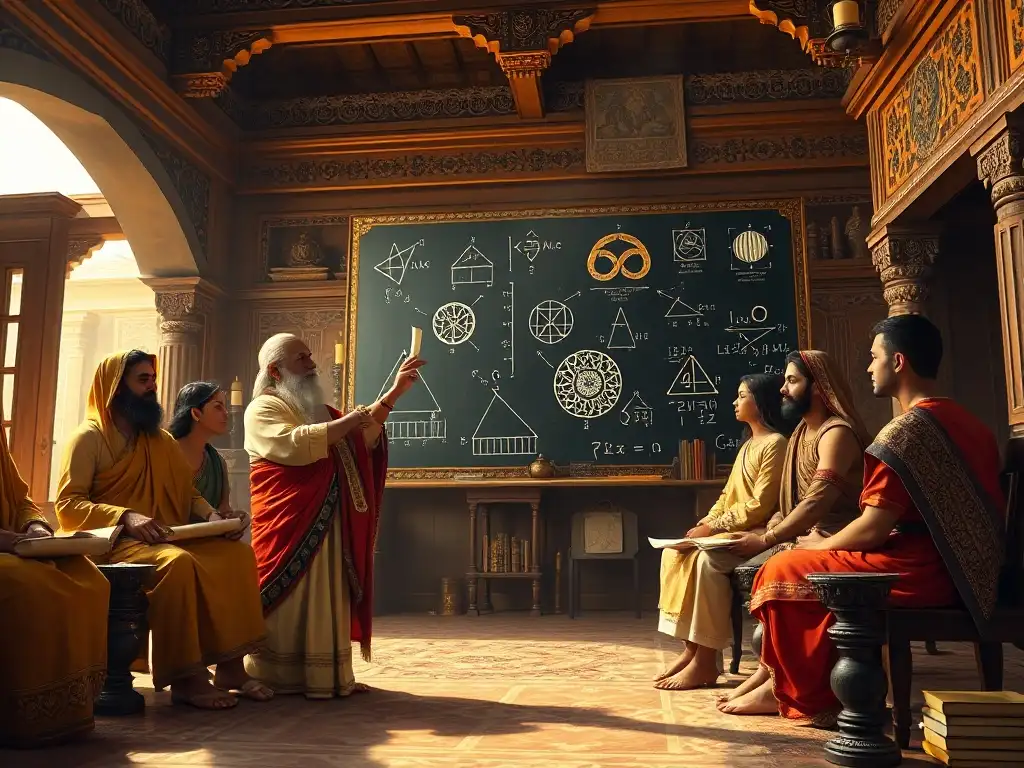
Ancient Indian mathematicians and philosophers laid the groundwork for understanding the concept of infinity, blending mathematical reasoning with profound philosophical inquiry. This dual approach provided a rich framework for exploring infinity, which was not merely a mathematical abstraction but also a metaphysical concept. By intertwining mathematics and philosophy, ancient Indian thinkers examined infinity through various lenses, leading to significant advancements in both fields.
The Intersection of Mathematics and Philosophy
In ancient India, mathematics was deeply interwoven with philosophical thought. The mathematicians of the time, such as Aryabhata and Brahmagupta, did not merely seek numerical solutions; they pondered the implications of numbers and their relationships to the universe. This philosophical inquiry is particularly evident in their approach to infinity.
- Mathematics as a Reflective Discipline:
- Ancient Indian mathematicians regarded mathematics as a reflective discipline, where numerical calculations were a means to understand the cosmos.
- They utilized mathematical constructs to explore concepts such as space, time, and the nature of reality.
- Philosophical Texts and Mathematical Concepts:
- Texts like the Aryabhatiya and Brahmasphutasiddhanta reveal how mathematicians considered infinity in the context of philosophical discourses.
- The concept of ananta (endlessness) was explored in various philosophical schools, including Nyaya and Vedanta.
- Numerical Representation of Infinity:
- Ancient Indian mathematicians employed a variety of symbols and methods to represent infinity, such as the use of the term infinity itself and the concept of zero.
- The introduction of zero as a placeholder was revolutionary, allowing mathematicians to express infinite processes and quantities.
How Ancient Indian Philosophers Viewed Infinity
The ancient Indian perspective on infinity encompassed both mathematical and metaphysical dimensions, leading to a unique understanding of the concept.
- Infinity in Cosmology:
- Philosophers viewed infinity as a fundamental aspect of the universe, influencing their cosmological theories.
- The idea that the universe is infinite in extent and time was a prevalent theme in ancient texts, echoing the notion of an eternal cosmos.
- Mathematical Practices:
- The mathematical treatment of infinity involved practices such as the calculation of limits, which laid the groundwork for later developments in calculus.
- Ancient Indian mathematicians explored infinite series and geometric progressions, revealing their intuitive grasp of infinitesimal quantities.
- Philosophical Dialogues:
- Dialogue between different philosophical schools enriched the understanding of infinity. For instance, the contrast between the Advaita (non-dualism) and Dvaita (dualism) schools provided diverse interpretations of infinite realities.
- These debates often touched upon the implications of infinity for understanding the self and the cosmos.
The engagement of ancient Indian mathematicians with the concept of infinity reflects a profound philosophical inquiry that transcends mere numerical calculations. Their contributions not only enriched mathematics but also laid the foundations for future explorations of infinity in both mathematical and philosophical contexts.
Mathematical Texts and Their Role in Understanding Infinity
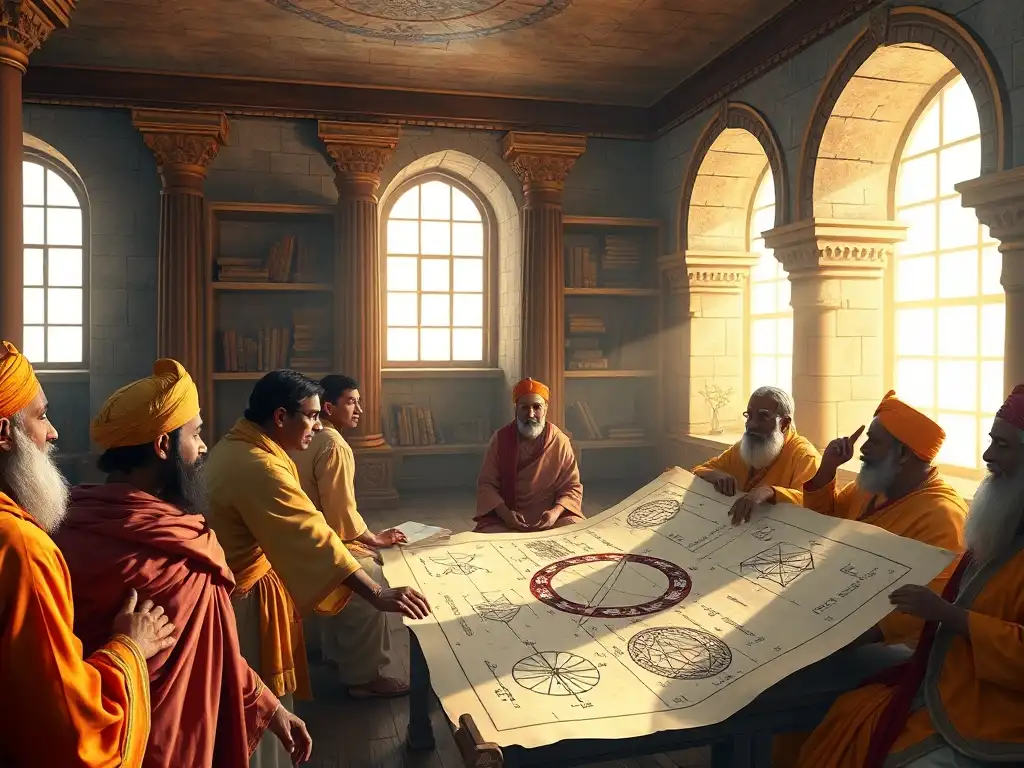
Key Texts on Ancient Indian Mathematics
Ancient Indian mathematicians made significant contributions to the field of mathematics, particularly in the understanding and development of the concept of infinity. Several key texts from this period elucidate these ideas, showcasing the advanced mathematical thought that emerged in India. Below are some of the most influential works that shaped the discourse on infinity:
- The Aryabhatiya by Aryabhata
- Brahmasphutasiddhanta by Brahmagupta
- Lilavati by Bhaskara I
These texts not only explore arithmetic and geometry but also delve into concepts that approach infinity, demonstrating a sophisticated understanding of numbers and their properties.
The Aryabhatiya and Its Influence
Composed in 499 CE, The Aryabhatiya is one of the earliest and most significant mathematical texts from ancient India. Aryabhata introduced the concept of zero as a placeholder, which is fundamental to the development of mathematics as we know it today.
In this text, Aryabhata discusses various mathematical operations, including arithmetic, algebra, and geometry. Notably, he presents concepts that hint at the infinity in mathematics, such as:
- Infinite Series: Aryabhata's work includes methods for generating infinite series, indicating an understanding of approaching limits.
- Cyclic Calculations: His methods for calculating the areas of circles and volumes of spheres reflect an early grasp of infinitesimal calculus.
Aryabhata's influence extended far beyond his lifetime, as his concepts were adopted and further developed by later mathematicians, laying the groundwork for more complex ideas surrounding infinity.
Brahmagupta's Brahmasphutasiddhanta and Concepts of Infinity
Written in 628 CE, Brahmagupta's Brahmasphutasiddhanta is another cornerstone of ancient Indian mathematics. This text expands upon Aryabhata's ideas and introduces new concepts, particularly in the realm of arithmetic and algebra. Brahmagupta is often credited with formalizing rules for arithmetic operations involving zero and negative numbers.
Key contributions relating to the concept of infinity in his work include:
- Division by Zero: Brahmagupta explored the implications of division by zero, an operation that leads to discussions on infinite values. He stated that dividing a number by zero yields an infinite quantity, a groundbreaking idea for his time.
- Equations and Their Solutions: Brahmagupta's methodologies for solving quadratic equations often involved considering infinite solutions, showcasing his understanding of the concept beyond mere integers.
- Philosophical Insights: He also delves into the philosophical aspects of infinity, discussing the infinite nature of the universe and mathematical truths.
Both The Aryabhatiya and Brahmasphutasiddhanta are pivotal texts that reflect the advanced mathematical thought of ancient Indian mathematicians, profoundly influencing mathematical concepts such as infinity. They not only laid the foundation for future generations but also contributed to the global mathematical landscape, highlighting the rich intellectual tradition of ancient India.
The Legacy of Ancient Indian Mathematicians on Infinity

The legacy of ancient Indian mathematicians in developing the concept of infinity is profound and far-reaching. Their work laid the groundwork for mathematical ideas that would later influence scholars around the globe. The concept of infinity, or ananta in Sanskrit, was not merely a philosophical notion but a mathematical entity that early Indian mathematicians explored rigorously.
These scholars, particularly during the period from the 5th century CE onwards, began to articulate complex ideas about infinity that would later resonate in the works of mathematicians worldwide. Notable figures such as Brahmagupta, Bhaskara I, and Bhaskara II contributed significantly to this discourse. Their insights into the nature of numbers, including the realization that numbers could extend infinitely in both directions, were revolutionary.
Impact on Global Mathematics
The influence of ancient Indian mathematicians on the global understanding of infinity can be traced through several key contributions:
- Zero as a Placeholder: The introduction of zero (0) by ancient Indian mathematicians provided a crucial stepping stone in the comprehension of numerical systems. This concept allowed for the representation of infinitely large and infinitely small numbers, changing the landscape of mathematics.
- Negative Numbers: The acceptance of negative numbers in calculations also paved the way for a better understanding of infinity. Ancient Indian texts documented rules for their use, which contributed to more complex mathematical models and theories.
- Infinite Series: Mathematicians like Madhava of Sangamagrama in the 14th century began to explore infinite series, particularly in trigonometry. His work on the Taylor series is considered one of the earliest instances of infinite series being applied, laying the groundwork for calculus.
- Contributions to Geometry: The ideas surrounding infinite geometric series were explored by Aryabhata in the 5th century, wherein he demonstrated how to calculate the area of a circle and the volume of a sphere. His formulas implicitly assumed concepts of limits and infinitesimals.
These contributions, disseminated through trade and cultural exchanges, eventually reached Europe, where they influenced the Renaissance and the development of modern mathematics. The understanding of infinity became a crucial aspect of mathematical theories, leading to advancements in calculus and set theory.
Continuing Influence of Ancient Indian Concepts of Infinity
The impact of ancient Indian concepts of infinity continues to be felt in contemporary mathematics and philosophy. Several areas reflect this enduring legacy:
- Mathematical Theory: The exploration of infinite sets and their properties in modern set theory can trace its roots back to the pioneering work of ancient Indian mathematicians. Concepts such as cardinality and ordinality find their philosophical underpinnings in ancient Indian texts.
- Philosophical Interpretations: The philosophical inquiry into the nature of infinity, as articulated in texts like the Yoga Sutras, provides a broader context for understanding infinity beyond mathematics. This duality of mathematical and philosophical interpretations enriches the study of infinity in both fields.
- Cultural Resonance: Ancient Indian concepts of infinity resonate in various cultural narratives and teachings, influencing modern thought in areas like cosmology and theology. The idea of an infinite universe, as discussed in ancient texts, finds parallels in contemporary scientific discourse.
- Educational Frameworks: The inclusion of historical mathematical concepts in educational curricula helps students appreciate the rich heritage of mathematics. Understanding the roots of infinity in ancient Indian mathematics fosters a deeper appreciation for the subject and encourages critical thinking.
The legacy of ancient Indian mathematicians in developing the concept of infinity is not just a chapter in history but a vibrant thread woven into the fabric of modern mathematics and philosophy. Their insights continue to inspire and challenge our understanding of infinity, proving that their contributions transcend time and culture.
Conclusion

Summary of Contributions of Ancient Indian Mathematicians to the Concept of Infinity
Ancient Indian mathematicians made groundbreaking contributions to the concept of infinity, laying the groundwork for modern mathematical thought. Notable among these mathematicians were Brahmagupta and Bhaskara II, whose works in the 7th and 12th centuries, respectively, showcased their understanding of infinite processes and quantities.
- Brahmagupta introduced the idea of zero as a number and explored operations involving it. His seminal text, Brahmasphutasiddhanta, included rules for arithmetic operations with zero and negative numbers, leading to deeper discussions about infinity.
- Bhaskara II, in his work Lilavati, addressed the concept of infinity through the lens of cyclic numbers and infinite series. He emphasized the importance of infinity in calculations, particularly in the context of astronomical calculations.
Their exploration of series and limits can be seen as early steps towards formalizing the concept of infinity. They recognized that numbers could extend indefinitely and formulated rules regarding the behavior of infinite quantities. Additionally, the concept of infinite sequences was discussed, illustrating a sophisticated understanding that predated similar developments in Europe by several centuries.
The Lasting Importance of Understanding Infinity in Mathematics
The contributions of ancient Indian mathematicians to the concept of infinity have had a profound and lasting impact on the field of mathematics. Their insights not only advanced mathematical theory but also influenced various other fields, including astronomy, physics, and philosophy.
- Foundation for Calculus: The understanding of infinity paved the way for the development of calculus in the 17th century. The concepts of limits and infinite series, essential to calculus, can trace their roots back to the ideas put forth by Indian mathematicians.
- Philosophical Implications: The exploration of infinity also raised philosophical questions about the nature of numbers and reality. These discussions were integral to the evolution of mathematical thought, influencing both Eastern and Western philosophies.
- Modern Mathematics: In contemporary mathematics, the concept of infinity is crucial in various branches, including set theory, topology, and mathematical analysis. The legacy of ancient Indian mathematicians continues to resonate in the way infinity is approached and understood today.
The pioneering work of ancient Indian mathematicians on infinity not only reshaped their own cultural context but also laid a robust foundation for future generations, influencing the trajectory of mathematics worldwide. Their contributions serve as a reminder of the rich history of mathematical thought and its evolution through diverse civilizations.
References
Notable Sources on Ancient Indian Mathematicians and Infinity
The contributions of ancient Indian mathematicians to the concept of infinity are well-documented in various scholarly works. Here are some notable sources that delve into this significant topic:
-
"The History of Mathematics: A Brief Course" by Roger L. Cooke
This comprehensive text offers insights into the development of mathematical concepts across cultures, including the pioneering ideas of ancient Indian mathematicians.
-
"Mathematics in India" by Kim Plofker
Plofker's research highlights the evolution of mathematics in India, presenting detailed accounts of mathematicians like Aryabhata and Brahmagupta, who explored concepts related to infinity.
-
"Infinity and the Mind: The Science and Philosophy of the Infinite" by Rudy Rucker
While not solely focused on ancient India, this book provides a broader philosophical context for understanding infinity, including references to the contributions of Indian mathematicians.
-
"The Mathematics of India: History and Development" by G. N. Srinivas
This work examines the historical progression of mathematics in India, specifically addressing how ancient scholars approached the idea of infinity.
Suggested Further Reading on Ancient Indian Mathematical Concepts
To gain a deeper understanding of ancient Indian mathematical concepts, including infinity, consider exploring the following resources:
-
"The Legacy of Indian Mathematics" by C. V. Rajagopal
This text discusses various mathematical ideas originating from ancient India, including calculations involving zero and infinity.
-
"A History of Indian Mathematics" by B. R. Ramesh
Ramesh provides an extensive overview of Indian mathematics, elaborating on key concepts and their implications for modern mathematics.
-
"Zero: The Biography of a Dangerous Idea" by Charles Seife
This book provides historical context for the development of zero and its connection to infinity, highlighting the contributions of Indian mathematicians.
-
"Mathematics and the Imagination" by Edward Kasner and James Newman
Although focusing on broader mathematical ideas, this book references ancient Indian perspectives on infinity, enriching the reader's understanding of the subject.
-
Research Articles and Journals
Academic journals such as the Indian Journal of History of Science often publish articles that discuss ancient Indian mathematics and its philosophies, including the concept of infinity.
By diving into these sources, readers will be equipped with a comprehensive understanding of how ancient Indian mathematicians approached and developed the concept of infinity, showcasing their significant contributions to the field of mathematics.
Frequently Asked Questions
What is the significance of ancient Indian mathematicians in the concept of infinity?
Ancient Indian mathematicians played a crucial role in developing the concept of infinity, providing foundational ideas that influenced later mathematical thought.
Which ancient Indian text first introduced the concept of infinity?
The concept of infinity was notably introduced in the Aryabhatiya, written by Aryabhata in the 5th century, where he discussed infinite numbers and their implications.
How did ancient Indian mathematicians approach calculations involving infinity?
They used sophisticated methods and symbolic representations to handle calculations involving infinity, often incorporating it into their astronomical and mathematical theories.
Who were some key figures among ancient Indian mathematicians?
Apart from Aryabhata, other key figures include Brahmagupta and Bhaskara, who made significant contributions to number theory and the concept of zero in relation to infinity.
How did the concept of infinity in ancient India influence modern mathematics?
The ancient Indian understanding of infinity laid the groundwork for later developments in calculus and set theory, demonstrating its enduring impact on mathematics today.
Final Reflection: Embracing the Infinite Wisdom of Ancient Indian Mathematicians
The exploration of infinity by ancient Indian mathematicians remains profoundly relevant today, as it challenges our understanding of mathematics and the universe. Their groundbreaking work not only laid the foundation for modern mathematical concepts but also invites us to ponder the limitless possibilities that lie ahead. In a world increasingly defined by boundaries, the idea of infinity serves as a reminder that there is always more to discover, more to learn, and more to achieve.
Cultural and social landscapes have been significantly shaped by the insights of these mathematicians, whose contributions extend far beyond numbers and equations. Their work has inspired generations of thinkers, artists, and innovators, fostering a spirit of inquiry and creativity. Mathematics knows no races or geographic boundaries; for mathematics, the cultural world is one country.
This quote encapsulates the universal nature of mathematical exploration, emphasizing how the legacy of ancient Indian mathematicians transcends time and space, continuing to influence diverse fields and cultures around the globe.
As we reflect on the profound impact of these ancient thinkers, let us carry their lessons into our own lives. Consider how the concept of infinity can inspire you to break free from limitations and embrace a mindset of endless possibilities. Whether in your personal pursuits, professional endeavors, or creative expressions, challenge yourself to think beyond the finite and explore the infinite potential within you. The journey of discovery is ongoing, and like the mathematicians of ancient India, we too can contribute to the ever-expanding tapestry of knowledge and understanding.
Unveil the Infinite Wisdom of Ancient Mathematicians!
Thank you for delving into the fascinating world of ancient Indian mathematics with us! You've uncovered the remarkable contributions that shaped the concept of infinity, and now it's time to put this knowledge into action.
Here are some exciting ways you can explore further and embrace this rich legacy:
- Dive deeper into ancient texts: Find and read translations of works by **Brahmagupta** and **Bhaskara** to experience their brilliance firsthand.
- Join our community: Share your insights or questions on our forum, and connect with fellow enthusiasts who share your passion for ancient mathematics.
- Create a living history project: Experiment with mathematics inspired by ancient techniques or write an article about your findings to share with others!
What aspect of ancient Indian mathematics would you like to explore next, and how do you think it influences our understanding of mathematics today?