
From Aryabhata to Brahmagupta: The Mathematicians Who Advanced Zero

Welcome to Ancient India History, your gateway to uncovering the rich tapestry of India's past! Here, we delve into the intriguing contributions of ancient Indian mathematicians, who not only advanced the concept of zero but also laid the groundwork for modern mathematics. In our featured article, "From Aryabhata to Brahmagupta: The Mathematicians Who Advanced Zero," you'll discover how these brilliant minds transformed mathematical thought and influenced civilizations worldwide. Join us on this captivating journey and unlock the secrets behind the numerical wonders that shaped our world!
- Introduction to Ancient Indian Mathematicians Contributions
- Aryabhata: The Pioneer of Mathematics
- Brahmagupta: The Mathematician Who Expanded the Concept of Zero
- The Transition from Aryabhata to Brahmagupta
- Other Notable Ancient Indian Mathematicians and Their Contributions
- Conclusion: The Lasting Impact of Ancient Indian Mathematicians Contributions
-
Frequently Asked Questions
- What are the major contributions of ancient Indian mathematicians?
- Who was Aryabhata and what was his impact on mathematics?
- How did Brahmagupta contribute to the understanding of zero?
- What role did the Indus Valley civilization play in early mathematics?
- How did ancient Indian mathematicians influence later cultures?
- Final Reflection: The Enduring Legacy of Ancient Indian Mathematicians
- Embrace the Power of Zero: Take Action Today!
Introduction to Ancient Indian Mathematicians Contributions
The history of mathematics is a tapestry woven with the contributions of brilliant minds from diverse cultures. Among these, ancient Indian mathematicians stand out for their groundbreaking work, particularly in the conceptualization and application of zero. The journey of zero from a mere placeholder to a fundamental element in mathematics is a testament to the innovative spirit of ancient Indian scholars.
This article delves into the contributions of renowned mathematicians such as Aryabhata and Brahmagupta, exploring how their insights and discoveries laid the groundwork for modern mathematics. By examining their writings and philosophies, we can appreciate the profound impact of these ancient thinkers on the mathematical world, emphasizing their role in innovating and advancing the concept of zero.
Overview of the Importance of Zero in Mathematics
Zero is not just a number; it is a concept that revolutionized mathematics. It serves multiple crucial roles, such as:
- Placeholder: In positional numeral systems, zero allows for the differentiation between numbers like 10 and 100.
- Identity Element: In addition, zero acts as the identity element, meaning that adding zero to any number does not change its value.
- Facilitator of Operations: It enables the formulation of various mathematical operations, including algebra, calculus, and beyond.
The introduction of zero into mathematical systems allowed for more complex calculations, paving the way for advancements in science, engineering, and economics. The ancient Indian mathematicians were pivotal in this development, as they not only conceptualized zero but also established its symbolic representation, which became foundational for subsequent mathematicians worldwide.
Significance of Ancient Indian Mathematicians in Advancing Zero
The ancient Indian mathematicians made remarkable strides in the understanding and utilization of zero, with notable figures including Aryabhata and Brahmagupta:
- Aryabhata (476–550 CE):
- He is often credited with the earliest known use of zero as a placeholder in calculations. His seminal work, the Aryabhatiya, introduced mathematical concepts that included the systematic use of zero in the decimal numeral system.
- Brahmagupta (598–668 CE):
- Brahmagupta further developed the concept of zero in his work Brahmasphutasiddhanta. He defined rules for arithmetic operations involving zero, such as the result of subtracting a number from itself being zero, which was groundbreaking for his time.
These mathematicians not only advanced the understanding of zero but also influenced mathematical thought across cultures. Their contributions laid the foundation for future developments in mathematics, demonstrating the profound legacy of ancient Indian scholars in shaping the numerical systems we rely on today.
Aryabhata: The Pioneer of Mathematics
Aryabhata's Early Life and Education
Aryabhata was born in 476 CE in Kusumapura, which is believed to be modern-day Patna, Bihar. He demonstrated exceptional intellectual abilities from a young age, leading him to pursue studies in mathematics and astronomy. His education likely took place in renowned centers of learning like Nalanda, where he would have been exposed to the rich mathematical traditions of his time.
Aryabhata's works began to gain recognition as he delved deeply into the principles of mathematics and astronomy. His most famous text, the Aryabhatiya, was composed when he was just 23 years old, marking a significant milestone in the history of mathematics. In this text, he provided insights not only into arithmetic but also into astronomy and the calculation of time, showcasing his extensive knowledge and innovative thinking.
Contributions of Aryabhata to Mathematics
Aryabhata's contributions to mathematics were groundbreaking and laid the foundation for future mathematicians. His work introduced several concepts that would have a lasting impact on the field.
Introduction of the Concept of Zero
One of Aryabhata's most significant contributions is the early concept of zero. While the symbol for zero (0) had not yet been universally adopted, Aryabhata recognized the importance of a placeholder in the positional numeral system. In his calculations, he utilized a method that indicated the absence of a value, which is a precursor to the modern understanding of zero. This concept allowed for the representation of large numbers and facilitated the development of algebraic expressions.
Aryabhata's approach to zero was revolutionary as it enabled mathematicians to perform calculations more efficiently. The ability to denote an empty place in a number was crucial for the advancement of arithmetic and paved the way for more complex mathematical operations.
Innovations in Number Systems
Beyond the concept of zero, Aryabhata made notable innovations in number systems. He introduced the use of the decimal system, which organizes numbers based on powers of ten. This system is not only intuitive but also simplifies calculations, making it more accessible for further mathematical exploration.
Aryabhata's work also included methods for calculating squares and cubes of numbers, as well as rules for operations like addition, subtraction, multiplication, and division. His systematic approach to mathematics established a framework that later mathematicians would build upon.
Furthermore, Aryabhata's contributions extended into trigonometry, where he developed sine tables and established relationships between angles and their sine values. This advancement is critical for astronomical calculations, demonstrating the interconnection between mathematics and astronomy in ancient Indian scholarship.
Aryabhata's contributions to mathematics were profound, particularly through his introduction of the concept of zero and his innovations in number systems. His pioneering work set the stage for future developments in mathematics, highlighting the significant role of ancient Indian mathematicians in shaping the field.
Influence of Aryabhata on Subsequent Mathematicians
Aryabhata, often hailed as one of the greatest mathematicians and astronomers of ancient India, left an indelible mark on the field of mathematics that influenced generations of scholars and mathematicians across the globe. His seminal works, particularly the Aryabhatiya, not only laid the foundation for mathematical thought in India but also served as a catalyst for advancements in mathematical concepts and techniques in later periods.
One of Aryabhata’s most notable contributions was his introduction of the place-value system and the concept of zero, which revolutionized mathematics. This innovation enabled subsequent mathematicians to perform complex calculations with greater ease and accuracy. The significance of zero as a placeholder was particularly emphasized in Aryabhata's work, which set the stage for later scholars to explore its implications further.
His influence can be seen in the works of later mathematicians like Brahmagupta and Bhaskara I, who built upon Aryabhata’s theories and expanded mathematical knowledge. For instance, Brahmagupta, who lived in the 7th century, referenced Aryabhata in his own writings and adopted his methods for solving quadratic equations. He also introduced rules for arithmetic operations involving zero, directly influenced by Aryabhata's foundational concepts.
Aryabhata's impact extended beyond India, reaching the Islamic Golden Age, where scholars translated his works and incorporated his teachings into their own mathematical frameworks. The famous Persian mathematician Al-Khwarizmi, known for his contributions to algebra, was indirectly influenced by Aryabhata’s ideas on arithmetic and geometry, which helped shape the mathematical landscape of the medieval world.
Furthermore, Aryabhata's astronomical calculations and propositions regarding the rotation of the Earth and the movement of celestial bodies laid the groundwork for future astronomical studies. His sophisticated methods of calculation and problem-solving became integral to the works of later astronomers such as Varahamihira and Bhaskara II.
Aryabhata’s influence on subsequent mathematicians is profound and multifaceted. His pioneering ideas and innovations not only advanced the field of mathematics in ancient India but also contributed to a broader understanding of mathematical concepts that resonated throughout various cultures and time periods. The legacy of Aryabhata continues to inspire mathematicians today, underscoring the timelessness of his contributions to the world of mathematics.
Brahmagupta: The Mathematician Who Expanded the Concept of Zero
Brahmagupta's Background and Historical Context
Brahmagupta, born in 598 CE in the region of present-day Rajasthan, India, is one of the most influential ancient Indian mathematicians. He lived during a time when the Gupta Empire was flourishing, characterized by advancements in science, mathematics, and astronomy. Brahmagupta's work was pivotal in shaping mathematical thought, particularly in his treatment of zero and its operations.
His seminal text, Brahmasphutasiddhanta, written in 628 CE, is considered one of the earliest detailed expositions of arithmetic and algebra. Brahmagupta's contributions are not only significant in the context of Indian mathematics but have also had a lasting impact on the global mathematical landscape. His incorporation of zero as a number and the rules governing its operations laid foundational principles that would influence mathematicians for centuries to come.
Key Contributions of Brahmagupta to Mathematics
Brahmagupta's work is extensive, covering a range of mathematical concepts. His contributions can be categorized into several key areas:
- Arithmetic Operations: Brahmagupta established rules for arithmetic involving zero and negative numbers.
- Algebra: He made significant strides in solving equations, particularly quadratic equations.
- Geometry: His texts included methods for calculating areas and volumes.
- Astronomy: Brahmagupta's astronomical calculations utilized his mathematical innovations.
Rules for Arithmetic Operations Involving Zero
One of Brahmagupta's landmark contributions was the formulation of rules for arithmetic operations involving zero. He outlined these rules in his text, which can be summarized as follows:
- Addition and Subtraction:
- \( a + 0 = a \)
- \( a - 0 = a \)
- \( 0 + a = a \)
- \( 0 - a = -a \)
- Multiplication:
- \( a \times 0 = 0 \)
- \( 0 \times a = 0 \)
- Division:
- \( \frac{a}{0} \) is considered undefined.
- \( \frac{0}{a} = 0 \) (for \( a \neq 0 \))
Brahmagupta's formulation of these rules was revolutionary for his time, as it provided a systematic approach to handling calculations involving zero, which was previously a concept shrouded in ambiguity.
Brahmagupta's Solutions to Quadratic Equations
Brahmagupta made significant contributions to the field of algebra, particularly in solving quadratic equations. He established a systematic method for solving equations of the form:
\[ ax^2 + bx + c = 0 \]
His methods included:
- The use of the quadratic formula: Brahmagupta provided a formula that can solve any quadratic equation based on the coefficients \( a \), \( b \), and \( c \).
- Geometric interpretation: He often illustrated the solutions using geometric representations, linking algebra with geometry.
- Positive and Negative Solutions: Brahmagupta recognized the importance of both positive and negative roots, expanding the understanding of solutions in algebra.
These advancements were crucial, as they not only highlighted the importance of quadratic equations in mathematics but also set the groundwork for future mathematicians to explore and expand upon. Brahmagupta's work signifies a pivotal moment in the history of mathematics, where the principles of algebra began to take a more structured form.
Legacy of Brahmagupta in the Development of Zero
Brahmagupta, an eminent mathematician and astronomer of ancient India, made significant contributions to the development of the concept of zero. His work, particularly in his seminal text Brahmasphutasiddhanta, laid the groundwork for mathematical concepts that are still fundamental in mathematics today. Here’s a closer look at his legacy regarding zero:
-
Formal Definition of Zero
Brahmagupta was one of the first mathematicians to provide a formal definition of zero. He described zero as a number that represents the absence of quantity, a crucial innovation that allowed for the expansion of mathematical operations. This definition distinguished zero from mere absence, enabling mathematicians to treat it as a number that could be manipulated in calculations, thus paving the way for future mathematical advancements.
-
Rules for Arithmetic Involving Zero
In his writings, Brahmagupta established rules for arithmetic operations involving zero. He outlined how zero interacts with other numbers in addition, subtraction, multiplication, and division. For instance, he noted that adding zero to a number does not change its value, while subtracting a number from itself results in zero. These foundational rules facilitated the understanding of zero in arithmetic, allowing it to be integrated into mathematical equations and operations.
-
Contribution to Algebra
Brahmagupta's work extended beyond the mere definition of zero; he applied it within the realm of algebra. He introduced methods for solving quadratic equations and emphasized the role of zero in these equations. His approach to quadratic equations, particularly those yielding zero as a solution, exemplified the practical applications of zero in algebraic contexts. This innovative use of zero in solving equations significantly influenced later mathematicians, both in India and beyond.
-
Cultural and Historical Impact
Brahmagupta’s contributions to the understanding of zero were not limited to mathematics alone; they had a substantial cultural impact. His works were studied and translated in various cultures, influencing Islamic mathematicians during the Golden Age of Islam. The transmission of his ideas helped solidify the position of zero as a critical element in the global mathematical lexicon, ultimately leading to its adoption in Western mathematics.
-
Influence on Successors
The principles laid out by Brahmagupta served as a foundation for later mathematicians, such as Bhaskara I and II, who further refined the concepts of zero and negative numbers. His legacy can be seen in the works of successors who expanded upon his ideas, leading to a richer understanding of mathematics that incorporated zero as an essential component.
Brahmagupta’s legacy in the development of zero is profound and far-reaching. His formal definition, operational rules, and applications in algebra not only shaped the mathematical landscape of ancient India but also influenced the progression of mathematics across cultures. The integration of zero into mathematical frameworks owes much to his pioneering work, marking him as a pivotal figure in the history of mathematics.
The Transition from Aryabhata to Brahmagupta
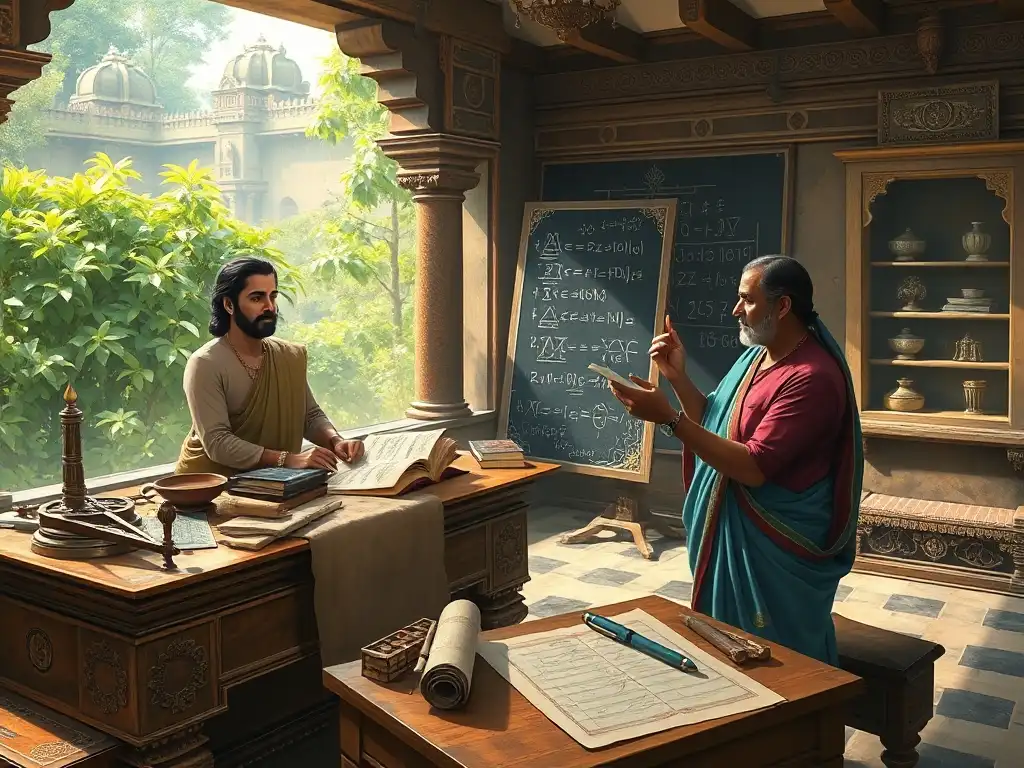
The transition from Aryabhata to Brahmagupta marks a significant evolution in ancient Indian mathematics, particularly in the context of the understanding and application of zero. Aryabhata, who lived around 476-550 CE, is often celebrated for his revolutionary concepts in mathematics and astronomy. His seminal work, the "Aryabhatiya," laid foundational principles that influenced later mathematicians, including Brahmagupta, who flourished in the 7th century CE.
The Evolution of Mathematical Thought in Ancient India
The mathematical thought in ancient India underwent a remarkable transformation during the period between Aryabhata and Brahmagupta. Aryabhata's contributions included:
- Place Value System: Aryabhata introduced a positional number system that allowed for the representation of large numbers efficiently. This system was crucial for the development of arithmetic operations.
- The Concept of Zero: While Aryabhata did not explicitly define zero, he utilized a place holder for calculations, which laid the groundwork for the symbolization and formalization of zero in later mathematics.
Brahmagupta, in contrast, expanded on Aryabhata's ideas and brought further clarity and development to the use of zero and negative numbers. His major work, "Brahmasphutasiddhanta," established rules for arithmetic operations involving zero, making it one of the earliest texts to do so. Some key aspects of Brahmagupta's contributions include:
- Rules for Zero: He defined zero as a number and provided specific rules for arithmetic operations involving zero, such as:
- \( a + 0 = a \)
- \( a - 0 = a \)
- \( 0 - a = -a \)
- Negative Numbers: Brahmagupta also introduced rules for operations with negative numbers, which was a significant advancement in mathematical thought.
This evolution signifies a transition from a rudimentary understanding of numbers to a more sophisticated mathematical framework that could handle complex calculations effectively.
How Aryabhata's and Brahmagupta's Ideas Interconnect
The interconnection between Aryabhata's and Brahmagupta's mathematical philosophies can be traced through their shared principles and divergent developments. While Aryabhata focused on astronomical calculations and introduced innovative techniques, Brahmagupta refined these ideas and made them more applicable to a broader range of mathematical problems.
- Influence of Aryabhata: Brahmagupta acknowledged Aryabhata's work and drew from it, particularly in the fields of astronomy and mathematics. For example, Aryabhata's methods for calculating the circumference of the Earth and the value of π influenced Brahmagupta's astronomical calculations.
- Advancement of Concepts: Brahmagupta expanded the use of zero that Aryabhata had hinted at by formalizing its arithmetic properties, thus allowing for operations that were previously not possible. This development was crucial for the evolution of algebra and further mathematical endeavors.
The intellectual lineage from Aryabhata to Brahmagupta showcases a continuum of thought where each mathematician built upon the foundations laid by the predecessor, illustrating the collaborative nature of knowledge production in ancient India.
The Role of Cultural and Scientific Exchange in Advancing Mathematics
The advancements in mathematics during the era of Aryabhata and Brahmagupta were not solely products of individual genius but were significantly influenced by cultural and scientific exchanges. Ancient India was a hub of trade and scholarship, where ideas transcended geographical boundaries.
- Cross-Pollination of Ideas: The interaction with other cultures, particularly through trade routes established by the Silk Road, facilitated the exchange of mathematical concepts. This exchange allowed Indian mathematicians to incorporate and adapt ideas from Greek, Persian, and Babylonian mathematics, leading to a richer mathematical tradition.
- Translation of Texts: The translation of mathematical texts and theories from various cultures played an essential role in the dissemination of knowledge. Indian scholars translated and interpreted works from other civilizations, further enhancing their understanding and innovation in mathematics.
- Cultural Patronage: The patronage of mathematics by various Indian kingdoms encouraged scholars to pursue research and share their findings. This environment fostered collaboration and led to significant advancements in mathematical thought.
The contributions of ancient Indian mathematicians such as Aryabhata and Brahmagupta not only advanced the concept of zero but also exemplified how cultural exchanges and a collaborative spirit fostered the growth of mathematics in ancient India. Their legacies continue to influence modern mathematics, demonstrating the timeless nature of their contributions.
Other Notable Ancient Indian Mathematicians and Their Contributions

Bhaskara I and His Mathematical Innovations
Bhaskara I, an influential mathematician of the 7th century, made significant contributions to the field of mathematics, particularly in trigonometry and number systems. He is best known for his works that laid foundational principles for later mathematicians, including the famous Bhaskara II. His most notable work, the "Lilavati," focused on arithmetic and number theory, serving as a practical guide for problem-solving.
One of Bhaskara I's major innovations was the introduction of the decimal system and the concept of place value, which were essential for the development of arithmetic operations. He developed methods for calculating the sine of angles, presenting tables of sines that greatly aided in astronomical calculations. His work not only advanced mathematical thought in India but also facilitated later developments in Islamic and European mathematics.
In addition to his mathematical theories, Bhaskara I was known for his commentary on Aryabhata's works, which played a crucial role in preserving and interpreting ancient mathematical knowledge. His emphasis on methodical problem-solving paved the way for future mathematicians to explore the depths of arithmetic and geometry.
Bhaskara II: A Continuation of the Zero Legacy
Bhaskara II, also known as Bhaskara Acharya, was a remarkable mathematician and astronomer who lived in the 12th century. His contributions built upon the groundwork laid by earlier mathematicians, particularly in the realm of zero and its applications. His seminal work, "Siddhanta Shiromani," is divided into two parts: "Lilavati," which focuses on arithmetic, and "Bijaganita," which deals with algebra.
The "Lilavati" not only elaborates on the concept of zero but also explains its operational significance in various mathematical problems. Bhaskara II demonstrated how zero functions as a placeholder and its critical role in simplifying calculations. He introduced practical applications of zero in solving quadratic equations, showcasing its versatility in algebra.
In "Bijaganita," Bhaskara II further explored the properties of zero in relation to negative numbers and provided solutions to complex algebraic equations. His innovative approach to mathematics inspired subsequent scholars in India and beyond, solidifying the importance of zero as a foundational element in mathematical operations.
The Influence of Ancient Indian Mathematicians on Global Mathematics
The contributions of ancient Indian mathematicians, particularly in the context of zero, resonated far beyond the Indian subcontinent. Their innovative approaches and discoveries laid the groundwork for significant advancements in global mathematics.
The introduction of zero as a numeral was revolutionary, allowing for the development of modern arithmetic and calculus. Ancient Indian mathematicians' works were translated into Arabic, which became a vital link in transferring mathematical knowledge to Europe during the Middle Ages. This cross-cultural exchange significantly influenced the European Renaissance, marking a turning point in mathematical thought.
Furthermore, the advancements in trigonometry and algebra by mathematicians such as Bhaskara I and II were instrumental in shaping mathematical practices across various cultures. Their methods for solving equations and understanding numerical relationships provided essential frameworks for later mathematicians, including those in the Islamic Golden Age and the European mathematical tradition.
The legacy of ancient Indian mathematicians, particularly their innovative contributions to the concept of zero and its applications, remains a cornerstone in the history of mathematics, highlighting the global significance of Indian intellectual contributions throughout history.
Conclusion: The Lasting Impact of Ancient Indian Mathematicians Contributions

The contributions of ancient Indian mathematicians, particularly in the development of the concept of zero, have had profound and lasting effects on mathematics and the sciences. The philosophical and practical implications of zero not only transformed mathematical thought in India but also paved the way for advancements in mathematics globally. This section aims to encapsulate the essence of these contributions and their enduring significance.
Summary of Key Contributions to the Concept of Zero
Ancient Indian mathematicians played a pivotal role in the conceptualization and formalization of zero. Key figures such as Aryabhata, Brahmagupta, and Bhaskara II contributed significantly to this evolution:
- Aryabhata (476–550 CE): He is often credited with introducing the place value system, where zero serves as a placeholder, allowing for the representation of large numbers and more complex calculations.
- Brahmagupta (598–668 CE): In his seminal work, Brahmasphutasiddhanta, he defined zero as a number and established rules for arithmetic involving zero. His insights included operations such as addition and subtraction with zero, highlighting its unique properties.
- Bhaskara II (1114–1185 CE): His works further developed the use of zero in calculations and emphasized its importance in solving equations. He also made significant strides in algebra, where zero played a crucial role in his formulas.
The contributions of these mathematicians laid the groundwork for subsequent developments in mathematics, influencing both Islamic and European scholars in the centuries that followed. The understanding of zero transformed mathematical operations, enabling the progression from simple arithmetic to complex calculus.
The Importance of Recognizing Ancient Indian Mathematicians in World History
The recognition of ancient Indian mathematicians is crucial not only for historical accuracy but also for appreciating the global narrative of mathematical development. Their contributions to the concept of zero and other mathematical principles demonstrate that mathematical innovation is a universal endeavor, transcending geographical and cultural boundaries.
- Cultural Legacy: By acknowledging the work of ancient Indian mathematicians, we honor the rich cultural legacy that has shaped modern mathematics. The integration of their discoveries into the broader historical context helps to illustrate the interconnectedness of various civilizations in advancing human knowledge.
- Inspiration for Future Generations: Recognizing these contributions serves to inspire future mathematicians and scholars. Understanding the origins and evolution of mathematical concepts like zero can motivate new generations to explore and innovate in the field of mathematics.
- Global Mathematical Dialogue: Highlighting the contributions of ancient Indian mathematicians fosters a more inclusive view of mathematical history. It encourages a dialogue that acknowledges the diverse influences and contributions from various cultures, promoting a more holistic understanding of the subject.
The contributions of ancient Indian mathematicians to the concept of zero are a testament to their ingenuity and the rich history of mathematics. Their insights continue to resonate today, influencing both theoretical and applied mathematics, and deserving of recognition in the global historical narrative.
Frequently Asked Questions
What are the major contributions of ancient Indian mathematicians?
Ancient Indian mathematicians made significant contributions to mathematics, including the concept of zero, advancements in algebra, and early trigonometric functions. Their work laid the foundation for modern mathematics.
Who was Aryabhata and what was his impact on mathematics?
Aryabhata was a prominent ancient Indian mathematician known for his work in place value system and trigonometry. His texts, like the Aryabhatiya, influenced both Indian and global mathematics.
How did Brahmagupta contribute to the understanding of zero?
Brahmagupta introduced rules for arithmetic operations involving zero and negative numbers, providing a systematic approach that greatly advanced mathematical theory and practice.
What role did the Indus Valley civilization play in early mathematics?
The Indus Valley civilization exhibited early signs of mathematical understanding through the use of measuring systems and weights. Their urban planning also demonstrated advanced geometry and spatial awareness.
How did ancient Indian mathematicians influence later cultures?
The works of ancient Indian mathematicians were translated into Arabic and Latin, significantly impacting the development of mathematics in the Islamic Golden Age and the European Renaissance, showcasing their enduring legacy.
Final Reflection: The Enduring Legacy of Ancient Indian Mathematicians
The contributions of ancient Indian mathematicians like Aryabhata and Brahmagupta are not just historical footnotes; they are the very foundation of modern mathematics. Their pioneering work on the concept of zero and the decimal system has shaped the way we understand and interact with numbers today. In an age where mathematics is integral to technology, science, and everyday life, it is crucial to recognize how these early thinkers laid the groundwork for future advancements. Their insights remind us that the pursuit of knowledge transcends time and culture, illuminating paths for generations to come.
The influence of these mathematicians extends far beyond their era, permeating various aspects of our cultural and social landscape. Their innovations have inspired countless scholars and thinkers throughout history, fostering a spirit of inquiry and exploration. As we navigate the complexities of the modern world, we can draw strength from their legacy, which teaches us that curiosity and creativity are essential to progress. Mathematics is the language in which God has written the universe.
This quote encapsulates the profound connection between mathematics and the world around us, a connection that these ancient mathematicians so brilliantly articulated.
As we reflect on the remarkable achievements of Aryabhata, Brahmagupta, and their contemporaries, let us embrace the lessons they imparted. Consider how you can apply their spirit of innovation and inquiry in your own life. Whether it’s through problem-solving in your career, fostering creativity in your personal projects, or simply nurturing a love for learning, remember that the journey of discovery is never-ending. Take a moment to appreciate the rich tapestry of knowledge woven by those who came before us, and let it inspire you to contribute your own thread to the ongoing narrative of human achievement.
Embrace the Power of Zero: Take Action Today!
Thank you for diving into the fascinating journey of mathematical evolution in ancient India! You've uncovered the brilliance behind the concept of zero and its groundbreaking impact on mathematics. Now, it’s time to put that knowledge into practice and share the wonder of these historical figures with others.
Here are some actionable steps you can take:
- Explore Further! Dive deeper into the history of mathematics by researching the works of renowned mathematicians such as Aryabhata and Brahmagupta. Consider reading insightful books or articles that illuminate their theories and contributions.
- Share Your Knowledge! Discuss the importance of zero with friends or on social media. You can create engaging posts or infographics to spark conversations about the significance of mathematical history.
- Join a Community! Engage with online forums or groups focused on mathematics and its historical context. Share insights and learn from others who are equally passionate about this subject.
What other historical contributions to mathematics do you believe deserve more recognition in today’s world?