
The Influence of Aryabhata's Astronomy on Later Scientific Discoveries


Welcome to Ancient India History, where we embark on a captivating journey through the rich tapestry of India's past. Here, we explore the profound contributions of ancient civilizations, from the enigmatic Indus Valley to the brilliant Gupta Empire. Dive into our featured article, “The Influence of Aryabhata's Astronomy on Later Scientific Discoveries,” and discover how Aryabhata's groundbreaking insights in astronomy not only shaped his era but also laid the groundwork for future scientific advancements.
Join us as we unveil the remarkable legacy of Indian scholars and their lasting impact on the world of mathematics and science. Your exploration begins now!
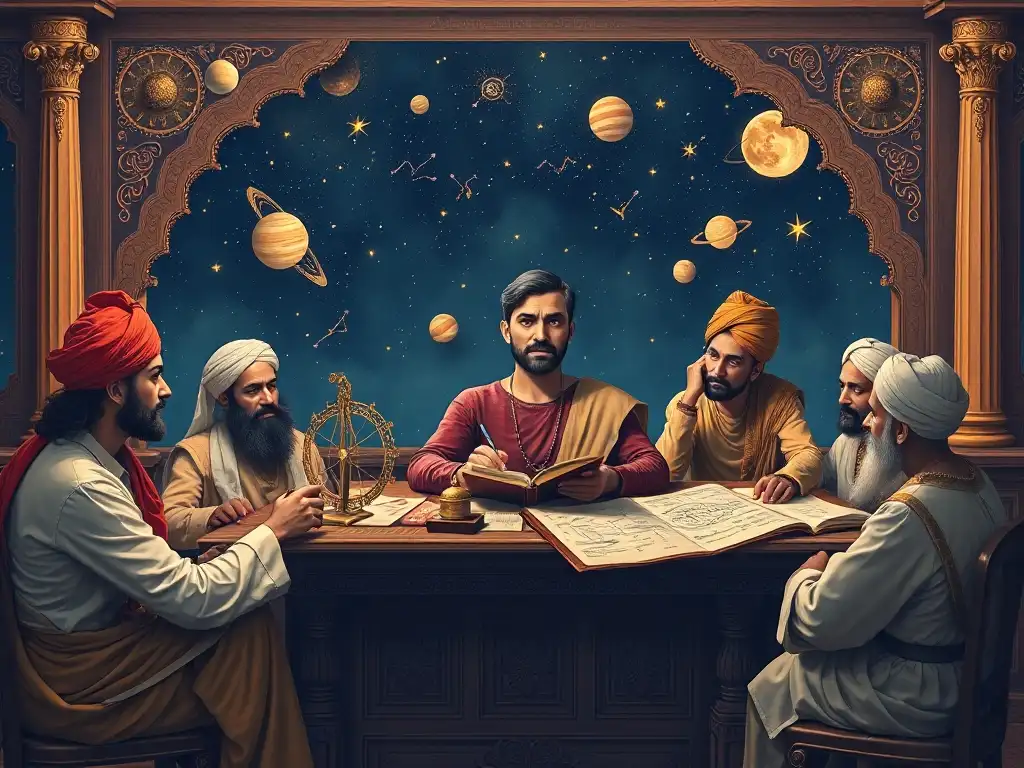
Introduction to Aryabhata and His Contributions
Aryabhata, an eminent mathematician and astronomer of ancient India, made monumental contributions that profoundly influenced the trajectory of scientific thought, particularly in the fields of astronomy and mathematics. Born in 476 CE, Aryabhata's work bridged the gap between traditional astronomy and mathematical principles, setting the foundation for future scholars both in India and the broader scientific community. His groundbreaking text, the Aryabhatiya, not only presented innovative astronomical theories but also introduced a systematic approach to mathematical calculations, emphasizing the importance of rigorous methods in scientific inquiry.
Aryabhata's influence extends far beyond his own era, as his ideas permeated through various cultures and epochs, paving the way for later scientific discoveries. This article delves into the key aspects of Aryabhata's astronomical theories and highlights how his insights have shaped subsequent developments in science and mathematics.
Overview of Aryabhata's Life and Era
Aryabhata was born in the region of Kusumapura, which is believed to be located in modern-day Bihar, India. His life coincided with the Gupta Empire, a period often referred to as the Golden Age of India, characterized by significant advancements in arts, science, and mathematics. Aryabhata was a prodigious intellect, at a time when the understanding of the cosmos was still in its infancy. He completed his seminal work, the Aryabhatiya, at the age of 23, indicating his exceptional talent and foresight.
During Aryabhata's era, India was a hub of intellectual activity, where scholars exchanged ideas across diverse fields. This environment enabled Aryabhata to synthesize knowledge from various traditions, laying the groundwork for future astronomers and mathematicians. His works not only presented astronomical models but also incorporated astronomical calculations that were critical in advancing the scientific discourse of the time.
Significance of Aryabhata in Ancient Indian Astronomy
Aryabhata's significance in ancient Indian astronomy cannot be overstated. He is often regarded as the first major mathematician-astronomer of India, whose theories challenged existing beliefs and introduced new methods of understanding celestial phenomena. His approach to astronomy was distinguished by its mathematical rigor, a departure from the purely observational methods that preceded him.
One of Aryabhata's key contributions was his insistence on the use of mathematical formulas to predict astronomical events, such as eclipses and planetary movements. This methodology laid a solid foundation for future astronomers, not just in India, but also in the Islamic and later European scientific traditions. His influence can be traced through the works of later scholars, who built upon his ideas and expanded the horizons of astronomical study.
Key Principles of Aryabhata's Astronomy
Aryabhata's astronomical insights were marked by several key principles that have had a lasting impact on the field. His innovative ideas encompassed a variety of topics, including the structure of the universe, planetary motion, and the fundamental nature of time.
Aryabhata's Model of the Universe
In Aryabhata's model, the Earth is a sphere that rotates on its axis, which was a revolutionary concept at the time. He proposed that the apparent motion of the stars was due to the Earth's rotation, a notion that contradicted the geocentric views prevalent in ancient civilizations. This heliocentric understanding of celestial mechanics laid the groundwork for later astronomers, who further refined the model and explored its implications.
Innovations in Mathematical Astronomy
Aryabhata's contributions to mathematics were equally significant. He introduced the concept of zero as a numeral, which was crucial in simplifying calculations and enabling more complex mathematical operations. His work also included methods for solving quadratic equations and calculating square and cube roots, demonstrating a sophisticated understanding of mathematical principles.
These innovations in mathematical astronomy not only enhanced the accuracy of astronomical calculations but also influenced mathematical practices in various cultures, highlighting Aryabhata's role as a pivotal figure in the history of mathematics.
Aryabhata's Work on the Earth's Rotation and Revolution
Aryabhata's examination of the Earth's rotation and revolution provided insights that were centuries ahead of his time. He accurately calculated the length of the solar year to be approximately 365.358 days, a figure remarkably close to the modern value. His observations about the Earth's axial tilt and its effect on seasonal changes further showcased his advanced understanding of astronomical dynamics.
Aryabhata's contributions to astronomy were foundational, influencing not only his contemporaries but also generations of scientists that followed. His methodologies and theories serve as a testament to the rich scientific legacy of ancient India, particularly in the realm of astronomy, and underscore the profound impact of Aryabhata's work on later scientific discoveries.
The Scientific Impact of Aryabhata's Astronomy
Aryabhata, one of the most renowned mathematicians and astronomers of ancient India, made significant contributions that shaped the course of scientific inquiry not only in India but also across various cultures. His seminal work, the "Aryabhatiya," presented revolutionary ideas regarding the heliocentric model of the solar system, the rotation of the Earth, and the calculation of astronomical phenomena.
Aryabhata's emphasis on observation and mathematical rigor laid the groundwork for future explorations in astronomy and mathematics, influencing generations of scholars both in India and beyond. His methods of calculation and his innovative approaches to astronomical problems established a framework that would resonate through history.
Influence on Later Indian Astronomers
The impact of Aryabhata's work on later Indian astronomers is profound and multi-faceted. Following his footsteps, scholars like Brahmagupta and Bhaskara II built upon Aryabhata's ideas, further developing astronomical concepts. For instance, Brahmagupta adopted Aryabhata's calculations of planetary positions and eclipses, refining them with his own observations. Bhaskara II, in his works, acknowledged Aryabhata's contributions and expanded them, particularly in the field of planetary motion.
Aryabhata’s introduction of sine tables and his methods for solving quadratic equations were particularly influential. These innovations were absorbed into the broader Indian astronomical tradition, leading to a rich tapestry of mathematical understanding that flourished long after Aryabhata's time.
Aryabhata's Astronomy and Its Role in the Development of Mathematics
Aryabhata's astronomical theories were deeply intertwined with the mathematical principles he introduced. His work on the calculation of the circumference of the Earth, where he approximated it to 3.1416, is an early example of the application of geometry in astronomy. Furthermore, Aryabhata's systematic use of zero and the place-value system allowed for complex astronomical calculations, which were not only vital for his own work but also set the stage for future mathematicians.
The development of trigonometry can also be traced back to Aryabhata's contributions. His sine and cosine functions paved the way for later advancements in this field, which became crucial for astronomical computations. Overall, Aryabhata’s innovative approach to blending mathematics with astronomy greatly influenced the evolution of both sciences.
Cross-Cultural Impact of Aryabhata’s Ideas
Aryabhata's work transcended geographical boundaries, influencing various cultures and scientific traditions. His texts were translated into Arabic, where they were further studied and expanded upon by Islamic astronomers. The translation of the "Aryabhatiya" into Arabic led to the dissemination of his ideas throughout the Islamic Golden Age, where scholars such as Al-Khwarizmi and Al-Battani utilized Aryabhata’s methods in their own astronomical research.
Additionally, Aryabhata's concepts found their way into European thought during the Renaissance, primarily through translations of Arabic texts. This cross-cultural exchange facilitated the adoption of Aryabhata's innovations in the development of modern science, showcasing the timeless relevance of his ideas.
Case Studies of Aryabhata's Influence on Scientific Discoveries

Aryabhata's Astronomy and the Development of Trigonometry
One of the most significant areas where Aryabhata's influence is evident is in the development of trigonometry. Aryabhata's introduction of the sine function, which he referred to as "ardha-jya," laid the groundwork for later advancements in this essential mathematical discipline. His detailed descriptions of the sine function allowed subsequent mathematicians and astronomers to perform more accurate astronomical calculations, particularly in predicting the positions of celestial bodies.
The sine tables created by Aryabhata served as a foundational reference for many scholars in India and beyond, paving the way for the more complex trigonometric functions that emerged in later centuries.
The Impact of Aryabhata's Work on Islamic Astronomy
Aryabhata's influence on Islamic astronomy is a compelling example of how his work transcended cultural boundaries. His "Aryabhatiya" was translated into Arabic, significantly impacting scholars like Al-Battani, who integrated Aryabhata’s methods into their astronomical models.
The Islamic astronomers adopted Aryabhata's innovative techniques for calculating planetary positions and eclipses, leading to advancements in observational astronomy. This exchange of knowledge not only preserved Aryabhata's legacy but also enriched the scientific discourse within the Islamic world.
Aryabhata's Influence on European Scientific Thought
The ripple effects of Aryabhata's contributions to astronomy and mathematics reached Europe, particularly during the Renaissance. Translations of Arabic texts that referenced Aryabhata's work introduced his ideas to European scholars, influencing key figures such as Copernicus and Galileo.
The heliocentric model, which Aryabhata hinted at, found resonance in Copernican theories, illustrating the far-reaching implications of his insights. Furthermore, the mathematical frameworks established by Aryabhata informed European approaches to celestial navigation and astronomical calculations, showcasing the enduring legacy of his scientific impact.
Comparisons with Other Ancient Astronomers
Aryabhata’s contributions to astronomy were not only groundbreaking for ancient India but also positioned him within a broader context of ancient astronomical thought. By comparing Aryabhata with other notable astronomers, we can better appreciate his unique insights and methodologies.
Ancient astronomers like Hipparchus, Ptolemy, and later Islamic scholars, all shared a common goal: to understand celestial phenomena. However, they approached it from different cultural and intellectual backgrounds. Aryabhata’s work emphasized mathematical rigor and a systematic approach to problems, setting a standard that influenced subsequent Indian mathematicians and astronomers, as well as those in other cultures.
Aryabhata vs. Ptolemy: A Comparative Analysis
When comparing Aryabhata to Ptolemy, a prominent figure in Greco-Roman astronomy, several distinctions arise.
- Methodology:
- Aryabhata employed a more mathematical approach, using algorithms and trigonometric functions to solve astronomical problems. His emphasis on mathematics was evident in his calculations of the Earth's circumference and the length of the solar year.
- Ptolemy, on the other hand, relied heavily on observational data and created a complex geocentric model of the universe, which dominated Western astronomy for centuries.
- Theories on Celestial Bodies:
- Aryabhata proposed that the Earth rotates on its axis, a revolutionary idea that contradicted the static Earth model of Ptolemy.
- Ptolemy’s model, while detailed, did not account for rotational motion, leading to inaccuracies in predicting celestial events.
- Influence and Legacy:
- Aryabhata’s work laid the foundation for further developments in Indian astronomy and mathematics, influencing scholars like Brahmagupta and Bhaskara.
- Ptolemy’s Almagest dominated Western astronomy until the Copernican revolution, showing how cultural contexts influenced the adoption and dissemination of astronomical ideas.
The contrasting methodologies and theories of Aryabhata and Ptolemy illustrate the diversity of ancient astronomical thought and highlight Aryabhata’s innovative contributions that paved the way for future discoveries.
Contributions of Aryabhata Compared to Other Indian Mathematicians
Aryabhata stands out among his contemporaries and successors in Indian mathematics due to his pioneering spirit and innovative techniques.
- Brahmagupta: While Brahmagupta expanded on Aryabhata's work, particularly in algebra and the concept of zero, Aryabhata’s approaches to planetary motion and eclipses were groundbreaking. Aryabhata's work on the sine function was also a precursor to later developments by Brahmagupta.
- Bhaskara I and II: Bhaskara I acknowledged Aryabhata’s influence in his writings, particularly in trigonometry. Bhaskara II further built upon Aryabhata's foundations, especially in calculus and astronomy, but Aryabhata’s original contributions laid the groundwork upon which these later mathematicians relied.
- Varahamihira: Varahamihira’s work in astrology and astronomy drew from Aryabhata’s astronomical calculations. His texts, while more focused on astrology, incorporated Aryabhata's mathematical insights, showing the interconnectedness of astronomy and astrology in ancient Indian thought.
Aryabhata’s emphasis on mathematics and a rational approach to astronomical phenomena significantly impacted the trajectory of Indian mathematics and influenced generations of mathematicians and astronomers that followed him.
Conclusion
Summary of Aryabhata's Lasting Legacy in Astronomy
Aryabhata’s lasting legacy in astronomy is characterized by his innovative ideas and mathematical approaches that challenged existing norms. His pioneering work on the rotation of the Earth, the calculation of eclipses, and the introduction of trigonometric functions laid the groundwork for future astronomical studies in both India and beyond. His influence can be seen in the works of later Indian mathematicians, who built upon his insights and expanded the field further.
Final Thoughts on the Scientific Impact of Aryabhata's Work on Modern Astronomy and Mathematics
The scientific impact of Aryabhata's work resonates even today, as modern astronomy and mathematics continue to reflect the principles he established. His methods of calculation, understanding of celestial mechanics, and mathematical innovations have shaped the frameworks used in contemporary scientific inquiry. Aryabhata's legacy is a testament to the profound contributions of ancient Indian scholars to the global tapestry of scientific knowledge, marking him as a pivotal figure in the history of astronomy and mathematics. His work not only influenced subsequent generations but also laid the foundation for a rich tradition of scientific exploration that persists in modern times.
- Introduction to Aryabhata and His Contributions
- Key Principles of Aryabhata's Astronomy
- The Scientific Impact of Aryabhata's Astronomy
- Case Studies of Aryabhata's Influence on Scientific Discoveries
- Comparisons with Other Ancient Astronomers
- Conclusion
Frequently Asked Questions
What was Aryabhata's contribution to astronomy?
Aryabhata was a pioneering astronomer who introduced innovative concepts like the Earth's rotation and the use of decimal place value, significantly advancing the field of astronomy.
How did Aryabhata influence later scientific discoveries?
Aryabhata's work laid the groundwork for subsequent scientific advancements, particularly in mathematics and astronomy, influencing scholars across cultures and time periods.
What are some key works of Aryabhata?
His most notable work, the Aryabhatiya, covers various subjects, including mathematics, astronomy, and mathematics, and remains a significant reference in the study of ancient science.
How did Aryabhata's ideas spread beyond India?
Aryabhata's ideas were translated and studied by scholars in the Islamic Golden Age, leading to the preservation and dissemination of his astronomical concepts to a broader audience.
What is the significance of Aryabhata in the context of ancient Indian civilization?
Aryabhata represents the intellectual achievements of ancient India, showcasing its rich scientific heritage and contributions to the global understanding of astronomy and mathematics.
Final Reflection: The Enduring Legacy of Aryabhata's Astronomy
The exploration of Aryabhata's contributions to astronomy reveals a profound truth: the foundations of modern science are deeply rooted in the insights of ancient scholars. As we navigate the complexities of contemporary scientific inquiry, it becomes increasingly clear that the pioneering work of figures like Aryabhata not only shaped the course of astronomy but also laid the groundwork for future discoveries. His innovative methods and mathematical precision resonate with today's scientific endeavors, reminding us that the quest for knowledge is a continuum, bridging past and present.
Clearly, Aryabhata's influence extends far beyond his time, permeating the cultural and social fabric of scientific thought. His groundbreaking ideas on planetary motion and the concept of zero have inspired generations of scientists and mathematicians across the globe. As we reflect on his legacy, we can appreciate how his work has sparked curiosity and innovation in countless fields. In the realm of science, the past is never dead; it is not even past.
This quote encapsulates the idea that the echoes of Aryabhata's discoveries continue to inspire and challenge us, urging us to push the boundaries of our understanding.
As we conclude our exploration of Aryabhata's astronomical impact, I invite you to consider how his legacy can inform your own journey in the pursuit of knowledge. Reflect on the importance of building upon the wisdom of those who came before us, and let it inspire you to contribute to the ever-evolving tapestry of scientific discovery. Embrace the spirit of inquiry that Aryabhata exemplified, and remember that every question you ask today may lead to the breakthroughs of tomorrow.
Unveil the Legacy of Aryabhata: Take Action Today!
Thank you for diving into the fascinating world of Aryabhata's astronomical influence! You've uncovered the profound impact his discoveries had on modern science and how they shaped future explorations in the cosmos. Now, let's transform that knowledge into action!
Here are some steps you can take to deepen your understanding and share the brilliance of Aryabhata:
- Explore Aryabhata's works more deeply: Delve into his original texts or read recommended translations to fully appreciate his groundbreaking ideas.
- Share your insights: Engage in discussions about Aryabhata’s contributions with friends or on social media platforms to inspire others to learn about his remarkable legacy.
- Join or attend astronomy clubs: Connect with a community of enthusiasts to explore the night sky together, applying the scientific principles Aryabhata introduced.
What aspect of Aryabhata's work surprises you the most, and how do you believe it can inspire modern scientific exploration?