
Revisiting the Mathematical Achievements of the Gupta Era


Welcome to Ancient India History, where we embark on a captivating journey through the rich tapestry of India's illustrious past. Today, we delve into the Gupta Empire, a remarkable period renowned for its groundbreaking mathematical contributions. Did you know that this era not only laid the foundations for modern arithmetic but also introduced concepts that transformed the world of mathematics?
Join us as we explore the achievements that have shaped our understanding of numbers and calculations, and uncover the legacy of innovation that continues to inspire generations. Prepare to be amazed—your journey into the wonders of ancient Indian mathematics begins now!

Introduction to the Gupta Empire and Its Mathematical Contributions
The Gupta Empire, often referred to as the "Golden Age of India," was a remarkable period from approximately 320 to 550 CE that witnessed a profound flourishing of arts, sciences, and mathematics. This era is distinguished not only for its cultural advancements but also for its significant mathematical contributions that have had lasting impacts on the world.
Ancient Indian mathematicians made pioneering discoveries and laid the foundation for various mathematical concepts that are still relevant today. By exploring the mathematical achievements of the Gupta Empire, we can gain insights into how these innovations shaped the intellectual landscape of not just India, but the global community as well.
Overview of the Gupta Empire's Historical Context
The Gupta Empire emerged after the fall of the Maurya Empire and became a dominant political force in northern India. Under the rule of notable emperors like Chandragupta I and Samudragupta, the empire expanded its territories and promoted trade, arts, and education. This cultural renaissance encouraged scholars to engage in various fields, including mathematics, astronomy, and philosophy.
Key aspects of the Gupta Empire's historical context include:
- Political Stability: A unified administration allowed for the patronage of scholars and the establishment of universities.
- Trade and Commerce: Increased trade facilitated the exchange of ideas and knowledge with other cultures.
- Cultural Flourishing: The arts, literature, and sciences thrived, leading to significant advancements.
Significance of Mathematics in Ancient Indian Civilization
Mathematics in ancient India was not merely a theoretical pursuit; it played a crucial role in daily life, trade, and scientific inquiry. The contributions of Indian mathematicians during the Gupta era laid the groundwork for future developments in mathematics, influencing both Islamic and European scholars. Notable areas of focus included:
- Arithmetic and Number Systems: The concept of zero and the decimal place value system emerged during this period.
- Geometry and Astronomy: Mathematics was integral to astronomical calculations and the mapping of celestial bodies.
- Algebra: The foundation of algebraic principles was established, paving the way for future mathematical explorations.
Key Mathematicians of the Gupta Era
The Gupta Empire was home to several eminent mathematicians whose work significantly advanced the field. Their contributions continue to be celebrated in historical discussions of mathematics.
Aryabhata: The Pioneer of Indian Mathematics
Aryabhata, born in 476 CE, is one of the most renowned mathematicians and astronomers of ancient India. His seminal work, the Aryabhatiya, addresses various mathematical concepts, including:
- Place Value System: He introduced the concept of using a place value system for numbers, which was revolutionary.
- Trigonometry: Aryabhata made significant advancements in trigonometric calculations, establishing sine and cosine functions.
- Approximation of Pi: He provided an approximation of π (pi) as 3.1416, which was remarkably accurate for his time.
Varahamihira: The Astronomer Mathematician
Varahamihira, a contemporary of Aryabhata, made notable contributions in both mathematics and astronomy. His influential text, the Brihat Samhita, covers various topics, including:
- Mathematical Astronomy: He calculated the positions of celestial bodies and devised methods for predicting eclipses.
- Geometric Principles: Varahamihira contributed to geometry, particularly in relation to architectural design and astrological practices.
- Meteorology: His work included mathematical models to predict weather patterns, demonstrating a blend of mathematics with practical applications.
Brahmagupta: The Father of Number Theory
Brahmagupta, born in 598 CE, is often regarded as the father of number theory due to his groundbreaking work in mathematics. His text, Brahmasphutasiddhanta, introduced several key concepts:
- Rules for Arithmetic Operations: Brahmagupta formulated rules for arithmetic operations involving both positive and negative numbers.
- Solutions to Quadratic Equations: He provided methods for solving quadratic equations, laying the groundwork for future algebraic studies.
- Concept of Zero: Brahmagupta's interpretation of zero was pivotal in establishing its role as a number and a placeholder in the decimal system.
The mathematical achievements of the Gupta Empire not only reflect the intellectual prowess of its scholars but also highlight the enduring legacy of ancient Indian mathematics in shaping the course of mathematical thought throughout history.
Major Mathematical Contributions of the Gupta Empire
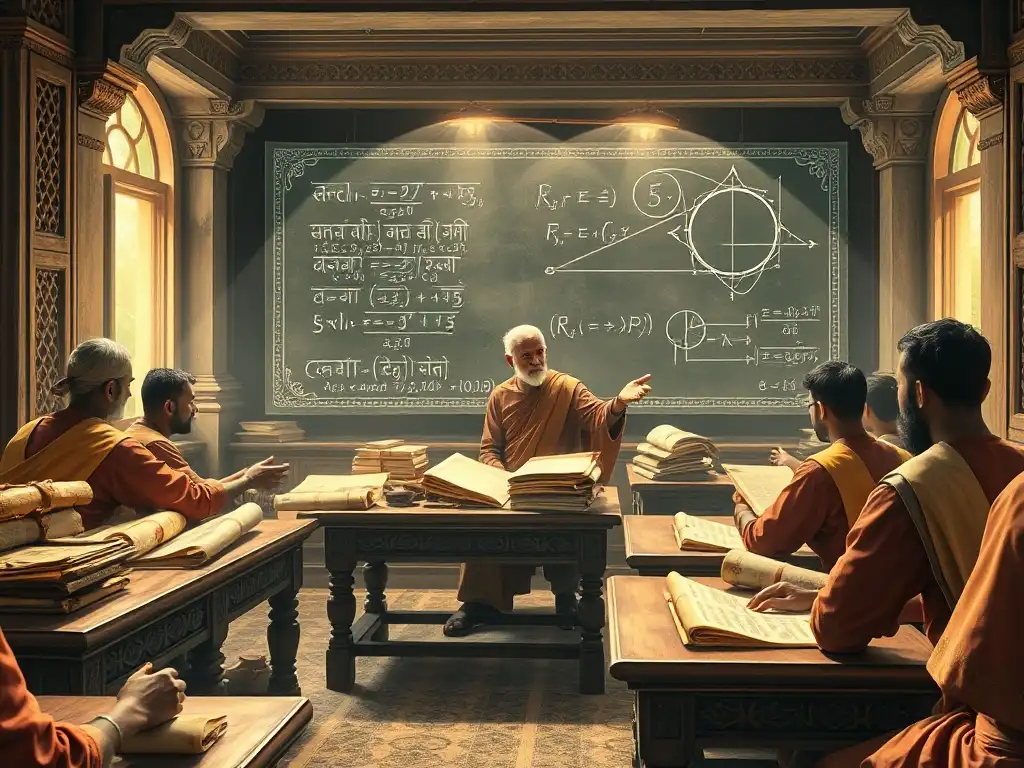
The Gupta Empire, which flourished from approximately 320 to 550 CE, is often hailed as a golden age of Indian mathematics. During this period, significant mathematical advancements were made that laid the groundwork for many modern mathematical concepts. Notable mathematicians like Aryabhata and Brahmagupta emerged during this time, contributing to various fields such as arithmetic, algebra, geometry, and astronomy. The Gupta Empire's mathematical contributions not only influenced the Indian subcontinent but also had a profound impact on the mathematical traditions in other cultures, notably through the transmission of knowledge to the Islamic world and later to Europe.
Development of the Decimal System and Place Value
One of the most revolutionary contributions of the Gupta Empire was the formalization of the decimal system, which included the concept of place value. This system allowed for the representation of numbers in a structured manner, significantly enhancing calculations and record-keeping.
- Base-10 System: The use of a base-10 system made arithmetic operations more efficient by simplifying the process of addition, subtraction, multiplication, and division.
- Zero as a Placeholder: The introduction of zero (0) as both a numeral and a concept allowed for the expression of large numbers and facilitated calculations that were previously cumbersome.
This innovation laid the foundation for modern numeral systems and was pivotal in the development of mathematics, influencing not only Indian scholars but also those in the Middle East and Europe.
Advancements in Algebra: Concepts and Techniques
The Gupta period saw remarkable developments in algebra, particularly through the works of mathematicians like Brahmagupta. His seminal text, the "Brahmasphutasiddhanta," provided comprehensive rules for arithmetic operations involving both positive and negative numbers.
- Algebraic Equations: Brahmagupta introduced methods for solving linear equations and quadratic equations, establishing systematic approaches that would influence subsequent generations.
- Applications of Algebra: The Gupta mathematicians also applied algebra to solve practical problems in trade, astronomy, and land measurement, demonstrating the utility of algebra in everyday life.
These advancements not only enhanced mathematical theory but also emphasized the practical applications of mathematics in society.
Innovations in Geometry and Trigonometry
The Gupta Empire witnessed significant progress in geometry and trigonometry, contributing to both theoretical and applied mathematics.
- Geometric Principles: Mathematicians like Aryabhata explored the properties of shapes and figures, leading to the formulation of geometric principles that are still relevant today. His work included calculations of areas and volumes, particularly in relation to circular and spherical shapes.
- Trigonometric Functions: The Gupta scholars made early strides in understanding trigonometric concepts, including the use of sine and cosine functions, which were essential for astronomical calculations.
These innovations played a crucial role in the development of mathematical sciences, influencing both Indian and global mathematical traditions.
Cultural and Scientific Impact of Gupta Era Mathematics
The mathematical advancements of the Gupta Empire were not merely academic; they had far-reaching implications for culture and science during the period and beyond. The integration of mathematics into various aspects of life contributed to a more profound understanding of the world.
Mathematics in Literature and Philosophy
Mathematics during the Gupta Era was closely intertwined with literature and philosophy, reflecting the intellectual climate of the time.
- Mathematical Poetry: Works of literature often incorporated mathematical concepts, using poetic forms to convey complex ideas. This blending of disciplines enriched both fields, fostering a culture that valued knowledge and education.
- Philosophical Texts: Philosophical treatises also discussed mathematical principles, emphasizing the importance of logic and reasoning in understanding the universe. The philosophical implications of mathematical ideas contributed to a holistic view of knowledge that persisted throughout centuries.
This synergy between mathematics and the humanities highlighted the Gupta Empire's distinct approach to learning and knowledge dissemination.
The Role of Mathematics in Advancing Science and Technology
The mathematical achievements of the Gupta Empire played a pivotal role in advancing science and technology, impacting various fields.
- Astronomy: Mathematics was fundamental in developing accurate astronomical models. Aryabhata's calculations regarding celestial bodies exemplified the direct application of mathematics in astronomy, leading to more precise predictions of celestial events.
- Architecture and Engineering: The principles of geometry and measurement were applied in architecture and engineering, contributing to the construction of monumental structures and urban planning.
These applications showcased the practical benefits of mathematical advancements, facilitating progress in multiple domains and establishing a legacy that would influence future civilizations.
Legacy of Gupta Empire Mathematical Contributions
The Gupta Empire, often referred to as the "Golden Age of India," witnessed remarkable advancements in various fields, especially mathematics. The mathematical contributions during this period laid the groundwork for future developments not only in India but also across the globe. Scholars like Aryabhata, Brahmagupta, and Varahamihira emerged, making significant strides in arithmetic, algebra, and astronomy. Their work introduced concepts such as zero as a numeral, the decimal system, and advanced techniques for calculating areas and volumes, which were revolutionary for their time.
The Gupta mathematicians formulated various mathematical texts, including Aryabhata's "Aryabhatiya," which served as an influential compendium of mathematical knowledge. This text covered topics such as trigonometry, algebra, and even the approximation of π (pi). The contributions made during this period were characterized by a blend of theoretical insights and practical applications, marking a significant transition in the mathematical landscape of ancient India.
Influence on Subsequent Indian Mathematicians
The mathematical achievements of the Gupta Empire profoundly influenced subsequent generations of Indian mathematicians. The establishment of foundational concepts such as the place value system and the use of zero inspired later mathematicians like Bhaskara I and Bhaskara II, who built upon these ideas to further develop mathematical theories. The works of these scholars, grounded in Gupta-era innovations, led to significant advancements in algebra and calculus.
Moreover, the Gupta period's mathematical texts became essential references for future scholars and students. The synthesis of astronomy and mathematics during this era prompted a rich tradition of mathematical inquiry that continued into the medieval period, fostering a culture of learning and intellectual exchange. The collaborative nature of this knowledge-sharing ensured that the innovations of the Gupta Empire were not only preserved but also adapted and expanded upon by future mathematicians.
Global Impact on Mathematics and Science
The mathematical contributions of the Gupta Empire had far-reaching effects beyond the borders of India. As trade routes expanded and cultural exchanges flourished, the mathematical concepts developed during this era were transmitted to other civilizations, including those in the Islamic world and Europe. The introduction of the decimal system, along with the concept of zero, revolutionized mathematical calculations and record-keeping across various cultures.
For instance, Persian mathematicians translated and built upon Indian texts, leading to significant advancements in algebra and trigonometry. By the time these concepts reached Europe during the Renaissance, they played a crucial role in the advancement of Western mathematics. The ripple effect of Gupta-era mathematics is evident in the works of renowned mathematicians such as Fibonacci and Descartes, showcasing a legacy that transcended geographical boundaries and time periods.
Conclusion: The Enduring Significance of Gupta Era Mathematics
The mathematical achievements of the Gupta Empire signify a pivotal moment in the history of mathematics. The innovative approaches and foundational concepts established during this time laid the groundwork for numerous mathematical disciplines that continue to impact contemporary mathematics. The legacy of this era is not merely historical; it serves as a testament to the intellectual prowess of ancient Indian scholars and their contributions to global knowledge.
Reflection on the Gupta Empire's Contributions to Modern Mathematics
The contributions made by Gupta mathematicians resonate within modern mathematics, where concepts such as zero and the decimal system are integral to mathematical operations and calculations. The principles of arithmetic and algebra formulated during the Gupta era are foundational to contemporary mathematical education. Reflecting on this heritage highlights the importance of recognizing and appreciating how ancient knowledge systems influence modern practices and thought processes.
The Importance of Preserving Ancient Mathematical Knowledge
Preserving the mathematical knowledge of the Gupta Empire is vital for understanding the evolution of mathematics as a discipline. Ancient texts, manuscripts, and the insights they contain offer invaluable lessons in creativity, problem-solving, and theoretical exploration. By ensuring that this knowledge is maintained and studied, we not only honor the legacy of ancient mathematicians but also inspire future generations to explore and innovate in the field of mathematics. The Gupta Empire's mathematical contributions remind us of the profound interconnectedness of knowledge across cultures and epochs.
- Introduction to the Gupta Empire and Its Mathematical Contributions
- Overview of the Gupta Empire's Historical Context
- Significance of Mathematics in Ancient Indian Civilization
- Key Mathematicians of the Gupta Era
- Major Mathematical Contributions of the Gupta Empire
- Cultural and Scientific Impact of Gupta Era Mathematics
- Legacy of Gupta Empire Mathematical Contributions
- Conclusion: The Enduring Significance of Gupta Era Mathematics
- What were the key mathematical contributions of the Gupta Empire?
- How did the mathematical achievements of the Gupta Era influence later civilizations?
- Who were the prominent mathematicians during the Gupta Empire?
- What role did the cultural context play in the Gupta Empire's advancements in mathematics?
- How did the Gupta Empire contribute to the development of geometry?
Frequently Asked Questions
What were the key mathematical contributions of the Gupta Empire?
The Gupta Empire is renowned for significant advances in mathematics, including the concept of zero, the decimal system, and contributions to geometry and algebra.
How did the mathematical achievements of the Gupta Era influence later civilizations?
The mathematical achievements of the Gupta Era laid the foundation for future mathematical theories and practices, influencing not only Indian scholars but also those in Islamic and European cultures.
Who were the prominent mathematicians during the Gupta Empire?
Notable mathematicians such as Aryabhata and Brahmagupta made groundbreaking contributions in areas like trigonometry, calculus, and the rules of arithmetic.
What role did the cultural context play in the Gupta Empire's advancements in mathematics?
The cultural context of the Gupta Empire fostered a spirit of intellectual inquiry and support for scholarship, leading to a flourishing of scientific and mathematical exploration.
How did the Gupta Empire contribute to the development of geometry?
During the Gupta Era, mathematicians made significant strides in geometry, developing concepts related to area, volume, and the properties of shapes, which were essential for both practical applications and theoretical understanding.
Final Reflection: Celebrating the Gupta Empire's Mathematical Legacy
The mathematical contributions of the Gupta Empire resonate profoundly in today's world, illustrating how ancient innovations continue to shape modern mathematics and science. As we revisit these achievements, we recognize that the foundations laid by Gupta scholars not only advanced mathematical thought but also fostered a spirit of inquiry that remains vital in our quest for knowledge. The brilliance of this era serves as a reminder that the pursuit of understanding is timeless and universal.
The impact of the Gupta Empire's mathematical advancements extends far beyond historical significance; it has woven itself into the very fabric of our cultural and social landscape. These contributions have inspired generations of mathematicians and scientists, encouraging a continuous exploration of mathematical principles. As we reflect on this legacy, we are reminded of the words of the renowned mathematician Carl Friedrich Gauss: Mathematics is the queen of the sciences and number theory is its crown jewel.
This quote encapsulates the enduring importance of the Gupta Empire's achievements, highlighting their role in elevating mathematics to a revered status.
As we conclude our exploration of the Gupta Empire's mathematical contributions, I invite you to reflect on how these ancient insights can inform your own understanding of mathematics and its applications in everyday life. Consider the ways in which you can embrace the spirit of curiosity and innovation that characterized this remarkable era. Let the legacy of the Gupta scholars inspire you to pursue knowledge with passion and creativity, ensuring that their remarkable achievements continue to influence future generations.
Unveil the Legacy of Ancient Mathematics!
Thank you for diving into the fascinating world of the Gupta Era's mathematical achievements! Your curiosity has equipped you with insights into how these groundbreaking advancements laid the foundation for modern mathematics.
Now, let’s take the next step and truly engage with this captivating history:
- Explore the original texts: Search for and read translations of renowned mathematicians from the Gupta Period, such as Aryabhata; their works offer invaluable knowledge and inspiration.
- Share your insights: Discuss what intrigued you most about Gupta mathematics with friends or in online forums—let's keep the conversation alive!
- Apply your learning: Try integrating some ancient mathematical techniques into your own problem-solving—who knows what new perspectives you might gain?
How do you think the mathematical innovations of the Gupta Era have shaped the world we live in today?