
The Rich Tapestry of Numerical Systems in Ancient Indian Mythology and Folklore


Welcome to Ancient India History, where we embark on a fascinating journey through the rich tapestry of ancient Indian civilizations. Dive deep into the intriguing world of ancient Indian numerical systems, a cornerstone of mathematical brilliance that has shaped our understanding of numbers today. From the enigmatic symbols of the Indus Valley to the sophisticated calculations of the Gupta Empire, this exploration will unveil how mythology and folklore intertwined with the development of these systems. Curious about how these ancient concepts continue to influence modern mathematics? Join us as we unravel the stories behind the numbers!

Ancient India boasts a profound legacy that intertwines mathematics with mythology and folklore, creating a rich tapestry that reflects the civilization's intellectual and cultural depth. The exploration of ancient Indian numerical systems reveals not only sophisticated mathematical concepts but also the spiritual and philosophical underpinnings that influenced their development.
From the legendary Indus Valley civilization to the era of the Gupta Empire, numerical systems were not merely tools for calculation; they were deeply embedded in the fabric of society, shaping rituals, traditions, and the very worldview of the people. This article delves into the multifaceted aspects of numerical systems as portrayed in ancient Indian mythology and folklore, highlighting their significance and the divine influences that shaped them.
Introduction to Ancient Indian Numerical Systems
Overview of Ancient Indian Mathematics
The foundation of mathematical thought in ancient India can be traced back to several key texts and scholars. The Sulbasutras, dating back to around 800 BCE, are among the earliest works that detail geometric principles and numerical calculations, primarily for the construction of altars. This period saw the emergence of concepts such as zero, infinity, and decimal systems, which would later influence mathematics globally.
- Key Contributions:
- The invention of the numeral system that includes the concept of zero.
- The development of the decimal place value system.
- Innovations in algebra and trigonometry by scholars like Aryabhata and Brahmagupta.
Ancient Indian mathematicians laid the groundwork for what would evolve into modern mathematical practices, integrating their findings with cosmological theories and philosophical inquiries.
Significance of Numerical Systems in Indian Culture
Numerical systems in ancient India transcended mere arithmetic; they were woven into the very fabric of cultural practices and social norms. Numbers held spiritual significance, often representing cosmic principles and divine entities.
- Cultural Importance:
- Numbers were used to delineate sacred texts and chants.
- Festivals and rituals often involved specific numerical patterns, signifying harmony and balance.
- The use of numerology in astrology and decision-making reflected a belief in the interconnectedness of the universe.
This cultural embedding of numerical systems illustrates how mathematics was perceived not just as a science but as an integral aspect of life and spirituality in ancient India.
Mythological Foundations of Numerical Systems
The Role of Gods and Goddesses in Mathematics
In ancient Indian mythology, gods and goddesses were often associated with various numerical concepts, highlighting the divine influence in mathematical thought. Deities like Saraswati, the goddess of knowledge, and Ganesh, the remover of obstacles, were revered figures whose attributes encompassed wisdom and intellect.
- Divine Associations:
- Saraswati is often depicted with a veena, symbolizing the harmony of music and mathematics.
- Ganesh is associated with the auspiciousness of numbers and is invoked at the beginning of any mathematical endeavor or new venture.
These divine associations reflect the belief that mathematical pursuits were sacred and guided by higher powers.
Symbolism of Numbers in Ancient Indian Myths
Numbers in ancient Indian mythology are imbued with symbolic meanings that convey deeper philosophical truths. For example, the number 108 is sacred in Hinduism, symbolizing the universe's wholeness and connection to the divine. Such symbolism extends to various aspects of life, from architecture to rituals, demonstrating how numbers served as a bridge between the material and the spiritual.
- Examples of Symbolic Numbers:
- 3: Represents the triad of creation, preservation, and destruction (Brahma, Vishnu, Shiva).
- 7: Often seen as a sacred number, associated with the seven Rishis (sages) and the seven chakras.
This rich symbolism illustrates that ancient Indian numerical systems were not merely functional but were deeply intertwined with the cultural and spiritual ethos of the civilization. Through the lenses of mythology and folklore, we gain a deeper appreciation for the legacy of ancient Indian numerical systems and their enduring impact on mathematics and culture.
Folklore and Its Influence on Numerical Concepts
The folklore of ancient India is a rich tapestry woven with stories, myths, and legends that have played a crucial role in shaping the numerical concepts prevalent in society. These narratives often incorporate numbers, not merely as quantities but as symbols of deeper meanings, reflecting the cultural psyche and the philosophical underpinnings of life. The presence of numbers in these tales served to convey moral lessons, signify auspiciousness, and illustrate the interconnectedness of life experiences.
In many stories, numbers are imbued with supernatural significance. For instance, the number seven frequently appears in Hindu mythology, denoting completeness and perfection. Such recurring motifs in folklore have fostered an appreciation for numerical systems, paving the way for their integration into daily life and spiritual practices. Furthermore, the oral tradition of storytelling ensured that these numerical concepts were passed down through generations, influencing the way communities approached mathematics and calculations.
Traditional Stories Featuring Numerical Systems
Ancient Indian folklore is replete with stories that illustrate the significance of various numerical systems. One prominent example is the tale of "The Seven Wonders," where the number seven encapsulates not only physical marvels but also spiritual enlightenment. Each wonder represents a unique aspect of life, teaching moral values and emphasizing the importance of harmony.
Another captivating narrative is the story of "The Ten Avatars of Vishnu," where the divine incarnations of Lord Vishnu are enumerated. Each avatar corresponds to a significant event in Hindu cosmology, emphasizing the cyclical nature of time and existence. This story highlights how numbers can serve as a framework for understanding complex philosophical ideas.
Moreover, the fables of Akbar and Birbal often involve clever riddles and puzzles that require mathematical reasoning, demonstrating the practical application of numerical thought in everyday scenarios. These tales not only entertain but also educate, embedding numerical systems into the cultural consciousness.
The Integration of Numbers in Folkloric Practices
Numerical systems are not just theoretical constructs in ancient Indian folklore; they are intricately woven into the fabric of daily life and spiritual practices. Many rituals and ceremonies are based on specific numbers, which are believed to hold spiritual power. For example, the practice of performing rituals in sets of three, five, or nine is common, as these numbers are considered auspicious.
In agricultural communities, the cycles of planting and harvesting are often aligned with specific numerical patterns, reflecting the natural rhythms of life. The timing of festivals, such as Diwali or Makar Sankranti, is often determined by numerical calculations related to lunar cycles or solar positions, demonstrating the practical application of these systems in societal functions.
Furthermore, numerology has played a significant role in astrological practices, where numbers are associated with planetary positions and their influence on human affairs. This integration of numbers into various aspects of life highlights the deep connection between folklore and the understanding of numerical systems in ancient India.
Key Numerical Systems in Ancient India
Ancient India is renowned for its sophisticated numerical systems, which laid the groundwork for many mathematical concepts that are still in use today. These systems reflect the innovative spirit of Indian mathematicians and the cultural importance placed on numerical understanding.
The Vedic Numerical System
The Vedic numerical system, which emerged during the Vedic period (approximately 1500-500 BCE), is one of the earliest known numerical frameworks in ancient India. This system was primarily based on a decimal structure, using a base-10 system that made calculations more efficient. The Vedic texts contain numerous references to numbers, often associating them with philosophical and cosmological ideas.
Vedic scholars developed intricate methods for calculations, including the use of mnemonic devices to aid memory and enhance computational skills. The concept of "Shulba Sutras," which are texts that provide rules for geometrical constructions in Vedic rituals, illustrates the application of numerical systems in practical situations, such as temple architecture and sacred geometry.
The Use of the Decimal System in Ancient India
The decimal system, which became widely recognized through the work of ancient Indian mathematicians, is a cornerstone of modern mathematics. This system utilizes ten symbols (0-9) to represent all numbers, allowing for the efficient expression of large values and complex calculations. Ancient texts, such as the "Aryabhatiya" by Aryabhata, showcase the application of the decimal system in astronomical calculations and timekeeping.
The adoption of the decimal system facilitated advancements in various fields, including commerce and trade, where accurate calculations were essential. Additionally, this numerical framework allowed for the development of more sophisticated mathematical concepts, such as algebra and arithmetic, which would later influence mathematicians around the world.
The Concept of Zero and Its Origins
The concept of zero, one of the most significant mathematical developments in history, has its origins in ancient India. The earliest known use of zero as a numerical value dates back to the 5th century CE in the work of mathematicians like Brahmagupta. In his writings, zero was not only a placeholder in the decimal system but also represented a distinct concept of "nothingness."
This revolutionary idea transformed mathematics, enabling the representation of large numbers and the execution of complex calculations. The acceptance of zero led to advancements in algebra and calculus, profoundly influencing mathematics in subsequent cultures, particularly in the Islamic Golden Age and later in Europe.
The philosophical implications of zero also resonate in Indian spirituality, symbolizing the void and the infinite possibilities that arise from it. This duality of zero as both a mathematical entity and a philosophical concept showcases the deep interconnection between mathematics and the cultural beliefs of ancient India.
Mathematical Contributions Reflected in Mythology
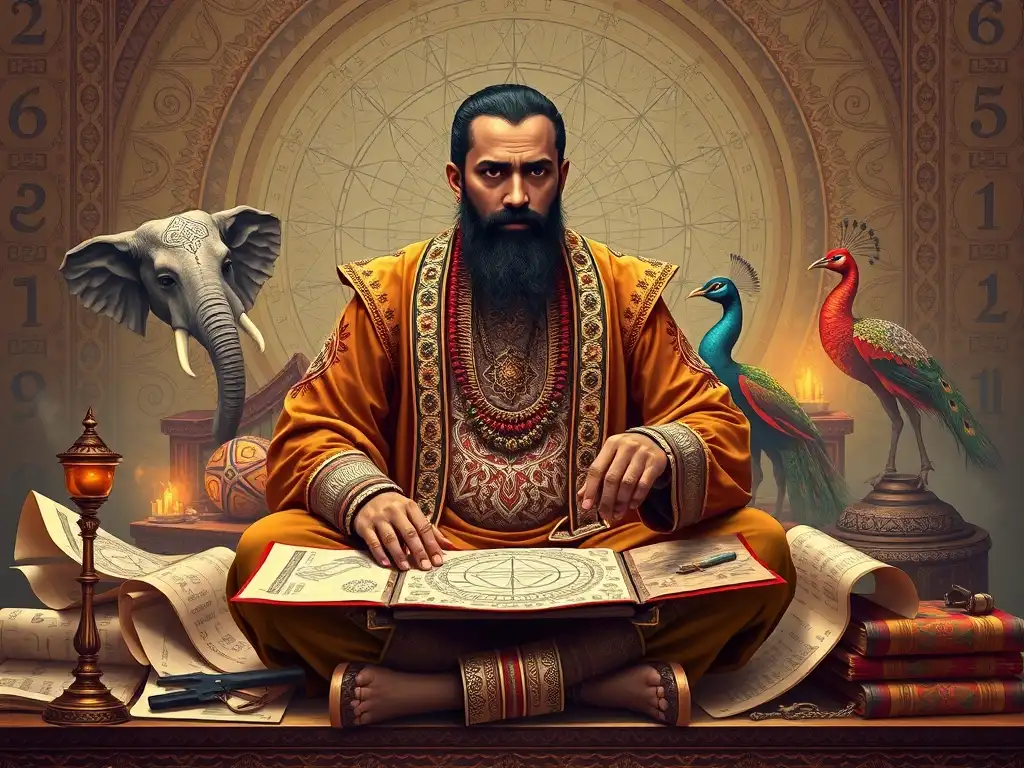
Ancient Indian mythology is not merely a collection of stories; it functions as a sophisticated medium through which complex mathematical concepts and numerical systems are communicated. Many myths contain embedded numerical references that reflect the advanced understanding of mathematics in ancient Indian society. For instance, the concept of zero, which was revolutionary, can be traced back to mythological interpretations of nothingness and infinity found in ancient texts. The Puranas, for example, often refer to cycles of time, such as the Yugas, which involve significant numerical calculations, highlighting the importance of numbers in understanding the cosmos.
Moreover, various deities in Hindu mythology are associated with specific numbers that symbolize cosmic principles. The number 108, revered in Hinduism, is often represented in rituals and spiritual practices, embodying a deeper metaphysical significance. This use of numbers in a mythological context not only showcases the cultural integration of mathematics but also emphasizes its role in shaping spiritual beliefs.
The rich tapestry of narratives surrounding mathematical concepts in ancient India illustrates how intertwined mathematics and mythology were. This relationship highlights the profound respect ancient Indian civilizations had for numbers, treating them as keys to unlocking both earthly and divine mysteries.
Famous Texts and Their Mathematical Significance
Several ancient Indian texts serve as crucial repositories of mathematical knowledge embedded within mythological narratives. The Aryabhatiya by Aryabhata, written in the 5th century CE, presents a blend of mathematical concepts and astronomical observations. The text uses poetic verses to convey mathematical principles, illustrating the significance of numbers through the lens of cosmic cycles and planetary movements.
Another pivotal text is the Bhaskara I's Mahabhaskariya, which discusses various mathematical functions and their applications. It presents a mythological context for the use of mathematical operations, thereby making complex concepts more accessible. Additionally, the Siddhanta Shiromani by Bhaskara II further explores numerical systems and their applications in astronomy, blending mathematical theory with mythological narratives that explain the workings of the universe.
These texts not only highlight the mathematical acumen of ancient Indians but also demonstrate the cultural practices that intertwined numerical systems with mythology, revealing how mathematics was ingrained in the fabric of ancient Indian thought.
The Influence of Mythological Narratives on Mathematical Thought
Mythological narratives in ancient India played a crucial role in shaping mathematical thought by providing a framework for understanding abstract concepts. The stories often served as mnemonic devices, helping scholars and students remember complex mathematical rules and operations. For example, the tale of Lord Ganesha, who is often associated with the removal of obstacles, can be interpreted as an allegory for overcoming challenges in mathematical problem-solving.
Furthermore, the cyclical nature of time as described in mythological texts influenced the development of numerical systems. The concept of cyclical time led to the establishment of various calendars, which required advanced mathematical calculations for their formulation. The interplay between mythology and mathematics fostered a culture that revered numerical literacy, encouraging innovations that would later be foundational for various branches of mathematics.
This deep-rooted connection between mythology and mathematics exemplifies how ancient Indian civilizations viewed numbers not just as tools for calculation but as integral elements of their philosophical and spiritual worldview.
Comparative Analysis of Numerical Systems
The exploration of ancient Indian numerical systems reveals unique characteristics that distinguish them from other civilizations. The use of a place-value system, particularly the introduction of zero, marked a significant advancement in mathematical thought. This system allowed for more complex calculations and the representation of large numbers, which was less developed in contemporaneous civilizations.
Comparison with Other Ancient Civilizations
When compared to ancient Egyptian or Babylonian numerical systems, which relied heavily on symbols and lacked a true place-value system, the ancient Indian numerical system emerged as remarkably advanced. While the Babylonians used a base-60 system, which was sophisticated in its own right, the ancient Indian decimal system provided a more flexible and comprehensive framework for mathematical operations.
The Chinese numerical system, while also advanced, did not integrate the concept of zero in the same way as ancient Indian mathematics. The ability to represent null values and perform calculations involving them was a significant leap forward, influencing not only mathematics but also philosophy and science across cultures.
Unique Features of Ancient Indian Numerical Systems
Ancient Indian numerical systems were distinguished by their innovative features, which included:
- Place-Value Notation: This system allowed for the representation of large numbers efficiently and facilitated complex calculations.
- Concept of Zero: The introduction of zero as a numeral was revolutionary, enabling the development of algebra and calculus.
- Decimal System: The use of a base-10 system streamlined mathematical operations, making it easier to perform arithmetic calculations.
- Mathematical Texts: Works such as the Siddhanta and Aryabhatiya not only provided concrete mathematical principles but also integrated them within mythological contexts, enriching the cultural significance of mathematics.
These features reflect the sophistication of ancient Indian mathematics and its profound impact on subsequent mathematical developments worldwide. The legacy of these numerical systems continues to influence modern mathematics, underscoring the importance of ancient Indian contributions to the field.
Conclusion: Legacy of Ancient Indian Numerical Systems
The legacy of ancient Indian numerical systems is profound and far-reaching, influencing not only the development of mathematics in India but also the broader global mathematical landscape. The intricate systems established by ancient Indian mathematicians, including the use of zero, decimal systems, and various numeral notations, laid the groundwork for mathematical concepts that are still in use today. Their contributions have been essential in shaping mathematical thought, allowing for more complex calculations and a deeper understanding of numerical relationships.
Ancient Indian texts, such as the Sulba Sutras and the work of mathematicians like Aryabhata and Brahmagupta, exemplify the innovative spirit of their time. These texts not only provided a framework for mathematics but also interwove mathematical principles with philosophical and astronomical insights. The integration of numerals into broader cultural practices, such as astrology and astronomy, highlights the multifaceted nature of these systems and their relevance across various aspects of life.
As we reflect on the rich tapestry of numerical systems in ancient Indian mythology and folklore, we recognize that these contributions are not just historical footnotes but rather foundational elements that continue to resonate in contemporary mathematical practices and cultural expressions.
The Impact on Modern Mathematics
The impact of ancient Indian numerical systems on modern mathematics is both significant and transformative. The introduction of the concept of zero as a number, rather than merely a symbol for separation, revolutionized arithmetic and algebra. This pivotal idea allowed for the development of calculus and advanced mathematical theories, which are indispensable in various fields today, including physics, engineering, and computer science.
Moreover, the place value system originating from ancient India enabled more efficient computation and record-keeping. The transition from Roman numerals to the Hindu-Arabic numeral system facilitated trade, navigation, and scientific advancements in the medieval period and beyond. As European mathematicians adopted these concepts during the Renaissance, they laid the groundwork for modern mathematics as we know it.
The ancient Indian approach to mathematics was also characterized by its philosophical underpinnings, promoting a holistic view of numbers that encompassed both practical applications and metaphysical reflections. This perspective influences contemporary mathematical thought, urging us to consider not only the numerical value but also the underlying principles and relationships.
Continuing Influence of Ancient Numerical Concepts in Contemporary Culture
The influence of ancient Indian numerical concepts persists in contemporary culture in various ways, from education to art and spirituality. In modern mathematics curricula, the principles derived from ancient Indian systems form the backbone of arithmetic and algebra taught worldwide. This enduring legacy is evident in how foundational concepts such as fractions, ratios, and geometric principles trace their origins back to ancient Indian mathematicians.
Culturally, symbols and motifs from ancient Indian numerology often appear in art, architecture, and literature. For instance, the significance of specific numbers, such as the sacredness of the number seven, continues to be reflected in folklore and rituals. The alignment of numerology with spirituality remains a vital aspect of various cultural practices, influencing everything from temple architecture to astrological calculations.
In addition, the resurgence of interest in traditional education systems, which emphasize holistic learning through mathematics, reflects the enduring relevance of these ancient concepts. Workshops and courses exploring Vedic mathematics, for example, highlight techniques that are not only efficient but also steeped in cultural history, allowing contemporary learners to connect with the rich mathematical heritage of ancient India.
The ancient Indian numerical systems are not merely relics of the past; they are vibrant components of our modern mathematical and cultural landscape, continually shaping how we perceive and interact with numbers today.
- Introduction to Ancient Indian Numerical Systems
- Mythological Foundations of Numerical Systems
- Folklore and Its Influence on Numerical Concepts
- Key Numerical Systems in Ancient India
- Mathematical Contributions Reflected in Mythology
- Comparative Analysis of Numerical Systems
- Conclusion: Legacy of Ancient Indian Numerical Systems
- What are the main contributions of ancient Indian numerical systems?
- How did ancient Indian mythology influence numerical systems?
- What role did the Gupta Empire play in the development of numerical systems?
- Are there any surviving texts on ancient Indian numerical systems?
- How do ancient Indian numerical systems compare to those of other civilizations?
Frequently Asked Questions
What are the main contributions of ancient Indian numerical systems?
Ancient Indian numerical systems significantly influenced mathematics, particularly through the development of the decimal system and the concept of zero, which transformed numerical representation and calculations.
How did ancient Indian mythology influence numerical systems?
In ancient Indian mythology, numbers often held symbolic significance. Certain numbers represented deities or cosmic concepts, which integrated mathematical ideas into cultural narratives and practices.
What role did the Gupta Empire play in the development of numerical systems?
The Gupta Empire was a golden age for mathematics, where scholars like Aryabhata enhanced numerical methods and documented important advancements, including algebra and trigonometry, which built on earlier systems.
Are there any surviving texts on ancient Indian numerical systems?
Yes, texts such as the Brahmasphutasiddhanta by Brahmagupta and other ancient manuscripts provide insights into the evolution of numerical systems and mathematical concepts used in ancient India.
How do ancient Indian numerical systems compare to those of other civilizations?
Ancient Indian numerical systems were unique in their use of base ten and the introduction of zero, contrasting with systems like Roman numerals, which lacked a symbol for zero and were less efficient for calculations.
Final Reflection: The Enduring Legacy of Ancient Indian Numerical Systems
The exploration of ancient Indian numerical systems reveals not only their mathematical ingenuity but also their profound cultural significance in shaping our understanding of the universe. Today, as we navigate a world increasingly driven by data and technology, the wisdom embedded in these ancient systems offers invaluable insights into the interplay between numbers and the narratives that define our existence. The legacy of these numerical systems is not merely a relic of the past; it is a beacon that illuminates our path forward.
The influence of ancient Indian numerical systems extends far beyond mathematics; it permeates our cultural and social landscapes, enriching our traditions and philosophies. From the intricate patterns of storytelling in folklore to the spiritual dimensions of numerology, these systems have woven themselves into the very fabric of our lives.
As the renowned mathematician and philosopher, Bhaskara II, once said, "> Mathematics is the language in which God has written the universe." This sentiment resonates deeply, reminding us that the numerical systems of ancient India are not just tools for calculation but are also keys to understanding the cosmos and our place within it.
As we reflect on the lessons of ancient Indian numerical systems, let us embrace the invitation to explore the stories and wisdom they hold. I encourage you to delve into your own relationship with numbers and narratives, recognizing that they are intertwined in ways that can enrich your life. Whether through the lens of mathematics, mythology, or personal reflection, let us carry forward the legacy of these ancient systems, allowing them to inspire creativity, foster understanding, and guide us toward a more harmonious existence.
Unveil the Secrets of Ancient Numerical Wisdom!
Thank you for exploring the fascinating connections between numerical systems and ancient Indian mythology with us! You've uncovered valuable insights that not only highlight the rich tapestry of our cultural heritage but also broaden your understanding of the intricate ties between numbers and stories. Now, it's time to take the next steps and deepen your engagement with this captivating topic!
- Dive deeper into ancient texts—visit your local library or online databases to find works that discuss mythological narratives involving numbers and their meanings.
- Join our community on social media! Share your favorite numerical stories from mythology or discover what others have found; your voice is a vital part of this ongoing conversation.
- Start a blog or journal documenting your own interpretations of numerical symbolism in various cultures. You might uncover surprising connections that inspire others!
What numerical myth or story from ancient India resonates with you the most, and how do you think it impacts our modern understanding of numbers? Share your thoughts below!