
The Significance of the Sulba Sutras in Ancient Indian Mathematics


Welcome to Ancient India History, where we embark on an enlightening journey through the rich and diverse tapestry of ancient Indian civilizations. From the intricate designs of the Indus Valley to the intellectual brilliance of the Gupta Empire, our exploration reveals the profound contributions that have shaped human knowledge. In this article, we delve into the fascinating world of Ancient Indian mathematics contributions, uncovering the significance of the Sulba Sutras. Prepare to be intrigued as we unravel how these ancient texts laid the groundwork for mathematical concepts still relevant today, inviting you to discover more about this remarkable legacy!

Introduction to Ancient Indian Mathematics Contributions
Ancient Indian mathematics is a profound and multifaceted field that showcases the intellectual accomplishments of civilizations that flourished on the Indian subcontinent. From the meticulous calculations of the Indus Valley civilization to the sophisticated theories developed during the Gupta Empire, the contributions of these ancient mathematicians laid the groundwork for many mathematical principles that continue to influence modern mathematics.
Among these contributions, the Sulba Sutras stand out as seminal texts that not only reflect the mathematical prowess of ancient Indian scholars but also integrate mathematics with geometry and religious rituals. This article delves into the significance of the Sulba Sutras in the realm of ancient Indian mathematics, exploring their historical context, foundational concepts, and lasting impact on the field.
Overview of Ancient Indian Mathematics
The landscape of ancient Indian mathematics is rich with concepts and techniques that have shaped various mathematical disciplines. Key contributions include:
- Decimal System: The establishment of the base-10 decimal system, which became a fundamental aspect of arithmetic.
- Zero: The conceptualization of zero as a number, revolutionizing calculations and number theory.
- Algebra: Development of early algebraic principles that influenced both Indian and global mathematics.
These contributions were often documented in religious and philosophical texts, reflecting the seamless integration of mathematics with spirituality and daily life.
Importance of Texts in Mathematical Development
The texts produced during ancient times serve as crucial artifacts that provide insight into the mathematical thought processes of the era. They not only contain mathematical theories and practices but also reveal the cultural and philosophical underpinnings that guided their development. Some key points include:
- Preservation of Knowledge: Texts like the Sulba Sutras preserved mathematical knowledge that might otherwise have been lost.
- Educational Framework: They provided a structure for teaching and understanding mathematics, ensuring that knowledge was passed down through generations.
- Interdisciplinary Connections: These texts often connected mathematics with astronomy, engineering, and architecture, showcasing the applied nature of mathematical concepts.
Historical Context of the Sulba Sutras
The Sulba Sutras are a collection of ancient Indian texts that primarily deal with geometry and its applications in Vedic rituals. Understanding their historical context is essential to appreciating their significance in ancient Indian mathematics.
Origins and Authorship of the Sulba Sutras
The Sulba Sutras are believed to have originated around 800-500 BCE, attributed to various authors, including notable mathematicians and scholars from the Vedic tradition. These texts are part of the larger body of literature known as the Kalpa Sutras, which provide guidelines for rituals and ceremonies. Key features of their origins include:
- Vedic Tradition: They were composed within the framework of the Vedic tradition, intertwining mathematics with religious practices.
- Anonymity: Many authors remain unknown, reflecting a collective intellectual effort rather than individual recognition.
Time Period and Cultural Background of the Sulba Sutras
The time period of the Sulba Sutras corresponds to the early stages of ancient Indian civilization, marked by significant developments in philosophy, science, and culture. Some contextual elements include:
- Cultural Flourishing: This era saw the flourishing of various schools of thought and an emphasis on rational inquiry, which greatly impacted mathematical advancements.
- Influence of Religion: The texts were heavily influenced by the religious practices of the time, emphasizing the importance of accurate measurements in rituals and constructions.
By exploring these contexts, we can better understand the profound impact of the Sulba Sutras on the evolution of ancient Indian mathematics and their contributions to the broader mathematical landscape.
Core Principles of the Sulba Sutras
The Sulba Sutras are foundational texts that illuminate the mathematical prowess of ancient India, primarily focusing on geometric constructions required for Vedic rituals. These texts, which date back to around 800-500 BCE, emphasize the significance of practical geometry in the context of religious practices. The core principles of the Sulba Sutras include:
- Geometric Relationships: The Sulba Sutras establish various geometric relationships, particularly in constructing altars, which were integral to Vedic rituals. They describe methods for transforming shapes, such as turning squares into circles, which reveals an understanding of spatial relationships.
- Rigorous Procedures: The texts outline systematic procedures for construction, often employing iterative methods that highlight the importance of precision. This reflects a broader mathematical discipline that was emerging in ancient Indian thought.
- Approximation Techniques: The Sulba Sutras provide rules for approximating square roots and areas, showcasing early forms of mathematical analysis and approximation strategies. For instance, it describes how to approximate the square root of 2, indicating an advanced understanding of irrational numbers.
- Integration of Mathematics and Spirituality: The Sulba Sutras illustrate how mathematics was intertwined with spirituality, as the constructions served not only practical purposes but were also imbued with religious significance. This integration underscores the holistic approach of ancient Indian civilization towards knowledge.
Geometric Concepts in the Sulba Sutras
The Sulba Sutras introduce a variety of geometric concepts that have had a lasting impact on mathematics. Among the key ideas are:
- Construction Techniques: The texts provide detailed instructions on how to construct various geometric figures such as squares, rectangles, and circles. For instance, they describe how to construct a square altar with specific dimensions, emphasizing the importance of accuracy in measurements.
- Transformations: One of the notable contributions includes the transformation of geometric shapes. The Sulba Sutras outline methods for converting squares to circles and vice versa, showcasing an understanding of geometric invariance and similarity.
- Area Calculations: The texts contain formulas for calculating the area of different shapes, which were essential for determining the sizes of altars. For example, they provide rules for calculating the area of a triangle using base and height, reflecting an early form of algebraic thinking.
- Symmetry and Proportions: The principles of symmetry and proportion are prevalent in the geometric constructions outlined in the Sulba Sutras. These concepts not only facilitated the construction of altars but also influenced later mathematical developments in India.
Measurement Techniques and Their Applications
Measurement techniques in the Sulba Sutras were critical for ensuring the accuracy of altar constructions. Some of the notable applications include:
- Standard Units: The Sulba Sutras introduce standardized units of measurement, such as the hasta (a handspan) and the danda (a staff), which were used to ensure consistency in construction across different regions and periods.
- Surveying Techniques: The texts contain methods akin to surveying that allowed ancient mathematicians to measure land and construct altars with precision. These techniques laid the groundwork for later developments in geometry and land measurement.
- Precision and Accuracy: The emphasis on precise measurements reveals a sophisticated understanding of construction techniques. The application of these measurements ensured that the altars were not only functional but also met the aesthetic and ritualistic standards of that era.
- Practical Applications in Rituals: The measurement techniques were directly tied to the performance of rituals, illustrating how mathematics served practical purposes in daily life and religious practices. This connection between measurement and spirituality further highlights the significance of the Sulba Sutras in ancient Indian culture.
Mathematical Innovations in the Sulba Sutras
The innovations found in the Sulba Sutras are remarkable, paving the way for advancements in mathematics not only in India but around the world. Key innovations include:
- Early Algebraic Concepts: The Sulba Sutras display early forms of algebraic reasoning, particularly in their treatment of geometric problems. They incorporate variables and establish relationships between different geometric parameters, suggesting a precursor to modern algebra.
- Rules for Calculation: The texts introduce rules for calculating areas and perimeters, laying the groundwork for future mathematical analysis. These rules highlight a systematic approach to problem-solving that is characteristic of algebraic thinking.
- Pythagorean Triples: The Sulba Sutras contain references to what we now recognize as the Pythagorean theorem, with specific examples of Pythagorean triples. This shows that ancient Indian mathematicians were aware of the relationship between the sides of right-angled triangles well before Pythagoras himself.
- Advancements in Geometry: The innovations in geometry, particularly regarding the construction of altars, demonstrate a sophisticated understanding of spatial relationships, which influenced subsequent generations of mathematicians in India and beyond.
Introduction to Pythagorean Theorem in Ancient Indian Mathematics
The Pythagorean theorem, often attributed to the Greek mathematician Pythagoras, has roots in ancient Indian mathematics as evidenced by the Sulba Sutras. These texts provide early formulations of the theorem:
- References to Right-Angled Triangles: The Sulba Sutras describe specific cases involving right-angled triangles, where the lengths of the sides are related in a manner consistent with the Pythagorean theorem. This indicates that Indian mathematicians were employing this relationship for practical applications long before it gained prominence in the West.
- Examples of Pythagorean Triples: The texts also present certain Pythagorean triples, such as (3, 4, 5), used in altar construction. These examples illustrate the practical application of the theorem in religious practices, highlighting the advanced mathematical understanding of the time.
- Connection with Geometry: The theorem’s connection with geometric constructions is evident in the way the Sulba Sutras incorporate it into their guidelines for building altars, showcasing an integration of theoretical mathematics with practical applications.
- Influence on Later Mathematics: The early acknowledgment of the Pythagorean theorem in the Sulba Sutras had far-reaching consequences for the development of mathematics in India, influencing subsequent mathematicians and contributing to the rich tradition of mathematical inquiry in the region.
Construction of Sacred Altars: A Practical Application
The practical applications of the Sulba Sutras are most vividly illustrated in the construction of sacred altars, which were integral to Vedic rituals. Key aspects of this application include:
- Architectural Guidelines: The Sulba Sutras provide detailed architectural guidelines for constructing various types of altars, including rectangular, circular, and triangular forms. Each altar's design was meticulously planned to adhere to specific religious requirements.
- Mathematical Precision: The construction of these altars required mathematical precision in measurements and angles. The texts detail the necessary dimensions and the relationships between different altar shapes, ensuring that they met both functional and aesthetic criteria.
- Ritual Significance: Each altar was not only a physical structure but also held spiritual significance. The precise dimensions and shapes of the altars played a crucial role in the rituals performed, showing the deep connection between mathematics and spirituality in ancient Indian culture.
- Cultural Legacy: The techniques and principles outlined in the Sulba Sutras for altar construction have had a lasting impact on architecture and mathematics in India, contributing to the rich tapestry of cultural and scientific knowledge that characterizes ancient Indian civilization.
The Sulba Sutras encapsulate a wealth of mathematical knowledge that reflects the sophistication of ancient Indian mathematics and its contributions to the broader field of mathematics. Through their innovative geometric principles, measurement techniques, and practical applications, these texts have secured a pivotal place in the history of mathematics.
The Influence of the Sulba Sutras on Later Mathematics
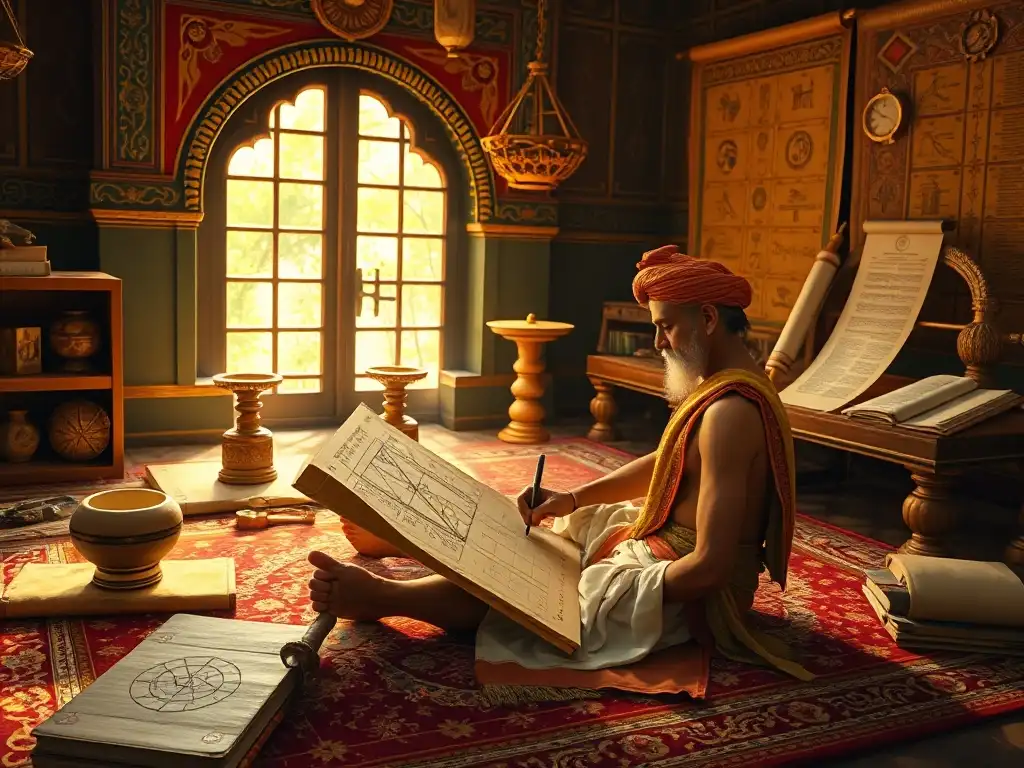
The Sulba Sutras, composed between 800 and 500 BCE, represent some of the earliest mathematical texts in ancient India. These scriptures primarily focus on geometry, particularly in the context of altar construction for Vedic rituals. Their influence extends far beyond religious practices; they laid foundational principles that would shape mathematical thought in India and beyond.
One of the significant contributions of the Sulba Sutras is the introduction of rigorous geometric constructions, including the calculation of areas and the Pythagorean theorem, long before it was formally acknowledged in Western mathematics. The principles outlined in these texts were instrumental in the development of subsequent mathematical works in ancient India, such as the Aryabhatiya by Aryabhata and Brahmagupta's Brahmasphutasiddhanta. These later texts expanded upon the principles established in the Sulba Sutras, showcasing their long-lasting impact on the mathematical landscape.
Furthermore, the Sulba Sutras influenced not only Indian mathematics but also contributed to mathematical developments in other cultures through translations and adaptations. Their geometric principles were incorporated into Islamic mathematics during the medieval period, showcasing the Sutras' far-reaching implications in the global mathematical narrative.
Relation to Other Ancient Mathematical Texts
The Sulba Sutras are often compared to other ancient texts, such as the Rhind Mathematical Papyrus from Egypt and the Plimpton 322 tablet from Mesopotamia. While these texts share similarities in their practical applications of mathematics, the Sulba Sutras stand out due to their systematic approach to geometry. Unlike the Egyptian and Babylonian texts, which primarily focused on practical calculations, the Sulba Sutras emphasize the theoretical underpinnings of geometric shapes and their relationships, showcasing the advanced level of mathematical understanding in ancient India.
The relationship between the Sulba Sutras and later Indian texts is particularly noteworthy. For instance, Aryabhata's work not only reflects the geometric principles of the Sulba Sutras but also introduces innovations in numerical systems and algebra, demonstrating a clear lineage of mathematical thought. The continuation of ideas from the Sulba Sutras through the Shulba Sutras and other texts highlights their significance as a cornerstone of ancient Indian mathematics.
Impact on Indian Mathematicians and Scholars
The Sulba Sutras significantly impacted Indian mathematicians and scholars, fostering a culture of mathematical inquiry that resulted in groundbreaking advancements. The emphasis on precise measurements and geometric constructions inspired scholars to explore more complex mathematical concepts, including algebra and trigonometry.
For example, mathematicians such as Brahmagupta and Bhaskara II drew upon the foundational principles of the Sulba Sutras to develop their theories in arithmetic and geometry. Their works not only advanced Indian mathematics but also paved the way for future generations, establishing a tradition of mathematical scholarship in India that continued for centuries.
Moreover, the teachings of the Sulba Sutras were integrated into the education system, influencing generations of students and scholars in their mathematical studies. This educational legacy ensured that the principles of the Sulba Sutras remained a vital part of the mathematical canon in ancient India.
Key Mathematicians Associated with the Sulba Sutras
Several key mathematicians are associated with the Sulba Sutras, illustrating the richness of mathematical thought during this period. These figures not only contributed to the texts but also influenced the broader landscape of ancient Indian mathematics.
Notable Figures in Ancient Indian Mathematics
Among the notable figures is Baudhayana, who is often credited with the formulation of the Pythagorean theorem in his work on geometry within the Sulba Sutras. His insights into the relationships between different geometric shapes laid the groundwork for future explorations in mathematics.
Another significant figure is Apastamba, who also contributed to the Sulba Sutras. His work emphasized the practical applications of geometry in constructing altars and other structures, showcasing the necessity of mathematics in Vedic rituals.
These mathematicians exemplified the blend of practical and theoretical mathematics, demonstrating the integral role of the Sulba Sutras in shaping their ideas and methodologies.
Contributions of These Mathematicians to the Field
The contributions of Baudhayana and Apastamba extend beyond their writings in the Sulba Sutras. Baudhayana's principles of construction influenced subsequent mathematicians, particularly in the realms of algebra and geometry. His work provided a framework for understanding complex geometric relationships, which was essential for later developments in Indian mathematics.
Apastamba’s emphasis on practical geometry not only facilitated the construction of Vedic altars but also laid the groundwork for the application of mathematical principles in various fields, including architecture and engineering. His approaches to measurement and construction were vital in advancing the understanding of spatial relationships, ensuring that the mathematical principles established in the Sulba Sutras were applied effectively in real-world scenarios.
The mathematicians associated with the Sulba Sutras played a crucial role in the evolution of ancient Indian mathematics, contributing foundational concepts that would influence generations of scholars and shape the trajectory of mathematical thought in India and beyond.
The Sulba Sutras and Their Legacy
The Sulba Sutras, a collection of ancient Indian texts dating back to around 800 to 500 BCE, are considered foundational works in the realm of mathematics. Composed as part of the larger body of Vedic literature, these texts primarily focus on geometry and its application to religious rituals, specifically the construction of altars. The Sulba Sutras lay the groundwork for principles that would later influence both Indian and global mathematical thought.
The significance of the Sulba Sutras extends beyond their primary function. They introduce several key mathematical concepts, including the Pythagorean theorem, long before it was formally recognized in Western mathematics. For instance, the Sutras contain rules for constructing right-angled triangles, illustrating the geometric understanding that existed in ancient India. This body of work represents not only an early example of systematic mathematical reasoning but also showcases the sophisticated level of abstraction achieved by ancient Indian mathematicians.
Long-term Significance in the History of Mathematics
The long-term significance of the Sulba Sutras in the history of mathematics cannot be overstated. They serve as one of the earliest examples of mathematical rigor, demonstrating a methodical approach to problem-solving. This methodology laid the groundwork for future developments in mathematics, influencing various fields such as geometry, arithmetic, and algebra.
The contributions of the Sulba Sutras are also reflected in the works of later Indian mathematicians, such as Aryabhata and Brahmagupta, who built upon these concepts. The principles outlined in the Sulba Sutras were integral in shaping the mathematical landscape of ancient India, fostering a culture of inquiry and exploration that would lead to significant advancements in the field. Their impact also reached beyond the Indian subcontinent, as these ideas eventually made their way into the mathematical traditions of the Islamic world and, subsequently, into Europe.
Continuing Relevance in Modern Mathematical Concepts
The relevance of the Sulba Sutras in modern mathematics is evident in various ways. The geometric principles and methods discussed in these texts resonate with contemporary mathematical practices. For example, the Sutras' approach to constructing altars mirrors modern techniques used in architectural design and engineering, where precise measurements and geometric configurations are critical.
Furthermore, the Pythagorean theorem, which is prominently featured in the Sulba Sutras, remains a cornerstone of mathematics today. The legacy of the Sulba Sutras is also present in modern educational curricula, where the foundational concepts of geometry are taught to students worldwide. This enduring influence highlights the timeless nature of the mathematical insights offered by ancient Indian scholars.
Conclusion: The Enduring Impact of the Sulba Sutras on Mathematics
The Sulba Sutras represent a cornerstone of ancient Indian mathematics, encapsulating a wealth of knowledge that has transcended time. Their insights into geometry, measurement, and mathematical reasoning have not only shaped the development of mathematics in India but have also contributed significantly to the global mathematical heritage.
Summary of Key Contributions to Ancient Indian Mathematics
The key contributions of the Sulba Sutras to ancient Indian mathematics include:
- Introductions of Geometric Principles: The texts provide early formulations of geometric concepts, particularly in relation to constructing altars.
- Pythagorean Theorem: They present principles similar to the Pythagorean theorem, showcasing advanced knowledge of right-angled triangles.
- Methodical Problem-Solving: The Sulba Sutras exemplify a systematic approach to mathematical reasoning, setting the stage for future mathematical inquiry.
Reflection on the Importance of Preserving Ancient Knowledge
Reflecting on the importance of preserving ancient knowledge, the Sulba Sutras serve as a crucial reminder of the rich intellectual heritage of ancient India. Preserving such texts is vital not only for understanding the historical context of mathematics but also for appreciating the contributions made by ancient civilizations to modern knowledge. As we continue to explore and build upon these foundational ideas, it is essential to honor and protect the wisdom of our ancestors, ensuring that their contributions to mathematics and other fields remain accessible to future generations.
- Introduction to Ancient Indian Mathematics Contributions
- Historical Context of the Sulba Sutras
- Core Principles of the Sulba Sutras
- Mathematical Innovations in the Sulba Sutras
- The Influence of the Sulba Sutras on Later Mathematics
- Key Mathematicians Associated with the Sulba Sutras
- The Sulba Sutras and Their Legacy
- Conclusion: The Enduring Impact of the Sulba Sutras on Mathematics
Frequently Asked Questions
What are the Sulba Sutras?
The Sulba Sutras are ancient texts that provide guidelines for constructing altars and other geometrical figures, reflecting significant mathematical contributions in ancient India.
How did ancient Indian mathematicians influence modern mathematics?
Ancient Indian mathematicians, especially through texts like the Sulba Sutras, introduced concepts like zero, decimal system, and geometry, which laid the foundation for many modern mathematical principles.
What is the importance of geometry in the Sulba Sutras?
Geometry in the Sulba Sutras is crucial as it describes various geometric constructions and principles, showcasing the sophisticated understanding of spatial relationships in ancient Indian mathematics.
Were the Sulba Sutras recognized outside of India?
Yes, the Sulba Sutras were acknowledged beyond India and influenced mathematical thinking in other cultures, highlighting the global impact of ancient Indian mathematics contributions.
How do the Sulba Sutras relate to the Gupta Empire?
The Sulba Sutras reflect the mathematical advancements that preceded the Gupta Empire, which is often regarded as a golden age for mathematics and science in ancient India.
Final Reflection: Embracing the Legacy of Ancient Indian Mathematics
The contributions of ancient Indian mathematics, particularly through the Sulba Sutras, resonate profoundly in today's world, illustrating how foundational ideas can shape modern thought. These ancient texts not only laid the groundwork for geometric principles but also showcased the innovative spirit of a civilization that valued knowledge and precision. As we navigate a world increasingly reliant on mathematics and technology, the wisdom embedded in these ancient scriptures reminds us of the timeless nature of intellectual pursuit.
The impact of the Sulba Sutras extends beyond historical significance; they continue to influence contemporary mathematical practices and educational frameworks. The principles of geometry and measurement articulated in these texts have found their way into modern curricula, fostering a deeper appreciation for the rich tapestry of mathematical history. Mathematics knows no races or geographic boundaries; for mathematics, the cultural world is one country.
– David Hilbert. This quote encapsulates the universality of mathematical thought, highlighting how the contributions of ancient Indian scholars transcend time and culture, enriching our collective understanding.
As we reflect on the significance of the Sulba Sutras and their contributions to ancient Indian mathematics, I invite you to consider how these lessons can inspire your own journey. Embrace the spirit of inquiry and exploration that characterized these ancient thinkers. Whether you are a student, educator, or simply a curious mind, let the legacy of these mathematical pioneers encourage you to delve deeper into the world of numbers and shapes. By doing so, you not only honor their contributions but also contribute to the ongoing dialogue of knowledge that spans generations.
Unleash the Wisdom of Ancient Mathematics!
Thank you for diving into the fascinating world of the Sulba Sutras! We hope you’ve gained valuable insights into how these ancient texts shaped mathematical practices in India. Now, it’s time to put that knowledge into action and explore further!
Here are a few steps you can take to deepen your understanding of this remarkable subject:
- Explore More: Check out additional resources or books on ancient Indian mathematics to uncover more fascinating concepts and techniques.
- Share Your Knowledge: Discuss what you've learned with friends, teachers, or on social media. Engaging with others can amplify your understanding and spark interesting conversations!
- Practice Geometry: Apply the principles from the Sulba Sutras in a practical project, such as constructing geometric patterns or replicating ancient-style constructions at home.
How will you incorporate the brilliance of ancient Indian mathematics into your everyday life? We’d love to hear your thoughts in the comments!