
The Intersection of Philosophy and Mathematics in Ancient India

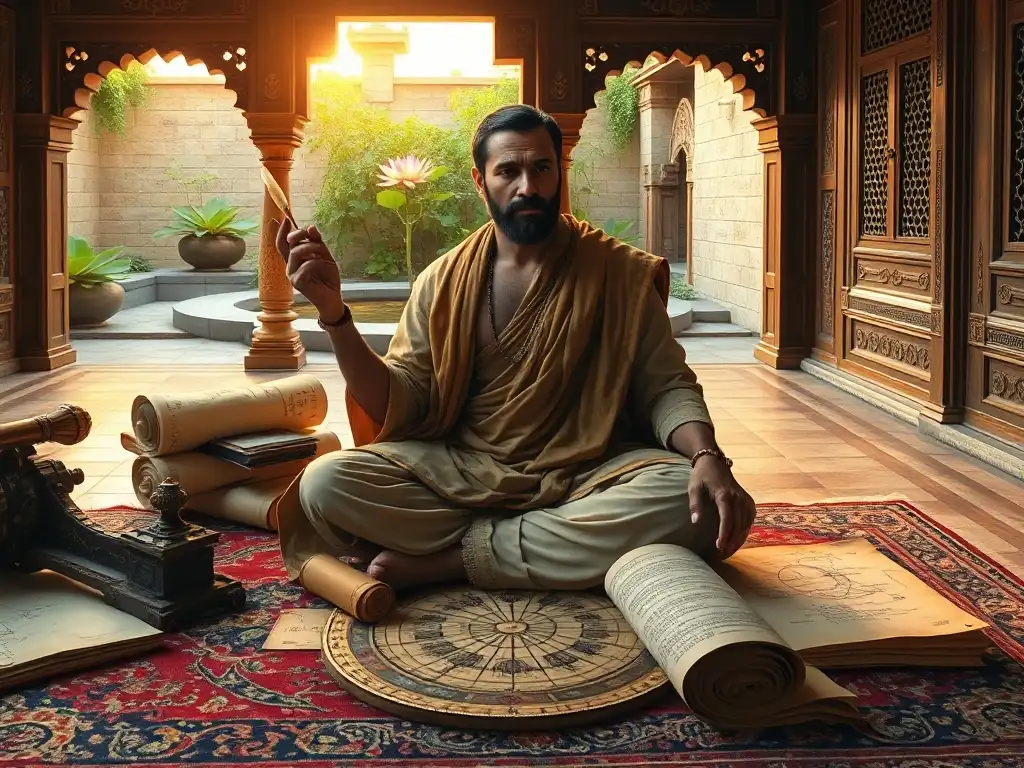
Welcome to Ancient India History, where we embark on a fascinating journey through the rich tapestry of India's past. In this captivating exploration, we delve into the profound realms of Ancient Indian philosophy and mathematics, uncovering the brilliant minds and groundbreaking ideas that shaped these intertwined disciplines. Have you ever wondered how ancient thinkers laid the foundations for modern mathematical concepts?
Our main article, “The Intersection of Philosophy and Mathematics in Ancient India,” promises to unveil the secrets of this extraordinary legacy. Join us as we unravel the complexities of thought and calculation that emerged from the vibrant civilizations of the Indus Valley to the illustrious Gupta Empire—prepare to be inspired!

Ancient India stands as a beacon of intellectual achievement, where the realms of philosophy and mathematics intertwine, creating a rich tapestry of thought that has influenced generations. The exploration of ancient Indian philosophy and mathematics reveals a unique symbiosis, where philosophical inquiry not only shaped ethical and metaphysical discussions but also provided a foundational framework for mathematical concepts.
This article delves into the significant contributions of ancient Indian civilizations, from the analytical rigor of the Nyaya school to the quantitative insights of the Vaisheshika, illustrating how these philosophical traditions fostered advancements in mathematics. By examining the interplay between these disciplines, we uncover the profound impact they had on not just Indian society, but the wider world of knowledge.
Introduction to Ancient Indian Philosophy and Mathematics
Overview of Ancient Indian Civilization
Ancient Indian civilization, flourishing from approximately 2500 BCE with the Indus Valley civilization, laid the groundwork for a complex society rich in cultural, spiritual, and intellectual pursuits. The cities such as Harappa and Mohenjo-Daro showcased advanced urban planning and trade networks, which later evolved into a society where philosophy and mathematics emerged as pivotal fields of study. The Vedic period, around 1500 BCE, ushered in a profound cultural shift, emphasizing spiritual inquiry and knowledge, leading to the codification of ideas in texts such as the Vedas and Upanishads.
Importance of Philosophy in Ancient Indian Culture
Philosophy in ancient India was not merely an abstract pursuit; it was deeply intertwined with daily life, ethics, and governance. Schools of thought such as Nyaya and Samkhya provided frameworks for understanding reality and human existence. These philosophies encouraged rigorous debate and logical reasoning, fostering an environment where inquiry into the nature of existence and knowledge thrived. The philosophical discourse shaped societal norms and influenced various aspects of culture, including the arts, religion, and education.
Significance of Mathematics in Ancient Indian Society
Mathematics in ancient India was not only a tool for trade and commerce but also played a crucial role in astronomy, architecture, and even in the spiritual domain. Ancient Indian mathematicians made significant advancements in arithmetic, geometry, and algebra, laying the groundwork for concepts such as zero and the decimal system. The mathematical texts of the time, including the "Sulba Sutras," provided practical guidelines for constructing altars, indicating the practical application of mathematical principles in religious practices.
Key Philosophical Schools and Their Mathematical Contributions
Nyaya: Logic and Its Mathematical Implications
The Nyaya school emphasized the importance of logic and reasoning, which can be seen in its approach to epistemology and inference. The analytical methods developed by Nyaya philosophers influenced mathematical reasoning, particularly in the formulation of proofs and problem-solving techniques.
Vaisheshika: Atomism and Quantitative Analysis
The Vaisheshika school, with its focus on the nature of reality through atomism, introduced early concepts of quantification. The categorization of substances and their properties paved the way for mathematical modeling, as philosophers sought to quantify and classify the elements of the natural world.
Samkhya: Enumeration and Mathematical Frameworks
Samkhya philosophy, known for its dualistic approach, utilized enumeration to explain the universe's structure. This systematic categorization laid a mathematical foundation for understanding the principles of existence, linking philosophical thought with mathematical frameworks.
Advaita Vedanta: Non-Duality and Mathematical Concepts
Advaita Vedanta, with its emphasis on non-duality, also found expression in mathematical thought. The philosophical exploration of oneness and the nature of reality encouraged a more abstract understanding of mathematical concepts, influencing later developments in both philosophy and mathematics.
Through this exploration of ancient Indian philosophy and mathematics, we can appreciate the intricate connections that have shaped intellectual traditions, not only within India but across the globe. As we delve deeper into each philosophical school and its mathematical contributions, we will uncover a rich legacy that continues to inspire and inform contemporary thought.
Prominent Mathematicians Influenced by Philosophy
Ancient Indian civilization produced a remarkable array of mathematicians whose work was deeply intertwined with philosophical thought. The interplay between philosophy and mathematics in this era is evident in the writings and methodologies of several prominent figures. These mathematicians not only contributed to mathematical theories but also engaged with philosophical concepts, which shaped their understanding and approaches. The influence of philosophical inquiry can be seen in their definitions, axioms, and problem-solving techniques, as they often sought to understand the universe and their place in it through mathematical frameworks.
Aryabhata: The Fusion of Philosophy and Mathematical Innovation
Aryabhata, one of the earliest and most influential mathematicians from ancient India, was born in 476 CE. His seminal work, the Aryabhatiya, reflects a profound integration of philosophical principles with mathematical concepts. Aryabhata approached mathematics as a tool for understanding the cosmos, emphasizing the significance of numerical precision and logical reasoning.
His exploration of concepts such as zero, place value, and the approximation of π (pi) was not merely technical but also philosophical, as he sought to explain the nature of reality through numbers. Aryabhata's belief in the cyclical nature of time and the cosmos influenced his mathematical models, exemplifying how philosophical inquiry can drive mathematical innovation.
Brahmagupta: Philosophical Foundations of Algebra
Brahmagupta, who lived in the 7th century CE, made significant contributions to algebra that were rooted in philosophical concepts. His work, the Brahmasphutasiddhanta, introduces rules for arithmetic operations involving both positive and negative numbers, showcasing a philosophical understanding of opposites and balance. Brahmagupta's emphasis on practical applications of mathematics for societal needs, such as land measurement and astronomy, highlighted the philosophical belief in the utility of knowledge.
He argued that mathematics should serve humanity, reflecting an ethical dimension to his work. His dialogues on mathematical problems also illustrate a philosophical approach, as he engaged with differing viewpoints and sought to harmonize them.
Bhaskara I and II: Philosophical Contexts of Mathematical Theorems
Bhaskara I (circa 600 CE) and his successor Bhaskara II (1114–1185 CE) were pivotal figures in the integration of philosophy with mathematics. Bhaskara I's translations of mathematical texts from Greek to Sanskrit emphasized the importance of cross-cultural knowledge and philosophical inquiry. He introduced the concept of sine in trigonometry, linking it to philosophical inquiries about angles and their relationships in nature.
Bhaskara II, known for his work Lilavati and Bijaganita, further expanded on these themes. His exploration of mathematical problems often included philosophical reflections on the nature of knowledge, error, and understanding. He believed that mathematics was a means to achieve a deeper insight into the universe, thus showcasing how philosophical thought informed his mathematical reasoning and teaching.
Mathematical Texts Reflecting Philosophical Thought
The mathematical texts produced in ancient India are not merely compendiums of numbers and equations; they are also rich in philosophical discourse. These works reflect a deep engagement with the principles of logic, ethics, and metaphysics, providing insights into how ancient Indian scholars perceived the relationship between mathematics and the broader universe.
The Aryabhatiya: A Philosophical and Mathematical Treatise
The Aryabhatiya is a foundational text in Indian mathematics, composed by Aryabhata. It is divided into several sections covering arithmetic, algebra, and astronomy, all framed within a philosophical context. Aryabhata's work begins with a philosophical assertion about the nature of numbers and their relation to the cosmos. The text emphasizes the importance of logical reasoning and systematic approaches to problem-solving, which mirrors philosophical methodologies. Aryabhata’s discussions on the motions of celestial bodies and their mathematical representation showcase how philosophical inquiries about the cosmos influenced mathematical formulations.
Brahmasphutasiddhanta: Algebraic Philosophy Explored
Brahmagupta’s Brahmasphutasiddhanta is another vital text that blends algebra with philosophical principles. This work addresses the conceptual foundations of algebra, including rules for solving equations and the treatment of zero as a number. Brahmagupta's philosophical reflections on the nature of existence and non-existence parallel his mathematical explorations, particularly in his discussions of positive and negative quantities. By situating algebra within a philosophical framework, Brahmagupta elevates mathematics to a discourse about reality, existence, and human understanding.
Siddhanta Shiromani: Bridging Philosophy and Mathematics
Bhaskara II’s Siddhanta Shiromani represents a culmination of earlier mathematical and philosophical thought. This text explores various mathematical concepts, including calculus and astronomy, while reflecting on philosophical questions about time, space, and perception. Bhaskara II’s insistence on the practical applications of mathematics in daily life and its role in understanding the universe underscores a philosophical commitment to knowledge as a means of enhancing human experience. His work serves as a bridge between abstract mathematical theories and their philosophical implications, illustrating how mathematics can illuminate deeper truths about existence.
The Role of Philosophy in the Development of Mathematical Concepts

The evolution of mathematical concepts in ancient India is deeply intertwined with philosophical thought. Philosophers of the time did not merely engage in abstract reasoning; they actively sought to understand the universe and human existence through logical frameworks, which laid the groundwork for mathematical principles. This intersection can be seen in the works of significant figures such as Aryabhata and Brahmagupta, who integrated philosophical ideas into their mathematical theories, demonstrating that mathematics was not just a tool for calculation but a means to explore deeper truths about the cosmos and existence.
Philosophy in ancient India prompted mathematicians to question the nature of numbers, infinity, and spatial relationships. The profound metaphysical inquiries led to the development of concepts such as zero and the decimal system, which were revolutionary not just mathematically but also philosophically, as they changed the perception of quantity and existence itself.
Philosophy as a Catalyst for Mathematical Thought
Philosophy acted as a catalyst for mathematical thought by encouraging a rigorous questioning of fundamental concepts. Ancient Indian philosophers, particularly those from the schools of Nyaya and Vaisheshika, emphasized logical reasoning and analysis. This philosophical approach fostered a culture where mathematical propositions were subjected to critical scrutiny.
For instance, the idea of proof and validation in mathematics can be traced back to philosophical discussions on epistemology, or the theory of knowledge. The meticulous nature of philosophical argumentation inspired mathematicians to formulate proofs that were not only valid but also logically sound. This relationship illustrates how philosophy enriched mathematical discourse, providing a framework for inquiry that was both systematic and profound.
The Influence of Spiritual and Ethical Perspectives on Mathematics
In ancient India, spiritual beliefs and ethical considerations significantly influenced mathematical thought. Mathematics was often viewed through the lens of dharma, or duty, and the pursuit of knowledge was considered a path to spiritual enlightenment. This integration meant that mathematical studies were not just academic endeavors but were also seen as moral pursuits that contributed to the greater good.
The concept of harmony, prevalent in Indian philosophy, found expression in mathematical theories such as those involving geometry and proportions. The sacredness attributed to numbers, especially in practices like Vedic mathematics, underscores the spiritual dimension of mathematical knowledge. For example, certain numbers were believed to hold mystical significance, influencing both mathematical formulations and philosophical interpretations of the universe.
Integrating Mathematical Logic with Philosophical Inquiry
The integration of mathematical logic with philosophical inquiry created a rich intellectual environment in ancient India. Thinkers like Bhaskara II advanced mathematical concepts while simultaneously engaging in philosophical discussions regarding their implications. This dual focus facilitated the development of sophisticated mathematical techniques, including algorithms for arithmetic operations and solutions to complex equations.
Moreover, this integration allowed for the exploration of logical paradoxes and the nature of infinity, topics that were central to both philosophical and mathematical discussions. The resulting dialogue between philosophy and mathematics not only advanced each field but also produced a holistic understanding of knowledge, emphasizing that mathematics could serve as a foundation for exploring philosophical questions about reality and existence.
Conclusion: The Legacy of Ancient Indian Philosophy and Mathematics
The legacy of ancient Indian philosophy and mathematics is profound and enduring. The contributions made by philosophers and mathematicians during this period laid foundational principles that continue to inform mathematical thought and philosophical inquiry today. The seamless blend of these disciplines not only advanced mathematical techniques but also enriched philosophical discourse, demonstrating the importance of interdisciplinary approaches to knowledge.
Lasting Impact on Modern Mathematics and Philosophy
The impact of ancient Indian philosophy and mathematics on modern disciplines is substantial. Concepts such as zero and the place-value system, originating from this era, are now fundamental to the global mathematical framework. Additionally, the philosophical inquiries of ancient Indian thinkers have influenced contemporary discussions on logic, ethics, and the nature of knowledge.
Modern mathematicians and philosophers alike draw inspiration from the methodologies and principles established in ancient India, highlighting the timeless relevance of these ideas. The legacy of this intersection continues to inspire scholars across the globe, affirming the importance of the ancient Indian contributions to both fields.
Reflection on the Interconnectedness of Disciplines in Ancient India
The interconnectedness of philosophy and mathematics in ancient India serves as a reminder of the holistic nature of knowledge. Rather than existing as isolated fields, these disciplines were seen as complementary, each informing and enriching the other. This perspective fosters a deeper appreciation for the contributions of ancient Indian civilizations, showcasing their unique ability to integrate diverse domains of thought.
In reflecting on this interconnectedness, it becomes clear that the achievements of ancient Indian philosophers and mathematicians were not simply isolated intellectual milestones; they were part of a broader tapestry of inquiry that sought to understand the universe and humanity’s place within it. This legacy endures, inviting modern thinkers to explore the symbiotic relationship between disciplines in their pursuit of knowledge.
Further Reading and Resources
To deepen your understanding of the intricate relationship between ancient Indian philosophy and mathematics, a variety of texts and online resources are available. These materials offer insights into the philosophical underpinnings of mathematical concepts, as well as the historical context in which these ideas flourished.
Recommended Texts on Ancient Indian Philosophy and Mathematics
-
"The History of Mathematics: A Brief Course" by Roger L. Cooke
This text provides a comprehensive overview of mathematical developments across various cultures, including ancient India. It highlights significant mathematical achievements and their philosophical implications.
-
"Mathematics in India" by Kim Plofker
Plofker's work delves into the mathematical practices of ancient India, examining texts from the Vedic period to the time of the Mughal Empire. The book discusses the philosophical context of these mathematical advancements.
-
"Indian Mathematics: A Historical Perspective" by C. B. Mahajan
This book offers a detailed exploration of the evolution of mathematical thought in India, alongside a discussion of the philosophical frameworks that influenced these developments.
-
"The Philosophy of Mathematics Education" by Paul Ernest
While not exclusively focused on ancient India, this text engages with the philosophical dimensions of mathematics education, providing a broader context that can be applied to ancient Indian thought.
-
"The Vedic Mathematics: A Mathematical System" by Jagadguru Swami Sri Bharati Krishna Tirthaji Maharaja
This book explores the unique system of mathematics derived from Vedic texts, emphasizing its philosophical underpinnings and practical applications.
Online Resources for Exploring Ancient Indian Mathematical Contributions
-
The Digital Library of India
This resource offers access to a plethora of ancient texts, many of which discuss mathematical concepts and their philosophical significance. It serves as a valuable repository for scholars and enthusiasts alike.
-
The Indian Mathematical Society
Their website provides various resources, including articles, publications, and historical records related to the contributions of ancient Indian mathematicians.
-
Publications by the Indian Institute of Science
The institute often publishes research on the historical aspects of mathematics in India, including the intersection of mathematics and philosophy.
-
Online Courses on Coursera and edX
Numerous courses focus on Indian philosophy and mathematics, offering insights into how these fields interconnect. Look for courses that specifically address ancient Indian contributions.
-
YouTube Channels
Channels like "The Mathologer" and "Numberphile" occasionally feature content related to ancient Indian mathematics, making complex topics accessible through visual media.
By engaging with these texts and resources, readers can gain a deeper appreciation of the rich tapestry of ancient Indian philosophy and mathematics, understanding how these disciplines influenced one another and contributed to the broader landscape of knowledge.
- Introduction to Ancient Indian Philosophy and Mathematics
- Key Philosophical Schools and Their Mathematical Contributions
- Prominent Mathematicians Influenced by Philosophy
- Mathematical Texts Reflecting Philosophical Thought
- The Role of Philosophy in the Development of Mathematical Concepts
- Conclusion: The Legacy of Ancient Indian Philosophy and Mathematics
- Further Reading and Resources
- What is the significance of ancient Indian philosophy in the context of mathematics?
- How did ancient Indian mathematicians contribute to the field of mathematics?
- Can you explain the relationship between philosophy and mathematics in ancient India?
- What role did religious texts play in the development of mathematics in ancient India?
- How did the Gupta Empire influence ancient Indian philosophy and mathematics?
Frequently Asked Questions
What is the significance of ancient Indian philosophy in the context of mathematics?
Ancient Indian philosophy provided a foundational framework for mathematical concepts, emphasizing logical reasoning and abstract thinking, which greatly influenced mathematical development.
How did ancient Indian mathematicians contribute to the field of mathematics?
Ancient Indian mathematicians made pioneering contributions, such as the invention of the decimal system and concepts like zero, significantly shaping modern mathematics.
Can you explain the relationship between philosophy and mathematics in ancient India?
In ancient India, philosophy and mathematics were intertwined, where philosophical inquiries led to mathematical advancements and vice versa, reflecting a holistic understanding of knowledge.
What role did religious texts play in the development of mathematics in ancient India?
Religious texts, such as the Vedas and Siddhantas, contained mathematical concepts embedded within rituals and astronomy, illustrating the integration of spirituality and science.
How did the Gupta Empire influence ancient Indian philosophy and mathematics?
The Gupta Empire was a golden age for both philosophy and mathematics, fostering an environment where thinkers like Aryabhata and Brahmagupta made significant theoretical advancements, further enriching Indian intellectual tradition.
Final Reflection: The Enduring Legacy of Ancient Indian Philosophy and Mathematics
The intersection of philosophy and mathematics in ancient India is not merely a historical curiosity; it is a profound reminder of how interconnected our understanding of the universe can be. In today's world, where disciplines often exist in silos, the ancient Indian approach serves as a powerful testament to the potential of integrating diverse fields of knowledge. This rich tapestry of thought challenges us to reconsider the boundaries we impose on learning and encourages a holistic view of education that is increasingly relevant in our complex, interconnected society.
The influence of ancient Indian philosophy and mathematics continues to resonate in contemporary discourse, shaping not only academic pursuits but also our cultural narratives. The synthesis of logical reasoning and metaphysical inquiry found in texts like the Sulbasutras and the works of thinkers such as Aryabhata and Brahmagupta illustrates a legacy that transcends time. Mathematics is the language with which God has written the universe.
This quote by Galileo Galilei encapsulates the essence of this intersection, highlighting how the mathematical principles developed in ancient India still underpin our understanding of the cosmos today.
As we reflect on the lessons from ancient Indian philosophy and mathematics, let us embrace the call to cultivate a mindset that values interdisciplinary exploration. Consider how you can apply these insights in your own life—whether through fostering curiosity in your studies, engaging in philosophical discussions, or seeking connections between seemingly disparate fields. The wisdom of the ancients invites us to think deeply and act boldly, reminding us that the pursuit of knowledge is a journey best undertaken with an open heart and a curious mind.
Unveil the Wisdom of Ancient Minds!
Thank you for exploring the fascinating intersection of philosophy and mathematics in Ancient India with us! You've uncovered the profound insights that these ancient thinkers have contributed to our understanding of the universe. Now, it's time to take this knowledge further and put it into practice.
Here’s how you can continue your journey:
- Dive deeper into the rich texts of Ancient Indian philosophy and mathematics by visiting your local library or accessing online resources to read original works such as Brahmasphutasiddhanta or GanitaSarasangraha.
- Share your insights with friends or on social media! Start a conversation about how these ancient ideas can apply to modern challenges.
- Join a discussion group or forum focused on ancient philosophies. Engaging with others can provide new perspectives and enrich your understanding!
What aspect of Ancient Indian philosophy or mathematics resonates with you the most, and how can you incorporate that into your life today?