
How Ancient India’s Invention of Zero Laid the Foundation for Future Mathematicians


Welcome to Ancient India History, where we take you on a captivating journey through the remarkable tapestry of ancient Indian civilizations. Here, we delve into their rich contributions, cultural heritage, and significant milestones that have shaped human progress. In our featured article, we explore the groundbreaking invention of zero—a mathematical marvel that not only revolutionized calculations but also laid the foundation for future mathematicians across the globe.
Curious about how this simple yet profound concept emerged from the brilliance of ancient minds? Join us as we unravel the story behind this pivotal invention and more, inviting you to discover the incredible legacy of ancient India.
- Introduction to Ancient India's Invention of Zero
- Historical Context of Mathematics in Ancient India
- The Concept of Zero in Ancient Indian Mathematics
- The Invention of Zero: Key Figures and Texts
- The Impact of the Invention of Zero on Mathematics
- Legacy of Ancient India's Invention of Zero
- Conclusion: Reflection on Ancient India’s Contribution to Mathematics
-
Frequently Asked Questions
- What is the significance of the invention of zero in ancient India?
- How did ancient Indian mathematicians contribute to mathematics?
- Who were the key figures involved in the development of mathematics in ancient India?
- How did the concept of zero spread to other cultures?
- What are some other innovations from ancient Indian civilizations?
- Final Reflection: The Enduring Legacy of Zero from Ancient India
- Explore the Infinite Possibilities of Zero!
Introduction to Ancient India's Invention of Zero
The invention of zero is one of the most significant contributions of ancient Indian civilization to the world of mathematics. This seemingly simple numeral has transformed mathematical thought and practice, enabling complex calculations and the development of advanced mathematical concepts. The ancient Indians not only conceptualized zero as a number but also recognized its importance as a placeholder, which facilitated the development of the decimal system.
Understanding this remarkable achievement allows us to appreciate how ancient India's invention of zero laid a solid foundation for future mathematicians, influencing cultures and civilizations across the globe. In this article, we will explore the significance of zero in mathematics, provide an overview of ancient Indian mathematics, and examine the lasting impact of this groundbreaking invention.
Understanding the Significance of Zero in Mathematics
Zero represents more than just a number; it embodies a revolutionary concept that reshaped mathematics as we know it. Its significance can be understood through several key aspects:
- Placeholder Function: Zero allows for the representation of large numbers in a compact form. For instance, without zero, differentiating between 10 and 100 would be impossible.
- Mathematical Operations: The inclusion of zero in arithmetic operations, such as addition and subtraction, simplifies calculations and enables the development of algebra.
- Conceptual Leap: Zero represents the idea of 'nothingness,' which was a profound philosophical and mathematical realization that paved the way for further discoveries in mathematics and science.
This innovative thinking laid the groundwork for future advancements in mathematical theory, making zero an essential element in the evolution of mathematics worldwide.
Overview of Ancient Indian Mathematics
Ancient Indian mathematics is marked by its depth and sophistication, reflecting the intellectual prowess of its scholars. Here are some key features:
- Decimal System: The ancient Indians developed a decimal numeral system, which included the use of zero, making calculations more efficient.
- Textual Contributions: Important texts such as the Bakhshali Manuscript and the works of mathematicians like Aryabhata and Brahmagupta illustrate the advanced understanding of mathematical principles in ancient India.
- Geometry and Algebra: Ancient Indian mathematicians made significant strides in geometry and algebra, including the formulation of rules for solving quadratic equations and the calculation of areas and volumes.
The ancient Indian contributions to mathematics were not isolated but interconnected with other fields such as astronomy and philosophy, showcasing a holistic approach to knowledge and learning. This rich mathematical heritage ultimately influenced later developments in mathematics, both in the East and the West.
Historical Context of Mathematics in Ancient India
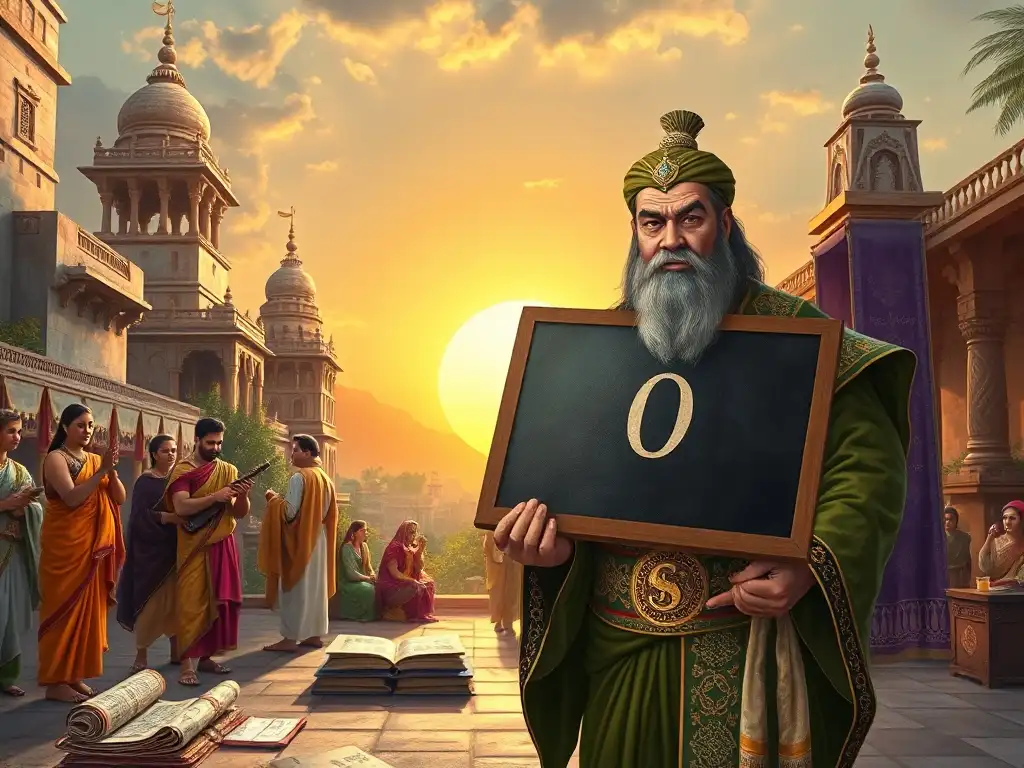
Mathematics in ancient India has a rich and complex history that spans several millennia. The region was home to some of the earliest known civilizations, such as the Indus Valley Civilization, where evidence of mathematical practices can be traced back to around 2500 BCE. The ancient India invention of zero is arguably one of the most significant contributions to mathematics that emerged from this fertile intellectual landscape.
The Early Mathematical Contributions of Ancient Civilizations
The mathematical journey in ancient India began with practical applications, primarily for trade, agriculture, and astronomy. Notable early contributions include:
- Geometry: The construction of cities and urban planning in the Indus Valley Civilization showcased advanced understanding of geometric principles. The grid layout of Harappa and Mohenjo-Daro indicates a sophisticated comprehension of measurements and spatial organization.
- Arithmetic: The use of weights and measures in trade necessitated the development of basic arithmetic operations. The Sulbasutras, texts that date back to around 800-500 BCE, provided rules for constructing altars and involved complex calculations, thereby laying the groundwork for arithmetic and geometric principles.
- Astronomy: Ancient Indian astronomers developed methods to calculate the positions of celestial bodies. The Aryabhatiya, written by Aryabhata in the 5th century CE, demonstrates advanced mathematical techniques including the concept of place value and calculations involving square and cube roots.
These early mathematical contributions illustrate how ancient Indian civilizations not only utilized mathematics in daily life but also began to abstract these concepts, paving the way for more advanced theories, such as the invention of zero.
Influential Mathematicians in Ancient India
Several mathematicians played pivotal roles in advancing mathematical knowledge in ancient India, particularly in relation to the concept of zero:
- Aryabhata (476–550 CE): A landmark figure in Indian mathematics, Aryabhata's work emphasized the importance of zero as a placeholder in positional notation. His treatise, the Aryabhatiya, included methods for calculating the value of pi and solving quadratic equations, showcasing the early understanding of zero's utility.
- Brahmagupta (598–668 CE): Often regarded as the first to formulate rules for arithmetic operations involving zero, Brahmagupta's Brahmasphutasiddhanta provided explicit guidelines on how to handle calculations with zero, including its role in subtraction and division.
- Bhaskara I (600–680 CE): A significant mathematician who built upon Aryabhata's work, he contributed to the knowledge of trigonometry and positional notation. His commentaries emphasized the practical applications of zero in calculations, further solidifying its importance in mathematics.
- Bhaskara II (1114–1185 CE): Known as Bhaskara the Great, he expanded on the work of his predecessors in his seminal text Lilavati, which includes detailed discussions on arithmetic, algebra, and the practical use of zero in various mathematical operations.
These mathematicians not only advanced the understanding of mathematics but also ensured that the ancient India invention of zero became an integral part of mathematical theory, influencing future generations of mathematicians around the world.
The historical context of mathematics in ancient India reveals a profound legacy of intellectual achievement. The early mathematical contributions laid a solid foundation, while influential mathematicians solidified the role of zero in mathematical thought, ultimately shaping the future of mathematics globally.
The Concept of Zero in Ancient Indian Mathematics

The invention of zero is one of the most significant contributions of ancient India to the field of mathematics. This concept not only revolutionized mathematical computation but also laid the groundwork for the advanced numerical systems we use today. Understanding the development and integration of zero into mathematics reveals a rich tapestry of intellectual achievement in ancient Indian culture.
Definition and Evolution of Zero in Ancient Texts
In ancient Indian mathematics, zero was referred to as "shunya," which translates to "void" or "empty." This term reflects the philosophical understanding of nothingness that permeated Indian thought. The earliest recorded use of zero can be traced back to the Bakhshali Manuscript, a 7th-century text that contains a dot representing zero, indicating its use as a placeholder.
The evolution of zero is documented in various texts, such as:
- Aryabhata's Aryabhatiya (499 CE): Aryabhata introduced the concept of zero in his work, emphasizing its importance in calculations.
- Brahmagupta's Brahmasphutasiddhanta (628 CE): Brahmagupta provided rules for arithmetic operations involving zero, including how to handle addition and subtraction with zero.
Through these texts, we can see how the concept of zero transitioned from a mere placeholder to a fundamental element of mathematical operations.
The Role of Zero in the Place Value System
The introduction of zero was crucial for the development of the place value system, which is a cornerstone of modern arithmetic. In this system, the position of a digit determines its value, and zero plays a pivotal role in distinguishing between different magnitudes.
For example, consider the numbers 205 and 25:
- The zero in 205 indicates that there are no "tens," allowing the number to be accurately represented in the decimal system.
- Without zero, the distinction between these two numbers would be lost, leading to confusion.
The use of zero in the place value system enabled ancient Indian mathematicians to perform complex calculations with ease and precision. This system also facilitated the advancement of algebra and arithmetic, allowing scholars to explore more sophisticated mathematical concepts.
The impact of the ancient India's invention of zero extends beyond its immediate use; it influenced mathematicians across the globe. The transmission of this knowledge through trade and cultural exchanges laid the foundation for future developments in mathematics, ultimately shaping the mathematical landscape we know today.
The Invention of Zero: Key Figures and Texts

The invention of zero is one of the most significant contributions from ancient India to the field of mathematics. This revolutionary concept not only transformed mathematical thought in India but also laid the groundwork for future advancements in mathematics globally. The key figures and texts from this era played a crucial role in formalizing and spreading the use of zero, which would eventually become an integral part of mathematical systems worldwide.
Brahmagupta and His Contributions to the Concept of Zero
Brahmagupta (c. 598–668 CE) was a prominent Indian mathematician and astronomer known for his seminal work, the Brahmasphutasiddhanta. In this text, Brahmagupta provided one of the earliest recorded discussions of zero as a number and its operational rules. His contributions can be summarized as follows:
- Definition of Zero: Brahmagupta defined zero as a number, stating that it represents the absence of a quantity. He described it as "the result of subtracting a number from itself," thereby recognizing its unique property.
- Arithmetic Rules: He established crucial arithmetic operations involving zero, including:
- Adding zero to a number yields the number itself.
- Subtracting a number from zero results in the negative of that number.
- The multiplication of zero by any number is zero.
- Division by Zero: Interestingly, Brahmagupta also ventured into the complex idea of division by zero, though he considered it to yield an undefined result. His exploration of this concept reflects the advanced level of mathematical inquiry in ancient India.
Brahmagupta's work not only elucidated the concept of zero but also laid the foundation for future mathematicians to build upon.
The Role of Aryabhata in Advancing Mathematical Ideas
Aryabhata (476–550 CE) was another monumental figure in ancient Indian mathematics whose influence extended far beyond his lifetime. His work, the Aryabhatiya, introduced several mathematical concepts, including the use of zero in calculations. Key highlights of his contributions include:
- Place Value System: Aryabhata utilized a place value system that relied heavily on the concept of zero, allowing for the representation of large numbers and simplifying calculations.
- Trigonometry and Astronomy: His mathematical methods were not confined to pure mathematics; they extended into astronomy. Aryabhata applied his understanding of zero and the decimal system in calculating the positions of celestial bodies, which was revolutionary for his time.
- Innovative Algorithms: Aryabhata devised algorithms that incorporated zero in computations, showcasing its practical application in mathematical problem-solving.
His work was pivotal in advancing mathematical thought, and his treatment of zero as an essential element in calculations significantly influenced subsequent mathematicians.
Ancient Indian Texts that Document the Invention of Zero
Several ancient Indian texts document the evolution and significance of zero, reflecting its integral role in mathematical development. Notable texts include:
- Brahmasphutasiddhanta by Brahmagupta: As previously mentioned, this text provides comprehensive rules for the use of zero in arithmetic operations, establishing a framework for future mathematicians.
- Aryabhatiya by Aryabhata: This foundational text not only discusses zero but also its application in various mathematical concepts, demonstrating its utility in calculations related to astronomy and trigonometry.
- Lilavati by Bhaskara II: Written in the 12th century, this mathematical treatise further elaborates on the use of zero in practical arithmetic and problem-solving, emphasizing its importance in everyday calculations.
- Bijaganita by Bhaskara II: This work extends the exploration of algebra and includes discussions on zero, underscoring its role in solving equations.
These texts collectively illustrate the journey of zero from a conceptual idea to a fundamental mathematical element, showcasing the sophisticated understanding that ancient Indian mathematicians had of this crucial invention. The ancient India invention of zero not only revolutionized mathematics but also had a lasting impact on the development of science and technology across cultures.
The Impact of the Invention of Zero on Mathematics

How Zero Transformed Calculations and Numerical Systems
The invention of zero in ancient India revolutionized mathematical calculations and numerical systems, providing a robust framework for arithmetic operations. Prior to the introduction of zero, calculations were cumbersome and often ambiguous, as numeral systems lacked a symbol to represent the absence of value. The concept of zero, denoted as "shunya" in Sanskrit, allowed mathematicians to express not just numbers, but also the idea of nothingness, which is crucial in positional notation.
- Positional Value:
- The introduction of zero enabled the development of a positional numeral system where the value of a digit depends on its position in a number. For example, in the number 205, the zero indicates that there are no tens, allowing for a clear understanding of the number's value.
- This system contrasts sharply with earlier numeral systems, such as Roman numerals, which did not have a zero and were limited in their ability to perform complex calculations efficiently.
- Simplifying Arithmetic Operations:
- With zero, addition and subtraction became significantly easier. For instance, subtracting a number from itself yields zero, simplifying the process of solving equations.
- Multiplication and division also benefited, as any number multiplied by zero yields zero, eliminating confusion and providing a solid foundation for more advanced mathematical concepts.
- Facilitating Advanced Mathematics:
- The concept of zero opened the door to algebra and calculus, allowing for the formulation of equations and the exploration of mathematical relationships.
- Mathematicians such as Brahmagupta, in the 7th century CE, made significant contributions by establishing rules for arithmetic operations involving zero, laying the groundwork for future mathematical exploration.
The Influence of Zero on Global Mathematical Development
The invention of zero in ancient India did not merely impact the subcontinent; it played a pivotal role in the global mathematical narrative. The transmission of this concept across cultures facilitated significant advancements in mathematics worldwide.
- Transmission to the Islamic World:
- The knowledge of zero and the Indian numeral system reached the Islamic mathematicians during the 8th and 9th centuries. Scholars such as Al-Khwarizmi and Al-Kindi recognized the potential of zero, integrating it into their mathematical work and further developing algebra.
- The term "algorithm" itself is derived from Al-Khwarizmi's name, highlighting the profound impact of Indian mathematics on the Islamic Golden Age.
- Adoption in Europe:
- The introduction of zero to Europe occurred through translations of Arabic texts during the Middle Ages. The Italian mathematician Fibonacci played a crucial role in popularizing the Hindu-Arabic numeral system in Europe through his work "Liber Abaci" in 1202.
- The acceptance of zero in European mathematics ultimately led to a transformation in how calculations were performed, transitioning from cumbersome Roman numerals to a more efficient numeral system.
- Foundation for Modern Mathematics:
- The use of zero became integral to the development of calculus in the 17th century, as mathematicians like Newton and Leibniz utilized the concept in their groundbreaking work.
- Today's mathematical practices, including binary code used in computer science, trace their roots back to the ancient Indian invention of zero, underscoring its lasting legacy.
The ancient India invention of zero stands as a monumental achievement that not only transformed calculations and numerical systems but also significantly influenced the global development of mathematics. The ability to represent absence and facilitate complex operations has shaped the mathematical landscape, leaving an indelible mark on the discipline as we know it today.
Legacy of Ancient India's Invention of Zero

The Lasting Influence on Future Mathematicians
The invention of zero in ancient India is not merely a mathematical breakthrough; it is a cornerstone that influenced countless mathematicians and cultures worldwide. The concept of zero, represented by the symbol "0," was first documented in ancient Indian texts such as the Bakhshali Manuscript and the works of the mathematician Aryabhata. This innovation fundamentally changed the way numbers were understood and manipulated.
- Facilitation of Complex Calculations: The introduction of zero allowed for the development of a positional number system, where the value of a digit depends on its position. This system simplified arithmetic operations, making calculations more efficient. For instance, adding or subtracting large numbers became a straightforward process without cumbersome counting methods.
- Advancements in Algebra: Zero's role in algebra cannot be overstated. It enabled mathematicians to formulate equations and solve for unknowns. The ability to represent the absence of quantity (zero) allowed for the exploration of negative numbers and the formulation of algebraic expressions that laid the groundwork for modern algebra.
- Influence on Global Mathematics: As ancient Indian scholars traveled and shared their knowledge, the concept of zero spread to the Islamic Golden Age and eventually reached Europe. Mathematicians like Al-Khwarizmi and Fibonacci played pivotal roles in adopting and adapting these concepts, which transformed Western mathematics. The widespread acceptance of zero in the West catalyzed significant advancements during the Renaissance, influencing figures such as Galileo and Newton.
- Cultural Integration: Beyond mathematics, the invention of zero found its way into various cultural and philosophical discussions, illustrating the interconnectedness of numerical concepts and human thought. It challenged existing paradigms and encouraged a more abstract understanding of mathematics, contributing to the philosophical discourse on the nature of existence and void.
Comparison with Other Civilizations’ Concepts of Zero
While ancient India's invention of zero is often hailed as revolutionary, it is essential to compare it with how other civilizations conceptualized the idea of zero.
- Mesopotamia: The Sumerians had a placeholder symbol that represented an absence but did not fully embrace the concept of zero as a number. Their numeral system lacked a true zero, leading to ambiguities in calculations.
- Ancient Greece: Greek mathematicians, such as Euclid, did not recognize zero as a number. They viewed numbers as quantities and believed that the absence of quantity (zero) could not be quantified. This perspective limited their mathematical advancements compared to those in ancient India.
- Mayan Civilization: The Maya independently developed a concept of zero in their vigesimal (base-20) number system around the 4th century CE. However, their approach was primarily symbolic and served a calendrical purpose rather than being integrated into a broader mathematical framework.
- Chinese Mathematics: The Chinese used a counting rod system that allowed for the representation of zero as an absence in counting. However, like the Greeks, they did not fully develop the idea of zero as an independent number, which delayed the evolution of mathematical concepts compared to those in ancient India.
While other civilizations had notions that approached the concept of zero, it was ancient India's comprehensive integration of zero into a positional numeral system that set the stage for future mathematical innovations. The legacy of this invention continues to resonate in contemporary mathematics, underscoring its significance in the broader narrative of human intellectual achievement.
Conclusion: Reflection on Ancient India’s Contribution to Mathematics

The invention of zero by ancient Indian mathematicians stands as one of the most significant milestones in the history of mathematics. This concept, which may seem simple to us today, was revolutionary in its time and laid the groundwork for many mathematical advancements that followed. Recognizing the ancient India invention of zero is crucial for understanding not only the mathematical landscape of the past but also the evolution of modern mathematics.
The Importance of Recognizing Ancient India’s Invention of Zero
The historical significance of zero cannot be overstated. It represents a shift in thinking that allowed for the development of more complex mathematical ideas. Here are some key points highlighting its importance:
- Conceptual Breakthrough: The introduction of zero as a numeral allowed mathematicians to conceptualize the idea of "nothingness," paving the way for place value systems.
- Facilitation of Calculations: With zero, calculations became more efficient. The ability to perform arithmetic operations without confusion over the absence of a quantity revolutionized mathematics.
- Influence on Global Mathematics: The ancient Indian numeral system, including zero, influenced mathematical practices worldwide. The transmission of this knowledge through trade and cultural exchange facilitated its adoption in various civilizations.
The acknowledgment of this contribution is vital not only for historical accuracy but also for fostering a deeper appreciation of the intellectual heritage of ancient India.
Final Thoughts on the Impact of Zero in Modern Mathematics
The impact of zero extends far beyond ancient times; it is a cornerstone of modern mathematics.
- Foundation for Algebra: The use of zero is essential in algebra, where it serves as a placeholder and enables the formulation of equations.
- Calculus and Beyond: In calculus, zero is critical in defining limits and understanding concepts like continuity and derivatives. Its role is essential in advanced mathematics and theoretical frameworks.
- Technological Advancements: In contemporary technology, zero plays a pivotal role in computer science and digital communications, where binary code relies heavily on the concepts of zero and one.
The ancient India invention of zero is a profound legacy that has shaped not only mathematical thought but also the very fabric of modern civilization. Recognizing and celebrating this contribution is essential for appreciating the rich history of mathematics and the innovative spirit of ancient Indian scholars.
Frequently Asked Questions
What is the significance of the invention of zero in ancient India?
The invention of zero in ancient India was crucial for the development of mathematics, allowing for complex calculations and the advancement of numerical systems.
How did ancient Indian mathematicians contribute to mathematics?
Ancient Indian mathematicians made significant contributions, including the development of the decimal system and the concept of negative numbers, which were foundational for modern mathematics.
Who were the key figures involved in the development of mathematics in ancient India?
Key figures include Aryabhata, who introduced concepts of trigonometry, and Brahmagupta, who expanded on the use of zero and formulated rules for arithmetic operations involving it.
How did the concept of zero spread to other cultures?
The concept of zero from ancient India spread through trade routes and cultural exchanges, influencing Arab mathematicians and eventually becoming integral to European mathematics.
What are some other innovations from ancient Indian civilizations?
Apart from zero, ancient India saw innovations in geometry, algebra, and astronomy, showcasing a rich tradition of scientific inquiry and intellectual achievement.
Final Reflection: The Enduring Legacy of Zero from Ancient India
The invention of zero in ancient India is not merely a historical footnote; it is a cornerstone of modern mathematics and technology. This revolutionary concept has transcended time and geography, shaping the way we understand and interact with the world around us. As we navigate an increasingly complex digital landscape, the significance of zero becomes even more apparent, reminding us that sometimes, the simplest ideas can lead to the most profound advancements.
The impact of the ancient Indian invention of zero resonates deeply within our cultural and social frameworks. From the realms of science and engineering to everyday calculations, zero has become an integral part of our lives. It serves as a reminder of the ingenuity of our ancestors and their ability to conceptualize ideas that would later become fundamental to our understanding of mathematics. In the grand tapestry of human achievement, the invention of zero is a thread that binds us all.
This quote encapsulates the universal importance of zero, illustrating how it has woven itself into the fabric of our collective knowledge.
As we reflect on the lessons from the ancient Indian invention of zero, let us embrace the spirit of innovation and curiosity that it embodies. I invite you to consider how you can apply this mindset in your own life. Whether it's through problem-solving, creative thinking, or simply appreciating the beauty of mathematics, let the legacy of zero inspire you to explore new possibilities and contribute to the ongoing journey of discovery. Remember, every great achievement starts with a single idea, and sometimes that idea is as simple as nothing at all.
Explore the Infinite Possibilities of Zero!
Thank you for diving into the fascinating world of Ancient India and its groundbreaking invention of zero. You've uncovered how this simple numeral transformed mathematics and shaped future innovations. Now, it's time to make your own mark on this legacy!
Here are some steps you can take to deepen your understanding and appreciation:
- Start a journey into mathematics: Challenge yourself with mathematical puzzles that incorporate the concept of zero. Discover how this invention influences modern calculations and enhances problem-solving skills.
- Share your newfound knowledge: Discuss what you've learned with friends or share insights on social media. Inspire others to appreciate the brilliance of Ancient Indian mathematicians!
- Engage with the community: Join forums or online groups focused on the history of mathematics. Share your insights, ask questions, and connect with fellow enthusiasts who share your passion.
What other historical innovations do you believe have had a profound impact on society, similar to the invention of zero? Let's discuss!