
How Aryabhata Calculated the Value of Pi: A Mathematical Marvel


Welcome to Ancient India History, where we embark on an exhilarating journey through the rich tapestry of India’s past! Dive into the captivating world of ancient civilizations, from the pioneering Indus Valley to the glorious Gupta Empire. In this exploration, we shine a spotlight on the brilliance of Aryabhata, whose groundbreaking calculation of the value of Pi stands as a testament to India’s profound contributions to mathematics. Are you ready to uncover the secrets behind this mathematical marvel? Join us as we unravel the legacy of Aryabhata and discover how his work continues to influence the world today.
- Introduction to Aryabhata and His Contributions to Mathematics
- Understanding the Concept of Pi in Ancient Mathematics
- Aryabhata's Calculation of Pi
- The Mathematical Techniques Employed by Aryabhata
- The Impact of Aryabhata's Value of Pi Calculation
- Conclusion
- References
- Frequently Asked Questions
- Final Reflection: The Enduring Legacy of Aryabhata's Pi Calculation
- Unveil the Wonders of Aryabhata’s Mathematics!
Introduction to Aryabhata and His Contributions to Mathematics
Aryabhata, one of the most celebrated mathematicians and astronomers of ancient India, made groundbreaking contributions that have left an indelible mark on the world of mathematics. Born in 476 CE in the region of Kusumapura (modern-day Patna), Aryabhata's work transcended geographical boundaries, influencing scholars and mathematicians for centuries.
His most notable achievement, the calculation of the value of Pi, showcases not only his mathematical prowess but also the advanced state of mathematical understanding in ancient Indian civilization. This article delves into Aryabhata's life, the historical context in which he operated, and the significance of his work, particularly in relation to the Aryabhata value of Pi calculation.
Overview of Aryabhata's Life and Era
Aryabhata lived during a time when India was experiencing a rich cultural and intellectual renaissance. The Gupta Empire, often referred to as the Golden Age of India, fostered an environment that encouraged advancements in mathematics, astronomy, and science. Aryabhata's most famous work, the Aryabhatiya, was composed when he was just 23 years old, and it encompassed a wide range of topics including arithmetic, algebra, and astronomy.
His approach was revolutionary; he combined rigorous mathematical analysis with astronomical observations. Aryabhata proposed that the earth rotates on its axis, a concept that was ahead of its time. His contributions to mathematics included not only the calculation of Pi but also the introduction of the concept of zero as a placeholder and the formulation of algorithms for arithmetic operations.
Significance of Aryabhata's Work in Ancient Indian Mathematics
Aryabhata's work is crucial for several reasons. First, his calculation of Pi was remarkably accurate for his time. He approximated the value of Pi as 3.1416, a figure that is strikingly close to the modern value of 3.14159. This demonstrates not only his mathematical skill but also the advanced level of abstract thinking in ancient Indian mathematics.
Moreover, Aryabhata's methods laid the foundation for further mathematical exploration in India and beyond. His contributions influenced later mathematicians, such as Brahmagupta and Bhaskara, who built upon his work. The impact of Aryabhata’s findings can be seen in the development of trigonometry and the use of algorithms, which are fundamental to modern mathematics.
Aryabhata's legacy extends far beyond his era. His innovative calculations and theories exemplify the rich heritage of mathematics in ancient India, making him a pivotal figure in the history of mathematics. Through exploring his life and contributions, we gain insight into the sophisticated understanding of mathematics that existed in ancient Indian civilization, particularly his remarkable calculation of the value of Pi.
Understanding the Concept of Pi in Ancient Mathematics
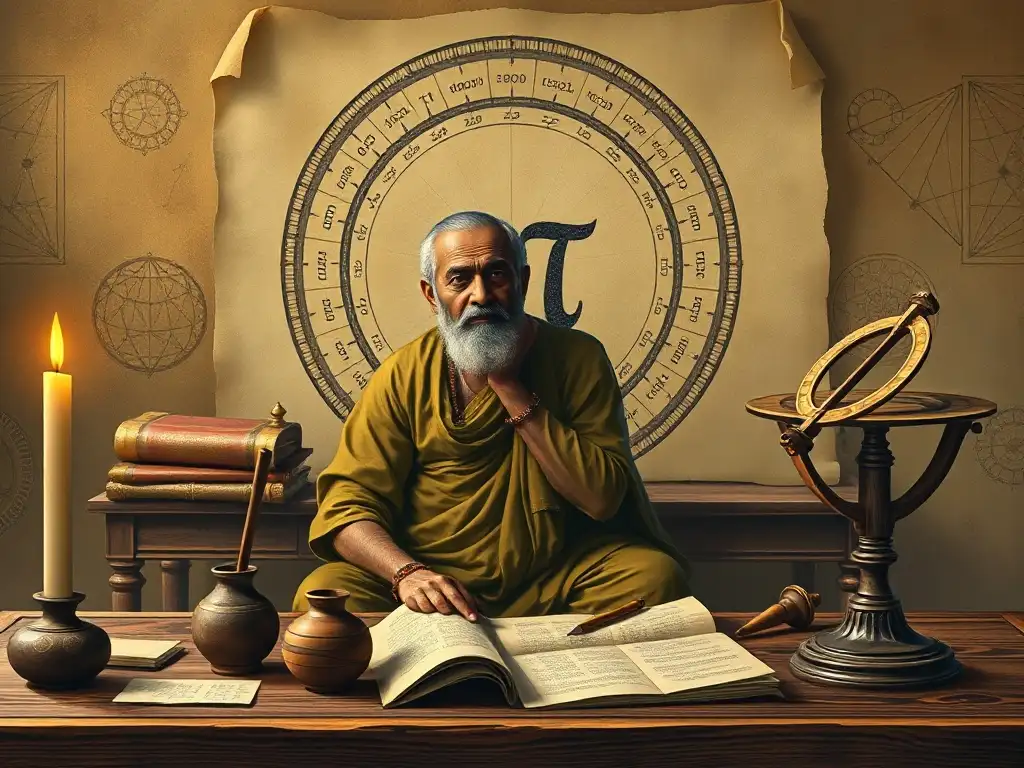
The Historical Context of Pi in Mathematics
The concept of Pi (π) has a storied history that dates back to ancient civilizations, including those in India. While the symbol π was only adopted in the 18th century, the understanding of this mathematical constant has roots that extend thousands of years. Ancient mathematicians recognized Pi as the ratio of the circumference of a circle to its diameter, a value that has been approximated in various cultures.
In ancient India, the value of Pi was known and utilized in mathematical calculations. Aryabhata, one of the most renowned mathematicians of the ancient era, made significant strides in determining this value. His work, the "Aryabhatiya," composed in the 5th century CE, presents the value of Pi as approximately 3.1416, which is remarkably close to the actual value of π (3.14159...). This approximation showcases the advanced mathematical understanding of the time and the meticulous nature of Aryabhata's calculations.
Other civilizations, such as the Egyptians and Babylonians, had their own methods of approximating Pi. The Egyptians used a value of 3.1605, while the Babylonians approximated it as 3.125. However, Aryabhata's calculations were among the most precise for his time, indicating a sophisticated grasp of geometry and mathematical principles.
Importance of Pi in Geometry and Astronomy
Pi plays a crucial role in various fields, especially geometry and astronomy. In geometry, Pi is fundamental in calculating the area and circumference of circles. The formulas:
- Circumference: \( C = \pi \times d \) (where \( d \) is the diameter)
- Area: \( A = \pi \times r^2 \) (where \( r \) is the radius)
are foundational in understanding circular shapes and figures. By accurately calculating Pi, mathematicians like Aryabhata were able to solve complex problems involving circles, which were prevalent in ancient architectural designs and land measurements.
In addition to geometry, Pi's significance extends to astronomy. Ancient astronomers relied on precise calculations to map celestial bodies and predict their movements. Aryabhata's work was instrumental in this regard, as his calculations of celestial orbits and the timing of eclipses depended heavily on an accurate understanding of Pi. His methods contributed to advancements in astronomical models, enhancing the precision of timekeeping and navigation.
Aryabhata's value of Pi calculation not only reflected the mathematical ingenuity of ancient India but also laid the groundwork for future explorations in both geometry and astronomy. The legacy of his work continues to resonate in modern mathematics, demonstrating the enduring significance of Pi across various fields.
Aryabhata's Calculation of Pi

Aryabhata, one of the most prominent mathematicians and astronomers of ancient India, made significant contributions to the field of mathematics, particularly in the calculation of the value of Pi (π). His work not only laid the foundation for future mathematicians but also showcased the advanced mathematical understanding present in ancient Indian civilization. Aryabhata’s approach to computing π was revolutionary for his time and is celebrated for its accuracy and ingenuity.
Methods Used by Aryabhata for Pi Calculation
Aryabhata employed several innovative methods to derive the value of Pi. His primary approach involved geometric calculations and approximations. Here are the key methods he used:
- Geometric Approach: Aryabhata used a geometric method that involved calculating the circumference of a circle. He considered the diameter and derived the ratio of the circumference to the diameter, which is the definition of π.
- Fractions and Approximations: He approximated π using the fraction \( \frac{62832}{20000} \), which simplifies to 3.1416. This approximation is remarkably close to the actual value of π (3.14159).
- Empirical Observations: Aryabhata's calculations were influenced by empirical observations and the need for practical applications in astronomy. He focused on how π could be utilized in astronomical calculations, such as determining the positions of celestial bodies.
Aryabhata's unique combination of theoretical mathematics and practical application allowed him to derive a value that was accurate for many practical purposes of his time.
The Value of Pi in Aryabhata's Work
In Aryabhata’s seminal work, the Aryabhatiya, he explicitly mentions his value of π in relation to his astronomical calculations. He states:
The circumference of a circle is equal to 3.1416 times the diameter.
This clear definition illustrates his understanding of π as a crucial constant in geometry. Additionally, Aryabhata also noted:
- Use of Decimal System: Aryabhata was one of the early mathematicians to use a decimal system, which facilitated more precise calculations, including those of π.
- Contributions to Trigonometry: His work extended into trigonometric functions, where he utilized π in the calculation of sine values, further demonstrating the importance of this mathematical constant in his broader work.
The precision with which Aryabhata calculated the value of π reflects not only his mathematical prowess but also the advanced state of mathematical knowledge in ancient India.
Comparison with Modern Approximations of Pi
When comparing Aryabhata's approximation of π with modern calculations, it's evident that his value was impressively close to the contemporary understanding. Here’s a comparison table to illustrate this:
| Method | Value of π | Accuracy Comparison |
|---|---|---|
| Aryabhata (approximation) | 3.1416 | 0.0002 away from true value |
| Modern Value | 3.14159 | Exact value |
- Continued Evolution: Modern mathematicians have calculated π to trillions of decimal places using advanced algorithms and computational techniques. However, Aryabhata's calculation stands out for its time, showing an exceptional grasp of mathematics.
- Cultural Impact: The significance of Aryabhata's work transcends mere numbers; it reflects the rich mathematical culture of ancient India and has inspired mathematicians across generations.
Aryabhata's value of Pi calculation remains a testament to the ingenuity of ancient Indian mathematicians, showcasing their ability to blend theoretical knowledge with practical application. His work continues to influence modern mathematics, illustrating the timeless nature of his contributions.
The Mathematical Techniques Employed by Aryabhata

Geometrical Approaches to Calculate Pi
Aryabhata, the eminent mathematician and astronomer of ancient India, utilized various geometrical techniques to compute the value of Pi (π). One of his most notable methods involved the use of polygons to derive an approximation for π. He famously posited that the circumference of a circle could be approximated by inscribing and circumscribing polygons around the circle.
To achieve this, Aryabhata likely began with a hexagon and progressively increased the number of sides of the polygon to refine his approximation. This method relies on the principle that as the number of sides of the polygon increases, its perimeter approaches the circumference of the circle.
Key Steps in Aryabhata's Geometrical Approach:
- Starting with a Circle: Aryabhata understood that the value of π is fundamentally linked to the ratio of a circle's circumference to its diameter.
- Polygon Construction: He constructed polygons with an increasing number of sides, starting from a hexagon and moving to a dodecagon (12 sides), and so forth. This iterative approach allowed him to hone in on a more accurate estimate of π.
- Calculating Perimeters: For each polygon, he calculated the perimeter, which provided a lower and upper bound for the circle's circumference. This enabled him to estimate π more precisely.
Aryabhata's methodological approach exemplifies the application of geometry in mathematical calculations, showcasing his innovative thinking in ancient mathematics.
The Role of Approximation and Estimation in Aryabhata's Methods
In addition to his geometrical techniques, Aryabhata's work also heavily relied on approximation and estimation strategies, which were crucial in his calculation of the value of Pi. He recognized the limitations of exact mathematical representations in the context of practical calculations and therefore developed methods that emphasized reasonable approximations.
Key Aspects of Aryabhata's Approximation Techniques:
- Use of Fractions: Aryabhata approximated π as \( \frac{62832}{20000} \), which simplifies to 3.1416. This fraction is remarkably close to the actual value of π and reflects his understanding of the ratio of a circle's circumference to its diameter.
- Estimation Techniques: He employed estimation techniques that allowed him to make quick calculations without requiring overly complex computations. This was vital for astronomical calculations and other practical applications.
- Iterative Refinement: By iterating his calculations and progressively refining his estimates, Aryabhata was able to improve the accuracy of π over time. This iterative process is foundational in mathematical problem-solving, allowing mathematicians to converge on solutions effectively.
Aryabhata's innovative geometrical approaches, combined with his adept use of approximation and estimation, laid a significant foundation for future mathematicians in their pursuit of accurate calculations. His contributions to the field, particularly in the context of the Aryabhata value of Pi calculation, remain a testament to the sophistication of ancient Indian mathematics.
The Impact of Aryabhata's Value of Pi Calculation

Influence on Subsequent Mathematicians in Ancient India
Aryabhata's calculation of the value of Pi (π) not only showcased his exceptional mathematical skills but also laid the groundwork for future mathematicians in ancient India. His approximation of π as 3.1416 was remarkably accurate for the time and represented a significant advancement in mathematical thought.
- Foundation for Future Works: Following Aryabhata, other notable mathematicians such as Brahmagupta and Bhaskara II built upon his methodologies. They further refined the approximations of π and incorporated Aryabhata's principles into their own works. For instance, Brahmagupta's "Brahmasphutasiddhanta" expanded on Aryabhata’s concepts, demonstrating the lasting influence of Aryabhata's calculations.
- Mathematical Texts and Treatises: Aryabhata's work was widely circulated, and the influence of his findings can be seen in various mathematical texts from the 5th century onward. These texts often referenced Aryabhata's methods for calculating π and provided a foundation for more complex calculations involving geometry and trigonometry.
- Cultural Transmission: The mathematical frameworks established by Aryabhata inspired generations of scholars across India. His insights contributed significantly to the cultural and academic discourse of the time, ensuring that the value of π became a fundamental aspect of Indian mathematics.
Contribution to Global Mathematical Knowledge
Aryabhata's contributions to the understanding of π transcended regional boundaries and contributed to the global mathematical community. His work can be seen as a bridge between ancient Indian mathematics and later developments in the field worldwide.
- Early Global Influence: Aryabhata's approximation of π was later recognized by scholars in the Islamic Golden Age, who translated and built upon his works. Mathematicians such as Al-Khwarizmi and Al-Biruni acknowledged Aryabhata's calculations, which facilitated the spread of Indian mathematical concepts to the Arab world and beyond.
- Integration into Western Mathematics: The principles established by Aryabhata and his successors eventually found their way into European mathematics during the Renaissance. The methods for calculating π influenced prominent mathematicians such as Archimedes and later European scholars, establishing a continuum of mathematical development that spanned cultures and centuries.
- Legacy in Modern Mathematics: Today, Aryabhata's approach to calculating π is appreciated not only for its historical significance but also for its mathematical elegance. His work serves as an early example of mathematical rigor and precision, influencing contemporary understandings of π in various fields, including physics and engineering.
Aryabhata's value of Pi calculation represents a monumental achievement that not only advanced mathematics in ancient India but also contributed significantly to the broader tapestry of global mathematical knowledge. His legacy continues to inspire mathematicians to this day, highlighting the importance of cross-cultural exchanges in the evolution of scientific thought.
Conclusion

Summary of Aryabhata's Mathematical Legacy
Aryabhata, one of the most influential mathematicians and astronomers of ancient India, made remarkable contributions that have shaped the course of mathematics. His work on the Aryabhatiya, a treatise composed in 499 CE, covers a wide array of topics including arithmetic, algebra, and astronomy. Among his most notable achievements is the calculation of the value of Pi (π). Aryabhata approximated Pi as 3.1416, showcasing not only his understanding of geometry but also his innovative approach to mathematical problems.
His methods of calculation were groundbreaking for his time. Aryabhata introduced the concept of using a decimal system, which allowed for more precise calculations than the fraction methods commonly employed by his contemporaries. His formula for Pi, derived from the circumference of a circle, laid the groundwork for future mathematicians and demonstrated the interconnectedness of geometry and arithmetic.
Aryabhata's work transcended the boundaries of mathematics. He also made significant advancements in algebra, introducing methods that would lead to important developments, such as the concept of zero and positional notation. His influence can be traced through centuries, impacting both Indian and global mathematical traditions.
The Continued Relevance of Aryabhata's Work in Today's World
The relevance of Aryabhata's work extends far beyond his era, influencing various fields of study and modern applications. In today's world, the mathematical principles he established continue to be foundational in various domains, including engineering, computer science, and even space exploration.
- Engineering Applications: Aryabhata's calculations of Pi are still used in engineering for designing structures and mechanical components, where precise measurements are crucial.
- Computer Science: The algorithms derived from Aryabhata's mathematical principles are implemented in programming and computational methods, particularly in simulations and graphical representations.
- Astronomy: Aryabhata's astronomical calculations, which included the understanding of planetary motion and eclipses, remain relevant, as modern astronomers often reference his methodologies when studying celestial bodies.
The enduring impact of Aryabhata's contributions is a testament to the ingenuity and foresight of ancient Indian mathematicians. As we delve deeper into the complexities of mathematics today, Aryabhata's legacy serves as both a foundation and an inspiration, reminding us of the rich intellectual heritage that has shaped our understanding of the universe.
References
Key Texts and Sources for Further Reading on Aryabhata and Pi Calculation
To gain a comprehensive understanding of Aryabhata's mathematical contributions, particularly his calculation of the value of Pi, several key texts and scholarly sources are invaluable. Below is a list of significant references that delve into Aryabhata's work and the historical context of his mathematical achievements.
-
Aryabhatiya
Aryabhata's seminal work, the Aryabhatiya, written in 499 CE, is essential for understanding his theories and methodologies. This text covers various mathematical topics, including arithmetic, algebra, and astronomy, with specific sections dedicated to calculations involving Pi. The original Sanskrit text, along with various translations, provides insight into his approach.
-
"The History of Mathematics: A Brief Course" by Roger L. Cooke
This text offers an overview of the history of mathematics, including a detailed section on Indian mathematicians. Cooke discusses Aryabhata's contributions, highlighting his innovative methods and the significance of his calculations.
-
"Mathematics in India" by Kim Plofker
Plofker's work explores the evolution of mathematical concepts in India, focusing on the contributions of key mathematicians, including Aryabhata. This book provides context for Aryabhata's work within the broader spectrum of Indian mathematics and its legacy.
-
"The History of Indian Mathematics" by C. N. Srinivasiengar
This book discusses the development of mathematics in India, with a dedicated chapter on Aryabhata. It investigates his techniques for calculating Pi and his influence on subsequent mathematicians.
-
Research Articles and Journals
- Journal of Indian Philosophy often publishes articles analyzing Aryabhata's work and its philosophical implications.
- The Indian Journal of History of Science features papers that evaluate Aryabhata's contributions to mathematics, including detailed studies on his methods for calculating Pi.
-
Online Resources
Several reputable educational websites and databases provide articles and lectures on Aryabhata. The following resources are recommended:
- The MacTutor History of Mathematics Archive offers biographical details and an analysis of Aryabhata’s contributions.
- The Digital Library of India hosts translations and commentaries on the Aryabhatiya, allowing for deeper exploration of Aryabhata’s mathematical insights.
These texts and resources not only highlight Aryabhata's groundbreaking work in mathematics but also serve as a foundation for further exploration into the historical and cultural context of his calculations, particularly the value of Pi.
Frequently Asked Questions
What was Aryabhata's contribution to mathematics?
Aryabhata made significant contributions to mathematics, particularly in the field of trigonometry and the calculation of pi. His methods laid the groundwork for future mathematical advancements in India.
How did Aryabhata calculate the value of Pi?
Aryabhata used a geometrical approach to approximate the value of pi, suggesting it as 3.1416, which was remarkably close to the modern value. His work showcased an impressive understanding of geometry and approximation.
Why is Aryabhata considered a mathematical marvel?
Aryabhata is revered as a mathematical marvel for his innovative techniques and insights, especially in astronomy and mathematics. His ideas have influenced many subsequent scholars and mathematicians globally.
What impact did Aryabhata have on later Indian mathematicians?
Aryabhata's work inspired many later Indian mathematicians, who built upon his ideas and calculations, particularly in algebra and calculus. His legacy is a cornerstone of Indian mathematics.
How does Aryabhata's work relate to the Gupta Empire?
Aryabhata's contributions occurred during the Gupta Empire, a period known for its advancements in science and culture. His work exemplifies the intellectual richness of this era, influencing various fields including mathematics and astronomy.
Final Reflection: The Enduring Legacy of Aryabhata's Pi Calculation
The brilliance of Aryabhata's calculation of Pi resonates profoundly in today's mathematical landscape. As we navigate an era defined by rapid technological advancements and a growing reliance on mathematics in everyday life, Aryabhata's pioneering work serves as a reminder of the timeless nature of mathematical inquiry. His methods not only laid the groundwork for future mathematicians but also highlight the significance of cultural contributions to global knowledge.
The impact of Aryabhata's work extends far beyond the realm of mathematics; it has woven itself into the fabric of our cultural and scientific heritage. His innovative approach to calculating Pi has inspired generations of scholars and enthusiasts alike, fostering a deep appreciation for the beauty of mathematics. Mathematics knows no races or geographic boundaries; for mathematics, the cultural world is one country.
– David Hilbert. This quote encapsulates the universal nature of Aryabhata's contributions, reminding us that the pursuit of knowledge transcends borders and unites us in our quest for understanding.
As we reflect on Aryabhata's remarkable achievements, let us embrace the spirit of inquiry and exploration that he exemplified. I invite you to consider how you can apply the lessons from his work in your own life. Whether through engaging with mathematics, exploring new ideas, or fostering a curiosity about the world around you, let Aryabhata's legacy inspire you to seek knowledge and contribute to the collective wisdom of humanity. The journey of discovery is ongoing, and each one of us has the potential to make our mark on the world, just as Aryabhata did centuries ago.
Unveil the Wonders of Aryabhata’s Mathematics!
Thank you for exploring the remarkable journey of Aryabhata and his groundbreaking calculations! You’ve unlocked an intriguing piece of history that illuminates the brilliance of ancient Indian mathematics. Now, it’s time to take the next step and delve deeper into this fascinating world.
Here’s how you can continue your adventure:
- Explore Aryabhata’s works by reading translations of his original texts or modern interpretations that reveal more about his innovative methods.
- Share your insights with fellow math enthusiasts! Join discussions in online forums or local study groups to exchange knowledge and inspire others.
- Create an infographic or a blog post to showcase your takeaways from Aryabhata’s methods, highlighting their relevance to contemporary mathematics!
Which aspect of Aryabhata’s calculations captivates you the most, and how do you believe they have shaped modern mathematical practices?