
The Use of Numerical Systems in Ancient Indian Astronomy and Calendar Making


Welcome to Ancient India History, where we embark on a fascinating journey through the rich tapestry of ancient Indian civilizations. Delve into the intriguing world of Ancient Indian numerical systems, a cornerstone of mathematical innovation that not only shaped astronomy but also influenced calendar making across ages. As you explore our latest article, discover how these sophisticated systems contributed to the advancements of the Gupta Empire and beyond, sparking a curiosity that beckons you to uncover more about the remarkable legacies of this vibrant culture. Join us in celebrating the brilliance of ancient minds!

Introduction to Ancient Indian Numerical Systems
Ancient Indian numerical systems played a pivotal role in the development of astronomy and calendar-making practices in the subcontinent. These systems, which evolved over millennia, not only facilitated complex calculations but also reflected the rich intellectual tradition of ancient Indian scholars. The ability to represent and manipulate numbers was crucial for various disciplines, including astronomy, where precise measurements and calculations were essential for understanding celestial phenomena. This article explores the intricacies of ancient Indian numerical systems, their significance in astronomical practices, and how they contributed to the broader field of mathematics.
Overview of Numerical Systems in Ancient India
Ancient India is renowned for its innovative numerical systems, particularly the decimal system, which laid the foundation for modern mathematics. The use of symbols for numbers, known as "digits," originated in the Indian subcontinent, with the earliest records dating back to the Indus Valley Civilization. This civilization employed a form of counting that would later evolve into more sophisticated systems.
Key features of ancient Indian numerical systems include:
- Decimal System: The base-10 system, which is still in use today, allowed for the representation of large numbers with efficiency and simplicity.
- Zero as a Placeholder: The concept of zero was revolutionary, enabling calculations that were previously impossible. It provided a means to denote the absence of a quantity and facilitated arithmetic operations.
- Positional Notation: Numbers were represented based on their position, which greatly enhanced the ability to perform complex calculations.
These advancements were critical not only for trade and commerce but also for the fields of astronomy and calendar-making, where precise numerical representations were required.
Importance of Mathematics in Ancient Indian Civilization
Mathematics was a cornerstone of ancient Indian civilization, influencing various aspects of life, from architecture and engineering to astronomy and astrology. Scholars such as Aryabhata and Brahmagupta made significant contributions to mathematical concepts, merging practical applications with theoretical insights.
The importance of mathematics in ancient India can be summarized as follows:
- Astronomical Calculations: Accurate measurements of celestial bodies were essential for navigation and agricultural planning.
- Calendar Systems: The development of calendars based on lunar and solar cycles relied heavily on mathematical computations.
- Cultural Significance: Mathematics was intertwined with spiritual beliefs and rituals, reflecting the civilization's holistic approach to knowledge.
Historical Context of Ancient Indian Astronomy
The field of astronomy in ancient India was rich and diverse, drawing from both indigenous traditions and external influences. The study of celestial bodies was not merely a scientific endeavor; it was also deeply connected to religious and cultural practices. This historical context provides insight into how ancient Indian numerical systems were applied to astronomical observations.
Development of Astronomy in Ancient India
The roots of Indian astronomy can be traced back to the Vedic period, where early texts such as the "Vedanga Jyotisha" laid the groundwork for astronomical knowledge. Over time, astronomers developed sophisticated methods for observing celestial bodies, predicting eclipses, and calculating planetary positions.
Key milestones in the development of astronomy include:
- Aryabhata's Contributions: Aryabhata, an influential mathematician-astronomer of the 5th century CE, introduced concepts such as the rotation of the Earth and the calculation of the value of pi.
- Brahmagupta's Works: Brahmagupta's texts expanded on Aryabhata's ideas, providing rules for arithmetic operations involving negative numbers and zero, which were essential for astronomical calculations.
- Influence of Persian and Greek Astronomy: The exchange of knowledge through trade and cultural interactions led to the assimilation of various astronomical concepts, enriching Indian practices.
Influences on Indian Astronomical Practices
The astronomical practices of ancient India were shaped by a variety of influences, including indigenous traditions, interactions with neighboring cultures, and advancements in mathematical thought. These influences can be categorized as follows:
- Cultural Exchange: Trade routes facilitated the exchange of knowledge, leading to the incorporation of foreign astronomical techniques and ideas.
- Religious and Philosophical Beliefs: Astronomy was often linked to astrology, influencing societal practices and decision-making.
- Technological Advancements: Innovations in observational tools and techniques allowed for more accurate measurements and predictions.
Understanding these influences helps to appreciate the sophistication of ancient Indian numerical systems and their application in astronomy and calendar-making.
Key Features of Ancient Indian Numerical Systems
Ancient Indian numerical systems are characterized by their sophistication and adaptability. They played a crucial role in various fields, particularly in astronomy and calendar making. Key features include:
- Place Value System: The Indian numerical system is notable for its place value system, which allows for the clear representation of large numbers through the use of positional notation. This system is foundational to modern mathematics and enabled astronomers to perform complex calculations with ease.
- Zero as a Concept: One of the most significant contributions of ancient Indian numerals is the concept of zero (0). The use of zero as both a placeholder and a number in its own right revolutionized mathematics and enabled more advanced calculations, particularly in astronomical contexts.
- Base Systems: While the decimal system (base 10) was predominant, there were also other base systems in use, such as base 60, which was particularly beneficial for calculations involving time and angles.
- Symbolic Representation: The numerical symbols used in ancient India were both innovative and practical, allowing for efficient recording and communication of numerical data.
Base Systems: Decimal and Others
The decimal (base 10) system was the most widely used numerical system in ancient India, allowing for straightforward calculation and representation of numbers. This system was particularly effective due to its simplicity and ease of use for everyday transactions and astronomical calculations.
Additionally, ancient Indian mathematicians utilized other base systems, such as the sexagesimal (base 60) system, which was instrumental in astronomy. The sexagesimal system's division of circles into 360 degrees and hours into 60 minutes reflects its deep influence on timekeeping and navigation.
The combination of these systems provided a robust framework for mathematical thought and calculation, enabling astronomers to develop sophisticated models of the cosmos.
Innovations in Symbol Representation
Ancient Indian numerical systems included significant innovations in symbol representation, which facilitated easier calculations and record-keeping. The most notable advancement was the development of distinct symbols for numbers, which evolved over time into the numerals we use today.
- Brahmi and Kharosthi Scripts: These early scripts contained specific symbols for numbers, laying the groundwork for the eventual development of the more recognizable Indian numerals.
- Adaptation of Symbols: The adaptability of these symbols allowed for the representation of increasingly large numbers, which was essential for astronomical calculations where large values were commonplace.
- Cultural Influence: The representation of numbers was not just mathematical but also had cultural significance, often integrated into religious texts and literature, reflecting the interconnectedness of mathematics, astronomy, and daily life in ancient India.
Applications of Numerical Systems in Astronomy

Ancient Indian numerical systems were pivotal in the field of astronomy, influencing the way celestial events were observed, recorded, and predicted. The application of these systems can be seen in various aspects of astronomical study, including the calculation of celestial events and the development of comprehensive astronomical tables.
Calculation of Astronomical Events
The ability to accurately calculate astronomical events was essential for ancient Indian astronomers. Utilizing their numerical systems, they could predict phenomena such as eclipses, planetary positions, and seasonal changes. Key aspects include:
- Eclipse Prediction: Ancient Indian texts like the "Surya Siddhanta" provided detailed methodologies for predicting solar and lunar eclipses, demonstrating a profound understanding of celestial mechanics.
- Planetary Movements: Astronomers employed numerical systems to track and calculate the movements of planets, contributing to the development of a calendar that aligned closely with astronomical cycles.
- Mathematical Models: By using sophisticated mathematical models grounded in their numerical systems, ancient Indian astronomers laid the groundwork for future advancements in astronomy.
Development of Astronomical Tables
The creation of astronomical tables was a significant achievement in ancient Indian astronomy, and it relied heavily on the numerical systems of the time. These tables served multiple purposes:
- Ephemerides: Astronomical tables provided ephemerides, which are listings of the positions of celestial bodies at regular intervals, crucial for navigation and timekeeping.
- Calendrical Systems: The integration of astronomical calculations with numerical systems led to the establishment of accurate calendrical systems, which were essential for agricultural and religious practices.
- Influence on Other Cultures: The astronomical tables developed in ancient India influenced other cultures, particularly in the Islamic world, where they were translated and further developed, showcasing the global impact of ancient Indian numerical systems.
The use of numerical systems in ancient Indian astronomy and calendar making not only reflects the mathematical ingenuity of the time but also highlights the interconnectedness of science, culture, and daily life in ancient India.
The Role of Numerical Systems in Calendar Making
Ancient Indian civilizations placed a significant emphasis on the development of numerical systems, which played a crucial role in the formulation of calendars. These calendars were vital for agricultural planning, religious festivals, and societal organization. The intricate relationship between astronomy and numerical systems allowed ancient Indians to track celestial events with remarkable precision.
Various numerical systems were utilized in the creation of calendars, such as the decimal system, which simplified calculations related to lunar and solar cycles. The use of specific numbers and their combinations enabled ancient astronomers to predict seasonal changes and align agricultural activities accordingly. For instance, the concept of a "month" was often defined using lunar cycles, with each month representing a distinct phase of the moon, which was meticulously calculated using numerical methods.
In addition to lunar calendars, solar calendars were also significant in ancient India. The numerical systems facilitated the conversion between these two types of calendars, allowing for a comprehensive understanding of time. This integration of numerical systems into calendar making reflects the sophistication of ancient Indian mathematical practices and their practical applications in daily life.
Structure of Ancient Indian Calendars
The structure of ancient Indian calendars was a complex interplay of lunar and solar cycles, often resulting in lunisolar calendars. A typical ancient Indian calendar included twelve months, each consisting of either 29 or 30 days, depending on the lunar phase. This resulted in a year that was approximately 354 days long, leading to a discrepancy with the solar year of around 365.25 days.
To reconcile this difference, ancient Indians introduced an additional month, known as "Adhika Masa" or intercalary month, which was added periodically to realign the calendar with the solar year. This adjustment demonstrated a sophisticated understanding of astronomical phenomena and highlighted the need for accuracy in timekeeping.
The months in the ancient Indian calendar were often named after constellations or significant celestial events, such as Chaitra, Vaishakha, and Ashadha. This naming convention not only reflected the cultural significance of celestial bodies but also served as a mnemonic device for the populace, aiding in the remembrance of important dates and festivals.
Methods of Timekeeping and Astronomical Alignments
Ancient Indian astronomers employed various methods for timekeeping that relied heavily on the observation of celestial bodies. Sundials, water clocks, and astronomical instruments like the gnomon were commonly used to measure time accurately. The gnomon, in particular, was a simple yet effective device that cast shadows, enabling the determination of the time of day based on the position of the sun.
Astronomical alignments were also pivotal in the development of calendars. The rising and setting of specific stars and planets were meticulously recorded and correlated with seasonal changes. This practice allowed ancient Indians to create accurate agricultural calendars, which enhanced crop yields and ensured food security.
Furthermore, ancient texts such as the "Surya Siddhanta" and "Aryabhata's Aryabhatiya" contained detailed instructions on calculating the positions of celestial bodies and predicting eclipses, showcasing the advanced mathematical skills embedded in their numerical systems. This integration of astronomy and mathematics highlights the depth of understanding ancient Indians had regarding the cosmos and its influence on terrestrial life.
Comparison with Other Civilizations
Contrasting Ancient Indian Numerical Systems with Babylonian Systems
While both ancient Indian and Babylonian civilizations developed sophisticated numerical systems for astronomical purposes, there were notable contrasts in their approaches. The Babylonians utilized a base-60 numerical system, which allowed for dividing the day into 60 minutes and the hour into 60 seconds. This system facilitated complex calculations but was less efficient for certain mathematical operations compared to the base-10 system prevalent in ancient India.
In contrast, ancient Indian numerical systems, particularly the decimal system, enabled more straightforward calculations and was more adaptable for various applications, including commerce and science. The introduction of zero as a placeholder further enhanced the efficiency of the Indian numerical system, allowing for the representation of large numbers and complex calculations without ambiguity.
The focus of Babylonian astronomy was primarily on predictive techniques related to eclipses and planetary movements, whereas ancient Indian astronomers emphasized the integration of astronomy with calendar making, reflecting a more holistic approach to timekeeping and agriculture.
Similarities with Ancient Greek Mathematics
Despite the geographical and cultural differences, there were intriguing similarities between ancient Indian numerical systems and Greek mathematics. Both civilizations emphasized geometric principles and developed methodologies for astronomical observations. For instance, the use of spherical geometry to calculate celestial positions was a common practice.
Ancient Indian mathematicians, like Aryabhata, made significant contributions to trigonometry, similar to Greek mathematicians such as Hipparchus and Ptolemy. Both cultures recognized the importance of angles and their relationship to celestial bodies, leading to advancements in navigation and timekeeping.
Moreover, the concept of mathematical proofs and logical reasoning was present in both traditions, fostering a spirit of inquiry and intellectual exchange. The cross-pollination of ideas between ancient Indian and Greek scholars, particularly during the Hellenistic period, contributed to the global development of mathematics and astronomy, showcasing the interconnectedness of ancient civilizations in their quest for knowledge.
Contributions of Ancient Indian Scholars
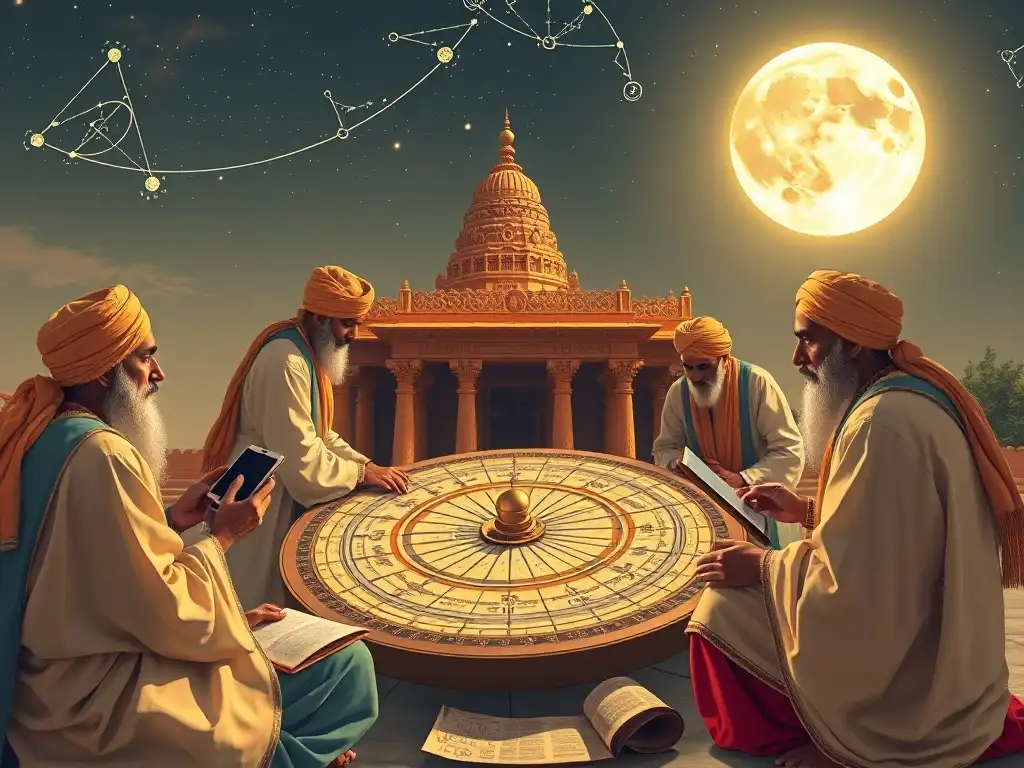
Ancient Indian scholars made significant contributions to the development of numerical systems, particularly in the fields of astronomy and calendar making. Their innovations not only advanced their own understanding of the cosmos but also laid the groundwork for future mathematical developments across cultures. The systematic use of numbers and the creation of complex algorithms allowed astronomers to make precise calculations that were crucial for determining celestial events and creating accurate calendars. Key figures, such as Aryabhata and Brahmagupta, were instrumental in these advancements, each contributing unique insights and methodologies that would influence generations of thinkers.
Aryabhata and His Numerical Innovations
Aryabhata, one of the most renowned mathematicians and astronomers of ancient India, was born in 476 CE. His seminal work, the Aryabhatiya, encompasses a variety of topics, including arithmetic, algebra, and astronomy. Aryabhata introduced the place-value system, which is a foundational concept in mathematics today. He used a decimal system that allowed for efficient calculations and the representation of large numbers.
In astronomy, Aryabhata's calculations of the length of the solar year, which he estimated to be 365.358 days, were remarkably accurate for his time. He also proposed that the Earth rotates on its axis, providing an innovative explanation for the apparent movement of stars. His numerical innovations extended to trigonometry as well, where he introduced sine functions, paving the way for future developments in both mathematics and astronomy.
Brahmagupta’s Contributions to Astronomy and Calendars
Brahmagupta, another towering figure in ancient Indian mathematics, lived around 598 CE. His work, Brahmasphutasiddhanta, is a comprehensive treatise that addresses both astronomy and mathematics. Brahmagupta expanded upon Aryabhata's foundations, offering methods for calculating the positions of celestial bodies and predicting eclipses with remarkable precision.
One of his notable contributions was the introduction of zero as a number, which revolutionized calculations and numerical systems. Brahmagupta also developed rules for arithmetic operations involving positive and negative numbers, which were groundbreaking concepts for his time. His work on calendar making included systematic methods for determining the lunar months and solar years, allowing for more accurate timekeeping in society. His legacy in astronomy and calendar systems continues to be recognized for its sophistication and clarity.
The Legacy of Ancient Indian Numerical Systems
The innovations introduced by ancient Indian scholars have had a lasting legacy that extends far beyond their time. The numerical systems they developed facilitated advancements in various domains, particularly in mathematics and astronomy, influencing cultures across the globe.
Influence on Later Mathematical Developments
Ancient Indian numerical systems significantly influenced later mathematical developments in both the Islamic Golden Age and the European Renaissance. The concept of zero, along with the place-value system, was transmitted to the Islamic world, where scholars like Al-Khwarizmi expanded upon these ideas. This exchange of knowledge eventually reached Europe, where it transformed mathematical practices.
Moreover, the sophisticated techniques for astronomical calculations established by figures such as Aryabhata and Brahmagupta set a precedent for future astronomers. Their methods were studied and adapted by scholars throughout the ages, forming the basis for many modern mathematical concepts and techniques.
Lasting Impact on Modern Astronomy and Calendar Systems
The impact of ancient Indian numerical systems on modern astronomy and calendar systems is profound. The algorithms developed for calculating celestial events are still in use today, albeit in more advanced forms. Many contemporary astronomical calculations can trace their roots back to the methodologies established by ancient Indian astronomers.
In calendar making, the sophisticated techniques for tracking lunar and solar cycles laid the groundwork for various modern calendar systems. The integration of these ancient practices into contemporary methods showcases the enduring relevance of ancient Indian numerical systems in our understanding of time and astronomy. The contributions of these scholars continue to be celebrated and studied, affirming their place in the rich tapestry of human intellectual history.
Conclusion
The exploration of ancient Indian numerical systems reveals a profound and intricate understanding of mathematics that significantly influenced astronomy and calendar-making practices. The innovative approaches adopted by ancient Indian scholars, such as the use of positional notation and the concept of zero, laid the groundwork for advanced calculations and astronomical observations. This analytical prowess not only facilitated accurate timekeeping and celestial navigation but also set the stage for future mathematical advancements both in India and globally.
As we delve into the contributions of ancient Indian civilizations, it becomes clear that their numerical systems were not merely tools for calculation but essential elements in the cultural and scientific fabric of the time. These systems reflect a deep engagement with the cosmos and a sophisticated understanding of time, showcasing the ingenuity of ancient Indian mathematicians and astronomers.
Summary of Key Points on Ancient Indian Numerical Systems
- Positional Notation: Ancient Indian mathematicians developed a positional numeral system that utilized the placement of digits to represent values, significantly enhancing calculation accuracy.
- The Concept of Zero: The introduction of zero as a numeral was a groundbreaking innovation that transformed mathematical computation, allowing for more complex arithmetic operations.
- Astronomical Calculations: Ancient texts such as the Aryabhatiya and Surya Siddhanta illustrated the application of numerical systems in astronomy, enabling precise calculations of planetary positions and eclipses.
- Calendar Systems: The use of numerical systems was crucial in the formulation of calendars, with ancient Indian scholars devising intricate systems that accounted for solar and lunar cycles, ensuring agricultural and religious events were accurately timed.
- Legacy: The numerical techniques and astronomical methods developed in ancient India laid the foundation for future mathematical developments, influencing mathematicians across cultures and epochs.
Reflection on the Importance of Ancient Indian Contributions to Mathematics
The contributions of ancient Indian civilizations to mathematics are monumental and continue to resonate in modern mathematical thought. The sophisticated numerical systems developed during this period not only advanced the field of mathematics but also had far-reaching implications for science, technology, and navigation.
The legacy of ancient Indian numerical systems is particularly evident in the global mathematical landscape, where concepts such as zero and positional notation became fundamental to various mathematical systems worldwide. This highlights how ancient Indian scholars were not isolated in their endeavors; rather, they were part of a broader intellectual tradition that transcended geographical and cultural boundaries.
In reflecting on these contributions, it is essential to recognize the role of ancient Indian mathematics in shaping our understanding of the universe. The meticulous astronomical calculations and calendar-making practices underscore a culture deeply invested in observation and empirical knowledge, marking ancient India as a critical player in the history of mathematics. As we continue to study and appreciate these contributions, we gain a richer understanding of the intellectual heritage that informs modern mathematics today.
- Introduction to Ancient Indian Numerical Systems
- Historical Context of Ancient Indian Astronomy
- Key Features of Ancient Indian Numerical Systems
- Applications of Numerical Systems in Astronomy
- The Role of Numerical Systems in Calendar Making
- Comparison with Other Civilizations
- Contributions of Ancient Indian Scholars
- The Legacy of Ancient Indian Numerical Systems
- Conclusion
- What were the ancient Indian numerical systems used for?
- How did ancient Indian numerical systems compare to other civilizations?
- What contributions did ancient Indian numerical systems make to mathematics?
- How were these numerical systems documented in ancient texts?
- Did ancient Indian numerical systems influence other cultures?
Frequently Asked Questions
What were the ancient Indian numerical systems used for?
Ancient Indian numerical systems were primarily used in astronomy and calendar making, allowing for precise calculations of celestial events and timekeeping.
How did ancient Indian numerical systems compare to other civilizations?
Ancient Indian systems, particularly the Hindu-Arabic numeral system, were more advanced than many contemporaneous systems, facilitating easier calculations and extensive mathematical applications.
What contributions did ancient Indian numerical systems make to mathematics?
The development of the concept of zero and place value in ancient Indian numerical systems significantly influenced global mathematics and laid the groundwork for modern arithmetic.
How were these numerical systems documented in ancient texts?
Ancient Indian scholars documented their numerical systems in various texts, such as the Aryabhatiya and Brahmasphutasiddhanta, which detailed astronomical calculations and mathematical theories.
Did ancient Indian numerical systems influence other cultures?
Yes, ancient Indian numerical systems greatly influenced other cultures, especially through trade and scholarship, leading to their adoption in Islamic mathematics and later in Europe.
Final Reflection: The Enduring Legacy of Ancient Indian Numerical Systems
The exploration of ancient Indian numerical systems reveals their profound impact on astronomy and calendar making, emphasizing their relevance in today's world. As we navigate an era dominated by technology and data, the foundational principles established by these ancient scholars remind us of the ingenuity that has shaped our understanding of time and space. The intricate methods they developed not only reflect a deep understanding of mathematics but also serve as a testament to human curiosity and the quest for knowledge.
The influence of these numerical systems extends far beyond their historical context, permeating our cultural and social landscapes. Today, we see echoes of these ancient practices in modern scientific advancements and the way we perceive time. The meticulous calculations and astronomical observations made by ancient Indian astronomers laid the groundwork for future generations, fostering a legacy of inquiry and precision. The greatest discoveries are born from the curiosity of those who dare to question the universe.
This quote encapsulates the spirit of exploration that characterized ancient Indian scholars and continues to inspire us.
As we reflect on the lessons from ancient Indian numerical systems, let us embrace the spirit of inquiry and innovation in our own lives. Consider how the principles of precision, observation, and curiosity can guide your personal and professional endeavors.
By honoring the legacy of those who came before us, we can cultivate a deeper appreciation for the interconnectedness of knowledge and the importance of preserving and advancing our understanding of the world. Take a moment to reflect on how you can apply these timeless lessons in your journey, and let the wisdom of the past illuminate your path forward.
Unveil the Secrets of Ancient Indian Astronomy!
Thank you for taking the time to delve into the fascinating world of ancient Indian astronomy and calendar making! You've uncovered the remarkable ways in which numerical systems shaped our understanding of the cosmos. Now, it's time to harness this knowledge and take action!
Here are a few steps you can take to further explore this captivating subject:
- Dive deeper: Explore the intricate numerical methods utilized by ancient Indian astronomers and discover how they compare to those from other cultures.
- Share your insights: Engage in discussions about your newfound knowledge with friends or in an online forum—your insights may inspire others to appreciate this rich heritage!
- Engage with the community: Consider joining a local astronomy club or an online group dedicated to ancient sciences to connect with like-minded enthusiasts.
What aspect of ancient Indian astronomy sparks your curiosity the most, and how do you envision applying this knowledge in your own life?