
The Gupta Empire: A Golden Age of Mathematics and the Birth of Zero


Welcome to Ancient India History, where we embark on a fascinating journey through time to uncover the rich tapestry of ancient Indian civilizations. Today, we delve into the Gupta Empire, a remarkable era often celebrated as a golden age of mathematics. Have you ever wondered how the concept of zero revolutionized mathematics and science? Join us as we unravel the captivating story behind the Gupta Empire's mathematics history, revealing the groundbreaking contributions that continue to influence our world today. Prepare to be inspired and intrigued as we explore the legacy of this extraordinary civilization!

Introduction to the Gupta Empire
The Gupta Empire, often heralded as a pivotal period in the tapestry of ancient Indian history, spanned roughly from 320 to 550 CE. This era is celebrated not only for its political stability and cultural achievements but also for its extraordinary advancements in mathematics. Among the most significant contributions of the Gupta Empire is the conceptualization and formalization of zero, a numeral that would revolutionize mathematics globally. This article delves into the rich mathematical history of the Gupta Empire, exploring its innovations, the influential mathematicians of the time, and the profound impact these developments have had on the world.
Overview of the Gupta Empire's Historical Context
The Gupta Empire emerged in the early 4th century CE, founded by Maharaja Sri Gupta. It marked a departure from the fragmentation prevalent in the post-Mauryan period, ushering in a time of unprecedented unity and prosperity across northern India. The empire reached its zenith under Chandragupta II, also known as Vikramaditya, who expanded its territories and fostered an environment conducive to intellectual pursuits.
During this period, cities such as Pataliputra (modern-day Patna) became thriving centers of trade, culture, and scholarship. The Gupta rulers were keen patrons of the arts and sciences, which significantly contributed to the flourishing of various disciplines, including mathematics, astronomy, and literature. This environment allowed scholars like Aryabhata and Brahmagupta to make groundbreaking contributions that would shape mathematical thought for centuries to come.
Significance of the Gupta Period in Ancient Indian History
The Gupta Empire is often referred to as the "Golden Age" of India, a designation that reflects not only its achievements in mathematics but also its advancements in other fields such as art, architecture, and philosophy. The period saw the creation of significant literary works, the establishment of the classical Sanskrit language, and the propagation of new ideas that would influence cultures far beyond the Indian subcontinent.
The significance of the Gupta period lies in its ability to merge traditional Indian knowledge with innovative ideas, leading to remarkable advancements. Mathematics during this time was not merely a tool for commerce or astronomy; it became a field of study that explored abstract concepts and logical reasoning. The advancements made during the Gupta Empire laid the groundwork for future generations of mathematicians and scholars, making it a cornerstone of ancient Indian history.
The Evolution of Mathematics During the Gupta Empire
The Gupta Empire was a transformative period for mathematics, characterized by profound developments that would set the stage for future mathematical exploration. The scholars of this era made substantial contributions to number theory, arithmetic, and algebra, with many concepts still in use today. The introduction of the decimal system and the formalization of zero as a number were among the most significant advancements, fundamentally changing the way mathematics was approached and understood.
Key Mathematical Innovations in Gupta Era
- The Concept of Zero: The Gupta mathematicians were pivotal in the development of zero as both a placeholder and a distinct numeral, which facilitated complex calculations and the advancement of the place-value system.
- Decimal System: The establishment of the decimal system allowed for more efficient calculations, paving the way for arithmetic operations that were previously cumbersome.
- Algebraic Methods: Scholars such as Brahmagupta introduced rules for solving linear and quadratic equations, setting the foundation for algebra as we know it today.
- Astronomical Calculations: Innovations in astronomy, including accurate calculations of celestial bodies' movements, showcased the mathematical prowess of Gupta scholars.
Influential Mathematicians of the Gupta Period
- Aryabhata: One of the earliest and most renowned mathematicians of the Gupta era, Aryabhata's work, Aryabhatiya, introduced concepts such as the approximation of π (pi) and methods for solving quadratic equations.
- Brahmagupta: Another prominent figure, Brahmagupta's seminal work, Brahmasphutasiddhanta, laid down rules for arithmetic operations involving zero and negative numbers, which were groundbreaking at the time.
- Bhaskara I: Known for his translations and commentaries, Bhaskara I further propagated the mathematical knowledge of the Gupta period and contributed to the understanding of sine functions.
The legacy of these mathematicians is a testament to the Gupta Empire's role as a cradle of mathematical innovation, influencing not only Indian mathematics but also the broader field of mathematics across the globe.
The Birth of Zero: A Revolutionary Concept
The concept of zero is one of the most significant contributions to mathematics, providing a foundation for the development of advanced mathematical operations. Before the Gupta Empire, various ancient civilizations had rudimentary forms of zero, but it was during this period that the concept matured into what we recognize today.
Zero is not merely a number; it serves as a placeholder, enabling the representation of vast quantities and the execution of complex calculations. The notion of zero as both a numeral and a concept of "nothingness" transformed mathematics, allowing for the development of algorithms and systems that could handle abstract concepts.
The Gupta Empire, flourishing from approximately 320 to 550 CE, played a crucial role in the formalization and dissemination of zero. It was within this era that mathematical texts began to articulate the principles of zero, leading to innovations that would resonate through time. This period is often referred to as a golden age of mathematics, significantly influencing subsequent cultures and civilizations.
Historical Background of Zero in Ancient Civilizations
The history of zero traces back to earlier civilizations, such as the Babylonians and the Mayans, who had symbols for zero but lacked a comprehensive understanding of its mathematical implications. The Babylonians used a placeholder in their base-60 numeral system, while the Mayans had a distinct symbol for zero in their vigesimal (base-20) system.
In India, the earliest mention of zero appears in the inscriptions found in the 5th century CE. However, the idea of zero was not fully developed until the Gupta period. Indian scholars began to recognize zero not just as a placeholder but as a separate number with its own value, which was a radical shift in mathematical thought. This conceptual leap paved the way for more sophisticated mathematical theories and practices.
The Role of the Gupta Empire in the Development of Zero
The Gupta Empire was pivotal in the mathematical revolution that led to the formalization of zero. During this time, scholars such as Aryabhata, Brahmagupta, and later mathematicians contributed significantly to the understanding and application of zero. The Gupta mathematicians explored the properties of zero, its interactions with other numbers, and the implications for arithmetic operations.
The introduction of zero allowed for the development of a positional number system, which improved the accuracy of calculations and paved the way for advanced mathematics. The writings from this period demonstrate a profound understanding of zero's role in calculations, leading to its acceptance and eventual adoption across various cultures. The Gupta Empire's influence ensured that zero became a fundamental element of mathematics, impacting fields such as astronomy, commerce, and science.
Contributions to Mathematics by Gupta Scholars
The Gupta Empire is renowned for its remarkable contributions to mathematics, primarily through its eminent scholars. These mathematicians not only advanced mathematical knowledge but also integrated it with other fields, such as astronomy and astrology. Their works laid the groundwork for future developments in mathematics and science, demonstrating an impressive blend of theoretical and practical applications.
Aryabhata: Pioneering Advances in Mathematics
Aryabhata, one of the most celebrated mathematicians of the Gupta period, made groundbreaking contributions to mathematics and astronomy. His seminal work, the Aryabhatiya, introduced concepts such as the place value system and the representation of zero. Aryabhata's innovative approach to arithmetic operations, including methods for calculating square and cube roots, showcased his advanced understanding of numbers.
In addition to these mathematical advances, Aryabhata's work in astronomy included calculations of the Earth's circumference and the length of the solar year. His ability to merge mathematics with practical applications in astronomy exemplified the intellectual achievements of the Gupta Empire. Aryabhata's legacy influenced subsequent mathematicians both in India and around the world.
Brahmagupta: Contributions to Arithmetic and Algebra
Brahmagupta, another prominent mathematician of the Gupta Empire, is often celebrated for his comprehensive treatise on mathematics, the Brahmasphutasiddhanta. This text systematically addressed arithmetic, algebra, and the use of zero. Brahmagupta was one of the first to establish rules for dealing with zero in arithmetic operations, such as addition and subtraction, which were groundbreaking at the time.
Moreover, Brahmagupta's work included solutions to linear and quadratic equations, which laid the foundation for algebra as a distinct discipline. His clear explanations and systematic approach to mathematics marked a significant advancement in the field, facilitating the future study of algebra and arithmetic across cultures.
Varahamihira: Astronomy and Mathematical Integration
Varahamihira, a renowned scholar of the Gupta Empire, made significant contributions that intertwined mathematics with astronomy and astrology. His work, the Brihat Samhita, includes extensive mathematical principles applied to various fields, including meteorology, agriculture, and architecture. Varahamihira's integration of mathematical concepts with practical applications demonstrated a holistic approach to knowledge during the Gupta period.
He also contributed to the understanding of planetary motions and eclipses, employing mathematical calculations to predict astronomical events. Varahamihira's innovative methods and interdisciplinary approach highlighted the importance of mathematics in understanding the natural world, further solidifying the Gupta Empire's legacy in the history of mathematics.
The Gupta Empire's contributions to mathematics, particularly the development of zero, fundamentally transformed mathematical thought and practice, setting the stage for future advancements in the field and beyond.
The Impact of Gupta Empire Mathematics on Future Generations
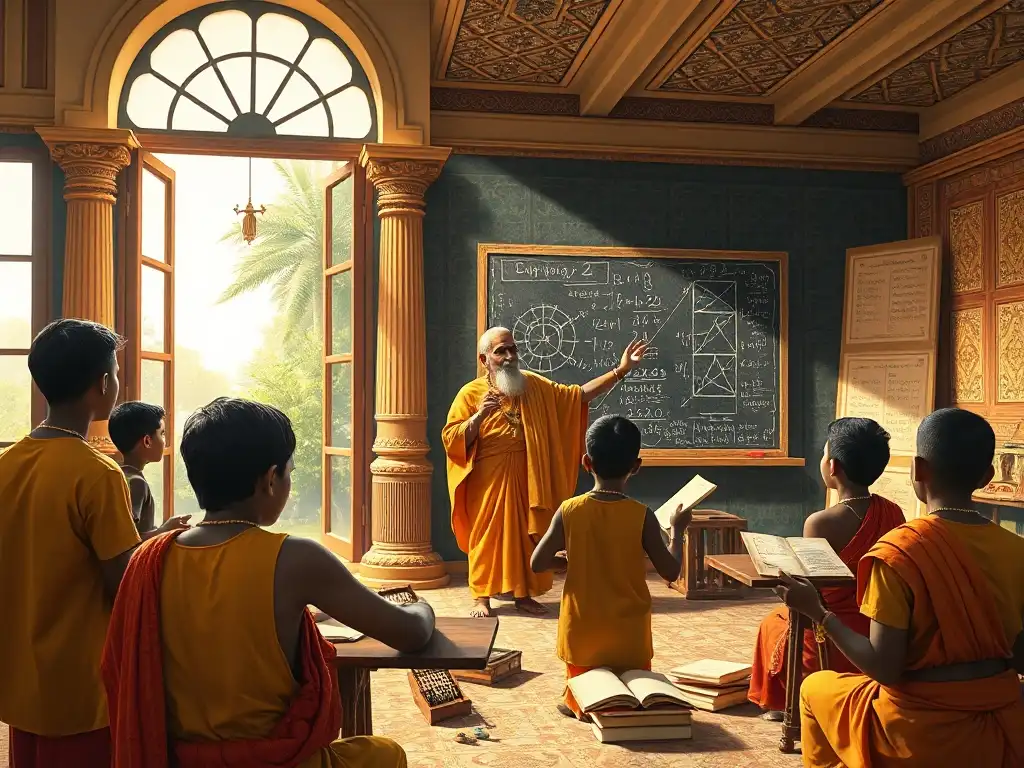
The Gupta Empire, often referred to as a golden age of Indian civilization, significantly shaped the landscape of mathematics. The innovations and concepts developed during this period laid the groundwork for future mathematical advancements, not only within India but across the globe. The introduction and formalization of the concept of zero, alongside advancements in arithmetic and algebra, revolutionized mathematical thought and practices.
The mathematicians of the Gupta Empire, including notable figures like Aryabhata and Brahmagupta, made profound contributions that influenced subsequent generations of scholars. Their work on the place-value system and the concept of zero as a numeral was not merely an academic achievement; it fundamentally altered how numbers were understood and manipulated. This legacy of mathematical sophistication was pivotal in driving later developments in mathematics and science, establishing a foundation that would support complex calculations and theories.
Influence on Subsequent Indian Mathematics
The advancements in mathematics during the Gupta Empire were instrumental in shaping subsequent Indian mathematics. The principles laid out in texts such as Aryabhata's Aryabhatiya and Brahmagupta's Brahmasphutasiddhanta became cornerstones for later Indian mathematicians. Their methods for solving quadratic equations, calculating square and cube roots, and their algorithms for arithmetic operations impacted later mathematical practices and education.
For instance, the use of zero as a placeholder in the decimal system allowed for more complex calculations and facilitated advancements in algebra. The contributions made during the Gupta period were not only preserved in Indian tradition but also influenced the Islamic Golden Age mathematicians who later adopted and expanded upon these concepts.
The Spread of Mathematical Knowledge to Other Cultures
The Gupta Empire's mathematical innovations did not remain confined within its borders. As trade routes flourished and cultural exchanges occurred, the mathematical knowledge from this era spread to other regions, including the Middle East and Southeast Asia. The transmission of mathematical texts, along with scholars traveling across these regions, facilitated the cross-pollination of ideas.
One notable example is the translation of Indian mathematical texts into Arabic, which played a crucial role in the development of mathematics in the Islamic world. The principles of arithmetic, algebra, and the use of zero were assimilated and further refined by scholars like Al-Khwarizmi, whose work later influenced European mathematics. This cross-cultural exchange underscores the Gupta Empire's role in shaping a global mathematical heritage.
Conclusion: The Lasting Legacy of the Gupta Empire in Mathematics
The contributions of the Gupta Empire to mathematics have left an indelible mark on the history of the discipline. The formalization of zero and the advancements in mathematical thought during this period established a legacy that continues to resonate in contemporary mathematics.
Summary of Gupta Empire's Contributions to Mathematics
The Gupta Empire was pivotal in advancing mathematical knowledge through the introduction of zero, the development of the decimal system, and significant work in algebra and arithmetic. These contributions fostered a mathematical environment that encouraged exploration and innovation, setting the stage for future developments in the field.
Reflection on the Importance of Zero in Modern Mathematics
Zero's introduction into mathematics cannot be overstated. It serves as a fundamental building block in modern arithmetic and algebra, enabling complex calculations and theoretical advancements. The concept of zero has transcended cultural boundaries, becoming a universal element in mathematics. Understanding its origins in the Gupta Empire highlights the importance of this civilization in shaping not only Indian mathematics but also the global mathematical landscape. The legacy of the Gupta Empire endures, reminding us of the profound impact of their innovations on the way we understand and engage with mathematics today.
Further Reading and Resources on Gupta Empire Mathematics History
To fully appreciate the mathematical advancements during the Gupta Empire, it is essential to delve into various literature and resources that document this golden age of mathematics. Below are some recommended readings and educational resources that will enhance your understanding of Gupta Empire mathematics history.
Recommended Books and Articles
-
"A History of Mathematics" by Carl B. Boyer and Uta C. Merzbach
This comprehensive book provides a detailed overview of the development of mathematics through the ages, including significant contributions made during the Gupta Empire. It offers insights into the historical context and the impact of Indian mathematicians.
-
"The History of Mathematics: A Brief Course" by Roger L. Cooke
This text provides a concise overview of the milestones in mathematical history, with special attention to the advancements made in India during the Gupta period. It highlights the contributions of notable mathematicians like Aryabhata and Brahmagupta.
-
"Mathematics in India" by Kim Plofker
This book extensively covers the evolution of mathematics in India, emphasizing the significant innovations during the Gupta Empire. Plofker meticulously details the mathematical techniques and theories developed in this era, including the conceptualization of zero.
-
"Zero: A Biography of a Dangerous Idea" by Charles Seife
While this book primarily focuses on the concept of zero, it also traces its origins and significance in ancient Indian mathematics, particularly during the Gupta period. It sheds light on how the invention of zero revolutionized mathematics worldwide.
-
Scholarly Articles in Journals
Numerous academic journals publish articles focused on the mathematics of ancient India. Journals such as the Indian Journal of History of Science and The Mathematical Gazette often feature articles that delve into the achievements of the Gupta Empire and its mathematicians.
Educational Resources for Exploring Ancient Indian Mathematics
-
Online Courses and Lectures
Websites like Coursera and edX offer free online courses that include modules on ancient mathematics. Look for courses related to the history of mathematics or specifically those that address Indian contributions.
-
Documentaries and Educational Videos
Platforms like YouTube have several educational documentaries focusing on the Gupta Empire and its contributions to mathematics. Channels dedicated to history or mathematics often provide visual representations of complex mathematical concepts.
-
Interactive Websites and Databases
Websites such as the MacTutor History of Mathematics Archive provide detailed biographies of mathematicians from the Gupta period and outline their contributions. These resources often include timelines and interactive elements that enhance learning.
-
Museums and Exhibitions
Visiting museums that have exhibitions on ancient Indian culture can provide a tangible connection to the mathematical advancements of the Gupta Empire. Many museums provide educational programs and guided tours focusing on mathematics and science.
-
University Resources
Many universities have dedicated resources and libraries specializing in the history of science and mathematics. Utilize their catalogs to find dissertations, theses, and papers focusing on the Gupta Empire and its contributions to the field of mathematics.
By exploring these resources, you can gain a deeper understanding of the Gupta Empire's mathematical legacy and its lasting impact on the world.
- Introduction to the Gupta Empire
- The Evolution of Mathematics During the Gupta Empire
- The Birth of Zero: A Revolutionary Concept
- Contributions to Mathematics by Gupta Scholars
- The Impact of Gupta Empire Mathematics on Future Generations
- Conclusion: The Lasting Legacy of the Gupta Empire in Mathematics
- Further Reading and Resources on Gupta Empire Mathematics History
Frequently Asked Questions
What was significant about the Gupta Empire in the context of mathematics?
The Gupta Empire is often referred to as a Golden Age for mathematics, where significant advancements like the concept of zero and the development of the decimal system emerged.
How did the Gupta Empire influence modern mathematics?
The mathematical innovations during the Gupta Empire laid the groundwork for modern numerical systems, particularly through the introduction of zero and the place-value notation.
Who were some prominent mathematicians from the Gupta Empire?
Notable mathematicians such as Aryabhata and Brahmagupta made significant contributions, including trigonometry and algebra, which influenced both Indian and global mathematics.
What role did astronomy play in Gupta mathematics?
Astronomy was closely linked to mathematics in the Gupta Empire, as calculations for calendar systems and celestial events required advanced mathematical techniques.
How is the birth of zero connected to the Gupta Empire?
The birth of zero as a numerical concept during the Gupta Empire revolutionized mathematics, enabling complex calculations and serving as a foundation for future mathematical theories.
Final Reflection: The Enduring Legacy of Gupta Empire Mathematics
The Gupta Empire's contributions to mathematics, particularly the concept of zero, resonate profoundly in today's digital age. As we navigate a world increasingly driven by technology and data, the foundational principles established during this golden age of mathematics remind us of the power of innovation and intellectual curiosity. The legacy of the Gupta mathematicians is not merely historical; it is a cornerstone of modern mathematical thought that continues to shape our understanding of the universe.
The influence of Gupta mathematics extends far beyond ancient texts; it has woven itself into the very fabric of our daily lives. From the algorithms that power our smartphones to the complex calculations that drive scientific discovery, the principles laid down by mathematicians like Aryabhata and Brahmagupta are omnipresent. As the historian Carl Sagan once said, "> We are made of star-stuff.
We are a way for the universe to know itself." This sentiment echoes the idea that the quest for knowledge, initiated by the Gupta scholars, is an intrinsic part of our existence and our connection to the cosmos.
As you reflect on the profound impact of the Gupta Empire on mathematics, consider how you can apply these lessons of innovation and exploration in your own life. Embrace curiosity, challenge conventions, and strive for understanding in your pursuits. Just as the mathematicians of the Gupta Empire dared to redefine the boundaries of knowledge, you too have the potential to contribute to the ongoing story of human discovery. Let the legacy of this golden age inspire you to explore, innovate, and leave your mark on the world.
Unveil the Wonders of Ancient Mathematics Today!
Thank you for diving into the fascinating world of the Gupta Empire and its incredible contributions to mathematics, particularly the birth of zero! Your interest in this golden age not only enriches your knowledge but also inspires a deeper appreciation for the remarkable achievements of ancient civilizations.
Now, it’s time to take that inspiration and transform it into action!
- Explore further: Read about other significant developments in mathematics and science during the Gupta period. Delve into our articles on Aryabhata and his revolutionary work!
- Join the conversation: Share your thoughts about the impact of zero on modern mathematics in the comments below. How do you think this fundamental concept has shaped our understanding of the universe?
- Spread the knowledge: Share this article with friends and family to inspire them to learn more about the rich history of India.
What aspect of ancient mathematics intrigues you the most, and how do you think it influences our lives today?