
The Journey of Mathematical Knowledge from Ancient India to the World

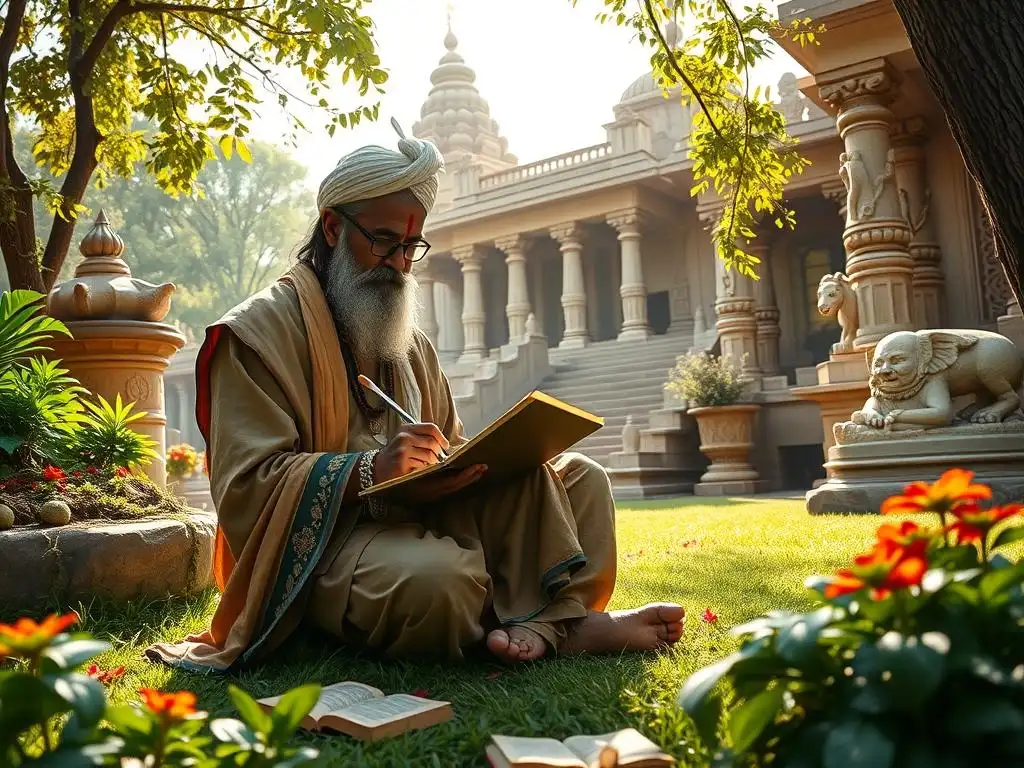
Welcome to Ancient India History, where we embark on an intriguing voyage through the vibrant tapestry of India's past. In our featured article, "The Journey of Mathematical Knowledge from Ancient India to the World," we delve into the remarkable contributions of ancient Indian mathematics, uncovering how these early innovations laid the groundwork for modern mathematical thought.
Prepare to be captivated as you explore the profound impact of civilizations from the Indus Valley to the Gupta Empire, and discover the brilliance that continues to inspire scholars and enthusiasts alike. Your journey into the depths of history starts here—let's unveil the mysteries together!
- Introduction to Ancient Indian Mathematics Contributions
- Historical Background of Mathematics in Ancient India
- Key Figures in Ancient Indian Mathematics
- Core Concepts and Theories in Ancient Indian Mathematics
- Transmission of Ancient Indian Mathematical Knowledge to the World
- Conclusion: Legacy of Ancient Indian Mathematics Contributions
- References and Recommended Reading on Ancient Indian Mathematics Contributions
-
Frequently Asked Questions
- What were the major contributions of Ancient Indian mathematics?
- How did Ancient Indian mathematicians influence the world?
- What is the significance of the concept of zero in mathematics?
- How did trade routes impact the spread of mathematical knowledge from Ancient India?
- What role did astronomy play in the development of mathematics in Ancient India?
- Final Reflection: The Enduring Legacy of Ancient Indian Mathematics
- Unleash the Power of Mathematics and Explore Its Roots!
Introduction to Ancient Indian Mathematics Contributions
The journey of mathematical knowledge from ancient India to the world is a testament to the rich intellectual tradition that flourished in this region thousands of years ago. Ancient Indian mathematics contributions have laid the groundwork for many modern mathematical concepts and practices, influencing not only the subcontinent but also extending their impact globally.
This article delves into the remarkable achievements of ancient Indian mathematicians, exploring their innovative techniques and theories that have shaped the mathematical landscape. From the sophisticated calculations of the Indus Valley Civilization to the advanced theories developed during the Gupta Empire, the legacy of ancient Indian mathematics is both profound and enduring.
Overview of Ancient Indian Mathematics
Ancient India was home to some of the earliest mathematical thinkers and practices. The Indus Valley Civilization, dating back to 2500 BCE, exhibited early signs of mathematical knowledge through their advanced systems of weights and measures, as well as their urban planning, which reflects geometric and spatial understanding.
Moving forward in time, the Vedic period (1500–500 BCE) saw the emergence of significant mathematical texts, such as the Sulba Sutras, which contained rules for constructing altars with precise geometric shapes. These texts not only laid the foundation of geometry but also introduced the concept of irrational numbers.
The classical period (approximately 400–1200 CE) witnessed further advancements with figures like Aryabhata, who introduced the concept of zero and positional notation. His seminal work, the Aryabhatiya, encompassed arithmetic, algebra, and astronomy, establishing a systematic approach to mathematics that would influence future generations.
Another significant mathematician, Brahmagupta, made notable contributions in the 7th century, particularly in the realm of algebra. His text, the Brahmasphutasiddhanta, outlined rules for solving quadratic equations and provided a clear framework for dealing with negative numbers.
Importance of Ancient Indian Contributions to Global Mathematics
The contributions of ancient Indian mathematicians hold immense significance in the history of mathematics. Their innovative approaches not only advanced mathematical thought but also facilitated the exchange of knowledge across cultures.
Key impacts include:
- The Concept of Zero: The introduction of zero as a number revolutionized mathematics, enabling a more comprehensive numerical system and paving the way for complex calculations.
- Positional Number System: The decimal system, which is the foundation of modern mathematics, can be traced back to ancient Indian practices. This system's efficiency is unmatched, allowing for the representation of large numbers with minimal symbols.
- Influence on the Islamic Golden Age: The translations of ancient Indian texts into Arabic during the 8th to 12th centuries played a crucial role in disseminating Indian mathematical knowledge throughout the Islamic world, which in turn influenced European mathematics during the Renaissance.
- Algebra and Trigonometry: The work of Indian mathematicians laid the groundwork for algebra and trigonometry, concepts that are integral to various branches of mathematics and applied sciences today.
The legacy of ancient Indian mathematics contributions is a remarkable journey that highlights the ingenuity and creativity of its mathematicians. Their work continues to inspire and shape mathematical practices around the world, affirming the vital role of ancient Indian civilization in the global mathematical narrative.
Historical Background of Mathematics in Ancient India

The mathematical landscape of ancient India is rich and intricate, showcasing a lineage of knowledge that has profoundly influenced the world. From the earliest settlements of the Indus Valley Civilization to the flourishing intellectual pursuits during the Gupta Empire, ancient Indian mathematics contributions encompassed various fields, including arithmetic, geometry, and algebra. This section delves into the historical development and key milestones of mathematical thought in ancient India.
The Indus Valley Civilization and Early Mathematical Concepts
The Indus Valley Civilization, which thrived between 3300 BCE and 1300 BCE, is often regarded as one of the earliest urban cultures. Archaeological findings suggest that the inhabitants possessed advanced mathematical skills, evidenced by:
- Measurement techniques: The standardized weights and measures discovered in Harappa and Mohenjo-Daro indicate an understanding of geometry and measurement.
- Urban planning: The grid layout of cities reflects the application of spatial awareness and geometric principles.
- Decimal system: The use of a decimal system is implied, as artifacts feature markings that may represent numerical values, suggesting early counting methods.
These early mathematical concepts laid the groundwork for subsequent developments in Indian mathematics, highlighting a culture that valued precision and practicality in their calculations.
Vedic Mathematics and Its Influence on Ancient Indian Mathematics
With the advent of the Vedic period (circa 1500 BCE to 500 BCE), mathematical thought in India began to flourish. The Vedas, particularly the Sulbasutras, are significant texts that reveal the mathematical knowledge of this era. Key contributions include:
- Geometric principles: The Sulbasutras provide rules for constructing altars with specific dimensions, illustrating a profound understanding of geometry. Notably, they contain early formulations of the Pythagorean theorem.
- Numerical systems: The Vedic texts introduced sophisticated concepts such as fractions, square roots, and the use of zero as a placeholder, which would later become integral to mathematical notation.
- Ritual mathematics: Mathematics was intertwined with religious practices, where calculations were essential for determining auspicious times and dimensions for altars, reflecting the cultural significance of mathematical knowledge.
The influence of Vedic mathematics extended beyond India, impacting mathematical thought in neighboring regions and laying a solid foundation for the developments that followed.
Contributions during the Maurya and Gupta Empires
The Maurya (322 BCE – 185 BCE) and Gupta empires (circa 320 CE – 550 CE) represent a golden age of mathematics in ancient India, marked by remarkable achievements and prominent mathematicians. Key contributions from this period include:
- Aryabhata: One of the most influential mathematicians and astronomers, Aryabhata introduced concepts such as the approximation of π (pi) and the use of algebra in solving quadratic equations. His work, Aryabhatiya, established a systematic approach to mathematics.
- Brahmagupta: A pivotal figure, Brahmagupta's Brahmasphutasiddhanta presented rules for arithmetic operations involving negative numbers and zero. His contributions to algebra and geometry further advanced mathematical understanding in India.
- Mathematics in astronomy: During this period, mathematics played a crucial role in astronomy, with scholars developing sophisticated models to predict celestial movements. The integration of mathematics and astronomy exemplified the interdisciplinary nature of ancient Indian scholarship.
The contributions made during the Maurya and Gupta empires not only enriched the field of mathematics within India but also established a framework that influenced subsequent mathematical traditions worldwide. The legacy of ancient Indian mathematics continues to resonate, demonstrating the enduring impact of these early scholars on contemporary mathematical thought.
Key Figures in Ancient Indian Mathematics

Aryabhata: The Pioneer of Indian Mathematics
Aryabhata, born in 476 CE in Kusumapura (modern-day Patna), is often regarded as the first significant mathematician and astronomer of ancient India. His seminal work, the Aryabhatiya, laid the foundation for many mathematical concepts that would influence both Indian and global mathematics. Notably, Aryabhata introduced the concept of zero as a placeholder and the decimal system, which are fundamental to modern mathematics.
Aryabhata's mathematical prowess is not only evident in his development of trigonometry and algebra but also in his innovative methods for solving quadratic equations. His approach was systematic and logical, marking a significant advancement from previous mathematical traditions.
Major Contributions of Aryabhata
- Place Value System: Aryabhata was among the first to use the place value system, allowing for the representation of large numbers with efficiency.
- Trigonometry: He developed sine tables, which were crucial for astronomical calculations. Aryabhata's work in trigonometry showed a deep understanding of the relationships between angles and lengths.
- Approximation of Pi: He provided an approximation of π (pi) as 3.1416, which was remarkably accurate for his time.
- Methods for Computing Areas: Aryabhata devised formulas for calculating areas of various geometric shapes, laying the groundwork for future advancements in geometry.
Aryabhata's Influence on Later Mathematicians
Aryabhata's influence extended far beyond his lifetime. His works inspired later mathematicians such as Brahmagupta and Bhaskara I, who further developed his concepts. His methods were translated and studied in various cultures, including those in the Islamic world, where they significantly impacted medieval European mathematics.
The Aryabhatiya was not just a mathematical text; it became a basis for astronomical studies across civilizations. Aryabhata’s emphasis on rigorous proofs and logical reasoning set a standard that would dominate Indian mathematics for centuries.
Brahmagupta: The Mathematician of the Gupta Era
Brahmagupta, who lived during the 7th century CE, is another pivotal figure in ancient Indian mathematics. His works, particularly the Brahmasphutasiddhanta, expanded on Aryabhata's theories and introduced new mathematical ideas that were groundbreaking for his era. Brahmagupta is credited with formalizing rules for arithmetic operations, including rules for dealing with zero and negative numbers.
Innovations in Algebra and Arithmetic
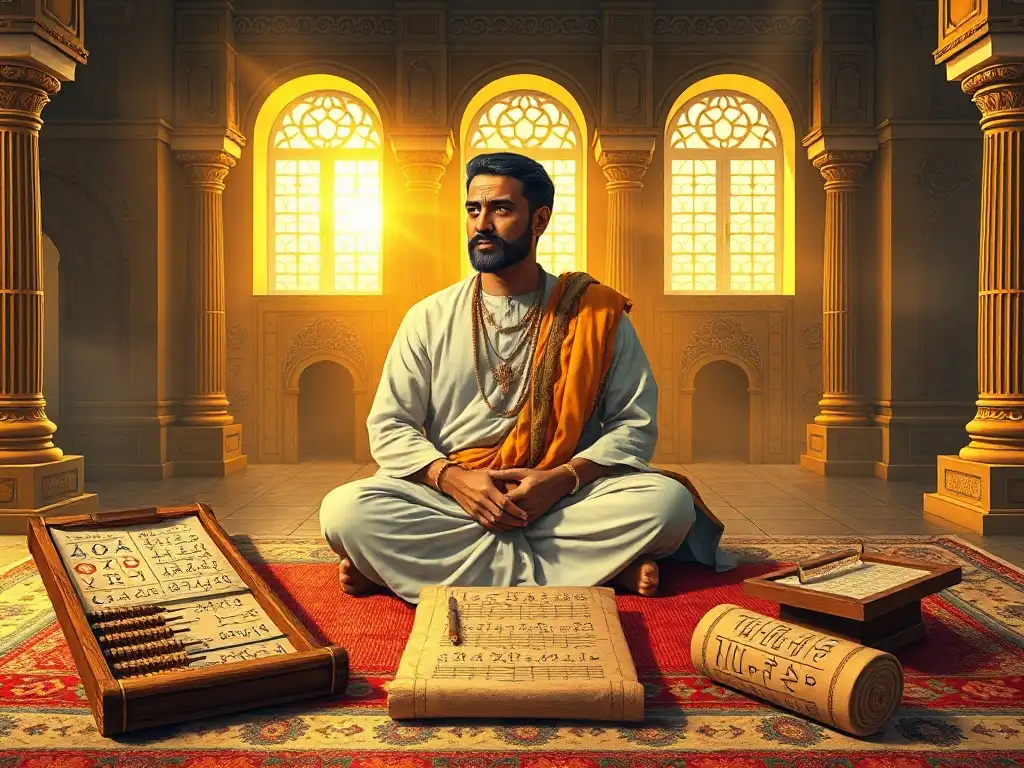
Brahmagupta made significant innovations in algebra, particularly in his methods for solving linear and quadratic equations. His contributions include:
- Rules for Arithmetic Operations: He established clear rules for addition, subtraction, multiplication, and division involving positive and negative numbers.
- Quadratic Equations: Brahmagupta provided systematic procedures for solving quadratic equations, marking a crucial development in algebra.
- Indeterminate Equations: He explored indeterminate equations, which laid the groundwork for future developments in number theory.
Brahmagupta's Theorems and Their Impact
Brahmagupta is known for his theorem related to cyclic quadrilaterals, which states that the area of a cyclic quadrilateral can be calculated if the lengths of its sides are known. This theorem has applications in various fields, including geometry and architecture.
His work also influenced various cultures and was pivotal in the transmission of mathematical knowledge to the Islamic world. The Brahmasphutasiddhanta was translated into Arabic, and its concepts permeated through to medieval European mathematics, cementing Brahmagupta's legacy as a crucial figure in the history of mathematics.
The contributions of Aryabhata and Brahmagupta to ancient Indian mathematics not only advanced mathematical thought in India but also laid the groundwork for future mathematical discoveries across the globe. Their innovative ideas and methodologies continue to resonate within the mathematical community today.
Bhaskara I and II: The Dual Legacy
The legacy of Bhaskara I and Bhaskara II represents a monumental contribution to the field of mathematics, particularly in ancient India. These two great mathematicians not only advanced mathematical concepts but also laid foundations that would influence generations of scholars both in India and across the world. Their works reflect a synthesis of mathematical rigor and astronomical insight, showcasing how intertwined these disciplines were in ancient Indian scholarship.
Bhaskara I, who lived in the 7th century, is often recognized for his pioneering work in astronomy, while Bhaskara II, also known as Bhaskara the Great, who flourished in the 12th century, expanded upon these foundations and made significant strides in calculus and number theory. Together, they symbolize a continuum of mathematical thought that emphasizes the evolution of ideas and techniques within the context of Indian intellectual tradition.
Bhaskara I’s Work on Astronomy and Mathematics
Bhaskara I’s contributions primarily lie in his astronomical texts, which also incorporate significant mathematical principles. His most notable work, the "Mahabhaskariya," serves as a treatise on the calculation of the positions of celestial bodies, which was crucial for the development of Indian astronomy.
- Innovative Techniques: Bhaskara I introduced several methods for calculating eclipses, planetary movements, and the positions of stars, which required advanced mathematical skills, including the use of sine functions. He is credited with the first systematic use of the sine in Indian mathematics, laying the groundwork for trigonometry.
- Decimal System: Bhaskara I utilized a decimal system for calculations, which was revolutionary for his time and demonstrated a clear understanding of place value, a concept that would later be fundamental in mathematical advancements.
- Influence on Later Scholars: His work influenced future astronomers and mathematicians, including Brahmagupta and Bhaskara II, who drew upon his methods and findings. The precision and clarity in his calculations helped in establishing a tradition of rigorous mathematical reasoning in Indian scholarship.
Bhaskara II’s Contributions to Calculus and Number Theory
Bhaskara II, known for his work in both mathematics and astronomy, made groundbreaking contributions that laid the groundwork for what we recognize today as calculus and number theory.
- "Lilavati" and "Bijaganita": In his texts "Lilavati" and "Bijaganita," Bhaskara II explored various mathematical concepts, including arithmetic, algebra, and geometry. "Lilavati," in particular, is a treatise on arithmetic problems and is well-known for its poetic style, making complex mathematical concepts accessible and engaging.
- Fundamental Theorem of Calculus: Bhaskara II is considered a precursor to calculus, as he described concepts resembling the fundamental theorem of calculus. He provided methods for calculating derivatives and integrals, including rules for finding the area under curves and the slope of a tangent line, showcasing an understanding of continuous change long before the formal development of calculus in Europe.
- Number Theory Advancements: His exploration of number theory included an early understanding of zero and negative numbers, as well as methods for solving quadratic equations. He also formulated rules for dealing with fractions and ratios, significantly advancing mathematical thought in these areas.
The contributions of Bhaskara I and II exemplify the depth and richness of ancient Indian mathematics. Their dual legacy not only influenced the mathematical landscape of their time but also set the stage for future developments in mathematics globally. Their works remain a testament to the sophistication of ancient Indian thought and its lasting impact on the world of mathematics.
Core Concepts and Theories in Ancient Indian Mathematics

Ancient Indian mathematics is characterized by its rich array of concepts and theories that laid the foundation for modern mathematical thought. Key contributions from this era reflect a deep understanding of numbers, operations, and geometric principles. This section explores some of the most significant aspects of ancient Indian mathematics, highlighting its influence on the world.
The Concept of Zero and Its Significance
One of the most revolutionary contributions of ancient Indian mathematics is the concept of zero (शून्य, śūnya). The introduction of zero as a numeral is attributed to the mathematicians of the Gupta period, particularly in the works of Aryabhata and Brahmagupta. Zero's significance can be outlined as follows:
- Place Value System: The incorporation of zero allowed for a positional numeral system, making it possible to represent large numbers succinctly. For example, the number 205 is represented as 2 in the hundreds place, 0 in the tens place, and 5 in the units place.
- Mathematical Operations: Zero serves as an identity element in addition (e.g., \( a + 0 = a \)) and provides a basis for subtraction and division, fundamentally altering the way calculations were performed.
- Algebraic Foundations: Brahmagupta's rules for arithmetic operations involving zero set the groundwork for future algebra. He stated that subtracting a number from zero yields its negative, which is pivotal in algebraic equations.
The concept of zero was not only significant for mathematics but also influenced various fields such as astronomy and physics, facilitating calculations that were previously cumbersome or impossible.
Development of the Decimal System in Ancient India
The decimal system, also known as the base-10 system, emerged distinctly in ancient India. This system is pivotal for its simplicity and efficiency in calculations. The development of the decimal system can be analyzed through several key points:
- Numeral Representation: The digits 1 to 9, along with zero, form the foundation of the decimal system. These numerals were first documented in the Bakhshali Manuscript and later in the works of mathematicians like Brahmagupta, who recognized the utility of using a base-10 system for calculations.
- Positional Notation: The positional notation in the decimal system allows for the representation of large numbers without the need for cumbersome adjectives. For instance, the number 1,234 is interpreted as \(1 \times 10^3 + 2 \times 10^2 + 3 \times 10^1 + 4 \times 10^0\).
- Global Influence: The decimal system, along with its accompanying numerals, spread to the Arab world and eventually to Europe, becoming the standard numeral system we use today. This transition was facilitated by trade and scholarship, showcasing the interconnected nature of mathematical development.
The decimal system's adoption revolutionized mathematics, simplifying calculations and fostering advancements in various scientific fields.
Geometry and Trigonometry in Ancient Indian Mathematics
Ancient Indian mathematicians made significant strides in geometry and trigonometry, contributing essential concepts that shaped these fields. The following highlights some of these contributions:
- Geometric Principles: Texts like the Shulba Sutras, attributed to mathematicians such as Baudhayana and Apastamba, laid out the principles of geometry. They provided methods for constructing altars and rituals, emphasizing the importance of geometric shapes such as squares, rectangles, and circles.
- Pythagorean Theorem: The Shulba Sutras contain early references to what is known as the Pythagorean theorem. For example, Baudhayana stated that the square of the hypotenuse is equal to the sum of the squares of the other two sides, a principle that is foundational in both mathematics and architecture.
- Trigonometric Functions: Ancient Indian scholars developed sine (ज्याज, jya) and cosine functions long before their Western counterparts. Aryabhata's work includes sine tables, which were crucial for astronomical calculations and navigation.
The advancements in geometry and trigonometry by ancient Indian mathematicians not only impacted their own civilization but also laid the groundwork for future developments in mathematics worldwide. These concepts continue to be integral to various scientific fields today.
Transmission of Ancient Indian Mathematical Knowledge to the World

Cultural Exchanges: Trade Routes and Knowledge Transfer
The transmission of ancient Indian mathematical knowledge to the broader world was significantly influenced by various trade routes and cultural exchanges that flourished over centuries. The Silk Road, for instance, was not merely a conduit for silk and spices; it also facilitated the exchange of ideas, including mathematical concepts. Indian merchants, traveling along these routes, brought with them knowledge of their numeral system and mathematical techniques, which were eagerly adopted by traders from other cultures.
- Key Trade Routes:
- Silk Road: Linked India to Central Asia and beyond, facilitating the exchange of goods and ideas.
- Maritime Routes: Indian Ocean trade networks connected India with East Africa, the Arabian Peninsula, and Southeast Asia, allowing for the dissemination of mathematical knowledge.
Among these exchanges, the Indus Valley Civilization (c. 3300–1300 BCE) laid the groundwork for mathematical thought, particularly with its advanced urban planning, which required sophisticated measurement systems and trade practices. The mathematical principles developed during this era were later elaborated upon in texts such as the Brahmasphutasiddhanta by Brahmagupta in the 7th century, which detailed concepts like zero and negative numbers.
The Role of Islamic Scholars in Preserving and Expanding Indian Mathematics
The Islamic Golden Age (8th to 14th century) played a pivotal role in preserving and furthering ancient Indian mathematics. Islamic scholars, such as Al-Khwarizmi, were instrumental in this process. They translated and expanded upon Indian texts, particularly those addressing arithmetic and algebra.
- Translation Movement:
- Scholars in Baghdad translated key Indian mathematical texts into Arabic, making them accessible to a wider audience.
- The Siddhanta texts, which contained crucial mathematical knowledge from ancient India, were among those translated.
These scholars not only preserved Indian mathematical concepts but also integrated them with Greek and Persian knowledge, resulting in the development of new mathematical theories. The introduction of Arabic numerals, which originated from Indian numeral systems, revolutionized mathematics and became the foundation for modern numerical notation.
Impact on European Mathematics during the Renaissance
The impact of ancient Indian mathematics on European mathematics became particularly pronounced during the Renaissance, a period marked by a resurgence of interest in classical knowledge. With the influx of translated texts from the Islamic world, European scholars were introduced to sophisticated mathematical concepts that had previously been unknown to them.
- Key Developments:
- The introduction of the decimal system and the concept of zero significantly simplified calculations and advanced mathematical thought in Europe.
- Works such as Fibonacci's "Liber Abaci" (1202), which incorporated Indian arithmetic, played a crucial role in spreading these ideas. Fibonacci’s advocacy for the Hindu-Arabic numeral system in Europe was a turning point that transformed mathematical practice.
The blending of ancient Indian mathematics with European thought paved the way for significant advancements in various fields, including astronomy, navigation, and engineering. The legacy of ancient Indian contributions to mathematics thus transcended geographical boundaries, influencing mathematical development across continents and shaping the course of mathematical history.
The journey of ancient Indian mathematics to the world is a testament to the interconnectedness of cultures and the enduring legacy of knowledge that transcends time and space.
Conclusion: Legacy of Ancient Indian Mathematics Contributions
The mathematical contributions of ancient Indian civilizations have left an indelible mark on the world. From the sophisticated numeral system that introduced the concept of zero to advanced techniques in algebra and geometry, ancient Indian mathematics has paved the way for many modern mathematical practices. These contributions not only reflect the intellectual prowess of ancient Indian scholars but also highlight the interconnected nature of human knowledge across cultures and eras.
The legacy of ancient Indian mathematics is preserved in various forms, including texts, algorithms, and concepts that continue to be relevant in modern mathematical discourse. Scholars like Aryabhata, Brahmagupta, and Bhaskara made significant strides that resonate in contemporary mathematics. Their work has laid the groundwork for future generations, influencing not only Indian culture but also the global mathematical landscape.
Lasting Influence on Modern Mathematics
The influence of ancient Indian mathematics can be seen in several key areas of modern mathematics:
- Numerical System: The decimal system, which originated in ancient India, has become the standard numerical system used globally. The introduction of the numeral zero by Indian mathematicians revolutionized arithmetic and paved the way for the development of calculus and complex number systems.
- Algebra: Ancient Indian mathematicians made considerable advancements in algebra, including the formulation of rules for solving quadratic equations. Brahmagupta's work in the 7th century laid the foundation for algebraic expressions and equations that are still taught in schools today.
- Trigonometry: Indian mathematicians contributed significantly to trigonometry, particularly in the formulation of sine and cosine functions. The work of mathematicians like Bhaskara II in the 12th century provided insights that would later influence Islamic and European mathematics.
- Mathematical Texts: Texts such as the "Aryabhatiya" and "Brahmasphutasiddhanta" are crucial to understanding the development of mathematical concepts. These works not only provided methods and theorems but also illustrated the application of mathematics in astronomy and other sciences.
The enduring nature of these contributions can be traced through various mathematical developments across different cultures, showcasing the universal relevance of ancient Indian knowledge.
Continued Relevance of Ancient Indian Mathematical Concepts
The principles and techniques developed by ancient Indian mathematicians continue to be relevant in today's mathematical practice and education. Some key areas of continued relevance include:
- Problem Solving: The methodologies used in ancient Indian mathematics, such as the use of algorithms and problem-solving strategies, are still employed in modern mathematical teaching and research.
- Mathematical Education: Concepts such as the importance of logical reasoning and abstraction in mathematics can be traced back to ancient Indian teachings. These foundational ideas are crucial in shaping contemporary mathematical pedagogy.
- Cultural Integration: The integration of ancient Indian mathematical concepts into global mathematics highlights the importance of cultural exchange in the evolution of knowledge. This ongoing relevance emphasizes the need to preserve and promote diverse mathematical traditions.
The contributions of ancient Indian mathematics are not merely historical footnotes; they are vital components of the mathematical canon that continue to inform and enrich our understanding of the discipline today. The legacy of these ancient scholars serves as a testament to the enduring power of mathematical knowledge in bridging cultures and advancing human understanding.
References and Recommended Reading on Ancient Indian Mathematics Contributions
Key Texts and Research Articles
Ancient Indian mathematics is a treasure trove of knowledge that has significantly influenced mathematical thought and practices across the globe. Below are some key texts and research articles that delve into the contributions of ancient Indian mathematicians:
-
"A History of Indian Mathematics" by C. N. Srinivasiengar
This comprehensive work outlines the evolution of mathematical concepts in ancient India, emphasizing the contributions of notable mathematicians and their influence on the global mathematical landscape.
-
"The Mathematics of Ancient India" by Kim Plofker
Plofker’s research provides an in-depth analysis of the mathematical advancements made during various periods in ancient India, including the development of numeral systems and geometry.
-
"The Sulbasutras: Ancient Indian Geometry" by J. C. Bhattacharya
This text examines the Sulbasutras, ancient Indian texts that contain rules for constructing altars, reflecting the geometric knowledge prevalent during that era.
-
"Mathematics in India" by Kim Plofker
This article discusses the historical context and mathematical practices in ancient India, highlighting how Indian scholars contributed to various fields, including arithmetic and astronomy.
-
"The Influence of Indian Mathematics on European Mathematics"
This research paper explores the transmission of mathematical knowledge from ancient India to Europe during the Medieval period, illustrating the far-reaching impact of Indian mathematicians.
Suggested Further Reading on Significant Mathematicians in Ancient India
To gain a deeper understanding of the individuals who shaped ancient Indian mathematics, consider the following recommended readings:
-
"Aryabhata: The Astronomer-Mathematician" by R. C. Gupta
This book focuses on Aryabhata, one of the earliest mathematicians from ancient India, detailing his innovative work in algebra, trigonometry, and astronomy.
-
"Brahmagupta’s Brahmasphutasiddhanta"
A critical edition and translation of Brahmagupta’s foundational text on mathematics and astronomy, showcasing his contributions to number theory and the rules of arithmetic.
-
"Bhaskara II: His Life and Work" by M. S. Raghunandan
This biography explores the life and mathematical contributions of Bhaskara II, known for his work in calculus and his famous treatise "Lilavati".
-
"The Legacy of Indian Mathematics"
An anthology that compiles various research papers discussing the legacy and contributions of significant mathematicians in ancient India, their methods, and their influence on subsequent generations.
-
"The Mathematics of Brahmagupta and Bhaskara"
This scholarly work investigates the mathematical theories proposed by Brahmagupta and Bhaskara, including their contributions to solving quadratic equations.
These references and readings provide a robust foundation for anyone interested in exploring the profound contributions of ancient Indian mathematics and its significant mathematicians. Through these texts, readers can appreciate the depth and breadth of knowledge that ancient Indian civilizations contributed to the field of mathematics.
Frequently Asked Questions
What were the major contributions of Ancient Indian mathematics?
Ancient India is known for its innovations in mathematics, including the concept of zero, the decimal system, and advancements in geometry and algebra.
How did Ancient Indian mathematicians influence the world?
Mathematicians like Aryabhata and Brahmagupta laid the groundwork for various mathematical concepts that were later transmitted to the Islamic world and then to Europe, shaping modern mathematics.
What is the significance of the concept of zero in mathematics?
The concept of zero, developed in Ancient India, is fundamental to mathematics as it serves as a placeholder in the decimal system, enabling complex calculations and advancements in arithmetic.
How did trade routes impact the spread of mathematical knowledge from Ancient India?
Trade routes facilitated the exchange of ideas and knowledge, allowing Ancient Indian mathematics to reach other civilizations, influencing their numerical systems and mathematical practices.
What role did astronomy play in the development of mathematics in Ancient India?
Astronomy was deeply intertwined with mathematics in Ancient India, as it required precise calculations for calendar systems, celestial observations, and predicting eclipses, leading to significant advancements in both fields.
Final Reflection: The Enduring Legacy of Ancient Indian Mathematics
The contributions of ancient Indian mathematics are not merely historical footnotes; they are the bedrock upon which modern mathematical thought is built. As we navigate a world increasingly reliant on technology and data, the principles and innovations that emerged from ancient Indian scholars remain profoundly relevant. The intricate systems of numeration, the concept of zero, and advancements in algebra and geometry continue to shape our understanding of mathematics today. This legacy is a testament to the brilliance of ancient minds and their ability to transcend time and geographical boundaries.
The influence of ancient Indian mathematics extends far beyond the confines of textbooks; it permeates our daily lives and cultural practices. From the algorithms that power our digital devices to the mathematical concepts that underpin architectural marvels, the echoes of this ancient knowledge resonate in countless ways. As mathematician and historian of mathematics, Kim Plofker, aptly stated, The mathematical traditions of India have had a profound impact on the development of mathematics worldwide, shaping not only the discipline itself but also the way we think about numbers and computation.
This ongoing influence invites us to recognize and celebrate the rich tapestry of mathematical heritage that has shaped our world.
As we reflect on the journey of mathematical knowledge from ancient India to the present, let us embrace the lessons it imparts. Consider how the principles of innovation, collaboration, and intellectual curiosity demonstrated by ancient mathematicians can inspire us today.
I invite you to explore the depths of this legacy in your own life, whether by delving into the history of mathematics, applying these concepts in your studies, or fostering a spirit of inquiry and creativity in your pursuits. Together, we can honor the past while paving the way for a future where the brilliance of ancient Indian mathematics continues to illuminate our path.
Unleash the Power of Mathematics and Explore Its Roots!
Thank you for embarking on this fascinating journey through the history of mathematics, tracing its development from Ancient India to the modern world. You've uncovered the significant contributions and lasting influence of Indian mathematicians. Now, it's time to take action and delve deeper into this captivating subject!
- Join a local math club or an online community to discuss the impact of Ancient Indian mathematics on contemporary concepts.
- Share this article with friends and family to ignite their interest in the historical relevance of mathematics in our daily lives.
- Challenge yourself with a classic Indian mathematical problem and discover how these ancient techniques can be applied in today's context.
What insights or unexpected connections have you found regarding the influence of Ancient Indian mathematics on current practices? We invite you to share your thoughts below!