
The Evolution of Zero: From Ancient Indian Concepts to Modern Applications


Welcome to Ancient India History, where we delve deep into the rich tapestry of ancient civilizations that shaped the world as we know it today. Here, we invite you to explore the fascinating journey of mathematics, particularly through the lens of the ancient Indian concepts of zero. This seemingly simple numeral holds profound significance in our understanding of mathematics and its evolution. Are you curious about how the brilliance of ancient Indian scholars laid the groundwork for modern mathematical applications? Join us as we unravel the story of zero and its remarkable journey, connecting the past with the present.

The evolution of zero is a fascinating journey that traces back to ancient Indian civilizations, showcasing their profound contributions to mathematics. The concept of zero is not merely a numeral; it represents a revolutionary idea that transformed mathematical thought and practice. From its early representations in the Indus Valley to its formalization by influential scholars like Brahmagupta and Aryabhata, the ancient Indian concepts of zero laid the groundwork for modern mathematics. This article will explore how these ancient ideas have permeated through time, influencing contemporary applications and our understanding of mathematics today.
Introduction to the Concept of Zero
The concept of zero serves as a cornerstone in mathematics, acting as both a placeholder and a representation of null quantity. Understanding zero is essential for grasping more complex mathematical theories and operations. It enables the representation of a vast range of mathematical concepts, from basic arithmetic to advanced calculus, and its significance cannot be overstated.
Understanding the Importance of Zero in Mathematics
- Placeholder Value: Zero is crucial in positional numeral systems, helping differentiate between numbers like 10 and 100.
- Mathematical Operations: It plays a vital role in operations such as addition, subtraction, and even in defining limits in calculus.
- Foundation for Advanced Concepts: Concepts like infinity and negative numbers heavily rely on the understanding of zero.
Brief Overview of Ancient Indian Concepts of Zero
In ancient India, the concept of zero evolved from a practical necessity for counting and measurement. The earliest forms of zero can be traced back to the inscriptions found in the Indus Valley Civilization, where symbols were used to represent the absence of quantity. This primitive understanding laid the groundwork for more sophisticated theories developed by later mathematicians.
Historical Context of Zero in Ancient India
To fully appreciate the evolution of zero, it is essential to understand the historical context within which it developed. Ancient Indian mathematicians not only recognized the need for a symbol to represent nothingness but also began to explore its properties and implications.
The Indus Valley Civilization and Early Counting Systems
The Indus Valley Civilization (circa 3300–1300 BCE) showcased some of the earliest known uses of counting systems, including markings that suggested the concept of zero. Archaeological findings, such as seals and pottery, indicate a sophisticated understanding of weight and measurement, hinting at the need for a symbol to denote absence in trade and counting.
Brahmagupta's Contributions to the Concept of Zero
One of the most significant figures in the evolution of zero is Brahmagupta (598–668 CE). His seminal work, the "Brahmasphutasiddhanta," provided one of the first comprehensive treatments of zero and its operations. Brahmagupta established rules for arithmetic involving zero, including:
- Addition: Zero added to any number yields the same number.
- Subtraction: A number subtracted by itself equals zero.
- Multiplication: Any number multiplied by zero results in zero.
The Role of Aryabhata in Advancing Zero in Mathematics
Aryabhata (476–550 CE) further advanced the concept of zero through his influential work, the "Aryabhatiya." He introduced a positional system that allowed for the use of zero as a placeholder, which was critical for calculations involving large numbers. His methods and insights not only solidified the importance of zero in Indian mathematics but also paved the way for its acceptance and application in other cultures and civilizations.
The exploration of zero's evolution from ancient Indian concepts to its modern applications reveals a rich tapestry of innovation and intellectual achievement. By delving into the historical context and contributions of early mathematicians, we can appreciate the profound impact that these ancient ideas have had on mathematics as we know it today.
The Development of Zero in Ancient Indian Texts
The concept of zero has its roots deeply embedded in ancient Indian mathematics, evolving over centuries and manifesting in various mathematical texts. The development of zero as a numeral and a concept is documented in several significant works by influential scholars. The ancient Indians not only introduced the concept of zero but also established a positional decimal system, which revolutionized mathematics. This profound understanding of zero laid the foundation for various mathematical advances in both theoretical and practical applications.
Key Texts: Aryabhata's "Aryabhatiya" and Brahmagupta's "Brahmasphutasiddhanta"
Two of the most pivotal texts in the history of mathematics that highlight the ancient Indian concepts of zero are Aryabhata's Aryabhatiya and Brahmagupta's Brahmasphutasiddhanta.
- Aryabhata's "Aryabhatiya" (circa 499 CE) introduced zero as a placeholder in the decimal system. Aryabhata emphasized the importance of zero in calculations, particularly in defining the rules of arithmetic operations. He described methods for calculating square roots and provided algorithms for various mathematical problems, showcasing the utility of zero in computations.
- Brahmagupta's "Brahmasphutasiddhanta" (circa 628 CE) expanded on Aryabhata's work and provided a more detailed exploration of zero’s properties. Brahmagupta defined zero in terms of its operations, stating that subtracting a number from itself results in zero, and offered rules for arithmetic involving zero. His text was instrumental in formalizing the rules that govern the use of zero, facilitating its adoption in broader mathematical contexts.
How Ancient Indian Scholars Defined and Utilized Zero
Ancient Indian scholars defined zero not merely as a numeral but as a vital concept in mathematics. They recognized zero’s role in the positional numeral system, allowing for more complex calculations and the representation of large numbers. Zero was utilized in various mathematical operations, including addition, subtraction, and multiplication.
- Arithmetic Operations: Scholars like Aryabhata and Brahmagupta established rules that involved zero, such as:
- Any number plus zero equals the number itself.
- Any number minus itself equals zero.
- Multiplying any number by zero results in zero.
These definitions were critical in advancing mathematical theory and practice, enabling scholars to perform calculations with greater accuracy and efficiency.
The Symbolism of Zero in Ancient Indian Philosophy and Culture
Beyond mathematics, zero held significant philosophical and cultural symbolism in ancient India. It represented the concept of 'shunya' in Sanskrit, meaning emptiness or void. This notion transcended mathematics to influence philosophical thought, spirituality, and cosmology.
- Philosophical Implications: The idea of emptiness was integral to various Indian philosophical schools, including Buddhism and Jainism, which viewed the concept of nothingness as key to understanding existence and reality.
- Cultural Significance: Zero also found its place in art and literature, symbolizing the infinite possibilities that arise from nothingness, reflecting the profound understanding of existence in ancient Indian culture.
The Transition of Zero from Ancient India to the World
The transition of zero from ancient Indian contexts to the broader world was a significant milestone in the history of mathematics. This transition facilitated the adoption of zero in various cultures, fundamentally transforming mathematical practices globally.
How Zero Spread to the Islamic World
The movement of zero into the Islamic world occurred mainly through translations of ancient Indian texts and the interactions of traders and scholars. By the 8th century, Islamic mathematicians began to adopt Indian numerals, including zero, as they sought to enhance their own mathematical knowledge and practices.
- Key Contributions: Prominent scholars such as Al-Khwarizmi played an essential role in disseminating these concepts. His works, which integrated Indian numeral systems, laid the groundwork for algebra and advanced arithmetic in the Islamic Golden Age.
The Influence of Ancient Indian Concepts of Zero on European Mathematics
The introduction of zero into Europe occurred primarily in the 10th century, facilitated by translations of Arabic mathematical texts that incorporated Indian numerical concepts. This transition had a profound impact on European mathematics, which had relied heavily on Roman numerals, making calculations cumbersome.
- Adoption in Europe: The adoption of the Arabic numeral system, including zero, allowed for more efficient mathematical processes and laid the groundwork for the Renaissance and the development of modern mathematics.
Key Figures in the Global Adoption of Zero
Several key figures were instrumental in the global adoption of zero and the wider Indian numeral system:
- Al-Khwarizmi: His foundational texts on algebra and arithmetic introduced Indian numerals and the concept of zero to the Islamic world, which then influenced European scholars.
- Fibonacci: In the early 13th century, Fibonacci’s work Liber Abaci popularized the use of the Hindu-Arabic numeral system in Europe, further cementing zero’s role in mathematics.
Through the efforts of these scholars and the rich legacy of ancient Indian mathematics, the concept of zero became a cornerstone of modern mathematical thought, illustrating its profound impact on the development of mathematics globally.
Modern Applications of Zero
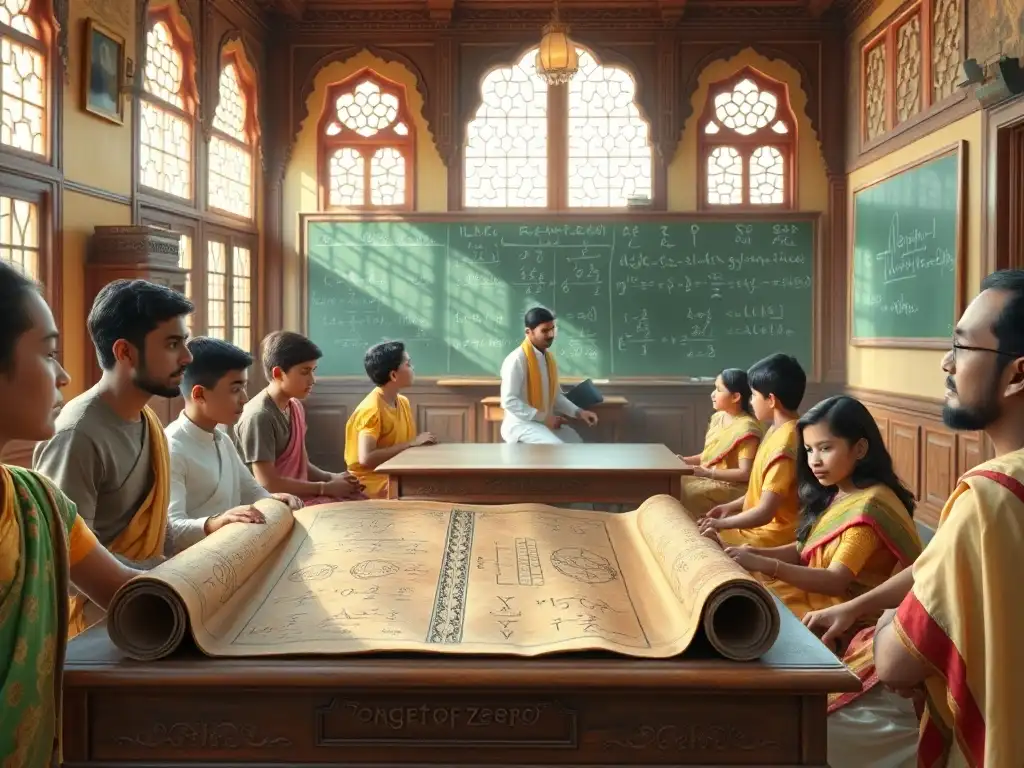
The concept of zero, originating from ancient Indian mathematics, has transcended its historical roots to become a fundamental element in modern science, technology, and economics. Its applications are vast, impacting various fields and reshaping our understanding of the universe.
The Role of Zero in Contemporary Mathematics and Science
In contemporary mathematics, zero serves as a crucial placeholder in the decimal system, enabling the representation of large numbers and performing calculations with precision. For instance, in algebra, zero is used to define the identity element for addition, meaning any number added to zero remains unchanged. In calculus, it plays a pivotal role in limits and derivatives, particularly in defining continuity and understanding instantaneous rates of change.
Moreover, zero is foundational in solving equations. The concept of the "zero solution" is critical in various mathematical theories, including linear algebra and differential equations. Additionally, in physics, zero is instrumental in formulating theories of relativity and quantum mechanics, where it often represents the baseline state or absence of a quantity, such as energy or force.
Zero in Computer Science and Digital Technology
In the realm of computer science, zero is fundamental to binary code, the language of computers. The binary system, which relies on two digits—0 and 1—forms the backbone of all digital technology. Every computation, data storage, and automated process hinges on this simple yet powerful concept.
Furthermore, zero is essential in programming languages where it often represents false in boolean logic. This usage impacts control flow and decision-making processes within algorithms. In databases, zero can signify the absence of value or a null entry, influencing data structures and query results.
Zero's Impact on Economic Models and Statistical Analysis
Economically, zero plays a vital role in modeling and analysis. It acts as a baseline measure in various economic indicators, such as inflation rates and unemployment figures. Economists use zero to signify equilibrium in supply and demand graphs, illustrating the point at which markets balance.
In statistical analysis, zero is crucial for hypothesis testing, particularly in establishing null hypotheses. The presence of zero in datasets can indicate trends, averages, and anomalies, allowing statisticians to derive meaningful insights and make informed decisions.
Conclusion: The Legacy of Ancient Indian Concepts of Zero
The legacy of ancient Indian concepts of zero extends far beyond its origins, influencing modern mathematics, science, technology, and economics. The journey from the conceptualization of zero in ancient times to its pervasive applications today reflects not only its significance but also the ingenuity of ancient Indian scholars.
Reflection on the Historical Significance of Zero
Historically, the introduction of zero revolutionized mathematics, enabling complex calculations and the development of advanced mathematical concepts. Ancient Indian mathematicians like Brahmagupta and Aryabhata recognized zero's potential, paving the way for its acceptance across cultures and civilizations. Their insights have allowed subsequent generations to build upon their findings, leading to breakthroughs in various disciplines.
The Continuing Influence of Ancient Indian Mathematics in Today's World
Today, the influence of ancient Indian mathematics, especially the concept of zero, is undeniable. It continues to shape educational curricula, inspire innovations in technology, and enhance our analytical capabilities in economics and science. As we delve deeper into the implications of zero, we pay homage to the ancient thinkers whose contributions have laid the groundwork for much of modern mathematics and beyond. The journey of zero is not just a historical narrative; it is a testament to the enduring legacy of ancient Indian intellect.
References
The evolution of zero is a fascinating journey that intertwines mathematical concepts with cultural and philosophical developments in ancient India. This section provides a list of notable works and suggested readings that delve deeper into the ancient Indian concepts of zero and its profound impact on mathematics.
Notable Works on Ancient Indian Mathematics
-
"A History of Indian Mathematics" by C. D. Sharma
This comprehensive work explores the development of mathematics in India, focusing on the contributions of key mathematicians and the significance of concepts like zero.
-
"The Mathematics of Ancient India" by Kim Plofker
Plofker's book offers insights into the mathematical practices of ancient Indian civilizations, emphasizing the role of zero in numeral systems and calculations.
-
"The Legacy of Indian Mathematics" edited by G. V. T. Murthy
A collection of essays that highlights various aspects of Indian mathematics, including detailed discussions on the origins and applications of the concept of zero.
-
"Zero: The Biography of a Dangerous Idea" by Charles Seife
While not exclusively about ancient Indian concepts, this book provides an engaging narrative about the history of zero and its philosophical implications, including its roots in Indian mathematics.
-
"The History of Mathematics: A Brief Course" by Roger L. Cooke
This textbook presents a broad overview of the history of mathematics, with sections dedicated to ancient Indian contributions, including the significance of zero.
Suggested Reading for Further Exploration of Zero and Its History
-
"The Story of Zero: A Mathematical Adventure" by Dot EDU
This engaging read explores the concept of zero in a manner accessible to younger audiences, covering its journey from ancient India to modern mathematics.
-
"The Birth of Zero" by Michael P. McCarthy
This book delves into how the concept of zero emerged in various cultures, with a focused discussion on ancient Indian developments and their influence on global mathematics.
-
"Mathematics in India" by Kim Plofker
Plofker's research provides an in-depth analysis of the mathematical landscape in India, tracing the evolution of zero and its profound influence on both eastern and western mathematical traditions.
-
"Mathematical Thought from Ancient to Modern Times" by Morris Kline
Kline’s work discusses the historical evolution of key mathematical concepts, including a dedicated section on the ancient Indian contributions to the concept of zero.
-
"Zero: A New Approach to Mathematics" by Charles Seife
This book offers a modern perspective on zero, discussing its historical context, philosophical implications, and its crucial role in contemporary mathematics.
These references and suggested readings serve as valuable resources for anyone interested in exploring the ancient Indian concepts of zero and their lasting impact on the field of mathematics.
- Introduction to the Concept of Zero
- Historical Context of Zero in Ancient India
- The Development of Zero in Ancient Indian Texts
- The Transition of Zero from Ancient India to the World
- Modern Applications of Zero
- Conclusion: The Legacy of Ancient Indian Concepts of Zero
- References
- What is the significance of ancient Indian concepts of zero?
- How did ancient Indians develop the concept of zero?
- Who were the key figures in the development of zero in ancient India?
- What impact did ancient Indian concepts of zero have on modern mathematics?
- Are there any ancient texts that discuss the concept of zero?
Frequently Asked Questions
What is the significance of ancient Indian concepts of zero?
The ancient Indian concepts of zero transformed mathematics by introducing the idea of a placeholder and the concept of nothingness, which later influenced global mathematical practices.
How did ancient Indians develop the concept of zero?
Ancient Indian mathematicians, particularly during the Gupta Empire, formalized the concept of zero as a number itself, allowing for complex calculations and advancements in mathematics.
Who were the key figures in the development of zero in ancient India?
Prominent figures include Brahmagupta, who provided rules for arithmetic involving zero, and Aryabhata, whose work laid foundational principles for further mathematical exploration.
What impact did ancient Indian concepts of zero have on modern mathematics?
The introduction of zero allowed for advanced mathematical theories, including calculus and algebra, significantly shaping modern scientific and technological advancements.
Are there any ancient texts that discuss the concept of zero?
Yes, texts such as Brahmagupta's Brahmasphutasiddhanta and Aryabhata's Aryabhatiya provide foundational discussions and rules concerning the use of zero in mathematics.
Final Reflection: The Timeless Journey of Zero
The evolution of the concept of zero from ancient Indian mathematics to its modern applications underscores the profound impact of ancient Indian concepts of zero on our understanding of mathematics and technology today. As we navigate an increasingly digital world, the significance of zero transcends mere numerical value; it embodies the essence of innovation and progress. The journey of zero is not just a historical narrative; it is a testament to human ingenuity and the relentless pursuit of knowledge.
The influence of zero extends beyond mathematics; it has shaped our cultural and social landscapes in ways we often overlook. From the ancient scholars who first conceptualized this revolutionary idea to the modern-day applications in computing and data science, zero has become a cornerstone of our intellectual heritage. In the realm of ideas, nothing is more powerful than a single thought that can change the course of history.
This quote encapsulates the transformative power of zero, reminding us that even the smallest concepts can lead to monumental advancements.
As you reflect on the journey of zero, I invite you to consider how this ancient concept can inspire your own pursuits. Embrace the lessons of innovation, adaptability, and the courage to challenge conventional wisdom. Whether in your personal life or professional endeavors, let the story of zero remind you that every great achievement begins with a single idea—sometimes, even one that seems insignificant at first.
Embrace the Power of Zero: Transform Your Understanding Today!
Thank you for diving deep into the fascinating journey of zero—from its roots in ancient India to its profound impact on modern mathematics and technology. You’ve unlocked a powerful concept that has reshaped our understanding of the universe! Now, let’s take the next steps to fully embrace this knowledge.
Here’s how you can continue your exploration of this remarkable concept:
- Join the Conversation: Share your thoughts on how the concept of zero has influenced your life or studies. Leave a comment below, and connect with fellow enthusiasts!
- Explore Further: Check out additional resources on ancient Indian mathematics. Consider reading about the significant contributions of mathematicians like Aryabhata and Brahmagupta.
- Create or Share: Craft a brief presentation or article summarizing the importance of zero in today’s world and share it on social media to inspire others!
What new insights about numbers or mathematics do you think will emerge as we continue to uncover the rich history behind our most fundamental concepts?