
Bhaskara II: The Mathematician Who Mapped the Stars and Numbers


Welcome to Ancient India History, where we embark on a fascinating journey through the rich tapestry of ancient Indian civilizations. Today, we delve into the remarkable contributions of Bhaskara II, a brilliant mathematician whose work not only illuminated the realms of stars and numbers but also laid the foundation for modern mathematics. What secrets did Bhaskara II uncover that continue to influence our understanding today? Join us as we explore his groundbreaking ideas and the profound impact they had on the world of mathematics, inviting you to uncover the mysteries of the past with each click.
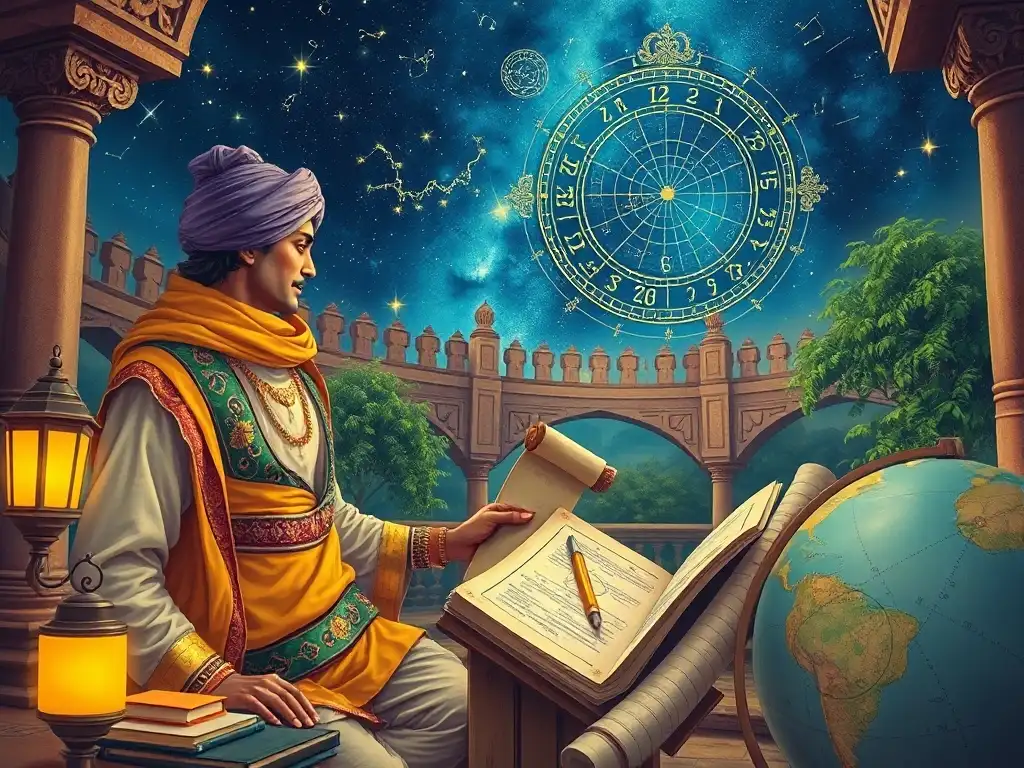
Introduction to Bhaskara II
Bhaskara II, often referred to as Bhaskara the Younger, stands as a monumental figure in the history of mathematics and astronomy. Born in the 12th century in what is now modern-day India, he made groundbreaking contributions that not only advanced mathematical thought but also laid the groundwork for future scholars across the globe. His works, characterized by their clarity and innovative approach, represent a bridge between ancient knowledge and modern mathematical concepts.
The significance of Bhaskara II's contributions to mathematics is not limited to his era; they resonate through time, influencing both Eastern and Western mathematical traditions. As we explore the life and works of this eminent mathematician, we will uncover how his insights into numbers and celestial phenomena helped shape the understanding of mathematics in ancient India and beyond.
Overview of Bhaskara II's Life and Era
Born in 1114 CE in a region that was a hub of intellectual activity, Bhaskara II was raised in an environment that fostered scholarly pursuits. He was the son of the renowned mathematician and astronomer, Bhaskara I, who inspired his interest in mathematics from an early age. His most notable work, the "Siddhanta Shiromani," is a comprehensive text divided into two parts: the "Lilavati," which focuses on arithmetic and geometry, and the "Bijaganita," which delves into algebra.
During Bhaskara II's lifetime, India was experiencing a rich cultural and intellectual renaissance. The period saw a confluence of ideas from various philosophies and sciences, making it an ideal backdrop for his innovations. Bhaskara II’s contributions emerged from a society that valued knowledge, and his scholarly achievements were recognized by his contemporaries, establishing him as a leading figure in the field.
Importance of Bhaskara II in Ancient Indian Mathematics
Bhaskara II is often celebrated for his ability to synthesize existing mathematical knowledge and expand upon it. His works introduced new techniques and concepts that were crucial in the evolution of mathematics in India. He is particularly renowned for his systematic approach to solving equations and his introduction of zero as a placeholder, which was a significant advancement in the representation of numbers.
Moreover, his methods not only simplified complex calculations but also made mathematics more accessible to learners of all ages. His influence stretched beyond mathematics into the realm of astronomy, where he applied mathematical principles to celestial observations, thereby enhancing the understanding of astronomical phenomena. The importance of Bhaskara II in ancient Indian mathematics cannot be overstated; his legacy continues to inspire mathematicians and astronomers today.
Bhaskara II Contributions to Mathematics
Key Contributions to Algebra
Bhaskara II's contributions to algebra are among the most significant in the history of mathematics. His work in the "Bijaganita" not only provided solutions to quadratic equations but also introduced a systematic way of tackling various algebraic problems. He employed practical methods for solving equations and illustrated these with examples that made the concepts easier to grasp.
One of his notable achievements is the formulation of rules for solving linear and quadratic equations, which laid the foundation for future algebraic studies. His use of symbols and notation in algebra was revolutionary for his time, allowing for greater efficiency in calculations.
Innovations in Arithmetic
In the "Lilavati," Bhaskara II made remarkable strides in arithmetic, presenting a range of topics from basic operations to more complex calculations. He introduced various techniques for performing arithmetic operations, including methods for multiplication, division, and the extraction of square roots.
His approach emphasized practical applications, often using real-life scenarios to illustrate mathematical principles. This made his work not only theoretical but also applicable, providing learners with tools they could use in everyday situations. Furthermore, Bhaskara II's exploration of permutations and combinations paved the way for future advancements in combinatorial mathematics.
Bhaskara II's Work on Astronomy and Its Mathematical Applications
Bhaskara II's contributions extended beyond pure mathematics into the field of astronomy, where he applied mathematical concepts to celestial observations. His work included detailed calculations of planetary positions and eclipses, demonstrating the practical application of mathematics in understanding celestial phenomena.
In his treatise "Siddhanta Shiromani," he provided algorithms for calculating the movements of celestial bodies, showcasing the deep connection between mathematics and astronomy in ancient India. By integrating mathematical principles with astronomical observations, Bhaskara II not only advanced the field of astronomy but also highlighted the importance of mathematics in interpreting the universe.
Bhaskara II's contributions to mathematics were diverse and profound, influencing generations of mathematicians and astronomers. His innovative approaches to algebra, arithmetic, and astronomy laid the groundwork for future advancements, making him a pivotal figure in the legacy of ancient Indian mathematics.
The Influence of Bhaskara II on Later Mathematicians
Bhaskara II, often regarded as one of the most significant mathematicians of ancient India, had a profound influence on subsequent generations of mathematicians, not only in India but also around the world. His innovative approaches and comprehensive works laid a strong foundation for future mathematical explorations. Notably, his treatise "Lilavati" became a crucial text for teaching mathematics, serving as both a textbook and a source of inspiration.
His methods and ideas on calculus, particularly concepts of derivatives and integration, predate similar discoveries in Europe by several centuries. Through the transmission of his works to the Islamic world and then to Europe, Bhaskara II's contributions significantly influenced mathematicians such as Al-Khwarizmi and later European scholars, who built upon his concepts to advance mathematics in their own cultures.
How Bhaskara II Inspired Future Generations
Bhaskara II inspired future generations through both his mathematical insights and his pedagogical style. His ability to simplify complex concepts into engaging narratives, as exemplified in "Lilavati," made mathematics accessible to learners. This approach not only fostered a love for mathematics but also encouraged innovative thinking.
Moreover, Bhaskara's emphasis on practical applications of mathematics, such as in commerce and astronomy, showcased the utility of mathematical principles in everyday life. His assertion that mathematics is not merely theoretical but a tool for understanding the world around us resonated with many scholars who followed him, encouraging them to explore and expand upon his ideas.
Comparative Analysis with Other Mathematicians of His Time
When comparing Bhaskara II to other mathematicians of his time, such as Brahmagupta and Aryabhata, it becomes evident that his contributions were unique in their breadth and depth. While Brahmagupta focused on arithmetic rules and solutions to quadratic equations, Bhaskara II integrated these findings into a more holistic framework that encompassed both mathematics and astronomy.
Aryabhata, known for his work in astronomy, laid the groundwork for mathematical astronomy, yet Bhaskara II expanded upon these concepts, particularly in his works like "Siddhanta Shiromani". His innovative use of zero and the concept of positional notation were also ahead of his contemporaries, allowing for more complex calculations and a clearer representation of numerical systems.
Notable Works of Bhaskara II
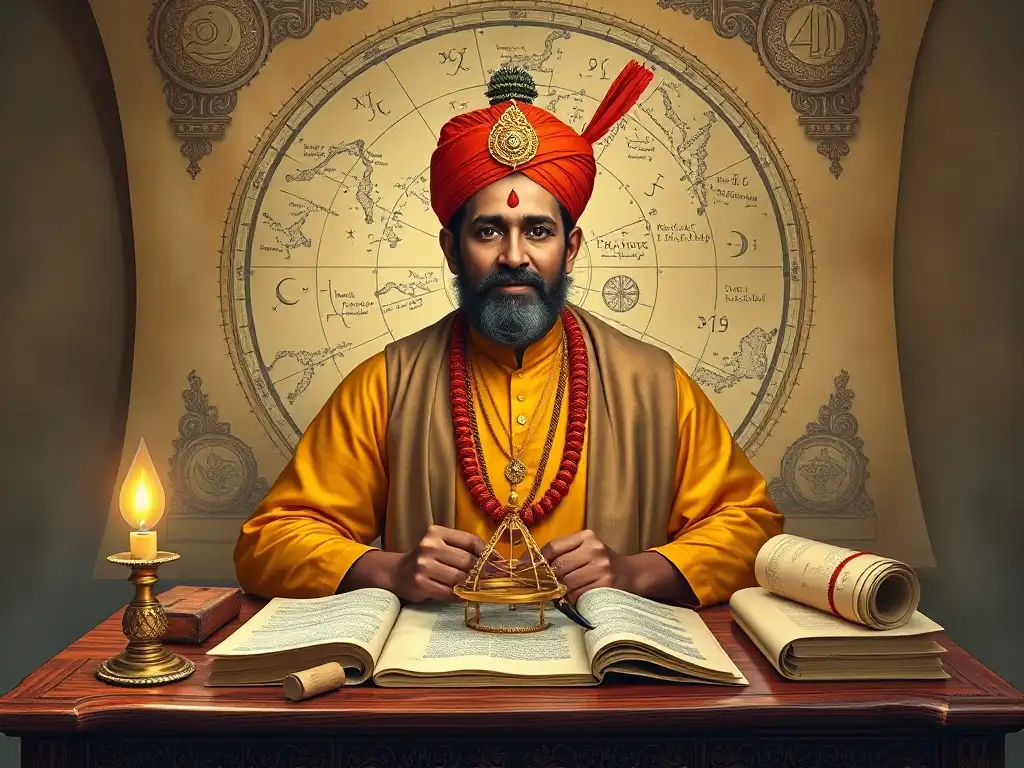
Bhaskara II's legacy is encapsulated in several remarkable works that illustrate his genius and his contributions to mathematics. His texts not only provide profound mathematical insights but also reflect his ability to merge theory with practical applications.
"Lilavati": A Masterpiece in Mathematical Literature
"Lilavati" is perhaps Bhaskara II's most famous work, celebrated for its poetic style and engaging content. This text covers various topics, including arithmetic, geometry, and mensuration, all presented through charming stories and problems.
The title character, Lilavati, is said to be his daughter, and the work is structured around her learning journey, making it relatable and appealing to students. This approach has made "Lilavati" a timeless educational resource, influencing countless mathematicians and educators throughout history. Its impact on teaching methods in mathematics is still acknowledged today, as it provides a blend of theory and practical problem-solving skills.
"Bījagaṇita": The Foundation of Algebra
In "Bījagaṇita", Bhaskara II delves into algebra, presenting a systematic approach to the subject that was revolutionary for his time. This work introduces concepts such as equations and their solutions, as well as rules for manipulating algebraic expressions.
Bhaskara's innovative methods laid the groundwork for future developments in algebra, influencing both Indian and Islamic mathematicians. His clear categorization of different types of equations and the systematic treatment of solutions are considered a precursor to modern algebraic notation and methods, highlighting his role as a pioneer in this field.
"Siddhanta Shiromani": Astronomy and Its Mathematical Principles
"Siddhanta Shiromani" stands as Bhaskara II's magnum opus, combining mathematics and astronomy in a comprehensive framework. This work is divided into several parts, with the "Graha Gati" section focusing on planetary motion and the "Golādhyāya" detailing spherical geometry.
In "Siddhanta Shiromani," Bhaskara II employs sophisticated mathematical techniques to solve astronomical problems, demonstrating the interconnectedness of mathematics and the natural world. His calculations for planetary positions and eclipses were remarkably accurate, showcasing his mastery of both mathematics and observational astronomy. This work not only solidified his status in the realm of mathematics but also significantly contributed to the advancement of astronomical sciences in ancient India.
Bhaskara II's Legacy in Mathematics
Bhaskara II, also known as Bhaskara Acharya, was a prominent Indian mathematician and astronomer who lived during the 12th century. His contributions to mathematics were groundbreaking and have had a lasting influence on both ancient and modern mathematical thought. One of his most significant works, "Lilavati," serves as a comprehensive treatise on arithmetic and algebra, presenting complex mathematical ideas in an accessible format. His other notable work, "Bijaganita," focused on algebra, introducing concepts such as quadratic equations and the use of zero in calculations.
Bhaskara II's innovative approach to mathematics emphasized practical applications, allowing his theories to be utilized in real-world scenarios, such as calculating time, distance, and astronomical phenomena. His methods for solving problems were not only mathematically rigorous but also highly applicable, reflecting a deep understanding of the practical needs of his time. As a result, Bhaskara II's legacy is marked by his ability to merge theoretical mathematics with everyday problem-solving, establishing a foundation for future mathematicians to build upon.
The Impact of His Work on Modern Mathematics
The impact of Bhaskara II's work on modern mathematics is profound, particularly in the fields of algebra and calculus. His exploration of concepts such as cyclic equations and indeterminate equations laid the groundwork for future developments in algebra. For instance, his techniques for solving quadratic equations are still taught in modern mathematics curricula.
Moreover, Bhaskara II's work anticipated certain principles of calculus, particularly in his treatment of infinitesimals and rates of change. His ideas about the relationship between mathematics and astronomy also prompted further advancements in these areas, influencing later mathematicians and astronomers in both India and the Islamic world. His assertion that "the moon shines by light reflected from the sun" is an early example of the application of mathematical reasoning to astronomical phenomena, showcasing his forward-thinking approach.
Recognition of Bhaskara II in Contemporary Studies
In contemporary studies, Bhaskara II is recognized as a pivotal figure in the history of mathematics. His works have been translated and studied extensively, shedding light on the sophistication of ancient Indian mathematics. Scholars have noted the originality of his ideas and the clarity with which he presented them, making them accessible to students and mathematicians alike.
Bhaskara II's contributions have also been acknowledged in various mathematical conferences and publications, where his methodologies and findings are discussed in the context of both historical significance and modern relevance. This recognition serves not only to honor his legacy but also to inspire new generations of mathematicians to explore the rich history of mathematical thought in ancient cultures, particularly that of India.
Conclusion
Summary of Bhaskara II's Contributions to Mathematics
Bhaskara II's contributions to mathematics are characterized by his innovative approaches to solving complex problems, his pioneering work in algebra and arithmetic, and his integration of mathematics with astronomy. His texts, "Lilavati" and "Bijaganita," continue to be celebrated for their clarity and practical applications, making significant strides in the understanding and teaching of mathematics. His methods for problem-solving and his insights into mathematical principles remain relevant, serving as foundational elements for modern mathematical education.
The Enduring Relevance of Bhaskara II in the Study of Ancient Indian Mathematics
The enduring relevance of Bhaskara II in the study of ancient Indian mathematics lies in his ability to bridge the gap between theoretical concepts and practical applications. His works not only contributed to the mathematical knowledge of his time but also influenced future generations of mathematicians across cultures. The principles he established continue to resonate in contemporary mathematical thought, affirming his place as a luminary in the history of mathematics. As scholars and students delve into the rich legacy of ancient Indian mathematics, Bhaskara II remains a central figure whose work inspires ongoing discovery and innovation.
- Introduction to Bhaskara II
- Bhaskara II Contributions to Mathematics
- The Influence of Bhaskara II on Later Mathematicians
- Notable Works of Bhaskara II
- Bhaskara II's Legacy in Mathematics
- Conclusion
Frequently Asked Questions
What are Bhaskara II's main contributions to mathematics?
Bhaskara II, also known as Bhaskara the Great, made significant contributions, including advancements in algebra and calculus, particularly in solving equations and understanding infinitesimals.
How did Bhaskara II influence astronomy?
His work, particularly in the text Siddhanta Shiromani, integrated mathematics and astronomy, providing methods for calculating celestial positions and movements which were crucial for astrological predictions.
What is the significance of Bhaskara II's work in calculus?
Bhaskara II introduced concepts of derivatives and integrals long before they were formally recognized in Europe, showcasing an early understanding of infinitesimal calculus.
Did Bhaskara II contribute to any specific mathematical texts?
Yes, his notable works include the Līlāvatī, a treatise on arithmetic, and Bījagaṇita, focusing on algebra, both of which are fundamental to understanding ancient Indian mathematics.
How did Bhaskara II's contributions shape modern mathematics?
His innovative techniques and mathematical concepts laid the groundwork for future mathematicians, influencing both Indian and global mathematics through his systematic approach to problem-solving.
Final Reflection: Celebrating Bhaskara II's Enduring Legacy in Mathematics
Bhaskara II's contributions to mathematics are not just historical footnotes; they resonate profoundly in today's world. His innovative approaches to algebra and astronomy laid the groundwork for future generations, illustrating how one individual's brilliance can illuminate the path for countless others. The mathematical principles he developed continue to influence modern science and technology, reminding us that the quest for knowledge knows no boundaries.
The impact of Bhaskara II's work extends far beyond the confines of ancient India; it has woven itself into the very fabric of our global understanding of mathematics. His ability to blend practical applications with theoretical insights has inspired mathematicians and scientists alike. As we reflect on his legacy, we are reminded of the words of Carl Sagan: Somewhere, something incredible is waiting to be known.
This sentiment captures the essence of Bhaskara II's contributions, as his work invites us to explore the mysteries of the universe through the lens of mathematics.
As we look to the future, let us carry forward Bhaskara II's spirit of inquiry and innovation. I invite you to reflect on how his teachings can inspire your own journey in mathematics and beyond. Whether you are a student, educator, or simply a curious mind, consider how you can apply the lessons of perseverance and creativity that Bhaskara II exemplified. Embrace the challenge of mapping your own stars and numbers, for in doing so, you contribute to a legacy that transcends time and space.
Explore the Legacy of Bhaskara II Today!
Thank you for diving into the fascinating world of Bhaskara II! Your interest in this great mathematician not only enriches your knowledge but also honors the incredible contributions of Ancient India to science and mathematics. Now, let's take your passion to the next level!
- Start implementing Bhaskara’s methods in your studies or work. Choose a mathematical problem and discover how his techniques can simplify your approach!
- Share this article with friends or colleagues who would appreciate the brilliance of Bhaskara II. Spark conversations about the impact of ancient mathematics on our modern world!
- Join a local astronomy or mathematics club to explore the fascinating connections between stars and numbers, just as Bhaskara did centuries ago.
Which aspect of Bhaskara II's work inspires you the most—his mathematical prowess or his astronomical insights? We would love to hear your thoughts!