
The Secrets of Ancient Indian Numerical Puzzles and Recreational Math

Welcome to Ancient India History, where we embark on a fascinating journey through the rich tapestry of ancient Indian civilizations. Dive into the world of intricate mathematical puzzles that not only showcase the brilliance of our ancestors but also reveal their profound understanding of numbers and logic. Have you ever wondered how these ancient Indian mathematical puzzles shaped the foundations of recreational math? Join us as we unravel the secrets of these captivating enigmas, igniting your curiosity and inspiring you to explore the profound contributions of ancient India to mathematics and beyond!
Exploring the captivating world of ancient Indian mathematical puzzles reveals not only the ingenuity of the civilization but also its profound contributions to the field of mathematics. From the intricate designs of the Indus Valley Civilization to the sophisticated algorithms of the Gupta Empire, ancient India was a cradle of mathematical innovation.
In this article, we will delve into the fascinating realm of ancient Indian mathematical puzzles, examining their historical context, significance, and the legacy they left behind in the broader scope of mathematics. Join us as we unravel the secrets of these numerical enigmas and uncover the recreational aspects of mathematics that thrived in ancient Indian culture.
Introduction to Ancient Indian Mathematical Puzzles
Overview of Ancient Indian Contributions to Mathematics
Ancient India boasts a rich tapestry of mathematical advancements that played a crucial role in shaping modern mathematics. The contributions ranged from the development of the decimal system, the concept of zero, and algebraic techniques to intricate puzzles that stimulated intellectual curiosity. Notable mathematicians such as Aryabhata, Brahmagupta, and Bhaskara II formulated principles that are foundational to contemporary mathematical thought. Their work often included recreational puzzles that were not merely academic exercises but also a means of engaging with numbers in a playful yet profound manner.
Importance of Recreational Mathematics in Ancient India
Recreational mathematics served as a bridge between the abstract world of numbers and the tangible experiences of daily life in ancient India. It provided a means to explore mathematical concepts through engaging puzzles and games, fostering critical thinking and problem-solving skills. These activities were not only enjoyed by scholars but also by the general populace, reflecting a cultural appreciation for mathematics as a source of entertainment and intellectual challenge. The legacy of this recreational approach continues to resonate in modern mathematical practices, highlighting the timeless nature of these ancient puzzles.
Historical Context of Numerical Puzzles in Ancient India
The Evolution of Mathematical Thought in Ancient India
The evolution of mathematical thought in ancient India can be traced back to the Vedic period, where the earliest numerical concepts emerged. As society progressed, so did the complexity of mathematical ideas. The integration of philosophy, astronomy, and commerce necessitated a deeper understanding of mathematics, leading to the formulation of numerous puzzles and problems. This evolution was marked by a shift from simple arithmetic to more complex problems involving geometry and algebra, illustrating the dynamic nature of mathematical inquiry in ancient Indian civilization.
Key Texts and Manuscripts Featuring Numerical Puzzles
Several key texts and manuscripts from ancient India provide invaluable insights into the world of numerical puzzles. Works such as the Lilavati by Bhaskara II and the Brahmasphutasiddhanta by Brahmagupta contain a wealth of problems that challenge the reader's mathematical prowess. These texts not only present puzzles but also offer solutions and methods of problem-solving, showcasing the pedagogical approach to mathematics in ancient India. Through these manuscripts, we gain a glimpse into the playful yet serious engagement with numbers that characterized the era.
As we continue through this article, we will explore specific examples of these mathematical puzzles and their impact on both ancient and modern mathematical thought.
Types of Ancient Indian Mathematical Puzzles
Ancient Indian mathematics is renowned for its diverse range of numerical puzzles that not only served as recreational activities but also as educational tools for honing mathematical skills. These puzzles can be broadly categorized into three main types: arithmetic, geometric, and algebraic puzzles. Each type highlights unique techniques and applications, showcasing the innovative spirit of ancient Indian mathematicians.
Arithmetic Puzzles and Their Techniques
Arithmetic puzzles in ancient India often revolved around basic operations such as addition, subtraction, multiplication, and division. These puzzles were designed to challenge the problem-solving abilities of students and practitioners.
- Word Problems: Many arithmetic puzzles were framed as word problems requiring the solver to extract numerical values from descriptive scenarios. For example, a common problem might involve calculating the total cost of multiple items purchased in varying quantities.
- Riddles: These puzzles typically involved clever phrasing and required lateral thinking. Riddles often played with numerical relationships, leading to surprising conclusions and deeper understanding.
- Number Patterns: Ancient mathematicians explored sequences and series through puzzles that involved finding missing numbers or predicting subsequent numbers in a pattern. This encouraged logical reasoning and analytical skills.
These techniques were essential in cultivating mathematical fluency and fostering a love for numbers among learners.
Geometric Puzzles in Ancient Indian Mathematics
Geometric puzzles were prominent in ancient Indian mathematical literature, particularly in texts such as the Sulba Sutras. These puzzles often involved shapes, areas, and volumes, challenging solvers to apply their understanding of geometry in practical contexts.
- Construction Challenges: Many geometric puzzles required the solver to construct specific shapes using a given set of tools, such as a compass and straightedge. For instance, determining the dimensions of a square with the same area as a given rectangular plot was a common task.
- Area and Volume Problems: Puzzles often involved calculating the area of complex figures or the volume of solids. These practical applications were not only theoretical but also had real-world implications in architecture and land measurement.
- Symmetry and Patterns: Geometric puzzles frequently explored concepts of symmetry and tessellation, encouraging solvers to recognize patterns and visual relationships within shapes.
Through these puzzles, ancient Indian mathematicians laid the foundations for modern geometric reasoning.
Algebraic Puzzles and Their Applications
Algebraic puzzles in ancient India reflected a sophisticated understanding of algebraic concepts, even before the formal establishment of algebra as a distinct field of study. These puzzles involved manipulating symbols and unknowns to find solutions.
- Equations and Unknowns: Ancient texts contained problems that required the formulation and solution of equations. Puzzles often involved finding the value of unknown quantities from a set of relationships, demonstrating early algebraic thinking.
- Diophantine Problems: Some algebraic puzzles asked solvers to find integer solutions to equations, which is a precursor to modern number theory. These problems were significant in understanding the properties of numbers.
- Practical Applications: Many algebraic puzzles were grounded in real-life applications, such as trade and agriculture, where solving for unknown quantities could yield profitable outcomes.
These puzzles showcased the blend of theoretical and practical mathematics that characterized ancient Indian mathematical thought.
Famous Examples of Ancient Indian Mathematical Puzzles
Ancient Indian mathematical puzzles are not only fascinating for their complexity but also for their historical significance. Some of the most famous examples include magic squares, the Chaturanga, and the Sulba Sutras, each contributing to the rich tapestry of ancient Indian mathematics.
The Magic Squares of Ancient India
Magic squares are arrangements of numbers in a square grid where the sums of each row, column, and diagonal are equal. Ancient India produced several remarkable magic squares, reflecting both mathematical ingenuity and artistic expression.
- Historical Significance: References to magic squares can be found in various ancient texts, including the Ganita Sara Sangraha by Bhaskara II, indicating their importance in mathematical culture.
- Construction Techniques: The methods used to construct these squares involved systematic approaches and creativity, often requiring the solver to engage with numbers in innovative ways.
- Cultural Impact: Beyond mathematics, magic squares held symbolic meanings in various cultures, including religious and astrological significance, further entrenching them in the cultural fabric of ancient India.
The Chaturanga and its Numerical Challenges
The Chaturanga, a game that is considered a precursor to modern chess, offered numerous numerical challenges that engaged players in strategic thinking and problem-solving.
- Strategic Puzzles: Players often faced puzzles related to optimal moves and outcomes based on the configuration of pieces on the board. These challenges required mathematical reasoning and foresight.
- Combinatorial Analysis: The game inspired early notions of combinatorial mathematics, as players calculated potential outcomes based on various moves and strategies.
- Cultural Significance: The Chaturanga was more than a game; it was a vehicle for teaching strategy, mathematics, and critical thinking, reflecting the values of ancient Indian society.
The Sulba Sutras: Geometry and Puzzles
The Sulba Sutras are ancient texts that provide rules for constructing altars and various geometrical forms used in Vedic rituals. These texts are rich with mathematical insights and puzzles.
- Geometric Constructions: The Sulba Sutras detail methods for constructing squares, rectangles, and circles, often with specific area requirements, showcasing advanced geometric understanding.
- Pythagorean Triples: The texts also discuss relationships between different lengths, hinting at early forms of the Pythagorean theorem, which was essential for the construction of altars.
- Cultural Context: The mathematical principles outlined in the Sulba Sutras were deeply intertwined with religious practices, illustrating how mathematics served both spiritual and practical purposes in ancient India.
Through these famous examples, we see how ancient Indian mathematical puzzles not only advanced mathematical thought but also enriched cultural and spiritual life.
The Role of Numerical Puzzles in Education
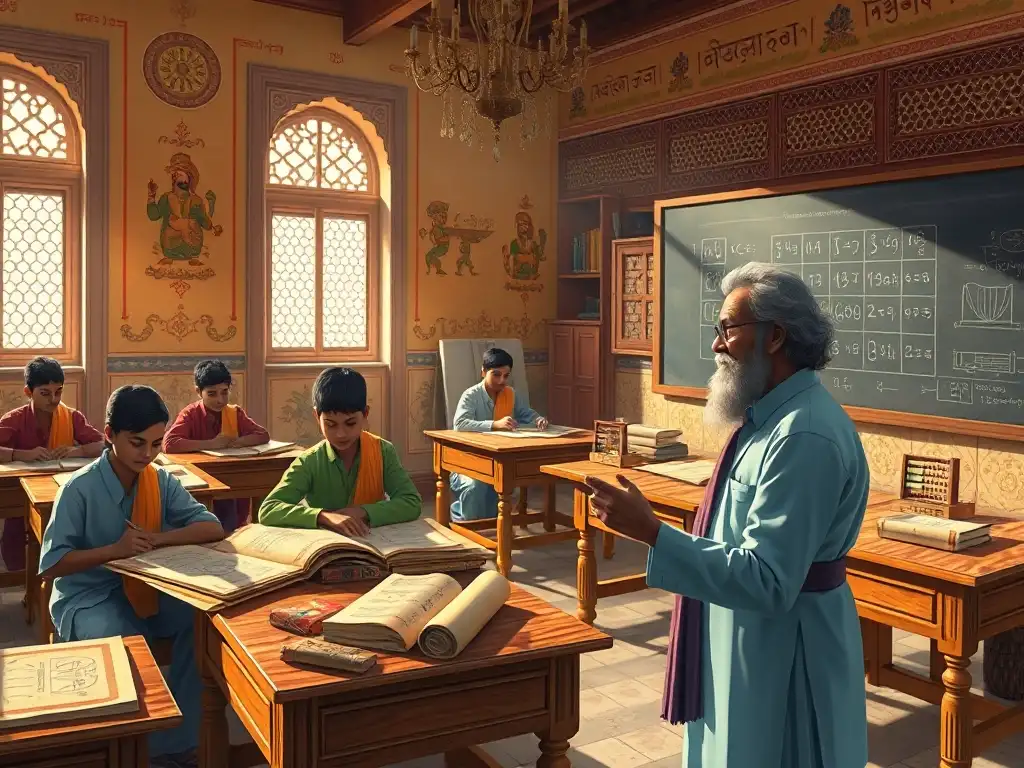
Numerical puzzles have played a significant role in the educational landscape of ancient India, serving as a vital tool for learning and intellectual development. These puzzles, often embedded within stories or cultural contexts, helped students grasp mathematical concepts in a more engaging manner. They encouraged problem-solving skills, logical reasoning, and critical thinking—essential skills that were valuable not only in mathematics but also in various aspects of life.
In ancient Indian educational systems, such as the Gurukul, students were introduced to mathematical puzzles as part of their curriculum. These puzzles often involved intricate calculations, geometric problems, and algebraic challenges that stimulated the mind and fostered a deep understanding of numerical relationships. By integrating puzzles into the learning process, educators could maintain learners' interest and make complex topics more accessible.
Furthermore, these puzzles often required collaboration, prompting students to work together to find solutions. This not only reinforced social bonds but also promoted a sense of community in learning. Overall, the use of numerical puzzles enriched educational practices, making mathematics a lively and dynamic field of study.
Teaching Methods Involving Recreational Mathematics
Teaching methods that incorporate recreational mathematics have been essential in ancient Indian education, particularly through the use of numerical puzzles. Educators utilized various techniques to convey mathematical principles, including storytelling, games, and challenges that made learning interactive and enjoyable.
One notable method was the use of riddles and puzzles that required students to think critically and creatively. For example, mathematical riddles often posed a scenario where students had to find a solution through logical deduction. This approach not only reinforced mathematical concepts but also enhanced verbal skills and cultural knowledge as many puzzles were rooted in folklore and tradition.
Additionally, the implementation of hands-on activities played a pivotal role. Students might engage in constructing geometric shapes or solving puzzles using physical objects, which provided a tactile learning experience that solidified their understanding. Such methods fostered a love for mathematics, encouraging students to explore further and develop their skills beyond the classroom.
The Impact of Puzzles on Cognitive Development
The engagement with numerical puzzles has a profound impact on cognitive development, particularly in the context of ancient Indian education. These puzzles challenge the brain, promoting mental agility and enhancing various cognitive functions, including memory, attention, and problem-solving abilities.
Through the process of solving puzzles, students are encouraged to employ logical reasoning and analytical thinking. For instance, many ancient Indian puzzles required individuals to break down complex problems into simpler components, fostering a systematic approach to problem-solving. This practice not only nurtured their mathematical acumen but also aided in developing skills applicable in various real-life situations.
Moreover, the competitive aspect of solving puzzles often motivated students to push their boundaries. The thrill of solving a particularly challenging puzzle or competing with peers provided a stimulating environment where cognitive skills could flourish. As a result, the legacy of these numerical puzzles extends beyond entertainment, highlighting their essential role in shaping the intellectual capabilities of ancient Indian scholars.
Cultural Significance of Mathematical Puzzles
Mathematical puzzles in ancient India were not merely educational tools; they held considerable cultural significance. They were deeply intertwined with the social and philosophical fabric of society, reflecting the values and beliefs of the time. These puzzles often served as a bridge between mathematics and other cultural domains, including art, literature, and spirituality.
Puzzles frequently appeared in literary works, demonstrating the integration of mathematical thought into storytelling. This connection emphasized the importance of mathematics in daily life and its representation in various cultural narratives. Additionally, the communal aspect of solving puzzles reinforced social ties, as people gathered to challenge each other and share knowledge, thus enriching their collective culture.
Symbolism and Philosophy Behind Ancient Indian Puzzles
The symbolism embedded within ancient Indian mathematical puzzles is both rich and complex. Many puzzles were designed not just for entertainment but to convey deeper philosophical ideas. For instance, certain puzzles reflected concepts of balance and harmony, which were central to Indian philosophy. The act of solving a puzzle could symbolize the journey of life, where one navigates through challenges to achieve understanding and enlightenment.
Moreover, the use of numbers in puzzles often carried symbolic meanings, such as the significance of certain numbers in religious or philosophical contexts. For example, the number seven is often associated with completeness and perfection in various cultures, including Indian traditions. Puzzles incorporating such numbers would thus invite participants to reflect on broader existential themes while engaging with mathematical concepts.
This intertwining of mathematics with philosophy and symbolism showcases the depth of ancient Indian thought, highlighting how numerical puzzles served as a medium for exploring profound truths about existence, knowledge, and the universe.
The Influence of Religion on Mathematical Recreations
Religion played a pivotal role in shaping mathematical recreations in ancient India. Many mathematical puzzles and problems were influenced by religious texts and practices, reflecting the deep connection between spirituality and intellectual pursuits. For instance, the study of astronomy, which was often linked to religious observances, necessitated advanced mathematical calculations, leading to the development of intricate numerical puzzles.
Moreover, religious festivals and rituals frequently incorporated mathematical elements, challenging individuals to solve puzzles related to calendar calculations or architectural designs of temples. These activities not only served a practical purpose but also reinforced the idea that mathematics was a sacred discipline, worthy of reverence and exploration.
The influence of religion on mathematical puzzles also extended to the philosophical discussions surrounding numbers and their meanings. Scholars would often engage in debates about the nature of infinity, the universe, and the divine, using puzzles as a means to articulate and explore these complex ideas. As such, mathematical puzzles in ancient India were not merely recreational; they were a fundamental aspect of the cultural and spiritual life, reflecting the intertwining of mathematics with the rich tapestry of religious beliefs.
Legacy of Ancient Indian Mathematical Puzzles
The legacy of ancient Indian mathematical puzzles is rich and profound, reflecting the intellectual prowess and creativity of early mathematicians. One of the most notable contributions is the Sulba Sutras, a collection of texts that not only outlined geometric principles but also included various puzzles and problems related to construction and measurement. These texts employed a unique blend of geometry and arithmetic, demonstrating the innovative spirit of ancient Indian scholars.
Another significant aspect of this legacy is seen in the playful mathematical riddles that were prevalent in ancient Indian culture. These puzzles often served as educational tools, engaging students and scholars alike in critical thinking and problem-solving. Notable among these is the Chandashastra, which includes numerous mathematical riddles that were designed to challenge the mind and promote deeper understanding of numerical concepts.
Moreover, the fascination with puzzles persisted throughout history, influencing the way mathematics was approached and taught in subsequent generations. The intricate nature of these puzzles laid the groundwork for more advanced mathematical concepts and practices, ensuring that the legacy of ancient Indian numerical puzzles continues to resonate in today’s mathematical discourse.
Continuation of Recreational Math Traditions in Modern India
In modern India, the tradition of recreational math continues to thrive, drawing inspiration from its ancient roots. Today, various forms of puzzles, brain teasers, and mathematical games are integral to educational curricula and cultural practices. Institutions and organizations promote mathematical literacy through competitions that celebrate the spirit of ancient numerical puzzles, engaging students in a playful yet educational manner.
The resurgence of interest in traditional Indian games, such as Chaturanga and Pachisi, reflects this continuation of recreational mathematics. These games not only entertain but also incorporate strategic thinking and mathematical reasoning, fostering a deeper appreciation for the complexity and beauty of numbers. Additionally, math clubs and online platforms dedicated to problem-solving encourage the exploration of both ancient and modern mathematical puzzles, providing a space for learners to connect with their mathematical heritage.
Furthermore, the integration of ancient mathematical concepts into contemporary educational practices emphasizes the importance of understanding cultural history in the study of mathematics. By recognizing and celebrating these traditions, modern India preserves its rich mathematical legacy while inspiring new generations of mathematicians and enthusiasts.
Influence on Global Mathematics and Recreational Puzzles
The influence of ancient Indian mathematical puzzles on global mathematics is significant and multifaceted. Many principles and techniques developed in ancient India were transmitted to other cultures through trade, exploration, and scholarly exchange. Notably, the Hindu-Arabic numeral system, which originated in India, revolutionized mathematical practice worldwide by introducing the concept of zero and place value.
Additionally, the recreational aspects of ancient Indian mathematics have inspired global puzzle enthusiasts and mathematicians alike. The unique styles of problem-solving and the creative approaches to numerical challenges that emerged from ancient India have influenced various cultures, contributing to the development of recreational math in different parts of the world. This cross-cultural exchange can be seen in the way mathematical riddles and puzzles have evolved, often incorporating elements from various traditions while maintaining their Indian roots.
Moreover, modern mathematicians and educators often draw upon ancient Indian puzzles as a source of inspiration for designing new mathematical challenges that promote critical thinking and creativity. By exploring these ancient puzzles, contemporary scholars can gain insights into the problem-solving techniques that have shaped the development of mathematics across civilizations.
Conclusion
Recap of the Importance of Ancient Indian Mathematical Puzzles
Ancient Indian mathematical puzzles hold an esteemed place in the history of mathematics, reflecting the ingenuity and intellectual curiosity of their time. These puzzles not only served as educational tools but also fostered a spirit of exploration and creativity that transcends cultural boundaries. The principles and techniques developed through these puzzles laid the groundwork for future advancements in mathematics, influencing both local and global mathematical practices.
Encouragement to Explore Further into Ancient Indian Mathematics
As we delve deeper into the fascinating world of ancient Indian mathematics, there is much to discover and appreciate. The mathematical puzzles of this era invite us to engage with complex concepts in a playful manner. Exploring these puzzles not only enriches our understanding of mathematics but also connects us with a vibrant cultural heritage. Therefore, we encourage readers to further investigate the treasures of ancient Indian mathematical traditions, embracing the joy and fascination that recreational math offers.
- Introduction to Ancient Indian Mathematical Puzzles
- Historical Context of Numerical Puzzles in Ancient India
- Types of Ancient Indian Mathematical Puzzles
- Famous Examples of Ancient Indian Mathematical Puzzles
- The Role of Numerical Puzzles in Education
- Cultural Significance of Mathematical Puzzles
- Legacy of Ancient Indian Mathematical Puzzles
- Conclusion
Frequently Asked Questions
What are ancient Indian mathematical puzzles?
Ancient Indian mathematical puzzles are engaging problems or riddles that originated in India, showcasing the country's rich numerical heritage and logical thinking.
How did these puzzles contribute to mathematics?
These puzzles served as a means to develop critical thinking and problem-solving skills, laying the groundwork for advanced mathematical concepts that influenced later civilizations.
Can you give an example of a famous puzzle from ancient India?
One notable example is the Chandahshastra, a treatise that includes various recreational math puzzles that challenge logical reasoning and numerical skills.
What role did ancient Indian scholars play in mathematics?
Ancient Indian scholars like Aryabhata and Brahmagupta made significant contributions, introducing concepts such as zero and algebra, which were often explored through puzzles.
Are these puzzles still relevant today?
Yes, ancient Indian mathematical puzzles continue to inspire modern mathematicians and enthusiasts, as they promote creative problem-solving and a deeper appreciation for mathematics.
Final Reflection: Unveiling the Timeless Wisdom of Ancient Indian Mathematical Puzzles
**The exploration of ancient Indian mathematical puzzles reveals a profound connection between culture and intellect, demonstrating that mathematics is not merely a set of numbers and operations, but a vibrant tapestry woven with creativity and insight. Today, as we navigate an increasingly complex world, the wisdom embedded in these puzzles offers not only entertainment but also a means to enhance critical thinking and problem-solving skills. The legacy of ancient Indian mathematicians continues to resonate, reminding us that the pursuit of knowledge is a timeless endeavor.
The influence of these ancient puzzles extends far beyond their historical context; they have become a vital part of our cultural and educational landscape. As we embrace the challenges of modern life, these puzzles encourage us to think outside the box and approach problems with curiosity and resilience. Mathematics is the music of reason,
as James Joseph Sylvester aptly put it, and the melodies created by ancient Indian mathematicians still echo in our classrooms and minds today.
As you reflect on the insights gained from this exploration, consider how you can incorporate the spirit of these ancient puzzles into your own life. Challenge yourself to embrace the joy of problem-solving, engage with numbers in a playful manner, and share these timeless treasures with others. By doing so, you not only honor the legacy of ancient Indian mathematicians but also inspire a new generation to appreciate the beauty and power of mathematics. Let us carry forward this rich tradition, ensuring that the secrets of ancient Indian mathematical puzzles continue to illuminate our paths for years to come.
Unveil the Wonders of Ancient Numerical Wisdom!
Thank you for exploring the fascinating world of ancient Indian numerical puzzles with us! We hope you uncover valuable insights that inspire your mathematical journey. Now, it’s your turn to take action and dive deeper into the rich legacy of recreational mathematics.
- Challenge yourself by solving a classic ancient Indian numerical puzzle. You can also try creating one or discover additional puzzles through online resources!
- Share your experiences with friends or family—initiate a fun math challenge to see who can solve the puzzles the quickest.
- Join a community of math enthusiasts or participate in online forums to engage in discussions about these intriguing concepts and explore collaborative opportunities.
Which ancient puzzle has ignited your curiosity the most, and how do you plan to integrate its wisdom into your everyday life?