
How Ancient Indian Philosophy Shaped Mathematical Concepts and Numerical Systems


Welcome to Ancient India History, where we embark on a fascinating journey through the rich tapestry of ancient Indian civilizations. Today, we delve into a captivating exploration of Ancient Indian philosophy and mathematics, uncovering how profound philosophical insights shaped groundbreaking mathematical concepts and numerical systems. Have you ever wondered how the thinkers of ancient India influenced the way we understand numbers today? Join us as we unravel this intriguing connection and discover the lasting contributions that continue to inspire generations. Prepare to be amazed by the depth and wisdom of a civilization that laid the foundation for modern thought!
- Introduction to Ancient Indian Philosophy and Mathematics
- Key Philosophical Concepts Influencing Mathematical Thought
- Historical Context of Mathematics in Ancient India
- Contributions of Ancient Indian Philosophers to Mathematics
- The Impact of Ancient Indian Mathematics on the World
- Conclusion: The Legacy of Ancient Indian Philosophy in Mathematics
-
Frequently Asked Questions
- What is the significance of ancient Indian philosophy in mathematics?
- How did the Indus Valley Civilization contribute to mathematics?
- What role did the Gupta Empire play in the development of mathematics?
- Can you explain the connection between ancient Indian philosophy and numerical systems?
- How did ancient Indian mathematicians influence modern mathematics?
- Final Reflection: The Enduring Legacy of Ancient Indian Philosophy in Mathematics
- Unveil the Profound Connection Between Philosophy and Mathematics!
Introduction to Ancient Indian Philosophy and Mathematics
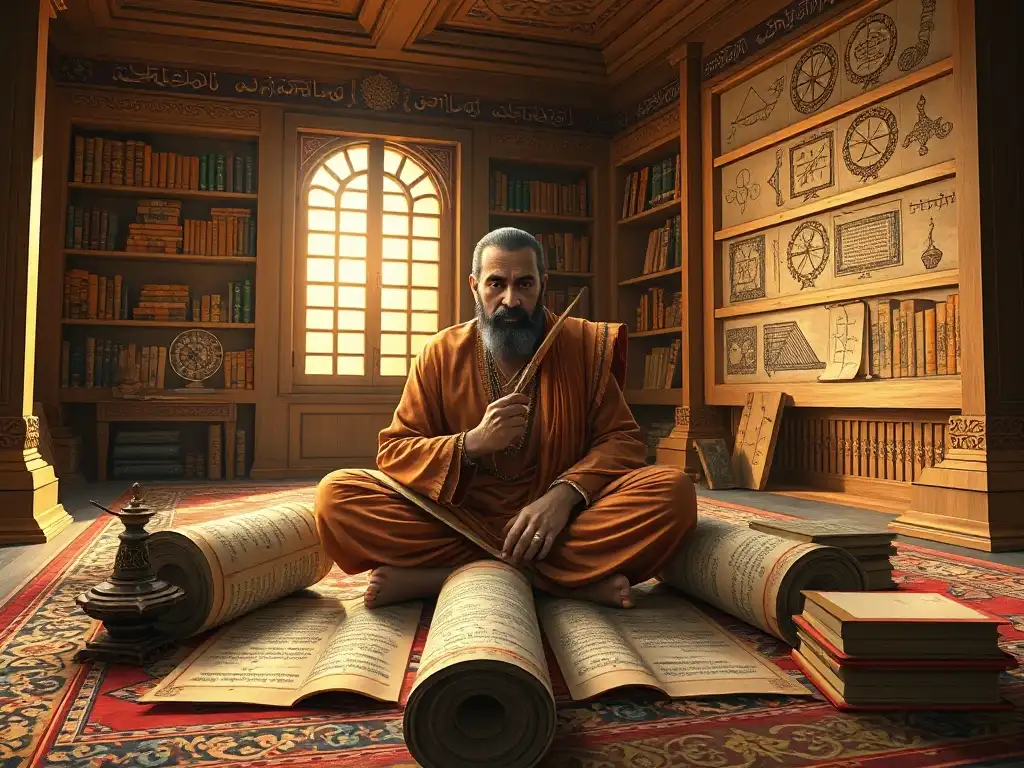
Ancient Indian philosophy and mathematics are two intertwined facets of India's rich cultural heritage, where profound philosophical insights have profoundly influenced mathematical concepts and numerical systems. From the sophisticated calculations of the Indus Valley Civilization to the groundbreaking contributions of mathematicians during the Gupta Empire, the relationship between these two domains reveals a unique approach to understanding the universe.
This article delves into the various philosophical traditions of ancient India, exploring how they shaped mathematical thought and practice. By examining the integration of philosophical principles with mathematical innovations, we will uncover the legacy that continues to resonate in contemporary mathematical frameworks.
Overview of Ancient Indian Philosophy
Ancient Indian philosophy encompasses a wide array of schools of thought, each offering unique perspectives on existence, reality, and knowledge. Key philosophical traditions include:
- Vedic Philosophy: Rooted in the Vedas, this school focuses on metaphysical concepts and the nature of reality.
- Sankhya: An analytical philosophy that categorizes existence into two fundamental realities: Purusha (consciousness) and Prakriti (matter).
- Nyaya: The logic and epistemology school that emphasizes reasoning and inference as means to gain knowledge.
- Buddhism and Jainism: Philosophies that challenge Vedic traditions, introducing concepts such as impermanence and non-violence.
These schools not only addressed existential questions but also laid the intellectual groundwork for mathematical thought. The emphasis on logic, reasoning, and systematic analysis in these philosophies created an environment conducive to mathematical exploration.
The Intersection of Philosophy and Mathematics in Ancient India
The synergy between philosophy and mathematics in ancient India is evident in several significant ways:
- Logical Frameworks: Indian philosophers developed rigorous logical systems that were instrumental in formulating mathematical proofs. For instance, the Nyaya school’s emphasis on inference and syllogism provided a methodical approach to problem-solving in mathematics.
- Conceptual Innovations: Philosophical inquiries into the nature of infinity and continuity led to the development of advanced mathematical concepts. The work of mathematicians like Aryabhata and Brahmagupta reflected these philosophical discussions, resulting in innovations such as the concept of zero and positional numeral systems.
- Ethical Dimensions: Philosophical teachings on ethics and the nature of knowledge influenced the way mathematics was taught and practiced. Ancient Indian mathematicians often viewed their work as a form of spiritual pursuit, seeking harmony with the universe through numerical understanding.
The rich tapestry of ancient Indian philosophy significantly shaped the development of mathematical concepts and numerical systems, leaving a lasting legacy that continues to inform modern mathematical thought. The exploration of these intersections not only highlights the intellectual prowess of ancient Indian civilizations but also underscores the profound impact of philosophy on the evolution of mathematics.
Key Philosophical Concepts Influencing Mathematical Thought

Ancient Indian philosophy profoundly influenced the development of mathematical concepts and numerical systems. This philosophical tradition emphasized logical reasoning, abstract thinking, and a deep understanding of the nature of reality, which laid the groundwork for advanced mathematical ideas. The intersection of philosophy and mathematics in ancient India illustrates how abstract concepts were not merely theoretical but were deeply intertwined with practical applications in various fields, including astronomy, architecture, and commerce.
The Role of Logic in Ancient Indian Philosophy
Logic, or "Nyaya," emerged as a critical area of study within ancient Indian philosophy. The Nyaya school systematically analyzed reasoning processes, establishing rules for valid inference and argumentation. This logical framework had a significant impact on mathematical reasoning and problem-solving.
- Formal Logic: The Nyaya philosophers developed formal methods for argumentation that paralleled mathematical proof techniques. They emphasized the importance of premises leading to conclusions, which is foundational in both logic and mathematics.
- Quantification and Relations: Ancient Indian logicians explored relationships between concepts, such as the quantification of terms. This exploration paved the way for the development of early forms of set theory and relational mathematics.
- Influence on Mathematicians: Prominent mathematicians like Brahmagupta and Bhaskara II were influenced by Nyaya principles, applying logical reasoning to formulate mathematical rules and algorithms. Their works demonstrate a sophisticated understanding of logical relationships in arithmetic and geometry.
The Concept of Infinity in Indian Philosophy
The philosophical discourse on infinity in ancient India is notable for its depth and complexity. Indian thinkers grappled with the concept of the infinite, which played a crucial role in the evolution of mathematical thought.
- Transcendental Infinity: In texts such as the "Siddhanta Siromani," mathematicians articulated the idea of infinite numbers and the concept of "ananta," or boundlessness. This understanding of infinity differed from the finite numbers traditionally emphasized in other cultures.
- Zero and the Infinite: The introduction of "shunya," or zero, was revolutionary in the context of infinity. Zero represented not just a placeholder but also an abstract concept that facilitated calculations involving infinite series and limits.
- Calculus Precursor: Indian mathematicians like Madhava of Sangamagrama contributed to early calculus concepts, including infinite series and convergence, demonstrating a sophisticated grasp of infinity long before similar ideas emerged in Europe.
The Influence of Spirituality on Mathematical Concepts
Spirituality in ancient Indian culture often intertwined with intellectual pursuits, including mathematics. This relationship significantly influenced the development of numerical systems and mathematical thought.
- Sacred Geometry: Many mathematical ideas were derived from religious rituals and architectural designs. The construction of temples and altars required precise measurements and geometric calculations, leading to advancements in geometry.
- Numerology and Symbolism: The significance of numbers in religious texts, such as the Vedas, fostered a culture that revered mathematics as a divine language. This view encouraged explorations into numerology, where numbers held symbolic meanings and were used in various philosophical contexts.
- Holistic Understanding: The spiritual perspective emphasized interconnectedness, influencing mathematicians to view mathematics not as an isolated discipline but as part of a broader understanding of the universe. This holistic approach led to innovative concepts in mathematics that resonated with philosophical inquiries about existence and the cosmos.
By integrating these key philosophical concepts, ancient Indian philosophy not only shaped mathematical thought but also created a rich tapestry of ideas that resonated throughout subsequent generations, influencing mathematics in both India and beyond.
Historical Context of Mathematics in Ancient India

Ancient India boasts a rich tapestry of mathematical concepts, deeply intertwined with its philosophical paradigms. The evolution of mathematics in this region can be traced back to the Indus Valley Civilization (circa 2600–1900 BCE), where early forms of measurement and calculation were evident. This period laid the groundwork for subsequent mathematical advancements, influenced significantly by the prevailing philosophical thought.
The ancient Indian approach to mathematics was not merely a practical tool but also a reflection of deeper philosophical inquiries. Concepts such as infinity, zero, and the nature of numbers were explored through a blend of mathematical rigor and metaphysical contemplation. As ancient Indian philosophy emphasized the interconnectedness of all knowledge, mathematics became a vital component of broader philosophical discourses.
The Evolution of Numerical Systems in Ancient India
The development of numerical systems in ancient India was marked by significant milestones that transformed mathematical practices. The earliest known numerical system used in India was likely a decimal system, which laid the foundation for more complex mathematical operations. By around 500 CE, this system had evolved to incorporate sophisticated concepts such as place value and the representation of large numbers.
Key Features of Ancient Indian Numerical Systems:
- Base-10 System: The decimal system was prevalent, allowing for easy calculations and record-keeping.
- Place Value Concept: This innovative approach enabled the expression of large numbers without cumbersome notation.
- Introduction of Symbols: Unique symbols for numbers were developed, leading to the eventual creation of the digits we recognize today.
The numerical systems were not static; they evolved through interaction with various cultures and were influenced by the philosophical ideas that pervaded society. This adaptability played a critical role in the advancement of mathematics in ancient India.
Major Texts Influencing Mathematical Knowledge
The mathematical landscape of ancient India was significantly shaped by key texts that codified and disseminated mathematical knowledge. These texts served as crucial references for scholars and practitioners, ensuring the continuity of mathematical thought throughout various periods.
The Sulba Sutras and Geometry
Among the earliest texts that contributed to mathematical knowledge are the Sulba Sutras, a collection of ancient Indian texts dated around 800 BCE to 200 BCE. These sutras were primarily focused on geometry and were used for constructing altars for Vedic rituals.
Key Contributions of the Sulba Sutras:
- Geometric Principles: The Sulba Sutras provided guidelines for constructing geometric figures, including squares, rectangles, and circles.
- Pythagorean Theorem: Interestingly, these texts contained early formulations of what is now known as the Pythagorean theorem, long before it was recognized in the West.
- Measurement Techniques: They included procedures for precise measurements, which were crucial for religious rituals.
The Sulba Sutras exemplify the integration of practicality and philosophical inquiry in ancient Indian mathematics, showcasing how geometry was not merely a theoretical pursuit but had real-world applications.
Aryabhata and the Introduction of Zero
Aryabhata, one of the most revered mathematicians and astronomers of ancient India, made substantial contributions to mathematics during the Gupta period (around 476–550 CE). His seminal work, the Aryabhatiya, encapsulated numerous mathematical concepts, including the revolutionary introduction of zero.
Key Aspects of Aryabhata's Contributions:
- Concept of Zero: Aryabhata is credited with formalizing the concept of zero as a numeral, a groundbreaking idea that transformed mathematical operations and calculations.
- Place Value System: He expanded upon the place value system, which allowed for more efficient arithmetic operations and paved the way for advanced mathematical theories.
- Trigonometry and Algebra: Aryabhata made significant advances in trigonometry and provided methods for solving algebraic equations, influencing generations of mathematicians.
Aryabhata's work not only impacted Indian philosophy and mathematics but also laid the groundwork for mathematical thought in other cultures, illustrating the profound interconnectedness of ancient Indian philosophy and mathematics.
Contributions of Ancient Indian Philosophers to Mathematics

Brahmagupta and Algebraic Concepts
Brahmagupta, a prominent Indian mathematician and astronomer of the 7th century, made significant contributions to the development of algebra. His seminal work, Brahmasphutasiddhanta, laid the foundation for mathematical operations involving zero and negative numbers, which were revolutionary at the time.
Key Contributions:
- Rules for Operations: Brahmagupta formulated rules for arithmetic operations with positive and negative numbers. He stated that:
- A positive number added to a positive number yields a positive result.
- Similarly, a negative number added to a negative number yields a negative result.
- The addition of a positive number and a negative number can produce either a positive or negative outcome, depending on their magnitudes.
- Zero as a Number: Perhaps his most notable contribution was the recognition of zero as a distinct number. Brahmagupta described rules for using zero in calculations:
- "A number multiplied by zero is zero."
- "When zero is subtracted from a number, the result is that same number."
- Quadratic Equations: Brahmagupta also provided methods for solving quadratic equations, introducing an early form of algebraic notation. He presented solutions to equations in the form of a problem, which has influenced mathematical processes ever since.
The essence of Brahmagupta's work lies in the systematic approach to mathematical problems, which paved the way for future generations of mathematicians.
Bhaskara II and Calculations of Astronomy
Bhaskara II, also known as Bhaskara Acharya, was a 12th-century mathematician and astronomer who expanded upon the works of Brahmagupta and introduced innovative concepts in mathematics and astronomy. His book, Lilavati, is particularly notable for its practical applications of mathematics, while Bijaganita focuses on algebra.
Key Contributions:
- Astronomical Calculations: Bhaskara II developed algorithms for calculating planetary positions and eclipses, demonstrating a deep understanding of celestial mechanics. He introduced methods for determining the time of planetary conjunctions and the cycles of celestial bodies.
- Fractional Calculations: He made significant advancements in dealing with fractions, presenting rules for operations involving them. For example, he provided methods for calculating the least common multiple (LCM) and greatest common divisor (GCD) of numbers, which are fundamental concepts in number theory.
- Innovative Techniques: Bhaskara II is known for his "Chakravala method" for solving indeterminate equations, which is a precursor to modern algebraic techniques. This systematic approach to finding solutions was groundbreaking and showcased the sophistication of ancient Indian mathematics.
Bhaskara II elevated the study of mathematics and astronomy to new heights, demonstrating the intricate relationship between the two fields.
The Development of Trigonometry in Ancient India
The development of trigonometry in ancient India can be traced back to the works of mathematicians like Aryabhata and later, Bhaskara II. Their contributions laid the groundwork for the trigonometric concepts that are essential in modern mathematics.
Key Contributions:
- Sine and Cosine Functions: Aryabhata introduced the sine function (known as jya) and provided tables for its values, which were crucial for astronomical calculations. His work emphasized the importance of circular functions in trigonometry.
- Bhaskara II's Innovations: Bhaskara II further advanced trigonometric concepts by exploring the relationship between different angular measures. He introduced the concept of the ardha jya, which corresponds to what we now know as the cosine function.
- Applications in Astronomy: The application of trigonometric functions in astronomy allowed for more accurate predictions of celestial events. Ancient Indian astronomers utilized these concepts to calculate distances and angles between celestial bodies.
| Mathematician | Contribution |
|---|---|
| Aryabhata | Introduced sine functions and tables |
| Bhaskara II | Explored relationships between angles |
| Brahmagupta | Established rules for operational algebra |
The developments in trigonometry by ancient Indian mathematicians reveal the sophisticated understanding of geometry and astronomy that characterized their work.
The contributions of ancient Indian philosophers to mathematics extend far beyond mere numerical calculations. They laid the foundational concepts and methods that continue to influence mathematical thought and practice today, particularly in the realms of algebra, astronomy, and trigonometry. Through their innovative approaches, these mathematicians demonstrated a profound understanding of the interconnectedness of various mathematical principles, ultimately shaping the very fabric of mathematics as we know it.
The Impact of Ancient Indian Mathematics on the World
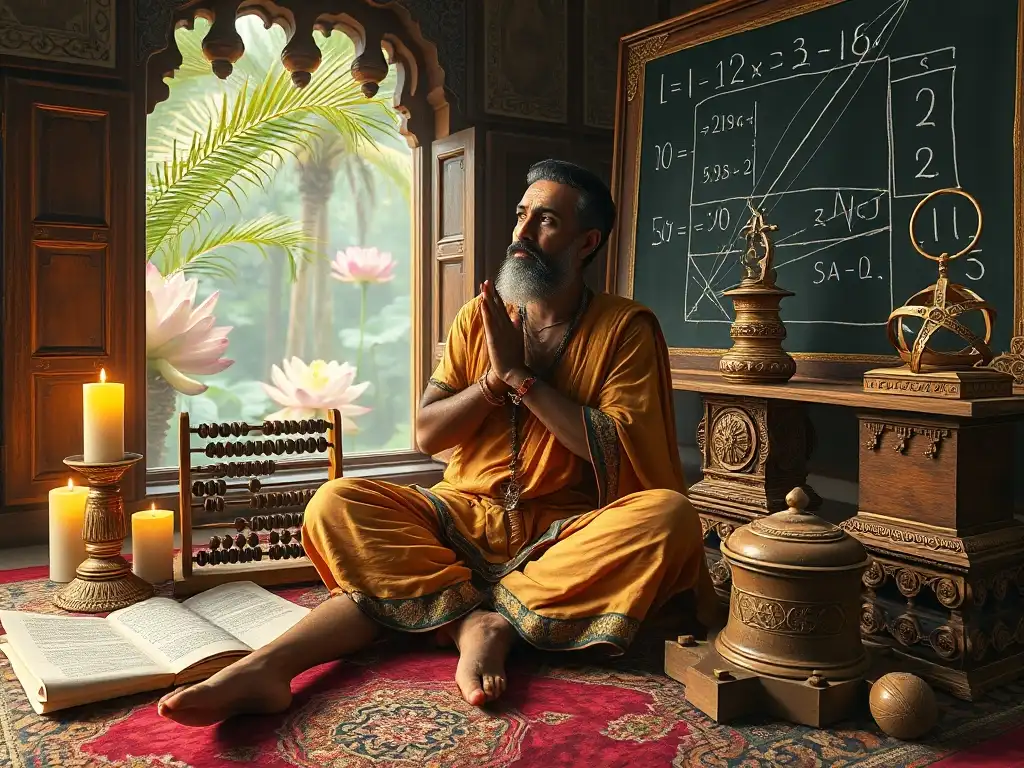
The mathematical advancements of ancient Indian civilization have left a lasting legacy that has shaped mathematical thought across various cultures. From the sophisticated concepts of zero to the intricate systems of calculus, ancient Indian mathematics serves as a cornerstone for many numerical systems used today. Its influence is evident in the methodologies and philosophies that have been adopted and adapted by different civilizations throughout history.
Transmission of Mathematical Knowledge to Other Cultures
Ancient Indian mathematics was characterized by a unique blend of philosophy and practicality. The transmission of this knowledge occurred through various channels, including trade, conquest, and scholarly exchange.
- Trade Routes: The Silk Road and maritime routes facilitated the movement of mathematicians and traders who exchanged ideas and numerical concepts. Indian merchants traveled extensively, bringing with them not only goods but also mathematical knowledge.
- Cultural Exchanges: As empires expanded, scholars from regions like Persia and the Middle East began to document and translate Indian texts. The works of mathematicians like Aryabhata and Brahmagupta were particularly influential, as they introduced concepts such as the place-value system and the rules for arithmetic operations.
- Translations and Adaptations: The translation of Sanskrit texts into Arabic during the medieval period played a crucial role in preserving and disseminating ancient Indian mathematical knowledge. These translations often included commentaries that further elucidated complex concepts, making them accessible to a broader audience.
- Educational Institutions: The establishment of ancient universities, such as Nalanda and Takshashila, attracted scholars from various regions. These institutions became melting pots of knowledge, where Indian mathematicians taught their techniques to students from foreign lands.
Influence on Islamic Golden Age and European Renaissance
The influence of ancient Indian mathematics reached its zenith during the Islamic Golden Age and later during the European Renaissance:
- Islamic Scholars: During the 8th to 14th centuries, Islamic scholars translated and built upon Indian mathematical works. Al-Khwarizmi, often referred to as the "father of algebra," incorporated Indian numeral systems and concepts of zero into his writings. His seminal work, Al-Kitab al-Mukhtasar fi Hisab al-Jabr wal-Muqabala, laid the groundwork for algebra as we know it today.
- Numerical Systems: The adoption of the Hindu-Arabic numeral system in the Islamic world allowed for more efficient calculations and record-keeping. This system later spread to Europe, revolutionizing the way mathematics was taught and practiced.
- Renaissance Innovations: The reintroduction of ancient texts in Europe during the Renaissance sparked a renewed interest in mathematics. Scholars such as Fibonacci, influenced by Indian numerals, introduced the Hindu-Arabic system to Europe through his work, Liber Abaci. This led to significant advancements in trade, navigation, and the sciences.
The interplay between ancient Indian philosophy and mathematics created a rich tapestry of ideas that not only advanced mathematical thought but also fostered a spirit of inquiry and intellectual exchange that would resonate through the ages. The profound impact of these contributions underscores the importance of examining ancient Indian philosophy and mathematics as a critical foundation of global mathematical heritage.
Conclusion: The Legacy of Ancient Indian Philosophy in Mathematics
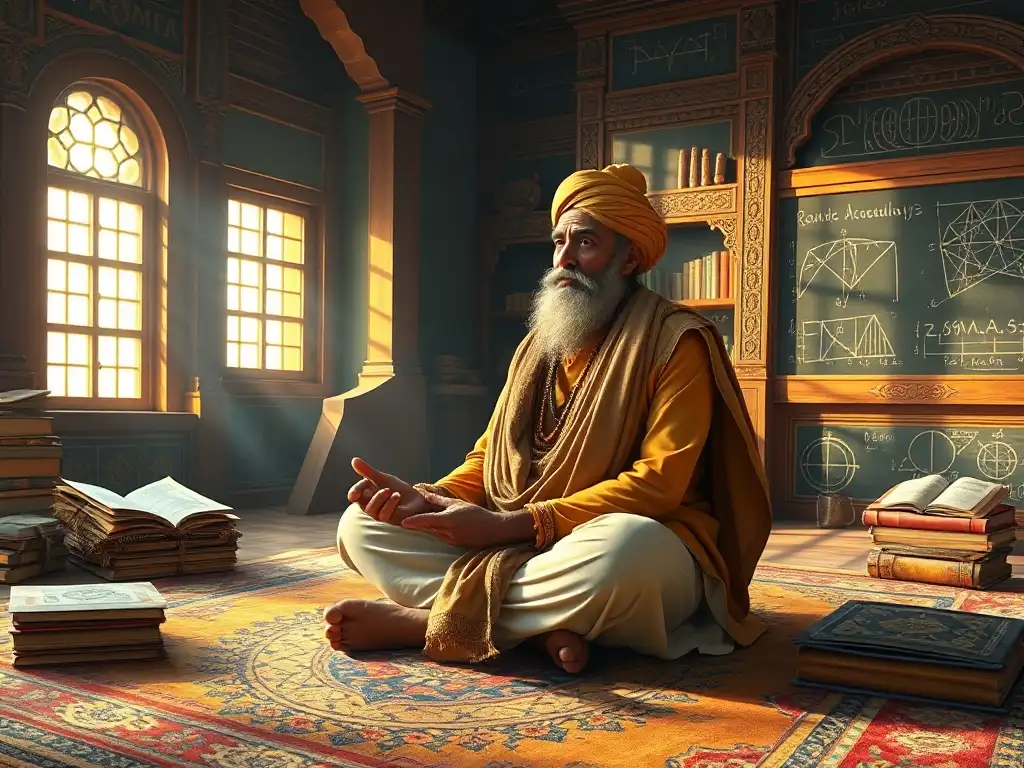
The profound influence of ancient Indian philosophy on the development of mathematical concepts and numerical systems is a testament to the intellectual rigor and cultural richness of ancient Indian civilizations. This legacy has not only shaped the mathematical landscape of India but has also left an indelible mark on global mathematics.
Summary of Key Contributions
Ancient Indian philosophy contributed significantly to the evolution of mathematics through several key aspects:
- Philosophical Foundations: The philosophical inquiry into the nature of numbers and the universe laid the groundwork for mathematical abstraction. Thinkers like Brahmagupta and Aryabhata explored mathematical principles through a philosophical lens, seeking to understand the fundamental truths of existence.
- Zero as a Concept: The introduction of zero (0) as a numeral and a concept is one of the most critical contributions of ancient Indian mathematics. This concept, rooted in philosophical thought, revolutionized arithmetic and laid the foundation for the positional number system.
- Decimal System: The development of the decimal system, which is fundamental to modern mathematics, can be traced back to ancient Indian scholars. This system enabled complex calculations and fostered advancements in mathematics that were previously unattainable.
- Algebraic Innovations: Ancient Indian mathematicians made significant strides in algebra, treating unknowns as numbers and developing systematic methods for solving equations. Brahmagupta's rules for arithmetic operations with negative numbers exemplify this innovative approach.
- Trigonometry and Geometry: The philosophical examination of space and form led to early developments in trigonometry and geometry. Mathematicians like Bhaskara I and Bhaskara II made remarkable contributions in these fields, which have influenced both theoretical and applied mathematics.
The Continued Relevance of Ancient Indian Mathematical Concepts Today
The mathematical concepts and numerical systems developed by ancient Indian philosophers continue to resonate in contemporary mathematics and beyond. Their relevance can be observed in several areas:
- Education: Modern curricula often incorporate the foundational principles established by ancient Indian mathematicians, particularly in algebra and geometry. This educational legacy fosters a deeper understanding of mathematical concepts among students.
- Global Mathematics: The influence of ancient Indian mathematics can be seen in the works of mathematicians worldwide. The spread of the decimal system and the concept of zero transformed mathematical practices globally, demonstrating the universal applicability of these concepts.
- Philosophical Inquiry: The philosophical roots of mathematics encourage ongoing exploration into the nature of mathematical truths. This inquiry continues to inspire mathematicians and philosophers alike, fostering a dialogue that connects ancient wisdom with contemporary thought.
- Technological Applications: The algorithms and numerical systems developed in ancient India serve as the foundation for modern computing and technology. The understanding of positional notation, for example, is crucial in programming and data analysis today.
Ancient Indian philosophy and mathematics are intricately intertwined, with a legacy that extends far beyond their time. As we continue to explore and build upon these foundational concepts, the contributions of ancient Indian scholars remain a vibrant part of our mathematical heritage.
Frequently Asked Questions
What is the significance of ancient Indian philosophy in mathematics?
Ancient Indian philosophy profoundly influenced mathematical concepts by introducing abstract reasoning and logical thinking, which laid the groundwork for advanced mathematical theories.
How did the Indus Valley Civilization contribute to mathematics?
The Indus Valley Civilization is known for its early use of weights and measures and urban planning, showcasing an understanding of numerical systems that predated many modern mathematical ideas.
What role did the Gupta Empire play in the development of mathematics?
During the Gupta Empire, advancements in numerical systems, including the introduction of the decimal system, significantly shaped the evolution of mathematics, making it more efficient and accessible.
Can you explain the connection between ancient Indian philosophy and numerical systems?
Ancient Indian philosophy emphasized the interconnectedness of knowledge, allowing for the integration of philosophical concepts with practical applications in mathematics, leading to sophisticated numerical systems.
How did ancient Indian mathematicians influence modern mathematics?
Ancient Indian mathematicians like Aryabhata and Brahmagupta made groundbreaking contributions, such as zero and algebra, which have become fundamental to modern mathematical practices worldwide.
Final Reflection: The Enduring Legacy of Ancient Indian Philosophy in Mathematics
The intricate relationship between ancient Indian philosophy and mathematics continues to resonate in today's world, highlighting the profound impact of these early thinkers on modern numerical systems. As we navigate through an increasingly complex digital age, the foundational concepts laid down by ancient scholars remind us that the pursuit of knowledge is not a linear journey but a rich tapestry woven from diverse cultural insights and intellectual traditions. Their contributions are not merely historical footnotes; they are the bedrock upon which contemporary mathematical thought stands.
The influence of ancient Indian philosophy on mathematics is not just a relic of the past; it is a living testament to the power of interdisciplinary thought. The philosophical inquiries into the nature of numbers and infinity have shaped not only mathematical theory but also our understanding of reality itself. As we reflect on this legacy, we are reminded of the words of the mathematician Srinivasa Ramanujan: An equation for me has no meaning unless it represents a thought of God.
This perspective underscores the spiritual and philosophical dimensions that have historically intertwined with mathematical exploration, enriching both fields and encouraging us to seek deeper connections in our own lives.
As we look to the future, I invite you to embrace the lessons of ancient Indian philosophy and mathematics in your own journey of discovery. Consider how the principles of interconnectedness, inquiry, and creativity can inform your approach to problem-solving and innovation. Let the wisdom of the past inspire you to explore the unknown, challenge conventional boundaries, and cultivate a mindset that values the synthesis of ideas across disciplines. In doing so, you not only honor the legacy of those who came before us but also contribute to the ongoing evolution of knowledge in our world.
Unveil the Profound Connection Between Philosophy and Mathematics!
Thank you for exploring the fascinating ways ancient Indian philosophy influenced mathematical concepts and numerical systems! Your curiosity has brought you one step closer to understanding the deep wisdom our ancestors imparted. Now, it’s time to take action and dive even deeper into this rich heritage.
Here’s how you can continue your journey:
- Engage with history: Join an online forum or community dedicated to the exploration of ancient Indian philosophy and mathematics. Share insights and learn from others’ perspectives.
- Expand your knowledge: Read a book on Vedic mathematics to discover its practical applications in today’s world and how these concepts can enhance your mathematical understanding.
- Share your thoughts: Post your reflections on social media or discuss this topic with friends to spark conversations about the beauty of the connection between philosophy and mathematics.
How has your understanding of ancient philosophies shaped your perspective on contemporary mathematical practices?