
Ancient Indian Texts that Document the Invention of Zero and Its Applications


Welcome to Ancient India History, where we embark on a fascinating journey through the rich tapestry of ancient Indian civilizations. Today, we delve into an extraordinary milestone in mathematics: the invention of zero. This groundbreaking concept not only transformed numerical systems but also laid the foundation for countless mathematical advancements.
As you explore our main article, "Ancient Indian Texts that Document the Invention of Zero and Its Applications," prepare to uncover the profound impact of this invention on both ancient and modern worlds. Join us as we unravel the secrets of a civilization that has shaped our understanding of mathematics in ways that continue to resonate today!
- Introduction to the Invention of Zero in Ancient India
- Historical Context of Ancient Indian Mathematics
- Ancient Indian Texts Documenting the Invention of Zero
- The Applications of Zero in Ancient Indian Mathematics
- The Global Impact of the Invention of Zero
- Conclusion: The Legacy of the Invention of Zero in Ancient India
-
Frequently Asked Questions
- What is the significance of the invention of zero in ancient India?
- Which ancient Indian texts document the invention of zero?
- How did ancient Indian civilizations utilize zero in mathematics?
- What impact did the invention of zero have on other cultures?
- How is the invention of zero celebrated in modern times?
- Final Reflection: The Timeless Legacy of Zero's Invention
- Unlock the Power of Zero: Explore Its Origins and Impact!
Introduction to the Invention of Zero in Ancient India

The invention of zero is one of the most significant milestones in the history of mathematics, and its roots can be traced back to ancient India. This remarkable concept not only revolutionized mathematical calculations but also laid the groundwork for modern numeral systems. The Invention of Zero in Ancient India is documented in several ancient texts, showcasing its importance in various mathematical applications, including arithmetic, algebra, and even complex calculations. Understanding this historical development allows us to appreciate the ingenuity of ancient Indian civilizations and their contributions to the global mathematical heritage.
Importance of Zero in Mathematics
Zero is more than just a number; it serves as a fundamental placeholder in the decimal system, enabling the representation of large numbers and the execution of complex calculations. Without zero, operations such as addition, subtraction, multiplication, and division would be cumbersome and inefficient. Here are some key reasons highlighting the importance of zero:
- Placeholder Value: Zero allows for the differentiation between numbers like 10 and 100, clarifying their values through positional notation.
- Facilitating Calculations: The inclusion of zero simplifies calculations by allowing for easier manipulation of numbers, especially in large equations.
- Foundation for Algebra: Zero plays a crucial role in algebra, particularly in solving equations and understanding functions.
- Innovative Concepts: The concept of zero has led to the exploration of negative numbers and the development of advanced mathematical theories.
The acknowledgment of zero's significance extends beyond mathematics; it influences various fields such as science, engineering, and economics, making it an indispensable component of modern civilization.
Overview of Ancient Indian Contributions to Mathematics
Ancient India was a cradle of mathematical innovation, where scholars made groundbreaking contributions that shaped the discipline. Several texts from this period document the development and application of zero, reflecting a profound understanding of mathematical principles. Key contributions include:
- The Bakhshali Manuscript: This ancient text, believed to date back to the 3rd or 4th century CE, contains early references to the use of zero as a placeholder, indicating its practical applications in calculations.
- Aryabhata's Aryabhatiya: Composed in 499 CE, this seminal work introduced the concept of zero in the context of mathematics and astronomy, emphasizing its role in computations.
- Brahmagupta's Brahmasphutasiddhanta: Written in 628 CE, this influential text elaborated on the arithmetic rules involving zero, including operations with positive and negative numbers.
These texts not only exhibit the ingenuity of ancient Indian mathematicians but also highlight the rich intellectual tradition that fostered the development of mathematical concepts that are still in use today. The invention of zero remains a testament to the advanced thinking of ancient Indian civilizations, underscoring their lasting impact on mathematics worldwide.
Historical Context of Ancient Indian Mathematics

The Development of Mathematics in Ancient India
The mathematical tradition in ancient India is one of the most significant contributions to the field of mathematics on a global scale. This development can be traced back to the Indus Valley Civilization (c. 3300–1300 BCE), where evidence suggests the use of standardized weights and measures, indicating a rudimentary understanding of mathematical principles. However, the most profound advancements occurred during the later Vedic period and the classical age, particularly between the 5th and 12th centuries CE.
During this period, several key texts emerged, which laid the foundation for mathematics as we know it today. The Sulba Sutras, dating back to around 800 BCE, are among the earliest texts that provide insights into mathematical concepts. They include rules for geometric constructions, particularly in relation to altar building. These texts not only demonstrate the mathematical skills of the time but also highlight the practical applications of mathematics in religious rituals.
The Aryabhatiya, written by Aryabhata in 499 CE, marks a significant milestone in the history of mathematics in India. Aryabhata introduced the concept of zero, positional notation, and methods for calculating square roots and cubes. He also formulated an approximation for π (pi), showcasing a sophisticated approach to mathematical calculations. His work influenced both Indian and Islamic mathematics, illustrating the interconnectedness of mathematical development across cultures.
The Bakhshali Manuscript, dated between the 2nd and 4th centuries CE, further emphasizes the advancements in mathematics during this era. It contains rules for arithmetic operations, algebraic equations, and a unique representation of zero, reinforcing its importance in mathematical calculations. This manuscript serves as a testament to the mathematical ingenuity present in ancient India.
Key Civilizations Contributing to Mathematical Advances
Several ancient Indian civilizations played pivotal roles in the advancement of mathematics, each contributing unique insights and methodologies.
- Indus Valley Civilization (c. 3300–1300 BCE):
- Established early systems of measurement and trade.
- Evidence of geometric layouts in city planning, indicating an understanding of spatial relationships.
- Vedic Period (c. 1500–500 BCE):
- Development of the Sulba Sutras, which included geometric principles and their applications in rituals.
- Introduction of early arithmetic and algebraic concepts in religious texts.
- Maurya Empire (c. 322–185 BCE):
- Promotion of trade and commerce, necessitating advanced mathematical concepts for transactions and taxation.
- Early documentation of mathematical ideas in texts such as the Arthashastra.
- Gupta Empire (c. 320–550 CE):
- Often referred to as the Golden Age of India, this period saw a flourishing of arts, science, and mathematics.
- Notable mathematicians like Aryabhata and Brahmagupta made groundbreaking contributions, including the formalization of the rules for calculating with zero and negative numbers.
- Medieval India (c. 600–1200 CE):
- Continued innovation with the development of new mathematical texts and the spread of knowledge through trade routes.
- The transmission of Indian mathematical concepts to the Islamic world, which later influenced European mathematics.
These civilizations collectively contributed to a rich tapestry of mathematical knowledge that not only laid the groundwork for the invention of zero in ancient India but also established the principles of arithmetic and algebra that are foundational in modern mathematics. The legacy of their advancements continues to resonate in today's mathematical practices and education.
Ancient Indian Texts Documenting the Invention of Zero

Brahmagupta's Brahmasphutasiddhanta
Brahmagupta, a prominent mathematician and astronomer of the 7th century CE, made significant contributions to the understanding and formalization of zero in his seminal work, the Brahmasphutasiddhanta. This text is a cornerstone in the history of mathematics, particularly regarding the invention of zero in ancient India.
Explanation of Zero and Its Uses
In the Brahmasphutasiddhanta, Brahmagupta defines zero as a numeral and describes its role as a placeholder in the positional numeral system. He refers to zero as "shunya," which translates to "void" or "emptiness." This conceptualization marked a significant advancement in mathematical thought, as it allowed for the representation of numbers in a more efficient manner.
Brahmagupta's explanation of zero includes its application in various arithmetic operations. He states that when a number is subtracted from itself, the result is zero, establishing a foundational principle in mathematics. This understanding paved the way for more complex calculations involving zero, which later influenced mathematical practices.
Mathematical Rules Involving Zero
Brahmagupta outlines several rules regarding the use of zero in arithmetic operations:
- Addition and Subtraction:
- A number plus zero equals the number itself.
- A number minus itself equals zero.
- Multiplication:
- Any number multiplied by zero equals zero.
- Division:
- Division of a number by zero is considered undefined, highlighting an important boundary in mathematical operations.
These rules not only demonstrate Brahmagupta's understanding of zero but also laid the groundwork for future mathematicians to explore more complex equations involving this fundamental concept. His systematic approach to zero exemplifies its integral role in mathematics, particularly in algebra.
Bakhshali Manuscript
The Bakhshali Manuscript, discovered in the early 20th century in Pakistan, is another vital text that sheds light on the concept of zero in ancient India. This manuscript, dating back to the 7th or 8th century CE, contains numerous mathematical problems and techniques, showcasing the practical applications of zero.
Insights on the Concept of Zero
The Bakhshali Manuscript provides valuable insights into the understanding and application of zero. It refers to zero as a "dot" or "shunya," emphasizing its role as a placeholder in the decimal system. The manuscript illustrates how zero was used to represent the absence of a quantity, enabling more sophisticated mathematical reasoning.
Moreover, the text includes examples of arithmetic operations involving zero, indicating that the concept was well-established among mathematicians of that era. This demonstrates the progressive nature of ancient Indian mathematics and its ability to adapt and innovate.
Applications of Zero in Calculations
The manuscript contains numerous calculations that utilize zero in various contexts, including:
- Arithmetic Operations: The use of zero in addition and subtraction is well-documented, illustrating its importance in basic calculations.
- Algebraic Equations: Zero is employed to solve equations, showcasing its role in algebra long before it became a standardized concept in Western mathematics.
The practical applications of zero in the Bakhshali Manuscript reflect the advanced mathematical thought of ancient Indian scholars, highlighting their contributions to the global understanding of mathematics and the significance of the invention of zero in ancient India.
Aryabhata's Aryabhatiya
Aryabhata, one of the most renowned ancient Indian mathematicians and astronomers, authored the Aryabhatiya around 499 CE. This seminal text is a cornerstone of Indian mathematics and astronomy, laying the groundwork for many mathematical principles, including the concept of zero. Aryabhata's work is composed of four sections: Gitika, Ganitaka, Kalakriya, and Goladhyaya, each focusing on various mathematical and astronomical topics. The Aryabhatiya is noted not just for its mathematical rigor, but also for its innovative use of place value, which is crucial for understanding the role of zero.
In the Aryabhatiya, Aryabhata introduces a positional numeral system which inherently requires the concept of zero as a placeholder. This was revolutionary, as it allowed for the representation of large numbers and simplified calculations. Aryabhata's insights into mathematics were not merely theoretical; they had practical applications in astronomy, particularly in calculations related to time and planetary positions. The text signifies a shift towards a more abstract understanding of numbers, where zero plays an essential role in the continuum of mathematics.
The Role of Zero in Aryabhata's Work
In the Aryabhatiya, Aryabhata explicitly acknowledges the necessity of zero, though he does not use the term "zero" in the same way we do today. Instead, he employs specific symbols to denote the absence of a quantity, effectively demonstrating the concept of zero as a number in its own right. For instance, Aryabhata's positional notation allowed him to express numbers like 10, 20, and 100, relying on the zero to indicate the absence of value in certain places.
The Aryabhatiya also illustrates how zero interacts with other numbers through operations such as addition and subtraction. Aryabhata's calculations show that when a number is subtracted from itself, the result is zero, which lays the foundation for later mathematical operations involving zero. His systematic approach to integrating zero into arithmetic operations signifies a profound understanding of its significance, paving the way for future mathematicians to further explore its implications.
Influence on Later Mathematical Concepts
The introduction of zero in Aryabhata's work had a lasting impact on mathematics, influencing subsequent scholars and civilizations. His innovative use of zero and the positional numeral system was foundational for later mathematicians in India, such as Brahmagupta and Bhaskara, who expanded on these concepts. Brahmagupta, in particular, built upon Aryabhata's ideas in his Brahmasphutasiddhanta (628 CE), explicitly discussing rules for arithmetic operations involving zero, such as division by zero and the concept of negative numbers.
Zero's role continued to evolve, becoming an integral part of mathematical systems across cultures. The spread of Indian mathematics, including the concept of zero, reached the Islamic world and later Europe, revolutionizing arithmetic and algebra. By the 10th century, scholars in the Islamic Golden Age were using zero in their calculations, and it eventually found its way into the European mathematical lexicon by the Renaissance.
Aryabhata's Aryabhatiya not only documents the invention of zero but also showcases its application in a broader mathematical context. The text's influence reverberated through centuries, affirming zero's status as a fundamental element of mathematics and transforming mathematical thought across various cultures.
The Applications of Zero in Ancient Indian Mathematics
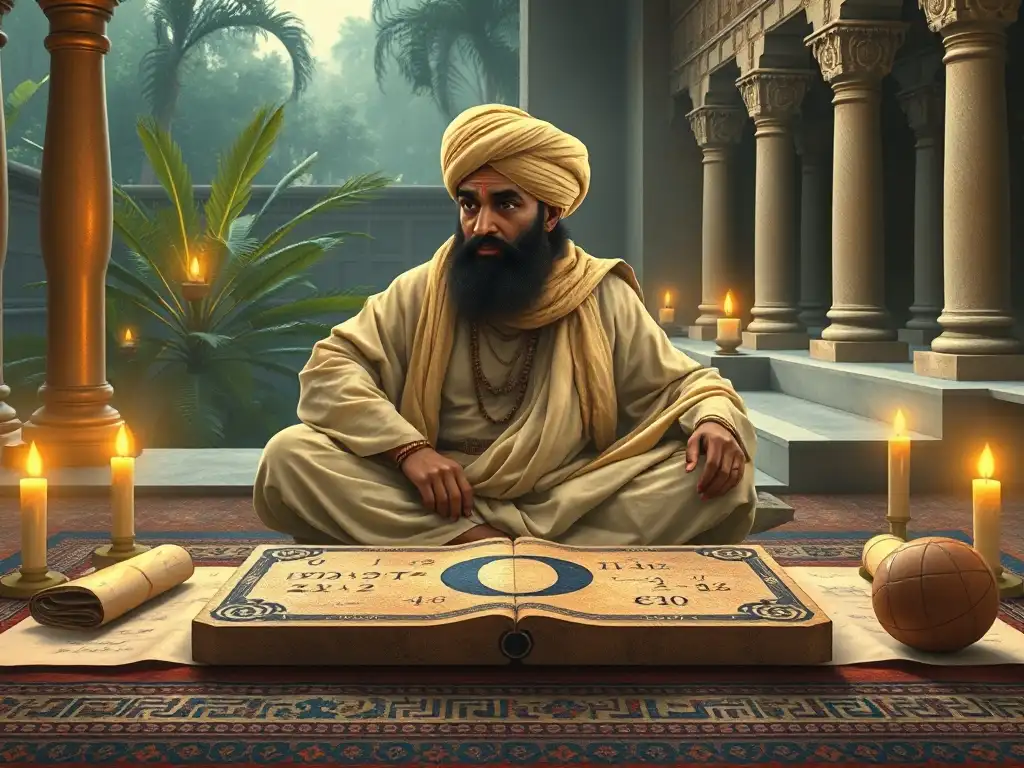
The invention of zero was a groundbreaking advancement in mathematics, and its applications in ancient Indian mathematics significantly transformed the way calculations were performed. Understanding these applications helps to appreciate the profound impact that the concept of zero had on mathematical practices in ancient civilizations, particularly in India.
Arithmetic Operations Involving Zero
Zero's utilization in arithmetic operations marked a pivotal shift in mathematical practices. Ancient Indian mathematicians recognized that zero could serve as both a placeholder and a number in its own right. This duality allowed for more complex calculations and the development of arithmetic rules.
- Addition and Subtraction:
- Addition: The addition of zero to any number yields the number itself. For example, \(5 + 0 = 5\).
- Subtraction: Similarly, subtracting zero from a number does not change its value, as in \(5 - 0 = 5\).
- Multiplication:
- Multiplying any number by zero results in zero. This fundamental principle can be expressed as \(n \times 0 = 0\), where \(n\) is any integer.
- Division:
- The concept of division involving zero is more complex. Dividing zero by any number results in zero (\(0 \div n = 0\)), but dividing any number by zero is undefined, a concept that was recognized by ancient Indian scholars.
These operations demonstrate that the inclusion of zero streamlined calculations, making them more efficient and systematic.
The Concept of Place Value and Its Significance
The place value system, which was significantly advanced by ancient Indian mathematicians, relies heavily on the concept of zero. The introduction of zero as a placeholder enabled a clearer representation of numbers and enhanced computational accuracy.
- Structure of Numbers:
- In the numeral system, each digit's position conveys its value. For example, in the number 205, the zero indicates that there are no tens, which clarifies the number's value as two hundred five, rather than twenty-five.
- Facilitating Large Numbers:
- The use of zero allowed for the representation of large numbers with relative ease. This capability was crucial for trade, commerce, and astronomy, where extensive calculations were necessary.
- Impact on Future Mathematics:
- The place value system significantly influenced later mathematical developments, including the arithmetic operations we use today. The clarity and efficiency introduced by zero facilitated advances in mathematics across various cultures.
Zero in Algebra and Geometry
Zero's role in algebra and geometry further underscores its importance in ancient Indian mathematics.
- Algebraic Equations:
- In algebra, zero was used to denote the solution of equations. For instance, the equation \(x + 0 = x\) illustrates that zero does not alter the value of the variable \(x\). This property is vital in solving equations and understanding variable relationships.
- Geometric Interpretations:
- Zero had geometric implications, particularly in coordinate systems. The origin point (0,0) in a Cartesian plane serves as the reference for all other points, allowing for a systematic approach to geometry.
- The Concept of Limits:
- Ancient Indian scholars also explored the concept of limits, which is foundational in calculus. The notion of approaching zero, whether in sequences or functions, showcases an early understanding of mathematical analysis.
The applications of zero in ancient Indian mathematics reveal a sophisticated understanding of numerical systems that laid the groundwork for future mathematical advancements. The versatility of zero in arithmetic, its significance in the place value system, and its applications in algebra and geometry highlight the critical role it played in the development of mathematics in ancient India.
The Global Impact of the Invention of Zero
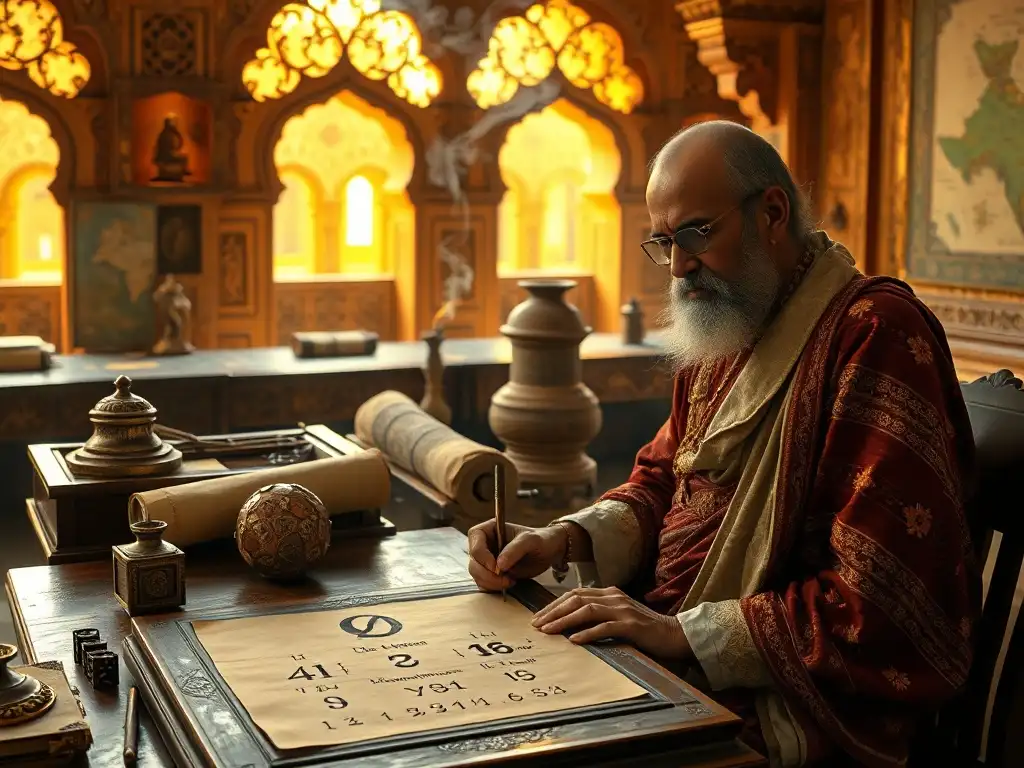
The invention of zero in ancient India is one of the most significant contributions to global mathematics. This concept not only revolutionized mathematical thought but also facilitated advancements in various fields, including science and engineering. The introduction of zero as a numeral allowed for more complex calculations and paved the way for the development of algebra and calculus, which are essential to modern mathematics.
Transmission of Zero to Other Cultures
The journey of zero from ancient India to other cultures is a remarkable tale of intellectual exchange. The concept was first documented in Indian texts, such as the Bakhshali Manuscript and the works of mathematicians like Aryabhata and Brahmagupta. These texts laid the foundation for mathematical notation that included zero and demonstrated its utility in calculations.
- Trade Routes: The Silk Road and maritime trade routes played a crucial role in transmitting the concept of zero to other civilizations. Indian traders and scholars traveled extensively, sharing their knowledge with merchants and intellectuals in Persia, the Middle East, and beyond.
- Translation of Texts: The translation of Indian mathematical texts into Arabic during the 7th to 9th centuries CE was instrumental in spreading the concept of zero. Scholars such as Al-Khwarizmi and Al-Kindi incorporated Indian mathematical principles into their works, which later influenced European mathematics.
- Cultural Adaptation: As zero was adopted by various cultures, it was adapted to fit local numeral systems. The Arabic numeral system, which included zero, eventually made its way to Europe, transforming mathematical practices there.
Influence on Islamic Mathematics
The introduction of zero into Islamic mathematics marked a turning point that greatly enhanced mathematical capabilities in the Islamic Golden Age. Muslim scholars embraced the Indian numeral system, which included zero, and made significant advancements.
- Al-Khwarizmi's Contributions: The Persian mathematician Al-Khwarizmi, often referred to as the "father of algebra," utilized the concept of zero in his works. His book, Al-Kitab al-Mukhtasar fi Hisab al-Jabr wal-Muqabala, laid the groundwork for algebra, relying heavily on positional notation that included zero.
- Advancements in Arithmetic: The use of zero allowed Islamic mathematicians to develop more efficient algorithms for arithmetic operations. The ability to represent large numbers and perform complex calculations contributed to advancements in astronomy, engineering, and navigation.
- The Spread of Knowledge: The translation of works from Arabic to Latin in the 12th century brought the concept of zero and its applications to European scholars, effectively bridging the gap between ancient Indian mathematics and Western thought.
The Role of Zero in the Development of Modern Mathematics
Zero serves as a fundamental building block in modern mathematics, influencing numerous fields and concepts.
- Place Value System: The positional value system, which relies on zero to denote the absence of a quantity, is critical for understanding large numbers and performing computations. This system allows for concise representation and manipulation of numbers.
- Calculus and Analysis: The concept of zero is vital in calculus, particularly in defining limits and continuity. It plays a crucial role in the formulation of derivatives and integrals, which are foundational to higher mathematics.
- Computer Science: In the digital age, the binary system—comprising only zeros and ones—forms the basis of computer programming and information technology. The invention of zero has thus transcended traditional mathematics, impacting modern technology and communication.
The invention of zero in ancient India not only transformed mathematical thought within the region but also had profound effects on global mathematics, influencing subsequent cultures and leading to the development of modern mathematical concepts and technologies.
Conclusion: The Legacy of the Invention of Zero in Ancient India

Summary of Contributions to Mathematics
The invention of zero in ancient India is a pivotal milestone in the history of mathematics, intricately linked to the development of numerical systems and mathematical concepts that have shaped modern arithmetic. This innovation emerged around the 5th century CE, primarily attributed to Indian mathematicians like Aryabhata and Brahmagupta, whose works laid the groundwork for the formal introduction and application of zero.
- Aryabhata (476-550 CE): He introduced the concept of zero as a placeholder within the decimal system, allowing for the representation of large numbers and facilitating complex calculations. In his seminal work, Aryabhatiya, Aryabhata outlined methods for arithmetic, algebra, and the calculation of astronomical phenomena, all of which relied on the use of zero.
- Brahmagupta (598-668 CE): In his text, Brahmasphutasiddhanta, Brahmagupta expanded upon Aryabhata's ideas, providing rules for arithmetic operations involving zero. He famously stated that "a number divided by zero is a number," establishing foundational principles for handling division and equations that involve zero.
The contributions of these mathematicians were not isolated; they influenced subsequent scholars across cultures. The transmission of Indian mathematical knowledge to the Islamic world, and ultimately to Europe, demonstrates the profound impact of ancient Indian texts on the evolution of mathematics.
The Enduring Importance of Zero in Modern Mathematics
The role of zero in modern mathematics transcends its historical origins, serving as a critical element in various mathematical fields. Today, zero is not merely a number but a concept that underpins numerous mathematical theories and applications. Here are some key aspects of its significance:
- Place Value System:
- Zero allows for the efficient representation of numbers in positional notation. For example, the difference between 205 and 25 is made clear by the presence of zero, which signifies the absence of tens.
- Algebra and Calculus:
- In algebra, zero plays a crucial role in solving equations. The equation \( x = 0 \) represents a fundamental concept in finding roots. In calculus, the concept of limits often involves approaching zero, a critical factor in defining derivatives and integrals.
- Computer Science:
- In digital computing, zero is integral to binary code, the foundation of modern computing systems. The binary representation (0s and 1s) is essential for data processing and storage.
- Mathematical Theorems:
- Zero is involved in various theorems, including the Zero Product Property, which states that if the product of two numbers is zero, at least one of the numbers must be zero. This principle is foundational in solving polynomial equations.
The invention of zero in ancient India not only revolutionized mathematics during its time but also laid the groundwork for advancements that continue to influence various fields today. The legacy of Indian mathematicians and their pioneering work with the concept of zero remains an enduring testament to human intellectual achievement in mathematics.
Frequently Asked Questions
What is the significance of the invention of zero in ancient India?
The invention of zero is significant because it revolutionized mathematics and enabled complex calculations, laying the groundwork for modern numerical systems.
Which ancient Indian texts document the invention of zero?
Key texts that document the invention of zero include the Bakhshali Manuscript and works by mathematicians like Brahmagupta and Aryabhata, which detail its applications and implications.
How did ancient Indian civilizations utilize zero in mathematics?
Ancient Indian civilizations used zero as a placeholder and to represent null values, facilitating advanced calculations and contributing to the development of algebra and arithmetic.
What impact did the invention of zero have on other cultures?
The invention of zero significantly impacted other cultures, particularly during the Spread of Indian Mathematics, influencing Islamic and later European mathematical practices.
How is the invention of zero celebrated in modern times?
Today, the invention of zero is celebrated as a pivotal moment in the history of mathematics, recognized globally for its contributions to science, technology, and education.
Final Reflection: The Timeless Legacy of Zero's Invention
The invention of zero in ancient India is not just a mathematical milestone; it is a profound testament to human ingenuity and the quest for knowledge. Today, as we navigate a world increasingly defined by technology and data, the significance of zero transcends its numerical value, reminding us of the power of innovation and the importance of intellectual curiosity. The legacy of zero continues to shape our understanding of mathematics, science, and even philosophy, illustrating how a single concept can alter the course of history.
The impact of zero's invention resonates deeply within our cultural and social landscapes, influencing everything from modern mathematics to computer science. This foundational concept has enabled advancements that were once unimaginable, fostering a spirit of exploration and discovery. As the mathematician Carl Friedrich Gauss once said, "> Mathematics is the queen of the sciences and number theory is its crown jewel." This quote encapsulates the essence of how the invention of zero has become a cornerstone of mathematical thought, inspiring generations to push the boundaries of what is possible.
As we reflect on the significance of zero and its origins, I invite you to consider how this concept can inspire your own journey of exploration and learning. Embrace the spirit of inquiry that led to the invention of zero, and let it guide you in your pursuits. Whether in mathematics, science, or any other field, remember that every great achievement begins with a single idea. Take a moment to reflect on the power of innovation in your life and how you can contribute to the ongoing legacy of knowledge and discovery.
Unlock the Power of Zero: Explore Its Origins and Impact!
Thank you for diving into the fascinating world of ancient Indian texts and discovering how the concept of zero transformed mathematics! Your interest in this pivotal invention reflects a quest for knowledge that can unlock endless possibilities.
Now that you’re inspired, here are a few meaningful actions you can take:
- Delve Deeper: Explore additional ancient texts from our collection to uncover how zero influenced various fields such as astronomy and architecture.
- Share the Knowledge: Engage your friends and family by sharing this article on social media or starting a discussion group about the historical significance of zero.
- Join the Conversation: Contribute your thoughts or insights in the comments below, or share your personal experiences with mathematics and its evolution.
What insights about the significance of zero have resonated with you the most? We’d love to hear your thoughts!