
Zero and Infinity: How Ancient Indian Mathematicians Shaped Our Understanding


Welcome to Ancient India History, where we take you on an enthralling journey through the rich tapestry of cultures, innovations, and legacies that define ancient Indian civilizations. Prepare to delve into the fascinating world of Ancient Indian mathematics history, where the concepts of zero and infinity emerged from the minds of brilliant mathematicians, forever reshaping our understanding of numbers.
What secrets did these scholars hold, and how did their discoveries influence mathematics in the world today? Join us as we uncover the remarkable contributions that laid the groundwork for modern mathematical thought, inviting you to explore further into this captivating narrative.
- Introduction to Ancient Indian Mathematics History
- The Concept of Zero in Ancient Indian Mathematics
- The Role of Infinity in Ancient Indian Mathematics
- The Influence of Ancient Indian Mathematics on the World
- Case Studies: Documenting Ancient Indian Mathematical Texts
- Myths and Realities about Zero and Infinity in Ancient Indian Mathematics
- Conclusion: The Legacy of Ancient Indian Mathematics History
-
Frequently Asked Questions
- What is the significance of zero in ancient Indian mathematics?
- How did ancient Indian mathematicians contribute to the concept of infinity?
- Which civilizations contributed to the history of mathematics in ancient India?
- What were the key mathematical texts produced in ancient India?
- How did ancient Indian mathematics influence the world?
- Final Reflection: The Timeless Legacy of Ancient Indian Mathematics
- Unleash the Power of Ancient Wisdom!
Introduction to Ancient Indian Mathematics History
Mathematics, often regarded as the universal language, has deep roots that trace back to various civilizations. Among these, ancient India stands out for its remarkable advancements and contributions, particularly in the fields of arithmetic and geometry. The history of ancient Indian mathematics is not merely a chronological account of numbers and symbols; it is a vibrant tapestry woven with intellectual brilliance and groundbreaking discoveries. This article delves into the pivotal role that ancient Indian mathematicians played in shaping our understanding of key mathematical concepts, such as zero and infinity, which continue to influence modern mathematics and science.
Overview of Ancient Indian Contributions to Mathematics
Ancient Indian mathematicians, including the likes of Aryabhata, Brahmagupta, and Bhaskara, made significant strides that laid the groundwork for many mathematical principles used today. Their contributions can be categorized into several key areas:
- Numerical System:
- The development of a positional decimal system, which included the use of zero as a numeral, revolutionized mathematics.
- This system allowed for the representation of large numbers and facilitated complex calculations.
- Arithmetic and Algebra:
- Ancient texts, such as the Brahmasphutasiddhanta by Brahmagupta, outlined methods for solving quadratic equations and provided rules for operations involving negative numbers.
- The approach to arithmetic was practical and aimed at solving real-world problems, such as land measurement and trade.
- Geometry and Trigonometry:
- Contributions in geometry, such as the calculation of areas and volumes, were profound.
- Works like the Surya Siddhanta introduced early concepts of trigonometry, establishing relationships between angles and distances.
- Mathematical Astronomy:
- The integration of mathematics with astronomy led to accurate calculations of planetary positions and eclipses.
- This field saw significant advancements with the introduction of sine and cosine functions.
The cumulative effect of these contributions not only advanced mathematics but also laid the foundation for future explorations in science and technology.
Importance of Zero and Infinity in Mathematical Concepts
The concepts of zero and infinity are cornerstones of mathematical thought, with roots deeply embedded in ancient Indian mathematics.
- Zero (0):
- The introduction of zero as both a placeholder and a number marked a revolutionary shift in mathematical notation and operations. This allowed for the development of algebra and calculus, paving the way for complex mathematical theories.
- Zero's role in arithmetic, particularly in operations involving addition and subtraction, signifies its fundamental importance in understanding numerical relationships.
- Infinity (∞):
- Ancient Indian scholars also grappled with the concept of infinity, exploring the infinite divisibility of space and time.
- This philosophical approach to infinity influenced mathematical thought, providing a framework for calculus and the understanding of limits.
By examining these pivotal concepts, we can appreciate how ancient Indian mathematicians shaped the trajectory of mathematics, influencing thinkers across cultures and eras. Their legacy continues to resonate in contemporary mathematical practices, reminding us of the profound connections between ancient wisdom and modern understanding.
The Concept of Zero in Ancient Indian Mathematics
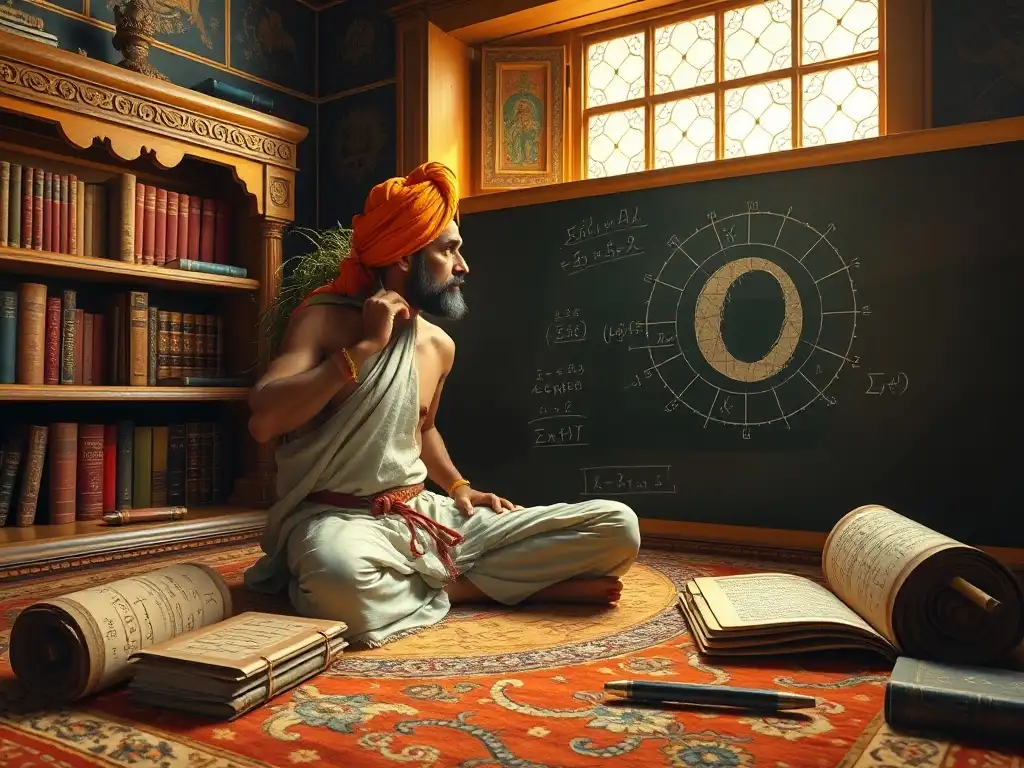
The concept of zero is one of the most profound contributions of ancient Indian mathematics. It represents not just a numeral but a revolutionary idea that transformed mathematics and science worldwide. Ancient Indian mathematicians recognized zero as a number in its own right, leading to advancements that would shape the future of mathematical thought.
Historical Background of Zero in Indian Culture
The origins of zero can be traced back to ancient Indian civilization, where it emerged from the need for a placeholder in positional numeral systems. The Brahmi numerals, dating back to around the 3rd century BCE, show early signs of a symbol for zero. This placeholder allowed for the differentiation of numbers such as 10 and 100, providing clarity in mathematical expressions.
By the 5th century CE, the use of zero became more defined in the works of mathematicians like Aryabhata. He utilized a symbol for zero, which he referred to as “shunya,” meaning empty or void. This concept was not just a numerical value but also represented philosophical ideas about nothingness, aligning with the spiritual and metaphysical beliefs prevalent in ancient Indian culture.
The acceptance of zero as a number catalyzed significant developments in arithmetic and algebra. It enabled calculations that were previously cumbersome, leading to advancements in astronomy, trade, and engineering. The evolution of zero in ancient Indian mathematics set the foundation for its eventual adoption in other cultures, influencing the mathematical systems we use today.
Key Figures in the Development of Zero
Several key figures played a crucial role in the evolution of zero in ancient Indian mathematics. Their works laid the groundwork for understanding and utilizing zero within mathematical frameworks.
Brahmagupta's Contributions to Zero
Brahmagupta, a 7th-century mathematician and astronomer, is often celebrated for his comprehensive work on zero and its operations. In his seminal text, the Brahmasphutasiddhanta, he introduced formal rules for using zero in calculations. His contributions include:
- Arithmetic Operations: Brahmagupta established rules for addition and subtraction involving zero. For instance, he asserted that any number plus zero remains unchanged, while zero subtracted from any number also yields the original number.
- Division by Zero: He addressed the complex issue of division by zero, stating that dividing a number by zero results in an undefined value, a concept still relevant in modern mathematics.
- Negative Numbers: Brahmagupta also explored the use of negative numbers in conjunction with zero, paving the way for a more comprehensive understanding of the number line.
His work laid the foundation for future mathematicians and significantly influenced the mathematical discourse of subsequent generations.
Bhaskara II and the Use of Zero
Bhaskara II, also known as Bhaskara the Great, was another prominent mathematician of ancient India who further developed the concept of zero. In his influential work, the Lilavati, he presented mathematical problems that incorporated zero, showcasing its practical applications. Bhaskara II's contributions include:
- Practical Applications: His writings illustrated how zero could be employed in various real-life scenarios, including calculations related to trade, geometry, and astronomy.
- Zero in Equations: Bhaskara II effectively used zero in equations, demonstrating its role in solving quadratic and polynomial equations. His approach not only simplified calculations but also enhanced the understanding of mathematical relationships.
- Cultural Impact: Bhaskara II's work highlighted the significance of zero beyond mere numerical representation, emphasizing its philosophical implications in understanding infinity and the continuum of numbers.
The contributions from Brahmagupta and Bhaskara II collectively advanced the concept of zero, embedding it deeply within the fabric of ancient Indian mathematics and influencing mathematical thought globally. Their legacies underscore the importance of zero in the evolution of mathematics, illustrating how ancient Indian mathematicians shaped our comprehension of numbers and their relationships.
The Role of Infinity in Ancient Indian Mathematics
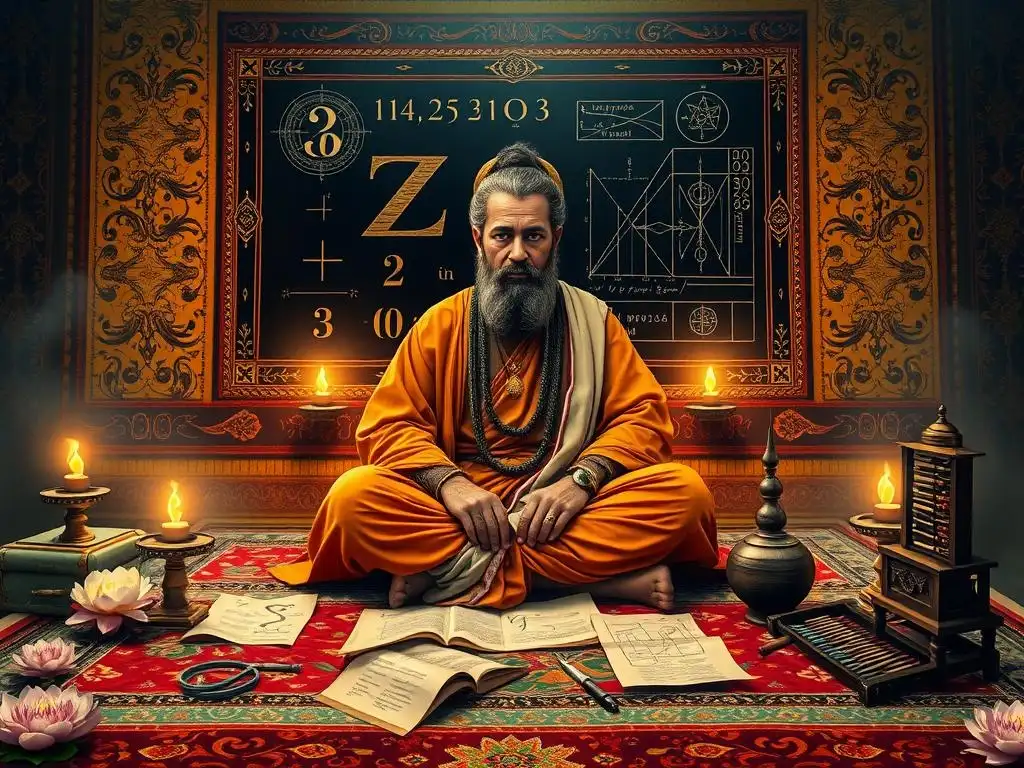
Ancient Indian mathematics not only revolutionized number systems but also explored profound concepts like infinity. This exploration formed a crucial part of the mathematical landscape in ancient India, where infinity was not merely a theoretical abstraction but intertwined with philosophical and practical applications.
Understanding Infinity in Ancient Indian Texts
In ancient Indian literature, the concept of infinity can be traced back to texts such as the Siddhanta Shiromani by Bhaskara II and the Aryabhatiya by Aryabhata. These texts discussed mathematical principles that reflected an understanding of infinite processes. For example, Aryabhata's work included discussions on the infinite series, where he articulated ideas about the approximation of values through endless divisions.
- Key Concepts of Infinity:
- Ananta (अनन्त): The Sanskrit term for infinity, meaning "endless" or "boundless".
- Limitless Quantities: Ancient Indian mathematicians demonstrated the ability to conceptualize infinitely large numbers and infinitely small fractions.
- Mathematical Operations: They considered the implications of performing operations on infinite quantities, contributing to the foundational principles of calculus.
The Philosophical Implications of Infinity
The exploration of infinity in ancient Indian mathematics was not limited to numerical values; it also delved into philosophical interpretations. The philosophical schools of thought, particularly in Hinduism and Buddhism, often incorporated the notion of infinity into their understanding of the universe and existence.
- Philosophical Interpretations:
- Brahman: In Vedantic philosophy, Brahman is considered the ultimate reality, which is infinite and beyond comprehension.
- Samsara: The cycle of birth and rebirth in Buddhism illustrates the infinite nature of existence and the continuous flow of time.
- Mathematics as Philosophy: The intertwining of mathematics with philosophy allowed ancient Indian thinkers to approach infinity not just as a mathematical concept but as a reflection of the cosmos.
The Connection Between Zero and Infinity
The relationship between zero and infinity is a fundamental aspect of ancient Indian mathematics. While zero represents the absence of quantity, infinity embodies the concept of boundlessness. This duality highlights the sophisticated understanding that ancient Indian mathematicians possessed.
- Key Relationships:
- Limits and Approaches: The idea of approaching infinity can be illustrated through sequences that converge towards a limit, where zero acts as a pivotal point.
- Mathematical Operations: Operations involving zero often lead to discussions about infinity, such as division by zero, which historically raised questions about undefined values.
- Cyclic Nature of Numbers: The cyclical view of numbers in ancient Indian thought emphasizes that zero and infinity are not endpoints but integral parts of an infinite continuum.
Major Mathematicians Discussing Infinity
Several renowned mathematicians from ancient India contributed to the discourse on infinity, each adding unique perspectives that shaped the understanding of the concept.
- Aryabhata (476–550 CE):
- His work included methods for calculating areas and volumes, which involved infinite processes.
- Bhaskara II (1114–1185 CE):
- He explored concepts of motion and time in the context of infinity, offering insights into the infinite nature of celestial cycles.
- Madhava of Sangamagrama (c. 1340–1425 CE):
- A pioneer in the development of calculus, Madhava's infinite series for trigonometric functions laid the groundwork for future mathematical theories.
These mathematicians not only advanced mathematical thought but also bridged the gap between numerical theory and philosophical inquiry, leaving an indelible mark on the history of ancient Indian mathematics.
The Influence of Ancient Indian Mathematics on the World
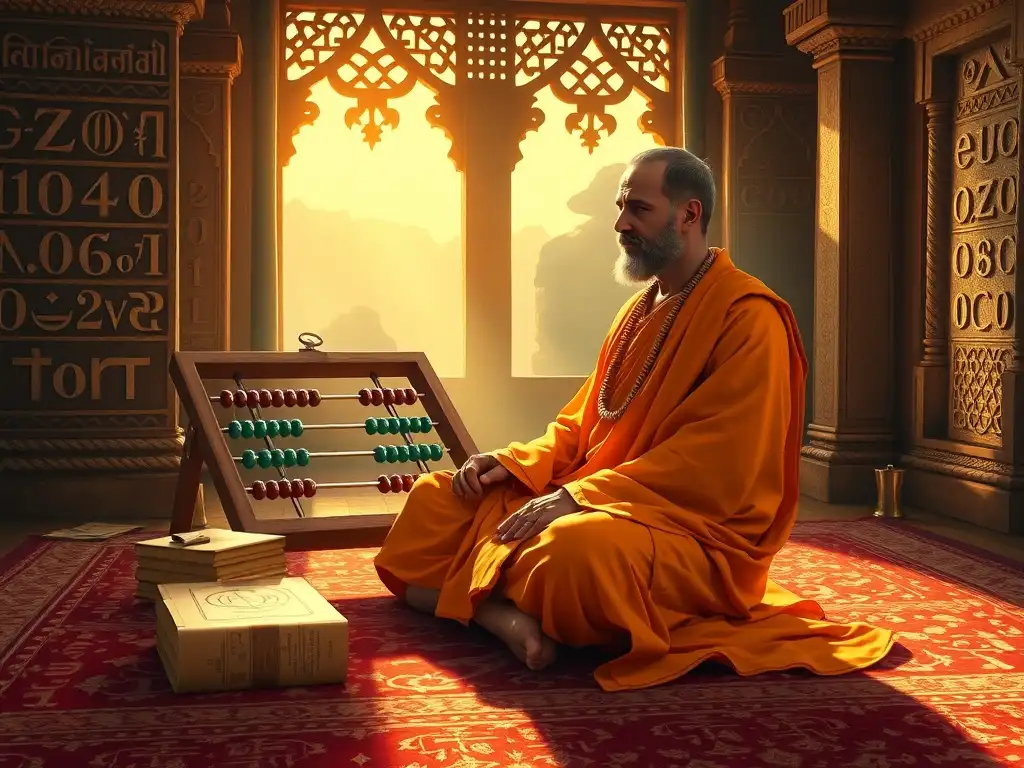
The influence of ancient Indian mathematics on the world is profound and far-reaching, significantly shaping mathematical thought and practice across various cultures. The legacy of Indian mathematicians can be traced back to key concepts such as the numeral system, the invention of zero, and advanced techniques in arithmetic and algebra. These ideas not only revolutionized mathematics in India but also paved the way for later developments in other parts of the world.
Transmission of Mathematical Ideas to the Islamic World
The transmission of mathematical ideas from ancient India to the Islamic world played a crucial role in the evolution of mathematics. During the 7th to 12th centuries, a period marked by extensive trade and cultural exchange, Indian mathematicians shared their discoveries with scholars in the Islamic realm. This exchange was facilitated through:
- Translations: Texts written by Indian mathematicians, particularly those on numerals and mathematical concepts, were translated into Arabic. Notable works include the Aryabhatiya by Aryabhata and the Brahmasphutasiddhanta by Brahmagupta.
- Travel and Scholars: Indian scholars traveled to the Islamic caliphates, sharing knowledge directly. The famous mathematician Al-Khwarizmi, whose name gives rise to the term "algorithm," was influenced by Indian methods, particularly in his work on the Hindu-Arabic numeral system.
- Adoption of Symbols: The concepts of zero and negative numbers were integrated into Islamic mathematics, leading to remarkable advancements in algebra and arithmetic.
This cross-cultural interaction enriched the mathematical landscape and laid the groundwork for future innovations.
The Impact of Indian Mathematics on European Scholars
The impact of ancient Indian mathematics on European scholars was significant, especially during the Renaissance when classical knowledge was rediscovered. Key points include:
- Introduction of the Hindu-Arabic Numerals: The numeral system, which included the concept of zero, was introduced to Europe through translations of Arabic texts, profoundly changing European mathematics. The Italian mathematician Fibonacci played a pivotal role in popularizing this system in his work Liber Abaci in 1202.
- Influence on Mathematical Techniques: Indian mathematical techniques, especially in arithmetic and algebra, influenced European methods. The rules for calculating square roots and the use of algorithms for basic arithmetic operations can be traced back to Indian sources.
- Expansion of Mathematical Thought: The ideas of infinite series and early concepts of calculus, developed by Indian mathematicians like Madhava of Sangamagrama, found their way into European mathematics, contributing to the work of scholars such as Newton and Leibniz.
The Role of Trade and Cultural Exchange
Trade routes served as vital channels for the exchange of knowledge between ancient India and other civilizations. The role of trade and cultural exchange in disseminating mathematical ideas can be understood through several dimensions:
- Silk Route: The Silk Route was instrumental in connecting India with the Middle East and Europe. Merchants and travelers not only exchanged goods but also ideas. Indian mathematical texts were transported along these routes, influencing cultures far beyond their origin.
- Cultural Interaction: The fusion of cultural and intellectual traditions during trade led to a unique blending of mathematical concepts. The cross-pollination of ideas fostered innovation, as scholars from various backgrounds collaborated and built upon each other's work.
- Establishment of Learning Centers: Cities that thrived on trade, such as Baghdad and Cordoba, became centers of learning where scholars from different cultures convened. Here, the works of Indian mathematicians were studied, translated, and further developed, creating a legacy that would endure for centuries.
The ancient Indian mathematics history is not merely a chapter in the annals of progress; it is a testament to the interconnectedness of human intellect across time and geography. The contributions of Indian mathematicians, particularly their revolutionary ideas such as zero and the numeral system, have left an indelible mark on the mathematical practices that underpin our modern understanding.
Case Studies: Documenting Ancient Indian Mathematical Texts
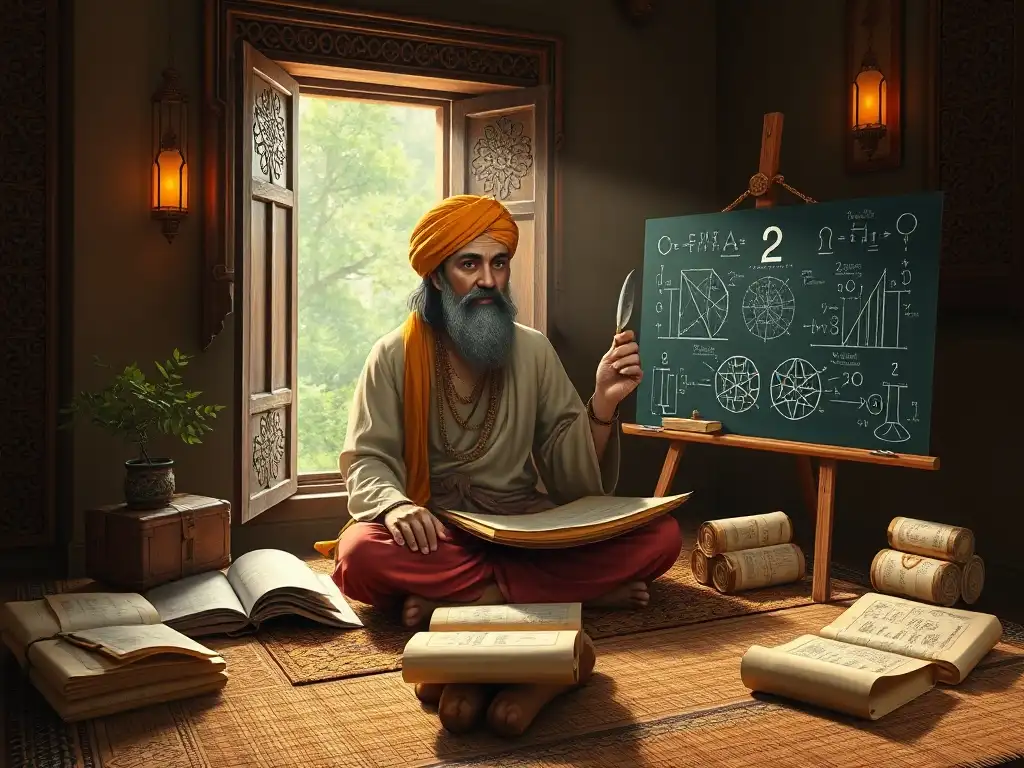
Analysis of the Aryabhatiya by Aryabhata
The Aryabhatiya, written by the renowned mathematician Aryabhata in 499 CE, is a seminal work that laid the foundation for many concepts in ancient Indian mathematics. This text comprises four sections, focusing on mathematics, astronomy, and the mathematics of time, demonstrating a profound understanding of both fields.
- Numerical System: Aryabhata introduced a place-value system using the digits 0-9, which was crucial for the development of arithmetic operations. His notation allowed for efficient calculations, and he was one of the first to treat zero as a number, a concept that was revolutionary for the time.
- Mathematical Functions: Aryabhata's work included sine and cosine functions, which he used to calculate the positions of celestial bodies. He presented sine values for specific angles, setting a precedent for trigonometry.
- Innovative Methods: Aryabhata proposed methods for solving linear and quadratic equations. His approach emphasized the importance of systematic procedures in mathematics. For instance, he provided a method for calculating the area of a triangle, which is still relevant today.
- Astrological Calculations: The astronomical aspects of the Aryabhatiya included calculations of eclipses and planetary positions, showcasing the fusion of mathematics with astronomy. This integration highlights the significance of mathematics in understanding celestial events.
Overall, Aryabhata's Aryabhatiya not only served as a mathematical manual but also as a bridge between ancient and modern mathematical thought, influencing future generations of mathematicians.
Exploration of Brahmagupta's Brahmasphutasiddhanta
Brahmagupta's Brahmasphutasiddhanta, composed in 628 CE, is another pivotal text in ancient Indian mathematics. Known for its clarity and systematic presentation, this work expanded upon Aryabhata's ideas and introduced new concepts that would shape the future of mathematics.
- Rules for Zero: Brahmagupta is credited with formulating the first set of rules for arithmetic operations involving zero. He distinguished between positive and negative numbers and established methods for their addition and subtraction, significantly advancing mathematical theory.
- Quadratic Equations: The Brahmasphutasiddhanta provides a comprehensive treatment of quadratic equations, including methods for solving them. Brahmagupta's solutions often included cases with multiple roots, showcasing his depth of understanding.
- Geometry and Measurement: Brahmagupta made substantial contributions to geometry, particularly in calculating areas and volumes. His formulas for the area of cyclic quadrilaterals are still taught in modern geometry classes.
- Astronomical Applications: Much like Aryabhata, Brahmagupta integrated mathematics with astronomy, offering algorithms for calculating the positions of celestial bodies. His work highlighted the practical applications of mathematics, influencing both scientific and astrological practices.
Through the Brahmasphutasiddhanta, Brahmagupta not only preserved the mathematical knowledge of his predecessors but also expanded and refined it, making significant contributions to the field.
The Siddhanta Shiromani by Bhaskara II
Bhaskara II's Siddhanta Shiromani, composed in the 12th century, is a monumental work that synthesizes and advances the mathematical knowledge of earlier scholars. Divided into two parts— Lilavati and Bijaganita—this text covers a wide range of mathematical topics.
- Comprehensive Arithmetic: The Lilavati focuses on arithmetic, dealing with topics from basic operations to more complex problems involving fractions and geometry. Bhaskara's approach is characterized by practical applications, making the content accessible and relevant.
- Innovative Techniques: Bhaskara II introduced several innovative techniques, including methods for calculating permutations and combinations, which laid the groundwork for future developments in combinatorial mathematics.
- Algebraic Mastery: In Bijaganita, Bhaskara II addressed algebraic equations and introduced advanced methods for solving them. His work on indeterminate equations, particularly the famous Pell's equation, demonstrated his mathematical prowess.
- Influence on Astronomy: Like his predecessors, Bhaskara II integrated mathematics with astronomy. His calculations for eclipses and planetary movements were remarkably accurate, reflecting his deep understanding of both fields.
Bhaskara II's Siddhanta Shiromani not only encapsulated the mathematical advancements of ancient India but also served as a significant reference point for future mathematicians, ensuring that the legacy of ancient Indian mathematics continued to thrive.
Myths and Realities about Zero and Infinity in Ancient Indian Mathematics

Common Misconceptions About Zero in Indian History
The concept of zero is often surrounded by myths and misconceptions that can cloud its true historical significance in ancient Indian mathematics. One prevalent myth is that zero was invented in India. While it is true that ancient Indian mathematicians played a crucial role in formalizing the concept, the idea of zero as a placeholder and a number itself had already been conceptualized in various cultures.
- Cultural Origins:
- The earliest recorded use of a symbol resembling zero dates back to the Babylonian civilization, where they utilized a placeholder in their sexagesimal system.
- However, it was the Indian mathematicians, particularly during the Gupta period (circa 4th to 6th century CE), who expanded the concept, defining it as a number with its own unique properties.
- Historical Figures:
- One of the most notable figures associated with the formalization of zero is Brahmagupta. In his work, Brahmasphutasiddhanta, he defined zero and its properties, providing rules for arithmetic operations involving zero.
- Additionally, Bhaskara II (12th century CE) further developed these ideas, illustrating the extensive understanding of zero in calculations.
- Language and Terminology:
- The term "shunya" in Sanskrit means "void" or "empty," reflecting the philosophical implications of zero in Indian thought, which extends beyond mere mathematics into metaphysical realms.
These misconceptions can often overshadow the collaborative nature of mathematical development across cultures. Ancient Indian mathematics history reveals a rich tapestry of ideas that contributed to the evolution of zero, making it a collective human achievement rather than an isolated invention.
The Reality of Infinity in Ancient Indian Mathematical Thought
While zero represents the absence of quantity, infinity in ancient Indian mathematics embodies the concept of boundlessness. This philosophical and mathematical exploration of infinity is profound and distinct from modern interpretations.
- Philosophical Underpinnings:
- Ancient Indian texts, such as the Yoga Sutras and various philosophical treatises, explored the idea of the infinite, linking it to concepts of the universe, time, and consciousness.
- The interplay between the finite and infinite is a recurring theme in Indian philosophy, suggesting a deep understanding of these concepts long before they were formally studied in Western mathematics.
- Mathematical Applications:
- The mathematicians of ancient India utilized the concept of infinity in calculations involving limits and series. For example, Jain mathematicians in the 9th century CE developed methods for calculating infinite series, which were foundational for later mathematical advancements.
- Notably, the Ganita Sutra contains references to infinite processes, indicating that Indian scholars were not only aware of infinity but also engaged with it in practical mathematical applications.
- Cultural Impact:
- The acceptance and integration of infinity into mathematical thought in India had profound implications for later developments in calculus and mathematical analysis.
- The recognition of infinity as a valid concept helped bridge the gap between the finite calculations of earlier mathematicians and the more abstract notions that emerged in the Renaissance.
The reality of infinity in ancient Indian mathematical thought reflects a sophisticated understanding that transcends mere numerical representation. By studying these concepts, we gain valuable insights into the intellectual legacy of ancient Indian mathematics history and its influence on contemporary mathematical frameworks.
Conclusion: The Legacy of Ancient Indian Mathematics History
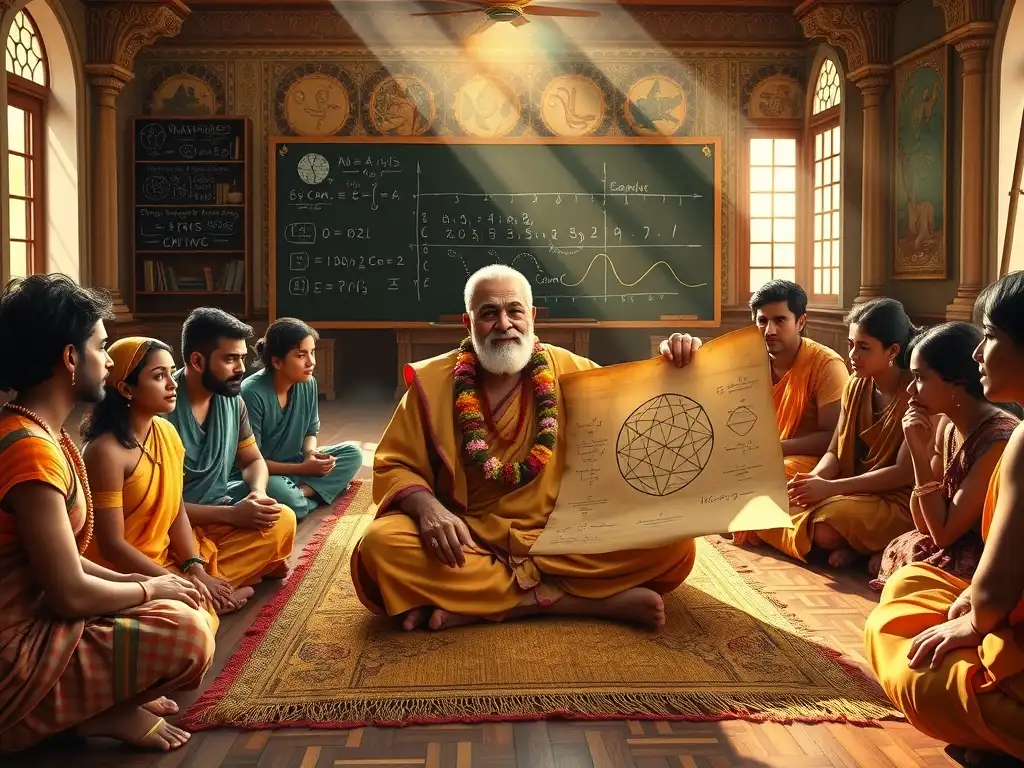
The legacy of ancient Indian mathematics is profound and far-reaching, influencing not only the development of mathematics in India but also shaping mathematical thought across the globe. The contributions of ancient Indian mathematicians, particularly in their conceptualization and formalization of zero and the concept of infinity, have laid foundational stones for many mathematical innovations in the modern world. Their work transcends mere arithmetic; it encompasses a philosophy of numbers that continues to resonate in contemporary mathematics.
Summary of Contributions to Modern Mathematics
The innovations of ancient Indian mathematicians, especially those from the 5th to the 12th centuries, have significantly impacted modern mathematics. Key contributions include:
- The Invention of Zero (0):
- The concept of zero as a number, rather than just a placeholder, revolutionized arithmetic and algebra.
- Notably attributed to Brahmagupta in the 7th century, zero allowed for the development of more complex mathematical operations.
- Decimal System:
- The introduction of the base-10 decimal system facilitated calculations and laid the groundwork for modern numerical systems.
- This system was popularized through texts like the Aryabhatiya by Aryabhata in the 5th century.
- Infinity (∞):
- Ancient Indian texts explored the concept of infinity, particularly in the context of calculus and limits.
- Jain mathematicians, such as Bhaskara II, delved into the infinite divisibility of numbers, which anticipated modern calculus concepts.
- Advanced Algebra:
- Ancient Indian mathematicians developed rules for solving quadratic equations and contributed to the understanding of algebraic identities.
- The works of mathematicians like Brahmagupta and Bhaskara II provided systematic approaches to these equations.
These contributions demonstrate a sophisticated understanding of mathematical concepts that predate many Western developments, showcasing the rich and intricate tapestry of ancient Indian mathematics.
The Continuing Relevance of Zero and Infinity Today
The concepts of zero and infinity are not just historical curiosities; they are crucial to various fields of modern mathematics and science. Here’s how they continue to influence contemporary thought:
- Mathematics and Computer Science:
- Zero serves as the foundation for binary code, the basis of computer programming and digital technology.
- Infinity is vital in calculus, particularly in limits, integrals, and series, forming the backbone of modern analysis.
- Physics and Engineering:
- The understanding of infinite series plays a critical role in physics, especially in theories involving quantum mechanics and relativity.
- Engineers utilize concepts of limits and continuity, which are rooted in the principles laid down by ancient Indian mathematicians.
- Philosophical Implications:
- The philosophical exploration of infinity has implications in metaphysics and cosmology, affecting our understanding of the universe.
- The concept of nothingness represented by zero challenges and enriches philosophical discourse on existence and reality.
The ancient Indian mathematics history is not merely a chapter in the past; it is a living legacy that continues to shape our understanding of mathematics, science, and philosophy today. The innovative ideas surrounding zero and infinity not only transformed ancient thought but also laid the groundwork for the modern mathematical framework that we rely on in various disciplines.
Frequently Asked Questions
What is the significance of zero in ancient Indian mathematics?
The concept of zero, developed by ancient Indian mathematicians, revolutionized numerical systems and calculations, forming the foundation of modern mathematics.
How did ancient Indian mathematicians contribute to the concept of infinity?
Ancient Indian scholars, particularly in the Brahmagupta era, explored ideas of infinity, paving the way for advanced mathematical theories and concepts in calculus.
Which civilizations contributed to the history of mathematics in ancient India?
The Indus Valley Civilization and later the Gupta Empire were pivotal in advancing mathematical knowledge, with significant contributions documented in texts like Aryabhata's works.
What were the key mathematical texts produced in ancient India?
Key texts include Aryabhata's Aryabhatiya and Brahmagupta's Brahmasphutasiddhanta, which laid the groundwork for arithmetic, algebra, and geometry.
How did ancient Indian mathematics influence the world?
The innovations in numerical systems, including the use of decimal notation and the concept of zero, profoundly influenced mathematics in Islamic and European cultures, shaping modern mathematical thought.
Final Reflection: The Timeless Legacy of Ancient Indian Mathematics
The exploration of Ancient Indian mathematics history reveals a profound connection between the past and our present understanding of numbers and concepts such as zero and infinity. These foundational ideas not only shaped mathematical thought in ancient times but continue to influence modern mathematics and science. The brilliance of ancient mathematicians serves as a reminder that the quest for knowledge transcends time, and their contributions are as relevant today as they were centuries ago.
The impact of ancient Indian mathematicians extends far beyond the realm of numbers; it has woven itself into the very fabric of our cultural and intellectual landscape. Their work has inspired generations of thinkers, mathematicians, and scientists, fostering a spirit of inquiry and innovation. As we reflect on their achievements, we are reminded of the words of the great mathematician Srinivasa Ramanujan: An equation for me has no meaning unless it represents a thought of God.
This sentiment underscores the idea that mathematics is not merely a tool, but a bridge to understanding the universe and our place within it.
As we stand on the shoulders of these giants, let us take a moment to reflect on how we can honor their legacy in our own lives. Embrace the curiosity that drove these ancient scholars, and allow it to guide your own journey of discovery.
Whether you are a student, a teacher, or simply a lover of knowledge, consider how you can contribute to the ongoing narrative of mathematics. Let us carry forward the spirit of inquiry, for in doing so, we not only celebrate the past but also pave the way for future innovations that will shape our understanding of the world.
Unleash the Power of Ancient Wisdom!
Thank you for diving into the fascinating world of ancient Indian mathematics with us! Your interest highlights the incredible insights these pioneers offered, shaping our understanding of concepts like **zero** and **infinity**. Now it’s time to take that inspiration further!
Here’s how you can explore this rich heritage and continue your learning journey:
- Engage with the legacy: Read more about the lives of influential mathematicians from different cultures and how their discoveries influence modern science.
- Start a discussion: Share your thoughts on social media or in the comments section below about what you found most surprising from this article.
- Rediscover other cultures: Explore how various civilizations approached mathematical concepts and what valuable lessons we can learn from them today.
As you embark on this journey of rediscovery, we’d love to know: How do you believe ancient mathematical concepts have impacted your life today?