
The Power of Place Value: Ancient India's Contribution to Global Mathematics


Welcome to Ancient India History, where we embark on a fascinating journey through the rich tapestry of ancient Indian civilizations. Here, we delve into the remarkable contributions to mathematics, unveiling the brilliance of ancient Indian mathematicians who revolutionized the way we understand numbers and calculations. In our featured article, "The Power of Place Value: Ancient India's Contribution to Global Mathematics," we explore how these early scholars laid the groundwork for modern mathematics, forever changing the course of history. Are you ready to discover the secrets of place value that echo through time? Let’s unlock the past together!

Introduction to Ancient Indian Mathematics Contributions
Ancient India is often celebrated for its profound contributions to various fields, including mathematics. One of the most remarkable innovations that emerged from this ancient civilization is the place value system, which revolutionized the way numbers are understood and manipulated. This mathematical framework not only facilitated calculations but also laid the groundwork for modern arithmetic and numerical representation.
In this article, we will explore the significance of ancient Indian mathematics contributions, focusing on the development and impact of the place value system, as well as the broader context of numerical systems used in ancient India. Through this exploration, we aim to illuminate how these foundational concepts have influenced global mathematics.
Understanding the Significance of Place Value in Mathematics
The place value system is a method of assigning values to digits based on their position within a number. This system, which allows for the representation of large numbers with relative ease, was a groundbreaking advancement in mathematical thought. In ancient India, this concept was not merely a numerical convenience; it was tied to philosophical and cultural understandings of mathematics.
- Key Advantages of the Place Value System:
- Efficiency: It simplifies calculations, allowing for quicker addition, subtraction, and multiplication.
- Scalability: Large numbers can be represented compactly without the need for cumbersome tallying.
- Zero Representation: The introduction of zero as a placeholder was a revolutionary concept that further enhanced the efficacy of the place value system.
The implications of this system extend beyond mere calculations; it enabled mathematicians to engage in more complex mathematical concepts, such as algebra and calculus.
Overview of Ancient Indian Numerical Systems
Ancient Indian mathematicians developed several numerical systems that demonstrated advanced understanding and innovative thinking. These systems included:
- Decimal System: A base-10 system that is foundational to modern mathematics.
- Fractions: Ancient texts reveal a sophisticated understanding of fractions and their operations.
- Algebraic Concepts: Early forms of algebra were explored, with texts providing solutions to various equations.
These numerical systems illustrate the depth and complexity of ancient Indian mathematics, highlighting its significance in the evolution of mathematical thought.
Historical Context of Mathematics in Ancient India
Understanding the historical context in which these mathematical advancements occurred is crucial. Ancient India was home to several civilizations, each contributing uniquely to the development of mathematics.
The Indus Valley Civilization and Early Numerical Practices
The Indus Valley Civilization (circa 3300–1300 BCE) is one of the earliest urban cultures in the world and exhibited advanced practices that hint at early mathematical understanding. Archaeological findings reveal:
- Weights and Measures: Standardized weights suggest a sophisticated understanding of measurement and trade.
- Seals with Symbols: The use of symbols on seals indicates an early form of record-keeping, possibly related to counting and trade.
These early numerical practices laid the groundwork for more complex mathematical concepts that would emerge in later periods.
The Vedic Period: Mathematical Texts and Concepts
The Vedic period (circa 1500–500 BCE) marked a significant evolution in mathematical thought. During this time, texts such as the Sulba Sutras emerged, which are considered some of the earliest works on geometry and mathematics. Key highlights include:
- Geometric Principles: The Sulba Sutras provide rules for constructing altars and geometric figures, reflecting advanced spatial reasoning.
- Mathematical Operations: These texts introduced methods for calculations and provided insights into the practical applications of mathematics in rituals and daily life.
This period not only showcased the practical applications of mathematics but also influenced subsequent mathematical developments in ancient India and beyond.
The Development of the Place Value System
The place value system is a cornerstone of modern mathematics, and its roots can be traced back to ancient Indian civilization. This numerical system allows for the representation of numbers in a way that the position of a digit determines its value, a concept that radically transformed mathematical calculations. The development of the place value system in ancient India was not merely an abstract thought; it was a practical solution that emerged from the need for efficient computation and record-keeping.
Defining Place Value: A Key Concept in Ancient Indian Mathematics
Place value refers to the value of a digit depending on its position within a number. For instance, in the number 345, the digit '3' is in the hundreds place, giving it a value of 300. This system contrasts with earlier numeral systems, where the value of a digit was fixed and did not change based on its position. Ancient Indian mathematicians introduced a zero placeholder, which was crucial in facilitating this system. This innovation allowed for the representation of large numbers succinctly and enabled complex calculations.
The significance of the place value system extends beyond convenience; it embodies a profound comprehension of numerical relationships. By employing this system, ancient Indian scholars could perform arithmetic operations more efficiently, laying the groundwork for advanced mathematical concepts.
How the Place Value System Evolved in Ancient India
The evolution of the place value system in ancient India can be traced through various historical texts and artifacts. Early references can be found in the Bakhshali Manuscript, a mathematical text dating back to the 3rd or 4th century CE, which illustrates the use of a dot to denote zero. This marked a significant step towards the fully developed place value system.
By the time of the Gupta Empire (circa 320–550 CE), the place value system was fully operational, as evidenced in the works of mathematicians like Aryabhata and Brahmagupta. These mathematicians not only utilized the place value system in their calculations but also expanded its applications in astronomy, astrology, and commerce. The transition from using simple counting methods to a sophisticated numerical system signified a remarkable leap in intellectual thought and mathematical practice in ancient India.
Key Figures in Ancient Indian Mathematics
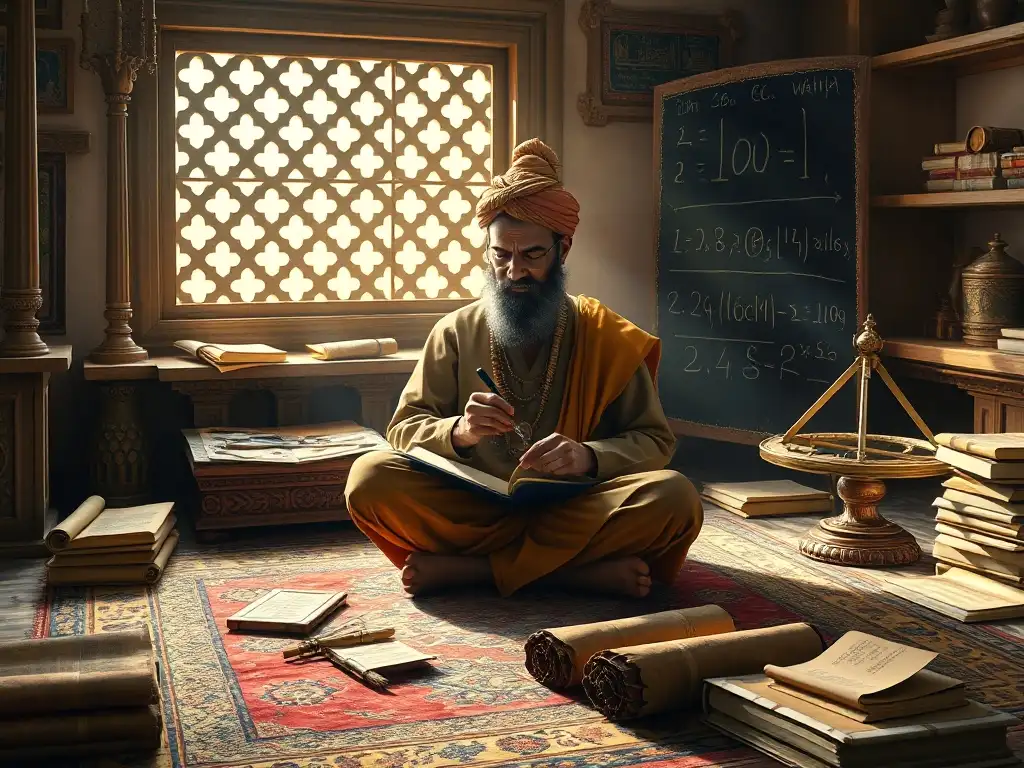
Ancient India produced several eminent mathematicians whose contributions were pivotal in the development of mathematics, particularly concerning the place value system. Two of the most notable figures are Aryabhata and Brahmagupta, who made groundbreaking advancements in both mathematics and astronomy.
Aryabhata: Innovations in Mathematics and Astronomy
Aryabhata (476–550 CE) is often regarded as one of the first major mathematicians from ancient India. His seminal work, the Aryabhatiya, outlines various mathematical concepts, including the use of the place value system. Aryabhata was notable for his advanced understanding of arithmetic and geometry, as well as his astronomical calculations. He accurately calculated the value of π (pi) and proposed a heliocentric model of the solar system, which was revolutionary for his time.
Aryabhata's methodology emphasized the importance of the decimal system and the positional value of numbers. His influence extended far beyond India, as his works were later translated into Arabic and played a crucial role in the development of mathematics in the Islamic world and beyond.
Brahmagupta: Contributions to Arithmetic and Algebra
Brahmagupta (598–668 CE) further advanced the mathematical concepts laid down by his predecessors. His influential text, the Brahmasphutasiddhanta, is one of the earliest treatises to discuss zero as a number and its role in the place value system. He introduced rules for arithmetic operations involving zero, including rules for dealing with positive and negative numbers, which were groundbreaking at that time.
Brahmagupta also made significant contributions to algebra, presenting equations and solutions that showcased the practical applications of mathematics in daily life, such as in land measurement and taxation. His work not only solidified the place value system but also inspired future generations of mathematicians in both India and the broader world.
Through their innovative approaches, Aryabhata and Brahmagupta established a strong mathematical foundation that has continued to influence mathematics throughout history.
The Influence of Ancient Indian Mathematics on Global Mathematics
Ancient Indian mathematics has played a pivotal role in shaping the mathematical landscape of the world. The innovations and concepts developed by Indian mathematicians laid the groundwork for various mathematical fields, influencing a multitude of cultures and civilizations. One of the most significant contributions was the introduction of the decimal place value system, which revolutionized numerical representation. This system not only simplified calculations but also provided a framework for more complex mathematical operations.
The impact of ancient Indian mathematics can be observed in the development of algebra, geometry, and trigonometry, with concepts and techniques that were later assimilated by scholars in the Arab world and Europe. The rigorous methodologies and logical reasoning employed in Indian mathematical texts highlighted the sophistication of ancient Indian thought and its importance in the global context of mathematics.
Transmission of Mathematical Knowledge to the Arab World
The transmission of mathematical knowledge from ancient India to the Arab world occurred primarily through trade, cultural exchanges, and conquests. During the 7th to 9th centuries, this exchange was facilitated by the interactions between Indian and Arab scholars, particularly during the Abbasid Caliphate, which was known for its patronage of sciences and mathematics.
Indian numerals and the place value system were adopted and further developed by Arab mathematicians. Notably, the Indian concept of zero, which was essential for the functioning of the decimal system, was embraced by Islamic scholars. Prominent figures such as Al-Khwarizmi, who is often regarded as the father of algebra, utilized these concepts to create foundational texts that would later influence European mathematics during the Renaissance. The translation of Indian mathematical works into Arabic helped preserve and disseminate this knowledge across the Islamic world and beyond.
The Impact of Ancient Indian Mathematics on European Mathematics
The influence of ancient Indian mathematics reached Europe through various channels, most notably during the Middle Ages. The introduction of the Hindu-Arabic numeral system, which included the concept of zero and the decimal place value system, marked a significant turning point in European mathematics. Before this, European mathematicians relied on the cumbersome Roman numeral system, which hindered complex calculations.
By the 10th century, the knowledge acquired from Arabic translations of Indian texts began to permeate into Europe. The works of mathematicians such as Fibonacci facilitated the acceptance of these numerals, leading to a mathematical revolution. In his book "Liber Abaci," Fibonacci introduced the Hindu-Arabic numeral system to a broader audience, demonstrating its advantages over the Roman system. This shift allowed for advances in commerce, engineering, and science, ultimately laying the groundwork for the mathematical advancements of the Renaissance and beyond.
Case Studies of Ancient Indian Mathematical Texts
The study of ancient Indian mathematical texts reveals a wealth of knowledge and insight into the mathematical practices of the time. Two of the most significant texts, the Aryabhatiya and the Brahmasphutasiddhanta, provide a glimpse into the advanced mathematical concepts developed by Indian scholars.
The Aryabhatiya: Key Concepts and Contributions
Composed by the eminent mathematician Aryabhata in the 5th century CE, the Aryabhatiya is a foundational text that covers various aspects of mathematics and astronomy. Aryabhata introduced the place value system and used it to explain arithmetic operations, including addition, subtraction, multiplication, and division.
One of the notable contributions of the Aryabhatiya is Aryabhata's approximation of π (pi), which he calculated to be 3.1416, a remarkably accurate value for his time. Additionally, he provided rules for extracting square roots and cube roots, as well as methods for solving linear equations. His work significantly influenced subsequent Indian mathematicians and laid the groundwork for future developments in mathematics and astronomy.
Brahmasphutasiddhanta: Insights into Algebra and Geometry
The Brahmasphutasiddhanta, authored by Brahmagupta in the 7th century CE, is another seminal work that made considerable contributions to algebra and geometry. This text is notable for its systematic treatment of algebraic equations and its introduction of the concept of negative numbers, which was revolutionary at the time.
Brahmagupta also presented methods for solving quadratic equations and provided rules for operating with fractions. His work on geometry included calculations for the area of various geometric shapes and the properties of cyclic quadrilaterals. The Brahmasphutasiddhanta not only influenced Indian mathematics but also had a lasting impact on the development of algebraic concepts in the Islamic world and Europe, showcasing the significance of ancient Indian contributions to global mathematics.
Conclusion: The Lasting Legacy of Ancient Indian Mathematics Contributions

The contributions of ancient Indian mathematics, particularly in the development of the place value system, have left an indelible mark on global mathematical practices. This innovative numerical system not only revolutionized calculations in ancient India but also paved the way for subsequent advancements in mathematics worldwide. The use of zero as a placeholder and its conceptualization as a number in its own right were groundbreaking achievements that facilitated complex calculations and laid the foundation for algebra and calculus. The influence of these contributions can be traced through centuries, extending far beyond the geographical boundaries of ancient India.
In addition to place value, ancient Indian mathematicians made significant strides in various fields, including geometry, trigonometry, and arithmetic. Works such as Aryabhata's "Aryabhatiya" and Brahmagupta's "Brahmasphutasiddhanta" not only addressed practical problems but also explored theoretical concepts, demonstrating a profound understanding of mathematical principles. The collaborative spirit of knowledge sharing among mathematicians across regions further enriched the field, allowing for a synthesis of ideas that contributed to the evolution of mathematics.
Summary of Key Contributions to Place Value and Beyond
Ancient Indian mathematics is characterized by several key contributions that have significantly shaped the field of mathematics:
- Place Value System: The introduction of a decimal system based on powers of ten allowed for efficient representation and manipulation of large numbers. This system, which includes the concept of zero, was revolutionary and forms the backbone of modern numeral systems.
- Concept of Zero: Ancient Indian scholars conceptualized zero not merely as a placeholder but as a number with its own value, facilitating more complex mathematical operations.
- Numerical Notation: The development of a concise numerical notation system made it easier to express large numbers and perform calculations, leading to advancements in arithmetic.
- Algebraic Innovations: The work of mathematicians like Brahmagupta in algebra laid the groundwork for solving equations and understanding mathematical relationships, influencing later mathematicians globally.
- Trigonometry and Astronomy: Indian mathematicians made substantial contributions to trigonometry and its applications in astronomy, including sine and cosine functions, which are foundational to modern mathematics.
These contributions have not only been pivotal in the development of mathematics in India but have also profoundly influenced the global mathematical landscape.
The Continued Relevance of Ancient Indian Mathematics in Modern Times
The principles and innovations of ancient Indian mathematics continue to resonate in contemporary mathematical practices and education. The place value system is universally employed in modern arithmetic, and the concept of zero remains essential in various fields, including computer science and digital technology. The legacy of ancient Indian mathematicians is evident in the way mathematics is taught and understood today.
Moreover, the exploration of ancient texts reveals timeless mathematical ideas that are still relevant. For instance, the methods of solving quadratic equations and the understanding of arithmetic operations can be traced back to ancient Indian scholars, illustrating a continuity of knowledge that transcends time.
Educational institutions and scholars around the world are increasingly recognizing the importance of ancient Indian mathematics, integrating its concepts into curricula and research. This renewed interest not only honors the contributions of ancient Indian mathematicians but also encourages a deeper understanding of the historical context of mathematical development.
The power of place value and the broader contributions of ancient Indian mathematics are not merely historical artifacts; they are living legacies that continue to influence and shape the mathematical world today.
- Introduction to Ancient Indian Mathematics Contributions
- Historical Context of Mathematics in Ancient India
- The Development of the Place Value System
- Key Figures in Ancient Indian Mathematics
- The Influence of Ancient Indian Mathematics on Global Mathematics
- Case Studies of Ancient Indian Mathematical Texts
- Conclusion: The Lasting Legacy of Ancient Indian Mathematics Contributions
- Summary of Key Contributions to Place Value and Beyond
- The Continued Relevance of Ancient Indian Mathematics in Modern Times
- What is the significance of place value in ancient Indian mathematics?
- How did ancient Indian mathematicians influence modern mathematics?
- What are some notable texts from ancient Indian mathematics?
- Who were the prominent mathematicians of ancient India?
- How did ancient Indian mathematics spread to other cultures?
Frequently Asked Questions
What is the significance of place value in ancient Indian mathematics?
The place value system developed in ancient India was revolutionary, allowing for complex calculations and the representation of very large numbers with ease.
How did ancient Indian mathematicians influence modern mathematics?
Ancient Indian mathematicians made crucial contributions, including the development of the decimal system and concepts like zero, which are foundational to modern mathematics.
What are some notable texts from ancient Indian mathematics?
Key texts include the Sulbasutras, which contain rules for geometry and constructions, and the Aryabhatiya, authored by Aryabhata, which discusses various mathematical principles.
Who were the prominent mathematicians of ancient India?
Prominent figures include Aryabhata, who introduced the concept of zero, and Brahmagupta, known for his work on algebra and rules for dealing with negative numbers.
How did ancient Indian mathematics spread to other cultures?
The trade routes between India and other civilizations facilitated the exchange of ideas, leading to the adoption of Indian mathematical concepts in Islamic and European cultures, particularly during the medieval period.
Final Reflection: The Enduring Legacy of Ancient Indian Mathematics
The contributions of ancient Indian mathematics, particularly the concept of place value, remain profoundly relevant today, as they form the backbone of our modern numerical system. This remarkable innovation not only revolutionized calculations in its time but also laid the groundwork for advancements across various fields, from engineering to computer science. The power of place value is a testament to the ingenuity of ancient scholars and their enduring impact on global mathematics.
The influence of ancient Indian mathematics transcends borders and cultures, shaping the way we understand and interact with numbers in our daily lives. The principles established by these early mathematicians continue to resonate in contemporary education and technology, reminding us of the rich tapestry of knowledge that spans centuries. Mathematics knows no races or geographic boundaries; for mathematics, the cultural world is one country.
— David Hilbert. This quote encapsulates the universal nature of mathematical concepts, highlighting how the contributions from ancient India have woven themselves into the fabric of global mathematics.
As we reflect on the significance of ancient Indian mathematics, let us embrace the lessons it imparts about innovation, collaboration, and the pursuit of knowledge. I invite you to explore how these timeless principles can inspire your own journey in mathematics and beyond. Whether you are a student, educator, or simply a curious mind, consider how the legacy of place value can influence your understanding of the world and encourage you to contribute to the ongoing story of mathematics.
Unlock the Secrets of Ancient Mathematics Today!
Thank you for exploring the profound influence of place value in ancient India with us! You've gained valuable insights into how this mathematical concept shaped global practices. Now, it’s time to take your understanding to the next level. Here’s how you can dive deeper and make a difference:
- Explore further: Delve into additional resources about ancient Indian mathematicians—discover their innovative formulas and theories that continue to impact modern mathematics.
- Engage with the community: Participate in discussions on forums or social media to share your insights and learn from others who are equally passionate about the intersections of mathematics and history.
- Experiment with calculations: Challenge yourself with mathematical puzzles that utilize place value—see how ancient techniques can enhance your problem-solving skills and inspire others.
What mathematical concept from ancient India do you find most fascinating, and how do you see its relevance in today’s world?