
Zero: The Unsung Hero of Indian Mathematics and Its Global Impact


Welcome to Ancient India History, where we embark on a fascinating journey through the rich tapestry of India's past! Dive into the depths of ancient civilizations that laid the groundwork for modern society. In this exploration, discover the untold story of the history of zero in mathematics—a concept that revolutionized numerical systems around the globe.
As we unravel the significance of this mathematical marvel, prepare to be captivated by its origins in ancient India and the profound impact it has had on the world. Join us as we celebrate the contributions of our ancestors and ignite your curiosity about the incredible legacy of Indian mathematics!
- Introduction to the History of Zero in Mathematics
- The Origins of Zero in Ancient India
- Key Figures in the Development of Zero
- The Evolution of Zero Through the Ages
- The Impact of Zero on Mathematics and Science
- Cultural and Historical Significance of Zero
- Conclusion: The Unsung Hero of Mathematics
-
Frequently Asked Questions
- What is the significance of zero in ancient Indian mathematics?
- How did ancient Indian civilizations contribute to the history of zero?
- Who were the key figures in the development of zero in mathematics?
- How did the concept of zero spread to other cultures?
- What impact did the history of zero have on modern mathematics?
- Final Reflection: The Legacy of Zero in Mathematics
- Unveil the Power of Zero: Take Action Today!
Introduction to the History of Zero in Mathematics
The history of zero is a fascinating journey that reflects the evolution of mathematical thought and the pivotal role that ancient Indian civilizations played in shaping this concept. Zero, often considered a mere placeholder in the numeral system, is far more significant than it appears on the surface. It represents the very foundation of modern arithmetic and serves as a critical tool in various mathematical operations.
Understanding the history of zero in mathematics involves delving into its origins, its adoption across cultures, and its profound impact on both mathematics and science. This exploration reveals how ancient Indian mathematicians not only conceptualized zero but also integrated it into a comprehensive numerical system that influenced the world.
The Importance of Zero in Mathematical Concepts
Zero's significance in mathematics cannot be overstated. It is a unique number that serves several essential functions:
- Placeholder Role: In the decimal system, zero acts as a placeholder that allows us to distinguish between numbers like 10 and 100. Without zero, the numerical system would lack clarity and precision.
- Representation of Absence: Zero symbolizes the absence of quantity, serving as a fundamental concept in counting and calculations. This representation is crucial for various mathematical operations, especially in algebra.
- Foundation for Algebra and Calculus: The introduction of zero paved the way for advanced mathematical concepts, including algebra and calculus. It allows for the formulation of equations and the understanding of limits and functions.
- Facilitating Complex Calculations: The use of zero enables the execution of complex arithmetic operations, such as addition, subtraction, multiplication, and division, with greater ease and accuracy.
The integration of zero into mathematical frameworks has revolutionized the way calculations are performed, allowing for advancements in various fields, including physics, engineering, and computer science.
Overview of Ancient Indian Contributions to Mathematics
Ancient India was a cradle of mathematical innovation, with contributions that laid the groundwork for many modern mathematical concepts. The development of zero is one of the most significant achievements attributed to Indian mathematicians.
- Brahmagupta's Work: One of the earliest known texts to discuss zero and its properties is Brahmagupta's "Brahmasphutasiddhanta," written in the 7th century CE. In this work, Brahmagupta defined zero as a number and established rules for arithmetic operations involving zero.
- The Concept of the Number Line: Indian mathematicians conceptualized the number line, where zero serves as the midpoint between positive and negative integers. This visual representation is essential for understanding numerical relationships.
- Advancements in Place Value System: The ancient Indian numeral system, which included zero, was instrumental in developing the place value system. This system is still in use today, allowing for efficient representation of large numbers.
- Influence on Other Cultures: The knowledge of zero and the Indian numeral system spread to the Islamic world and later to Europe, profoundly impacting the development of mathematics in these regions.
Through these contributions, ancient Indian mathematicians not only enhanced their own culture but also laid the foundation for mathematical practices that would eventually shape global mathematics. The legacy of zero is a testament to the ingenuity and intellectual prowess of ancient Indian civilizations.
The Origins of Zero in Ancient India

Early Concepts of Nothingness in Indian Philosophy
The concept of nothingness has profound philosophical roots in ancient Indian thought. Indian philosophers contemplated the idea of "śūnyatā," which translates to "emptiness" or "void." This notion found its expression in various ancient texts, including the Upanishads, where it was closely tied to the understanding of the universe and the self.
- Philosophical Context:
- The idea of nothingness was not merely a mathematical abstraction; it was a fundamental aspect of metaphysical discussions. Philosophers like Nagarjuna, who lived around the 2nd century CE, further explored this concept in the context of Buddhist philosophy, suggesting that all phenomena are interconnected and lack inherent existence.
- Influence on Mathematics:
- The philosophical exploration of nothingness paved the way for mathematical interpretations. By recognizing the importance of 'nothing' in understanding existence, ancient Indian mathematicians began to formalize this concept within their numeral systems.
- Cultural Significance:
- The acceptance of nothingness eventually influenced various aspects of Indian culture, including art and spirituality, encouraging a holistic approach to understanding both the material and spiritual worlds.
The Birth of the Symbol for Zero
The transition from the philosophical notion of nothingness to a mathematical symbol for zero was a significant milestone in the history of mathematics. This transition occurred during the early centuries of the Common Era, particularly within the context of Indian numeral systems.
- Development of the Symbol:
- The first recorded use of a symbol for zero can be traced back to the 5th century CE. Indian mathematicians began to represent the concept of zero with a dot or small circle, which eventually evolved into the numeral '0' we recognize today. This innovation was crucial in allowing for more sophisticated calculations and notations.
- Brahmagupta’s Contributions:
- Brahmagupta, a prominent mathematician and astronomer, played a pivotal role in formalizing the rules of arithmetic involving zero in his seminal work "Brahmasphutasiddhanta" (628 CE). He defined zero as a number and established operations such as addition, subtraction, and multiplication involving zero, which laid the groundwork for modern mathematics.
- Global Impact of the Zero:
- The introduction of zero significantly transformed mathematical practices, not just in India but across the globe. As trade routes expanded, the concept of zero spread to the Middle East and later to Europe, revolutionizing mathematics and enabling advances in various scientific fields.
The history of zero in mathematics is deeply rooted in the philosophical exploration of nothingness and the innovative spirit of ancient Indian civilization. Its symbol and the rules governing its use marked a turning point in mathematical history, influencing countless generations of mathematicians worldwide.
Key Figures in the Development of Zero

Aryabhata: Pioneering the Use of Zero
Aryabhata, an eminent mathematician and astronomer born in 476 CE, is often regarded as one of the first to introduce the concept of zero as a placeholder in the numeral system. His seminal work, the Aryabhatiya, laid the groundwork for the future of mathematics and astronomy in India. Within this text, Aryabhata employed a positional numeral system, which was revolutionary for its time.
Key Contributions:
- Place Value System: Aryabhata's use of zero as a placeholder allowed for the representation of large numbers efficiently. For instance, the number 205 was represented as "2, 0, 5," demonstrating the essential role of zero in distinguishing between values.
- Mathematical Innovations: His work included innovations in trigonometry and algebra, where he utilized zero in calculations involving square and cube roots.
- Astronomical Calculations: In astronomy, Aryabhata calculated the circumference of the Earth and the length of the year with remarkable precision, relying on the mathematical principles that included zero.
Aryabhata's contributions marked a significant shift in mathematical thought, making him a pivotal figure in the history of zero in mathematics.
Brahmagupta: Defining the Rules for Zero
Brahmagupta, who lived in the 7th century CE, further developed the concept of zero and established the foundational rules that govern its use. His work, Brahmasphutasiddhanta, is a landmark text that addressed mathematics with a focus on algorithms, including operations involving zero.
Key Contributions:
- Arithmetic Rules: Brahmagupta articulated rules for arithmetic operations with zero, stating that:
- A number added to zero remains unchanged.
- A number subtracted from itself equals zero.
- Multiplying any number by zero yields zero.
- Negative Numbers: He also began to explore the concept of negative numbers in relation to zero, which was a significant advancement in mathematical theory.
- Practical Applications: Brahmagupta's work emphasized the practical applications of zero in various calculations, including land measurement and taxation.
His definitions and rules were crucial for the acceptance and understanding of zero, cementing Brahmagupta's legacy as a key figure in the history of zero in mathematics.
Other Notable Mathematicians in Ancient India
In addition to Aryabhata and Brahmagupta, several other mathematicians contributed to the understanding and application of zero in ancient Indian mathematics:
- Bhaskara I (c. 600 CE): Known for his commentaries on Aryabhata's work, Bhaskara I contributed to the popularization of the numeral system that included zero.
- Bhaskara II (1114–1185 CE): Often referred to as Bhaskaracharya, he expanded upon the work of his predecessors in his text, Siddhanta Shiromani, which included rules for operations involving zero in both arithmetic and algebra.
- Madhava of Sangamagrama (c. 1340–1425 CE): As a precursor to calculus, Madhava's work on infinite series and trigonometric functions integrated zero into more complex mathematical concepts.
These mathematicians collectively advanced the concept of zero, contributing to its significance in both Indian and global mathematics. Their works laid the foundation for subsequent developments in mathematics, influencing scholars across the world and solidifying the pivotal role of zero in the history of zero in mathematics.
The Evolution of Zero Through the Ages
From Ancient India to the Islamic Golden Age
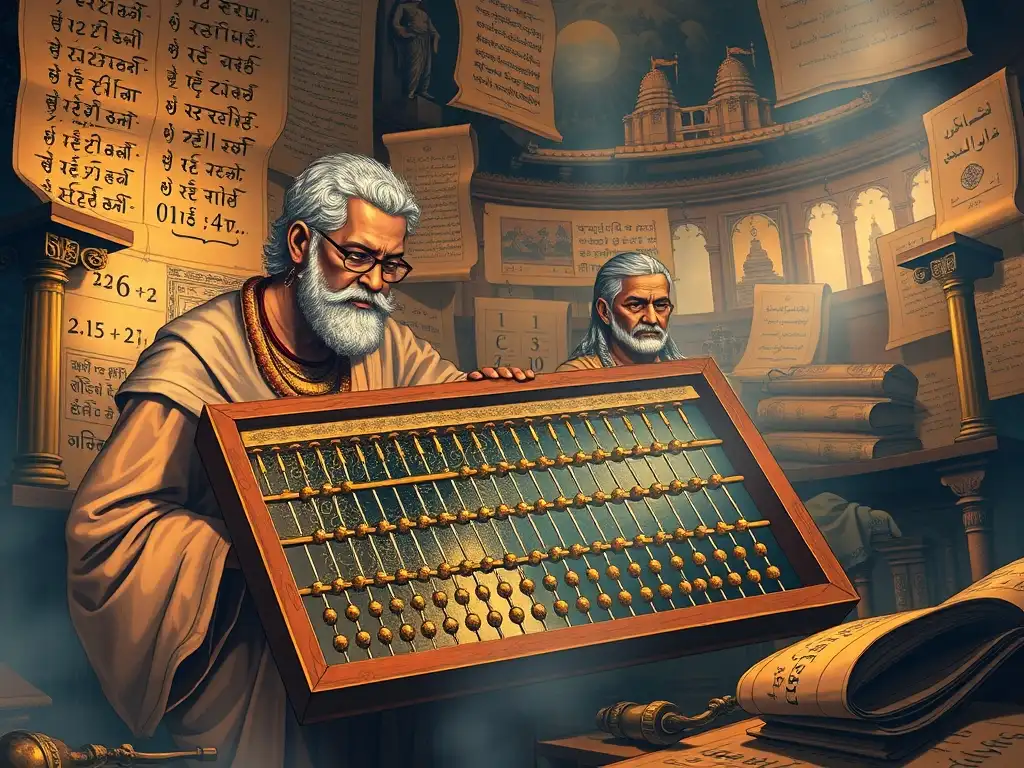
The concept of zero as both a placeholder and a number originated in ancient India, marking a pivotal moment in the history of zero in mathematics. The earliest recorded use of zero dates back to the 5th century CE, as evidenced by inscriptions found in the Bakhshali Manuscript. This ancient text, discovered in modern-day Pakistan, showcases the use of a dot to represent an absence, which we recognize today as zero.
Indian mathematicians like Brahmagupta were instrumental in refining the concept. In his seminal work, Brahmasphutasiddhanta (628 CE), he not only defined zero but also established rules for arithmetic operations involving zero. He stated that:
"A positive number subtracted from zero gives a negative number, while zero subtracted from a positive number yields a positive number."
This understanding laid the groundwork for future mathematical explorations.
As the knowledge of zero spread, it found its way into the Islamic Golden Age, where scholars translated and expanded upon Indian mathematical texts. Notable figures like Al-Khwarizmi and Al-Kindi incorporated zero into their work, with Al-Khwarizmi's Al-Kitab al-Mukhtasar fi Hisab al-Jabr wal-Muqabala (The Compendious Book on Calculation by Completion and Balancing) emphasizing the utility of zero in algebraic equations. Through these translations and adaptations, zero became fundamental in the development of arithmetic and algebra in the Islamic world.
The Journey of Zero in Europe
The introduction of zero to Europe was a gradual process, significantly influenced by the translations of Arabic mathematical texts in the 12th century. European scholars, particularly in Italy, began to adopt the Hindu-Arabic numeral system, which included zero as an essential component. This shift was notably championed by Fibonacci in his work Liber Abaci (1202), where he advocated for the use of the numeral system that included zero, contrasting it with the cumbersome Roman numeral system.
Despite its advantages, the acceptance of zero faced resistance. Many European mathematicians were skeptical of its role, viewing it as merely a placeholder rather than a legitimate number. This skepticism persisted until the 15th century, when the practical applications of zero in commerce and navigation became undeniable. The ability to perform calculations with zero revolutionized trade and accounting systems, facilitating a more efficient economic landscape.
The Role of Zero in Global Mathematical Advancements
Zero's impact on mathematics transcended cultures and eras, proving to be a catalyst for significant advancements. With its incorporation into various numeral systems, zero enabled the development of complex mathematical concepts. For instance:
- Place Value System: Zero allowed for the expression of large numbers succinctly, enhancing the efficiency of calculations.
- Algebraic Innovations: The ability to represent unknowns and perform operations with zero led to breakthroughs in algebra, influencing the works of mathematicians like Descartes and Newton.
The acceptance of zero also played a critical role in the evolution of calculus and the later development of computer science. In digital computing, zero serves as one of the two fundamental binary digits, underpinning all modern technological advancements.
The history of zero in mathematics illustrates not only its origins in ancient India but also its journey through various cultures, ultimately establishing itself as a cornerstone of mathematical thought globally. The evolution of zero has significantly shaped our understanding of mathematics, paving the way for innovations that continue to resonate in contemporary mathematical practices.
The Impact of Zero on Mathematics and Science
Zero's Role in Arithmetic and Calculations
The introduction of zero revolutionized arithmetic and calculations, leading to a more efficient and systematic way of performing mathematical operations. In ancient India, mathematicians recognized zero as a number, not merely a placeholder, which was a groundbreaking concept. This understanding enabled the development of a positional numeral system, where the value of a digit is determined by its position in relation to others.
- Positional Value: The use of zero allowed for the representation of large numbers with greater simplicity. For example, the number 205 is interpreted as \(2 \times 10^2 + 0 \times 10^1 + 5 \times 10^0\). Without zero, representing such numbers would have been cumbersome.
- Basic Operations: Zero simplifies basic arithmetic operations:
- Addition: Any number plus zero equals the number itself (e.g., \(5 + 0 = 5\)).
- Subtraction: Subtracting zero from a number yields the number (e.g., \(8 - 0 = 8\)).
- Multiplication: Any number multiplied by zero results in zero (e.g., \(7 \times 0 = 0\)).
This ability to manipulate numbers more freely laid the groundwork for advanced mathematical concepts and paved the way for efficiency in calculations, particularly in trade and astronomy.
The Influence of Zero on Algebra and Geometry
Zero's introduction significantly influenced algebra and geometry, enabling mathematicians to explore new concepts and solve complex equations.
- Algebraic Functions: With zero, mathematicians were able to formulate equations involving variables, leading to the development of algebra. The equation \(x + 0 = x\) illustrates how zero acts as an identity element in algebraic structures. This foundational principle helped in defining more complex algebraic systems.
- Geometric Interpretations: In geometry, zero facilitated the representation of points in a coordinate system. The Cartesian plane, established later, relies on zero to define the origin (0,0). This allowed for the visualization of geometric shapes and algebraic equations, enhancing the study of both fields.
- Complex Numbers: The concept of zero extends into the realm of complex numbers, where it is crucial in defining the imaginary unit. The equation \(a + bi = 0\) (where \(a\) and \(b\) are real numbers) highlights the necessity of zero in exploring the relationship between real and imaginary parts.
Zero in Modern Mathematical Theories
Today, zero remains a fundamental component of modern mathematics, influencing various theories and applications.
- Calculus: In calculus, the concept of limits often involves zero, particularly when dealing with rates of change and integrals. The idea of approaching zero is essential in defining continuity and differentiability.
- Set Theory: Zero also plays a role in set theory, representing the cardinality of an empty set. This concept is crucial in understanding the foundations of mathematics and logical reasoning.
- Computer Science: In the digital age, zero is integral to computer science. Binary code, which underpins all computer algorithms, uses a base-2 system where zero and one represent all data. This reliance on zero highlights its importance beyond pure mathematics, affecting technology and information systems.
The history of zero in mathematics is a testament to its transformative power, shaping arithmetic, algebra, geometry, and modern mathematical theories. Its journey from ancient India to contemporary applications illustrates its undeniable role as a cornerstone of mathematical thought and innovation.
Cultural and Historical Significance of Zero

Zero in Indian Culture and Philosophy
The concept of zero holds a profound significance in Indian culture and philosophy, extending beyond mere mathematics. In ancient Indian thought, zero was not just a numeral; it represented the idea of śūnyatā, or emptiness, which is a central tenet in various philosophical schools, particularly Buddhism and Jainism. This concept suggested that emptiness is a necessary condition for existence, leading to a philosophical understanding of the void that parallels the mathematical zero.
In ancient texts, especially in the Brahmasphutasiddhanta by Brahmagupta (7th century CE), zero was defined not only as a number but also as a placeholder in positional numeral systems. Brahmagupta's work laid the foundation for arithmetic operations involving zero, including addition, subtraction, multiplication, and division. His insights into zero's role in calculations reflect a sophisticated understanding of mathematics intertwined with philosophical contemplation.
Moreover, in Indian astronomy and astrology, zero played a crucial role. The calculations for celestial movements and timekeeping relied heavily on the concept of zero, showcasing its practical applications in daily life. The use of zero in these contexts illustrates its integration into the cultural fabric of ancient India, influencing various aspects of life including trade, science, and spirituality.
The Legacy of Zero in Global Mathematics
The introduction of zero to the global mathematical community has had a transformative impact, reshaping various mathematical practices across cultures. The transmission of the concept began through the works of Indian mathematicians, who documented their findings in texts that traveled through the Silk Road to the Islamic world and eventually to Europe.
One of the pivotal moments in the legacy of zero was its adoption by Persian mathematicians such as Al-Khwarizmi in the 9th century. His seminal work, Al-Kitab al-Mukhtasar fi Hisab al-Jabr wal-Muqabala, not only utilized zero but also popularized algebra, which relies heavily on the foundational principles established by Indian mathematicians. This work laid the groundwork for the modern algebraic approach used today.
The eventual introduction of zero to Europe through translations of Arabic works in the 10th and 11th centuries marked a significant turning point in Western mathematics. The Italian mathematician Fibonacci, in his book Liber Abaci (1202), advocated for the adoption of the Hindu-Arabic numeral system, which included zero. This transformative shift facilitated advancements in commerce, navigation, and science, establishing a new era of mathematical exploration.
In contemporary mathematics, zero's importance cannot be overstated. It serves as a fundamental element in calculus, computer science, and numerical systems. Its role in defining limits, derivatives, and algorithms underscores the depth of its influence, rooted in ancient Indian thought and practice.
Overall, the legacy of zero transcends geographical and cultural boundaries, serving as a testament to the ingenuity of ancient Indian civilizations and their enduring contributions to global mathematics.
Conclusion: The Unsung Hero of Mathematics

Reflecting on the Global Impact of Zero
The history of zero in mathematics is a fascinating journey that transcends geographical boundaries and cultural contexts. Originating from ancient India, the concept of zero was not merely a placeholder in a numerical system; it represented a profound philosophical idea that influenced various aspects of mathematics. The earliest recorded use of zero dates back to the 5th century CE in the work of the Indian mathematician Aryabhata, who used a symbol for zero in his calculations. This pivotal moment laid the groundwork for future developments in mathematics and science.
The transmission of zero to the Islamic world through translations and scholarly exchanges during the medieval period facilitated its adoption in Europe. By the 12th century, with the introduction of the numeral system known as Arabic numerals, zero became a cornerstone of modern mathematics. Its use allowed for more sophisticated calculations and laid the foundation for algebra, calculus, and computer science.
The impact of zero extends beyond mathematics; it has profound implications in fields such as physics, engineering, and economics. The ability to denote nothingness or a null value has enabled scientists and researchers to model complex systems, making zero an essential tool in problem-solving and innovation.
The Continued Relevance of Zero in Contemporary Mathematics
In contemporary mathematics, zero remains a critical component of various mathematical disciplines. It serves as the additive identity in arithmetic, meaning that any number added to zero remains unchanged. This fundamental property is crucial for establishing the foundations of number theory and algebra.
Furthermore, zero plays a significant role in calculus, particularly in defining limits and derivatives. The concept of approaching zero is vital for understanding continuity and infinitesimals, which are foundational to modern mathematical analysis.
In computer science, the binary system, which underpins digital technology, relies heavily on the concept of zero. In binary code, zero represents the absence of a signal, allowing computers to perform complex calculations and store vast amounts of information efficiently.
As we reflect on the history of zero in mathematics, it is evident that this seemingly simple concept has had a profound and lasting impact on the world. The contributions of ancient Indian scholars not only shaped mathematical thought but also laid the groundwork for advancements that continue to influence our lives today. As we move forward, the legacy of zero will undoubtedly continue to inspire future generations of mathematicians, scientists, and thinkers.
Frequently Asked Questions
What is the significance of zero in ancient Indian mathematics?
Zero is considered a foundational concept in mathematics, enabling complex calculations and paving the way for the development of the decimal system.
How did ancient Indian civilizations contribute to the history of zero?
Ancient Indian scholars were among the first to recognize zero as a number, leading to its formal adoption in mathematics during the Gupta Empire.
Who were the key figures in the development of zero in mathematics?
Brahmagupta, a prominent mathematician from the 7th century, made significant contributions, defining rules for operations involving zero in his work.
How did the concept of zero spread to other cultures?
The introduction of zero to the Islamic world through translations of Indian texts led to its adoption in European mathematics, influencing the global mathematical landscape.
What impact did the history of zero have on modern mathematics?
The concept of zero revolutionized mathematics, enabling advancements in algebra, calculus, and computer science, and remains a crucial element of mathematical education today.
Final Reflection: The Legacy of Zero in Mathematics
The history of zero in mathematics is not just a tale of a numeral; it is a profound narrative that underscores the evolution of human thought and innovation. Today, as we navigate an increasingly complex world driven by technology and data, the significance of zero resonates more than ever. It serves as a reminder of how a simple concept can revolutionize entire fields, from mathematics to computer science, and shape our understanding of the universe.
The impact of zero extends far beyond its mathematical utility; it has fundamentally transformed our cultural and social landscapes. The introduction of zero into the number system allowed for advancements in commerce, science, and philosophy, fostering a culture of inquiry and exploration. As we reflect on this legacy, we recognize that "the invention of zero is one of the most significant achievements in human history." > This quote encapsulates the essence of zero's influence, reminding us that its implications stretch across time and geography, connecting diverse cultures through a shared mathematical language.
As we look to the future, let us embrace the lessons that the history of zero teaches us about innovation and collaboration. I invite you to reflect on how you can apply the spirit of zero in your own life—by embracing new ideas, challenging the status quo, and recognizing the potential in what may seem insignificant. In doing so, we honor the unsung hero of mathematics and pave the way for future discoveries that can change our world for the better.
Unveil the Power of Zero: Take Action Today!
Thank you for diving into the remarkable journey of zero and its profound influence on mathematics and beyond! We hope you’ve gained insights into how this unsung hero has shaped our world. Now, it's time to take that knowledge further and make a difference.
Here are some exciting steps you can take to honor the legacy of zero:
- Dive Deeper: Explore the contributions of Indian mathematicians who significantly advanced the concept of zero. Consider reading books or articles that highlight their stories and discoveries.
- Share the Knowledge: Engage in discussions with friends or on social media about the importance of zero in mathematics and its implications in today’s technology. You might just ignite someone else's curiosity!
- Join a Local Discussion Group: Seek out or initiate a community group focused on mathematics, history, or innovation. Sharing and discussing ideas can enhance appreciation for contributions from diverse cultures.
What new perspective on mathematics and its history has zero opened up for you? Share your thoughts in the comments below!