
The Aryabhata Revolution: How One Scholar Changed the Face of Mathematics

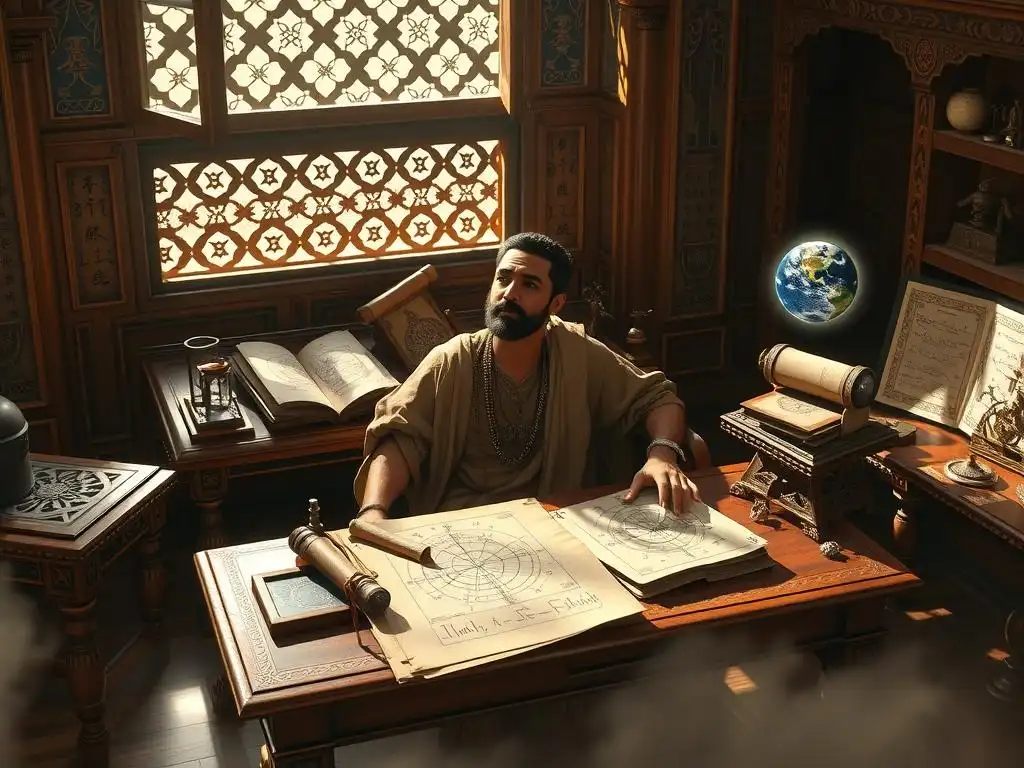
Welcome to Ancient India History, where we embark on a captivating journey through the rich tapestry of ancient Indian civilizations. From the enigmatic Indus Valley to the illustrious Gupta Empire, our exploration unveils the profound contributions that have shaped our world. In this edition, we delve into the remarkable Aryabhata and his contributions to mathematics, a revolutionary figure whose insights transformed numerical understanding and paved the way for future innovations. Curious to uncover how one scholar's brilliance can alter the course of mathematics? Join us as we unravel the legacy of Aryabhata and the extraordinary impact of his work.

Introduction to Aryabhata and His Era
The legacy of Aryabhata, one of the most celebrated mathematicians and astronomers in ancient India, marks a significant turning point in the history of mathematics. Flourishing in the 5th century CE, Aryabhata's contributions laid the groundwork for future mathematical inquiry, influencing not only the Indian subcontinent but also extending its reach to the wider world.
His innovative ideas and methods transformed the mathematical landscape, introducing concepts that would later become foundational in various fields of science and mathematics. This article delves into Aryabhata's life, the historical context of his work, and his groundbreaking contributions to mathematics, emphasizing the enduring impact of his revolutionary ideas.
Overview of Aryabhata's Life and Background
Aryabhata was born in 476 CE in Kusumapura, present-day Patna, Bihar. Little is known about his early life, but his brilliance became evident through his seminal work, the Aryabhatiya, composed when he was just 23 years old. This text encapsulated his knowledge and served as a comprehensive guide to mathematics and astronomy.
Aryabhata's approach was characterized by a systematic use of mathematics to solve practical problems, demonstrating an impressive understanding of concepts such as fractions and the principles of geometry. His scholarly achievements earned him a prominent place in the annals of ancient Indian history, as he became a renowned figure in both mathematics and astronomy.
Historical Context of Mathematics in Ancient India
To fully appreciate Aryabhata's contributions, it is essential to understand the historical milieu of mathematics in ancient India. The mathematical tradition in India can be traced back to the Vedic period, where early texts contained rudimentary arithmetic and geometry. By the time of Aryabhata, Indian mathematicians had developed sophisticated techniques, including the use of numerals, arithmetic operations, and geometric principles.
The cultural emphasis on astronomy and astrology during this era further fueled mathematical advancements, as scholars sought to create accurate astronomical models. Aryabhata's work emerged as a synthesis of these prior developments, reflecting a deep engagement with both mathematical theory and practical applications.
Aryabhata's Major Contributions to Mathematics
Aryabhata's influence on mathematics is profound, with several key contributions that reshaped the discipline. His work not only provided solutions to existing mathematical problems but also introduced innovative concepts that would be pivotal for future generations of mathematicians.
The Concept of Zero and Place Value
One of Aryabhata's most significant contributions is his early conceptualization of zero as a number and the establishment of place value in the numeral system. Although the concept of zero was present in earlier Indian texts, Aryabhata's work helped formalize its usage, allowing for more efficient calculations and a clearer representation of large numbers. This breakthrough laid the foundation for the decimal system, which is crucial in mathematics today. His recognition of the importance of place value enabled more complex operations and calculations, influencing both Indian and global mathematics.
Innovations in Arithmetic and Algebra
Aryabhata made remarkable strides in arithmetic and algebra, introducing systematic methods for computation. He developed algorithms for operations such as addition, subtraction, multiplication, and division, which improved the efficiency of calculations. His work also encompassed algebraic expressions, where he provided rules for solving linear equations and introduced concepts that would later be recognized as foundational in algebra. These innovations not only advanced mathematical techniques but also facilitated the practical application of mathematics in various fields, including commerce and astronomy.
Aryabhata's Work on Trigonometry
In the realm of trigonometry, Aryabhata significantly advanced the understanding of sine and cosine functions. He introduced the concept of ardha-jya (half-chord), which laid the groundwork for trigonometric calculations that are essential in astronomy and navigation. His precise calculations of the sine values for various angles demonstrated an impressive level of accuracy, surpassing earlier methods. This work on trigonometry not only influenced later Indian mathematicians but also set the stage for the development of trigonometric concepts in other cultures.
Introduction of Algebraic Methods and Techniques
Aryabhata's contributions to algebra were groundbreaking, as he introduced methods that encompassed a wide range of mathematical problems. His work involved the formulation of rules for manipulating algebraic expressions and solving equations, thereby providing a structured approach to algebra that was innovative for its time. He also addressed complex problems related to the calculation of the area and volume, showcasing his ability to apply algebraic techniques to geometric contexts. These contributions were instrumental in shaping the trajectory of mathematics, influencing both contemporaries and future scholars.
Aryabhata's extensive contributions to mathematics not only enriched the field but also established a legacy that resonates through the ages. His pioneering ideas on zero, arithmetic, trigonometry, and algebra have left an indelible mark on the development of mathematics, making him a pivotal figure in the history of science and mathematics in ancient India.
Aryabhata's Influence on Later Mathematicians
Aryabhata, one of the most influential figures in ancient Indian mathematics, laid the groundwork for subsequent generations of mathematicians. His revolutionary ideas transcended time and geography, influencing many scholars in India and beyond. The Aryabhatiya, his seminal work, served as a crucial reference for mathematicians such as Brahmagupta and Bhaskara. Through the dissemination of Aryabhata's principles, the foundations of algebra and trigonometry were advanced significantly, fostering a rich intellectual climate that nurtured further exploration in these fields.
Aryabhata’s introduction of innovative concepts, such as the place value system and the use of zero, revolutionized mathematical practices. Later mathematicians built upon these concepts, further refining and expanding them. The collaborative nature of Indian scholarship during Aryabhata’s time allowed for a continuous flow of ideas, which facilitated the growth of mathematics as a robust discipline. His influence can be seen in various branches of mathematics, including arithmetic, geometry, and astronomy, fundamentally altering the mathematical landscape of ancient India.
The Impact of Aryabhata's Ideas on Indian Mathematics
Aryabhata's ideas had a profound impact on the development of mathematics in India. His assertion that the Earth rotates on its axis was not just an astronomical observation but a mathematical assertion that reshaped the way scholars approached celestial calculations. By proposing that the Earth’s rotation causes the apparent movement of stars, Aryabhata encouraged a mathematical framework that could describe and predict astronomical events, which became foundational in later Indian astronomy.
Moreover, Aryabhata’s work on sine tables and his systematic approach to solving quadratic equations contributed to the emergence of algebra in Indian mathematics. The introduction of systematic methods for calculating squares, cubes, and square roots laid the groundwork for future mathematicians to explore polynomial equations and higher-order calculations. This shift towards abstraction and formalism in mathematics can be traced back to Aryabhata’s pioneering contributions, marking a significant evolution in mathematical thought.
Aryabhata's Contributions to Astronomy and Their Mathematical Implications
Aryabhata's contributions to astronomy are intricately linked to his mathematical innovations. His calculation of the Earth's circumference, which he estimated to be approximately 39,968 kilometers, showcases his exceptional understanding of geometry and trigonometry. This remarkable approximation reflects his skill in applying mathematical principles to real-world problems, thereby enhancing the accuracy of astronomical observations.
In addition, Aryabhata's methods for predicting eclipses and understanding lunar phases were underpinned by mathematical calculations that accounted for the relative positions of celestial bodies. His formulation of the sine function, which he used to solve various astronomical problems, was an early instance of trigonometric applications that would later influence both Indian and Islamic mathematics. The mathematical rigor he applied to astronomy not only advanced the field but also inspired subsequent scholars to develop more sophisticated models for understanding the cosmos.
Comparison with Other Ancient Mathematicians
When comparing Aryabhata with other ancient mathematicians, his contributions stand out for their originality and depth. For instance, while Greek mathematicians like Euclid focused heavily on geometry, Aryabhata’s work encompassed a broader range of mathematical disciplines, including arithmetic, algebra, and astronomy. His approach was more holistic, integrating various mathematical concepts into a cohesive framework.
Additionally, while mathematicians in other cultures relied on geometric proofs, Aryabhata emphasized numerical calculations. This shift towards a more analytical method reflected a unique perspective that distinguished Indian mathematics from its contemporaries. The integration of mathematics and astronomy in Aryabhata’s work not only paved the way for future Indian mathematicians but also influenced Islamic scholars, who later translated and expanded upon his ideas.
Legacy of Aryabhata in the Global Context
Aryabhata's legacy extends far beyond the borders of ancient India, marking him as a pivotal figure in the global history of mathematics. His works were translated into Arabic and Latin, influencing scholars in the Islamic Golden Age and Renaissance Europe. The transfer of knowledge facilitated by translations allowed Aryabhata’s innovative concepts to permeate various cultures, contributing to the development of mathematics worldwide.
His introduction of the place-value system, which is now fundamental in mathematics, revolutionized computational methods not only in India but also in the Islamic world and eventually in Europe. Aryabhata’s influence is evident in the way modern mathematics is structured, showcasing the enduring relevance of his contributions.
How Aryabhata's Contributions Shaped Mathematics Worldwide
Aryabhata's contributions played a crucial role in shaping mathematics on a global scale. His work on the place value system and the concept of zero enabled more complex calculations and paved the way for advanced algebra. These concepts became integral to the development of mathematics in the Islamic world, where scholars like Al-Khwarizmi built upon Aryabhata’s foundation to create algorithms that are the basis of modern arithmetic.
Moreover, Aryabhata’s trigonometric innovations, particularly in the use of sine and cosine functions, were pivotal in advancing astronomical calculations throughout history. These mathematical tools facilitated navigation, astronomy, and engineering across different cultures, illustrating the far-reaching implications of his work.
Recognition of Aryabhata in Modern Mathematics
In contemporary mathematics, Aryabhata is recognized not just as a historical figure but as a foundational contributor to mathematical thought. His methods are studied in mathematics and astronomy courses worldwide, highlighting the relevance of his work in modern education. This recognition is further evidenced by the naming of satellites and institutions after him, emphasizing his enduring impact on science.
The acknowledgment of Aryabhata’s achievements in various academic fields underscores the importance of integrating historical figures into the mathematics curriculum. By learning about his contributions, students can appreciate the evolution of mathematical concepts and their applications across cultures and time periods.
The Relevance of Aryabhata's Work in Contemporary Mathematics Education
Aryabhata’s work remains highly relevant in contemporary mathematics education. His innovative methods for solving equations and his understanding of numerical systems are essential components of modern mathematical curricula. Educators often use his writings to illustrate the historical development of mathematical concepts and to foster a deeper understanding of the subject.
Incorporating Aryabhata’s contributions into the classroom not only enriches the educational experience but also encourages students to explore the interconnectedness of mathematics and other disciplines, such as astronomy and physics. By studying the works of pioneers like Aryabhata, students are inspired to appreciate the rich tapestry of mathematical history and the ongoing evolution of mathematical thought.
Conclusion

Aryabhata stands as a monumental figure in the history of mathematics, serving as a bridge between ancient and modern mathematical thought. His pioneering methodologies and profound insights laid the groundwork for subsequent advancements in mathematics and astronomy not only in India but also across the globe. His ability to blend theoretical concepts with practical applications exemplifies the rich intellectual tradition of ancient India, marking him as a true visionary of his time.
Summary of Aryabhata's Contributions to Mathematics
Aryabhata's contributions to mathematics are numerous and incredibly influential. He is best known for:
- Place Value System: Aryabhata introduced the concept of zero and the place value system, which are fundamental in modern mathematics. This innovation allowed for more complex calculations and laid the foundation for the decimal system.
- Arithmetic and Algebra: His work encompassed various arithmetic calculations, including methods for finding square roots and cube roots, as well as techniques for solving linear and quadratic equations.
- Trigonometry: Aryabhata made significant advances in trigonometry, particularly with the introduction of sine and cosine functions, which played a crucial role in astronomical calculations.
- Approximation of Pi: He provided an approximation of pi (π) as 3.1416, which was remarkably accurate for his time and served as a vital reference for future mathematicians.
These contributions reflect his deep understanding of mathematical principles and their applications in astronomy and daily life.
The Lasting Impact of Aryabhata on Mathematics and Science in Ancient India
The influence of Aryabhata extends far beyond his lifetime, shaping the trajectory of mathematics and science in ancient India and beyond. His methods and techniques were adopted and refined by later scholars, leading to a rich tradition of mathematical inquiry.
- Influence on Later Mathematicians: Scholars such as Brahmagupta and Bhaskara II built upon Aryabhata's work, developing new theories and concepts that further advanced the field of mathematics.
- International Recognition: Aryabhata's ideas eventually permeated into the Islamic world and Europe, influencing notable figures such as Al-Khwarizmi and leading to the eventual spread of the decimal system worldwide.
- Integration of Mathematics and Astronomy: His approach to mathematics was inherently linked with astronomical observations, emphasizing the importance of applied mathematics in understanding celestial phenomena, which set a precedent for subsequent astronomers.
Aryabhata's contributions not only transformed mathematics during his era but also established a legacy that continues to resonate in contemporary fields of study.
References
Suggested Readings and Resources on Aryabhata and Ancient Mathematics
- "Aryabhata: The Astronomer and Mathematician" by K. R. N. Rao: - This book provides an in-depth exploration of Aryabhata's life and works, detailing his contributions to mathematics and astronomy.
- "The History of Indian Mathematics" by C. V. D. Dhananjay - A comprehensive overview of the development of mathematics in India, with significant sections dedicated to Aryabhata's influence.
- "Mathematics in Ancient India" by Kim Plofker - This resource discusses various mathematicians, including Aryabhata, and the mathematical practices of ancient Indian civilization.
- "Aryabhata's Brahmasphutasiddhanta: A Translation" by R. N. Iyengar: - An accessible translation of Aryabhata's seminal work, providing insights into his mathematical theories and methodologies.
These readings offer valuable insights into the life and contributions of Aryabhata, as well as the broader context of mathematics in ancient India.
- Introduction to Aryabhata and His Era
- Aryabhata's Major Contributions to Mathematics
- Aryabhata's Influence on Later Mathematicians
- Legacy of Aryabhata in the Global Context
- Conclusion
- Summary of Aryabhata's Contributions to Mathematics
- The Lasting Impact of Aryabhata on Mathematics and Science in Ancient India
- References
Frequently Asked Questions
What were the major contributions of Aryabhata to mathematics?
Aryabhata made significant contributions, particularly in algebra, trigonometry, and the concept of zero. His work laid the foundation for many mathematical principles still in use today.
How did Aryabhata influence astronomy?
Aryabhata's astronomical calculations were groundbreaking; he accurately calculated the length of the year and proposed that the Earth rotates on its axis, challenging contemporary views.
What is Aryabhata's most famous work?
His most famous work is the Aryabhatiya, a comprehensive treatise that covers mathematics and astronomy, detailing his innovative methods and findings in these fields.
How did Aryabhata's ideas spread beyond India?
Aryabhata's ideas were translated into Arabic and eventually into Latin, significantly influencing Islamic scholars and the development of mathematics in Europe during the Middle Ages.
Why is Aryabhata considered a pioneer in mathematics?
Aryabhata is considered a pioneer because he introduced concepts such as the place value system and made significant advancements in trigonometry, fundamentally altering the course of mathematical history.
Final Reflection: Embracing the Legacy of Aryabhata's Mathematical Revolution
The contributions of Aryabhata to mathematics are not just historical footnotes; they are foundational pillars that continue to shape our understanding of the world today. In an era where technology and science are advancing at an unprecedented pace, revisiting Aryabhata's revolutionary ideas reminds us of the timelessness of knowledge and the profound impact one individual can have on the collective intellectual journey of humanity. His innovative approaches to mathematics and astronomy resonate in our modern calculations and scientific endeavors, proving that the seeds of wisdom planted centuries ago still bear fruit in contemporary society.
The legacy of Aryabhata is woven into the very fabric of our cultural and scientific landscape. His work not only laid the groundwork for future mathematicians but also inspired generations to explore the realms of knowledge with curiosity and rigor. The ripple effects of his contributions can be seen in various fields, from computer science to space exploration.
As the mathematician Carl Friedrich Gauss once said, "> Mathematics is the queen of the sciences and number theory is its crown jewel." Aryabhata's pioneering spirit exemplifies this truth, reminding us that the pursuit of mathematical understanding is an endeavor worthy of our deepest commitment.
As we reflect on Aryabhata's monumental impact, let us take a moment to consider how we can apply his lessons in our own lives. Embrace the spirit of inquiry and innovation that Aryabhata embodied. Whether you are a student, a professional, or simply a curious mind, challenge yourself to explore the unknown, question the status quo, and contribute to the ongoing revolution of knowledge. In doing so, you honor the legacy of Aryabhata and become a part of the ever-evolving narrative of mathematics and science, inspiring future generations to dream bigger and reach further.
Embrace the Legacy of Aryabhata: Take Action!
Thank you for diving into the inspiring story of Aryabhata and his monumental impact on mathematics! You've uncovered insights into how one brilliant mind can transform an entire field of study. Now, it’s time to harness that motivation and take meaningful steps forward.
Here are ways you can channel Aryabhata's spirit of innovation and curiosity:
- Dive Deeper: Explore Aryabhata’s theories by selecting one and presenting your insights at your next group discussion or study session.
- Share the Knowledge: Discuss Aryabhata’s contributions with friends or on social media, helping others learn about his significant role in the development of mathematics and history.
- Get Involved: Join a local math or science club to engage more actively with your community and inspire others with Aryabhata’s revolutionary ideas!
Let’s keep the conversation alive: How do you think mastering Aryabhata’s concepts could change your perspective on mathematics today?