
How Ancient Indian Scholars Used Geometry to Understand the Universe


Welcome to Ancient India History, where we embark on an enthralling journey through the rich tapestry of ancient Indian civilizations. Here, you'll uncover the remarkable contributions of scholars who utilized geometry not just as a mathematical tool, but as a means to understand the universe itself.
In our featured article, "How Ancient Indian Scholars Used Geometry to Understand the Universe," we delve into the fascinating intersection of science and ancient wisdom, revealing insights that have shaped our understanding of the world. Join us as we explore the profound legacy of ancient Indian geometry and its enduring impact on modern thought—your adventure into this captivating history begins here!
- Introduction to Ancient Indian Geometry Contributions
- Historical Context of Geometry in Ancient India
- Major Geometric Concepts in Ancient Indian Mathematics
- Applications of Geometry in Astronomy
- The Influence of Ancient Indian Geometry on Modern Mathematics
- Conclusion: The Lasting Impact of Ancient Indian Geometry Contributions
-
Frequently Asked Questions
- What were the major contributions of ancient Indian scholars to geometry?
- How did ancient Indian geometry influence other cultures?
- What role did geometry play in ancient Indian architecture?
- Who are some notable ancient Indian mathematicians associated with geometry?
- How does the study of ancient Indian geometry relate to modern mathematics?
- Final Reflection: The Enduring Legacy of Ancient Indian Geometry
- Unlock the Secrets of Geometry in Ancient Wisdom
Introduction to Ancient Indian Geometry Contributions

Ancient Indian geometry contributions represent a significant aspect of the mathematical and astronomical advancements that emerged from one of the world's oldest civilizations. From the meticulous planning of urban centers in the Indus Valley Civilization to the sophisticated astronomical calculations during the Gupta Empire, geometry played a crucial role in understanding both the terrestrial and celestial realms.
This article delves into the remarkable achievements of ancient Indian scholars in geometry, highlighting how their work laid the groundwork for various fields including astronomy, architecture, and mathematics. By exploring the intellectual legacy of these scholars, we can appreciate the profound impact their geometric insights had on not only ancient Indian society but also on the broader canvas of global knowledge.
Overview of Ancient Indian Scholars
The exploration of geometry in ancient India can be traced back to several key scholars and texts that shaped its development. Notable figures include:
- Aryabhata (476–550 CE): Often regarded as the father of Indian mathematics, Aryabhata's work "Aryabhatiya" introduced concepts of trigonometry and provided methods for calculating areas and volumes.
- Brahmagupta (598–668 CE): His seminal text "Brahmasphutasiddhanta" included rules for handling geometric shapes and the calculation of areas for various figures, including circles and triangles.
- Bhaskara I (c. 600 CE): Known for his commentaries on Aryabhata, he contributed to the understanding of sine functions and their geometric implications.
- Bhaskara II (1114–1185 CE): His work "Lilavati" is famous for its practical applications of geometry in real-world problems, making mathematics accessible to a broader audience.
These scholars not only advanced geometric knowledge but also integrated it into astronomical models, thereby influencing subsequent generations of mathematicians and astronomers.
Importance of Geometry in Ancient Indian Culture
Geometry was not merely an abstract discipline in ancient India; it was deeply intertwined with various aspects of daily life and cultural practices. Some key points include:
- Architecture and Urban Planning: The precise geometric designs of temples and urban layouts in cities like Mohenjo-Daro and Harappa showcased the practical application of geometry in construction.
- Astronomy: Ancient Indian astronomers utilized geometric principles to map the stars and predict celestial events, which were essential for agricultural planning and religious ceremonies.
- Art and Aesthetics: Geometry influenced art forms, such as the intricate designs found in textiles and sculptures, reflecting a deep appreciation for symmetry and proportion.
The contributions of ancient Indian geometry were not only foundational for the development of mathematics but also enriched the cultural and intellectual fabric of the civilization. By understanding these contributions, we gain insight into how ancient Indian scholars utilized geometry to explore and interpret the universe around them.
Historical Context of Geometry in Ancient India
Early Civilizations and Mathematical Foundations
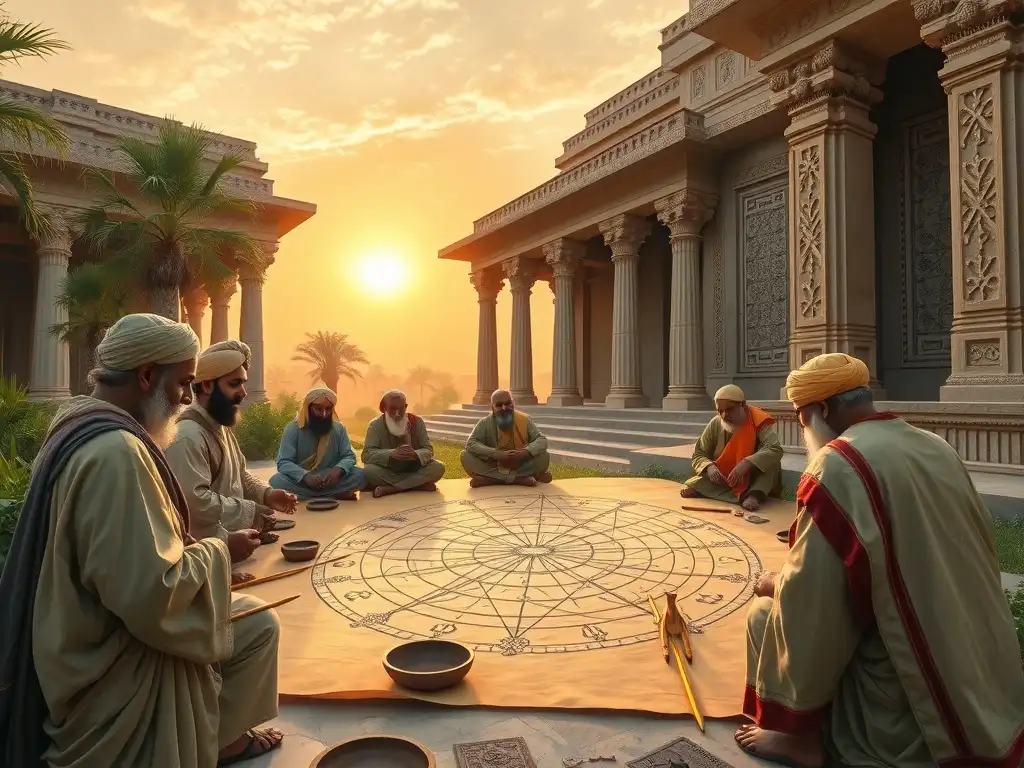
Ancient Indian geometry has its roots in the early civilizations that flourished in the Indian subcontinent, particularly the Indus Valley Civilization (circa 3300–1300 BCE). This civilization displayed remarkable urban planning and architectural skills, which hint at an understanding of geometry long before formal texts were written. The layout of cities like Mohenjo-Daro and Harappa, characterized by grid patterns and advanced drainage systems, suggests that the inhabitants possessed a foundational knowledge of geometric principles.
As societies evolved, so did their mathematical practices. By the time of the Vedic period (circa 1500–500 BCE), geometry began to be more formally integrated into religious and cultural practices. The need for precise measurements in rituals, architecture, and agriculture facilitated the development of mathematical concepts. Geometry was not merely a theoretical study but was applied practically in constructing altars (yajna) and understanding celestial movements, linking it closely to astronomy.
Key Texts Influencing Ancient Indian Geometry
The advancements in geometric understanding were documented in various ancient Indian texts, which laid the groundwork for future scholars. These texts encapsulated mathematical theories, practical applications, and philosophical considerations regarding the universe.
The Sulba Sutras
The Sulba Sutras, composed between the 8th and 6th centuries BCE, are among the earliest texts that pertain to geometry in ancient India. These texts provided rules for constructing altars for Vedic rituals, showcasing the application of geometric principles in religious contexts.
Key Contributions of the Sulba Sutras:
- Pythagorean Theorem: The Sulba Sutras contain early formulations of the Pythagorean theorem, which was used to construct right angles and squares. One particular sutra states that the square of the length of the hypotenuse is equal to the sum of the squares of the other two sides.
- Geometric Constructions: The texts describe methods for constructing geometric shapes such as squares, rectangles, and circles, often with elaborate step-by-step instructions. This illustrates a sophisticated understanding of spatial relationships and measurements.
- Sacred Geometry: The importance of geometry in the construction of altars reflects a belief that mathematical precision had divine significance, bridging the gap between the material and spiritual worlds.
Aryabhata's Contributions
Aryabhata (476–550 CE) is perhaps one of the most influential mathematicians and astronomers in ancient India. His seminal work, the Aryabhatiya, not only advanced mathematics but also had profound implications for geometry.
Key Contributions of Aryabhata:
- Trigonometry and Geometry: Aryabhata introduced sine functions, which were pivotal in calculations involving angles and distances. His work included the calculation of areas of triangles and circles, emphasizing the importance of geometric figures in astronomical observations.
- Coordinate Geometry: He developed methods for calculating the position of celestial bodies, which required an understanding of coordinate systems. This laid the groundwork for more complex geometric applications in astronomy.
- Mathematical Rigor: Aryabhata’s approach was systematic and rigorous. He provided algorithms for calculations, showcasing the interplay between geometry and arithmetic, and influencing future generations of mathematicians, not only in India but across the world.
The contributions of ancient Indian geometry were integral to the development of mathematical thought and astronomical understanding. The texts and scholars from this period reflect a deep intertwining of geometry with practical applications, spirituality, and the quest for knowledge about the universe.
Major Geometric Concepts in Ancient Indian Mathematics
The Concept of Zero and Its Significance
The concept of zero, represented by the symbol "0", is one of the most profound contributions of ancient Indian mathematics. It emerged during the Gupta period (around the 5th century CE) and revolutionized numerical systems globally. Traditionally, numbers were represented using various symbols, but the invention of zero as a placeholder allowed for the representation of large numbers and more complex calculations.
- Historical Background: The earliest recorded use of zero dates back to the Bakhshali Manuscript, a mathematical text from ancient India, which demonstrates its significance in arithmetic operations. Ancient Indian mathematicians such as Brahmagupta and Aryabhata further elaborated on the properties and applications of zero.
- Mathematical Implications: The introduction of zero allowed for the formulation of the decimal system, which is still in use today. It facilitated calculations in algebra, geometry, and even astronomy by enabling mathematicians to perform operations such as addition, subtraction, multiplication, and division more efficiently.
- Philosophical Significance: Beyond mathematics, the concept of zero had philosophical implications in ancient Indian thought. It represented the idea of 'shunya' (emptiness or void) in various schools of philosophy, showcasing a deep understanding of the nature of existence and the universe.
Geometric Shapes and Their Symbolism
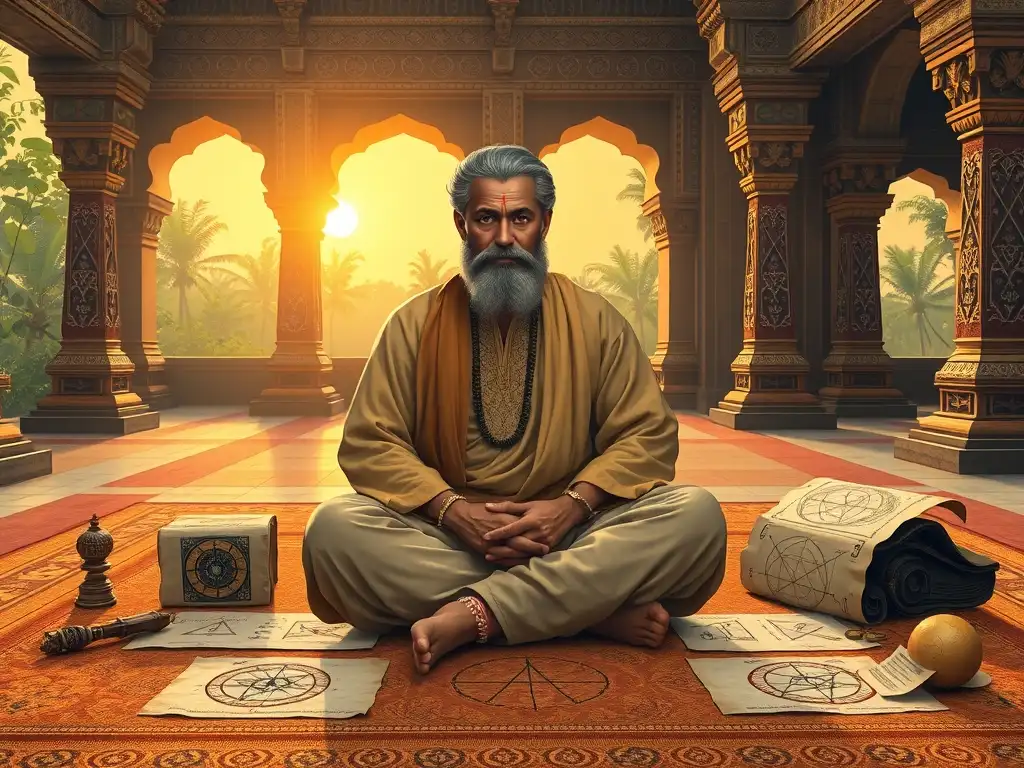
Ancient Indian scholars utilized geometric shapes not only for practical purposes but also imbued them with deep cultural and spiritual symbolism. Various geometric figures played a crucial role in religious rituals, art, and architecture.
- Circles: The circle, symbolizing eternity and the cosmos, was prevalent in ancient Indian art and architecture. For example, the circular mandalas represent the universe in Hindu and Buddhist cosmology. The design of temples often incorporates circular motifs to signify the cyclical nature of life and the cosmos.
- Squares: Squares were often associated with stability and order. In Vastu Shastra, the ancient Indian science of architecture, squares are used to design sacred spaces, representing the earthly realm. The concept of 'Vastu Purusha Mandala' illustrates how geometric shapes dictate the layout of buildings to ensure harmony and balance.
- Triangles: Representing the trinity in Hinduism, triangles were significant in temple architecture. The pyramidal structures of temples often symbolize spiritual ascent and the connection between the earthly realm and the divine.
The Use of Geometry in Architecture
Ancient Indian architecture showcases a sophisticated understanding of geometry that reflects both aesthetic beauty and practical functionality. Architects employed geometric principles to design structures that were not only visually striking but also aligned with cosmic principles.
- Temple Construction: The intricate designs of ancient temples, such as those in Khajuraho and Brihadeeswarar Temple, exhibit advanced geometric patterns. The use of symmetry and proportion in temple architecture is a testament to the mathematical prowess of ancient Indian builders.
- Urban Planning: The urban layout of cities like Mohenjo-Daro and Harappa from the Indus Valley Civilization demonstrates an advanced understanding of geometry. Streets were laid out in grid patterns, with houses constructed using standardized dimensions, indicating a systematic approach to urban planning.
- Astronomical Alignments: Many ancient Indian structures were aligned with celestial bodies, reflecting the integration of geometry with astronomy. The Jantar Mantar observatories, built during the 18th century, exemplify how geometry was applied to create instruments for astronomical observations, further showcasing the rich heritage of ancient Indian geometry contributions.
The geometric concepts developed by ancient Indian scholars significantly influenced mathematics, architecture, and even philosophical thought, leaving a lasting legacy that continues to inspire modern science and culture.
Applications of Geometry in Astronomy
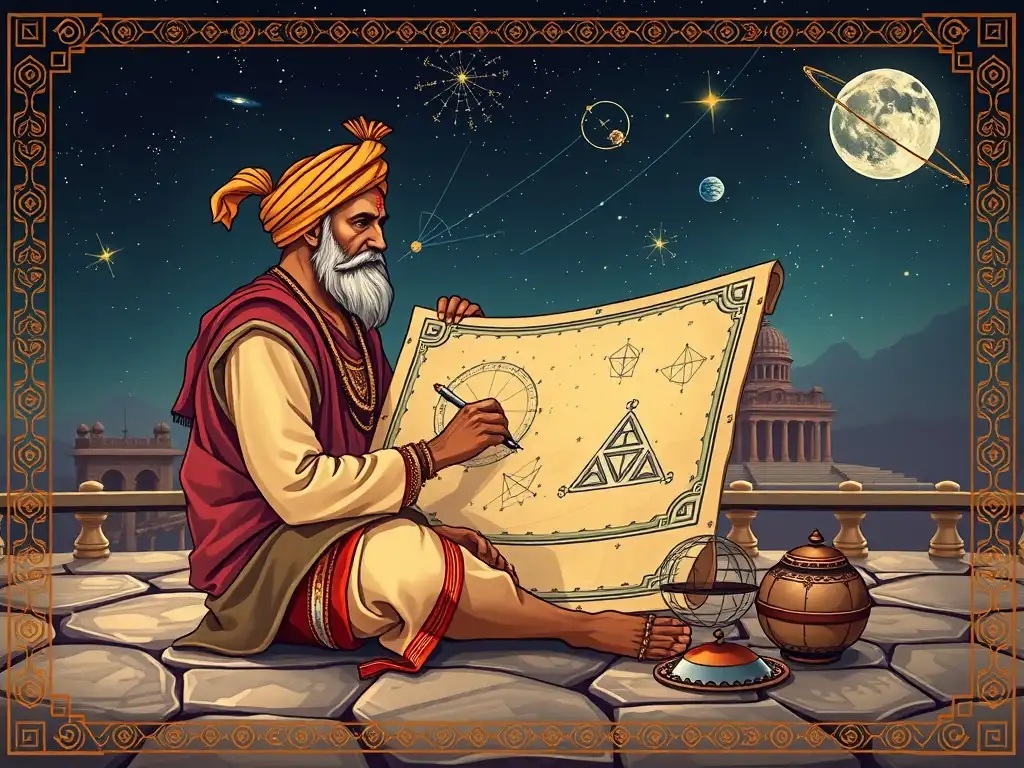
The intersection of geometry and astronomy in ancient India showcases how scholars employed mathematical principles to deepen their understanding of celestial phenomena. These contributions not only shaped astronomical practices but also laid the groundwork for future advancements in both mathematics and astronomy. The use of geometry facilitated precise measurements and calculations, enabling ancient Indian astronomers to create models that effectively represented the cosmos.
Celestial Measurements and Observations
Ancient Indian scholars utilized geometric techniques to make accurate celestial measurements. They developed methods for determining the positions of celestial bodies, which were crucial for navigation, timekeeping, and agricultural planning.
- Instruments Used:
- Gnomons: Simple devices for measuring the angle of the sun's shadow, which aided in determining the time of day.
- Astronomical Tables: These records included geometric calculations based on the positions of planets and stars.
- Geometric Principles:
- Triangles: The principles of trigonometry were employed to calculate angles and distances between celestial bodies.
- Circles: The notion of circular motion was central to modeling the paths of planets and stars.
The integration of geometry into astronomy allowed scholars to not only observe but also predict celestial events with remarkable accuracy, significantly influencing agricultural cycles and religious practices.
The Role of Geometry in Calendar Calculations
Geometry played a pivotal role in the development of calendars in ancient India. Accurate calendar systems were essential for agricultural societies, and scholars relied on geometric calculations to align lunar and solar cycles.
- Lunar and Solar Cycles:
- Ancient mathematicians used geometric methods to calculate the lengths of months and years, ensuring that their calendars remained in sync with celestial events.
- Seasonal Changes:
- Geometry helped in determining the equinoxes and solstices, allowing for the adjustment of calendars to reflect seasonal changes accurately.
The meticulous nature of these calculations illustrates the sophistication of ancient Indian geometry contributions, highlighting how they enabled societies to plan agricultural activities and religious observances effectively.
Notable Astronomers and Their Geometric Methods
Several prominent astronomers in ancient India made significant contributions to the field of astronomy through their application of geometric principles. Their work not only advanced astronomical knowledge but also influenced the mathematical approaches used in subsequent generations.
Aryabhata's Astronomical Models
Aryabhata, one of the most revered mathematicians and astronomers of ancient India, made remarkable strides in the application of geometry to astronomy. His seminal work, the Aryabhatiya, outlines several geometric concepts related to celestial phenomena.
- Key Contributions:
- Aryabhata introduced the concept of the Earth's rotation on its axis, explaining the apparent movement of stars and planets.
- He utilized trigonometric functions and geometric principles to derive formulas for calculating the positions of celestial bodies.
- Geometric Models:
- Aryabhata's models incorporated spherical geometry to represent the Earth and celestial spheres, allowing for more accurate predictions of planetary positions.
Aryabhata's innovative approach to geometry and astronomy exemplifies the depth of ancient Indian geometry contributions and their lasting impact on the scientific community.
Varahamihira’s Contributions to Astronomy
Varahamihira, another distinguished figure in ancient Indian astronomy, expanded upon the geometric methods established by his predecessors. His work, particularly in the Brihat Samhita, encompasses a wide range of topics, including astrology, meteorology, and astronomy.
- Innovative Techniques:
- Varahamihira employed geometric principles to create detailed star charts and planetary models, enhancing navigation and timekeeping practices.
- He emphasized the importance of geometric ratios in predicting celestial events, demonstrating a sophisticated understanding of mathematical relationships.
- Integration of Geometry and Astronomy:
- Varahamihira's work illustrates how geometry was not only a mathematical tool but also a practical means of understanding the universe. His contributions reinforced the essential role of geometry in ancient Indian astronomical studies.
Through the efforts of scholars like Varahamihira, ancient Indian geometry contributions flourished, leading to a comprehensive understanding of the cosmos that influenced later astronomical developments in various cultures.
The Influence of Ancient Indian Geometry on Modern Mathematics
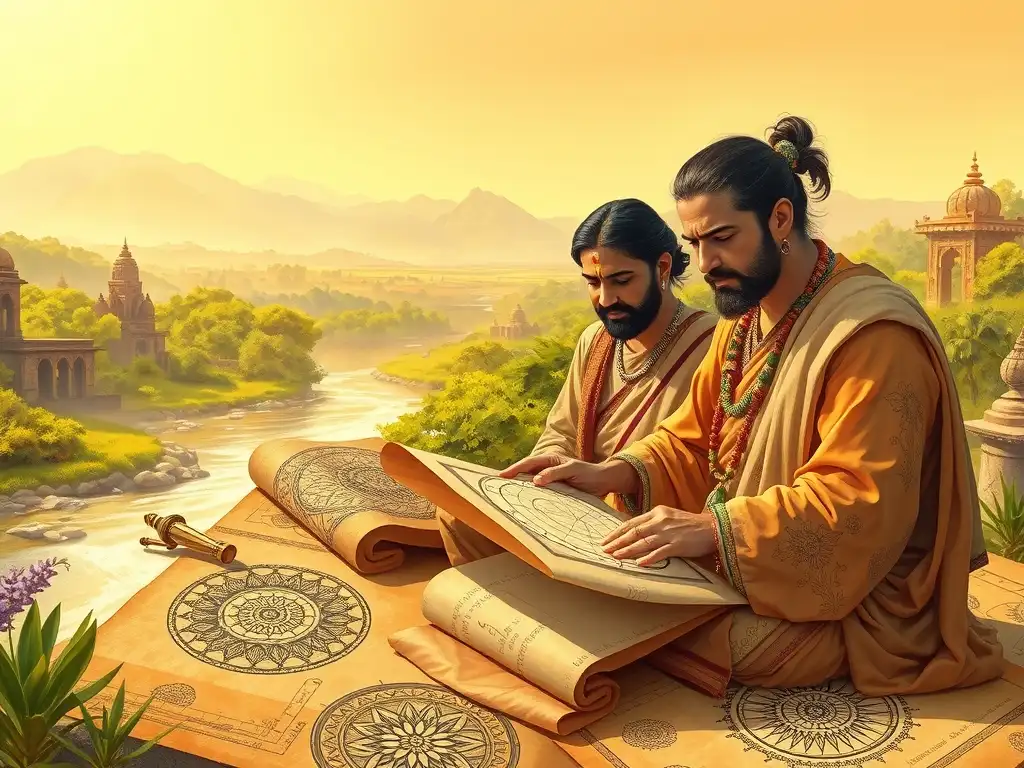
Ancient Indian geometry has played a crucial role in shaping modern mathematical thought. The contributions of Indian scholars, particularly during the classical period, have resonated through time, influencing various domains of mathematics and astronomy. This influence extends from foundational principles in geometry to the development of algorithms still in use today.
Legacy of Ancient Indian Scholars in Global Mathematics
The legacy of ancient Indian scholars, such as Aryabhata, Brahmagupta, and Bhaskara, is profound. Their works laid the groundwork for understanding geometric concepts and the application of mathematics in astronomy. For instance, Aryabhata's Aryabhatiya introduced innovative ideas on the circumference of circles and the concept of zero, which revolutionized mathematical calculations.
Brahmagupta's Brahmasphutasiddhanta is another key text that discusses the properties of geometric shapes, allowing for advancements in algebra and arithmetic. His rules for solving quadratic equations not only demonstrated a deep understanding of geometry but also provided methods that would later influence mathematicians across cultures.
Bhaskara II, known for his work Lilavati, further expanded geometric principles, including calculations involving triangles and circles, significantly impacting the teaching of mathematics. His contributions are not just historical artifacts; they are foundational elements still studied in modern geometry.
Cross-cultural Exchanges and Their Impact on Geometry
The cross-cultural exchanges that occurred between ancient Indian scholars and other civilizations played a vital role in the evolution of geometry. Trade routes and scholarly interactions facilitated the sharing of mathematical ideas, leading to a rich exchange of knowledge.
For example, the transmission of the concept of zero from India to the Islamic world and then to Europe marked a significant turning point in mathematical history. The decimal system, which includes the use of zero, was instrumental in simplifying calculations and expanding the scope of mathematical exploration.
Moreover, Indian texts were translated into Arabic, allowing for the integration of Indian geometric principles into Islamic mathematics. Scholars like Al-Khwarizmi, who was influenced by Indian mathematics, contributed to the development of algebra and geometry in the Islamic Golden Age. This synergy not only enriched Islamic scholarship but also laid the groundwork for the Renaissance in Europe, showcasing the far-reaching impact of ancient Indian geometry contributions.
The ripple effect of these exchanges highlights the interconnectedness of mathematical development across cultures, demonstrating how ancient Indian geometry has not only shaped its own civilization but has also significantly contributed to global mathematical heritage.
The influence of ancient Indian geometry on modern mathematics is evident through the rich legacy of its scholars and the cross-cultural exchanges that facilitated the spread of mathematical ideas. This intricate tapestry of knowledge continues to inspire and guide contemporary mathematical thought, ensuring the enduring relevance of ancient Indian contributions.
Conclusion: The Lasting Impact of Ancient Indian Geometry Contributions

The contributions of ancient Indian geometry go far beyond mere mathematical constructs; they represent a profound understanding of the universe that continues to inspire modern scientific inquiry. Scholars such as Aryabhata and Brahmagupta laid the groundwork for geometric principles that integrated mathematics with astronomical observations. Their works not only advanced the field of mathematics but also provided critical insights into the nature of celestial bodies and their movements.
The application of geometry in ancient Indian astronomy facilitated the development of sophisticated models that could predict astronomical events with remarkable accuracy. For instance, Aryabhata's introduction of the concept of zero and the decimal system was revolutionary, allowing for more complex calculations that were essential in celestial mechanics. This intersection of geometry and astronomy reflects a holistic approach to understanding the cosmos, where mathematical precision was necessary for the philosophical exploration of existence.
Reflection on the Role of Geometry in Understanding the Universe
Ancient Indian scholars viewed geometry as a tool that transcended mere calculation; it was a means to comprehend the cosmos and humanity's place within it. This philosophy is evident in various texts, such as the Sulba Sutras, which emphasize the spiritual dimensions of geometry alongside its practical applications.
- Sacred Geometry: The geometric principles found in ancient Indian architecture, such as the construction of temples and altars, were often imbued with spiritual significance. The use of specific geometric shapes and proportions was believed to create harmony with the universe, reflecting the idea that mathematical concepts could express divine order.
- Astronomical Calculations: The meticulous methods used by scholars to calculate planetary positions and eclipses demonstrate how geometry served as a bridge between the earthly and the celestial. For example, Brahmagupta's rules for calculating the area of cyclic quadrilaterals were directly applicable to determining the positions of celestial bodies, showcasing the practical utility of geometric principles.
- Philosophical Insights: Geometry in ancient India was also a means of exploring metaphysical concepts. The Pythagorean theorem, for example, was not only a mathematical principle but also a way to understand relationships within the universe, suggesting a deeper connection between mathematics and the nature of reality.
Future Implications of Ancient Indian Mathematical Knowledge
The legacy of ancient Indian geometry contributions extends into contemporary mathematics and science, offering valuable lessons and methodologies that can be explored further. Today's mathematicians and scientists continue to draw inspiration from these ancient texts and practices, recognizing their significance in the evolution of mathematical thought.
- Interdisciplinary Approaches: The integration of geometry with fields such as astronomy, architecture, and philosophy in ancient India provides a model for modern interdisciplinary research. Scientists today can benefit from this holistic perspective, fostering collaboration across various fields to tackle complex problems.
- Cultural Heritage and Education: Understanding the contributions of ancient Indian geometry can enhance educational curricula, promoting cultural appreciation and historical awareness in mathematics. By incorporating these concepts into teaching, educators can inspire a new generation of students to explore the foundations of mathematics in a broader context.
- Mathematical Innovations: As modern mathematicians delve into ancient works, there is potential for new discoveries based on ancient principles. The exploration of geometric concepts can lead to innovative approaches in fields like computer science, physics, and engineering, proving that ancient knowledge remains relevant in contemporary research.
The profound insights of ancient Indian geometry not only shaped their understanding of the universe but continue to resonate in today's scientific discourse. The ongoing exploration of these ancient contributions reveals a rich tapestry of knowledge that bridges the past and the future, encouraging a deeper appreciation of the mathematical heritage that has influenced civilizations worldwide.
Frequently Asked Questions
What were the major contributions of ancient Indian scholars to geometry?
Ancient Indian scholars made significant contributions to geometry, including the development of theorems and principles that laid the groundwork for various mathematical concepts, particularly in architecture and astronomy.
How did ancient Indian geometry influence other cultures?
The geometry developed by ancient Indian scholars influenced mathematicians in other cultures, particularly in the Islamic Golden Age, where Indian texts were translated and integrated into their mathematical frameworks.
What role did geometry play in ancient Indian architecture?
Geometry was essential in ancient Indian architecture, guiding the design and construction of temples and cities, ensuring structures were not only functional but also aesthetically pleasing through geometric precision.
Who are some notable ancient Indian mathematicians associated with geometry?
Notable figures include Aryabhata, who introduced concepts of trigonometry and algebra, and Brahmagupta, who contributed to understanding geometric properties related to quadrilaterals and their areas.
How does the study of ancient Indian geometry relate to modern mathematics?
The study of ancient Indian geometry provides insight into the evolution of mathematical thought and showcases how foundational principles have shaped modern disciplines, encouraging a deeper understanding of mathematical history.
Final Reflection: The Enduring Legacy of Ancient Indian Geometry
The contributions of ancient Indian geometry are not just relics of the past; they are foundational elements that continue to shape our understanding of the universe today. The intricate mathematical concepts developed by scholars like Aryabhata and Brahmagupta not only advanced the field of geometry but also laid the groundwork for modern scientific inquiry. Their work exemplifies how ancient wisdom can illuminate contemporary thought, reminding us that the quest for knowledge transcends time and culture.
The influence of ancient Indian geometry is palpable in various aspects of our modern world, from architecture to astronomy. These early scholars approached geometry not merely as a mathematical discipline but as a means to comprehend the cosmos and our place within it. Their insights encourage us to see the interconnectedness of all things. As the mathematician and philosopher Alfred North Whitehead once said, Civilization advances by extending the number of important operations which we can perform without thinking of them.
This notion resonates deeply with the legacy of ancient Indian geometry, which has become an integral part of our collective intellectual heritage.
As we reflect on the profound impact of ancient Indian geometry, let us embrace the lessons it offers for our own lives. Consider how the principles of balance, proportion, and harmony can guide your personal and professional endeavors. Engage with the world around you through a lens of curiosity and wonder, just as those ancient scholars did. By doing so, we not only honor their contributions but also pave the way for future discoveries that can enrich our understanding of the universe.
Unlock the Secrets of Geometry in Ancient Wisdom
Thank you for taking the time to explore the intriguing ways ancient Indian scholars utilized geometry to unveil the cosmos. Your curiosity is the first step towards appreciating the depth of this knowledge. Now, let’s dive deeper!
Here are a few actions you can take to enhance your understanding and connection to this fascinating topic:
- Start your own journey: Explore resources on ancient Indian mathematics and geometry. Consider beginning with a book or documentary that immerses you in this rich history.
- Join the conversation: Share this article with friends or on social media to spark discussions about ancient knowledge and its relevance in our modern world.
- Dive into a project: Create a visual representation of ancient geometric concepts through diagrams or models, allowing you to visualize how these scholars mapped the universe.
What newfound geometric principles from ancient India inspire you to explore further in your own life or studies?