
The Mathematical Legacy of Brahmagupta: From Quadratic Equations to Geometry

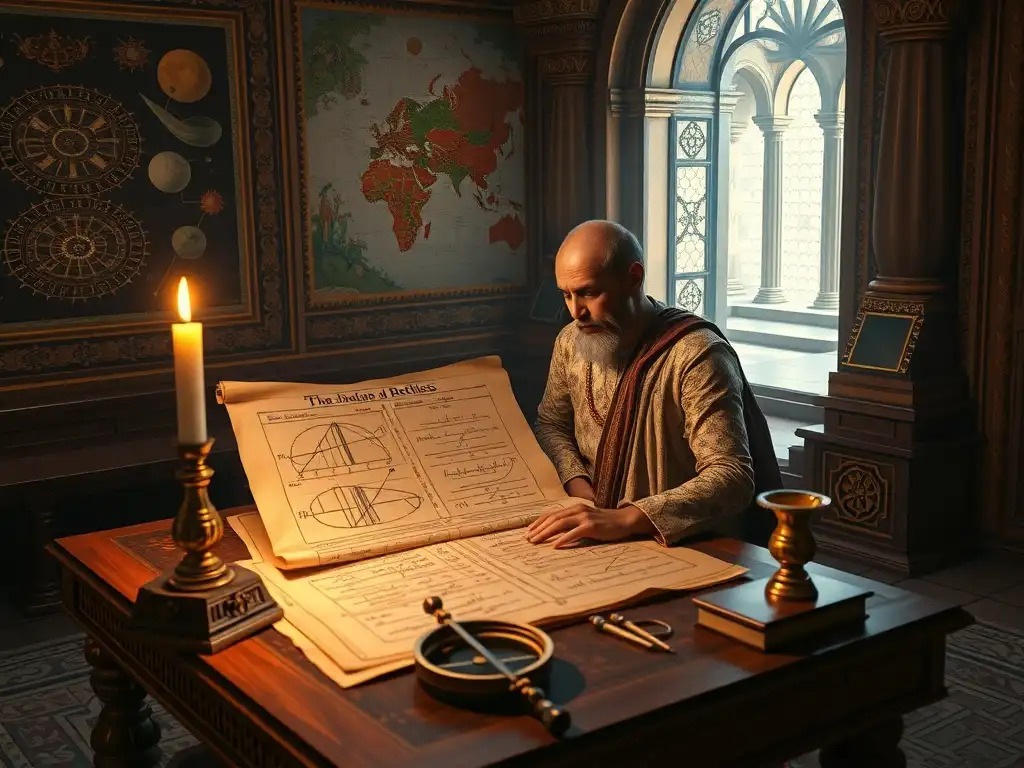
Welcome to Ancient India History, where we embark on a captivating journey through the rich tapestry of India's past! In this exploration, we delve into the mathematical contributions of Brahmagupta, a towering figure whose groundbreaking work laid the foundation for modern mathematics. Did you know that his insights into quadratic equations and geometry transformed the way we understand numbers? Uncover the intricacies of his legacy and discover how the ancient wisdom of Indian civilizations continues to inspire today. Join us as we unravel the secrets of the past and celebrate the brilliance of Brahmagupta!

Introduction to Brahmagupta's Mathematical Contributions
Brahmagupta, an eminent mathematician and astronomer of ancient India, has left an indelible mark on the field of mathematics that resonates even in modern times. Born in 598 CE in the region of present-day Rajasthan, his contributions not only advanced mathematical concepts but also laid the groundwork for future scholars in the realm of mathematics and astronomy.
Brahmagupta's work is particularly notable for its systematic approach to arithmetic, algebra, and geometry, which he presented in his seminal texts. Understanding his mathematical contributions provides a glimpse into the innovative spirit of ancient Indian civilization and highlights the significant role of Brahmagupta in shaping mathematical thought.
His treatises, particularly the Brahmasphutasiddhanta, introduced groundbreaking concepts including the solutions of quadratic equations and rules for operations with zero, which were revolutionary for their time. As we delve into Brahmagupta's mathematical legacy, we will explore his life, the historical context in which he worked, and the lasting significance of his contributions to mathematics.
Overview of Brahmagupta's Life and Era
Brahmagupta lived during a time of great intellectual activity in ancient India, characterized by advancements in various fields such as mathematics, astronomy, and philosophy. His life coincided with the flourishing of the Gupta Empire, a period often referred to as the "Golden Age of India." This era was marked by significant progress in science and art, which fostered an environment conducive to scholarly pursuits.
Brahmagupta's upbringing in a culturally rich society allowed him to access a wealth of knowledge from earlier mathematicians and astronomers. His educational background and the scholarly exchanges of his time greatly influenced his work. He served as the head of an astronomical observatory in Ujjain, one of the prominent centers of learning, where he engaged with other scholars and made significant contributions to the understanding of celestial phenomena.
Significance of Brahmagupta in Ancient Indian Mathematics
Brahmagupta's significance in ancient Indian mathematics cannot be overstated. He is often credited with formalizing mathematical operations involving negative numbers and zero, concepts that were not universally accepted or understood at the time. His work provided a framework for mathematical calculations that would later influence both Indian and Islamic mathematics.
Moreover, Brahmagupta's methods for solving quadratic equations laid the groundwork for algebra as we know it today. He introduced systematic procedures for finding solutions, which demonstrated a clear progression in mathematical thought. His contributions were not limited to theoretical mathematics; he also emphasized practical applications, making his work relevant for commerce and astronomy.
Early Mathematical Works of Brahmagupta
Brahmagupta's Texts: Key Contributions and Context
Brahmagupta's primary mathematical contributions are encapsulated in his works, particularly the Brahmasphutasiddhanta and the Khandakhadyaka. The Brahmasphutasiddhanta is perhaps his most famous text, consisting of 25 chapters that address various topics such as arithmetic, algebra, and geometry. This text served as a comprehensive guide to the mathematical knowledge of his time and included rules for calculations involving fractions, as well as methods for solving linear and quadratic equations.
In the context of ancient Indian mathematics, Brahmagupta's texts represented a significant advancement. They were written in a clear and systematic manner, making them accessible to students and scholars. His emphasis on rigorous proof and logical reasoning set a precedent for future mathematicians.
The Brahmasphutasiddhanta: An In-Depth Analysis
The Brahmasphutasiddhanta stands out not only for its mathematical content but also for its innovative approach to problem-solving. Brahmagupta’s work introduced the concept of zero as a number, paving the way for its acceptance in mathematical operations. Among the many significant topics covered in this text are:
- Rules for Arithmetic Operations: Brahmagupta established rules for addition, subtraction, multiplication, and division, including operations with zero and negative numbers.
- Quadratic Equations: He provided methods for solving quadratic equations, including the use of geometric interpretations. His approaches were systematic and laid the groundwork for algebraic methods.
- Geometry: The text also covers various geometric principles, including calculations of areas and volumes, which were essential for practical applications in architecture and land measurement.
Through his work, Brahmagupta not only contributed to the mathematical knowledge of his time but also established a foundation that would influence generations of mathematicians in India and beyond. The legacy of his mathematical contributions continues to be a subject of study and admiration in the history of mathematics.
Quadratic Equations in Brahmagupta's Work
Brahmagupta, an eminent Indian mathematician and astronomer of the 7th century, made significant contributions to the field of mathematics, particularly in the realm of quadratic equations. His seminal work, "Brahmasphutasiddhanta," is one of the earliest known texts to provide systematic methods for solving quadratic equations. Brahmagupta's approach not only laid the groundwork for future mathematicians but also showcased the advanced mathematical knowledge present in ancient India.
Understanding Quadratic Equations: Definitions and Concepts
A quadratic equation is a polynomial equation of the second degree, typically expressed in the standard form:
\[ ax^2 + bx + c = 0 \]
where \( a \), \( b \), and \( c \) are constants, and \( a \neq 0 \). The roots of the quadratic equation can be found using various methods, including factoring, completing the square, and the quadratic formula. Brahmagupta's treatment of quadratic equations was groundbreaking because he systematically categorized and solved different types of equations, thus providing a clear framework for understanding their properties and solutions.
Brahmagupta's Rules for Solving Quadratic Equations
In his writings, Brahmagupta introduced specific rules for solving quadratic equations that were remarkably advanced for his time. He categorized equations into two types:
- Positive Solutions: For equations where the coefficients are positive, Brahmagupta provided a method for determining the roots by identifying the squares of numbers and their relationships.
- Negative Solutions: He also addressed equations with negative results, outlining how to interpret negative roots. His rules emphasized the importance of calculation accuracy and the systematic approach to algebraic manipulation.
Brahmagupta’s rules facilitated not only the solving of quadratic equations but also encouraged the use of algebraic expressions, which contributed to the evolution of mathematical thought in India.
The Role of Zero and Negative Numbers in Brahmagupta's Methods
One of Brahmagupta's most notable contributions was his treatment of the number zero and the concept of negative numbers. He recognized zero as a legitimate number and discussed its role in computations, particularly in the context of addition and subtraction. His rules included operations involving zero, stating that:
- A number added to zero yields the same number.
- A number subtracted from itself results in zero.
Moreover, Brahmagupta provided methods for working with negative numbers, acknowledging their existence and significance in solving equations. This understanding of zero and negatives was pivotal in advancing mathematical operations and paved the way for future mathematicians.
Geometry and Brahmagupta's Innovations
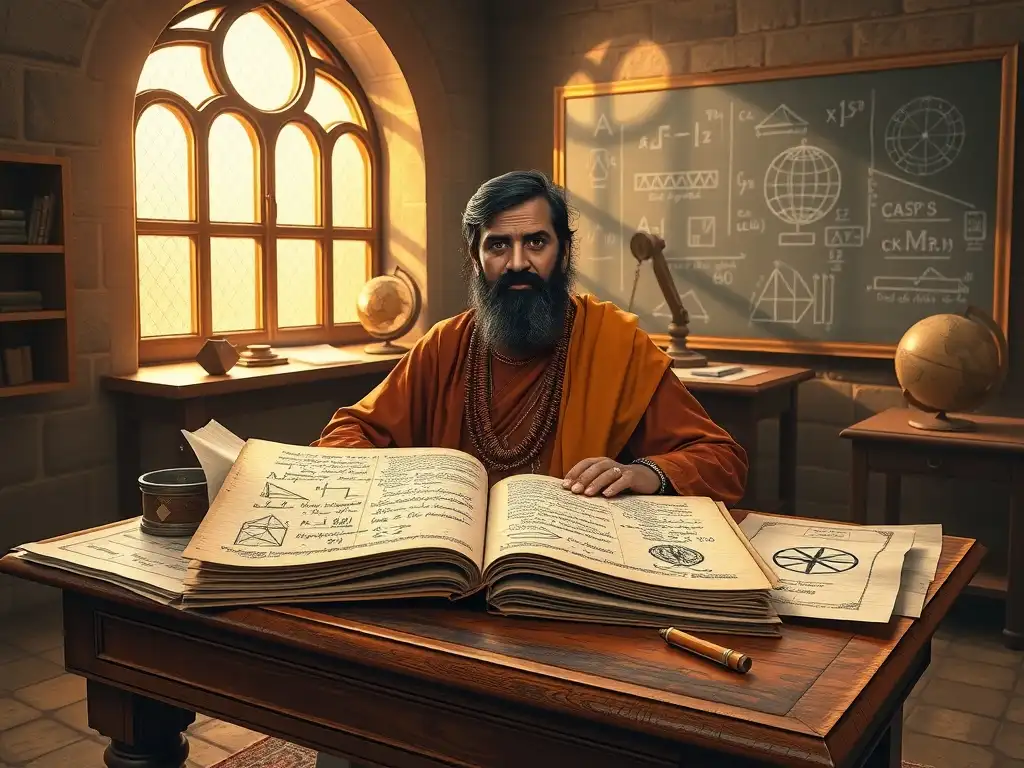
Brahmagupta's influence extended beyond algebra into the realm of geometry, where he made several significant contributions. His work displayed a deep understanding of geometric principles and their applications, particularly in calculating areas and volumes.
Geometric Principles Introduced by Brahmagupta
Brahmagupta's geometric principles included methods for calculating areas and perimeters of various shapes, including triangles, rectangles, and circles. He emphasized the importance of congruence and similarity in geometric figures, which allowed for the development of more complex geometric reasoning. His work also encompassed the concepts of cyclic quadrilaterals, a significant advancement in understanding multi-sided figures.
The Area of Cyclic Quadrilaterals: Brahmagupta's Formula
One of the most celebrated contributions of Brahmagupta to geometry is his formula for calculating the area of cyclic quadrilaterals, which are quadrilaterals whose vertices lie on a single circle. The formula states that the area \( A \) can be calculated using the semi-perimeter \( s \) and the lengths of the sides \( a \), \( b \), \( c \), and \( d \):
\[ A = \sqrt{(s-a)(s-b)(s-c)(s-d)} \]
where \( s = \frac{(a+b+c+d)}{2} \).
This formula not only simplified the process of calculating the area of cyclic quadrilaterals but also demonstrated Brahmagupta's innovative approach to geometry, showcasing his ability to connect algebraic methods with geometric applications.
Brahmagupta's Contribution to Trigonometry and Circle Geometry
Brahmagupta also made contributions to trigonometry and circle geometry, providing insights into the relationships between angles and sides in various geometric figures. He explored the properties of circles and the relationships between chords, angles, and arcs. His work laid the foundation for future developments in trigonometric functions and their applications in astronomy and navigation.
Brahmagupta's mathematical legacy is not only a testament to his genius but also a reflection of the rich mathematical tradition in ancient India, influencing generations of mathematicians and scholars across the globe.
The Influence of Brahmagupta on Later Mathematicians
Brahmagupta's contributions to mathematics, particularly through his seminal work, Brahmasphutasiddhanta, created a profound and lasting impact on the mathematical landscape of India and beyond. His rules for arithmetic and algebra, particularly concerning zero and negative numbers, laid a foundational framework that would influence mathematicians for centuries. Notably, his approach to quadratic equations and the systematic treatment of mathematical operations set a benchmark for future scholars.
Subsequent mathematicians, such as Bhaskara I and Bhaskara II, drew upon Brahmagupta's principles, refining and expanding upon his methods. For instance, Bhaskara II, who came nearly four centuries later, acknowledged Brahmagupta's work in his own treatises, building on the ideas of zero and the solutions to quadratic equations. The legacy of Brahmagupta is evident in the way these later mathematicians integrated and advanced his concepts, ensuring that his influence permeated through various mathematical developments.
Moreover, Brahmagupta's rules for calculating the area of geometric shapes and his methods for solving problems related to geometry were pivotal in shaping the curriculum of mathematics in ancient India. By establishing a clear set of rules and procedures, he not only influenced Indian scholars but also provided a model for mathematical inquiry that would resonate through the ages.
How Brahmagupta's Work Shaped Indian Mathematics
Brahmagupta's work had a transformative effect on the mathematical practices of ancient India. His innovative contributions introduced systematic methods for solving quadratic equations, which were previously addressed in a more rudimentary manner. He provided specific algorithms for different types of quadratic equations, which streamlined the problem-solving process and made it accessible to a wider audience.
Additionally, Brahmagupta's treatment of numbers, particularly his introduction of rules for arithmetic involving zero and negative numbers, was revolutionary. He was one of the first to define zero as a number, which allowed for more sophisticated calculations and laid the groundwork for future mathematical theories. This conceptual leap transformed the understanding of mathematics in India, enabling more complex mathematical manipulations and paving the way for advancements in algebra.
His influence also extended to the development of trigonometry and astronomical calculations, where his methods were applied to predict celestial phenomena. The integration of his mathematical principles into astronomy showcased the interdisciplinary nature of science in ancient India, where mathematics served as a critical tool for understanding the cosmos.
The Global Impact of Brahmagupta's Mathematical Concepts
Brahmagupta's mathematical concepts transcended regional boundaries, influencing scholars across the globe. His works were translated into Arabic during the Islamic Golden Age, where they played a significant role in the development of mathematics in the Arab world. Arab mathematicians such as Al-Khwarizmi, who is often referred to as the "father of algebra," were directly influenced by Brahmagupta's methodologies, particularly in the realm of solving quadratic equations.
The spread of Brahmagupta's ideas through the translation and adaptation of his works facilitated the exchange of knowledge between cultures. His concepts related to zero and the place-value system became integral to the development of mathematics in Europe during the Renaissance. The introduction of these ideas into European mathematical thought marked a significant turning point, leading to advancements that would shape modern mathematics.
Furthermore, Brahmagupta's geometric principles and rules for calculating areas contributed to the mathematical foundations in various cultures. His legacy can be seen in the works of later European mathematicians, where the understanding of geometry and algebra was greatly enhanced by the knowledge initially articulated by Brahmagupta.
Conclusion: The Enduring Legacy of Brahmagupta's Mathematical Contributions
Brahmagupta's mathematical contributions represent a pivotal moment in the history of mathematics. His innovative ideas, particularly regarding zero, negative numbers, and quadratic equations, not only advanced the understanding of mathematics in ancient India but also had a lasting influence on the global mathematical community.
Summary of Key Contributions and Their Importance
Brahmagupta's key contributions include:
- Rules for Arithmetic: His systematic approach to arithmetic operations, including the treatment of zero and negative numbers.
- Quadratic Equations: The development of methods for solving different types of quadratic equations, which established a foundation for algebra.
- Geometric Principles: Formulas for calculating areas of various geometric figures, enhancing the understanding of geometry.
These contributions were crucial in shaping the trajectory of mathematics, providing foundational concepts that would influence future generations of mathematicians across the world.
Final Thoughts on the Relevance of Brahmagupta in Modern Mathematics
In contemporary mathematics, Brahmagupta's influence remains significant. The concepts he introduced are not only fundamental to algebra and geometry but also continue to resonate in various fields of science and technology. His visionary approach to mathematical problems encourages a spirit of inquiry and innovation that is essential even today.
As we explore the depths of mathematical theory and application, the legacy of Brahmagupta serves as a reminder of the rich intellectual heritage that ancient Indian mathematicians contributed to the world. His work exemplifies the timeless nature of mathematical inquiry and its ability to bridge cultures and epochs, reminding us that the pursuit of knowledge is a universal endeavor.
- Introduction to Brahmagupta's Mathematical Contributions
- Early Mathematical Works of Brahmagupta
- Quadratic Equations in Brahmagupta's Work
- Geometry and Brahmagupta's Innovations
- The Influence of Brahmagupta on Later Mathematicians
- Conclusion: The Enduring Legacy of Brahmagupta's Mathematical Contributions
Frequently Asked Questions
What are Brahmagupta's major mathematical contributions?
Brahmagupta's major contributions include quadratic equations, geometry, and the concept of zero in calculations. His work laid the foundation for future developments in mathematics.
How did Brahmagupta influence later mathematicians?
Brahmagupta's detailed methods for solving quadratic equations and his rules for arithmetic operations significantly influenced later mathematicians in both India and the Islamic world.
What is the significance of Brahmagupta's rules for arithmetic?
His rules for addition, subtraction, multiplication, and division were groundbreaking and provided a systematic approach that is still relevant in modern mathematics.
What was Brahmagupta's approach to zero?
Brahmagupta was one of the first to treat zero as a number, defining its properties and operations, which represented a major advancement in mathematical theory.
How does Brahmagupta's work compare to that of other ancient mathematicians?
Brahmagupta's work is notable for its systematic approach and comprehensive coverage, making it comparable to other great mathematicians such as Euclid and Diophantus in the ancient world.
Final Reflection: Embracing the Timeless Wisdom of Brahmagupta's Mathematical Contributions
The mathematical contributions of Brahmagupta resonate profoundly in today's world, reminding us that the foundations of modern mathematics are built upon the insights of ancient scholars. His pioneering work in quadratic equations and geometry not only shaped the course of mathematics but also laid the groundwork for future generations to explore and expand upon these concepts. As we navigate an increasingly complex world, the relevance of Brahmagupta's ideas becomes ever more apparent, urging us to appreciate the depth of knowledge that has come before us.
The influence of Brahmagupta's work extends beyond mere numbers and equations; it has woven itself into the very fabric of our cultural and intellectual heritage. His methods and theories continue to inspire mathematicians, educators, and students alike, fostering a sense of curiosity and innovation. As we reflect on his legacy, we are reminded of the words of mathematician Carl Friedrich Gauss: Mathematics is the queen of the sciences and number theory is its crown.
Brahmagupta's contributions are indeed a jewel in this crown, illuminating the path for future discoveries and advancements.
As we contemplate the lessons derived from Brahmagupta's mathematical legacy, I invite you to consider how these timeless principles can be applied in your own life. Let us embrace the spirit of inquiry and creativity that he embodied, challenging ourselves to explore the world of mathematics with the same passion and dedication. Whether you are a student, a teacher, or simply a curious mind, take a moment to reflect on how you can incorporate the wisdom of the past into your present endeavors, ensuring that the legacy of Brahmagupta continues to inspire and guide us into the future.
Unveil the Wonders of Brahmagupta's Legacy!
Thank you for diving into the incredible world of Brahmagupta and his contributions to mathematics! Your interest reveals the power of ancient wisdom that remains relevant today. Now, let’s take this knowledge a step further and embrace the genius of this remarkable mathematician.
Here’s how you can continue exploring and engaging with Brahmagupta's legacy:
- Dive Deeper: Read more about the impact of Brahmagupta's work on modern mathematics and consider how his groundbreaking ideas can be applied to contemporary problem-solving.
- Share the Knowledge: Discuss this topic with friends or share your insights on social media. Spark a conversation about how ancient theories have laid the groundwork for today's mathematical practices.
- Engage with Community: Join a local or online mathematics group that appreciates historical perspectives. Collaborate on projects that highlight the significant contributions of ancient mathematicians.
What aspect of Brahmagupta's work resonates most with you, and how do you believe it influences modern-day problem-solving?