
The Influence of Ancient Indian Astronomy on Navigation and Trade


Welcome to Ancient India History, where we embark on a fascinating journey through the vibrant tapestry of ancient Indian civilizations. In this captivating exploration, we delve into the profound impact of ancient Indian astronomy on trade, revealing how celestial knowledge not only guided navigators across vast oceans but also shaped the economic landscapes of their time. Curious about how the stars aligned with commerce? Join us as we unravel the intricate connections between astronomy and trade, laying the groundwork for a deeper understanding of India’s historical influence on global commerce. The adventure awaits—let’s dive in!

Introduction to Ancient Indian Astronomy
Ancient Indian astronomy is a profound and intricate field that has significantly influenced various aspects of life, particularly navigation and trade. As early as the Vedic period, Indian scholars began to observe celestial bodies, developing a rich understanding of the cosmos that was not only theoretical but also practical. This knowledge played a crucial role in maritime navigation, facilitating trade across vast distances.
The integration of astronomy into commerce enabled ancient Indian civilizations to establish themselves as pivotal players in international trade networks, connecting regions as far apart as Southeast Asia and the Middle East. This article delves into the impact of ancient Indian astronomy on trade, exploring its techniques, key figures, and the navigation practices that emerged from this unique blend of science and commerce.
Overview of Ancient Indian Astronomy
Ancient Indian astronomy is characterized by its systematic approach to the observation and interpretation of celestial phenomena. Indian astronomers made significant contributions in various areas, including:
- Mathematical calculations: Development of sophisticated methods to calculate planetary positions.
- Calendar systems: Creation of lunar and solar calendars that regulated agricultural and trade activities.
- Textual contributions: Important texts such as the Aryabhatiya by Aryabhata and the Surya Siddhanta provided guidelines on astronomical calculations and timekeeping.
These advancements laid the groundwork for a navigation system that relied heavily on celestial bodies, allowing traders to traverse the oceans with greater accuracy.
Key Figures in Ancient Indian Astronomy
Several prominent figures stand out in the history of ancient Indian astronomy, whose contributions have had lasting impacts:
- Aryabhata (476–550 CE): Often hailed as one of the first major mathematicians and astronomers, Aryabhata introduced the concept of zero and developed methods for calculating the circumference of the Earth.
- Varahamihira (505–587 CE): A polymath who wrote extensively on astrology and astronomy, Varahamihira’s works included predictions about celestial events, which were crucial for navigational purposes.
- Brahmagupta (598–668 CE): Known for his seminal work on mathematics and astronomy, he provided insights into planetary movements and eclipses, which were vital for navigation.
These scholars not only advanced the field of astronomy but also integrated their findings into practical applications that benefitted trade and navigation.
The role of astronomy in navigation cannot be overstated. Ancient Indian traders relied on celestial navigation techniques, which utilized the position of stars and planets to determine their location at sea. This method allowed for safer and more efficient travel, essential for trade across the Indian Ocean and beyond.
Understanding Celestial Navigation Techniques
Celestial navigation involved several techniques that were crucial for ancient Indian seafarers:
- Sextant and Gnomon Usage: Instruments were developed to measure the angle between celestial bodies and the horizon, aiding in the determination of latitude.
- Star Compasses: Navigators used a star compass to align their courses based on prominent stars visible during the night.
- Lunar Phases: The phases of the moon were also utilized to predict tides and seasonal changes, which were essential for planning voyages.
These techniques exemplify the advanced understanding of astronomy possessed by ancient Indian civilizations and their ability to apply this knowledge effectively in trade.
The Use of Stars and Planets in Trade Routes
The stars and planets served as reliable guides for ancient Indian traders. Specific celestial bodies were associated with particular trade routes, allowing merchants to navigate with confidence. Key aspects include:
- Identifying Trade Winds: Knowledge of the monsoon winds and their correlation with celestial events enabled traders to optimize their travel schedules.
- Mapping Trade Networks: Astronomical knowledge facilitated the mapping of trade routes, connecting India with the Roman Empire, Africa, and the islands of Southeast Asia.
By leveraging their understanding of astronomy, ancient Indian traders not only enhanced their navigation skills but also expanded their commercial activities, fostering a vibrant exchange of goods and ideas across cultures.
Ancient Indian Trade Networks and Their Connection to Astronomy
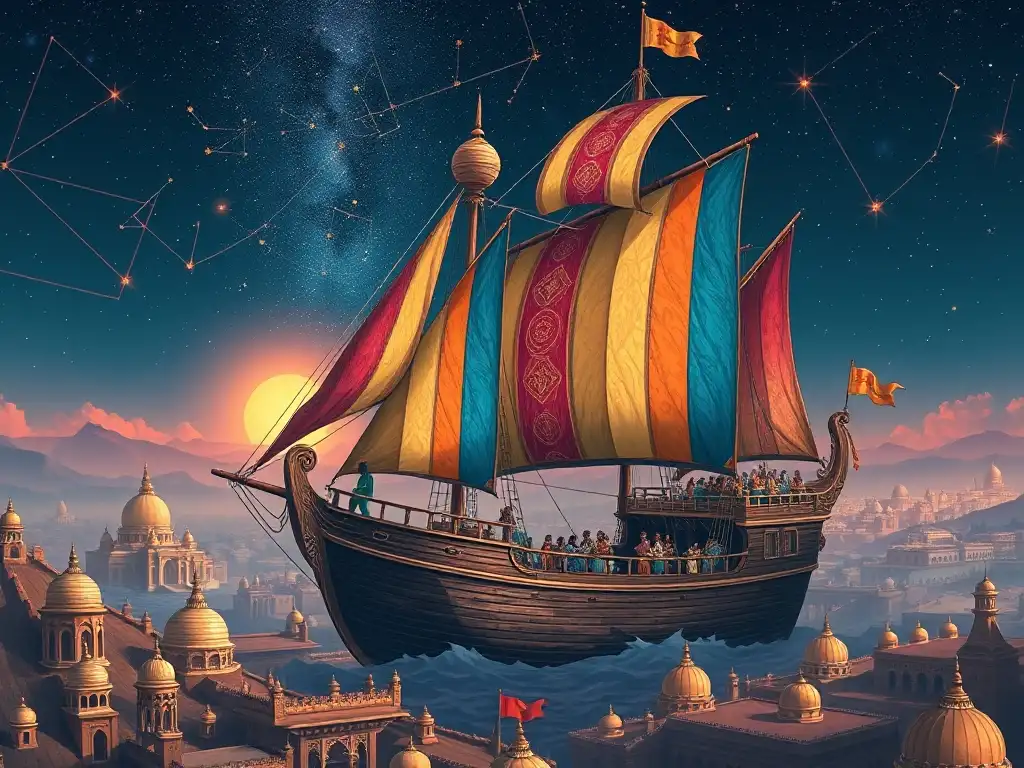
The trade networks of ancient India were extensive, connecting various regions of the subcontinent with distant lands such as the Middle East, Southeast Asia, and even parts of Africa. These networks were not merely conduits for the exchange of goods; they were also significantly influenced by astronomical knowledge. Ancient Indian traders relied on the stars for navigation, which allowed them to traverse vast distances across land and sea with precision.
The understanding of celestial bodies, such as the sun, moon, and stars, played a crucial role in determining the timing of voyages and the routes taken. For instance, sailors would use the position of the North Star to maintain their direction while navigating the open seas. This reliance on astronomy facilitated trade by ensuring that merchants could travel safely and efficiently, thereby enhancing the economic prosperity of ancient Indian civilizations.
Major Trade Routes Influenced by Astronomical Knowledge
Several major trade routes in ancient India were directly influenced by astronomical knowledge. The Silk Road, which connected India to Central Asia and beyond, relied on navigational techniques that incorporated celestial observations. Merchants used the stars to chart their course across deserts and mountains, ensuring that they could find their way even in challenging terrains.
Similarly, the maritime routes that linked India to regions such as the Arabian Peninsula and the East African coast were navigated with the help of astronomical tools. The monsoon winds, which were critical for sea travel, were also understood through careful observation of the skies. Traders would time their journeys to coincide with favorable wind patterns, which were predicted using astronomical phenomena, thus optimizing their trade activities.
The Impact of Astronomy on Maritime Trade
The impact of ancient Indian astronomy on maritime trade cannot be overstated. The ability to navigate the vast Indian Ocean allowed Indian merchants to establish trade links with various cultures and economies. The knowledge of celestial navigation enabled them to undertake long voyages, facilitating the exchange of goods such as spices, textiles, and precious metals.
Furthermore, the accurate timing of voyages, based on astronomical observations, contributed to the efficiency of maritime trade. Traders could predict seasonal changes and plan their expeditions accordingly. This knowledge not only minimized the risks associated with sea travel but also enhanced the volume of trade, making ancient Indian ports bustling hubs of commercial activity.
Ancient Indian astronomers made significant contributions to navigation that extended beyond mere star charts. Their works laid the foundation for a deeper understanding of celestial mechanics and its applications in trade and commerce. Texts produced by these astronomers provided insights into the movements of celestial bodies, which were crucial for both land and sea navigation.
Key Astronomical Texts and Their Significance
Several key astronomical texts from ancient India, such as the "Aryabhatiya" by Aryabhata and the "Surya Siddhanta," offered comprehensive methods for calculating time and predicting celestial events. These texts detailed the movements of planets and stars, providing traders with essential information for navigation.
The significance of these texts goes beyond their mathematical insights; they also emphasized the importance of astronomy in daily life and trade. For instance, the "Surya Siddhanta" included guidelines on how to calculate the best times for agricultural activities, which indirectly influenced trade by affecting crop yields and market supplies.
Innovations in Timekeeping and Navigation
Innovations in timekeeping were pivotal for enhancing navigation in ancient India. The development of instruments like the gnomon and water clocks enabled traders to measure time more accurately, which was essential for planning voyages and trading activities.
These innovations allowed for a more systematic approach to navigation. By understanding the length of days and nights, merchants could better gauge their travel times and schedules. Moreover, the integration of astronomical techniques with practical navigation ensured that ancient Indian traders could embark on journeys with confidence, thereby boosting trade across vast distances and contributing to the overall prosperity of ancient Indian civilization.
The Influence of Ancient Indian Astronomy on Global Trade
Ancient Indian astronomy played a pivotal role in shaping navigation and trade practices, not only within the Indian subcontinent but also across global trade networks. The sophisticated understanding of celestial bodies allowed Indian traders to navigate vast oceans, ensuring safe passage and timely arrivals at distant ports. This knowledge was vital for the flourishing maritime trade routes, particularly those connecting India with regions such as Southeast Asia, the Middle East, and even parts of Africa.
The astronomical calculations made by ancient Indian scholars enabled merchants to determine their latitude and longitude, facilitating more precise navigation. Additionally, the use of star charts and lunar calendars helped traders plan voyages according to seasonal patterns, optimizing trade opportunities. The integration of astronomy into trade practices thus not only enhanced navigation but also contributed significantly to the economic growth of ancient Indian civilizations.
Comparisons with Other Ancient Civilizations' Navigation
When comparing ancient Indian astronomy to that of other civilizations, such as the Greeks and the Chinese, several similarities and differences emerge. Like Indian astronomers, the Greeks developed sophisticated models of celestial movements; however, their focus was more on philosophical implications rather than practical applications in navigation. The Greek astronomer Hipparchus, for instance, established the basis for trigonometry, which was crucial for navigation, yet it was not utilized as extensively in trade.
Conversely, Chinese navigators employed a variety of compasses and celestial navigation techniques, which were highly effective in their maritime endeavors. However, the integration of astronomy with astrology in China often complicated the practical application of navigational techniques. In contrast, ancient Indian astronomy maintained a more pragmatic focus, directly linking celestial observations to trade routes and economic activities. This emphasis on application over theory allowed Indian traders to thrive in their commercial pursuits, showcasing the unique impact of ancient Indian astronomy on global trade.
The Spread of Indian Astronomical Knowledge Through Trade
The trade routes established by ancient Indian merchants were not only conduits for goods but also for knowledge. As Indian traders interacted with various cultures along the Silk Road and maritime routes, they exchanged astronomical knowledge and navigational techniques. This dissemination of information played a significant role in the evolution of navigational practices in other regions.
One prominent example is the transmission of the Indian concept of the zodiac and astrological calculations to the Arab world. Through trade, Indian texts on astronomy were translated into Arabic, influencing Islamic scholars' understanding of celestial navigation. This knowledge was then carried to Europe during the Middle Ages, where it contributed to the development of European navigational techniques. Hence, the impact of ancient Indian astronomy transcended its geographical boundaries, enriching global navigational practices through trade.
Case Studies of Ancient Indian Astronomy in Trade Practices

Example of Astronomical Navigation in Specific Trade Expeditions
One notable case study exemplifying the use of astronomy in trade is the maritime expeditions to Southeast Asia during the early centuries CE. Indian traders, equipped with extensive astronomical knowledge, relied on the positions of stars such as the North Star and the Southern Cross to guide their vessels through the Indian Ocean.
For instance, the trade route to the Spice Islands was heavily influenced by the understanding of monsoon winds, which were documented through astronomical observations. Indian navigators timed their voyages to align with seasonal winds, ensuring safer and more efficient travel. This strategic approach not only maximized profit from spice trade but also established India as a central hub in global commerce during that period.
Analysis of Trade Agreements Influenced by Astronomical Understanding
Another significant aspect of ancient Indian astronomy's impact on trade can be observed in the formulation of trade agreements between Indian merchants and foreign traders. The precise knowledge of celestial cycles and seasonal changes allowed Indian traders to negotiate favorable terms based on optimal trading periods.
For example, agreements with merchants from the Arabian Peninsula often stipulated specific times of the year for trade, correlating with the best navigational conditions informed by astronomical observations. This mutual understanding fostered trust and reliability in trade relationships, leading to prosperous exchanges of goods such as textiles, spices, and precious stones. The ability to predict celestial events thus had a tangible effect on the economic interactions and agreements formed in the ancient trading world, highlighting the profound influence of ancient Indian astronomy on trade practices.
Conclusion: The Lasting Impact of Ancient Indian Astronomy on Trade
The impact of ancient Indian astronomy on trade and navigation remains a fascinating subject that bridges the past with contemporary practices. The sophisticated understanding of celestial movements allowed ancient Indian traders to navigate vast distances across land and sea with remarkable precision.
This knowledge was not just limited to the physical realm; it also facilitated cultural exchanges and economic interactions with various civilizations, establishing India as a central hub in ancient global trade networks. As we reflect on this historical influence, it becomes clear that the methodologies and principles derived from ancient Indian astronomy played a crucial role in shaping trade routes and practices that resonate even today.
Summary of Key Points on Astronomy and Trade
- Celestial Navigation: Ancient Indian astronomers developed techniques for navigating by the stars, significantly aiding maritime and terrestrial trade routes.
- Trade Routes: The application of astronomical knowledge in determining latitude and longitude enabled traders to establish reliable routes across the Indian Ocean and beyond.
- Cultural Exchange: The intersection of astronomy and trade facilitated not only economic transactions but also cultural and intellectual exchanges between India and other ancient civilizations, such as Greece and China.
- Astrological Influence: The consideration of celestial events in astrological practices influenced the timing of trade expeditions, enhancing their success.
- Legacy of Knowledge: The astronomical texts and practices from ancient India laid foundational principles that would later influence navigational methods in various parts of the world.
Reflection on the Legacy of Ancient Indian Astronomy in Modern Navigation
The legacy of ancient Indian astronomy can be observed in the principles of modern navigation. Techniques such as the use of celestial bodies for orientation and timekeeping have evolved but remain rooted in the astronomical observations of ancient scholars. Concepts such as the zodiac and lunar calendars, which were extensively studied in ancient India, still play a role in contemporary navigation and agricultural practices.
Furthermore, the ancient methods of calculating positions based on star alignments can be seen in modern navigational technologies, emphasizing the remarkable foresight and intellectual contributions of ancient Indian astronomers. This enduring legacy underscores the importance of acknowledging how historical knowledge continues to influence our understanding of navigation and trade today.
References and Further Reading
Suggested Books and Articles on Ancient Indian Astronomy
- "The History of Indian Astronomy" by K. R. N. Rao: This comprehensive text explores the evolution of astronomical practices in India, detailing how they impacted various aspects of society, including trade.
- "Ancient Indian Science and Technology" by D. N. Rao: This book delves into the scientific advancements in ancient India, with a focus on how astronomy shaped navigational techniques.
- "Cosmic Order and Cultural Astronomy in India" by David Pingree: An examination of the intersection between Indian culture and its astronomical practices, highlighting trade implications.
Online Resources for Exploring Ancient Trade Practices
- The Indian Council of Historical Research: This site offers a wealth of articles and reports on ancient Indian trade practices, including the role of astronomy.
- Ancient India: A Historical Overview: A comprehensive online resource that details various aspects of ancient Indian civilization, including trade and astronomy.
- The Digital South Asia Library: An excellent repository of historical texts, maps, and resources related to ancient Indian astronomy and trade routes.
The exploration of these resources can provide deeper insights into how ancient Indian astronomy significantly impacted trade practices and navigation, enriching our understanding of this remarkable civilization's contributions.
- Introduction to Ancient Indian Astronomy
- Overview of Ancient Indian Astronomy
- The Role of Astronomy in Navigation
- Ancient Indian Trade Networks and Their Connection to Astronomy
- The Contribution of Ancient Indian Astronomers to Navigation
- The Influence of Ancient Indian Astronomy on Global Trade
- Case Studies of Ancient Indian Astronomy in Trade Practices
- Conclusion: The Lasting Impact of Ancient Indian Astronomy on Trade
- References and Further Reading
Frequently Asked Questions
What was the significance of ancient Indian astronomy in trade?
Ancient Indian astronomy played a crucial role in navigation, enabling traders to determine their positions at sea and facilitating long-distance trade routes.
Ancient Indian astronomers developed sophisticated astronomical tools and techniques, such as celestial navigation, which improved the accuracy of maritime travel and trade.
What were the key astronomical texts from ancient India?
Key texts like the Surya Siddhanta and the Aryabhatiya provided insights into mathematics and astronomy, influencing both navigation and trade practices in ancient India.
How did the Gupta Empire influence astronomy and trade?
During the Gupta Empire, advancements in astronomy fostered a better understanding of celestial bodies, which in turn enhanced trade efficiency and expanded trade networks.
What impact did Indian astronomy have on global trade?
The knowledge from ancient Indian astronomy was shared along trade routes, significantly impacting global trade practices and influencing other cultures' navigation techniques.
Final Reflection: The Enduring Legacy of Ancient Indian Astronomy on Trade
The profound impact of ancient Indian astronomy on trade and navigation is not merely a relic of the past; it remains a cornerstone of modern maritime practices and global commerce. As we navigate an increasingly interconnected world, the principles and techniques developed by ancient Indian astronomers continue to resonate, reminding us of the ingenuity and foresight that shaped early trade routes and cultural exchanges. The stars, once guiding sailors across vast oceans, still serve as a metaphor for the direction and purpose we seek in our own journeys today.
The influence of ancient Indian astronomy extends far beyond its historical context; it has woven itself into the very fabric of our cultural and social landscapes. From the intricate calculations that informed trade expeditions to the celestial navigation techniques that are still taught in maritime academies, the legacy of these ancient scholars is palpable. As noted by historian R. N. Dandekar, “The stars were not just points of light; they were the compass of civilization.” This observation underscores the importance of understanding our past to appreciate the foundations of our present and future.
As we reflect on the lessons of ancient Indian astronomy, let us be inspired to look up at the night sky and recognize the wisdom it holds. I invite you to consider how the principles of exploration, curiosity, and innovation that guided ancient traders can inform your own pursuits today.
Whether in your personal or professional life, let the legacy of these celestial navigators encourage you to chart your own course, embrace new horizons, and foster connections that transcend boundaries. The stars are not just a guide; they are a reminder of the vast possibilities that await us when we dare to navigate the unknown.
Thank you for diving into the fascinating world of ancient Indian astronomy and its profound impact on navigation and trade. You've uncovered the remarkable ways our ancestors charted the stars, and now it's time to put this knowledge into action!
Here’s how you can take the next step:
- Explore a local planetarium or join an astronomy club to experience celestial navigation firsthand. Engage with fellow enthusiasts who share your passion!
- Start a discussion with friends or family about how ancient navigation influences modern practices. Who knows? You might discover some amazing insights together!
- Share your newfound knowledge on social media or in a community forum to inspire others about the wonders of ancient Indian astronomy and its relevance today.
What aspect of ancient navigation or astronomy excites you the most, and how can you explore it further in your own life?