
The Art of Mathematics in Ancient India: A Cultural Perspective


Welcome to Ancient India History, where we journey through the fascinating tapestry of ancient Indian civilizations! Delve into the remarkable contributions of these cultures, particularly in the realm of mathematics. Our featured article, “The Art of Mathematics in Ancient India: A Cultural Perspective,” invites you to uncover how mathematical advancements were not merely numbers and equations, but an integral part of societal development and cultural expression. Are you ready to explore the rich legacy of ancient Indian mathematics history? Join us as we reveal the secrets and stories that shaped a civilization!
Introduction to Ancient Indian Mathematics History
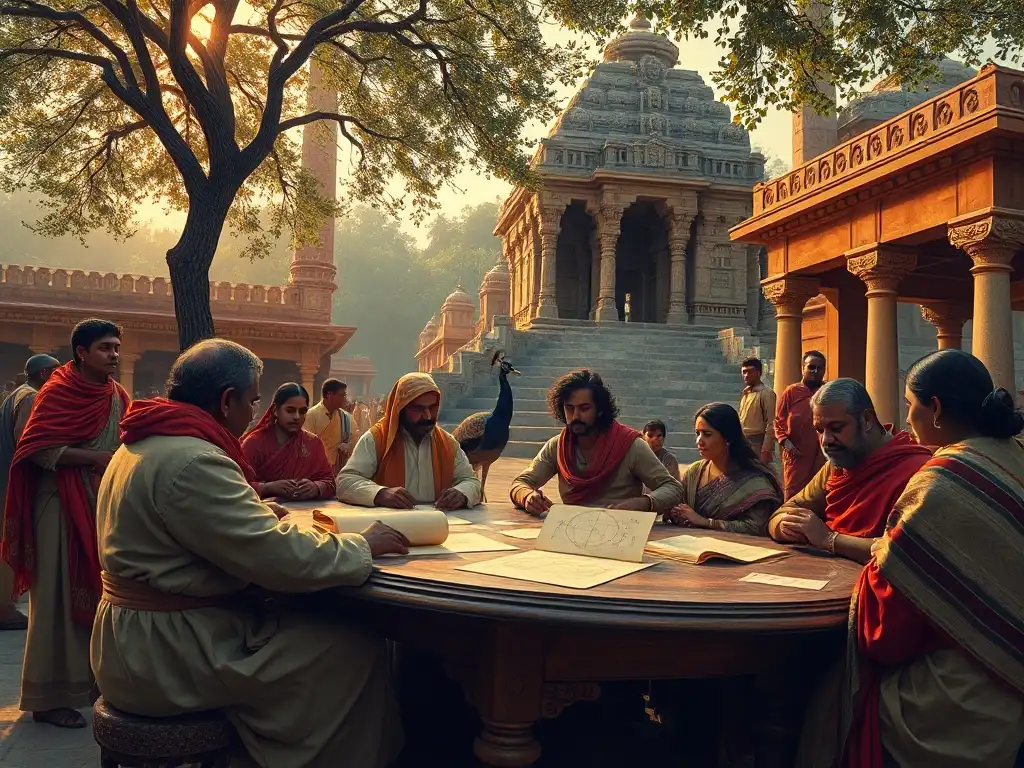
The exploration of Ancient Indian mathematics history unveils a rich tapestry of knowledge that significantly shaped the mathematical landscape of the world. From the sophisticated calculations of the Indus Valley Civilization to the profound treatises of the Gupta Empire, ancient Indian mathematicians contributed extensively to various mathematical disciplines, including arithmetic, geometry, and algebra.
This article delves into the cultural perspective of these contributions, highlighting the interplay between mathematics and the socio-religious context of ancient India. By examining the historical evolution of mathematical concepts and their significance within the broader cultural framework, we gain a deeper understanding of how ancient Indian civilizations approached mathematics as not just a tool for calculation, but as an integral part of their philosophical and spiritual life.
Overview of Ancient Indian Mathematics
Ancient India was a cradle of mathematical innovation, where scholars developed advanced concepts that would later influence both Eastern and Western thought. Key contributions from ancient Indian mathematicians include:
- The concept of zero: Ancient Indian mathematicians such as Brahmagupta formalized the use of zero as a numeral, which revolutionized arithmetic.
- Decimal system: The place-value system we use today is rooted in ancient Indian practices, allowing for complex calculations and the representation of large numbers.
- Geometry: Texts like the Sulba Sutras provided rules for constructing altars and other structures, emphasizing the practical applications of geometry in religious rituals.
These foundational elements not only demonstrate the mathematical prowess of ancient Indian civilizations but also reflect their cultural priorities and the significance they placed on systematic knowledge.
Significance of Mathematics in Ancient Indian Culture
Mathematics in ancient India was deeply intertwined with various aspects of daily life, spirituality, and education. Some key points of significance include:
- Religious rituals: Mathematics played a crucial role in the construction of altars and temples, where precise measurements were necessary to align with cosmic principles.
- Astronomy: Indian mathematicians contributed to astronomical calculations, including the timing of festivals and agricultural activities, which were essential for societal organization.
- Education: The transmission of mathematical knowledge occurred through oral traditions and texts, reflecting a culture that valued learning and intellectual discourse.
The cultural perspective of mathematics in ancient India showcases its role as a vital component of civilization, influencing everything from architecture to social governance.
Historical Context of Mathematics in Ancient India
To fully appreciate the contributions of ancient Indian mathematics, it is essential to contextualize it within the historical timeline of Indian civilization.
The Indus Valley Civilization and Early Mathematical Concepts
The Indus Valley Civilization (circa 3300–1300 BCE) is often credited with some of the earliest mathematical concepts. Archaeological findings, such as standard weights and measures, suggest that the people of this civilization engaged in trade and construction that required mathematical knowledge. Key elements include:
- Weights and measures: Uniformity in trade suggests an understanding of ratios and measurements.
- Geometry in urban planning: The meticulous layout of cities like Mohenjo-Daro indicates an application of geometric principles.
These early mathematical practices laid the groundwork for subsequent developments in Indian mathematics, reflecting a culture that appreciated order and precision.
The Vedic Period: Foundations of Mathematical Thought
The Vedic period (circa 1500–500 BCE) marked a significant evolution in mathematical thought, characterized by the composition of texts that explored numerical concepts. Important features include:
- The Sulba Sutras: These texts, written by ancient Indian mathematicians, provided rules for geometrical constructions and calculations necessary for rituals, showcasing the intersection of mathematics and spirituality.
- Numerical systems: The Vedic texts also introduced concepts of arithmetic, including operations such as addition, subtraction, multiplication, and division.
The Vedic period represents a formative era in which mathematical thought began to flourish, ultimately influencing later developments in ancient Indian mathematics and its legacy in the world.
Through a closer examination of these historical contexts, we can appreciate the profound contributions of ancient Indian mathematics and the rich cultural backdrop that fostered such intellectual achievements.
Significant Mathematicians in Ancient India
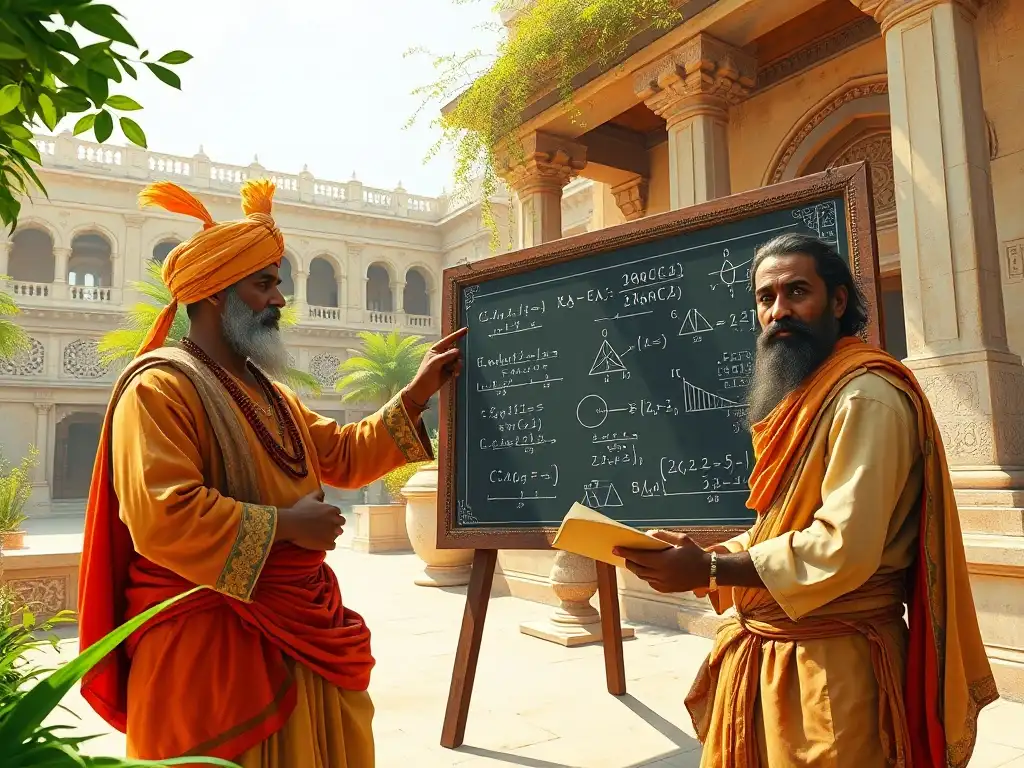
Ancient India was home to several brilliant mathematicians whose contributions have left an indelible mark on the development of mathematics. Their work not only advanced mathematical theory but also influenced subsequent civilizations, particularly in the fields of arithmetic, algebra, and geometry. These mathematicians operated within a rich cultural context that valued knowledge and learning, and their innovations laid the groundwork for many modern mathematical concepts.
Aryabhata: The Revolutionary Mathematician
Aryabhata, who lived in the 5th century CE, is often celebrated as one of the most influential mathematicians and astronomers of ancient India. His seminal work, the Aryabhatiya, covers a wide range of subjects, including arithmetic, algebra, and trigonometry. Aryabhata introduced the concept of zero as a placeholder, which was crucial for the development of the decimal system.
He also provided methods for calculating the area of a triangle and the volumes of various geometric shapes. Aryabhata's approach to astronomy was groundbreaking; he proposed that the Earth rotates on its axis and calculated the circumference of the Earth with remarkable accuracy. His work laid the foundation for later mathematicians and scholars, and his insights into the mathematical sciences continue to be studied and revered today.
Brahmagupta: The Father of Algebra
Brahmagupta, active in the 7th century CE, is often referred to as the "Father of Algebra" for his pioneering contributions to the field. His most significant work, the Brahmasphutasiddhanta, offers one of the earliest known treatments of algebra. In this treatise, he introduced rules for solving quadratic equations and established methods for dealing with negative numbers, something that was revolutionary for his time.
Brahmagupta also made substantial contributions to arithmetic, establishing rules for calculating with fractions and providing algorithms for computations. His work on the properties of cyclic quadrilaterals and the solutions to various mathematical problems had a lasting impact on the development of mathematics not only in India but also in the wider world.
Bhaskara I and II: Mathematicians of the Gupta Empire
Bhaskara I, who lived in the 7th century, made significant contributions to both mathematics and astronomy. He is known for his work on sine tables, which were crucial for astronomical calculations. His commentary on Aryabhata's work helped disseminate Aryabhata's ideas further, emphasizing the interconnectedness of their contributions.
Bhaskara II, also known as Bhaskara the Great, lived in the 12th century and is often considered one of the greatest mathematicians of ancient India. His magnum opus, the Siddhanta Shiromani, is divided into four parts, covering various mathematical topics including arithmetic, algebra, and geometry. Bhaskara II further advanced the understanding of calculus concepts, particularly in his work on rates of change and the concept of derivatives. His contributions significantly influenced mathematics in India and beyond, making him a pivotal figure in the history of mathematics.
Mathematical Texts and Treatises from Ancient India
The mathematical texts produced in ancient India reflect the depth of knowledge and the sophisticated understanding of mathematics that existed in that era. These works not only served as practical manuals for calculations and astronomical observations but also as philosophical treatises that explored the nature of numbers and mathematical relationships.
The Aryabhatiya: A Landmark in Mathematics
The Aryabhatiya is a foundational text in mathematics and astronomy written by Aryabhata around 499 CE. This treatise is divided into four sections, dealing with mathematics, astronomy, and planetary calculations. Aryabhata's presentation of mathematical concepts in the Aryabhatiya includes innovative approaches to solving problems involving whole numbers, fractions, and geometric calculations.
One of the key features of the Aryabhatiya is its focus on systematic computation and the application of mathematical principles to real-world problems. Aryabhata's insights into arithmetic operations, including multiplication and division, laid the groundwork for future mathematical inquiry in India and influenced mathematical thought across cultures.
Brahmasphutasiddhanta: Algebra and its Applications
Brahmagupta's Brahmasphutasiddhanta, written in 628 CE, is one of the earliest comprehensive texts on algebra. This treatise systematically discusses rules for operations with numbers, including the handling of zero and negative numbers, which were revolutionary concepts at the time. Brahmagupta's work also includes practical applications of algebra to solve real-life problems, such as calculating areas and solving equations.
The text is notable for its structured approach to mathematics, providing a clear methodology for problem-solving that would influence subsequent mathematicians. Brahmagupta's contributions to algebra not only advanced the field significantly but also demonstrated the practical utility of mathematics in various domains of life.
Siddhanta Shiromani: The Jewel of Mathematics
The Siddhanta Shiromani, authored by Bhaskara II in the 12th century, is often regarded as a jewel of ancient Indian mathematics. This extensive work is divided into four parts: Lilavati, Bija Ganita, Grahagana, and Goladhyaya, each focusing on different mathematical concepts, including arithmetic, algebra, astronomy, and geometry.
Lilavati is particularly famous for its poetic style and the way it intertwines mathematics with real-life situations, making it accessible to learners. Bhaskara II's exploration of mathematical concepts, such as permutations, combinations, and the rules of calculus, reveal a profound understanding of mathematics that was far ahead of its time. The Siddhanta Shiromani not only solidified Bhaskara II's legacy but also served as a crucial reference for scholars in the centuries to come, emphasizing the richness of ancient Indian mathematics history.
Cultural Perspective on Mathematics in Ancient India
Mathematics in ancient India was not merely a tool for calculation but a profound cultural phenomenon intertwined with religion, philosophy, and daily life. The ancient Indian mathematicians viewed mathematics as a sacred discipline, essential for understanding the universe and the divine. This perspective is evident in the texts and artifacts of the time, where mathematical concepts were often expressed through spiritual and philosophical ideas. The contributions of ancient Indian mathematicians such as Aryabhata, Brahmagupta, and Bhaskara were deeply influenced by the cultural milieu of their times, reflecting a society that revered knowledge and learning.
Moreover, the mathematical advancements of ancient India were shared through oral traditions and texts, which served both educational and ceremonial purposes. The use of mathematics in rituals, temple architecture, and even in the alignment of cities and monuments underscores its significance in ancient Indian culture. Thus, the study of mathematics was not limited to theoretical exploration but was a means of connecting with the natural and spiritual worlds.
Mathematics and Religion: The Spiritual Dimension
In ancient India, mathematics was closely linked to religious practices and beliefs. The ancient texts, including the Vedas and the Puranas, highlighted mathematical concepts that were integral to rituals and ceremonies. For instance, the construction of altars (vedi) for sacrifices required precise measurements and geometric understanding, showcasing how mathematics served a functional role in spirituality.
Additionally, the concept of zero, a groundbreaking mathematical invention attributed to ancient Indian scholars, held philosophical significance as well. It represented the idea of nothingness, a concept that resonated with the spiritual insights of Buddhism and Hinduism. The cyclic nature of time, as depicted in Indian philosophy, also influenced the mathematical models developed during this period, reflecting a worldview that recognized both the finite and infinite.
The Role of Mathematics in Astronomy and Astrology
Ancient Indian mathematics was profoundly intertwined with astronomy and astrology, fields that were crucial for agricultural, religious, and social activities. Indian astronomers, such as Aryabhata, made significant contributions to understanding celestial movements, calculating eclipses, and developing sophisticated models of the solar system. Aryabhata's work, particularly in his text "Aryabhatiya," laid the foundations for trigonometry and provided methods for calculating the positions of celestial bodies.
Astrology, or Jyotisha, was also deeply integrated with mathematics. The alignment of planets and stars was believed to influence human affairs, leading to the development of complex calculations for horoscopes and astrological predictions. This blend of mathematics and astrology reflects a cultural reverence for the cosmos and its perceived influence on earthly life, illustrating how mathematics served both practical and metaphysical purposes in ancient Indian society.
Influence of Mathematics on Art and Architecture
Mathematics played a vital role in the art and architecture of ancient India, influencing everything from temple designs to intricate sculptures. The principles of geometry and symmetry were paramount in creating aesthetically pleasing structures, which were often imbued with religious significance. The design of temples, such as those at Khajuraho and Hampi, exemplifies the application of mathematical concepts to achieve harmony and balance.
Moreover, the use of fractals and patterns in Indian art, particularly in mandalas and rangoli, showcases the understanding of mathematical principles in visual expression. These patterns often represented cosmic concepts and were used in religious rituals, further highlighting the interconnectedness of mathematics, art, and spirituality in ancient Indian culture.
Comparative Analysis: Ancient Indian Mathematics vs. Other Civilizations

In examining the mathematical practices of ancient India in a broader context, it is essential to compare them with those of other civilizations, such as Greece and China. Each civilization developed its mathematical concepts in response to unique cultural and practical needs, leading to both similarities and differences in approach and application.
Contrasting Approaches to Mathematics in Ancient Greece
Ancient Greek mathematics was heavily focused on theoretical proofs and abstract reasoning, exemplified by figures like Euclid and Pythagoras. The Greeks emphasized deductive reasoning and logical structures, developing a framework that would later influence modern mathematics. In contrast, ancient Indian mathematics was often more empirical and applied, rooted in practical needs such as trade, agriculture, and astronomy.
While Greek mathematicians sought universal truths through abstract principles, Indian mathematicians were more inclined towards pragmatic applications of mathematics, integrating it with religious and cultural practices. This divergence in approach highlights the distinct philosophical underpinnings that shaped the mathematical traditions of both civilizations.
Similarities and Differences with Chinese Mathematical Practices
The mathematical practices of ancient India and China also exhibit both similarities and differences. Both cultures recognized the importance of mathematics in agriculture, astronomy, and daily life. For instance, the Chinese developed their own concepts of zero and algebraic methods, paralleling some of the advancements made in India.
However, the Chinese approach to mathematics was often more systematic and bureaucratic, with a strong emphasis on administration and record-keeping. In contrast, Indian mathematics was more diverse in its applications, influenced by its integration with spirituality and philosophy. The trade routes between India and China facilitated the exchange of mathematical ideas, leading to a rich tapestry of cultural and intellectual interconnections that shaped both civilizations' mathematical legacies.
The Legacy of Ancient Indian Mathematics
The legacy of ancient Indian mathematics is profound and multifaceted, deeply intertwined with the culture, philosophy, and scientific advancements of the time. From the early contributions of the Indus Valley Civilization, where evidence of basic mathematical concepts such as weights and measures can be found, to the sophisticated works of later mathematicians like Aryabhata and Brahmagupta, ancient Indian mathematics laid foundational principles that shaped not only Indian culture but also influenced global mathematical thought.
One of the most notable aspects of ancient Indian mathematics is the development of the decimal system and the concept of zero. The introduction of zero as both a numeral and a concept was revolutionary, enabling more complex calculations and paving the way for advances in arithmetic. This innovation is often credited to Indian mathematicians, with the earliest recorded use appearing in the works of Aryabhata in the 5th century CE.
Furthermore, ancient Indian mathematicians explored various branches of mathematics, including geometry, algebra, and trigonometry. Texts such as "Brahmasphutasiddhanta" by Brahmagupta contain significant mathematical principles and rules for solving quadratic equations, showcasing the advanced understanding of mathematics in ancient India. The mathematical achievements of this era not only contributed to Indian scholarship but also resonated through time, influencing scholars in the Islamic Golden Age and the European Renaissance.
Modern Implications of Ancient Mathematical Principles
The principles established by ancient Indian mathematicians continue to resonate in modern mathematics. Concepts such as the base-10 system and the systematic approach to problem-solving remain fundamental to contemporary mathematical education and practice. The legacy of these early mathematicians can be seen in the algorithms used for arithmetic operations, many of which trace their origins back to ancient texts.
Additionally, the study of ancient Indian mathematics provides insights into mathematical concepts that predate their European counterparts. For instance, the concept of negative numbers and their practical applications were detailed in Brahmagupta's works long before they gained acceptance in Europe. This historical context enriches the understanding of mathematics as a global endeavor, highlighting the contributions of diverse cultures.
The mathematical techniques developed in ancient India also influence various fields today, including computer science and engineering. Algorithms that stem from ancient mathematical principles are integral to modern computational methods, illustrating the timeless relevance of these ideas.
Continuing Influence on Contemporary Mathematics
The influence of ancient Indian mathematics is not merely historical; it continues to shape current mathematical practices and theories. For example, the Indian method of multiplication, often referred to as the "lattice method," is a technique that remains popular in schools around the world. This method showcases the innovative spirit of ancient Indian mathematicians who sought efficient ways to approach arithmetic.
Furthermore, the works of mathematicians like Aryabhata and Bhaskara are frequently referenced in academic circles, as their insights into astronomy and mathematics reveal a sophisticated understanding of the universe that transcends time. The principles of trigonometry, as developed by these scholars, are essential for various applications in science and engineering today.
The enduring nature of these contributions is also reflected in the resurgence of interest in ancient Indian mathematical texts and their applications in contemporary research. Scholars continue to delve into these works, uncovering new interpretations and findings that can enhance modern mathematical thought.
Conclusion: The Enduring Impact of Ancient Indian Mathematics History
The history of ancient Indian mathematics is a testament to the rich intellectual heritage of the civilization. The foundational concepts and innovative techniques developed during this period have left an indelible mark on the field of mathematics, influencing both historical and modern practices.
Summary of Key Contributions and Cultural Significance
The key contributions of ancient Indian mathematics include the introduction of the decimal system, the concept of zero, and the systematic approaches to algebra and geometry. These advancements not only reflect the mathematical prowess of ancient Indian scholars but also highlight the cultural significance of mathematics as a tool for understanding and interpreting the world. The interplay between mathematics and philosophy in ancient India showcases a holistic view of knowledge that continues to inspire contemporary thought.
Call to Explore Further into Ancient Indian Mathematical Heritage
For those interested in the rich tapestry of ancient Indian mathematics, there is much to explore. Delve into the original texts, study the lives of influential mathematicians, and appreciate the cultural contexts in which these mathematical ideas flourished. By exploring this heritage, one can gain a deeper understanding of the contributions that have shaped not only mathematics but also the broader spectrum of human knowledge and inquiry. Let’s celebrate and continue to investigate the remarkable legacy of ancient Indian mathematics!
- Introduction to Ancient Indian Mathematics History
- Overview of Ancient Indian Mathematics
- Significance of Mathematics in Ancient Indian Culture
- Historical Context of Mathematics in Ancient India
- Significant Mathematicians in Ancient India
- Mathematical Texts and Treatises from Ancient India
- Cultural Perspective on Mathematics in Ancient India
- Comparative Analysis: Ancient Indian Mathematics vs. Other Civilizations
- The Legacy of Ancient Indian Mathematics
- Conclusion: The Enduring Impact of Ancient Indian Mathematics History
- What were the major contributions of ancient Indian mathematics?
- How did ancient Indian mathematicians influence the world?
- What role did ancient Indian culture play in the development of mathematics?
- How is ancient Indian mathematics documented?
- What is the significance of the numeral system developed in ancient India?
Frequently Asked Questions
What were the major contributions of ancient Indian mathematics?
Ancient India made significant contributions such as the concept of zero, the decimal system, and advancements in algebra and geometry. These innovations laid the groundwork for modern mathematics.
How did ancient Indian mathematicians influence the world?
The work of ancient Indian mathematicians, including Aryabhata and Brahmagupta, spread to other cultures, particularly through trade routes, influencing the development of mathematics in Islamic and European civilizations.
What role did ancient Indian culture play in the development of mathematics?
The rich cultural and philosophical environment of ancient India fostered an early appreciation for mathematics as a tool for understanding the universe, leading to its integration in fields like astronomy and architecture.
How is ancient Indian mathematics documented?
Ancient Indian mathematics is primarily documented in texts like the Aryabhatiya and Brahmasphutasiddhanta, which contain theorems, algorithms, and numerical methods that reflect the mathematical knowledge of the time.
What is the significance of the numeral system developed in ancient India?
The numeral system developed in ancient India, especially the use of place value and zero, is crucial as it forms the basis for the Hindu-Arabic numeral system used worldwide today, revolutionizing mathematics globally.
Final Reflection: Embracing the Legacy of Ancient Indian Mathematics
The exploration of ancient Indian mathematics reveals not only a rich history but also a profound connection to our contemporary world. The intricate systems developed by mathematicians like Aryabhata and Brahmagupta continue to influence modern mathematical thought and practices. Their work transcends mere numbers and equations; it embodies a cultural legacy that shapes our understanding of mathematics today. This legacy is a testament to the enduring power of knowledge across generations.
Cultural narratives surrounding ancient Indian mathematics have left an indelible mark on our social landscape. The principles of zero, algebra, and trigonometry that emerged from this period are not just historical footnotes; they are foundational elements of our current mathematical framework. As we reflect on this rich heritage, we can appreciate how these contributions have fostered a global dialogue about the evolution of mathematics. Mathematics is the language in which God has written the universe.
— Galileo Galilei. This quote resonates deeply as it underscores the universal significance of mathematical concepts that originated in ancient India.
As we conclude this journey through the art of mathematics in ancient India, I invite you to reflect on how these historical insights can inspire your own engagement with mathematics. Consider how the principles of creativity, innovation, and cultural appreciation can enhance your understanding and application of mathematics in your life. Let the legacy of ancient Indian mathematicians motivate you to explore, question, and contribute to the ever-evolving tapestry of mathematical knowledge.
Unlock the Wisdom of Ancient Indian Mathematics!
Thank you for diving into the fascinating world of mathematics in ancient India! We hope this exploration has enriched your understanding of how culture intertwines with numerical brilliance. Now, let’s take that newfound knowledge and put it into action!
- Immerse yourself in a local library or online database to discover ancient mathematical texts and treatises that have significantly influenced modern mathematics.
- Connect with a community of like-minded individuals by joining forums or social media groups dedicated to the history of mathematics and its cultural significance.
- Share your insights! Consider writing a personal blog post or engaging in discussions with friends about how ancient mathematical concepts can be applied to today's challenges.
Which aspect of ancient Indian mathematics intrigues you the most, and how do you plan to incorporate it into your life or studies?