
The Evolution of Mathematics in Ancient India: From Vedic to Gupta Period


Welcome to Ancient India History, where we embark on an exhilarating journey through the rich tapestry of ancient Indian civilizations. Here, we delve into the fascinating evolution of mathematics in ancient India, tracing its roots from the Vedic period all the way to the remarkable Gupta Empire. Discover how these early scholars laid the groundwork for mathematical concepts that continue to influence our world today. Curious about the groundbreaking discoveries and innovations that emerged during this vibrant era? Join us as we unravel the captivating story of numbers, calculations, and the brilliance of ancient Indian intellect. Let’s explore together!
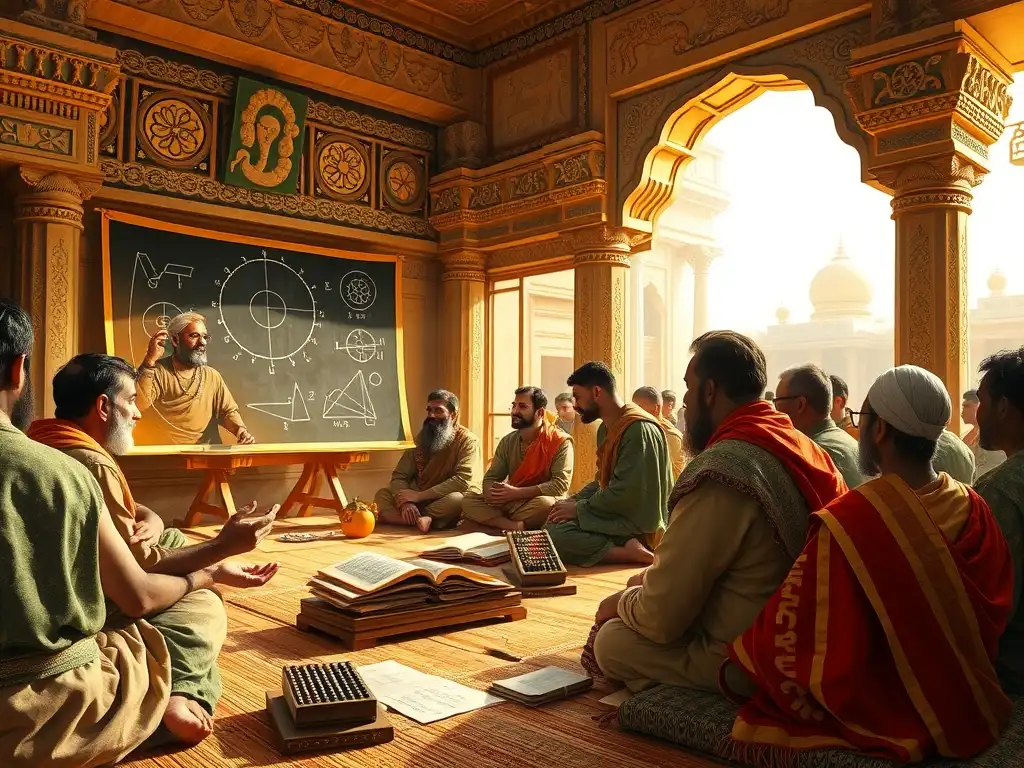
Introduction to Mathematics in Ancient India
The evolution of mathematics in ancient India represents a profound journey through the intellectual landscapes of one of the world's oldest civilizations. From the foundational concepts in the Vedic texts to the remarkable advancements seen during the Gupta Empire, mathematics in ancient India was not merely a tool for calculation but a vital component of cultural, astronomical, and philosophical pursuits.
This article explores the various stages of mathematical development, illustrating how ancient Indian scholars laid the groundwork for significant mathematical theories and practices that continue to influence contemporary mathematics. By examining the intricate relationship between mathematics and other fields such as astronomy and philosophy, we gain insight into the rich tapestry of knowledge that characterized ancient India.
Importance of Mathematics in Ancient Indian Civilization
Mathematics played a crucial role in various aspects of ancient Indian civilization, serving as a framework for advancements in architecture, astronomy, and trade. The ability to perform complex calculations enabled the construction of monumental structures, the development of calendars, and the facilitation of commerce. Not only did mathematics contribute to practical applications, but it also fostered a spirit of inquiry and intellectual exploration.
- Architecture: Mathematical principles guided the design and construction of temples and public buildings.
- Astronomy: Accurate calculations were essential for understanding celestial movements and developing calendars.
- Trade: Mathematics facilitated the measurement of land, commodities, and the establishment of trade routes.
Through these applications, mathematics in ancient India became an integral part of daily life and societal advancement.
Overview of the Vedic to Gupta Periods
The journey of mathematics in ancient India can be distinctly divided into two significant periods: the Vedic and the Gupta.
- Vedic Period (1500 BCE - 500 BCE): This era marked the beginnings of mathematical thought, with early texts introducing fundamental concepts. The Sulba Sutras, for example, laid down precise rules for constructing altars and geometric shapes, showcasing the application of mathematics in rituals.
- Gupta Period (c. 320 - 550 CE): Often referred to as the Golden Age of India, this period witnessed remarkable advancements in mathematics, including the introduction of the decimal system and significant contributions from mathematicians like Aryabhata and Brahmagupta.
The transition from the Vedic to the Gupta period reflects an evolution from rudimentary mathematical practices to sophisticated theories that would lay the groundwork for future developments in the field.
The Vedic Period: Foundations of Mathematics
Early Mathematical Concepts in Vedic Texts
The Vedic texts are among the earliest sources of mathematical thought in ancient India. They reveal a deep understanding of numbers, geometry, and arithmetic, often intertwined with religious and philosophical ideas.
- Numerical Systems: The Vedic texts utilized a base-10 system, emphasizing the significance of numbers in both spiritual rituals and practical applications.
- Geometric Principles: Concepts of area and volume are found in the Sulba Sutras, which outline methods for constructing geometric shapes used in sacrificial altars.
This foundational knowledge provided the bedrock for further mathematical exploration and innovation in subsequent periods.
The Role of Astronomy and Rituals in Developing Mathematics
Astronomy and rituals were closely linked in Vedic society, driving the need for mathematical precision. The calculation of time, seasons, and celestial events required a sophisticated understanding of mathematics.
- Calendar Systems: The Vedic texts describe lunar and solar calendars, necessitating calculations for timing agricultural activities and religious ceremonies.
- Ritualistic Mathematics: The construction of altars involved intricate geometric designs, highlighting the practical application of mathematics in religious practices.
This intersection of mathematics, astronomy, and rituals illustrates how ancient Indian scholars approached mathematics not just as a theoretical discipline but as an essential component of their cultural identity.
Notable Mathematical Contributions During the Vedic Era
Several key mathematical contributions emerged during the Vedic period, setting the stage for future advancements. Among the notable achievements are:
- The Sulba Sutras: These texts provide rules for constructing altars with precise geometric measurements, showcasing early applications of geometry.
- Ritual Mathematics: The Vedic priests developed algorithms for computations related to rituals, emphasizing the importance of accuracy.
These contributions reflect a burgeoning mathematical tradition that would eventually flourish in the Gupta period, leading to innovations that would resonate throughout history.
The Post-Vedic Era: Transition and Development
The Post-Vedic era marked a significant transition in the mathematical landscape of ancient India, characterized by the emergence of new philosophical and religious thoughts that influenced various fields, including mathematics. This period saw a departure from the ritualistic approach of the Vedic texts, paving the way for a more analytical and abstract understanding of mathematical concepts. The introduction of new schools of thought, particularly Buddhism and Jainism, played a crucial role in this evolution, fostering a spirit of inquiry and rationality that contributed to the development of mathematics.
During this time, mathematics began to be applied more practically in fields such as commerce, astronomy, and architecture. The need for accurate calculations in trade and the observation of celestial bodies encouraged mathematicians to refine their methods and explore new concepts. The transition from oral traditions to written texts also facilitated the dissemination of mathematical knowledge, enabling scholars to build on previous discoveries and innovate further.
Influence of Buddhism and Jainism on Mathematical Thought
Buddhism and Jainism significantly influenced mathematical thought during the Post-Vedic era. These religions emphasized logical reasoning and empirical observation, encouraging scholars to question traditional beliefs and explore mathematical concepts more deeply. The Buddhist texts, particularly the Sutras, contained numerous references to arithmetic and geometry, illustrating the practical applications of mathematics in daily life.
Jainism contributed to the development of mathematics through its focus on the concept of infinity and the notion of non-absolutism, which challenged mathematicians to consider multiple perspectives in their calculations. Jain scholars, such as Bhadrabahu and Siddhasena, made substantial contributions to combinatorial mathematics and number theory, pushing the boundaries of mathematical thought.
The interplay between these religious philosophies and mathematics fostered an environment conducive to intellectual growth, leading to the formulation of new mathematical ideas and techniques that would later be foundational in the Gupta period.
The Emergence of New Mathematical Concepts
The Post-Vedic era witnessed the emergence of several new mathematical concepts that laid the groundwork for future developments. Among these was the concept of zero, a revolutionary idea that transformed mathematics by allowing for the representation of nothingness and enabling more complex calculations. The use of place value notation began to take shape, facilitating arithmetic operations and making calculations more manageable.
Additionally, advancements in geometry became prominent during this period. Scholars began to explore the properties of geometric shapes and figures, leading to the formulation of principles that would later be essential in architecture and astronomy. Concepts such as the Pythagorean theorem were likely known and utilized in ancient Indian mathematics, showcasing the sophistication of mathematical understanding.
These emerging concepts reflected a growing abstraction in mathematical thought, moving beyond mere practical applications to more theoretical frameworks that would be further developed during the Gupta Empire.
Notable Scholars and Texts from the Post-Vedic Period
Several notable scholars emerged during the Post-Vedic period, contributing to the rich tapestry of mathematical thought in ancient India. One of the most recognized figures was Aryabhata, who, although his most significant work fell within the Gupta period, laid the foundation for mathematical exploration in the preceding era. His work inspired subsequent generations of mathematicians and astronomers.
Other scholars, such as Brahmagupta, made significant contributions to arithmetic and algebra. His seminal text, Brahmasphutasiddhanta, compiled in the 7th century CE, discussed rules for operations involving zero and negative numbers, showcasing a deep understanding of mathematical principles.
The Mathematical Treatise of the Jains, particularly the work of mathematician Mahāvīra, introduced advanced concepts in combinatorics and number systems, reflecting the rich intellectual environment of the time. Collectively, these scholars and their texts played a crucial role in advancing mathematical knowledge, setting the stage for the remarkable achievements of the Gupta period.
The Gupta Period: The Golden Age of Mathematics
The Gupta period, often referred to as the Golden Age of India, was marked by a flourishing of art, science, and mathematics. This era, spanning from approximately 320 to 550 CE, saw remarkable advancements in mathematical thought, driven by a cadre of exceptional scholars and a supportive cultural environment that encouraged intellectual pursuits. The Gupta mathematicians built on the foundations laid in the Post-Vedic period and made groundbreaking contributions that would influence mathematics for centuries.
Mathematics during this time was characterized by a systematic approach to problem-solving and a focus on theoretical frameworks. The application of mathematics to astronomy, architecture, and commerce was evident, with scholars developing sophisticated techniques that showcased their understanding of complex mathematical concepts.
Key Mathematical Achievements in the Gupta Empire
The Gupta Empire was home to several key mathematical achievements that marked a significant leap in the field. The introduction and formalization of the decimal system, particularly the use of zero as a placeholder, revolutionized arithmetic and calculation techniques. This innovation enabled mathematicians to perform complex calculations with greater ease and accuracy, laying the groundwork for future mathematical advancements.
The Gupta mathematicians also excelled in trigonometry and astronomy. Works such as Aryabhata's Aryabhatiya presented sine and cosine functions and established rules for calculating the area of circles and the volume of spheres. These contributions not only advanced mathematical knowledge but also had practical applications in fields such as navigation and architecture.
Additionally, the Gupta period saw the development of algebraic techniques, with mathematicians like Brahmagupta formalizing rules for solving quadratic equations and understanding the properties of numbers. This period marked a synthesis of theoretical and practical mathematics that would influence subsequent generations.
The Work of Aryabhata: Innovations in Mathematics
Aryabhata, one of the most renowned mathematicians and astronomers of the Gupta period, made several groundbreaking innovations in mathematics that have had a lasting impact. His seminal work, the Aryabhatiya, composed in 499 CE, is a comprehensive treatise that covers a range of topics, including arithmetic, algebra, and astronomy.
In the Aryabhatiya, Aryabhata introduced the concept of place value and the representation of numbers using a positional system, which was a precursor to the modern decimal system. He also provided methods for calculating the value of pi (π) and established rules for various mathematical operations, including multiplication and division.
Aryabhata's astronomical work included calculations of the length of the solar year, the timing of eclipses, and the motion of celestial bodies, demonstrating the integration of mathematics and astronomy. His innovative approach to problem-solving and mathematical reasoning set a high standard for future scholars and significantly influenced the development of mathematics in ancient India.
Other Notable Mathematicians of the Gupta Period
In addition to Aryabhata, the Gupta period produced several other notable mathematicians who contributed significantly to the field. Brahmagupta, active in the 7th century, is known for his work in arithmetic and algebra, particularly his text Brahmasphutasiddhanta. He established rules for operations involving zero and negative numbers, providing a foundational understanding of algebraic principles.
Another significant figure was Varahamihira, who made contributions to astronomy and mathematics through his work Brihat Samhita. He included various mathematical concepts, including geometry and the calculation of planetary positions, reflecting the interconnectedness of mathematics and astronomy during this time.
Lastly, mathematician Bhaskara I, who lived in the 7th century, is credited with the introduction of the sine function and the concept of the sine table, which facilitated further advancements in trigonometry. These mathematicians and their pioneering works collectively contributed to making the Gupta period a hallmark of mathematical excellence in ancient India, with influences that resonate through the history of mathematics.
Mathematics in Ancient Indian Texts and Treatises

The evolution of mathematics in ancient India is intricately documented in various texts and treatises that illustrate the advanced mathematical concepts developed over centuries. These texts served not only as instructional material but also as a reflection of the cultural and scientific milieu of the time. Mathematics in ancient India was deeply connected to astronomy, architecture, and rituals, making it a crucial part of everyday life and scholarly pursuits.
Key texts such as the Vedas, the Sulbasutras, and the works of mathematicians like Aryabhata and Brahmagupta provide invaluable insights into the mathematical prowess of ancient Indian scholars. Through these texts, we can trace the development of arithmetic, geometry, algebra, and even early notions of calculus, showcasing the rich intellectual tradition that laid the groundwork for future advancements in mathematics.
The Sulbasutras: Geometry and Measurements
The Sulbasutras, composed around 800-500 BCE, are ancient texts that primarily focus on geometry and the construction of altars for Vedic rituals. These texts are significant for their systematic approach to geometry, establishing principles that would later influence various fields of mathematics.
The Sulbasutras contain detailed instructions for constructing geometric figures, including squares, circles, and various complex shapes. They introduce concepts such as the Pythagorean theorem long before it was formally recognized in the Western world. For instance, the text describes the relationship between the sides of a right triangle, allowing builders to create precise measurements for altars.
Moreover, the Sulbasutras also delve into the use of irrational numbers, providing rules for approximating values, such as the square root of two. This early exploration of geometry and measurement showcases the advanced mathematical knowledge possessed by ancient Indian mathematicians and their practical applications in daily and ritualistic life.
The Aryabhatiya: A Comprehensive Mathematical Text
Written by the renowned mathematician Aryabhata in 499 CE, the Aryabhatiya is a landmark text that covers a wide array of mathematical concepts, including arithmetic, algebra, and astronomy. Aryabhata's work stands out for its systematic organization and clarity, making it accessible for students and scholars alike.
In the Aryabhatiya, Aryabhata introduces the place-value system for numbers and the concept of zero, which were revolutionary in their time. He provides methods for solving linear and quadratic equations, as well as algorithms for arithmetic calculations. His treatment of mathematics is not merely theoretical; it includes practical applications in astronomy, such as calculating the positions of celestial bodies and predicting eclipses.
Additionally, Aryabhata's approach to mathematics emphasizes the importance of rigorous proof and logical reasoning, setting a standard for future mathematicians. His influence extended beyond India, as the Aryabhatiya was later translated and studied in various cultures, contributing to the global mathematical heritage.
Brahmagupta's Brahmasphutasiddhanta: Breakthroughs in Algebra
Brahmagupta's Brahmasphutasiddhanta, composed in 628 CE, is another seminal work that significantly advanced the field of algebra. This text is notable for its comprehensive treatment of rules for arithmetic operations, particularly concerning negative numbers and zero, which were often contentious topics in contemporary mathematics.
Brahmagupta's work laid down systematic rules for solving quadratic equations and provided methods for calculating areas and volumes. He is credited with establishing the concept of a "positive" and "negative" number, recognizing the importance of zero as a number in its own right. His equations and methods were groundbreaking, as they transitioned mathematics into a more abstract and generalized form, paving the way for further algebraic development.
In addition to theoretical advancements, Brahmagupta's text includes practical problems that reflect real-life scenarios, such as the distribution of wealth and the calculation of interest, highlighting the application of mathematics in administration and trade.
Comparison with Contemporary Mathematical Developments
Mathematics in Ancient India vs. Ancient Greece
When comparing the development of mathematics in ancient India with that of ancient Greece, several distinct differences and similarities emerge. While both civilizations made significant contributions to mathematics, their approaches and areas of focus varied considerably.
Ancient Indian mathematics was characterized by its practical applications, particularly in astronomy, architecture, and rituals. The emphasis on calculations related to time, space, and measurement was paramount. In contrast, ancient Greek mathematics often focused on theoretical constructs, such as geometry and proofs, exemplified by the works of Euclid and Archimedes.
While the Greeks are often credited with formalizing mathematical proofs and developing deductive reasoning, Indian mathematicians were pioneers in the use of the numeral system and innovations such as zero and negative numbers. This foundational work laid the groundwork for algebra and a more comprehensive understanding of numbers.
The Global Influence of Indian Mathematics on Other Cultures
The influence of Indian mathematics extended far beyond its borders, impacting various cultures and civilizations across the globe. As trade routes connected India with the Middle East and Southeast Asia, Indian mathematical texts began to circulate widely, introducing new concepts to diverse cultures.
The introduction of the Hindu-Arabic numeral system, which originated in India, revolutionized mathematics in the Islamic Golden Age. Scholars such as Al-Khwarizmi translated Indian texts, contributing to the development of algebra and the adoption of the numeral system in Europe. This exchange of knowledge played a crucial role in the transition from Roman numerals to a more efficient numerical system, facilitating advancements in mathematics, science, and commerce.
Moreover, the concepts introduced by Indian mathematicians laid the foundation for various mathematical developments during the Renaissance and beyond, illustrating the profound and lasting impact of mathematics in ancient India on global intellectual history.
Conclusion: The Legacy of Mathematics in Ancient India
The evolution of mathematics in ancient India is a testament to the intellectual prowess and innovative spirit of its civilizations. From the early Vedic period, where mathematics began as a practical tool for rituals and astronomy, to the sophisticated mathematical theories developed during the Gupta Empire, ancient Indian mathematicians laid the groundwork for numerous concepts that are fundamental to modern mathematics. The contributions of figures like Aryabhata and Brahmagupta not only enriched the mathematical landscape of their time but also influenced global mathematical thought.
As we reflect on this rich legacy, it is evident that the mathematical advancements made in ancient India have had a profound and enduring impact. The concepts of zero, negative numbers, and the decimal system have shaped not just mathematics, but also fields such as science, engineering, and economics. The methodologies and principles developed by ancient Indian scholars continue to resonate in contemporary mathematical practices, emphasizing the importance of this historical journey.
Lasting Impact on Modern Mathematics
The innovations in mathematics during ancient India are echoed in many aspects of modern mathematical practice. The introduction of the numeral system, which includes the concept of zero, revolutionized numerical representation and calculations. This foundational concept allowed for more complex mathematical operations and laid the groundwork for algebra and calculus.
Additionally, the work of mathematicians like Aryabhata, who calculated the value of π and explored astronomical calculations, has influenced not only mathematics but also the fields of physics and astronomy. The methods of approximation and estimation found in ancient Indian texts are still relevant today, showcasing the practicality and foresight of these ancient scholars.
The Importance of Preserving Ancient Mathematical Texts
Preserving ancient mathematical texts is crucial for understanding the full scope of mathematical development throughout history. These texts not only provide insight into the mathematical knowledge of the time but also illuminate the cultural and philosophical contexts in which this knowledge was produced.
By studying these texts, modern mathematicians and historians can trace the evolution of mathematical concepts and techniques, recognizing the contributions of various cultures to the global mathematical heritage. Furthermore, preserving these texts ensures that future generations can access and learn from the rich history of mathematics, fostering a deeper appreciation for the intellectual achievements of ancient civilizations.
References and Further Reading on Mathematics in Ancient India
For those interested in delving deeper into the fascinating topic of mathematics in ancient India, a wealth of resources is available that explores various aspects of this rich history.
Suggested Books and Articles
- "Mathematics in Ancient India" by Kim Plofker - This book offers a comprehensive overview of the mathematical achievements and practices in ancient India, detailing key contributions and their implications.
- "The History of Mathematics: A Brief Course": by Roger L. Cooke - This text includes sections dedicated to the contributions of ancient Indian mathematics and its influence on global mathematical development.
- "Mathematical Thought from Ancient to Modern Times" by Morris Kline - This book provides context on how ancient Indian mathematics fits into the broader narrative of mathematical history.
Online Resources for Exploring Ancient Indian Mathematics
- The Aryabhata Project: An online resource dedicated to the works of Aryabhata, featuring translations and analyses of his contributions to mathematics and astronomy.
- Indian Mathematical Society: This organization promotes the study and research of mathematics in India and offers a variety of resources, including articles and research papers on ancient Indian mathematicians and their works.
- Digital Library of India: A project that archives and digitizes texts from various fields, including mathematics, allowing access to original documents and translations related to ancient Indian mathematics.
By exploring these references and resources, one can gain a deeper understanding of the remarkable contributions of mathematics in ancient India and appreciate its enduring legacy in the modern world.
- Introduction to Mathematics in Ancient India
- The Vedic Period: Foundations of Mathematics
- The Post-Vedic Era: Transition and Development
- The Gupta Period: The Golden Age of Mathematics
- Mathematics in Ancient Indian Texts and Treatises
- Comparison with Contemporary Mathematical Developments
- Conclusion: The Legacy of Mathematics in Ancient India
- References and Further Reading on Mathematics in Ancient India
- What were the main contributions of mathematics in ancient India?
- How did the Vedic period influence mathematics?
- What advancements occurred during the Gupta Empire regarding mathematics?
- How did ancient Indian mathematics impact the world?
- Are there any modern applications of ancient Indian mathematical concepts?
Frequently Asked Questions
What were the main contributions of mathematics in ancient India?
Ancient Indian mathematicians made significant contributions, particularly in numerals, arithmetic, and geometry. They developed the decimal system and introduced the concept of zero, which revolutionized mathematics.
How did the Vedic period influence mathematics?
During the Vedic period, mathematical concepts were used in rituals and astronomy. The Sulba Sutras, texts from this time, laid out principles of geometry for constructing altars, showcasing early applications of mathematical reasoning.
What advancements occurred during the Gupta Empire regarding mathematics?
The Gupta Empire marked a golden age for Indian mathematics, with significant developments in algebra, trigonometry, and calculus. Notable mathematicians like Aryabhata and Brahmagupta made groundbreaking advancements that influenced global mathematics.
How did ancient Indian mathematics impact the world?
The innovations in mathematics in ancient India, such as the introduction of the Hindu-Arabic numeral system, had a profound impact on mathematical practices worldwide. These contributions were later transmitted to the Islamic world and Europe, shaping modern mathematics.
Are there any modern applications of ancient Indian mathematical concepts?
Yes, many modern mathematical concepts and techniques can be traced back to ancient India. For example, the use of place value and the concept of zero are foundational in today’s mathematical systems, illustrating the lasting legacy of ancient Indian mathematics.
Final Reflection: The Enduring Legacy of Mathematics in Ancient India
The evolution of mathematics in ancient India is not just a historical account; it is a testament to the profound impact that innovative thinking can have on the world today. From the intricate calculations of the Vedic period to the sophisticated concepts developed during the Gupta period, the mathematical advancements of ancient India laid the groundwork for modern mathematics. This legacy continues to resonate in contemporary society, reminding us that the pursuit of knowledge knows no boundaries and that the seeds of intellectual curiosity sown centuries ago still flourish in our educational systems today.
The influence of ancient Indian mathematics extends far beyond the confines of textbooks; it has shaped the very fabric of our cultural and scientific landscape. The concepts of zero, the decimal system, and advanced algebra are not merely historical footnotes but essential components of our daily lives.
As we navigate an increasingly complex world, we can draw inspiration from the words of the great mathematician Aryabhata, who said, ">In the world of mathematics, there is no limit to the heights one can reach." This sentiment echoes the spirit of exploration and discovery that characterized the mathematicians of ancient India, urging us to embrace challenges and seek innovative solutions.
As we reflect on the remarkable journey of mathematics in ancient India, I invite you to consider how this rich heritage can inspire your own quest for knowledge and understanding. Let the stories of these ancient mathematicians ignite your passion for learning and encourage you to explore the depths of your own potential.
Whether you are a student, a professional, or simply a curious mind, remember that the legacy of mathematics is not just about numbers and equations; it is about the relentless pursuit of truth and the courage to innovate. Embrace this journey, and who knows what extraordinary discoveries await you on the path ahead?
Unveil the Mysteries of Ancient Mathematics!
Thank you for diving into the fascinating world of mathematics in Ancient India! You've explored the remarkable journey from the Vedic to the Gupta period, uncovering insights that highlight the brilliance of ancient scholars. Now, it’s time to take your curiosity a step further and engage with this incredible legacy.
Here’s how you can continue your exploration:
- Dive deeper into the mathematical texts from this era—check out translations or analyses of works such as the Sulbasutras and the writings of Aryabhata.
- Consider sharing this article with friends or fellow history enthusiasts on social media to spark discussions about the impact of ancient mathematics on modern society.
- Join a local or online discussion group focused on history to uncover more about how ancient civilizations have influenced contemporary mathematical concepts.
What aspect of Ancient Indian mathematics fascinates you the most, and how do you believe it has shaped our current understanding of mathematics?