
The Contributions of Bhaskara II to Astronomy and Mathematics


Welcome to Ancient India History, where we embark on a fascinating journey through time to uncover the rich tapestry of ancient Indian civilizations. From the ingenious innovations of the Indus Valley to the intellectual triumphs of the Gupta Empire, our exploration reveals the profound contributions that have shaped our world. Today, we delve into the captivating realm of Bhaskara II and his contributions to astronomy, a pivotal figure whose groundbreaking work in mathematics and celestial observations continues to influence scientific thought.
Are you ready to uncover the secrets of the stars and the brilliance of ancient minds? Let’s dive deeper into the legacy of Bhaskara II and discover how his insights illuminate our understanding of the cosmos!
- Introduction to Bhaskara II and His Legacy in Astronomy and Mathematics
- Bhaskara II's Contributions to Astronomy
- Bhaskara II's Contributions to Mathematics
- Influence and Legacy of Bhaskara II
- Conclusion: The Enduring Legacy of Bhaskara II in Astronomy and Mathematics
- Frequently Asked Questions
- Final Reflection: The Enduring Legacy of Bhaskara II in Astronomy and Mathematics
- Unlock the Wonders of Bhaskara II's Legacy!
Introduction to Bhaskara II and His Legacy in Astronomy and Mathematics
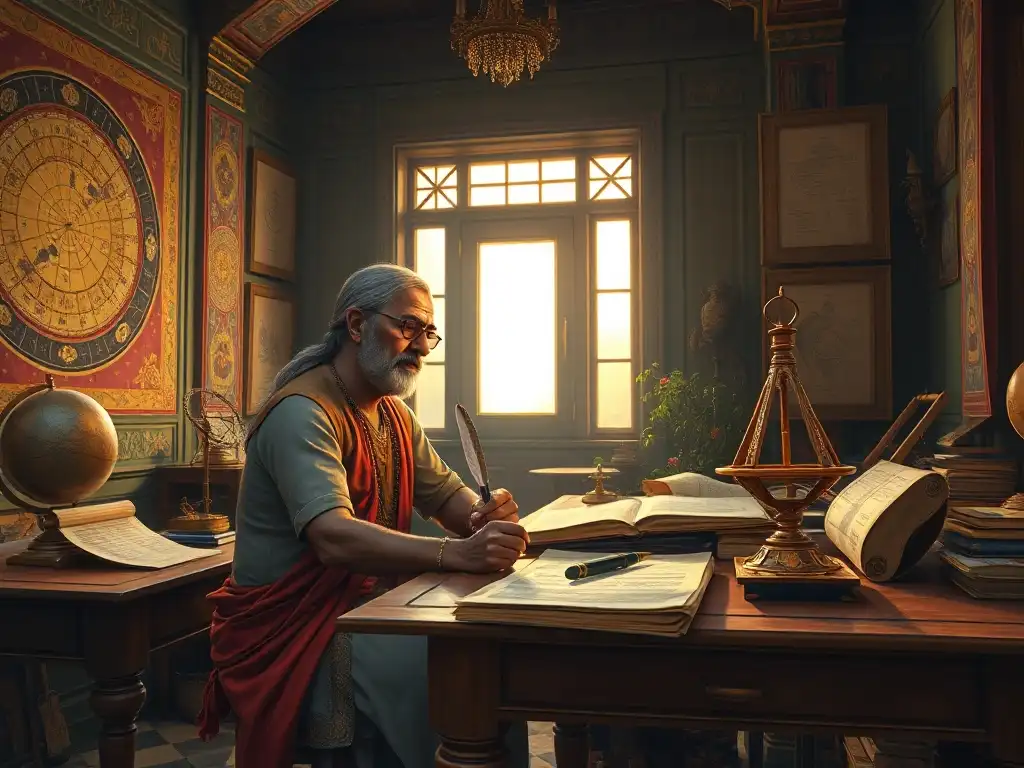
Bhaskara II, also known as Bhaskara Acharya, stands as a towering figure in the realms of astronomy and mathematics during the medieval period of ancient India. Born in 1114 CE in what is now Gujarat, India, Bhaskara II made profound contributions that not only advanced the scientific landscape of his time but also laid foundational principles that would influence future generations of mathematicians and astronomers across the globe.
His works, notably the Siddhanta Shiromani, encompass a wide array of topics including arithmetic, algebra, and trigonometry, showcasing his exceptional ability to synthesize complex ideas into practical applications. This article will delve into Bhaskara II's life, the historical context in which he operated, and the significance of his contributions to astronomy and mathematics, emphasizing how his innovative approaches remain relevant in contemporary science.
Overview of Bhaskara II's Life and Era
Bhaskara II lived during a period marked by the flourishing of intellectual pursuits in ancient India, particularly in the fields of mathematics and astronomy. His era was characterized by a rich tapestry of cultural and scientific advancements, influenced by earlier scholars and the prevailing socio-political climate.
- Early Life: Born into a family of mathematicians, Bhaskara II was immersed in the study of science from a young age. His father, Madhava, was also a notable scholar, which fostered an environment conducive to learning and innovation.
- Major Works: His seminal work, the Siddhanta Shiromani, is divided into four parts:
- Lilavati: Focused on arithmetic, this text is famous for its practical problems and elegant solutions.
- Bijaganita: This section deals with algebra, introducing concepts that would later be pivotal in the development of the subject.
- Graha Sutra: Concentrating on planetary motions, this work highlights Bhaskara's astronomical insights.
- Karan Kuthuhala: This part presents mathematical techniques for astronomical calculations.
The interplay of these texts not only demonstrates Bhaskara II’s depth of knowledge but also illustrates the interconnectedness of mathematics and astronomy in ancient Indian thought.
Importance of Bhaskara II in Ancient Indian Science and Mathematics
The significance of Bhaskara II in the annals of ancient Indian science cannot be overstated. His innovative methodologies and profound insights contributed to the understanding of both mathematics and astronomy, influencing scholars across cultures.
- Mathematical Innovations:
- Bhaskara II introduced concepts such as zero and negative numbers, which were revolutionary for his time.
- His work on quadratic equations laid the groundwork for solving complex mathematical problems, showcasing his prowess in algebra.
- Astronomical Contributions:
- In astronomy, Bhaskara II was known for his precise calculations of planetary positions and eclipses.
- His methods for calculating the time of sunrise and sunset were notably accurate, reflecting a sophisticated understanding of celestial mechanics.
- Legacy:
- Bhaskara II's works have been translated and studied for centuries, impacting mathematicians and astronomers around the world.
- His influence extends to the Islamic Golden Age, where his texts were studied and built upon by scholars such as Al-Khwarizmi and Omar Khayyam.
Through his extensive contributions, Bhaskara II not only enriched the fields of mathematics and astronomy but also cemented his legacy as a pivotal figure in the history of science, inspiring countless individuals and laying the groundwork for future discoveries.
Bhaskara II's Contributions to Astronomy

Bhaskara II, also known as Bhaskara Acharya, was a prominent Indian mathematician and astronomer who lived during the 12th century CE. His work has profoundly influenced both Indian and global mathematics and astronomy. He is often regarded as one of the greatest mathematicians of ancient India, and his contributions to astronomy are particularly noteworthy. His innovative approaches and methodologies laid the groundwork for future astronomical studies, making him a pivotal figure in the advancement of celestial sciences.
Innovations in Celestial Mechanics
Bhaskara II made significant advancements in celestial mechanics, which is the branch of astronomy that deals with the motions of celestial objects. He introduced several concepts that were revolutionary for his time, including:
- Astronomical Algorithms: Bhaskara developed algorithms for calculating the positions of celestial bodies, which were crucial for accurate astronomical predictions.
- Use of Sine Functions: He extensively utilized sine functions in his calculations, which were essential for understanding the geometry of the heavens. His work predated the introduction of trigonometric functions in Europe by several centuries.
- Corrections for Ecliptic Motion: Bhaskara provided corrections for the motion of planets across the ecliptic, enhancing the precision of astronomical models. This included accounting for the elliptical orbits of planets, which was a significant step forward in celestial mechanics.
His methodologies not only improved the accuracy of astronomical observations but also provided a systematic approach to understanding celestial phenomena.
The Siddhanta Shiromani: A Masterpiece of Astronomical Knowledge
One of Bhaskara II's most important contributions is the Siddhanta Shiromani, a comprehensive astronomical treatise divided into two main parts: Lilavati and Bijaganita. This work encapsulates a wealth of knowledge, including:
- Lilavati: This section focuses on mathematics, presenting problems related to arithmetic, geometry, and algebra. Bhaskara's approach is notable for its clarity and practicality, making complex concepts accessible.
- Bijaganita: This part deals with algebra and introduces techniques for solving equations, building on previous works while also incorporating original ideas.
The Siddhanta Shiromani not only serves as a reference for mathematical and astronomical principles but also reflects Bhaskara's profound understanding of the cosmos. His explanations of planetary motion, eclipses, and the calculation of time were groundbreaking and remained influential for generations.
Calculation of Planetary Positions and Eclipses
Bhaskara II's methods for calculating planetary positions and predicting eclipses were remarkable for their accuracy. He employed various techniques:
- Epicycles and Eccentric Circles: Bhaskara utilized the concept of epicycles—small circles that move along the circumference of larger circles—to explain the complex paths of planets. This innovative visualization helped in accurately predicting their positions.
- Eclipse Predictions: He formulated rules for predicting solar and lunar eclipses, which included calculations based on the relative positions of the Earth, Moon, and Sun. His predictions were often accurate, demonstrating his understanding of celestial dynamics.
- Time Calculation: Bhaskara also devised methods for calculating the time of day based on the position of celestial bodies, integrating his knowledge of astronomy with practical applications in daily life.
Bhaskara II's contributions to astronomy, particularly in celestial mechanics and eclipse prediction, are a testament to his genius and have had a lasting impact on the field. His works are celebrated not only for their mathematical rigor but also for their innovative approach to understanding the universe.
Impact of Bhaskara II's Astronomical Theories on Later Astronomers
Bhaskara II, also known as Bhaskara Acharya, was a pivotal figure in the realm of astronomy during the 12th century. His seminal work, Siddhanta Shiromani, is a comprehensive treatise that not only expanded upon the astronomical knowledge of his predecessors but also laid the groundwork for future astronomers. The impact of his theories can be observed in several significant ways.
Influence on Islamic Astronomy
One of the most profound impacts of Bhaskara II's contributions was on Islamic astronomy. His works were translated into Arabic, which facilitated the dissemination of his ideas across the Islamic world. Scholars such as Al-Biruni and Al-Khwarizmi drew upon Bhaskara's methods and calculations, which influenced their own astronomical models.
- Adoption of Mathematical Techniques: Bhaskara II's innovative use of mathematics to solve astronomical problems helped bridge the gap between pure mathematics and practical astronomy. His techniques, particularly in planetary motion and eclipses, were adopted and refined by later Islamic astronomers.
Foundation for Later Indian Astronomers
Bhaskara II’s influence extended notably to subsequent generations of Indian astronomers. His methods and theories were foundational for scholars like Madhava of Sangamagrama and the Kerala School of Astronomy.
- Continued Development of Astronomy: Madhava and his contemporaries built upon Bhaskara's work, incorporating his calculations into their own research, which eventually led to the development of calculus centuries before its formal introduction in Europe.
Adoption in European Astronomy
Interestingly, Bhaskara II's contributions also found their way into European astronomy. His works were introduced to European scholars during the colonial period, where they were studied and appreciated for their mathematical rigor and accuracy.
- Influence on Copernicus: Some historians suggest that the mathematical techniques developed by Bhaskara II may have influenced Copernicus's heliocentric model. The integration of his astronomical calculations into European frameworks demonstrates the far-reaching implications of his theories.
Lasting Legacy in Astronomy and Mathematics
The legacy of Bhaskara II is evident in both astronomy and mathematics, with his methodologies continuing to resonate in modern scientific practices. His ability to articulate complex astronomical concepts through mathematical expressions set a precedent for future scholars.
- Recognition in Modern Education: Today, Bhaskara II is recognized not only as a historical figure but also as a crucial contributor to the fields of astronomy and mathematics. Educational institutions often reference his work when discussing the evolution of these disciplines.
Bhaskara II's astronomical theories had a profound and lasting impact on later astronomers across various cultures. By integrating mathematical precision with astronomical observation, he established a framework that would influence both Indian and Islamic scholars, as well as European scientists. His contributions continue to be celebrated as a significant chapter in the history of astronomy.
Bhaskara II's Contributions to Mathematics

Developments in Algebra and Arithmetic
Bhaskara II, also known as Bhaskara the Elder, made significant strides in the fields of algebra and arithmetic during the 12th century. His seminal work, "Lilavati," not only serves as a comprehensive textbook on arithmetic but also incorporates various methods for solving problems that are relevant even today.
- Innovative Techniques:
- Bhaskara introduced the rule of signs for solving equations, which laid the groundwork for future algebraic methodologies.
- He employed proportions and ratios, facilitating a more systematic approach to problem-solving in arithmetic.
- Practical Applications:
- The problems presented in "Lilavati" often relate to real-life scenarios, such as calculating the area of various shapes and understanding the principles of trade and commerce.
- His work included numerous examples of practical applications, demonstrating the utility of mathematics in daily life.
- Algebraic Formulations:
- Bhaskara's explorations in algebra included the introduction of polynomials and the use of algebraic symbols.
- He worked extensively on quadratic equations, providing solutions and methods that are remarkably similar to those used in modern algebra.
The Concept of Zero and Its Significance in Mathematical Calculations
One of Bhaskara II's most profound contributions to mathematics is his treatment of the number zero. While the concept of zero existed prior to Bhaskara, his writings provided clarity and depth to its significance in calculations.
- Symbolic Representation:
- Bhaskara utilized the symbol for zero effectively, allowing for calculations that required a placeholder in the decimal system. This innovation was crucial for developing a reliable numerical system.
- Mathematical Operations:
- He extensively explored the implications of zero in different mathematical operations, such as addition, subtraction, and multiplication. His insights laid the foundation for further developments in arithmetic, highlighting how zero impacts the results of these operations.
- Cultural Impact:
- The acceptance and understanding of zero as a number revolutionized mathematics, influencing various fields, including astronomy and physics. Bhaskara’s work contributed to a cultural shift in how numbers were perceived, paving the way for future mathematicians.
Bhaskara II's Work on Indeterminate Equations
Bhaskara II's exploration of indeterminate equations marks a significant milestone in mathematical history. His work presented solutions to equations that had no fixed solutions, a concept that was advanced for its time.
- Equations of the Form x^2 = Dy^2 + N:
- Bhaskara tackled equations of this nature, which today are known as Pell's equations. He provided methods to find integer solutions, showcasing his innovative thinking in algebra.
- Examples and Solutions:
- In his texts, Bhaskara offered numerous examples of indeterminate equations, illustrating various techniques for finding solutions. This not only demonstrated his mathematical prowess but also served as a teaching tool for future scholars.
- Legacy:
- The methodologies Bhaskara introduced for solving indeterminate equations laid the groundwork for further developments in algebra. His work influenced later mathematicians, both in India and around the world, contributing to the evolution of mathematical theory.
Bhaskara II's contributions to mathematics, particularly in the realms of algebra, the concept of zero, and indeterminate equations, underscore his profound influence on the field. His works remain essential for understanding not only ancient Indian mathematics but also the broader development of mathematical thought through the ages.
The Role of Bhaskara II in Advancing Trigonometry
Bhaskara II, also known as Bhaskara the Great, made significant contributions to the field of trigonometry during the 12th century. His work laid the groundwork for future advancements in this mathematical discipline, particularly through his seminal text, the Siddhanta Shiromani. This text is divided into two parts: the Lilavati, which focuses on arithmetic and geometry, and the Bija Ganita, which specifically addresses algebra and provides insights into trigonometric concepts.
One of Bhaskara II's notable contributions was the introduction of the sine function, which he referred to as the "ardha-jya," or "half-chord." He systematically described the sine function's properties and relationships, establishing a foundation for its use in various astronomical calculations. His work detailed how to compute the sine values for specific angles, which helped simplify the calculations needed for astronomical observations.
Moreover, Bhaskara II's methods included innovative approaches to the relationships between different trigonometric ratios. He developed formulas that would allow for the calculation of angles and the derivation of sine and cosine values from one another. This interrelation between the trigonometric functions was crucial for various applications in astronomy, particularly in predicting celestial events and calculating the positions of celestial bodies.
Bhaskara II also emphasized the importance of numerical accuracy in calculations, which was a significant advancement for his time. He provided methods for approximating sine values, allowing for greater precision in astronomical computations. His work signified a shift towards a more systematic and rigorous approach to trigonometry, which was essential for the later developments in both Indian and global mathematics.
Bhaskara II's advancements in trigonometry represent a pivotal moment in the history of mathematics. His introduction of the sine function, systematic methods for angle calculations, and focus on numerical accuracy helped propel the field forward, influencing not only subsequent Indian mathematicians but also scholars across the globe. The legacy of his work in trigonometry continues to be recognized today, showcasing the enduring impact of ancient Indian mathematics on the evolution of scientific thought.
Influence and Legacy of Bhaskara II

Bhaskara II's Impact on Indian and Global Mathematics
Bhaskara II, also known as Bhaskara Acharya, made significant contributions to mathematics that have resonated through the ages. His seminal work, Lilavati, serves not only as a mathematical treatise but also as a poetic exploration of mathematical concepts. In it, he introduced various topics, including arithmetic, algebra, geometry, and even practical applications such as calculating interest and measuring areas. His ability to present mathematical problems in relatable contexts made his work exceptionally engaging and accessible.
One of Bhaskara II's most notable contributions to mathematics is his formulation of the "principle of zero" and his pioneering work in algebra. In Bijaganita, another of his renowned texts, he provided systematic methods for solving quadratic and cubic equations. He is credited with the early understanding of negative numbers as well, a concept that was considered controversial in many cultures at the time.
| Contribution | Description |
|---|---|
| Principle of Zero | Recognized zero as a number and a crucial mathematical concept. |
| Quadratic Equations | Developed methods for solving quadratic equations systematically. |
| Algebraic Techniques | Introduced innovative approaches to algebra, paving the way for future mathematicians. |
| Negative Numbers | Established early principles regarding the use of negative numerals. |
His work laid the groundwork for future Indian mathematicians and influenced scholars worldwide. The precision and clarity of his methods inspired subsequent generations, both in India and across the globe.
How Bhaskara II's Astronomical Contributions Influenced Islamic Astronomy
Bhaskara II's astronomical contributions were groundbreaking and had a profound impact on both Indian and Islamic astronomical traditions. His most famous work, Siddhanta Shiromani, is a comprehensive treatise that synthesizes earlier astronomical knowledge while introducing original ideas. This work encompasses the concepts of planetary motion, eclipses, and astronomical calculations with remarkable accuracy.
His observations and calculations, particularly regarding the length of the solar year and the positions of planets, were advanced for his time. He notably corrected earlier Indian calculations and provided methods that were later adopted by Islamic astronomers. The transmission of his work to the Islamic world during the medieval period facilitated the integration of Indian astronomical concepts into Islamic practices.
Key Influences:
- Bhaskara II's methodology was adopted and expanded upon by scholars such as Al-Biruni and Al-Khwarizmi, who were instrumental in the development of Islamic astronomy.
- His calculation of the sine function and trigonometric principles were foundational, allowing Islamic astronomers to make significant advancements in navigation and timekeeping.
- The astronomical tables developed by Bhaskara II were translated into Arabic, ensuring their preservation and influence on future scientific discourse.
Bhaskara II's Relevance in Contemporary Scientific Discourse
The legacy of Bhaskara II continues to be relevant in modern scientific discourse, particularly in the fields of mathematics and astronomy. His contributions are frequently cited in contemporary studies that explore the historical development of scientific ideas. Scholars recognize his work as a bridge between ancient Indian science and the advancements that followed in the Islamic Golden Age and beyond.
In contemporary mathematics education, Bhaskara II's methods and principles are often included in curricula that emphasize the historical evolution of mathematical concepts. His innovative approaches to problem-solving and the use of creative contexts for teaching mathematics resonate with modern pedagogical practices.
Moreover, as discussions around the global history of science gain momentum, Bhaskara II's contributions are increasingly acknowledged as essential components of the mathematical and astronomical heritage that shaped our understanding of these fields today. His work exemplifies the rich tapestry of scientific inquiry that transcends geographical and cultural boundaries, underlining the interconnectedness of ancient civilizations in the pursuit of knowledge.
Bhaskara II's contributions to astronomy and mathematics not only enriched Indian scholarship but also laid the groundwork for future advancements in these fields globally, demonstrating the enduring influence of his work in contemporary scientific discussions.
Conclusion: The Enduring Legacy of Bhaskara II in Astronomy and Mathematics

Summary of Key Contributions and Their Impact
Bhaskara II, often referred to as Bhaskara the Great, made remarkable contributions to both astronomy and mathematics that have had a lasting impact on these fields. His seminal works, particularly the Siddhanta Shiromani, are a cornerstone of ancient Indian scientific literature. This treatise is divided into two parts: the Lilavati, which focuses on arithmetic and geometry, and the Bijaganita, which delves into algebra.
- Innovations in Mathematics:
- Zero and Place Value System: Bhaskara emphasized the importance of zero and the positional numeral system, which facilitated complex calculations.
- Algebraic Methods: He introduced various algebraic techniques for solving equations, including rules for quadratic equations.
- Calculus Concepts: His work hinted at the principles of calculus, particularly in the context of infinitesimals and derivatives, which were far ahead of his time.
- Astronomical Contributions:
- Accurate Calculations: Bhaskara's astronomical calculations of planetary positions were noted for their precision, using methods that included the sine function, which is pivotal in modern trigonometry.
- Timekeeping: He developed methods for calculating the length of the solar year, which contributed significantly to calendar systems.
- Eclipses and Planetary Motions: His observations and explanations of eclipses and planetary motions influenced both Indian and later Islamic astronomy.
The impact of Bhaskara II's contributions is profound, laying the groundwork for future mathematicians and astronomers not only in India but globally. His techniques and theories resonated through the ages, influencing scholars during the medieval period and continuing into the Renaissance.
Reflection on Bhaskara II's Role in Shaping Ancient Indian Scientific Thought
Bhaskara II's role in shaping ancient Indian scientific thought cannot be overstated. His approach to mathematics and astronomy was characterized by a blend of theoretical insight and practical application. By integrating rigorous methodology with real-world problems, he set a standard for scientific inquiry in his time.
- Interdisciplinary Influence: Bhaskara's work transcended the boundaries of mathematics and astronomy, impacting fields such as engineering and architecture. His methods were utilized in constructing buildings and astronomical observatories.
- Educational Legacy: The Lilavati has not only served as a mathematical text but also as a tool for education in ancient India. It used poetic verses to make complex mathematical concepts accessible, fostering a culture of learning and inquiry.
- Cultural Context: Bhaskara II's contributions occurred during a period of rich intellectual activity in ancient India, where scholars engaged in extensive debates and collaborations. His works reflect this vibrant environment and contribute to our understanding of the scientific advancements of the time.
Bhaskara II's enduring legacy in astronomy and mathematics is a testament to his genius and the sophisticated scientific thought of ancient India. His contributions continue to inspire and inform contemporary scholars, demonstrating the richness of India's historical scientific heritage.
Frequently Asked Questions
What are Bhaskara II's major contributions to astronomy?
Bhaskara II, also known as Bhaskara Acharya, made significant advancements in astronomy by developing the surya siddhanta and formulating theories on planetary motion and eclipses.
How did Bhaskara II influence mathematics?
Bhaskara II contributed to mathematics with his work on algebra, particularly in solving quadratic equations and understanding calculus concepts, which were ahead of his time.
What is the significance of Bhaskara II's work "Siddhanta Shiromani"?
The Siddhanta Shiromani is a pivotal text that compiles Bhaskara II's astronomical theories and methods, serving as a foundation for astronomy education in ancient India.
How did Bhaskara II's contributions impact later civilizations?
His innovative approaches in astronomy and mathematics laid groundwork that influenced scholars in the Islamic Golden Age and later European Renaissance thinkers.
Where can I learn more about Bhaskara II's contributions?
For an in-depth exploration of Bhaskara II's contributions, refer to resources specializing in ancient Indian history, particularly those focusing on astronomy and mathematics.
Final Reflection: The Enduring Legacy of Bhaskara II in Astronomy and Mathematics
Bhaskara II's contributions to astronomy and mathematics remain profoundly relevant today, illustrating the timeless nature of knowledge and its ability to transcend cultural and temporal boundaries. His pioneering work not only laid the groundwork for future generations of mathematicians and astronomers but also serves as a reminder of the rich intellectual heritage that shapes our understanding of the universe. The brilliance of his insights continues to inspire modern scientific inquiry, highlighting the importance of historical figures in the evolution of knowledge.
The influence of Bhaskara II extends far beyond his own time, permeating various aspects of contemporary culture and education. His methods and discoveries have been integrated into modern curricula and continue to inform research in mathematics and astronomy. As we reflect on his legacy, we can appreciate how his work has fostered a spirit of inquiry and innovation that resonates with scholars and enthusiasts alike. Mathematics is the language with which God has written the universe.
This quote encapsulates the essence of Bhaskara II's contributions, reminding us that the pursuit of knowledge is a divine endeavor.
As we contemplate the lessons from Bhaskara II's life and work, let us embrace the challenge of curiosity and exploration in our own lives. I invite you to reflect on how you can apply the principles of inquiry, perseverance, and creativity in your pursuits, whether in academia, your career, or personal growth. By honoring the legacy of great thinkers like Bhaskara II, we not only enrich our understanding of the world but also contribute to the ongoing journey of discovery that defines humanity's quest for knowledge.
Unlock the Wonders of Bhaskara II's Legacy!
Thank you for diving into the fascinating world of Bhaskara II! You've uncovered the incredible contributions he made to astronomy and mathematics, enriching not only ancient knowledge but also inspiring modern thought. Now, it's time to take your newfound insights further!
- Explore Bhaskara II's works in-depth by reading his famous treatises, including "Lilavati" and "Bijaganita."
- Share this article with friends and family to spark conversations about the impact of ancient scholars on contemporary science.
- Consider joining a local math club or an online forum to discuss and discover more advancements in mathematics and astronomy.
What aspect of Bhaskara II’s work resonates with you the most, and how do you believe it can inspire today’s mathematicians and astronomers?