
Ancient Indian Contributions to Trigonometry and Their Numerical Foundations


Welcome to Ancient India History, where we delve into the fascinating tapestry of our past! Unlock the door to a world of discovery as we explore the remarkable contributions of ancient Indian civilizations to mathematics, with a spotlight on their groundbreaking advancements in trigonometry. This article, titled "Ancient Indian Contributions to Trigonometry and Their Numerical Foundations," invites you to uncover the mathematical brilliance that shaped not only India but the entire world. Join us on this journey through time, and let your curiosity lead you deeper into the rich legacy of ancient Indian intellect!

Introduction to Ancient Indian Trigonometry Contributions
The contributions of ancient Indian mathematicians to the field of trigonometry represent a pivotal chapter in the history of mathematics. Spanning several centuries, these advancements not only laid the groundwork for modern trigonometric concepts but also showcased the profound understanding of numerical systems and geometric principles possessed by ancient Indian scholars. As we explore the ancient Indian trigonometry contributions, it becomes evident that these developments were intricately linked to various aspects of their culture, science, and philosophy. Understanding these contributions enriches our appreciation of how ancient civilizations approached mathematical challenges and their lasting impact on the world.
Understanding the Significance of Trigonometry in Ancient Mathematics
Trigonometry, the branch of mathematics dealing with the relationships between the angles and sides of triangles, was crucial for various practical applications in ancient India. From astronomy and architecture to navigation and land surveying, the principles of trigonometry were essential. Notably, ancient Indian scholars began to formulate trigonometric ratios and concepts long before their counterparts in other civilizations. This early understanding of trigonometric relationships was not merely theoretical; it had practical implications that influenced day-to-day life and the advancement of science.
- Key Applications of Trigonometry in Ancient India:
- Astronomy: Used to calculate planetary positions and eclipses.
- Architecture: Aided in the design of structures, ensuring stability and aesthetic appeal.
- Navigation: Facilitated maritime exploration and trade by calculating distances and directions.
Overview of Ancient Indian Contributions to Mathematics
The mathematical landscape of ancient India is rich with contributions that extend beyond trigonometry. Notable advancements include the development of the decimal system, concepts of zero, and sophisticated algebraic techniques. Indian mathematicians such as Aryabhata and Brahmagupta made significant strides in these areas, intertwining their work with trigonometric concepts. This holistic approach not only advanced mathematics but also influenced the scientific methodologies of subsequent generations.
Historical Context of Trigonometry in Ancient India
Understanding the historical backdrop of trigonometric developments in ancient India is crucial for appreciating their significance. The evolution of mathematical ideas during this period was shaped by various cultural, religious, and scientific influences.
The Development of Mathematical Thought in Ancient India
Mathematical thought in ancient India can be traced back to the Indus Valley Civilization, where the early use of geometry is evident in urban planning and architecture. Over the centuries, philosophical schools and religious practices further propelled mathematical inquiry. The Vedic texts, for instance, contain references to geometric principles, suggesting an early awareness of trigonometric concepts.
- Milestones in the Development of Mathematics:
- Indus Valley Civilization (c. 2500–1900 BCE): Evidence of geometry in urban planning.
- Vedic Period (c. 1500–500 BCE): Introduction of mathematical concepts in religious texts.
- Classical Period (c. 400–1200 CE): Flourishing of mathematical and astronomical studies.
Influential Texts and Scholars in Ancient Indian Mathematics
Several key texts and scholars played a pivotal role in shaping the understanding of trigonometry in ancient India. Works like the Surya Siddhanta and Aryabhatiya not only included trigonometric concepts but also provided methodologies for their application.
- Key Texts and Their Contributions:
- Surya Siddhanta: An ancient astronomical text that includes early trigonometric principles.
- Aryabhatiya: Authored by Aryabhata, it presents sine functions and their applications in astronomy.
- Brahmagupta's Brahmasphutasiddhanta: Expanded on earlier works and included rules for calculating areas and volumes.
By examining these texts and the scholars behind them, we gain insight into how ancient Indian mathematicians approached trigonometry, contributing to a legacy that continues to influence modern mathematics.
Key Contributions to Trigonometry by Ancient Indian Mathematicians
Ancient Indian mathematicians made significant strides in the field of trigonometry, contributing foundational concepts and methods that were instrumental in the development of this branch of mathematics. Their work laid the groundwork for future explorations in trigonometry not only in India but across the world. The advancements made by these scholars were closely intertwined with their astronomical pursuits, highlighting the practical applications of trigonometry in measuring celestial bodies and understanding their movements. Key figures such as Aryabhata, Brahmagupta, and Bhaskara played pivotal roles in shaping trigonometric concepts that have endured through the ages.
Aryabhata and the Foundations of Trigonometry
Aryabhata, one of the most renowned mathematicians of ancient India, is often credited with establishing the foundations of trigonometry. His seminal work, the Aryabhatiya, composed in 499 CE, introduced concepts such as the sine function, which he referred to as "ardha-jya" (half-chord). Aryabhata's innovative approach to angles and their relationships was groundbreaking. He formulated the sine values for specific angles and provided a method for calculating the sine of an angle based on its corresponding chord values.
In his treatise, Aryabhata also emphasized the significance of trigonometric ratios in astronomical calculations, particularly for calculating the positions of celestial bodies. His work not only laid the groundwork for trigonometric functions but also highlighted their practical applications in astronomy, demonstrating an early understanding of the cyclical nature of angles and their relevance to real-world problems.
Brahmagupta and Advancements in Trigonometric Concepts
Brahmagupta, who lived in the 7th century CE, made notable contributions that further advanced trigonometric concepts established by Aryabhata. His work, the Brahmasphutasiddhanta, introduced a more systematic approach to trigonometry. Brahmagupta expanded on Aryabhata's sine function, providing a more comprehensive understanding of trigonometric calculations.
One of Brahmagupta's significant contributions was the development of formulas to compute the area of cyclic quadrilaterals, utilizing trigonometric principles. He also introduced the concept of the "jya" (sine) and "koti-jya" (cosine), which were crucial for the development of trigonometric tables. His work showcased a practical application of trigonometry in solving real-world problems, particularly in astronomy and navigation.
Bhaskara I and II: Expanding Trigonometric Knowledge
The contributions of Bhaskara I and II further enriched the field of trigonometry in ancient India. Bhaskara I, who lived in the 7th century CE, was instrumental in the creation of trigonometric tables that included values for sine, cosine, and tangent. His meticulous calculations provided essential tools for astronomers, enabling them to perform complex calculations with greater accuracy.
Bhaskara II, also known as Bhaskara the Great, emerged in the 12th century CE and built upon the work of his predecessors. His influential text, the Siddhanta Shiromani, covered various branches of mathematics, including a comprehensive treatment of trigonometry. Bhaskara II introduced innovative methods for solving equations involving trigonometric functions and established relationships between different trigonometric ratios. His contributions significantly influenced both Indian and Islamic mathematics, solidifying the legacy of ancient Indian trigonometry.
Numerical Foundations Supporting Ancient Indian Trigonometry
The numerical foundations of ancient Indian trigonometry were crucial for its development and application. The innovative use of the base 10 system and the decimal system not only facilitated calculations but also allowed for more complex trigonometric explorations.
The Role of Base 10 and Decimal System in Trigonometry
Ancient Indian mathematicians were pioneers in the development and use of the base 10 numeral system, which significantly impacted their trigonometric calculations. This system provided a framework for expressing large numbers and performing arithmetic operations with ease. The introduction of zero as a placeholder was particularly revolutionary, allowing for more sophisticated mathematical expressions and calculations.
In trigonometry, the base 10 system enabled mathematicians to express angles and their corresponding trigonometric functions with clarity and precision. The decimal representation of fractions, which was prevalent in ancient Indian mathematics, made it easier to work with trigonometric ratios and perform calculations involving sines and cosines. This numerical system laid the groundwork for more advanced mathematical concepts that would emerge in later centuries.
Contributions of Ancient Indian Astronomers to Trigonometric Calculations
Ancient Indian astronomers played a vital role in advancing trigonometric calculations, utilizing the principles laid out by mathematicians like Aryabhata and Brahmagupta. The need for accurate astronomical predictions necessitated the use of trigonometry for measuring angles, distances, and celestial positions.
Astronomers such as Varahamihira and Bhaskara II applied trigonometric concepts to their astronomical models, developing intricate methods for calculating the positions of planets and stars. Their observations and calculations required precise measurements, which were made possible through the use of trigonometric tables and formulas. This intersection of astronomy and trigonometry not only enhanced the accuracy of celestial predictions but also contributed to the overall understanding of the universe.
The contributions of ancient Indian mathematicians to trigonometry, supported by their numerical foundations, were instrumental in shaping the discipline. The legacy of their work continues to influence modern mathematics and astronomy, underscoring the importance of their innovations in the field of trigonometry.
Comparative Analysis: Ancient Indian Trigonometry vs. Other Civilizations
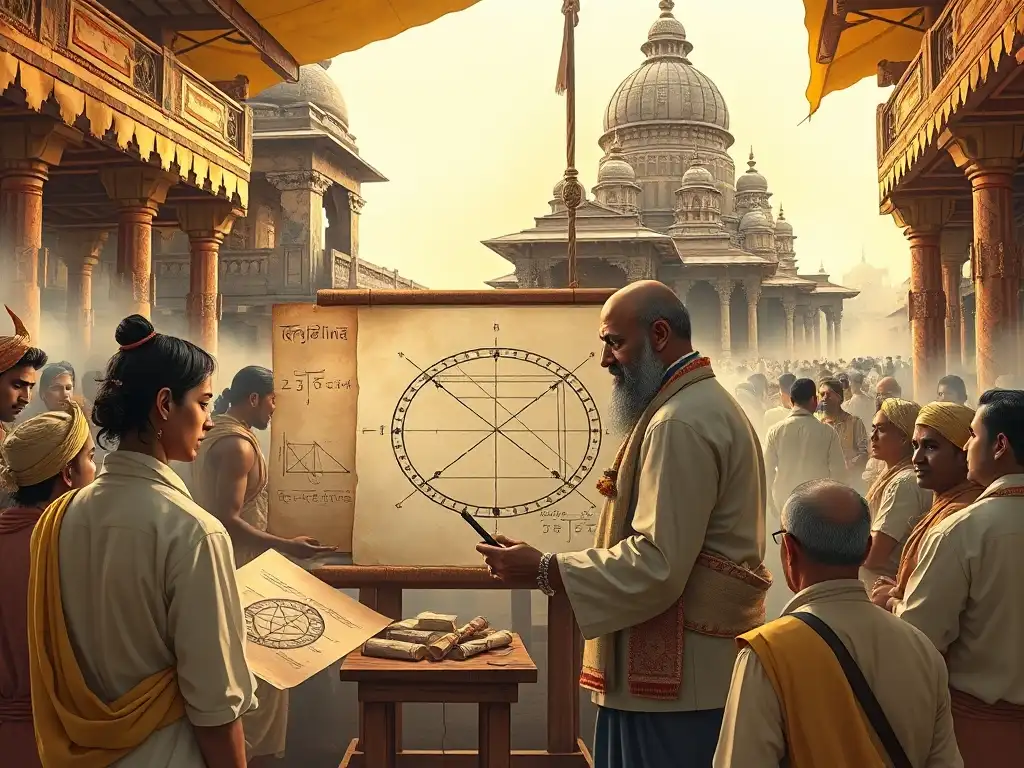
Ancient Indian trigonometry is often discussed in the context of its unique contributions and methodologies compared to other civilizations. The trigonometric concepts developed in India were not only innovative but also laid the groundwork for further advancements in mathematics across cultures. This comparative analysis highlights how ancient Indian trigonometry diverged from or paralleled the developments seen in other civilizations, particularly in terms of theoretical foundations and practical applications.
One of the most notable distinctions is the approach to trigonometric functions. While Greek mathematicians, such as Hipparchus and Ptolemy, focused on chords in circles, Indian mathematicians like Aryabhata and Brahmagupta utilized sine functions, which provided a more refined tool for astronomical calculations. This shift from chords to sines represented a significant advancement in trigonometric understanding.
In terms of numerical foundations, ancient Indian mathematicians made extensive use of the decimal system and positional notation, which was more advanced than the numeral systems employed by the Greeks and Romans. The introduction of zero as a placeholder was a revolutionary concept that further facilitated complex calculations, making Indian contributions to trigonometry uniquely powerful.
Similarities and Differences with Greek Trigonometric Contributions
The Greek contributions to trigonometry primarily revolved around geometry and circular functions, with a strong emphasis on the study of triangles and their properties. Greek mathematicians like Euclid and Ptolemy created comprehensive tables of chords, which were crucial for astronomical observations. However, the Greeks did not develop a systematic framework for trigonometric ratios as seen in Indian mathematics.
In contrast, ancient Indian scholars such as Aryabhata and Varahamihira introduced sine (and later cosine) functions, focusing on the relationships between angles and sides of triangles through these ratios. This transition from chord-based metrics to sine functions represented a paradigm shift in trigonometric thought.
Moreover, the methodology employed in ancient Indian texts, such as the "Surya Siddhanta," showcases a practical application of trigonometry for astronomical purposes, including calculations for eclipses and planetary positions. The systematic approach to defining and calculating sine values in various contexts illustrates a more analytical perspective compared to the Greeks.
Influence of Ancient Indian Trigonometry on Islamic Mathematics
The influence of ancient Indian trigonometry on Islamic mathematics during the medieval period is profound and well-documented. As Islamic scholars translated and built upon earlier texts, they integrated Indian trigonometric concepts, particularly the sine function, into their own mathematical frameworks. Notable figures such as Al-Khwarizmi and Al-Battani were instrumental in this transmission of knowledge.
The adoption of the sine function allowed Islamic mathematicians to refine astronomical calculations further, leading to improved models of celestial movements. Al-Battani’s astronomical tables, which incorporated Indian sine values, were particularly influential and set a precedent for later European astronomers.
Furthermore, the introduction of Indian numerical systems, particularly the use of zero and positional notation, significantly enhanced the computational abilities of Islamic mathematicians. This fusion of Indian and Islamic mathematical traditions ultimately contributed to the development of trigonometry as we know it today.
Conclusion: Legacy of Ancient Indian Trigonometry Contributions

The legacy of ancient Indian trigonometry is one marked by innovation and influence, extending well beyond its geographical and temporal boundaries. The foundational concepts introduced by Indian mathematicians not only enriched their own mathematical traditions but also provided a significant impetus for advancements in mathematics globally.
The Lasting Impact on Modern Trigonometry and Mathematics
The principles laid out by ancient Indian mathematicians continue to resonate in modern trigonometry. The sine function, which emerged from Indian trigonometric studies, remains a cornerstone of trigonometric analysis. The systematic approach to calculations and the use of a positional numeral system have become integral to contemporary mathematical practices.
Moreover, the revival of interest in ancient mathematical texts has inspired modern mathematicians to explore the historical contexts and cultural significance of these contributions, highlighting the interconnectedness of mathematical development across civilizations.
Encouraging Further Exploration of Ancient Indian Mathematical Innovations
The rich history of ancient Indian contributions to trigonometry invites further exploration and study. Researchers and enthusiasts are encouraged to delve into texts such as the "Aryabhatiya" and the "Surya Siddhanta" to uncover the depths of ancient Indian mathematical thought. Engaging with these works not only enhances our understanding of historical mathematics but also enriches our appreciation for the diverse contributions that have shaped modern mathematics.
Incorporating these insights into educational curricula can foster a greater awareness of the global nature of mathematical development, encouraging future generations to appreciate and build upon the legacies of ancient civilizations.
- Introduction to Ancient Indian Trigonometry Contributions
- Historical Context of Trigonometry in Ancient India
- Key Contributions to Trigonometry by Ancient Indian Mathematicians
- Numerical Foundations Supporting Ancient Indian Trigonometry
- Comparative Analysis: Ancient Indian Trigonometry vs. Other Civilizations
- Similarities and Differences with Greek Trigonometric Contributions
- Influence of Ancient Indian Trigonometry on Islamic Mathematics
- Conclusion: Legacy of Ancient Indian Trigonometry Contributions
- The Lasting Impact on Modern Trigonometry and Mathematics
- Encouraging Further Exploration of Ancient Indian Mathematical Innovations
- What are ancient Indian contributions to trigonometry?
- How did ancient Indian mathematicians define trigonometric functions?
- What was the significance of Aryabhata in trigonometry?
- How did the work of Brahmagupta impact trigonometry?
- In what ways did ancient Indian trigonometry influence other cultures?
Frequently Asked Questions
What are ancient Indian contributions to trigonometry?
Ancient Indians made significant contributions to trigonometry, particularly through the development of sine and cosine functions, which were used in astronomical calculations and geometry.
How did ancient Indian mathematicians define trigonometric functions?
They defined trigonometric functions using chord lengths in a circle, leading to the creation of tables that simplified calculations; these were essential for astronomy and navigation.
What was the significance of Aryabhata in trigonometry?
Aryabhata is one of the most renowned ancient Indian mathematicians whose work included the formulation of the sine function and the establishment of trigonometric tables, influencing future mathematical studies.
How did the work of Brahmagupta impact trigonometry?
Brahmagupta built upon previous works by introducing rules for calculating with sine values, thus solidifying the foundation for later advancements in both trigonometry and algebra.
In what ways did ancient Indian trigonometry influence other cultures?
The trigonometric methods developed in ancient India spread to the Islamic world and later to Europe, significantly impacting the development of mathematics and astronomy during the Middle Ages.
Final Reflection: The Enduring Legacy of Ancient Indian Trigonometry
The contributions of ancient Indian mathematicians to trigonometry are not just historical footnotes; they are foundational pillars that continue to shape modern mathematics and science. In an era where the world is increasingly reliant on technology and precise calculations, the principles established by these early scholars remind us of the profound depth of knowledge that has been passed down through generations. The brilliance of their work serves as a testament to human ingenuity and the timeless quest for understanding the universe.
The influence of ancient Indian trigonometry extends far beyond the confines of academia; it permeates our daily lives, from navigation to architecture. The methods and concepts developed by these mathematicians have laid the groundwork for advancements in various fields, including astronomy and engineering. As we reflect on this rich heritage, we are reminded of the words of the great mathematician Bhaskara II: Mathematics is the language of the universe.
This quote encapsulates the essence of how ancient Indian contributions have not only enriched our mathematical vocabulary but have also provided us with tools to interpret the world around us.
As we look to the future, let us embrace the lessons from ancient Indian trigonometry and recognize the importance of preserving and celebrating our mathematical heritage. I invite you to explore these contributions further, to appreciate the intricate connections between past and present, and to apply this knowledge in your own life. Whether you are a student, a teacher, or simply a curious mind, consider how the principles of trigonometry can enhance your understanding of the world and inspire you to contribute to the ongoing legacy of mathematical exploration.
Unveil the Secrets of Ancient Trigonometry!
Thank you for diving into the fascinating world of ancient Indian contributions to trigonometry! You've gained valuable insights into how these early mathematicians laid the groundwork for this essential field. Now, it's time to take your knowledge further and engage with this rich heritage.
Here are some actionable steps you can take:
- Dive deeper into ancient texts by accessing translations or analyses of works like the Surya Siddhanta. Discover the mathematical wonders of yesteryear!
- Share your insights with friends or fellow enthusiasts by discussing these contributions on social media or in community forums. Spread the knowledge and inspire others!
- Experiment with trigonometry in your own life by applying ancient methods to modern problems—try calculating heights or distances using the techniques you’ve learned.
What aspect of ancient Indian mathematics surprises you the most, and how can you incorporate it into your daily life?