
Beyond Numerals: The Philosophical Significance of Zero in Ancient Indian Thought


Welcome to Ancient India History, where we embark on a fascinating journey through the rich tapestry of India’s past! Delve into the profound philosophical significance of zero, a concept that transcended mere numerals and reshaped the very foundations of mathematics and thought in ancient Indian civilizations. As you explore this pivotal article, get ready to uncover how this seemingly simple symbol sparked a revolution in understanding and perception, influencing cultures far beyond its origin. Join us in unraveling the mysteries and contributions of the ancients, and prepare to be inspired by the depth of their wisdom!
- Introduction to the Philosophical Significance of Zero
- Historical Background of Zero in Ancient India
- The Philosophical Dimensions of Zero
- Zero in Ancient Indian Philosophy
- The Impact of Zero on Mathematical Thought
- The Legacy of Zero in Modern Philosophy and Mathematics
- Conclusion
-
Frequently Asked Questions
- What is the philosophical significance of zero in ancient Indian thought?
- How did ancient Indian mathematicians contribute to the concept of zero?
- In what ways did zero impact other fields beyond mathematics in ancient India?
- What are some key texts that discuss the significance of zero in ancient India?
- How does the understanding of zero differ in Western thought compared to ancient Indian thought?
- Final Reflection: Embracing the Philosophical Significance of Zero
- Embrace the Power of Zero: Transform Your Understanding Today!
Introduction to the Philosophical Significance of Zero
The concept of zero is often taken for granted in modern mathematics, yet its journey to prominence is deeply intertwined with ancient Indian thought. In the context of Indian civilization, zero transcends its role as merely a numerical placeholder; it embodies profound philosophical ideas and reflects the rich cultural tapestry of its time.
This article delves into the philosophical significance of zero, exploring how ancient scholars perceived this enigmatic numeral and its impact on both mathematics and philosophy. By understanding the origins and implications of zero in ancient Indian society, we gain insight into a pivotal moment in the evolution of mathematical thought and its broader existential questions.
Understanding Zero in Ancient Indian Context
The emergence of zero in ancient India marked a revolutionary shift not just in mathematics but also in the realms of philosophy and cosmology. In the Brahmi numerals, used during the early centuries CE, zero was represented as a dot or a small circle, signifying absence or void. This representation was not merely a mathematical convenience; it also carried significant philosophical weight.
- Symbol of Emptiness and Infinity:
- In Hindu philosophy, the concept of śūnyatā (emptiness) is central, illustrating that emptiness is not a lack but a state of potentiality. Zero symbolizes this idea, representing both the void and the infinite possibilities that arise from it.
- Interconnection of Existence:
- The ancient Indian worldview often emphasized the interconnectedness of all things. Zero, as a concept, encapsulates this by indicating that every number, no matter how large, contains within it the potential for nothingness. This duality invites deeper reflection on existence itself.
The exploration of zero in ancient texts like the Bakhshali Manuscript and works by mathematicians such as Brahmagupta illustrates the integration of mathematical rigor and philosophical inquiry, paving the way for future advancements in mathematics.
Importance of Zero in Mathematics and Philosophy
The philosophical significance of zero extends beyond its mathematical utility; it challenges and enriches our understanding of reality itself.
- Mathematical Revolution:
- The introduction of zero allowed for the development of advanced mathematical concepts such as algebra and calculus. Without zero, the binary system that underlies modern computing would not exist, demonstrating how this numeral is foundational to contemporary mathematics.
- Philosophical Implications:
- Zero raises essential questions regarding existence and non-existence, prompting philosophical debates that resonate even today. For instance:
- What does it mean to "have nothing"?
- How do we understand the concept of infinity through the lens of zero?
- Zero raises essential questions regarding existence and non-existence, prompting philosophical debates that resonate even today. For instance:
The philosophical significance of zero in ancient Indian thought is a testament to the civilization's profound intellectual contributions. This exploration reveals how a simple numeral can encapsulate complex philosophical ideas and transform our approach to mathematics and beyond. As we continue to delve deeper into this topic, we uncover not just the history of zero, but also its enduring legacy in shaping human thought and understanding.
Historical Background of Zero in Ancient India
Origins of Zero: The Concept and Its Development
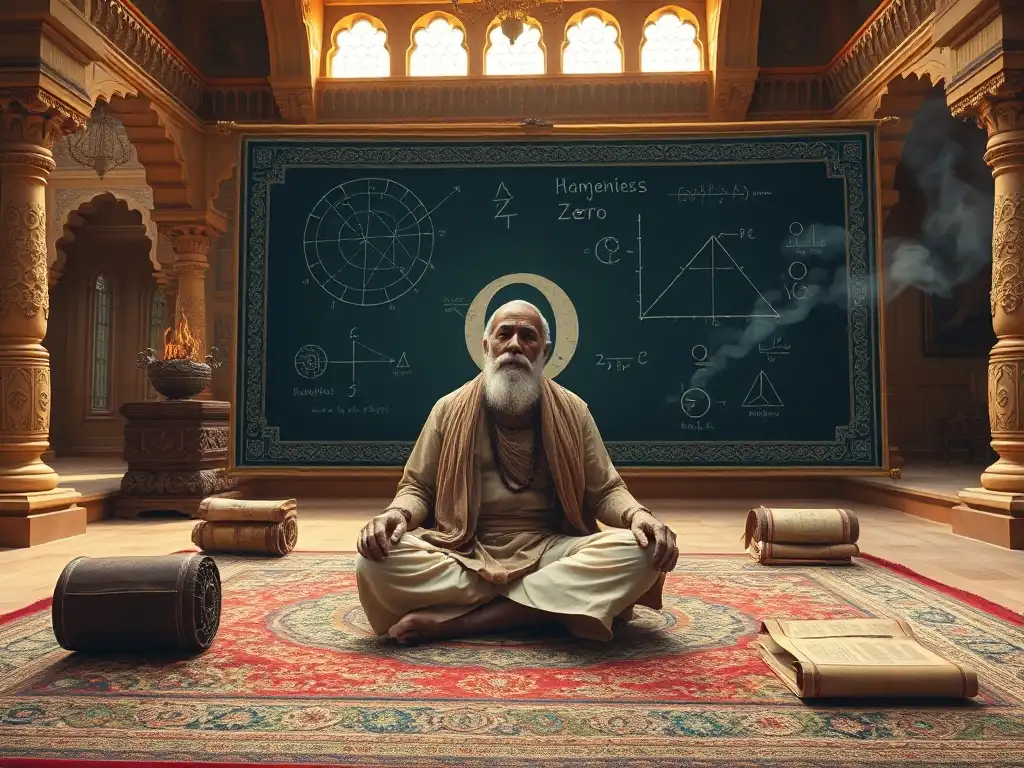
The concept of zero has profound philosophical significance in ancient Indian thought, transcending mere numerical value to embody deeper existential and metaphysical ideas. The origins of zero can be traced back to the ancient Indian numeral system, which evolved during the early centuries CE.
Initially, the notion of zero represented a placeholder in positional notation, which allowed for the distinction between numbers like 205 and 25. This innovation was crucial for simplifying calculations and enhancing the efficiency of trade and commerce. However, zero soon evolved beyond its practical utility to symbolize the concept of 'nothingness' or 'void' (शून्य, śūnya).
Philosophically, the idea of nothingness carries significant weight in Indian philosophy, particularly in schools such as Buddhism and Jainism. Zero as a concept illustrates the interplay between existence and non-existence, prompting profound questions about the nature of reality itself. This duality is encapsulated in the ancient saying, "From nothing, everything arises," suggesting that the void is an essential precursor to manifestation.
Historical Texts and References to Zero
The philosophical significance of zero is deeply embedded in numerous ancient texts, which reflect its mathematical, spiritual, and cosmological implications. One of the earliest recorded mentions of zero appears in the work of the mathematician Aryabhata (476–550 CE). In his seminal text, the Aryabhatiya, Aryabhata utilized a symbol for zero, indicating a sophisticated understanding of its role in mathematics and its importance as a concept.
Another critical reference can be found in the Bakhshali Manuscript, an ancient Indian text that dates back to the 2nd century CE. This manuscript contains mathematical problems and solutions, and it notably uses a dot to represent zero. This early utilization highlights the transition from a mere placeholder to an abstract concept worthy of philosophical exploration.
Furthermore, the Brahmasphutasiddhanta by Brahmagupta (598–668 CE) explicitly discusses the rules for arithmetic operations involving zero, including addition, subtraction, and multiplication. Brahmagupta’s insights reflect an advanced understanding of mathematics and hint at the philosophical ramifications of zero in terms of the cycle of creation and destruction, thus linking mathematics with metaphysics.
In the context of Indian philosophy, the works of philosophers such as Nagarjuna and Adi Shankaracharya also engage with the theme of nothingness, echoing the significance of zero as a philosophical cornerstone. Nagarjuna’s concept of śūnyatā (emptiness) parallels the mathematical notion of zero, reinforcing its role in both mathematics and spiritual discourse.
The historical references to zero in ancient India illustrate not only its mathematical significance but also its rich philosophical implications, which resonate through both classical texts and contemporary thought. The integration of zero into the fabric of Indian philosophy exemplifies how mathematical concepts can provide profound insights into the nature of existence and reality.
The Philosophical Dimensions of Zero
Zero as a Symbol of Emptiness and Potential
In ancient Indian philosophy, zero transcended its mathematical function to embody profound philosophical meanings. It emerged as a symbol of emptiness, often linked with the concept of śūnyatā, or voidness, in Buddhist thought. This concept posits that emptiness is not merely a lack of existence but a space filled with potentiality. The idea of zero encapsulates this dual nature—representing both absence and the possibility of creation.
Key Interpretations of Zero
- Emptiness in Creation: Zero signifies the void from which all things arise, suggesting that from nothing comes everything. This aligns with the philosophical notion that reality is a synthesis of being and non-being.
- Transcendental Potential: Zero is seen as a gateway to infinite possibilities. In the context of meditation and spiritual practices, it reflects the state of mind where one can transcend material attachments and reach higher states of consciousness.
The philosophical significance of zero highlights a critical intersection where mathematics meets metaphysics, emphasizing that the absence of quantity is as meaningful as its presence. This reflects a deep understanding of existence that resonates throughout various ancient Indian philosophical traditions.
The Duality of Existence: Nothingness versus Being
The concept of zero in ancient Indian thought asserts a rich duality between nothingness and being. This duality is pivotal in understanding how ancient scholars perceived the universe and the nature of reality.
Exploring the Duality
- Philosophical Dichotomy:
- Nothingness: Considered a state devoid of tangible attributes, nothingness is often feared and misunderstood. However, it is also viewed as a necessary precursor to existence.
- Being: Represents the manifested world, full of forms and identities. It is celebrated as the realm of experience, yet it’s intrinsically linked to the emptiness that gives it meaning.
- Cyclic Nature of Existence:
- Ancient Indian philosophies often describe existence as cyclical, where creation, preservation, and dissolution reflect the interplay between being and nothingness. Zero symbolizes this cycle, emphasizing that endings lead to new beginnings.
- Spiritual Implications:
- In spiritual contexts, realizing the nature of zero—embracing both nothingness and being—can lead to enlightenment. This understanding fosters a profound acceptance of life’s transient nature, encouraging individuals to seek balance and harmony.
In essence, the philosophical significance of zero in ancient Indian thought offers a compelling framework for understanding the interplay of existence. It serves as a reminder that both absence and presence are vital in weaving the intricate tapestry of reality, ultimately leading to deeper insights into the human condition.
Zero in Ancient Indian Philosophy

Zero has a profound philosophical significance in ancient Indian thought, transcending its mathematical utility. In India, the concept of zero was not merely a number but also represented a philosophical idea reflecting the nature of existence, void, and the universe. This rich conceptualization is evident in various ancient texts and teachings that explore the nature of reality.
The earliest references to zero can be traced back to the Brahmi numerals around the 3rd century BCE. However, it was the philosophical discourse surrounding nothingness and infinitude that gave zero its profound significance. The ancient Indian philosophers explored the essence of existence and non-existence, often using zero as a representation of the void that exists between dualities. This exploration contributed to a broader understanding of reality, which is foundational in various Indian philosophies, including Buddhism and Vedanta.
Contributions of Notable Thinkers on Zero
Several notable thinkers in ancient India contributed to the philosophical understanding of zero, bridging the realms of mathematics and metaphysics.
- Brahmagupta: One of the most significant figures in the discourse on zero was Brahmagupta, a 7th-century mathematician and astronomer. In his seminal work, Brahmasphutasiddhanta, he described rules for arithmetic operations involving zero, but he also philosophically contemplated its implications. He viewed zero as a representation of the void and discussed its relationship with positive and negative numbers, emphasizing that zero itself does not possess a definitive value, thereby hinting at the philosophical notion of emptiness.
- Aryabhata: Aryabhata, another prominent mathematician from the 5th century, also engaged with the concept of zero. He introduced a positional number system that utilized zero, allowing for a more sophisticated approach to mathematics. His philosophical perspective revolved around the cyclic nature of time and existence, where zero symbolized the endless cycle of creation and dissolution, reflecting the broader cosmic order.
- Vedic Texts: The philosophical significance of zero can also be traced back to the Vedas, ancient Indian scriptures. The concept of Shunya (emptiness or void) in the Upanishads parallels the mathematical zero, suggesting a deeper understanding of the universe's nature. The interplay between existence and non-existence is a recurring theme, indicating that the philosophical discourse on zero was deeply entrenched in the spiritual and cosmological understanding of ancient Indian thought.
Zero and Its Relation to Indian Cosmology and Spirituality
In the context of Indian cosmology and spirituality, zero embodies the concept of Shunya, which signifies not just a numerical value but also a vital philosophical principle.
- Cosmic Cycle: In Hindu cosmology, the universe is often described as cyclic, comprising cycles of creation, preservation, and destruction. Zero symbolizes the point of transition between these cycles, representing the void that exists before creation and after destruction. This cyclical view of existence aligns with the understanding of zero as a pivotal element in the eternal nature of the cosmos.
- Spiritual Emptiness: Zero is also linked to the spiritual idea of emptiness in Buddhism, where the notion of Shunyata (emptiness) signifies the absence of inherent existence. This philosophical stance posits that all phenomena are interdependent and lack a permanent essence. The embrace of emptiness as a fundamental truth parallels the mathematical concept of zero, emphasizing the idea that true understanding arises from recognizing the void.
- Meditative Practices: In various meditative and yogic traditions, practitioners often seek to attain a state of emptiness or stillness, akin to the concept of zero. This reflects the philosophical notion that true knowledge and enlightenment stem from the realization of the void and the cessation of dualistic thinking, echoing the deeper implications of zero in ancient Indian philosophy.
The philosophical significance of zero in ancient Indian thought extends beyond mere mathematics, intertwining with cosmological and spiritual dimensions. The contributions of thinkers like Brahmagupta and Aryabhata, alongside the rich philosophical discourse found in the Vedic texts, highlight zero as a profound concept that encapsulates the essence of existence, non-existence, and the universe's cyclical nature.
The Impact of Zero on Mathematical Thought

Zero is not merely a numeral; it represents a profound concept that has significantly transformed mathematical thought. The introduction and conceptualization of zero in ancient India marked a pivotal moment in the evolution of mathematics, enabling mathematicians to explore and articulate complex theories and operations with unprecedented clarity and precision.
Zero’s Role in Advancing Mathematical Concepts
The philosophical significance of zero is deeply rooted in its dual role as both a placeholder and a symbol of void. This duality allowed mathematicians to perform calculations that were previously impossible, fundamentally altering the landscape of mathematics. Here are several key areas where zero made a notable impact:
- Place Value System:
- The inclusion of zero in the place value system enabled the representation of large numbers efficiently. For instance, the number 205 is distinctly different from 25, thanks to the zero serving as a placeholder.
- This advancement simplified arithmetic operations and paved the way for complex calculations involving large integers.
- Arithmetic Operations:
- Zero’s introduction facilitated operations such as addition and multiplication. For example:
- Any number added to zero remains unchanged (a + 0 = a).
- Any number multiplied by zero results in zero (a × 0 = 0).
- This property allowed for the development of algebraic structures and equations, leading to more sophisticated mathematical reasoning.
- Zero’s introduction facilitated operations such as addition and multiplication. For example:
- Negative Numbers and the Concept of Infinity:
- The philosophical implications of zero extend to the concepts of negative numbers and infinity. The existence of zero allows for the representation of quantities below zero, thus broadening the scope of mathematical inquiry.
- Moreover, zero serves as a bridge to the concept of infinity in calculus, influencing mathematical theories concerning limits and continuity.
- Symbolizing Nothingness:
- In a philosophical context, zero embodies the idea of nothingness, posing questions about existence and reality. This reflection was not merely mathematical; it influenced various fields such as metaphysics and cosmology in ancient Indian thought.
Comparing Ancient Indian Perspectives with Other Civilizations
While zero's introduction in ancient India was groundbreaking, its philosophical significance can be contrasted with perspectives from other civilizations. Here are some noteworthy comparisons:
- Mesopotamia:
- The Babylonians had a placeholder system similar to that of ancient India, but they lacked a true representation of zero. Their system, which was sexagesimal (base-60), used a space to indicate absence but did not conceptualize zero as a number.
- This limitation hindered their ability to perform more complex calculations and represent larger numbers effectively.
- China:
- The Chinese numerals system did not incorporate zero until later periods. Early Chinese mathematics relied heavily on counting rods, which did not necessitate a concept of zero. However, once introduced, it became integral to their mathematical practices.
- The philosophical implications of zero were less pronounced in Chinese thought compared to the rich discourse found in ancient Indian philosophy.
- Greece:
- Greek mathematicians were largely resistant to the idea of zero, primarily due to their philosophical views on infinity and nothingness. Figures like Aristotle considered the concept of "nothing" to be problematic, thus delaying the acceptance of zero within their mathematical frameworks.
- This philosophical stance contrasted sharply with the acceptance of zero in Indian thought, where it was embraced as a legitimate and beneficial concept.
The philosophical significance of zero in ancient Indian thought is vast and multifaceted, influencing not only mathematics but also a broader array of philosophical inquiries. Its integration into mathematical systems provided a framework for future advancements, allowing for the exploration of complex ideas that resonate through the ages. Zero's role as a symbol of both nothingness and potentiality continues to inspire philosophical reflection and mathematical innovation today.
The Legacy of Zero in Modern Philosophy and Mathematics

Influence of Ancient Indian Thought on Contemporary Understanding
The legacy of zero, as a concept and symbol, traces back to ancient Indian mathematics, where it was not merely a numeral but a profound philosophical idea. In ancient Indian texts, particularly from the 5th century onward, zero was recognized not just for its mathematical utility but for its broader implications about existence, nothingness, and the nature of reality.
- Philosophical Foundations:
- The concept of śūnyatā, or emptiness, as articulated in Buddhist philosophy, parallels the mathematical idea of zero. This notion suggests that nothingness holds intrinsic value and meaning, shaping contemporary dialogues in both philosophy and mathematics.
- Philosophers like Brahmagupta and Aryabhata integrated zero into their works, influencing the way mathematics was perceived. They established rules for arithmetic involving zero, which laid the groundwork for future mathematical thought.
- Cultural Integration:
- The transmission of zero from India to the Islamic world and eventually to Europe is a testament to its profound impact. It transformed not only mathematics but also philosophical discussions about the infinite and the void.
- Modern philosophers often draw on ancient Indian interpretations of zero to explore contemporary existential questions, highlighting the enduring relevance of these ancient insights.
- Mathematical Evolution:
- In the context of mathematics, zero's acceptance as a number revolutionized calculations and advanced the field significantly. The introduction of the decimal system, which included zero, paved the way for modern arithmetic and algebra.
- By understanding zero's historical roots, mathematicians today can appreciate its role in not just calculations but in shaping theoretical frameworks, such as calculus and set theory.
The Philosophical Significance of Zero in Modern Contexts
The philosophical significance of zero transcends its mathematical utility; it invites reflection on existence, identity, and the cosmos.
- Existential Reflections:
- Zero embodies the duality of existence and non-existence. It prompts critical questions about what it means to "be" versus "not be," influencing existentialist thought and discussions in metaphysics.
- In modern philosophy, zero emerges as a symbol of potentiality—representing the void from which all existence arises. This aligns with various philosophical traditions that regard emptiness as a fertile ground for creation.
- Implications in Science:
- Zero also plays a pivotal role in scientific theories. For instance, in physics, the concept of absolute zero symbolizes the complete absence of thermal energy, challenging our understanding of temperature and energy states. This has broader implications for theories about the universe and the nature of reality.
- Moreover, zero's role in chaos theory and complex systems highlights its importance in understanding unpredictable phenomena in nature, illustrating how ancient ideas continue to resonate in modern scientific discourse.
- Digital Age and Zero:
- In the digital realm, zero is foundational to binary code, making it essential for computer science and technology. Its philosophical implications are reflected in discussions about artificial intelligence and the nature of consciousness, where the distinction between existence (1) and non-existence (0) is paramount.
- As we navigate a world increasingly defined by technology, the philosophical significance of zero prompts us to consider the implications of digital existence and the nature of reality in an age dominated by information.
The philosophical significance of zero, rooted in ancient Indian thought, continues to shape contemporary understanding across various domains, from mathematics to existential inquiries. Its legacy is a rich tapestry woven with threads of cultural, philosophical, and scientific significance, proving that zero is not merely a number but a profound concept that challenges our understanding of existence itself.
Conclusion
Recap of the Philosophical Significance of Zero
The philosophical significance of zero in ancient Indian thought transcends mere numerical representation; it embodies a profound conceptual shift in understanding existence and the nature of reality. In the context of ancient Indian philosophy, zero symbolizes the idea of śūnyatā or emptiness, suggesting that the absence of something can be as significant as its presence. This duality challenges conventional perceptions and encourages a deeper exploration of existence.
The contributions of Indian mathematicians like Brahmagupta and Aryabhata not only revolutionized mathematics but also initiated a dialogue about the nature of nothingness. Zero was not merely a placeholder but a vital entity that influenced metaphysical discussions around creation and the cosmos. This perspective invites us to reflect on how notions of nothingness can influence our understanding of existence, knowledge, and the universe.
Future Implications of Understanding Zero in Philosophy and Mathematics
The exploration of the philosophical significance of zero continues to resonate within both philosophical and mathematical realms today. As we delve deeper into its implications, several key areas emerge:
- Interdisciplinary Connections:
- The study of zero bridges mathematics and philosophy, encouraging collaborative dialogues that can lead to innovative ideas and theories. Scholars from various disciplines can explore how zero influences concepts of void, existence, and reality.
- Influence on Modern Scientific Thought:
- Understanding zero can reshape our approach to scientific inquiry, especially in fields like quantum physics and cosmology, where the concepts of void and existence are pivotal. This re-examination can inspire new theories that challenge traditional views of the universe.
- Cultural and Philosophical Dialogue:
- The philosophical discourse surrounding zero can foster intercultural dialogues, allowing diverse perspectives on existence and nothingness to emerge. This inclusivity can enrich philosophical thought and enhance our understanding of different worldviews.
- Educational Implications:
- By integrating the philosophical significance of zero into educational curriculums, educators can encourage critical thinking and a deeper appreciation for the interplay between mathematics and philosophy among students.
- Application in Contemporary Issues:
- The ideas surrounding zero can be applied to contemporary issues, such as discussions on sustainability and the nature of resources. Understanding the significance of absence can lead to more profound insights into consumption, conservation, and the balance of existence.
The philosophical significance of zero serves as a cornerstone for future explorations in philosophy and mathematics. By recognizing its importance, we open pathways for new understanding and interdisciplinary connections that can illuminate both ancient and modern perspectives on existence.
Frequently Asked Questions
What is the philosophical significance of zero in ancient Indian thought?
The philosophical significance of zero lies in its representation of void and infinity, challenging our understanding of existence and non-existence.
How did ancient Indian mathematicians contribute to the concept of zero?
Ancient Indian mathematicians, notably Brahmagupta, developed the concept of zero not just as a numeral but as a philosophical idea, influencing mathematics and philosophy globally.
In what ways did zero impact other fields beyond mathematics in ancient India?
The concept of zero influenced astronomy, art, and spirituality, allowing for a deeper exploration of cosmic concepts and the nature of reality in ancient Indian culture.
What are some key texts that discuss the significance of zero in ancient India?
Key texts include Brahmagupta's Brahmasphutasiddhanta and Bhaskara's Lilavati, which articulate the mathematical and philosophical implications of zero.
How does the understanding of zero differ in Western thought compared to ancient Indian thought?
In Western thought, zero was often seen merely as a placeholder, while in ancient Indian thought, it symbolized existential concepts, bridging mathematics and philosophy.
Final Reflection: Embracing the Philosophical Significance of Zero
The exploration of zero transcends mere mathematics; it embodies a profound philosophical journey that is increasingly relevant in our modern world. In an age where we often find ourselves grappling with concepts of nothingness and existence, the ancient Indian understanding of zero as both a placeholder and a symbol of potential invites us to reconsider our perceptions of value and meaning. The philosophical significance of zero is not just a relic of history; it is a lens through which we can view our contemporary dilemmas and aspirations.
The impact of zero on our cultural and intellectual landscape is immeasurable, shaping not only mathematics but also our understanding of the universe and existence itself. The ancient Indian thinkers recognized that zero represents a duality—the void and the fullness—challenging us to find balance in our lives. As the philosopher Nagarjuna once articulated, “Emptiness is form, form is emptiness,” we are reminded that the absence of something can be just as significant as its presence. This ongoing dialogue about the nature of reality continues to influence modern philosophical discourse, urging us to embrace complexity and ambiguity.
As we reflect on the lessons of zero, let us consider how we can apply this understanding to our own lives. I invite you to ponder the spaces of emptiness within you—those moments of stillness and potential that often go unnoticed. Embrace the idea that from nothing can emerge great possibilities, and allow this perspective to inspire your journey forward. In recognizing the philosophical significance of zero, we not only honor the wisdom of the past but also empower ourselves to navigate the future with a deeper understanding of existence and purpose.
Embrace the Power of Zero: Transform Your Understanding Today!
Thank you for diving deep into the fascinating world of ancient Indian philosophy with us! By exploring the profound significance of zero, you've unlocked a unique lens through which to view mathematics, culture, and even existential inquiry.
Now, it's time to take your insights further and engage with this rich topic. Here are some exciting steps to consider:
- Join our discussion: Share your thoughts about the philosophical implications of zero in our comments section or in our community forum. Your perspective could inspire others!
- Explore related readings: Dive into more articles on the significance of numbers in ancient cultures or discover how philosophy has influenced scientific thought throughout history.
- Challenge yourself: Attempt to integrate concepts from ancient Indian philosophy into your daily life. How can the idea of "nothingness" influence your perspective on the challenges you face today?
What revelations or insights do you believe zero offers us in our quest for meaning and understanding in a complex world? Let's unravel this together!