
The Role of Astronomy in Advancing Ancient Indian Numerical Systems


Welcome to Ancient India History, where we delve into the rich tapestry of civilizations that shaped a remarkable era. In this exploration, we shine a light on the fascinating contributions of ancient Indian astronomy, a realm where the stars guided not only navigation but also the evolution of numerical systems. Join us as we uncover how these celestial insights influenced mathematics and left an indelible mark on the world. Prepare to be captivated by the stories that intertwine the cosmos and culture, inviting you to explore deeper into the legacy that continues to inspire.
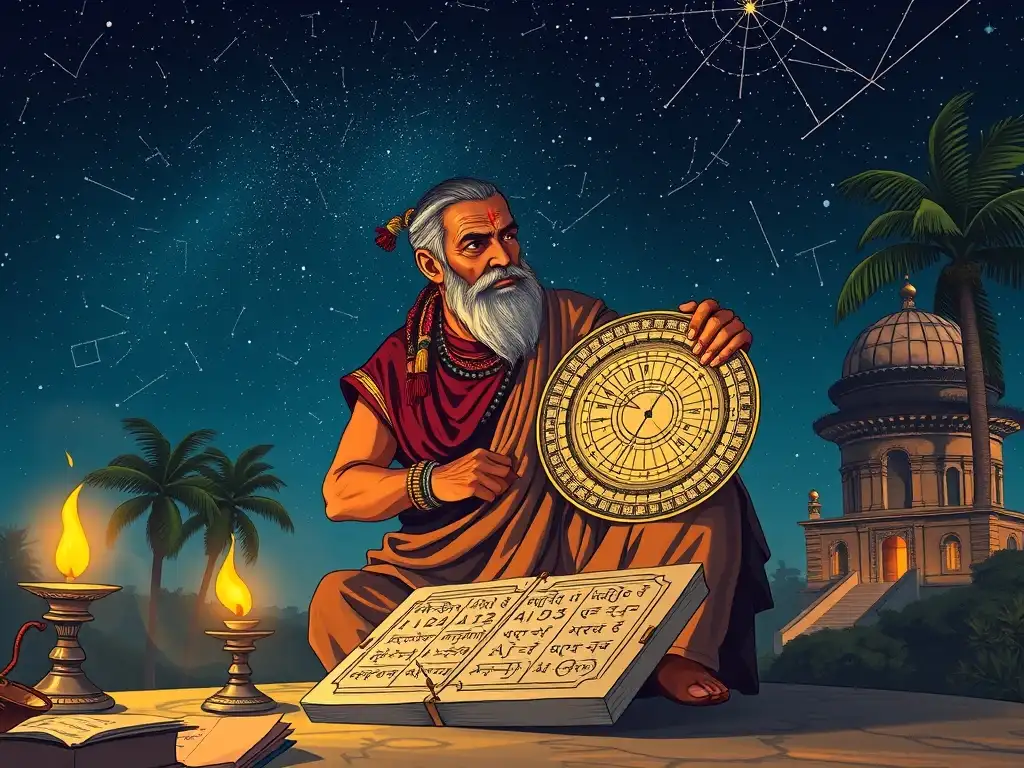
Introduction to Ancient Indian Astronomy Contributions
Ancient India has long been a cradle of knowledge, particularly in the fields of mathematics and astronomy. The contributions of ancient Indian astronomy are not only fascinating but also crucial in shaping the numerical systems that evolved over centuries. By examining the intersection of astronomy and mathematics, we can better understand how celestial observations influenced numerical concepts and calculations.
This exploration will delve into the sophisticated astronomical practices of ancient Indian civilizations and how they laid the groundwork for advancements in numerical systems, ultimately impacting mathematics as a whole. This article will highlight key elements of ancient Indian astronomy contributions, illustrating their significance in the development of numerical systems.
Overview of Ancient Indian Astronomy
Ancient Indian astronomy was characterized by its remarkable precision and depth, encompassing a variety of practices and theories. Astronomers like Aryabhata and Brahmagupta made groundbreaking observations that contributed to a rich tapestry of knowledge. Here are some key aspects:
- Celestial Observations: Ancient Indian astronomers meticulously observed the movements of celestial bodies, including the sun, moon, and stars, leading to the development of complex calendars.
- Mathematical Formulations: The integration of mathematics into astronomy resulted in innovative calculations for predicting eclipses, planetary positions, and other astronomical events.
- Influence on Navigation: These astronomical insights were vital for navigation and agriculture, helping societies align their activities with celestial cycles.
Importance of Numerical Systems in Astronomy
The connection between astronomy and numerical systems in ancient India cannot be overstated. The development of a robust numerical framework was essential for:
- Accurate Predictions: The ability to predict celestial events required precise numerical calculations, leading to the development of advanced mathematical techniques.
- Standardization of Measurements: The need for standardized measurements in astronomy fostered the creation of numerals and measurement systems, further enhancing numerical literacy.
- Cultural Significance: Astronomy played a crucial role in societal functions, influencing everything from religious practices to agricultural cycles, which necessitated a reliable numerical system.
Historical Context of Astronomy in Ancient India
To fully appreciate the contributions of ancient Indian astronomy to numerical systems, it is essential to explore the historical context in which these advancements occurred.
Key Civilizations Contributing to Astronomy
Several ancient Indian civilizations made significant strides in astronomy:
- Indus Valley Civilization: Early evidence of astronomical knowledge can be traced back to this civilization, which showcased an understanding of celestial patterns.
- Vedic Period: The texts from this era, particularly the Jyotisha (astrology), emphasized celestial phenomena and their importance in Vedic rituals.
- Classical Period: The Gupta Empire, often referred to as the Golden Age of India, saw the emergence of prominent astronomers like Aryabhata, whose works laid the foundation for future developments in both astronomy and mathematics.
Influence of Religious and Cultural Beliefs on Astronomy
Religious and cultural beliefs profoundly influenced the direction of astronomical studies in ancient India:
- Astrology: The intertwining of astronomy and astrology led to a deeper understanding of celestial movements and their perceived impact on human affairs.
- Calendar Systems: Cultural practices necessitated the development of accurate calendar systems, directly linking astronomical observations to societal needs.
- Philosophical Perspectives: Ancient Indian philosophy often explored the cosmos, leading to a holistic view of the universe that integrated scientific inquiry with spiritual understanding.
By examining these elements, we can appreciate how ancient Indian astronomy not only advanced numerical systems but also enriched the cultural and scientific heritage of the civilization.
Major Contributions of Ancient Indian Astronomy
Ancient Indian astronomy made significant contributions that not only advanced the study of the cosmos but also catalyzed the development of numerical systems. Scholars such as Aryabhata, Varahamihira, and Brahmagupta laid foundational principles that influenced both mathematics and astronomy. Their works illustrated sophisticated methods for calculating celestial phenomena, which in turn necessitated the development of more advanced numerical systems. These contributions were not merely theoretical; they had practical implications for navigation, agriculture, and religious practices, highlighting the integral relationship between astronomy and daily life in ancient India.
Development of Astronomical Calculations
The ancient Indian astronomers excelled in developing calculations that were essential for predicting celestial events. Aryabhata, in his seminal work "Aryabhatiya," introduced algorithms for calculating the positions of celestial bodies, eclipses, and planetary movements. His approach combined trigonometric methods with numerical calculations, effectively showcasing an early form of what we now recognize as mathematical modeling.
To facilitate these calculations, the ancient Indian mathematicians adopted a place-value system, which became crucial in performing complex computations. The use of zero as a placeholder emerged during this era, vastly improving numerical representation and calculation efficiency. This innovation allowed scholars to work with large numbers and perform operations that were previously cumbersome, thus advancing both astronomy and numerical systems significantly.
Innovations in Timekeeping and Calendar Systems
Timekeeping and calendar systems in ancient India were heavily influenced by astronomical observations. The need to align agricultural activities with celestial cycles led to the development of sophisticated calendars. The ancient Indian calendar, known as the "Panchang," was based on lunar cycles and incorporated solar adjustments. This combination allowed for accurate predictions of seasonal changes, which were crucial for farming societies.
Moreover, the use of astronomical instruments, such as the gnomon and the astrolabe, enabled astronomers to track the sun’s shadow and celestial positions, improving their timekeeping capabilities. These innovations required precise calculations and numerical accuracy, further enhancing the mathematical framework of the time.
The Role of Astronomical Observations in Numerical Advancements
Astronomical observations not only enriched the field of astronomy but also acted as a driving force behind the development of numerical systems. By systematically observing celestial phenomena, ancient astronomers collected data that demanded rigorous mathematical analysis. For instance, the calculation of planetary positions required the use of sine and cosine functions, which were developed to address the complexities of celestial mechanics.
The meticulous nature of these observations led to the formulation of various mathematical techniques, including interpolation and approximation methods. Such techniques were vital for refining numerical accuracy, thus fostering innovations in mathematics that would influence future generations of scholars.
Interconnection Between Astronomy and Numerical Systems
The interconnection between astronomy and numerical systems in ancient India is evident in the way astronomical phenomena influenced mathematical thought. The precision required in astronomical calculations spurred developments in numerical theories and practices that laid the groundwork for advanced mathematics.
How Astronomy Influenced Mathematical Concepts
Astronomy in ancient India played a pivotal role in shaping mathematical concepts. The necessity to compute celestial movements led to the establishment of various mathematical principles, including arithmetic, geometry, and algebra. For example, the calculations involved in determining the timing of eclipses required an understanding of cycles and ratios, which in turn led to the refinement of fractional mathematics.
The influence of astronomical observations also extended to the conceptualization of infinity and large numbers. Ancient Indian mathematicians grappled with the vastness of space and time, prompting the exploration of mathematical concepts that transcended conventional limits. This philosophical inquiry into numbers contributed significantly to the evolution of mathematics.
The Synergy Between Astronomy and Geometry in Ancient India
The synergy between astronomy and geometry in ancient India is particularly notable in the application of geometric principles to celestial problems. The ancient Indian astronomers utilized geometric shapes and theorems to understand the movements of celestial bodies, resulting in the development of spherical geometry. This advancement was essential for calculating the positions of stars and planets.
Additionally, texts like the "Surya Siddhanta" showcased the integration of geometry with astronomy, demonstrating how geometric constructions could be used to predict solar and lunar eclipses. The application of geometry not only facilitated precise astronomical calculations but also enriched the broader field of mathematics, illustrating the profound interdependence of these disciplines in ancient Indian intellectual tradition.
Prominent Figures in Ancient Indian Astronomy

Ancient Indian astronomy is a rich field marked by significant figures whose contributions laid the groundwork for mathematical innovations and numerical systems. The two most eminent astronomers, Aryabhata and Brahmagupta, profoundly influenced both the scientific landscape of their time and the evolution of mathematics in India. Their works not only advanced the understanding of celestial phenomena but also integrated complex numerical systems that addressed practical problems in astronomy and mathematics. This section delves into their individual contributions and the lasting impact of their discoveries.
Aryabhata and His Mathematical Innovations
Aryabhata, who lived in the 5th century CE, is often hailed as one of the greatest mathematicians and astronomers of ancient India. His seminal work, the Aryabhatiya, comprises four sections that cover various topics, including mathematics, astronomy, and trigonometry.
One of Aryabhata's most notable innovations includes the introduction of the concept of zero as a numeral, which was revolutionary at the time. This allowed for the development of place-value notation, a system that fundamentally transformed numerical representation. Aryabhata also proposed methods for calculating the area of a triangle and the volume of a sphere, showcasing his ability to connect geometry with astronomical applications.
In astronomy, Aryabhata accurately calculated the length of the solar year and theorized about the rotation of the Earth on its axis, proposing that it was this rotation that caused the apparent motion of the stars. His use of sine functions in trigonometry further solidified his legacy, as these mathematical tools were essential for astronomical calculations.
Brahmagupta's Contributions to Astronomy and Mathematics
Brahmagupta, a prominent figure in the 7th century CE, expanded upon Aryabhata's work and made significant strides in both astronomy and mathematics. His major text, the Brahmasphutasiddhanta, offers a comprehensive overview of mathematical rules and applications in astronomical contexts.
Brahmagupta is celebrated for his systematic treatment of arithmetic, including rules for the operations of addition, subtraction, multiplication, and division. Notably, he provided the first recorded rules for the treatment of negative numbers and their operations, which was a groundbreaking advancement in the mathematical field.
In the realm of astronomy, Brahmagupta discussed the movements of planets and the calculation of eclipses with remarkable accuracy. He introduced the concept of a spherical Earth and provided mathematical formulas for predicting celestial events, which were crucial for the development of accurate astronomical calendars. His contributions not only influenced subsequent Indian mathematicians but also laid the groundwork for future astronomical observations.
Case Studies of Astronomical Texts and Their Numerical Impact
The texts produced by Aryabhata and Brahmagupta are not just historical artifacts; they represent pivotal moments in the evolution of numerical systems influenced by astronomical needs. By examining these texts, we can better understand how ancient Indian astronomy shaped mathematical practices.
Analysis of the Aryabhatiya and Its Numerical Systems
The Aryabhatiya is a cornerstone of ancient Indian mathematics and astronomy. In it, Aryabhata integrated various numerical systems to solve astronomical problems, such as calculating the positions of celestial bodies. His systematic approach to mathematics involved the use of algorithms, which allowed for efficient computations.
One of the key highlights of the Aryabhatiya is Aryabhata's work on place-value notation, which enabled complex calculations without the cumbersome need for extensive written numbers. This numerical system facilitated advancements in both astronomy and mathematics, as it simplified the representation and manipulation of large numbers, paving the way for future mathematicians.
Furthermore, Aryabhata's use of trigonometric functions, particularly sine, demonstrated an advanced understanding of geometry that was essential for calculating angles and distances in astronomy. His methodologies not only influenced his contemporaries but also served as foundational techniques for later scholars.
Exploration of Brahmasphutasiddhanta and Its Contributions
The Brahmasphutasiddhanta stands as a testament to Brahmagupta's analytical brilliance in merging astronomy with mathematics. This work encompasses a range of topics, from arithmetic to planetary motion, and introduces innovative concepts that significantly advanced the field.
Brahmagupta's exploration of the cyclical nature of astronomical phenomena allowed for the creation of precise algorithms for predicting eclipses and planetary positions. His formulation of rules for calculating the intersection points of celestial bodies illustrated a sophisticated understanding of geometry and spatial relationships.
Moreover, Brahmagupta's discussions on the application of mathematics in real-world scenarios, such as land measurement and timekeeping, highlighted the practical implications of astronomical calculations. His contributions laid the groundwork for future developments in both mathematics and astronomy, making the Brahmasphutasiddhanta a vital reference for scholars in subsequent centuries.
Conclusion: The Lasting Impact of Astronomy on Ancient Indian Numerical Systems
The interplay between astronomy and numerical systems in ancient India marks a significant chapter in the history of mathematics. Ancient Indian astronomers not only advanced observational techniques but also developed sophisticated mathematical models that were crucial for accurate celestial predictions. This integration of astronomy with numerical systems fostered a culture of innovation, leading to the establishment of concepts such as zero, decimal notation, and advanced trigonometry.
These contributions laid the groundwork for subsequent mathematical developments, influencing both regional and global mathematical traditions. The methodologies developed by ancient Indian astronomers were instrumental in advancing navigation, agriculture, and timekeeping, showcasing the practical applications of their numerical innovations. The legacy of these contributions continues to resonate through modern mathematics, emphasizing the profound and lasting impact of ancient Indian astronomy on numerical systems.
Summary of Key Contributions and Innovations
- Development of the Concept of Zero: One of the most significant contributions was the conceptualization of zero as a number. This allowed for the creation of a place-value system that revolutionized numerical representation.
- Decimal System: Ancient Indian mathematicians formalized the decimal system, which facilitated complex calculations and laid the foundation for modern arithmetic.
- Trigonometry and Sine Functions: Indian astronomers made notable advances in trigonometry, particularly with the introduction of sine functions, which were essential for astronomical calculations.
- Astronomical Tables: The creation of detailed astronomical tables, such as the Siddhanta, allowed for precise calculations of celestial events, aiding in navigation and agricultural planning.
- Influence on Global Mathematics: The mathematical texts from ancient India, including the works of Aryabhata and Brahmagupta, influenced mathematicians around the world, particularly in the Islamic Golden Age and later in Europe.
The Legacy of Ancient Indian Astronomy in Modern Mathematics
The legacy of ancient Indian astronomy is profoundly embedded in modern mathematics. Concepts such as the decimal system and the use of zero have become fundamental to mathematical practices worldwide. Furthermore, the trigonometric principles established by ancient Indian scholars continue to be utilized in various fields, including physics, engineering, and computer science.
Modern mathematics education often references the works of ancient Indian mathematicians, highlighting their innovative approaches and methodologies. The collaboration between astronomy and mathematics during this period serves as a reminder of the interconnectedness of scientific disciplines and their evolution over time.
References and Further Reading
Recommended Texts on Ancient Indian Astronomy
- "Aryabhatiya" by Aryabhata - This foundational text outlines Aryabhata's astronomical theories and mathematical innovations.
- "Brahmasphutasiddhanta" by Brahmagupta - A comprehensive work that discusses the advancements in mathematics and astronomy during his time.
- "The History of Mathematics: A Brief Course" by Roger L. Cooke: - This book provides context about the influence of ancient Indian mathematics on the global stage.
Additional Resources on Numerical Systems in Ancient India
- "The Legacy of Ancient Indian Mathematics" by Kim Plofker - An insightful exploration of how ancient Indian numerical systems evolved and their influence on later mathematics.
- "Mathematics in India" by Kim Plofker - A detailed account of the development of mathematics in India, with a focus on its historical context and cultural significance.
- Online Databases and Journals: Accessing academic journals and databases that focus on the history of mathematics can provide further insights into the contributions of ancient Indian astronomy to numerical systems.
- Introduction to Ancient Indian Astronomy Contributions
- Historical Context of Astronomy in Ancient India
- Major Contributions of Ancient Indian Astronomy
- Interconnection Between Astronomy and Numerical Systems
- Prominent Figures in Ancient Indian Astronomy
- Case Studies of Astronomical Texts and Their Numerical Impact
- Conclusion: The Lasting Impact of Astronomy on Ancient Indian Numerical Systems
- References and Further Reading
- What were the main astronomical contributions of ancient Indian civilizations?
- How did ancient Indian astronomy influence other cultures?
- What role did the Gupta Empire play in astronomy?
- How did ancient Indian astronomers measure time?
- What is the significance of the Indus Valley Civilization in astronomy?
Frequently Asked Questions
What were the main astronomical contributions of ancient Indian civilizations?
Ancient Indian civilizations made significant contributions to astronomy, including the development of numerical systems and the concept of zero, which greatly impacted mathematics and scientific methods.
How did ancient Indian astronomy influence other cultures?
Ancient Indian astronomy, particularly advancements in astronomical calculations and calendar systems, greatly influenced neighboring cultures, including those in Persia and Southeast Asia, through the sharing of knowledge.
What role did the Gupta Empire play in astronomy?
The Gupta Empire was a golden age for astronomy in India, where scholars like Aryabhata made groundbreaking contributions, including the approximation of pi and the calculation of planetary positions.
How did ancient Indian astronomers measure time?
Ancient Indian astronomers developed intricate calendar systems based on lunar and solar cycles, allowing for accurate timekeeping and the prediction of eclipses and seasonal changes.
What is the significance of the Indus Valley Civilization in astronomy?
The Indus Valley Civilization laid the groundwork for early astronomical practices, including the alignment of cities with celestial events, indicating a sophisticated understanding of the cosmos and its relation to daily life.
Final Reflection: The Enduring Legacy of Ancient Indian Astronomy
The contributions of ancient Indian astronomy to numerical systems are not just historical footnotes; they are foundational pillars that have shaped modern mathematics and science. As we navigate an increasingly complex world, the insights and innovations from our ancestors remind us of the profound interconnectedness of knowledge across cultures and epochs. The brilliance of ancient Indian astronomers serves as a testament to human ingenuity, illustrating how the quest for understanding the cosmos can lead to groundbreaking advancements in numerical systems.
The influence of ancient Indian astronomy extends far beyond its time, resonating through centuries and impacting various fields such as mathematics, navigation, and even philosophy. The precision of astronomical calculations and the development of sophisticated numerical concepts laid the groundwork for future generations. As we reflect on this rich heritage, we are reminded of the words of the great mathematician Aryabhata: The earth is round, and it rotates.
This simple yet profound observation not only exemplifies the scientific spirit of ancient India but also underscores the importance of inquiry and exploration in our own lives.
As we stand on the shoulders of these giants, let us take a moment to reflect on how we can harness the lessons from ancient Indian astronomy in our daily pursuits. Consider how curiosity and a commitment to learning can propel you forward, just as it did for those early astronomers.
Embrace the spirit of exploration, and let it inspire you to seek knowledge, challenge assumptions, and contribute to the ongoing journey of discovery. The legacy of ancient Indian astronomy is a call to action for all of us to engage with the universe, both within and beyond, as we continue to unravel its mysteries.
Unveil the Wonders of Ancient Astronomy Today!
Thank you for delving into the fascinating connection between astronomy and ancient Indian numerical systems! Your exploration of this rich history helps illuminate the incredible advancements of our ancestors. Now, it’s time to take that inspiration and turn it into action.
Here’s how you can deepen your understanding and share the wonders of ancient knowledge:
- Explore the intricacies of ancient astronomical texts by visiting a local library or online archive. Discover the numerical systems that shaped our understanding of the cosmos!
- Share your newfound knowledge with friends or on social media! Start a conversation or host a virtual discussion about the impact of astronomy on mathematics.
- Join a local or online community that focuses on astronomy or history. Engage with like-minded individuals and broaden your perspective!
What aspect of ancient astronomy resonates with you the most, and how do you think it has influenced our modern understanding of math and science? We invite you to share your thoughts and insights!