
The Role of Mathematics in Ancient Indian Astronomy: A Deep Dive


Welcome to Ancient India History, where we embark on an exhilarating journey through the captivating tapestry of ancient Indian civilizations. Today, we delve into the intriguing intersection of mathematics and astronomy, exploring how these fields flourished in the ancient world. Our main article, " The Role of Mathematics in Ancient Indian Astronomy: A Deep Dive," invites you to uncover the groundbreaking contributions that shaped not only Indian culture but also the global understanding of the cosmos.
Prepare to be fascinated as we reveal the secrets of ancient Indian astronomy mathematics, a topic that promises to illuminate the brilliance of our past. Let’s dive deeper together!
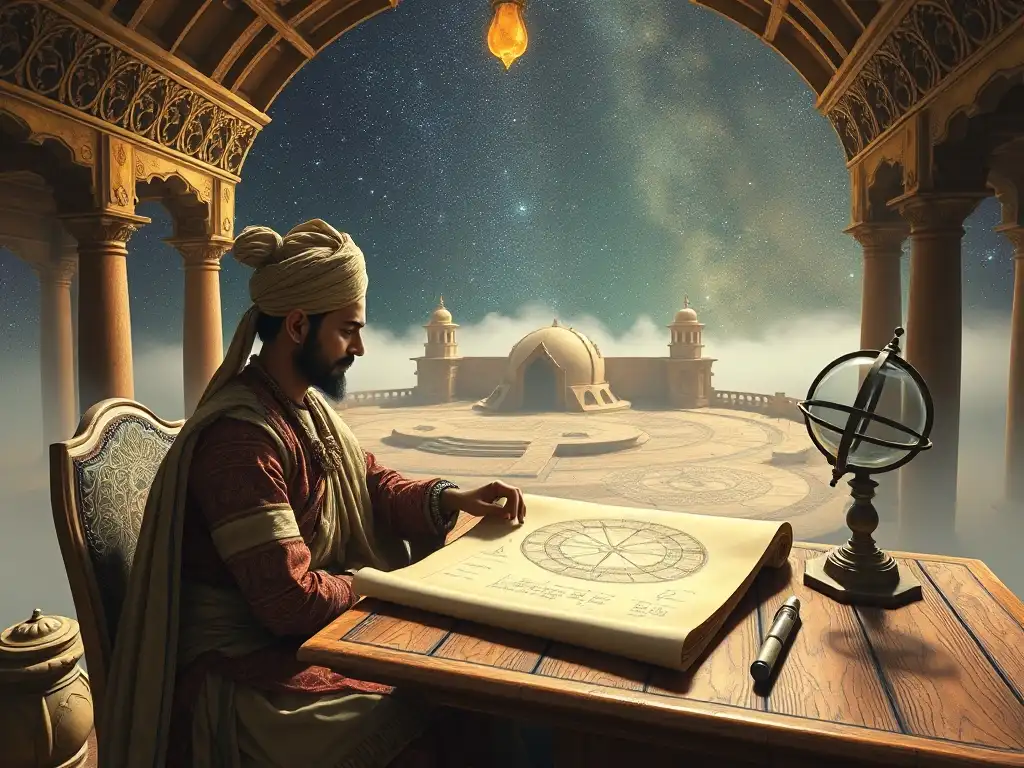
Introduction to Ancient Indian Astronomy Mathematics
The intricate relationship between mathematics and astronomy has been a hallmark of ancient civilizations, and India stands out with its profound contributions to this field. Ancient Indian astronomy mathematics encompasses not only the practical application of mathematical concepts to celestial observations but also a deep philosophical understanding of the cosmos.
From the meticulously planned cities of the Indus Valley Civilization to the astronomical treatises of the Gupta Empire, mathematics played a pivotal role in shaping the astronomical knowledge of ancient India. This article aims to explore how mathematical principles were interwoven with astronomical practices, highlighting the rich legacy left by ancient Indian mathematicians and astronomers.
Overview of Ancient Indian Astronomy
Ancient Indian astronomy was characterized by its comprehensive approach to celestial phenomena, which included the study of planetary movements, eclipses, and the calculation of time. The Vedic texts, particularly the Jyotisha, laid the groundwork for astronomical observations and calculations. Indian astronomers such as Aryabhata and Brahmagupta made significant advancements in this field, utilizing mathematics to predict celestial events accurately. Their work not only influenced subsequent Indian astronomers but also had a ripple effect on Islamic and European scientific thought.
Importance of Mathematics in Astronomy
Mathematics served as the backbone of ancient Indian astronomy, enabling astronomers to make precise calculations regarding celestial movements. Key mathematical concepts such as:
- Trigonometry: Developed for calculating angles and distances.
- Algebra: Used to formulate equations that describe celestial phenomena.
- Geometry: Essential for creating accurate models of planetary orbits.
These mathematical tools allowed astronomers to create calendars, predict eclipses, and understand the motions of celestial bodies with remarkable accuracy. The integration of mathematics and astronomy exemplifies how ancient Indian scholars approached the cosmos with a blend of empirical observation and theoretical rigor.
Historical Context of Mathematics in Ancient India
Evolution of Mathematical Concepts in Ancient India
The evolution of mathematical concepts in ancient India can be traced through various texts and inscriptions, revealing a rich tapestry of ideas that developed over centuries. Early records such as those found in the Sulba Sutras illustrate the use of geometry in religious rituals and the construction of altars. As time progressed, mathematicians like Aryabhata introduced innovative concepts such as the place value system and the concept of zero, which were crucial for astronomical calculations.
Significant Periods in Ancient Indian Astronomy
Ancient Indian astronomy can be divided into significant periods, each marked by advancements in mathematical techniques and astronomical discoveries.
- The Vedic Period: Emphasized calendar-making and the timing of rituals.
- The Gupta Period: A golden age for mathematics and astronomy, with notable figures such as Aryabhata and Brahmagupta, who made groundbreaking contributions that melded mathematical theory with astronomical practice.
- The Medieval Period: Continued advancements in astronomy, with scholars like Bhaskara II refining earlier works and expanding upon mathematical concepts.
These periods collectively underscore the profound influence of mathematics on the development of ancient Indian astronomy, establishing a legacy that continues to resonate in modern scientific discourse.
Key Mathematicians in Ancient Indian Astronomy
Ancient Indian astronomy is deeply intertwined with the mathematical advancements made by prominent mathematicians. These scholars not only contributed to the field of mathematics but also laid the groundwork for astronomical practices that would influence future generations. Their work encompassed a wide range of mathematical techniques, which were critical for making precise astronomical observations and calculations. Let's explore the contributions of some of the most significant mathematicians in ancient Indian astronomy.
Aryabhata: Pioneer of Mathematical Astronomy
Aryabhata, born in 476 CE, is often hailed as one of the foremost mathematicians and astronomers of ancient India. His seminal work, the Aryabhatiya, is a comprehensive treatise that covers various aspects of mathematics and astronomy. Aryabhata introduced methods for calculating the positions of celestial bodies and the timing of eclipses.
One of his most notable contributions was the introduction of the concept of zero as a placeholder in calculations, which revolutionized mathematics. Aryabhata's use of trigonometric functions, including sine (called jya), marked a significant advancement in astronomical calculations. He provided a formula for determining the sine of angles, which was crucial for understanding the geometry of celestial movements.
Furthermore, Aryabhata proposed a heliocentric model of the solar system, suggesting that the Earth rotates on its axis, a concept that was ahead of its time. His systematic approach to astronomy and mathematics established a foundation that influenced many subsequent scholars.
Brahmagupta and His Contributions
Brahmagupta, who lived during the 7th century CE, was another pivotal figure in ancient Indian mathematics and astronomy. His work, the Brahmasphutasiddhanta, built upon Aryabhata's ideas and introduced new concepts and methods. Brahmagupta is particularly known for his rules regarding arithmetic operations with zero and negative numbers, which were revolutionary for mathematical calculations.
In astronomy, he provided algorithms for calculating the positions of planets and determining the times of eclipses. He emphasized the importance of accurate measurements and computations, using a systematic approach to solve problems related to celestial phenomena. Brahmagupta's contributions laid the groundwork for later developments in both mathematics and astronomy, making him a key figure in this field.
Bhaskara I and II: Advancements in Astronomy Mathematics
Bhaskara I, who flourished in the 7th century, made significant strides in astronomical calculations. He is best known for his commentaries on Aryabhata's work, where he elaborated on the mathematical techniques used in astronomy. His contributions included methods for calculating planetary positions and eclipses, and he refined the sine function, improving its accuracy in astronomical computations.
Bhaskara II, also known as Bhaskara the Great, was a mathematician and astronomer of the 12th century who built upon the foundations laid by his predecessors. His monumental work, the Siddhanta Shiromani, is divided into four parts, with the Lilavati focusing on arithmetic and the Bija Ganita concentrating on algebra. Bhaskara II made groundbreaking contributions in the field of calculus long before it was formally established in the West.
He provided methods for solving quadratic equations and understanding differential calculus, which were essential for astronomical calculations. Bhaskara II's integration of mathematics and astronomy showcased the advanced understanding of celestial mechanics present in ancient Indian scholarship.
Mathematical Techniques Used in Ancient Indian Astronomy
The mathematical techniques employed by ancient Indian astronomers were diverse and sophisticated, enabling them to make significant contributions to the field. These techniques ranged from geometric calculations to innovative algebraic methods, reflecting a deep understanding of both mathematics and astronomy.
Use of Geometry in Astronomical Calculations
Geometry played a crucial role in ancient Indian astronomy, particularly in the calculations of celestial distances and the movements of planetary bodies. Ancient astronomers utilized geometric principles to create models of the universe, allowing them to visualize the positions of stars and planets.
For instance, the concept of spherical geometry was used to understand the spherical nature of the Earth and the celestial sphere. Techniques such as the calculation of angular distances, arcs, and chords were employed to determine the positions of celestial bodies during various times of the year. This geometric foundation was essential for solving complex astronomical problems and laid the groundwork for advancements in trigonometry.
Trigonometric Innovations in Ancient Indian Astronomy
Trigonometry was a significant area of development in ancient Indian astronomy, with mathematicians like Aryabhata and Bhaskara II making substantial contributions. They introduced various trigonometric functions and values, notably the sine and cosine, which became fundamental tools for astronomical calculations.
The sine function, referred to as jya in Sanskrit, was extensively used to calculate the angles and distances of celestial bodies. The mathematicians developed tables of sines, allowing for quick reference during calculations. These innovations not only improved the accuracy of astronomical observations but also contributed to the overall advancement of mathematics in ancient India.
Application of Algebraic Methods in Astronomy
Algebraic methods were integral to the astronomical calculations performed by ancient Indian scholars. Brahmagupta and Bhaskara II were particularly influential in applying algebraic techniques to solve problems related to planetary movements and celestial events.
Brahmagupta's rules for solving quadratic equations and his methods for working with fractions were critical in determining the positions of planets and predicting eclipses. Bhaskara II expanded upon these methods, developing algorithms that incorporated both algebraic and geometric approaches. This blend of techniques facilitated more accurate predictions of celestial phenomena and showcased the advanced understanding of mathematics in ancient Indian astronomy.
The interplay between mathematics and astronomy in ancient India was marked by the contributions of key mathematicians and the development of various mathematical techniques that advanced the field significantly. These innovations not only enriched ancient Indian scholarship but also laid the foundation for future developments in both disciplines.
Texts and Treatises on Astronomy and Mathematics
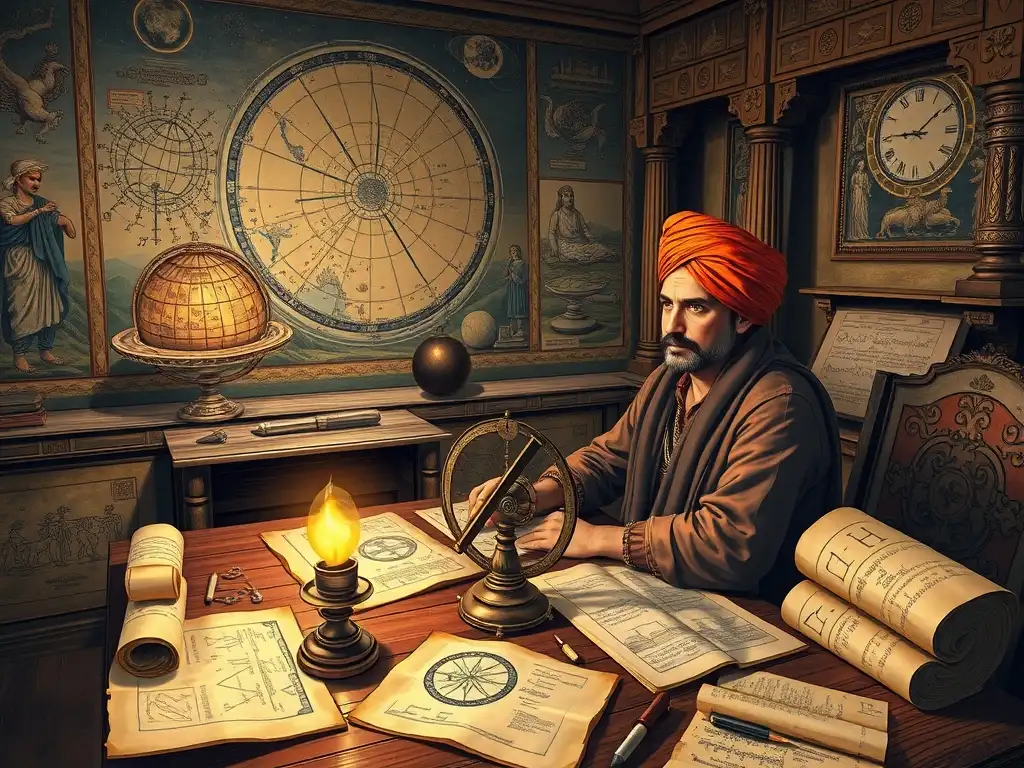
Ancient Indian astronomy is deeply intertwined with mathematics, as the precise calculations necessary for understanding celestial phenomena were essential for both astronomical observations and calendar systems. This relationship is encapsulated in several significant texts and treatises that not only highlight the mathematical prowess of ancient Indian scholars but also provide insight into their astronomical methods and theories. Key works from prominent mathematicians reveal the systematic approaches they used to address complex astronomical problems, setting the stage for future advancements in both Indian and global contexts.
Aryabhata's Aryabhatiya: A Mathematical Treatise
Aryabhata, one of the earliest and most influential mathematicians and astronomers in ancient India, composed the Aryabhatiya around 499 CE. This seminal work is divided into four sections: Gitika (mathematics), Ganita (arithmetic and algebra), Kalakriya (time calculations), and Grahaganita (celestial mechanics). Aryabhata introduced revolutionary concepts such as the place-value system and the concept of zero, which were pivotal for mathematical computations.
In the context of astronomy, Aryabhata's work included methods for calculating the positions of celestial bodies, eclipses, and the length of the solar year. He emphasized the importance of mathematics in astronomy, demonstrating how rigorous mathematical calculations could lead to accurate predictions of astronomical events. His innovative use of trigonometric functions, particularly sine, laid the groundwork for future developments in both Indian and Islamic astronomy.
Brahmagupta's Brahmasphutasiddhanta and Its Influence
Brahmagupta, writing in the 7th century CE, further advanced the mathematical foundations laid by Aryabhata in his work, Brahmasphutasiddhanta. This treatise is notable for its systematic approach to solving quadratic equations and its rules for arithmetic operations involving positive and negative numbers. Brahmagupta was among the first to present algorithms for these calculations, which were crucial for astronomical computations.
His contributions to astronomy included methods for calculating the positions of planets and the timing of eclipses. Brahmagupta's work significantly influenced Islamic astronomers, as his text was translated into Arabic and became a cornerstone for subsequent studies in the Islamic Golden Age. His approach to mathematics and astronomy not only advanced the field in India but also served as a bridge to the knowledge that would later permeate into Europe.
Bhaskara's Siddhanta Shiromani: A Mathematical Masterpiece
Bhaskara II, also known as Bhaskara the Great, wrote the Siddhanta Shiromani in the 12th century CE. This comprehensive text is divided into two main parts: Lilavati, which focuses on arithmetic and geometry, and Bijaganita, which deals with algebra. Bhaskara's work is renowned for its clarity and depth, employing a variety of mathematical techniques to solve problems relevant to astronomy.
In the astronomical section, Bhaskara presented refined methods for calculating planetary positions and eclipses, incorporating innovations such as the use of sine and cosine functions. His emphasis on practical applications of mathematics in astronomy highlighted the importance of accurate calculations for navigational purposes and calendar-making. The influence of Siddhanta Shiromani extended beyond India, impacting mathematicians and astronomers in various cultures.
Contributions of Ancient Indian Astronomy Mathematics to Global Knowledge
The mathematical accomplishments of ancient Indian astronomers had profound implications not only within the Indian subcontinent but also on a global scale. Their innovative approaches and methodologies contributed significantly to the development of astronomy and mathematics in other cultures, particularly during the Islamic Golden Age and the European Renaissance.
Influence on Islamic Astronomy
The mathematical texts produced by ancient Indian astronomers formed a vital link in the transmission of knowledge to the Islamic world. Scholars such as Al-Battani and Al-Khwarizmi were heavily influenced by Indian mathematical concepts, particularly the systematic approaches to trigonometry and algebra found in texts like the Aryabhatiya and Brahmasphutasiddhanta. The adoption of the Indian numeral system, including the concept of zero, revolutionized Islamic mathematics and astronomy, leading to more accurate calculations and advanced astronomical models.
Impact on European Renaissance Mathematics
The knowledge transmitted through Islamic scholars eventually made its way to Europe, particularly during the Renaissance. Texts such as Al-Khwarizmi's Al-Kitab al-Mukhtasar fi Hisab al-Jabr wal-Muqabala (The Compendious Book on Calculation by Completion and Balancing) showcased Indian mathematical techniques and algorithms, which were foundational for the development of algebra in Europe. The integration of Indian astronomical mathematics into European thought facilitated significant advancements in navigation, cartography, and the scientific revolution.
Legacy of Ancient Indian Mathematics in Modern Astronomy
The legacy of ancient Indian astronomy mathematics continues to resonate in modern scientific practices. Concepts developed by mathematicians like Aryabhata, Brahmagupta, and Bhaskara laid the groundwork for contemporary astronomical calculations. Their approaches to celestial mechanics, timekeeping, and mathematical modeling are still relevant in today's astronomical research and space exploration.
Moreover, the recognition of the contributions of ancient Indian scholars has fostered a renewed interest in the historical development of mathematics and astronomy, prompting further research into their sophisticated techniques. This ongoing legacy underscores the importance of ancient Indian mathematics in the broader context of global scientific heritage and its lasting impact on the field of astronomy.
Conclusion: The Lasting Impact of Ancient Indian Astronomy Mathematics
The contributions of ancient Indian mathematics to astronomy have left an indelible mark on the field, shaping not only regional practices but also influencing global developments in the sciences. The precision and rigor with which ancient Indian astronomers utilized mathematical concepts laid foundational principles that continue to resonate in modern astronomy. The innovative use of trigonometry, calculus, and sophisticated numerical systems showcases the advanced understanding of celestial movements and phenomena by mathematicians such as Aryabhata, Brahmagupta, and Bhaskara II. Their works not only charted the heavens but also provided tools that would be essential for future astronomical research.
The impact of these mathematical advancements extends beyond mere calculations. They fostered a culture of inquiry and exploration, encouraging subsequent generations to build upon this legacy. As scholars recognized the significance of the cosmos in various aspects of life—from agriculture to navigation—mathematics became an integral part of understanding and interpreting the universe. The enduring legacy of these contributions is evident in the rich tapestry of mathematical knowledge that continues to be a cornerstone of scientific inquiry today.
Reflection on Mathematical Contributions in Astronomy
The reflection on the mathematical contributions of ancient Indian scholars reveals a sophisticated understanding of the universe that predates many Western discoveries. The methodical approach to astronomical calculations—such as the use of sine tables and methods for solving quadratic equations—demonstrates an advanced level of mathematical thought.
For instance, Aryabhata's assertion that the Earth rotates on its axis was not just a philosophical idea but was bolstered by precise mathematical reasoning. His works, particularly the "Aryabhatiya," exemplify how mathematics was employed to explain celestial phenomena, making it a critical tool for astronomers.
Moreover, the collaborative nature of knowledge transfer, showcased through texts being translated and disseminated across cultures, highlights the importance of these mathematical contributions. They served as a bridge connecting civilizations and fostering a shared understanding of the universe that transcended geographical boundaries.
The Importance of Preserving Ancient Knowledge
Preserving the mathematical knowledge from ancient Indian astronomy is crucial for several reasons. Firstly, it allows contemporary scholars to appreciate the depth and breadth of ancient scientific inquiry. Recognizing the mathematical foundation upon which modern astronomy has been built can inspire further research and innovation.
Secondly, the preservation of these texts and concepts serves as a cultural heritage that informs identity and understanding of ancient Indian civilization. It provides insight into the intellectual pursuits of the time, revealing a complex society that valued knowledge and exploration.
Finally, in an age where scientific advancements are paramount, revisiting ancient wisdom can offer fresh perspectives on modern challenges. The holistic approach seen in ancient Indian astronomy, which intertwines mathematics, philosophy, and spirituality, can inspire contemporary scientists to consider multifaceted solutions to today’s problems.
References and Further Reading on Ancient Indian Astronomy Mathematics
Recommended Books and Articles
- "Aryabhata: The Astronomer-Mathematician" by A. K. Sharma: This book delves into Aryabhata's life and his groundbreaking work, offering insights into his mathematical contributions to astronomy.
- "A History of Indian Astronomy" by P. C. V. S. R. Reddy: This comprehensive text covers the evolution of astronomy in ancient India and highlights significant mathematical advancements.
- "Mathematics in Ancient India" by Kim Plofker: An essential read that explores various mathematical concepts developed in ancient India, with a focus on their astronomical applications.
Online Resources for Further Exploration
- The Indian Mathematics Archive: A digital repository containing translations and analyses of ancient Indian mathematical texts.
- NASA’s Digital Collections: Includes resources on historical contributions of ancient Indian astronomy and its impact on modern science.
- Digital Library of India: Offers access to various ancient texts, allowing for exploration of original works by prominent mathematicians.
By engaging with these resources, readers can further appreciate the richness of ancient Indian astronomy mathematics and its significance in the broader context of scientific history.
- Introduction to Ancient Indian Astronomy Mathematics
- Historical Context of Mathematics in Ancient India
- Key Mathematicians in Ancient Indian Astronomy
- Mathematical Techniques Used in Ancient Indian Astronomy
- Texts and Treatises on Astronomy and Mathematics
- Contributions of Ancient Indian Astronomy Mathematics to Global Knowledge
- Conclusion: The Lasting Impact of Ancient Indian Astronomy Mathematics
- References and Further Reading on Ancient Indian Astronomy Mathematics
- What is the significance of mathematics in ancient Indian astronomy?
- How did ancient Indian mathematicians contribute to astronomy?
- What are some key texts related to ancient Indian astronomy and mathematics?
- Did ancient Indian astronomers use any specific techniques in their calculations?
- How does ancient Indian astronomy influence modern mathematical practices?
Frequently Asked Questions
What is the significance of mathematics in ancient Indian astronomy?
Mathematics played a crucial role in ancient Indian astronomy, enabling astronomers to create accurate models of celestial movements and develop timekeeping systems.
How did ancient Indian mathematicians contribute to astronomy?
Ancient Indian mathematicians, such as Aryabhata and Brahmagupta, made significant advancements in trigonometry and calculus, which were essential for calculating planetary positions and eclipses.
Important texts include the Aryabhatiya by Aryabhata and the Brahmasphutasiddhanta by Brahmagupta, which explore various mathematical techniques and their applications in astronomy.
Did ancient Indian astronomers use any specific techniques in their calculations?
Yes, they utilized techniques like the decimal system, place value, and sine functions, which greatly enhanced their ability to perform complex calculations in astronomy.
How does ancient Indian astronomy influence modern mathematical practices?
The methods and discoveries from ancient Indian astronomy laid the groundwork for modern astronomical calculations and contributed to the global development of mathematics and science.
Final Reflection: The Enduring Legacy of Ancient Indian Astronomy Mathematics
The intricate relationship between mathematics and astronomy in ancient India is not just a relic of the past; it is a profound testament to human ingenuity and the quest for knowledge. Today, as we navigate a world increasingly driven by technology and data, the principles laid down by ancient Indian astronomers resonate more than ever. Their innovative approaches to celestial phenomena remind us that the pursuit of understanding the universe is timeless and universal.
The impact of ancient Indian astronomy mathematics extends far beyond its historical context; it continues to shape our cultural and scientific landscapes. The mathematical techniques developed by scholars like Aryabhata and Brahmagupta laid the groundwork for future astronomical discoveries and influenced civilizations across the globe. Their work serves as a reminder of the interconnectedness of cultures in the pursuit of knowledge.
As the philosopher Carl Sagan once said, "> We are made of star-stuff. We are a way for the universe to know itself." This profound connection emphasizes the importance of understanding our roots in mathematics and astronomy as we explore the cosmos.
As we reflect on the lessons of ancient Indian astronomy mathematics, let us embrace the spirit of inquiry and exploration that defined these early scholars. I invite you to consider how the principles of mathematics can illuminate your own understanding of the world around you. Whether through the lens of science, art, or philosophy, let the legacy of these ancient thinkers inspire you to seek knowledge, challenge assumptions, and appreciate the beauty of the universe. The journey of discovery is ongoing, and each of us has a role to play in this grand tapestry of understanding.
Unveil the Wonders of Ancient Indian Astronomy!
Thank you for taking the time to explore the fascinating intersection of mathematics and astronomy in ancient India. You've just uncovered the pivotal role that numerical concepts played in celestial observations and astrological predictions. Now, it's time to channel this inspiration into action!
Here are some ways you can deepen your understanding and engage with this remarkable topic:
- Dive deeper: Research a prominent mathematician or astronomer from ancient India and consider sharing your findings with friends or on social media.
- Join the conversation: Participate in our discussion forums to share your insights on how mathematics influenced celestial navigation and star mapping in ancient civilizations.
- Explore resources: Look for books or documentaries that highlight the advancements in astronomy and mathematics during ancient Indian times.
What aspect of ancient Indian astronomy captivates you the most, and how do you believe it impacts our current scientific understanding?