
How Ancient Indian Mathematicians Addressed Complex Problems


Welcome to Ancient India History, where we embark on a fascinating journey through time, uncovering the rich tapestry of ancient Indian civilizations. In this exploration, we delve into the extraordinary contributions of ancient Indian mathematicians, whose groundbreaking ideas and solutions to complex problems laid the foundation for modern mathematics. Prepare to be amazed as we unravel the stories behind these brilliant minds and their impact on the world. Join us as we dive deeper into the remarkable legacy of these scholars and discover how their innovations continue to shape our understanding of mathematics today.
- Introduction to Ancient Indian Mathematicians Contributions
- The Historical Context of Ancient Indian Mathematics
- Significant Mathematicians in Ancient India
- Techniques and Methods Used by Ancient Indian Mathematicians
- Case Studies of Complex Problems Addressed
- Legacy and Influence of Ancient Indian Mathematicians
- Conclusion: The Enduring Influence of Ancient Indian Mathematicians Contributions
-
Frequently Asked Questions
- What were the main contributions of ancient Indian mathematicians?
- How did the concept of zero originate in ancient India?
- What role did ancient Indian mathematics play in astronomy?
- Which ancient Indian mathematician is known for his work on arithmetic?
- How did ancient Indian mathematicians influence the world?
- Final Reflection: The Enduring Legacy of Ancient Indian Mathematicians
- Unveil the Secrets of Ancient Indian Mathematics!
Introduction to Ancient Indian Mathematicians Contributions
The contributions of ancient Indian mathematicians represent a profound legacy that has shaped not only the field of mathematics but also the very fabric of various modern scientific disciplines. From the intricate calculations of the Indus Valley Civilization to the sophisticated theories developed during the Gupta Empire, mathematicians in ancient India addressed complex problems with remarkable ingenuity.
Their work encompassed a wide range of topics, including arithmetic, algebra, geometry, and even early concepts of calculus, showcasing a rich tapestry of knowledge that laid the foundation for future generations. This article delves into the remarkable contributions of these mathematicians, exploring how their innovative approaches to complex problem-solving were pivotal not only within their own era but also for the advancement of mathematics worldwide.
Overview of Ancient Indian Mathematics
Ancient Indian mathematics is characterized by its unique methodologies and concepts that emerged from a blend of cultural and philosophical traditions. The earliest evidence of mathematical activity in India dates back to around 3000 BCE, particularly in the Indus Valley Civilization, where advanced urban planning and architectural feats required precise measurements and calculations.
Key milestones in the evolution of mathematics in ancient India include:
- The Sulba Sutras: These texts, written around 800 BCE, provide guidelines for constructing altars and involve geometrical principles, including the Pythagorean theorem, long before it was formally recognized in the West.
- Aryabhata: In the 5th century CE, Aryabhata introduced concepts of zero and place value, revolutionizing numerical representation and facilitating complex calculations.
- Brahmagupta: His work in the 7th century expanded on algebraic concepts, offering rules for solving quadratic equations and discussing negative numbers, which were groundbreaking for the time.
The contributions of these mathematicians, among many others, highlight the systematic approach to mathematics that was developed in ancient India, laying the groundwork for future advancements in the field.
Importance of Complex Problem Solving in Ancient India
Complex problem solving was integral to the development of mathematics in ancient India, as it not only addressed practical needs but also pushed the boundaries of theoretical understanding. The ability to solve intricate problems was essential for various aspects of daily life, including:
- Astronomy: Ancient Indian astronomers required accurate calculations to predict celestial events, which in turn influenced agricultural practices and religious ceremonies.
- Architecture: The construction of temples, palaces, and urban centers demanded precise measurements and innovative geometric solutions to ensure structural integrity and aesthetic appeal.
- Trade and Commerce: As trade flourished, mathematicians developed advanced techniques for accounting, currency conversion, and measurements, facilitating economic growth.
The methodologies employed by ancient Indian mathematicians in solving complex problems not only showcased their intellectual prowess but also contributed significantly to the global mathematical heritage. Their innovative approaches and concepts continue to inspire contemporary mathematicians and scientists, proving the timeless relevance of their contributions.
The Historical Context of Ancient Indian Mathematics
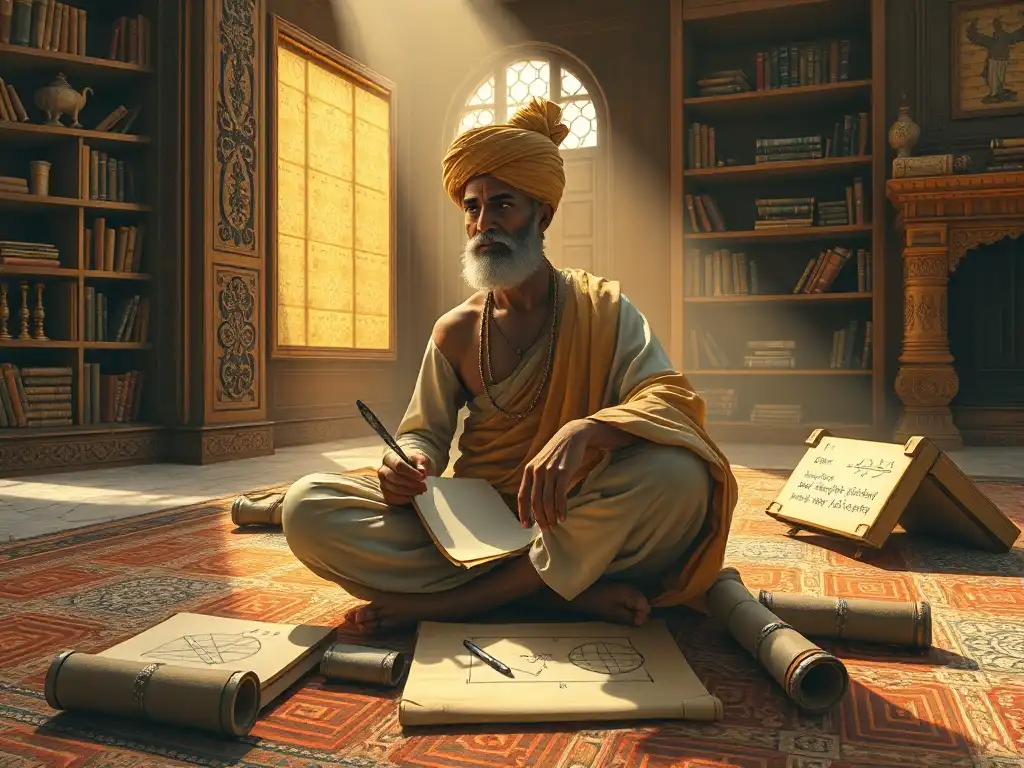
The evolution of mathematics in ancient India is a testament to the innovative spirit of its scholars, who made profound contributions that have had a lasting impact on the field. To fully appreciate these contributions, it is essential to examine the historical context in which these mathematicians operated. The mathematical developments in India can be traced through three significant periods: the Indus Valley Civilization, the Vedic Period, and the Gupta Empire.
The Indus Valley Civilization and Early Mathematical Concepts
The Indus Valley Civilization, which flourished between 3300 and 1300 BCE, is often credited with laying the groundwork for early mathematical concepts. Archaeological findings from sites like Harappa and Mohenjo-Daro suggest that the people of this civilization utilized a form of measurement and numerical notation.
- Weights and Measures: The presence of standardized weights and measures indicates an advanced understanding of mathematics for trade and construction. For instance, the use of a decimal system for weight measurements demonstrates an early grasp of numerical organization.
- Urban Planning: The layout of cities, with their grid patterns and sophisticated drainage systems, reflects an understanding of geometry and spatial reasoning. This suggests that mathematical principles were applied in practical, everyday contexts.
- Seals and Script: The use of seals with inscriptions may imply a numerical system, although the script remains undeciphered. The existence of these artifacts indicates that the inhabitants likely engaged in some form of recording numerical information.
The mathematical contributions of the Indus Valley Civilization may appear rudimentary compared to later developments, but they represent a crucial foundation upon which future mathematicians would build.
The Vedic Period: Foundations of Mathematical Thought
The Vedic Period (approximately 1500 to 500 BCE) marks a significant transformation in mathematical thought in ancient India. During this time, the Vedas—sacred texts—emerged, introducing concepts that would shape Indian mathematics for centuries to come.
- Shulba Sutras: These texts, part of the larger Vedic literature, provide the earliest known rules for geometric constructions, particularly in the context of altar building for rituals. The Shulba Sutras contain precise instructions for constructing various shapes, including squares and circles, reflecting an advanced understanding of geometry.
- Decimal System: The Vedic scholars developed a decimal system, which would later influence the numeral systems used worldwide. This system facilitated calculations and led to the formulation of basic arithmetic operations.
- Astronomy and Mathematics: The Vedic texts also laid the groundwork for astronomy, where mathematics played a crucial role in celestial observations. The concepts of time measurement and calculations related to lunar and solar cycles highlight the integration of mathematics into everyday life.
This period was pivotal, as it established a rigorous approach to mathematics that would evolve in complexity over time.
The Gupta Empire: A Golden Age of Mathematics
The Gupta Empire (approximately 320 to 550 CE) is often referred to as the "Golden Age" of Indian mathematics. This period saw remarkable advancements, culminating in the contributions of several prominent mathematicians.
- Aryabhata: One of the most illustrious mathematicians of this era, Aryabhata introduced concepts such as the approximation of π (pi) and the rules for solving quadratic equations. His work, Aryabhatiya, provides insights into arithmetic, algebra, and trigonometry, showcasing a sophisticated understanding of mathematics.
- Brahmagupta: Another key figure, Brahmagupta, made significant contributions in his text Brahmasphutasiddhanta, where he detailed rules for arithmetic operations involving negative numbers and zero. This work laid the foundation for algebra and was revolutionary for its time.
- Mathematical Notation: During the Gupta period, the use of symbols for numbers and operations became more prevalent, leading to greater efficiency in mathematical calculations. This notation system would evolve, influencing future mathematical practices.
The contributions of ancient Indian mathematicians during the Gupta Empire not only advanced mathematical thought in India but also paved the way for developments in mathematics globally.
Significant Mathematicians in Ancient India
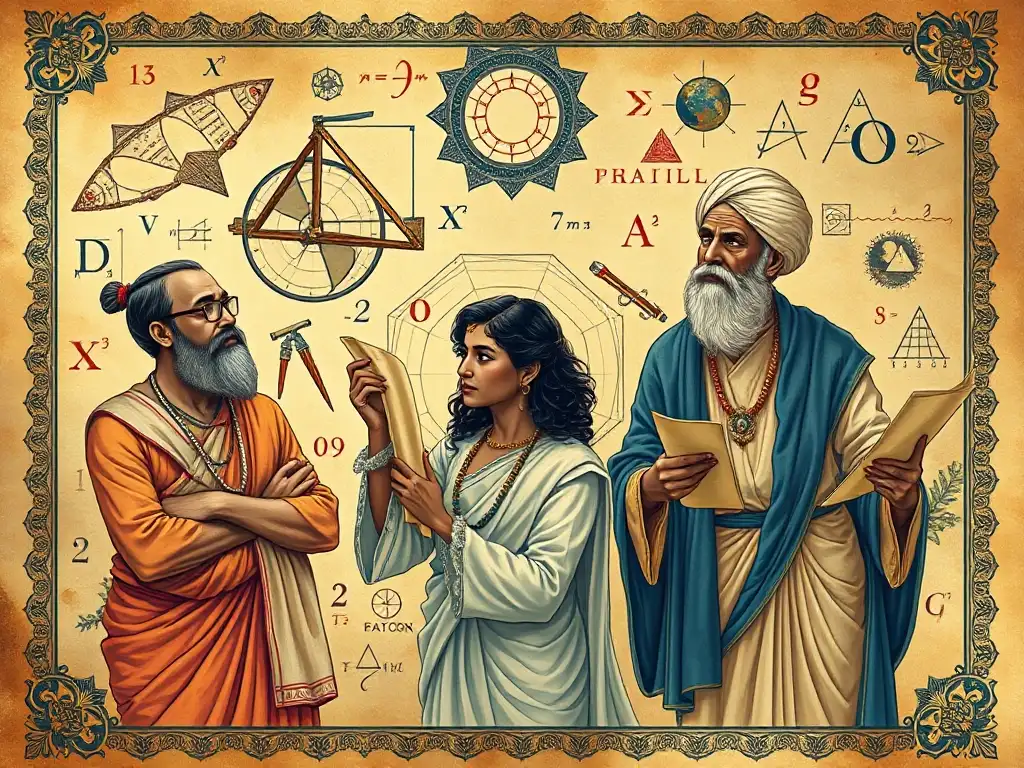
Aryabhata: Pioneer of Indian Mathematics
Aryabhata, born in 476 CE in Kusumapura (modern-day Patna), is often regarded as one of the most influential mathematicians of ancient India. His contributions laid the foundation for various branches of mathematics and astronomy. His seminal work, the Aryabhatiya, covers a wide array of topics, including arithmetic, algebra, and trigonometry, showcasing his innovative approach to mathematical problems.
Aryabhata’s influence extended beyond India, as his methods and ideas were later adopted by Persian and Arab mathematicians, further disseminating his teachings across civilizations.
Contributions to Algebra and Trigonometry
Aryabhata made significant strides in algebra, introducing concepts that would become fundamental in later mathematical discourse. He defined algebraic identities, notably:
- Addition and Subtraction: Aryabhata articulated clear methods for performing and understanding basic operations, emphasizing the importance of positional value.
- Multiplication and Division: He provided systematic methods for multiplication, including the use of various algorithms that improved computational efficiency.
In trigonometry, Aryabhata was among the first to use sine (known as jya) and cosine (known as kotijya) functions. He developed and utilized various trigonometric identities, paving the way for future advancements in this field. His work included:
- Sine Table: Aryabhata compiled a table of sines for angles, which was critical for astronomical calculations.
- Angle Measurements: He introduced methods to calculate angles based on the lengths of sides in triangles, contributing to the development of spherical trigonometry.
Innovations in Astronomical Calculations
Aryabhata's mathematical prowess was closely tied to his astronomical studies. He proposed a revolutionary model of the solar system, suggesting that the Earth rotates on its axis—a radical departure from the prevailing geocentric models of his time. His key innovations in astronomical calculations include:
- Approximation of Pi: Aryabhata approximated the value of Pi (π) to be 3.1416, which was remarkably accurate for his time.
- Planetary Motion: He formulated equations to describe the motion of planets, predicting eclipses and the positions of celestial bodies with a degree of accuracy that astonished later astronomers.
Brahmagupta: The Father of Algebra
Brahmagupta, a prominent mathematician born in 598 CE in Ujjain, is often referred to as the "Father of Algebra." His work, particularly in the Brahmasphutasiddhanta, marked a significant advancement in the understanding and application of algebraic principles. Brahmagupta's contributions are crucial in the evolution of mathematics, especially concerning the concept of zero and its functionality.
Development of Zero and Its Significance
Brahmagupta was one of the first mathematicians to formalize the use of zero as both a placeholder and a number in its own right. His insights into zero were groundbreaking:
- Arithmetic with Zero: He established rules for arithmetic operations involving zero, such as:
- Any number plus zero equals that number.
- Any number minus itself equals zero.
- Negative Numbers: Brahmagupta also laid down rules for operations involving negative numbers, expanding the mathematical landscape significantly.
His work on zero not only transformed mathematics in India but also influenced mathematical thinking globally, as these concepts were later transmitted to the Islamic world and Europe.
Solutions to Quadratic Equations
Brahmagupta's contributions to solving quadratic equations are among his most notable achievements. He provided an algorithmic approach for finding the roots of quadratic equations, encapsulated in the following steps:
- Standard Form: He recognized the standard form of a quadratic equation as \( ax^2 + bx + c = 0 \).
- Solutions: He formulated a general procedure to find solutions, which included:
- Considering the equation's discriminant to determine the nature of the roots.
- Providing a systematic method for calculating the roots based on the coefficients.
Brahmagupta's methodology in solving quadratic equations laid the groundwork for future mathematicians and remains relevant in contemporary algebra. His work exemplifies the rich tradition of mathematical inquiry in ancient India and highlights the profound contributions of ancient Indian mathematicians to the field of mathematics.
Bhaskara I and II: Bridging Concepts
The contributions of Bhaskara I and Bhaskara II significantly advanced the field of mathematics and astronomy in ancient India. Both mathematicians are recognized for their innovative approaches to complex problems, laying foundational principles that would influence future generations. Their works reflect an intricate blend of mathematical theory and astronomical practice, showcasing how ancient Indian mathematicians adeptly bridged various concepts to enhance understanding and application in these fields.
Bhaskara I’s Work on Indian Astronomy
Bhaskara I (circa 600 CE) is renowned for his pivotal role in Indian astronomy, particularly through his influential text, the Mahabhaskariya. In this work, he elaborated on the concepts of planetary movements and provided detailed calculations for eclipses. His methods included the use of sine functions, which he introduced to Indian mathematics, enabling more accurate astronomical predictions.
One of his notable contributions is the introduction of a more systematic approach to calculating the positions of celestial bodies. Bhaskara I emphasized the importance of observational accuracy and suggested methods for refining astronomical calculations, such as using the sine of angles rather than just their degrees. This mathematical innovation not only enhanced the precision of astronomical predictions but also laid the groundwork for subsequent astronomers and mathematicians who followed in his footsteps.
Bhaskara I's impact extended beyond mere calculations; he also contributed to the philosophical understanding of astronomy. He explored the relationship between mathematics and the cosmos, arguing that understanding celestial phenomena required both observational skills and mathematical rigor. His work showcased how ancient Indian mathematicians approached complex astronomical problems with a blend of empirical observation and theoretical insight.
Bhaskara II's Advances in Calculus
Bhaskara II, often referred to as Bhaskara the Younger (1114–1185 CE), made groundbreaking advancements in calculus that are still recognized today. His seminal work, the Lilavati, is a treatise that covers various mathematical topics, including arithmetic, geometry, and algebra, but it is his contributions to calculus that stand out remarkably.
One of his most significant achievements was the formulation of what we now call the "mean value theorem," which he presented in the context of his work on problems involving instantaneous motion. Bhaskara II described the concept of "fluxions," which closely resembles the modern understanding of derivatives. He skillfully addressed the challenges of calculating the rates of change, particularly in problems related to motion and geometry, showcasing a profound grasp of what would later evolve into calculus.
Furthermore, Bhaskara II introduced the concept of "infinitesimals," laying the groundwork for integral calculus. In his works, he provided methods for calculating the area under curves, which is a fundamental aspect of integral calculus today. His innovative approaches to solving complex problems demonstrated not only a high level of mathematical sophistication but also a practical application of these concepts to real-world problems, such as calculating the height of a mound or the distance traveled by an object in motion.
Bhaskara II's contributions to calculus exemplify the ingenuity of ancient Indian mathematicians, bridging the gap between theoretical mathematics and practical application. His legacy continues to inspire mathematicians and scientists, underscoring the rich heritage of mathematical thought in ancient India.
Techniques and Methods Used by Ancient Indian Mathematicians

Ancient Indian mathematicians made significant contributions to the field of mathematics through their innovative techniques and methods. These methods not only advanced mathematical thought but also laid the groundwork for various branches of mathematics that we recognize today. This section explores the specific techniques employed by these mathematicians, focusing on geometry, algorithms, and their role in astronomy.
Use of Geometry in Architectural Design
Geometry played a pivotal role in the architectural achievements of ancient India. The precise understanding of geometric principles allowed ancient architects and builders to construct intricate and monumental structures, such as temples and stupas.
- Sacred Geometry: Many ancient Indian structures were designed following sacred geometry principles, reflecting spiritual beliefs. The layout of temples often adhered to specific geometric shapes, such as squares and circles, symbolizing the universe.
- Measurement Techniques: Ancient mathematicians developed advanced measurement techniques. For example, the concept of
Shulba Sutras, a set of texts attributed to Baudhayana and other mathematicians, provided rules for constructing altars. These texts included methods for creating right angles, using the famous Pythagorean theorem, long before it was known in the West. - Practical Applications: The application of geometry can be seen in the construction of the Brihadeeswarar Temple in Thanjavur, which showcases intricate geometrical patterns in its design. The temple’s towering vimana (temple tower) is a testament to the precise geometric calculations employed by architects.
Algorithms for Solving Mathematical Problems
Ancient Indian mathematicians were pioneers in the development of algorithms, which are step-by-step procedures for calculations.
- Decimal System: The introduction of the decimal place value system was revolutionary. Aryabhata, in his work Aryabhatiya, introduced methods for arithmetic operations that utilized this system, allowing for efficient calculations.
- Algorithms in Sulba Sutras: The Sulba Sutras not only covered geometric constructions but also included algorithms for various operations, such as addition, subtraction, multiplication, and division. These texts demonstrate the systematic approach to problem-solving that characterized ancient Indian mathematics.
- The Concept of Zero: The development of the concept of zero was crucial for creating algorithms. It allowed for the representation of numbers in a positional system, enabling more complex calculations. The mathematician Brahmagupta detailed rules for arithmetic involving zero in his work Brahmasphutasiddhanta, marking a notable advancement in mathematical thought.
The Role of Mathematics in Astronomy and Calendar Systems
Mathematics was integral to the development of astronomy and calendar systems in ancient India, reflecting the civilization's sophisticated understanding of celestial phenomena.
- Astronomical Calculations: Ancient Indian astronomers, such as Aryabhata and Varahamihira, utilized mathematical techniques to predict astronomical events. Aryabhata's Aryabhatiya included formulas for calculating the positions of planets, eclipses, and other celestial occurrences.
- Calendar Systems: The use of mathematics was crucial in the formulation of calendar systems. The ancient Indian lunar and solar calendars were based on complex calculations involving cycles of the moon and sun. This allowed for the synchronization of agricultural activities with celestial events, which was essential for agrarian societies.
- Trigonometry and Sine Functions: The mathematician Bhaskara II made substantial contributions to trigonometry, particularly in the development of sine functions. His work, Siddhanta Shiromani, provided methods to compute sine values, which were essential for astronomical calculations and navigation.
The techniques and methods employed by ancient Indian mathematicians significantly advanced various fields, from architecture to astronomy. Their innovative approaches to geometry, algorithms, and astronomical calculations not only addressed complex problems of their time but also laid a foundation for future mathematical developments. The contributions of these mathematicians are a testament to their profound impact on the history of mathematics.
Case Studies of Complex Problems Addressed
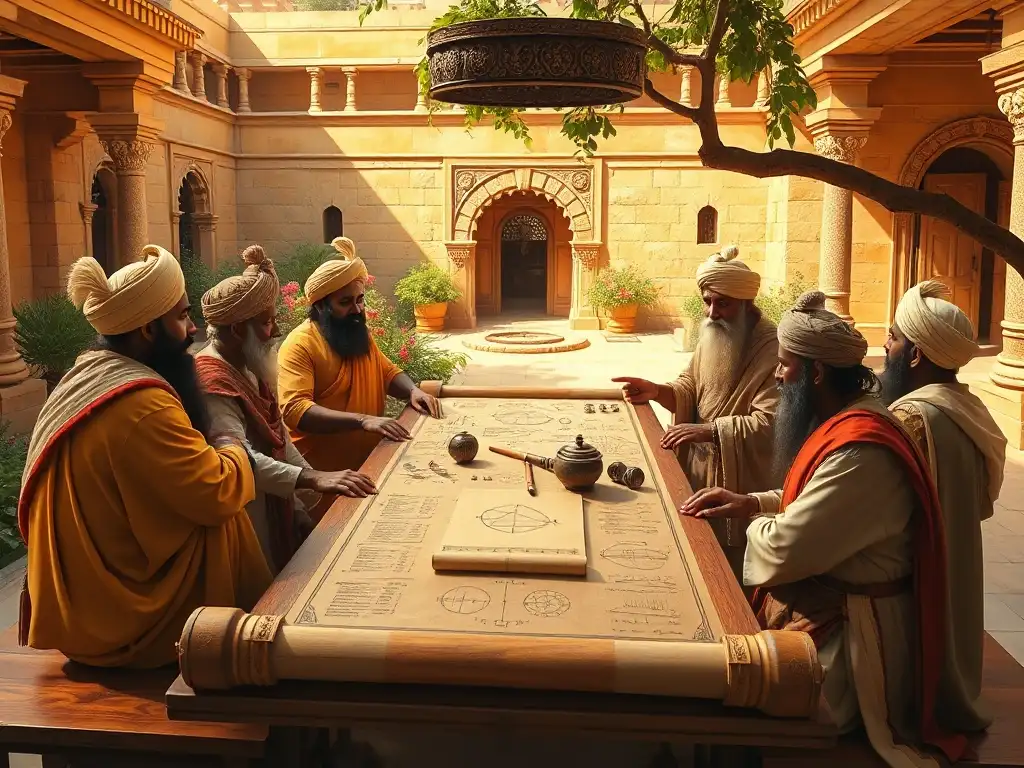
Calculation of the Area and Volume of Shapes
Ancient Indian mathematicians made significant strides in geometry, particularly in the calculation of the area and volume of various shapes. One of the most notable texts is the Surya Siddhanta, dated to the 4th or 5th century CE, which included methods for calculating areas of triangles, circles, and more complex figures.
- Triangles: The formula for the area of a triangle was articulated using the base and height, a concept that resonates with modern understanding. The mathematicians employed a variety of approaches, including the use of the Pythagorean theorem, which they had independently discovered.
- Circles: The area of a circle was calculated using the approximation of \(\pi\) (pi). Ancient Indian mathematicians like Aryabhata approximated \(\pi\) as 3.1416, a remarkably accurate value for the time. This approximation laid the groundwork for future explorations in geometry.
- Volumes: In terms of three-dimensional geometry, texts like the Bakhshali Manuscript detailed the methods for calculating the volume of solids, including spheres and cylinders. They used concepts of integration, which would not be formally developed in the West until much later.
Astronomy was a pivotal field that drove mathematical advancements in ancient India. Mathematicians like Aryabhata and Brahmagupta tackled complex astronomical problems that required sophisticated calculations and deep understanding of mathematical concepts.
- Planetary Motion: Aryabhata's work included models that described the motion of planets and calculated their positions in relation to Earth. His methods for calculating the length of a year and the timing of eclipses demonstrated remarkable precision and laid the foundation for modern astronomy.
- Spherical Geometry: To address the challenges posed by the spherical nature of celestial bodies, Indian mathematicians developed spherical geometry. They formulated techniques to calculate angles and distances in the night sky, which was crucial for navigation and calendar making.
- Calendar Creation: The development of accurate calendars was essential for agricultural societies. Brahmagupta's contributions included methods for determining the lunar month and the solar year, which required advanced calculations of cycles—an early form of what would later evolve into trigonometry.
The Concept of Infinity and Its Mathematical Implications
The concept of infinity, or ananta, was uniquely explored by ancient Indian mathematicians, leading to significant contributions in both philosophy and mathematics.
- Infinite Series: Mathematicians like Bhaskara II (also known as Bhaskara the Younger) ventured into the realm of infinite series. He provided methods to represent numbers as sums of increasingly smaller fractions, which foreshadowed the development of calculus.
- Zero and Place Value: The introduction of zero as a numeral was a revolutionary concept. It not only represented the absence of a quantity but also played a critical role in the place-value system, allowing for the representation of large numbers and operations involving infinity.
- Philosophical Implications: The philosophical discussions surrounding infinity, particularly in texts like the Yoga Sutras, indicate a deep understanding of the infinite nature of the universe. This understanding permeated mathematical thought, influencing later developments in mathematics and science.
Through these explorations, ancient Indian mathematicians made profound contributions that addressed complex problems, significantly advancing the field of mathematics and setting the stage for future innovations.
Legacy and Influence of Ancient Indian Mathematicians

Impact on Global Mathematics
The contributions of ancient Indian mathematicians have left an indelible mark on the history of mathematics, influencing not only local practices but also shaping mathematical thought across the globe. Notable figures like Aryabhata, Brahmagupta, and Bhaskara II introduced concepts that were revolutionary for their time and laid the groundwork for future developments in mathematics.
Key Contributions:
- Place Value System: The ancient Indian numeral system, particularly the concept of zero as a placeholder, was pivotal. This innovation allowed for the representation of large numbers and simplified complex calculations.
- Algebra: Brahmagupta's work in his treatise Brahmasphutasiddhanta (7th century CE) introduced rules for solving quadratic equations, principles of arithmetic operations, and methods for calculating areas of geometric shapes. His contributions were fundamental in the evolution of algebra.
- Trigonometry: Aryabhata's introduction of sine and cosine functions marked a significant advancement in trigonometry. His sine tables and rules for solving triangles were adopted by Arab mathematicians and later translated into Latin, influencing European mathematics.
The influence of these mathematicians extended beyond their immediate geographical boundaries. For instance, the concepts introduced by Brahmagupta and Aryabhata were later transmitted to the Islamic world, where they were further developed by scholars like Al-Khwarizmi.
The Transmission of Mathematical Knowledge to Other Cultures
The dissemination of mathematical knowledge from ancient India to other cultures was facilitated through trade routes, scholarly exchanges, and translations. As Indian mathematicians interacted with scholars from different regions, their ideas permeated various civilizations, leading to a fusion of knowledge.
Routes of Transmission:
- Silk Road: The Silk Road served as a crucial conduit for the exchange of ideas. Indian mathematicians traveled along these routes, sharing their numerical systems and mathematical concepts with traders and scholars from Persia and beyond.
- Translation Movement: During the Islamic Golden Age, many Indian texts were translated into Arabic. Notable translations included Aryabhata's works, which were studied by mathematicians like Al-Khwarizmi, who incorporated Indian mathematical principles into his own writings. This led to the establishment of algebra as a distinct mathematical discipline.
- Missionaries and Scholars: The spread of Indian mathematics also occurred through missionaries and scholars who traveled to different regions, carrying with them the knowledge of Indian numerical systems and mathematical methods.
Continued Influence:
The impact of ancient Indian mathematicians is still felt today. The decimal number system, which originated in India, is now universally used. Furthermore, the principles of algebra and trigonometry developed in ancient India continue to be foundational in modern mathematics and science.
The legacy of ancient Indian mathematicians is characterized by groundbreaking contributions that not only addressed complex mathematical problems of their time but also influenced global mathematics through the transmission of knowledge across cultures. Their pioneering work laid the groundwork for various mathematical disciplines, reflecting the rich intellectual heritage of ancient India.
Conclusion: The Enduring Influence of Ancient Indian Mathematicians Contributions

The legacy of ancient Indian mathematicians is a testament to their ingenuity and profound understanding of mathematics. Their contributions, spanning from the Indus Valley Civilization to the Gupta Empire, have left an indelible mark on the development of mathematical thought and practice worldwide. The intricate methods and concepts they developed not only addressed complex problems of their time but also laid the foundations for future advancements in mathematics.
Summary of Their Complex Problem-Solving Approaches
Ancient Indian mathematicians employed a variety of innovative techniques to tackle intricate mathematical challenges. Their approaches can be categorized into several key areas:
- Numerical Systems:
- The introduction of the decimal system was a groundbreaking achievement. This system facilitated complex calculations and is the basis for the numerical systems used today.
- The concept of zero as a number was revolutionary, enabling more sophisticated calculations and problem-solving methods.
- Geometry:
- Mathematicians like Aryabhata and Brahmagupta made significant advancements in geometry, particularly in understanding the properties of shapes and solids. They provided formulas for calculating areas and volumes, which were essential for architectural and engineering tasks.
- Algebra:
- Ancient Indian scholars were pioneers in algebraic methods. They developed strategies for solving quadratic equations and provided systematic procedures for handling algebraic expressions.
- The Bakhshali Manuscript, an ancient text, showcases early algebraic techniques, including the use of symbols and computations that resemble modern algebra.
- Trigonometry:
- The work of mathematicians like Bhaskara I and Bhaskara II in trigonometry established the foundations for sine and cosine functions, which were crucial for astronomical calculations and navigation.
- Mathematical Astronomy:
- The integration of mathematics and astronomy was prevalent, with mathematicians developing precise methods for calculating planetary positions and eclipses. Their astronomical tables were used for centuries across various cultures.
These approaches underscore the innovative spirit of ancient Indian mathematicians, who not only sought solutions to the problems of their era but also contributed to a broader understanding of mathematics as a discipline.
The Continued Relevance of Their Mathematical Innovations
The mathematical innovations introduced by ancient Indian mathematicians continue to resonate in contemporary mathematics and science. Several aspects highlight their enduring relevance:
-
Global Mathematical Framework:
The decimal system and the concept of zero have become integral to global mathematics, facilitating arithmetic operations that are foundational in education today.
-
Inspiration for Modern Techniques:
The algebraic methods developed in ancient India laid the groundwork for modern algebra. Contemporary mathematicians often reference these ancient techniques when formulating new theories and solving complex problems.
-
Cultural Exchange:
As ancient Indian mathematics spread through trade and cultural exchange, it influenced various mathematical traditions around the world, including those in the Islamic Golden Age and European Renaissance. This cross-pollination of ideas enriched the global mathematical landscape.
-
Educational Legacy:
The pedagogical methods and mathematical texts from ancient India continue to be studied and revered. Institutions around the world incorporate these historical contributions into their curricula, emphasizing the importance of understanding the historical context of mathematical development.
The contributions of ancient Indian mathematicians are not merely historical footnotes; they are vital components of the global mathematical heritage. Their innovative problem-solving approaches and groundbreaking ideas continue to inspire mathematicians and scholars, ensuring that their legacy endures through the ages.
Frequently Asked Questions
What were the main contributions of ancient Indian mathematicians?
Ancient Indian mathematicians made significant contributions in areas such as algebra, geometry, and the concept of zero. They developed methods for solving complex problems that laid the groundwork for modern mathematics.
How did the concept of zero originate in ancient India?
The concept of zero was first formalized by ancient Indian mathematicians, particularly by Brahmagupta in the 7th century. This revolutionary idea transformed mathematics by facilitating calculations and representing nothingness.
What role did ancient Indian mathematics play in astronomy?
Ancient Indian mathematicians developed sophisticated astronomical calculations that were crucial for understanding celestial movements. Their work in trigonometry and calendrical calculations significantly influenced later astronomical studies.
Which ancient Indian mathematician is known for his work on arithmetic?
Brahmagupta is renowned for his work on arithmetic and algebra, particularly his treatise, Brahmasphutasiddhanta. His rules for arithmetic operations and solutions to quadratic equations were groundbreaking.
How did ancient Indian mathematicians influence the world?
The innovations of ancient Indian mathematicians, particularly in numerical systems and mathematical concepts, were transmitted to the Islamic world and eventually reached Europe, significantly shaping global mathematical practices.
Final Reflection: The Enduring Legacy of Ancient Indian Mathematicians
The contributions of ancient Indian mathematicians are not merely historical footnotes; they are foundational pillars that continue to shape our understanding of mathematics today. From the intricate concepts of zero and infinity to advanced algorithms, these brilliant minds addressed complex problems with unparalleled creativity and insight. Their work serves as a reminder of the profound impact that intellectual exploration can have on the world, transcending time and geography.
The influence of ancient Indian mathematicians extends far beyond the confines of academia; it resonates deeply within our cultural and social fabric. Their legacy is evident in modern mathematical practices, educational frameworks, and even technological advancements. As we navigate an increasingly complex world, we can draw inspiration from their innovative approaches to problem-solving. Mathematics knows no races or geographic boundaries; for mathematics, the cultural world is one country.
– David Hilbert. This quote encapsulates the universal nature of mathematical inquiry, highlighting how the contributions of these mathematicians have enriched global knowledge.
As we reflect on the lessons from ancient Indian mathematicians, let us embrace the spirit of inquiry and creativity in our own lives. Consider how you can apply their problem-solving techniques to the challenges you face today. Whether in personal endeavors or professional pursuits, the wisdom of these ancient thinkers encourages us to approach complexities with curiosity and resilience. Take a moment to reflect on how you can honor their legacy by fostering a love for mathematics and a commitment to lifelong learning.
Unveil the Secrets of Ancient Indian Mathematics!
Thank you for journeying through the intriguing world of ancient Indian mathematicians with us! You've uncovered how these brilliant minds tackled complex problems and made groundbreaking discoveries that continue to inspire us today. Now, it’s time to take your newfound knowledge even further.
Here’s how you can engage and explore more:
- Dive Deeper: Explore the specific methods used by ancient mathematicians and their practical applications in modern mathematics.
- Share Your Insights: Discuss your favorite mathematical discoveries with friends or on social media to inspire others to appreciate the brilliance of ancient mathematics!
- Join Our Community: Subscribe to our newsletter for the latest insights on discussions and discoveries in ancient history.
What aspect of ancient Indian mathematics has sparked your curiosity, and how do you envision it influencing today’s problem-solving techniques?