
The Cultural Significance of Zero in Ancient Indian Society and Its Innovations


Welcome to Ancient India History, where we embark on a fascinating journey through the vibrant tapestry of India's past. Here, you'll uncover the profound cultural significance of zero in India, a concept that revolutionized mathematics and transformed the way we understand the universe.
As we delve into this pivotal innovation born from ancient Indian intellect, prepare to be captivated by the stories of brilliance and creativity that shaped civilizations from the Indus Valley to the Gupta Empire. Join us as we explore the legacy of zero and its remarkable impact on both ancient society and the world at large—your adventure into history starts now!

The concept of zero stands as one of the most profound contributions of ancient Indian civilization to the world of mathematics and science. Often viewed merely as a numeral, zero holds a rich tapestry of cultural significance that extends beyond its mathematical utility.
This article delves into the cultural significance of zero in India, unraveling its origins, historical context, and the innovations it sparked within ancient Indian society. By exploring the evolution of zero from an abstract idea to a fundamental component of mathematics, we aim to highlight how this simple symbol transformed not only mathematical thought but also the broader intellectual landscape of ancient India.
Introduction to the Concept of Zero
Zero is not just a number; it embodies a concept that reflects the depth of human thought and innovation. In mathematical terms, zero represents the absence of quantity, acting as a placeholder that enables the efficient representation of numbers in positional numeral systems. However, its significance in ancient Indian culture is far-reaching, influencing philosophy, astronomy, and commerce.
Definition of Zero in Mathematical Terms
In mathematics, zero is defined as the integer that precedes the positive one and follows the negative one. It plays a crucial role in arithmetic and algebra, serving as the identity element for addition and the absorbing element for multiplication. The introduction of zero allows for the formulation of equations, the development of calculus, and the establishment of number systems that form the foundation of modern mathematics.
Historical Context of Zero in Ancient Civilizations
The concept of zero did not emerge in a vacuum; it was influenced by various ancient civilizations. The Babylonians, for instance, had a placeholder symbol, but it lacked the true conceptualization of zero as a number. It was in ancient India, particularly during the Gupta Empire (circa 320-550 CE), that zero was formalized and integrated into the numeral system, becoming a cornerstone of mathematical innovation.
The Emergence of Zero in Ancient Indian Mathematics
The journey of zero in ancient Indian mathematics is marked by significant milestones that reflect its growing importance.
Early References to Zero in Indian Texts
Early texts such as the Bakhshali Manuscript and Aryabhata's Aryabhatiya contain references to zero, showcasing its application in calculations and astronomical calculations. These texts illustrate how zero was used not just as a numeral but also as a philosophical concept representing the void and the infinite.
Key Mathematicians Contributing to the Concept of Zero
Several key mathematicians played pivotal roles in the development of zero in ancient India. Notable figures include:
- Brahmagupta (598-668 CE): He is credited with formalizing the rules for arithmetic involving zero and negative numbers.
- Bhaskara I (circa 600 CE): He made significant contributions to astronomical calculations, utilizing zero effectively in his works.
- Aryabhata (476-550 CE): Often considered the father of Indian mathematics, he laid foundational principles that incorporated zero into mathematics.
These mathematicians not only contributed to the practical use of zero but also elevated its status as a crucial element in the evolution of mathematical thought.
Cultural Significance of Zero in India
The cultural significance of zero in India transcends mere numerical value; it embodies profound philosophical concepts and has significantly influenced various aspects of Indian society. The introduction of zero as a concept marked a pivotal moment in mathematics, allowing for more complex calculations and fostering advancements in commerce, science, and philosophy. In ancient Indian culture, zero was not just a placeholder but an essential element that redefined the understanding of numbers and mathematics. The acceptance and integration of zero into mathematical practices reflect a broader cultural appreciation for abstract thought and intellectual inquiry.
Zero as a Symbol of Nothingness and Infinity
In Indian philosophical thought, zero represents duality—it symbolizes both nothingness and infinity. This paradoxical nature of zero aligns with the philosophical concepts found in many Indian traditions, where the idea of "Shunya" (शून्य), meaning emptiness or void, is crucial. In this context, nothingness is not merely a lack of existence but a space for potential and creation. Conversely, zero also conveys the idea of infinity, as it provides a foundation for infinite numerical sequences and calculations. This duality encourages a deeper understanding of existence, consciousness, and the universe, showcasing how numerical concepts can reflect complex philosophical ideas.
Philosophical Implications of Zero in Indian Thought
The philosophical implications of zero extend into various Indian schools of thought, influencing metaphysics, epistemology, and spirituality. The concept of zero challenges the binary nature of existence, suggesting that the void is just as significant as material reality. For instance, in the context of Buddhism, the notion of emptiness is central, where understanding the nature of existence involves recognizing the interdependence of all things, including the void.
In Hindu philosophy, zero relates to the infinite nature of Brahman, the ultimate reality, where creation arises from the void. Thus, zero serves as a bridge connecting mathematics with deeper existential inquiries, illustrating the interconnectedness of numerical concepts and spiritual understanding.
The Role of Zero in Ancient Indian Religion and Cosmology
In ancient Indian religion and cosmology, zero's role extends beyond mathematics into the realms of spiritual and cosmic understanding. The cyclical nature of time, as represented in Hindu cosmology through concepts like Yugas (ages), resonates with the idea of infinity. The use of zero in calculations related to planetary motions and astronomical phenomena reflects a sophisticated understanding of the universe.
Additionally, rituals and cosmological models often utilized numerical patterns and sequences, where zero played a crucial role in symbolizing the cosmos' vastness and the divine. Through this lens, zero emerges as a symbol of both the material and spiritual dimensions of existence, grounding mathematical concepts in the broader context of Indian belief systems.
Innovations Linked to Zero in Ancient Indian Society
The innovations linked to zero in ancient Indian society are multifaceted, impacting various fields such as mathematics, astronomy, and trade. The acceptance and application of zero facilitated significant advancements in several disciplines, showcasing India's intellectual contributions to the world. These innovations not only transformed mathematical practices but also influenced global mathematical systems, highlighting the importance of this concept in the evolution of knowledge.
The Development of the Place Value System
One of the most notable innovations linked to zero is the development of the place value system. This system revolutionized mathematics by allowing for the efficient representation of large numbers and simplifying calculations. By utilizing zero as a placeholder, Indian mathematicians could denote different values based on the position of a digit, a concept that vastly improved numerical comprehension and arithmetic operations. This innovation laid the groundwork for modern numeral systems, influencing the way mathematics is taught and understood globally.
Contributions to Arithmetic and Algebra
Zero's integration into arithmetic and algebra catalyzed significant advancements in these fields. Ancient Indian mathematicians, such as Aryabhata and Brahmagupta, made substantial contributions to arithmetic operations using zero, enabling complex calculations that were previously unmanageable. The introduction of rules for operations involving zero—including addition, subtraction, and multiplication—allowed for the formulation of algebraic expressions and equations. This foundational work in arithmetic paved the way for later developments in algebra, influencing both Indian and Islamic mathematicians and contributing to the broader mathematical discourse.
Influence on Astronomy and Calendar Systems
The influence of zero extended to astronomy and calendar systems in ancient India, where it played a critical role in celestial calculations and timekeeping. Indian astronomers employed zero to represent epochs and phases in their calculations of planetary movements and eclipses, enhancing the accuracy of their astronomical models.
The use of zero in calendrical calculations allowed for the development of sophisticated calendars, such as the Hindu lunar calendar, which accurately accounted for variations in lunar cycles. These innovations not only advanced scientific understanding but also demonstrated the practical applications of mathematical concepts in everyday life, highlighting the cultural significance of zero in ancient Indian society.
Zero's Impact on Global Mathematics
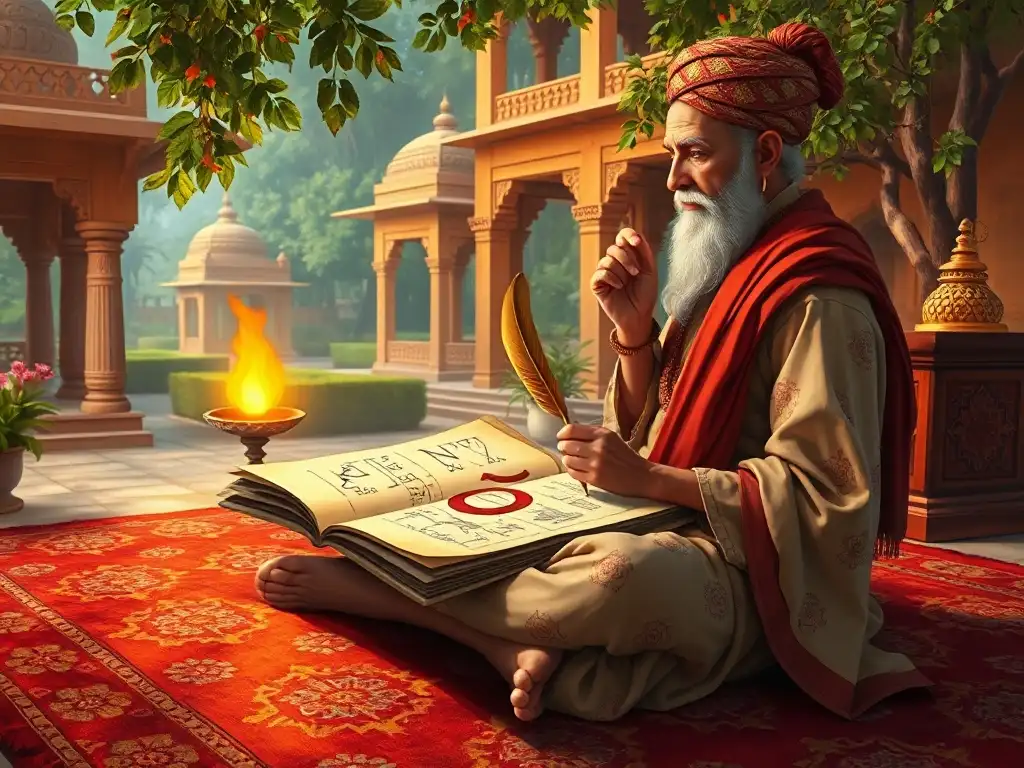
The introduction of zero as a numerical concept revolutionized mathematics not just in India, but across the globe. In ancient Indian society, zero was not merely a placeholder; it represented the concept of 'nothingness,' which was a profound philosophical and mathematical advancement. This innovation allowed for more complex calculations and the development of arithmetic operations, which were essential for trade, astronomy, and engineering.
The decimal system, which heavily relies on the concept of zero, enabled mathematicians to perform calculations more efficiently and accurately. This laid the groundwork for algebra, calculus, and many other branches of mathematics that we utilize today.
The cultural significance of zero in India is evident in texts such as the Bakhshali Manuscript, where it is used to denote an empty place in numerical expressions. This early documentation of zero emphasizes its mathematical importance and its role in the evolution of numerical systems. As zero traveled beyond India, its impact on global mathematics became increasingly pronounced, as it facilitated a more systematic approach to calculations and problem-solving.
Transmission of Zero to the Islamic World
The journey of zero to the Islamic world marks a pivotal moment in the history of mathematics. After its development in India, zero and the decimal numeral system were transmitted to Arab scholars during the 7th century. Notably, the Persian mathematician Al-Khwarizmi played a crucial role in this transmission, as his works introduced Indian numerals, including zero, to the Islamic Empire. His book, Al-Kitab al-Mukhtasar fi Hisab al-Jabr wal-Muqabala, laid the foundation for algebra and demonstrated practical applications of zero in calculations.
The acceptance of zero in Islamic mathematics led to significant advancements in various fields, including astronomy, navigation, and architecture. Scholars in the Islamic Golden Age utilized zero in their mathematical treatises, which were later translated into Latin and disseminated throughout Europe. This cross-cultural exchange not only preserved Indian mathematical knowledge but also enriched the Islamic intellectual tradition, showcasing zero's pivotal role in the evolution of mathematics.
The Spread of Zero to Europe and Beyond
The transmission of zero from the Islamic world to Europe occurred during the Middle Ages, primarily through translations of Arabic texts into Latin. By the 12th century, European mathematicians began to adopt the Hindu-Arabic numeral system, which included zero. Figures such as Fibonacci, in his seminal work Liber Abaci, advocated for the use of this numeral system over the Roman numeral system, showcasing the efficiency and practicality of zero in calculations.
The gradual acceptance of zero in Europe faced resistance, particularly due to its association with the concept of nothingness, which some scholars viewed with skepticism. However, as the benefits of using zero became increasingly evident, it gained traction among mathematicians and merchants alike. By the Renaissance, zero had become an integral part of European mathematics, facilitating advancements in various scientific fields and laying the groundwork for modern mathematics.
Conclusion
Recap of the Cultural Significance of Zero in India
The cultural significance of zero in India cannot be overstated. It represents a remarkable intersection of mathematics, philosophy, and culture. In ancient Indian society, zero was not only a numerical concept but also a symbol of the infinite and the void, reflecting deep philosophical ideas. The development of zero enabled more complex mathematical operations and played a crucial role in trade and astronomy. This innovative spirit is a testament to the intellectual achievements of ancient Indian civilizations, highlighting their contributions to the global understanding of mathematics.
Legacy of Zero in Contemporary Mathematics and Culture
The legacy of zero continues to resonate in contemporary mathematics and culture. Today, zero is a fundamental component of the number system, essential for computing, engineering, and scientific research. Its role in representing null values, in programming languages, and in digital technology underscores its ongoing relevance in modern society.
Culturally, zero has transcended its mathematical origins to influence art, philosophy, and spirituality. It has inspired various interpretations and representations, symbolizing the void and the infinite in different cultural contexts. The journey of zero from ancient India to its current status as a cornerstone of mathematics exemplifies its profound impact on human thought and civilization, ensuring that its cultural significance endures.
References
The cultural significance of zero in ancient Indian society is extensively documented in various texts and scholarly articles. This section reviews key texts and sources that provide insights into the mathematical innovations and cultural implications surrounding the concept of zero.
Key Texts and Sources on Ancient Indian Mathematics
-
Brahmagupta's Brahmasphutasiddhanta
Brahmagupta, a 7th-century mathematician, is known for his seminal work, Brahmasphutasiddhanta, where he discusses the rules for arithmetic operations involving zero. This text is crucial for understanding how zero was integrated into mathematical systems.
-
Aryabhata's Aryabhatiya
In his work Aryabhatiya, Aryabhata introduces a positional number system that includes zero. His methods and notations have influenced mathematical thought and development significantly.
-
Bhaskara II's Lilavati
Lilavati, authored by Bhaskara II in the 12th century, is a treatise on arithmetic that illustrates various mathematical problems, including calculations involving zero. This work highlights the practical applications of zero in everyday life.
-
The History of Mathematics: A Brief Course by Roger L. Cooke
This text explores the evolution of mathematical concepts, including zero, tracing its origins in ancient India and its spread to other cultures. It provides a comprehensive view of the cultural context that nurtured the invention of zero.
Further Reading on the Cultural Implications of Zero
-
"The Cultural Significance of Zero in Ancient Indian Society" by N. R. Sharma
This article delves into the philosophical and cultural contexts in which zero emerged in ancient India, discussing its impact on various fields such as astronomy, commerce, and philosophy.
-
"Zero: The Biography of a Dangerous Idea" by Charles Seife
This book offers a broader perspective on the concept of zero, tracing its evolution from ancient India to its implications in modern mathematics and science. It discusses how zero was perceived and utilized in different cultures, including its cultural significance in India.
-
"Mathematics in the Time of the Pharaohs" by Richard J. Gillings
Although primarily focused on Egyptian mathematics, this book contextualizes the development of numerical systems, including zero, and compares its cultural significance across different ancient civilizations, including India.
-
"The Origins of Zero" by Constance Reid
This text explores the historical journey of zero, emphasizing its revolutionary role in mathematics and its cultural significance in ancient Indian society. It examines how the concept reshaped numerical practices and philosophical thought.
These texts and resources provide a comprehensive foundation for understanding the cultural significance of zero in ancient Indian society and its far-reaching innovations, making them essential for anyone interested in the history of mathematics and its cultural implications.
- Introduction to the Concept of Zero
- The Emergence of Zero in Ancient Indian Mathematics
- Cultural Significance of Zero in India
- Innovations Linked to Zero in Ancient Indian Society
- Zero's Impact on Global Mathematics
- Conclusion
- References
Frequently Asked Questions
What is the cultural significance of zero in ancient India?
The cultural significance of zero in ancient India lies in its role as a mathematical concept that revolutionized calculations and contributed to the development of modern mathematics.
How did ancient Indian civilizations contribute to the concept of zero?
Ancient Indian scholars, particularly during the Gupta Empire, played a crucial role in the formalization of zero as a number, which enabled advanced mathematical operations and innovations.
Who was the first to use zero as a number in India?
The Bakhshali Manuscript, dated between the 2nd century and 4th century CE, is one of the earliest texts to use a placeholder zero, showcasing its early use in mathematics.
In what ways did zero impact Indian culture and society?
The introduction of zero not only influenced mathematics but also had a profound effect on astronomy, architecture, and trade, facilitating advancements in various fields in ancient India.
How did the concept of zero spread beyond India?
The concept of zero spread to the Middle East and later to Europe through trade routes and cultural exchanges, significantly impacting global mathematics and science.
Final Reflection: The Enduring Legacy of Zero in Indian Culture
The cultural significance of zero in India transcends mere mathematics; it embodies a profound philosophical understanding of existence and the universe. In today's fast-paced world, where technology and innovation dominate our lives, the concept of zero serves as a reminder of the foundational ideas that have shaped our intellectual heritage. It is not just a number but a symbol of the infinite possibilities that arise from acknowledging the void, urging us to explore the depths of knowledge and creativity.
The innovations stemming from the cultural significance of zero have profoundly influenced our social and intellectual landscape. From ancient scholars who embraced the concept to modern-day thinkers who continue to build upon this legacy, the impact of zero is felt across disciplines. As the mathematician and philosopher Bhaskara II once said, What is the use of a number if it cannot express the infinite?
This quote encapsulates the essence of zero, highlighting its role as a bridge between the finite and the infinite, and its ongoing relevance in our quest for understanding.
As we reflect on the cultural significance of zero in India, let us embrace its lessons in our own lives. Consider how the idea of starting from nothing can lead to remarkable innovations and transformations. Challenge yourself to find value in the voids and gaps in your own experiences, and recognize that from these spaces, new ideas and opportunities can emerge. Together, let us honor this ancient wisdom and apply it to our modern challenges, fostering a future where creativity and knowledge continue to flourish.
Unveil the Legacy of Zero in Ancient Indian Culture!
Thank you for taking the time to explore the profound cultural significance of zero in ancient Indian society! We hope you’ve gained valuable insights into how this remarkable innovation shaped mathematics and beyond. Now, it’s time to take action and delve deeper into this fascinating topic.
Here’s what you can do next:
- Dive deeper: Explore more about the impact of Indian mathematicians on the world by reading related articles available on our website.
- Join the conversation: Share this article with friends or on social media to spark discussions about the innovations of the past!
- Reflect and engage: Consider how the concept of zero influences your perspective on numeracy today—what future innovations might emerge from this foundational idea?
What do you believe is the most significant way the invention of zero has transformed modern mathematics?