
Ancient Indian Mathematics: Bridging the Gap Between Art and Science


Welcome to Ancient India History, where we embark on a journey through time to uncover the rich tapestry of ancient Indian civilizations. In our featured article, "Ancient Indian Mathematics: Bridging the Gap Between Art and Science," we delve into the remarkable contributions of ancient Indian mathematics that not only shaped the foundations of the field but also intertwined with the cultural and artistic expressions of the time.
Prepare to be captivated by the ingenuity of mathematicians who transformed numbers into a language of beauty and logic. Join us as we explore these fascinating contributions and their enduring legacy—your adventure into the past begins here!
-
Ancient Indian Mathematics Contributions: Bridging the Gap Between Art and Science
- Introduction to Ancient Indian Mathematics
- Historical Context of Mathematics in Ancient India
- Prominent Figures in Ancient Indian Mathematics
- Major Contributions of Ancient Indian Mathematics
- The Intersection of Mathematics and Art in Ancient India
- The Legacy of Ancient Indian Mathematics
- Conclusion: The Lasting Impact of Ancient Indian Mathematics Contributions
- Summary of Key Contributions and Their Relevance Today
- Future Directions in the Study of Ancient Indian Mathematics
-
Frequently Asked Questions
- What are some key contributions of ancient Indian mathematics?
- How did ancient Indian mathematicians influence modern mathematics?
- Who were some prominent figures in ancient Indian mathematics?
- In what ways did ancient Indian mathematics intersect with art and culture?
- How is ancient Indian mathematics relevant in today's educational curriculum?
- Final Reflection: The Timeless Legacy of Ancient Indian Mathematics
- Unveil the Secrets of Ancient Indian Mathematics!
Ancient Indian Mathematics Contributions: Bridging the Gap Between Art and Science
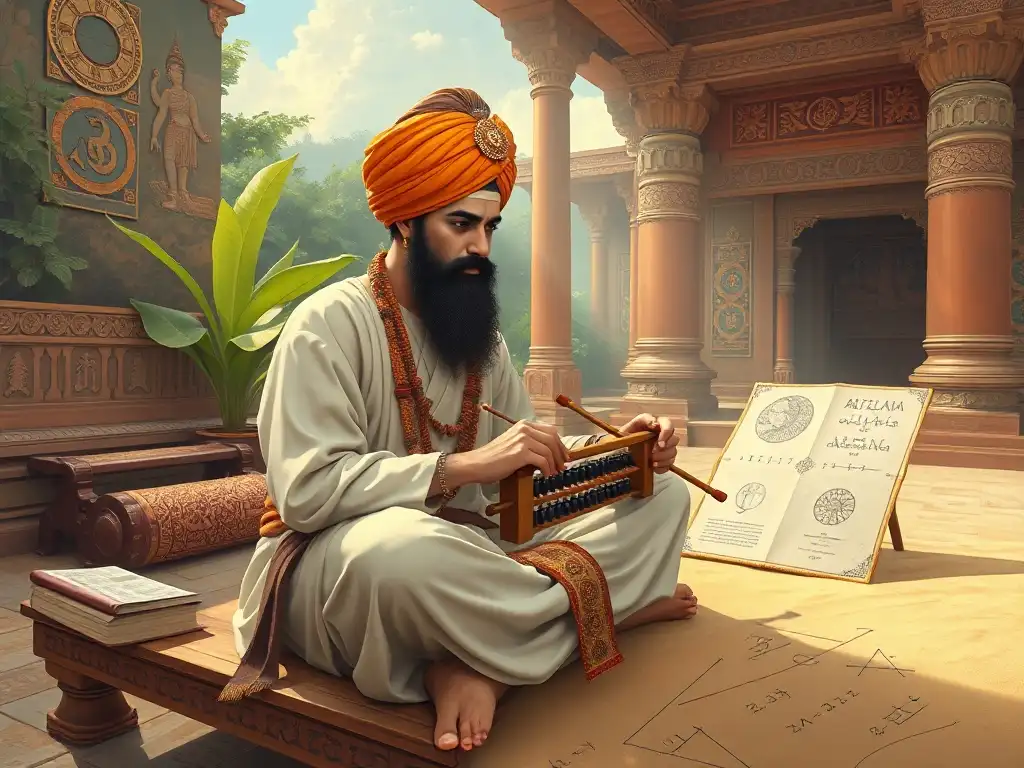
Introduction to Ancient Indian Mathematics
Ancient Indian mathematics is a remarkable testament to the ingenuity and intellectual prowess of Indian civilizations, showcasing a rich tapestry woven with concepts that bridge the realms of art and science. This article delves into the significant contributions of ancient Indian mathematics, highlighting its profound influence on both cultural practices and scientific advancements.
From the sophisticated numerical systems developed during the Indus Valley Civilization to the intricate calculations in astronomy and architecture during the Gupta Empire, the legacy of ancient Indian mathematicians is a cornerstone of global mathematical heritage. By exploring these contributions, we can appreciate how ancient Indian mathematics not only facilitated practical applications but also embodied philosophical and aesthetic principles that resonate to this day.
Overview of Ancient Indian Mathematics Contributions
The contributions of ancient Indian mathematics are vast and varied, encompassing numerous fields including arithmetic, geometry, algebra, and astronomy. Some of the most notable achievements include:
- The Concept of Zero: The introduction of zero as a numeral, which revolutionized mathematical calculations.
- Decimal System: The development of the base-10 numeral system that is still in use today.
- Algebraic Solutions: Early formulations of algebraic equations, which laid the groundwork for future mathematical exploration.
- Trigonometry: The establishment of sine and cosine functions, crucial for advancements in astronomy and navigation.
These contributions not only provided practical tools for trade, architecture, and astronomy but also reflected the philosophical underpinnings of Indian thought, where mathematics was seen as a means to understand the universe.
Importance of Mathematics in Ancient Indian Culture
Mathematics in ancient India was not merely a tool for calculation; it was deeply intertwined with cultural and religious practices. The precision required in rituals, the construction of temples, and astronomical observations necessitated a strong mathematical foundation. The significance of mathematics can be observed in:
- Vedic Texts: Mathematical concepts were embedded in the Vedas, with hymns and rituals requiring intricate calculations.
- Architecture: The construction of monumental structures, such as temples, demonstrated advanced geometric understanding.
- Astronomy: The alignment of celestial bodies was crucial for agricultural cycles and religious festivities, necessitating precise astronomical calculations.
This integration of mathematics into daily life and spiritual practices highlights its essential role in the ancient Indian worldview.
Historical Context of Mathematics in Ancient India
Understanding the historical context of mathematics in ancient India provides insight into how various civilizations contributed to its development. This period was marked by a continuous exchange of ideas, leading to significant advancements that influenced both regional and global mathematical thought.
Early Numerical Systems in Ancient India
The foundations of ancient Indian numerical systems can be traced back to the Indus Valley Civilization (c. 3300–1300 BCE), where early forms of counting and measurement were evident. Here are some key features of these systems:
- Use of Binary and Ternary Systems: Evidence suggests the use of multiple bases for calculations.
- Standardized Weights and Measures: Artifacts indicate a sophisticated understanding of measurement, crucial for trade and architecture.
- Inscriptions: Early inscriptions in various sites reveal numerical notations that hint at advanced mathematical thinking.
These early systems set the stage for the more developed mathematical concepts that followed.
Key Civilizations Contributing to Mathematical Knowledge
Several key civilizations played pivotal roles in the evolution of mathematics in ancient India:
- Indus Valley Civilization: As one of the earliest urban cultures, it established fundamental counting systems and trade mechanisms.
- Vedic Period: The period marked significant advancements in mathematics, with texts such as the Sulbasutras outlining geometrical principles for altar construction.
- Gupta Empire: Often referred to as the Golden Age of India, this era saw remarkable advancements in mathematics and astronomy, with scholars such as Aryabhata and Brahmagupta making groundbreaking contributions.
These civilizations collectively fostered an environment where mathematics flourished, bridging the gap between art and science, and establishing a legacy that continues to influence modern mathematics.
Prominent Figures in Ancient Indian Mathematics
Ancient Indian mathematics boasts a remarkable lineage of scholars whose contributions have significantly shaped the discipline. These mathematicians not only advanced mathematical theories but also intertwined these ideas with astronomy, philosophy, and art, showcasing a holistic understanding of knowledge. Key figures such as Aryabhata, Brahmagupta, and Bhaskara II emerged as trailblazers, each contributing unique insights that bridged the gap between abstract mathematics and practical applications. Their legacies continue to influence modern mathematics and inspire contemporary scholars.
Aryabhata: The Pioneer of Indian Mathematics
Aryabhata, who lived in the 5th century CE, is often regarded as the pioneer of Indian mathematics. His seminal work, the Aryabhatiya, laid down foundational concepts in arithmetic, algebra, and trigonometry. Aryabhata introduced a refined approach to the decimal number system and emphasized the importance of zero, which was revolutionary for its time.
His calculations of π (pi) were remarkably accurate, as he approximated it to 3.1416, which reflects his advanced understanding of geometry. Additionally, Aryabhata's work in astronomy included precise computations for planetary positions and eclipses, integrating mathematical principles with celestial observations. His influence extends beyond national borders, impacting mathematical thought in the Islamic world and Europe.
Brahmagupta: Innovations in Arithmetic and Algebra
Brahmagupta, a 7th-century mathematician, is best known for his work Brahmasphutasiddhanta, which provided comprehensive rules for arithmetic operations with both positive and negative numbers. He is credited with formalizing the rules for solving quadratic equations and introduced methods for calculating the area of cyclic quadrilaterals.
One of his most notable contributions was the concept of the "rules of signs" in arithmetic, which paved the way for the understanding of positive and negative integers. Brahmagupta's innovative ideas regarding zero, including its use as a placeholder and in calculations, represented a significant leap in mathematical thought. His work laid the groundwork for future mathematicians and established a systematic approach to algebra.
Bhaskara II: Advances in Calculus and Astronomy
Bhaskara II, also known as Bhaskara the Great, lived during the 12th century and made profound contributions to mathematics, particularly in calculus and astronomy. His principal works, Lilavati and Bijaganita, reflect a deep understanding of mathematical concepts and practical applications.
In Lilavati, Bhaskara II presented problems related to arithmetic, geometry, and even practical scenarios such as commerce and measurement. His work on the concept of "instantaneous motion" foreshadowed calculus principles, demonstrating an understanding of differential calculus long before its formal development in Europe. Furthermore, Bhaskara II's astronomical calculations, including determining the position of planets with remarkable accuracy, showcased the integration of mathematics with observational science.
Major Contributions of Ancient Indian Mathematics

Ancient Indian mathematics is characterized by significant advancements that laid the foundation for modern mathematical concepts. The development of the decimal system, the introduction of zero, and contributions to algebra and arithmetic are among the most notable achievements that have had a lasting impact on mathematics worldwide.
Development of the Decimal System and Place Value
The decimal system, which utilizes a base of ten, was a revolutionary advancement in the history of mathematics. Ancient Indian mathematicians were instrumental in formalizing this system, establishing a method for representing large numbers efficiently through a place-value notation. This innovation allowed for complex calculations and facilitated the development of arithmetic operations.
The place value system, where the position of a digit determines its value, was a profound shift from previous numeral systems. This method not only streamlined calculations but also made it easier to perform operations like addition, subtraction, multiplication, and division, setting the stage for modern numerical representations.
Introduction of Zero and Its Significance
The concept of zero as both a number and a placeholder is one of the most significant contributions of ancient Indian mathematics. The mathematician Brahmagupta was among the first to articulate the rules surrounding zero, emphasizing its operational roles in arithmetic. This innovation allowed for the representation of the absence of quantity and enabled more complex calculations.
Zero's introduction transformed mathematics by facilitating the development of equations, the ability to express large numbers compactly, and the advancement of algebraic concepts. Its impact on mathematics is immeasurable, as it serves as a fundamental building block in both theoretical and applied mathematics today.
Contributions to Algebra and Arithmetic
Ancient Indian mathematicians made remarkable advancements in algebra and arithmetic, establishing principles that would influence generations to come. The works of Aryabhata and Brahmagupta included systematic approaches for solving linear and quadratic equations, providing algorithms that formed the basis of algebraic practices.
These scholars also explored arithmetic in practical contexts, addressing problems related to trade, measurement, and timekeeping. Their methods included the use of algorithms and systematic problem-solving techniques, enhancing the efficiency of mathematical calculations. This foundational work in algebra and arithmetic not only elevated the discipline in India but also laid the groundwork for future developments in mathematics across the globe.
The Intersection of Mathematics and Art in Ancient India
In ancient India, mathematics and art were not isolated disciplines; rather, they were intricately woven together, reflecting the civilization's holistic approach to knowledge. Ancient Indian mathematicians and artists perceived numbers and shapes as essential elements of beauty, leading to innovations that showcased the profound connection between mathematical principles and artistic expression. This synergy can be observed in various forms, from temple architecture to intricate frescoes, where mathematical precision played a crucial role in achieving aesthetic harmony.
The application of geometry in creating symmetrical designs and patterns was deeply rooted in cultural and spiritual practices. Artists employed mathematics to achieve balance and proportion, which were believed to reflect cosmic order. This alignment with spirituality not only elevated the art form but also emphasized the significance of mathematics as a tool for understanding the universe.
Geometric Patterns in Indian Art and Architecture
Geometric patterns are a hallmark of ancient Indian art and architecture, prominently featured in temples, palaces, and textiles. The use of geometric shapes such as circles, triangles, and squares can be seen in the layout of famous sites like the Brihadeeswarar Temple and the intricate carvings of Khajuraho. These designs often symbolize various philosophical concepts, including the cyclical nature of life and the universe.
Mathematicians of the time developed sophisticated techniques to create these patterns. For example, the art of mandala, a spiritual symbol representing the universe, employs complex geometric arrangements that require precise calculations and an understanding of symmetry. These patterns not only served aesthetic purposes but also functioned as tools for meditation and religious practices, demonstrating the seamless integration of mathematics in spiritual art.
The Influence of Mathematics on Classical Indian Dance and Music
Classical Indian dance and music also exhibit a significant influence from ancient Indian mathematics. The rhythmic patterns known as "tala" in music and dance choreography are deeply rooted in mathematical concepts. Each tala consists of specific beats that are arranged in a cyclical manner, often employing intricate time signatures that reflect mathematical relationships.
In dance forms like Bharatanatyam and Kathak, movements are choreographed to align with these rhythmic patterns, creating a harmonious blend of art and mathematics. Moreover, the concept of "natya shastra," an ancient treatise on performing arts, illustrates the mathematical underpinnings in the structure of dance, such as the use of ratios and proportions to achieve precise body movements and expressions.
The Legacy of Ancient Indian Mathematics
The contributions of ancient Indian mathematics have left an indelible mark on the world, influencing both contemporary mathematics and various fields beyond it. The mathematical principles developed during this era laid the groundwork for future advancements in arithmetic, geometry, and astronomy.
Impact on Later Indian Mathematicians
The legacy of ancient Indian mathematics is evident in the works of later Indian mathematicians, such as Brahmagupta and Bhaskara II, who built upon the foundational concepts established by their predecessors. Their innovations, including advancements in algebra and the introduction of zero as a numerical concept, were pivotal in shaping modern mathematics. The methods and principles devised during ancient times served as a springboard for these mathematicians, who further explored and expanded mathematical theories, ensuring the continuity of knowledge through generations.
Influence on Global Mathematical Thought
Ancient Indian mathematics has significantly influenced global mathematical thought, particularly during the Middle Ages when Indian texts were translated and disseminated across the Islamic world and Europe. The introduction of concepts such as the decimal system and the numeral zero transformed mathematical practices worldwide, allowing for more sophisticated calculations and advancements in various scientific fields.
The exchange of knowledge between cultures facilitated the spread of these mathematical ideas, ultimately contributing to the Renaissance and shaping modern mathematical education. The legacy of ancient Indian mathematics remains a testament to the remarkable contributions of this civilization, bridging the gap between art and science in a way that continues to inspire and inform contemporary thought.
Conclusion: The Lasting Impact of Ancient Indian Mathematics Contributions

Ancient Indian mathematics contributions have significantly shaped the landscape of mathematical thought and practice, showcasing a remarkable blend of artistry and scientific rigor. The innovations stemming from this era, particularly in areas such as numeral systems, geometry, and algebra, not only advanced local practices but also laid foundational principles that resonated across cultures and centuries. The work of mathematicians such as Aryabhata, Brahmagupta, and Bhaskara reflects a deep understanding of mathematical concepts and their applications, from astronomical calculations to practical problem-solving in trade and agriculture.
The influence of ancient Indian mathematics can still be felt today in various fields, including computer science, engineering, and financial mathematics. Concepts such as zero, the decimal system, and intricate algorithms continue to serve as core elements in contemporary mathematical discourse. As we delve deeper into the historical roots of these ideas, we uncover a rich tapestry of knowledge that underscores the interconnectedness of culture, science, and mathematics.
Summary of Key Contributions and Their Relevance Today
The contributions of ancient Indian mathematics are manifold, with several key innovations that continue to resonate in modern mathematics:
- The Concept of Zero: The introduction of zero as a numeral was a groundbreaking advancement that revolutionized mathematical calculations. This concept paved the way for the development of calculus and computer science.
- Decimal System: Ancient Indian scholars standardized the decimal system, which is now universally used in mathematics. This system allows for efficient computation and is integral to various mathematical applications.
- Algebraic Methods: Contributions from mathematicians like Brahmagupta and Bhaskara laid the groundwork for algebra, including rules for solving quadratic equations. Their work is foundational for modern algebraic concepts.
- Trigonometry: The early formulations of trigonometric concepts in ancient India, particularly in Aryabhata’s work, have influenced the development of trigonometry in both theoretical and applied mathematics.
- Mathematical Astronomy: The integration of mathematics and astronomy in ancient Indian texts demonstrates the practical application of mathematical principles in understanding celestial phenomena.
These contributions are not merely historical footnotes; they are essential to the very fabric of contemporary mathematics. The principles established by ancient Indian mathematicians continue to inform modern mathematical techniques and problem-solving strategies.
Future Directions in the Study of Ancient Indian Mathematics
As the study of ancient Indian mathematics continues to evolve, several promising directions offer opportunities for deeper exploration and understanding:
- Interdisciplinary Research: The collaboration between mathematicians, historians, and cultural scholars can yield new insights into the socio-cultural context of ancient mathematical practices. This approach can help illuminate how mathematics was perceived and utilized in daily life.
- Digital Humanities: The digitization of ancient texts and mathematical manuscripts provides access to a wealth of information previously confined to archives. Researchers can utilize computational tools to analyze patterns and relationships within these texts more efficiently.
- Comparative Studies: Examining ancient Indian mathematics alongside contemporaneous mathematical developments in other civilizations, such as the Greeks and Chinese, can reveal unique features and shared concepts, enriching our understanding of global mathematical evolution.
- Educational Integration: Incorporating the history of ancient Indian mathematics into modern curricula can inspire a new generation of mathematicians. Understanding the roots of mathematical concepts can foster appreciation and innovation.
- Preservation and Translation: Ongoing efforts to preserve and translate ancient mathematical works ensure that this knowledge remains accessible. This effort will facilitate further research and engagement with the mathematical heritage of ancient India.
By pursuing these avenues, scholars can enhance our comprehension of ancient Indian mathematics and its enduring legacy, illuminating the profound connections between art and science that characterized this remarkable period in history.
Frequently Asked Questions
What are some key contributions of ancient Indian mathematics?
Ancient Indian mathematics made significant contributions, including the concept of zero, the decimal system, and advancements in geometry and algebra.
How did ancient Indian mathematicians influence modern mathematics?
Ancient Indian mathematicians laid the groundwork for modern mathematics by introducing key concepts such as negative numbers, infinity, and calculus, which are still used today.
Who were some prominent figures in ancient Indian mathematics?
Notable mathematicians include Aryabhata, who calculated the value of pi, and Brahmagupta, known for his work in algebra and rules regarding zero.
In what ways did ancient Indian mathematics intersect with art and culture?
Mathematics in ancient India was often intertwined with architecture, astronomy, and music, showcasing how these fields influenced each other in cultural expressions.
How is ancient Indian mathematics relevant in today's educational curriculum?
The principles and concepts from ancient Indian mathematics are fundamental in modern education, helping students understand the historical context and evolution of mathematical ideas.
Final Reflection: The Timeless Legacy of Ancient Indian Mathematics
The contributions of Ancient Indian mathematics are not merely relics of the past; they are vibrant threads woven into the fabric of modern science and art. Today, as we stand on the shoulders of giants, we recognize that the mathematical principles developed centuries ago continue to influence contemporary thought and innovation. The intricate relationship between mathematics and art, as exemplified by the works of ancient scholars, serves as a powerful reminder that these disciplines are not mutually exclusive but rather complementary forces that shape our understanding of the universe.
The impact of Ancient Indian mathematics extends far beyond historical significance; it has profoundly influenced our cultural and social landscape. The elegance of mathematical concepts such as zero and the decimal system has permeated various aspects of life, from architecture to technology. Mathematics is the language with which God has written the universe.
This quote by Galileo Galilei encapsulates the essence of how ancient mathematical discoveries resonate through time, inspiring generations to explore the beauty of numbers and their applications in art, science, and everyday life.
As we reflect on the lessons of Ancient Indian mathematics, let us embrace the call to integrate these timeless principles into our own lives. Consider how the balance of creativity and logic can enhance your personal and professional endeavors. Whether you are an artist, a scientist, or simply a curious mind, take a moment to explore the connections between these fields. Challenge yourself to see the world through the lens of mathematics and art, and let this exploration inspire you to contribute to the ongoing legacy of innovation and creativity.
Unveil the Secrets of Ancient Indian Mathematics!
Thank you for exploring the intriguing world of Ancient Indian Mathematics with us! You've uncovered valuable insights into how this fascinating discipline has connected art and science throughout history. Now, it's time to take those learnings and put them into action!
Here are some engaging ways to deepen your understanding and share your newfound knowledge:
- Dive into further reading: Explore books and online resources that delve deeper into the mathematical concepts and the influence of these ancient techniques on various artists.
- Share with your community: Discuss your findings with friends or initiate a conversation in an online forum about the impact of ancient mathematics on modern art and science.
- Create your own mathematical art: Experiment with incorporating ancient Indian techniques into your artwork! Whether through geometric designs or intricate patterns, bring these historical insights to life.
As you embark on these exciting paths, we’d love to hear from you: In what ways do you believe ancient mathematics can inspire contemporary art and science? Share your thoughts in the comments below!