
How Ancient Indian Mathematics Influenced the Development of Modern Numerical Systems


Welcome to Ancient India History, where we embark on a fascinating journey through the rich tapestry of ancient Indian civilizations. From the enigmatic Indus Valley to the illustrious Gupta Empire, the contributions of these cultures have shaped the world in profound ways. In our featured article, "How Ancient Indian Mathematics Influenced the Development of Modern Numerical Systems," we delve into the remarkable achievements of ancient Indian mathematicians.
Discover how their groundbreaking innovations not only advanced the field of mathematics but also laid the foundation for the numerical systems we use today. Are you ready to unlock the secrets of mathematical wisdom that transcends time? Let’s dive deeper into this captivating exploration!
- Introduction to Ancient Indian Mathematics Contributions
- Historical Context of Ancient Indian Mathematics
- Major Contributions of Ancient Indian Mathematics
- Influence of Ancient Indian Mathematics on Modern Numerical Systems
- Case Studies of Specific Contributions
- Conclusion: The Lasting Legacy of Ancient Indian Mathematics Contributions
- Further Reading and Resources on Ancient Indian Mathematics Contributions
-
Frequently Asked Questions
- What are the key contributions of ancient Indian mathematics?
- How did the decimal system originate in ancient India?
- Who were some notable mathematicians in ancient India?
- How did ancient Indian mathematics influence the Islamic Golden Age?
- What role did ancient Indian mathematics play in trade and commerce?
- Final Reflection: The Enduring Legacy of Ancient Indian Mathematics
- Uncover the Secrets of Ancient Wisdom!
Introduction to Ancient Indian Mathematics Contributions
Ancient Indian mathematics is a profound and intricate field that has significantly shaped the development of numerical systems and mathematical thought across the globe. From the sophisticated calculations of the Indus Valley Civilization to the advanced theories proposed during the Gupta Empire, the contributions of ancient Indian mathematicians have laid the groundwork for many modern mathematical concepts.
This article will explore how ancient Indian mathematics influenced contemporary numerical systems, highlighting key developments, notable figures, and the lasting legacy of this rich tradition. By understanding these contributions, we can appreciate the remarkable advancements that emerged from ancient India and their ramifications on the global mathematical landscape.
Overview of Ancient Indian Mathematics
Ancient Indian mathematics encompasses a vast array of concepts, techniques, and innovations that emerged over several millennia. Key features include:
-
Numerical Systems:
The introduction of the decimal number system and the concept of zero revolutionized numerical representation and computation.
-
Arithmetic and Algebra:
Ancient texts, such as the Sulba Sutras and Aryabhata's Aryabhatiya, outlined methods for performing calculations and solving equations.
-
Geometry:
The application of geometry in architecture and rituals showcased advanced understanding, particularly in the construction of altars and temples.
-
Trigonometry:
The study of sine and cosine functions began in ancient Indian mathematics, influencing both astronomy and navigation.
Notable mathematicians like Aryabhata, Brahmagupta, and Bhaskara II made significant advances in these areas, contributing to a comprehensive mathematical framework that was both practical and theoretical.
Importance of Ancient Indian Mathematics in Global Context
The contributions of ancient Indian mathematics are not only remarkable within the context of their own civilization but also have had a profound impact on mathematical practices worldwide. Key points include:
-
Transmission of Knowledge:
Ancient Indian mathematical texts were translated and disseminated throughout the Middle East and Europe, influencing scholars like Al-Khwarizmi, who is often credited with introducing algebra to the Western world.
-
Cultural Exchange:
The Silk Road facilitated the exchange of ideas, allowing for the integration of Indian mathematical concepts with those from the Islamic Golden Age and eventually into European mathematics during the Renaissance.
-
Foundational Principles:
The principles of mathematics developed in ancient India, such as the concept of zero and the use of positional notation, are foundational to modern computing and digital systems.
In essence, the legacy of ancient Indian mathematics continues to resonate today, as its contributions form an essential part of the mathematical tools and concepts we utilize in our daily lives and scientific endeavors. Understanding this legacy not only enriches our knowledge of mathematics but also highlights the interconnectedness of global intellectual traditions.
Historical Context of Ancient Indian Mathematics

The Indus Valley Civilization and Early Numerical Concepts
The Indus Valley Civilization, which thrived around 2500 BCE in what is now modern-day Pakistan and northwest India, is one of the earliest urban cultures known for its advanced societal structures and economic systems. Evidence suggests that the people of this civilization had developed a rudimentary form of mathematics, primarily for trade, measurement, and inventory purposes.
- Weights and Measures: Archaeological findings indicate the use of standardized weights made from stone, which points to a system of measurement essential for trade. The uniformity of these weights suggests a sophisticated understanding of numerical concepts, allowing for fair trade practices.
- Numerical Symbols: The Indus script, although still undeciphered, includes symbols that are believed to represent numerical values. Some researchers propose that these symbols might have been used to denote quantities or to keep records, indicating an early form of mathematical notation.
- Architecture and Planning: The layout of cities like Mohenjo-Daro and Harappa showcases an understanding of geometry. The precise measurements used in constructing public baths, granaries, and residential areas demonstrate an application of mathematical concepts, reinforcing the role of mathematics in urban planning.
Development of Mathematics During the Vedic Period
The Vedic period, spanning approximately 1500 to 500 BCE, marked a significant evolution in ancient Indian mathematics, deeply intertwined with religious and philosophical developments.
- Vedic Texts and Mathematics: The Vedas, ancient sacred texts, contain hymns that include mathematical concepts, particularly in the context of rituals. For instance, the Shulba Sutras, a set of texts associated with the Vedic tradition, provided rules for constructing altars and required precise measurements, reflecting early geometry.
- Introduction of Zero and Decimal System: While the concept of zero was not fully developed during the Vedic period, the groundwork laid in this era influenced later mathematical advancements. The decimal system, which is foundational to modern mathematics, can trace its origins back to these early calculations and measurements.
- Astronomical Calculations: Vedic scholars made significant contributions to astronomy, requiring mathematical calculations for celestial observations. This need spurred the development of more sophisticated mathematical techniques, including the use of various calculations for timekeeping and predicting astronomical events.
Contributions of Notable Ancient Indian Mathematicians
Ancient India produced several mathematicians whose contributions have had a lasting impact on the field of mathematics, influencing both contemporary practices and modern numerical systems.
- Aryabhata (476–550 CE): One of the most renowned mathematicians and astronomers, Aryabhata introduced the concept of zero and the place value system. His work, the Aryabhatiya, includes methods for solving quadratic equations and calculating the value of pi (π) with remarkable accuracy.
- Brahmagupta (598–668 CE): Another significant figure, Brahmagupta's seminal text, the Brahmasphutasiddhanta, elaborated on arithmetic operations involving zero and negative numbers. His rules for solving equations laid the groundwork for algebra, showcasing a deep understanding of mathematical principles.
- Bhaskara II (1114–1185 CE): Often referred to as Bhaskara the Great, he made substantial contributions to both algebra and calculus. His work, the Siddhanta Shiromani, includes innovative approaches to solving problems involving cyclic processes and astronomical calculations.
These mathematicians not only advanced mathematical knowledge in their time but also established concepts that would later shape the development of modern numerical systems. The legacy of their work continues to be recognized and celebrated in the field of mathematics today.
Major Contributions of Ancient Indian Mathematics
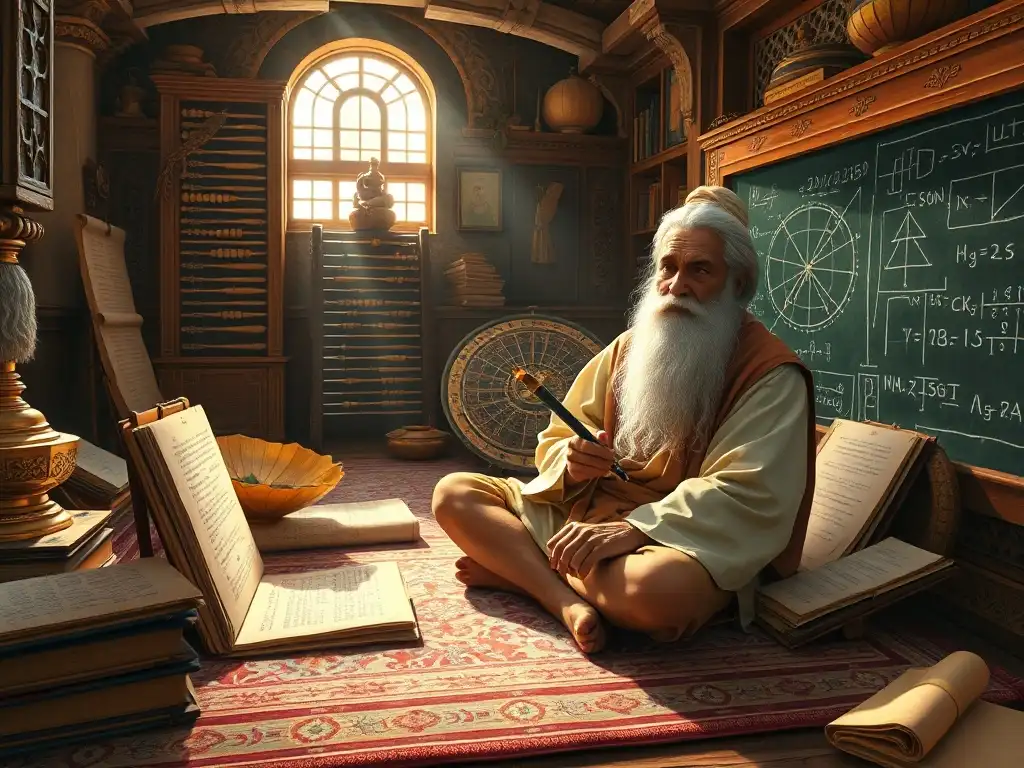
Ancient Indian mathematics encompasses a variety of groundbreaking concepts that have significantly influenced modern numerical systems. From the invention of the concept of zero to the development of the place value system, these contributions laid the groundwork for advanced mathematical thought and applications. Below, we delve into some of the most notable contributions made by ancient Indian mathematicians.
The Concept of Zero and Its Significance
One of the most revolutionary contributions of ancient Indian mathematics is the concept of zero (शून्य, śūnya). This idea, which emerged around the 5th century CE, transformed the way numbers are understood and utilized.
- Origins: The earliest recorded use of zero can be traced back to the Brahmi numerals, where it was represented as a dot. By the 7th century, mathematician Brahmagupta formalized its use in his work Brahmasphutasiddhanta, defining zero as a number and outlining rules for arithmetic involving zero.
- Mathematical Implications: Zero serves as a placeholder in positional numeral systems, allowing for the representation of large numbers efficiently. For example, without zero, the numbers 10 and 100 would be indistinguishable, drastically limiting the representation of numerical values.
- Cultural Impact: The concept of zero not only revolutionized mathematics but also influenced other fields, including astronomy and physics. It allowed for more precise calculations, leading to advancements in these disciplines.
Place Value System and Its Evolution
The place value system, which assigns value to digits based on their position within a number, is another monumental contribution of ancient Indian mathematics.
- Development: This system is believed to have evolved during the Gupta period (approximately 4th to 6th centuries CE). Indian mathematicians recognized that the value of a digit changed according to its position in a number, a concept that was instrumental in simplifying calculations.
- Example: In the number 205, the '2' represents two hundred, while the '5' signifies five. This clarity in representation was critical for arithmetic operations.
- Global Influence: The place value system was later transmitted to the Islamic world and subsequently to Europe, where it became foundational in modern mathematics.
Innovations in Arithmetic and Algebra
Ancient Indian mathematicians made significant strides in both arithmetic and algebra, introducing concepts that are still relevant today.
- Arithmetic Techniques: Techniques such as the use of rules for addition, subtraction, multiplication, and division were documented in texts like the Lilavati by Bhaskara II. His work emphasized practical arithmetic and included methods for solving everyday problems.
- Algebraic Contributions: The Aryabhatiya by Aryabhata presented early forms of algebra, including the systematic approach to solving equations. The use of symbols and algorithms in algebraic expressions can be seen as a precursor to modern algebra.
- Notable Theorems: The contributions of mathematicians like Brahmagupta, who formulated rules for handling negative numbers and quadratic equations, laid the groundwork for future developments in algebra.
By analyzing these major contributions of ancient Indian mathematics, we can better appreciate the profound influence they have had on the development of modern numerical systems. The innovative spirit of ancient Indian mathematicians continues to resonate, underscoring the importance of their work in today's mathematical landscape.
Geometry and Trigonometry in Ancient Indian Mathematics
Ancient Indian mathematicians made significant strides in the fields of geometry and trigonometry, laying the groundwork for modern mathematical concepts. Their contributions not only advanced mathematical thought but also served practical purposes in astronomy, architecture, and land surveying.
Geometry
The study of geometry in ancient India can be traced back to texts such as the Shulba Sutras, which date from around 800 to 500 BCE. These texts are primarily concerned with the construction of altars and rituals, but they also contain geometric principles that reflect a deep understanding of shapes and their properties. One notable aspect of the Shulba Sutras is their systematic approach to constructing geometric figures, including squares, rectangles, and circles, using only a compass and a straightedge.
One of the most remarkable contributions was the Pythagorean theorem, which was known to Indian mathematicians long before Pythagoras himself. The Shulba Sutras provide several proofs of this theorem, illustrating the right triangle's relationship between its sides. This early understanding not only shows the sophistication of Indian geometry but also suggests that these concepts were utilized in practical applications such as altar construction and land measurement.
Trigonometry
Trigonometry, as a branch of mathematics, also flourished in ancient India. The Aryabhatiya, written by Aryabhata in the 5th century CE, is one of the earliest Indian texts to systematically discuss trigonometric concepts. It introduced the sine function, known as jya, which later evolved into the modern sine. Aryabhata's work included tables of sine values and various techniques for calculating angles, which were crucial for astronomical calculations.
The contributions of later mathematicians, such as Brahmagupta and Bhaskara II, further developed trigonometric principles. Brahmagupta's Brahmasphutasiddhanta, composed in 628 CE, provided rules for working with fractions and offered methods to solve quadratic equations, which indirectly influenced trigonometric calculations. Bhaskara II’s Lilavati and Bijaganita expanded these concepts, presenting practical applications for trigonometric functions in solving real-world problems.
Practical Applications
The geometric and trigonometric advancements of ancient Indian mathematicians had profound implications beyond theoretical mathematics. They were instrumental in the design of architectural marvels, such as temples and palaces, where precise measurements and alignments were crucial. Additionally, these mathematical principles played a significant role in astronomy, enabling astronomers to predict celestial events and create accurate calendars.
The legacy of ancient Indian contributions to geometry and trigonometry has left an indelible mark on the evolution of mathematical thought. Their innovative approaches and practical applications set the stage for future developments in mathematics, influencing not only India but also the broader world. The rigorous study of these fields highlights the sophistication of ancient Indian mathematics, showcasing its enduring relevance in contemporary mathematical practices.
Influence of Ancient Indian Mathematics on Modern Numerical Systems
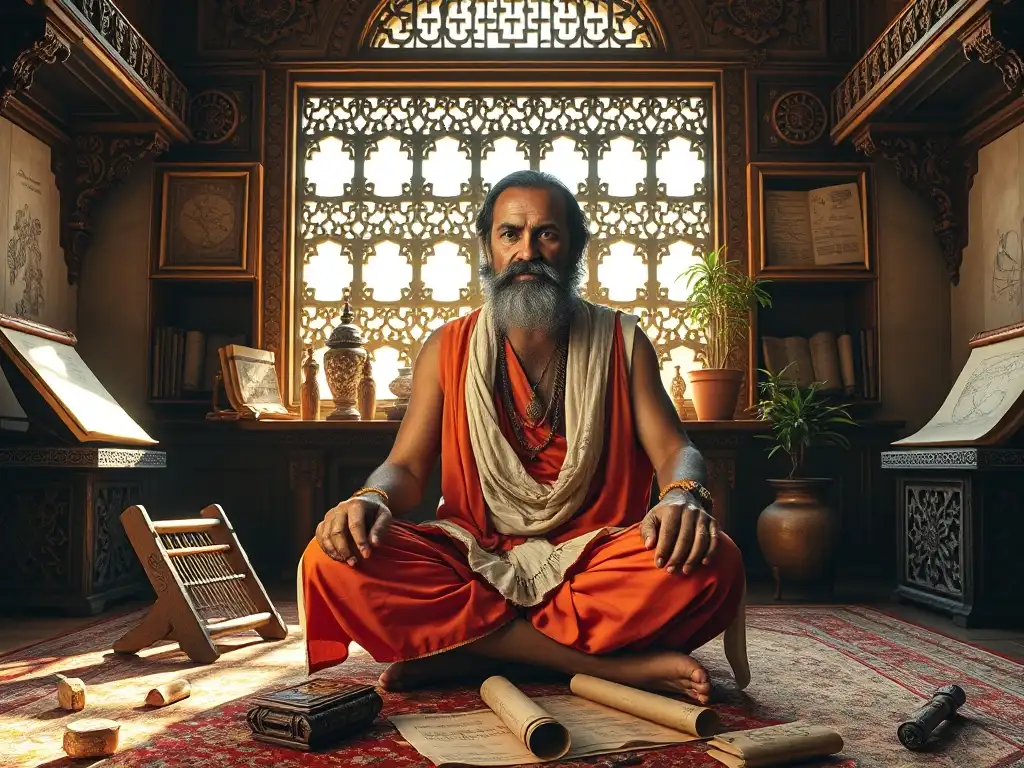
Transfer of Knowledge to the Islamic World
The flow of knowledge from ancient Indian mathematics to the Islamic world is a pivotal chapter in the history of mathematics. During the early medieval period, Indian mathematicians made significant contributions, particularly in the fields of arithmetic and astronomy, which caught the attention of scholars in the Islamic empire.
Key Contributions
- Decimal System: Indian mathematicians were among the first to use a decimal system, which included the concept of zero as a numeral. This innovation was crucial as it allowed for the efficient representation of large numbers and simplified calculations.
- Numerical Notation: The numeral system developed in India, known as "Hindu-Arabic numerals," was later transmitted to the Islamic mathematicians. They adopted and modified these symbols, which facilitated further advancements in mathematics.
- Translation Movement: Scholars such as Al-Khwarizmi, who is often referred to as the "father of algebra," played a vital role in this transfer of knowledge. His works, which included translations of Indian texts, helped disseminate these mathematical ideas throughout the Islamic world and beyond.
The impact of this transfer was profound, as it laid the groundwork for the evolution of mathematical thought in the Middle Ages and beyond.
Adoption of Indian Numerical Concepts in Europe
The introduction of Indian mathematical concepts into Europe marked a significant transition in the development of numerical systems. This process unfolded gradually, particularly from the 10th century onward, as trade routes and scholarly exchanges expanded.
Milestones of Adoption
- Translation of Texts: European scholars gained access to translated works from Arabic into Latin, which included Indian mathematical knowledge. Notable texts such as Al-Khwarizmi's "Al-Kitab al-Mukhtasar fi Hisab al-Jabr wal-Muqabala" showcased the practical applications of Indian numerals and arithmetic.
- Renaissance Influence: The Renaissance period saw a renewed interest in mathematics and science, fueled by these translations. Mathematicians like Fibonacci, who incorporated Indian numerals into his works, helped popularize the use of the decimal system in Europe.
- Shift to Base-10: The adoption of the base-10 system, derived from ancient Indian mathematics, replaced the cumbersome Roman numeral system. This transition greatly enhanced calculation efficiency and accuracy, leading to advancements in commerce, science, and engineering.
Thus, the integration of Indian numerical concepts into European mathematics was a key factor in reshaping the mathematical landscape of the continent.
The Role of Ancient Indian Mathematics in Global Mathematical Development
Ancient Indian mathematics played a crucial role in shaping mathematical practices across the globe, influencing various cultures and systems. Its contributions are evident in several key areas.
Global Impact
- Algebra: The principles of algebra, particularly the systematic use of equations and algorithms, can trace their roots back to Indian mathematicians. This foundation laid the groundwork for future developments in algebraic theory.
- Astronomy and Trigonometry: Indian scholars made significant advances in astronomy and trigonometry, developing methods for astronomical calculations that were later adopted by Islamic and European astronomers. The sine and cosine functions, for example, were refined by Indian mathematicians, influencing subsequent astronomical models.
- Legacy of Zero: The introduction of zero as a number was revolutionary. This concept not only transformed mathematical calculations but also had profound implications for the development of computer science and digital systems in the modern era.
Ancient Indian mathematics not only contributed significantly to the development of numerical systems but also influenced global mathematical thought, serving as a bridge between cultures and paving the way for future advancements in the field.
Case Studies of Specific Contributions

Aryabhata's Contributions to Mathematics and Astronomy
Aryabhata, one of the most prominent figures in ancient Indian mathematics, made remarkable contributions that significantly influenced both mathematics and astronomy. Born in 476 CE, Aryabhata's seminal work, the Aryabhatiya, is composed of four sections that cover a wide range of mathematical topics.
- Place Value System: Aryabhata is credited with developing a place value system that utilized zero as a placeholder, which was revolutionary for its time. This system laid the groundwork for the efficient representation of large numbers, facilitating complex calculations.
- Trigonometry: Aryabhata introduced the concept of sine (known as ardha-jya in his texts), which became a fundamental element in trigonometry. He provided tables of sines and detailed methods for their calculation, influencing later mathematicians in both India and the Islamic world.
- Approximation of Pi: Aryabhata approximated π (pi) to be 3.1416, a remarkably accurate value for calculations involving circles, which was crucial for both mathematical and astronomical computations.
- Astronomical Calculations: His work contained methods for calculating the positions of celestial bodies, eclipses, and the length of the solar year, showcasing the integration of mathematical principles with astronomy.
Aryabhata's contributions not only enriched Indian mathematics but also laid the foundation for future advancements in both mathematics and science worldwide.
Brahmagupta's Treatises on Arithmetic and Algebra
Brahmagupta, a 7th-century mathematician, further advanced the field of mathematics with his influential work, the Brahmasphutasiddhanta. This treatise is considered one of the earliest comprehensive texts on arithmetic and algebra, making significant strides in various mathematical concepts.
- Rules for Arithmetic: Brahmagupta established clear rules for arithmetic operations involving positive and negative numbers. He was among the first to formalize the rules for dealing with zero in calculations, treating it as a number rather than merely a placeholder.
- Quadratic Equations: He provided methods for solving quadratic equations, introducing systematic approaches that are still in use today. His contributions to algebra laid the groundwork for future mathematicians to explore more complex equations.
- Geometry and Measurement: Brahmagupta made significant contributions to geometry, particularly in the calculation of areas and volumes. He formulated formulas for the area of cyclic quadrilaterals and provided methods for calculating the volumes of various solids.
- Influence on Later Mathematics: The principles outlined in Brahmagupta's work influenced both Indian and Islamic mathematicians, leading to the eventual development of algebra as a distinct mathematical discipline.
Brahmagupta's treatises not only consolidated previous mathematical knowledge but also introduced innovative ideas that propelled the field forward, marking a significant milestone in ancient Indian mathematics.
Bhaskara II and the Advancements in Calculations
Bhaskara II, also known as Bhaskara the Great, lived during the 12th century and is celebrated for his comprehensive understanding of mathematics and astronomy. His primary work, the Siddhanta Shiromani, is divided into two parts: Lilavati (dealing with arithmetic) and Bijaganita (focused on algebra).
- Innovative Arithmetic: In Lilavati, Bhaskara II introduced a range of practical arithmetic techniques, including rules for calculating interest, profit, and loss, which were essential for commerce and trade.
- Advanced Algebra: Bijaganita contains methods for solving a variety of algebraic equations, including linear and quadratic equations. His systematic approaches to algebra had a lasting impact on the development of mathematical theory.
- Calculus Foundations: Bhaskara II hinted at concepts resembling calculus, particularly in his work on the motion of planets and the calculation of their orbits. His insights into infinitesimal quantities were precursors to later developments in calculus.
- Publications and Legacy: Bhaskara II's works were widely disseminated and translated into various languages, influencing mathematicians across the globe. His contributions to mathematics were foundational, leading to advancements in both theoretical and applied mathematics.
Bhaskara II's advancements in calculations and his innovative approaches shaped the trajectory of mathematical thought, solidifying his legacy as one of the greatest mathematicians in the history of ancient India.
Conclusion: The Lasting Legacy of Ancient Indian Mathematics Contributions

The contributions of ancient Indian mathematics have profoundly influenced the development of numerical systems and mathematical concepts that are foundational to contemporary mathematics. As we reflect on the myriad ways ancient Indian scholars advanced mathematical thought, we recognize that their innovations were not merely academic pursuits but essential tools that facilitated trade, astronomy, and everyday life.
Summary of Key Contributions and Influences
Ancient Indian mathematics is characterized by several pivotal contributions:
- The Concept of Zero:
- The invention of zero as a numeral was a groundbreaking development.
- It provided a place-holder in positional numeral systems, allowing for the representation of large numbers and enabling complex calculations.
- Decimal System:
- The adoption of the decimal system was crucial for simplifying calculations and record-keeping.
- Indian mathematicians like Aryabhata and Brahmagupta formalized this system around the 5th to 7th centuries CE.
- Algebraic Innovations:
- Ancient texts, such as the "Bakhshali Manuscript," illustrate the use of algebraic methods.
- These innovations included solving quadratic equations and developing algorithms for arithmetic operations.
- Trigonometry and Astronomy:
- Indian scholars made significant strides in trigonometric functions, which were necessary for astronomical calculations.
- The sine function was defined, paving the way for further advancements in mathematics and science.
- Mathematical Texts:
- Works like "Lilavati" and "Vedic Mathematics" provided not only mathematical principles but also practical applications, influencing future generations of mathematicians.
These contributions laid the groundwork for the mathematical frameworks that would eventually spread to other cultures, shaping the global understanding of mathematics.
The Relevance of Ancient Indian Mathematics in Contemporary Studies
The study of ancient Indian mathematics is not only of historical interest but also holds significant relevance in contemporary mathematical education and research. Here are some key points highlighting its importance:
- Cultural Integration: Understanding the historical context of mathematics fosters a greater appreciation for diverse mathematical traditions worldwide. This integration enriches the curriculum in educational institutions.
- Problem Solving Techniques: Ancient Indian mathematicians employed unique problem-solving techniques that can inspire modern approaches. For example, their methods for solving complex equations can be revisited and adapted in current mathematical practices.
- Interdisciplinary Applications: The principles derived from ancient Indian mathematics have applications beyond pure mathematics; they extend into fields such as computer science, engineering, and economics, showcasing the versatility of these ancient techniques.
- Preservation of Knowledge: As we continue to explore and document ancient mathematical texts, we preserve a rich intellectual tradition that informs contemporary mathematical thought and practices.
The contributions of ancient Indian mathematics are not relics of the past but rather living legacies that continue to influence modern numerical systems and mathematical practices. By recognizing and studying these contributions, we honor the rich history of mathematics and its evolution, ensuring that the insights of ancient scholars remain relevant in our ever-evolving world.
Further Reading and Resources on Ancient Indian Mathematics Contributions

Recommended Books and Articles
To delve deeper into the fascinating world of Ancient Indian mathematics contributions, several books and scholarly articles provide invaluable insights. Here are some noteworthy recommendations:
- "The History of Mathematics: A Brief Course" by Roger L. Cooke
- This comprehensive text offers a section dedicated to ancient Indian mathematics, discussing the pivotal works of mathematicians such as Aryabhata and Brahmagupta.
- "Mathematics in India" by Kim Plofker
- Plofker's work is significant for understanding the evolution of various mathematical concepts in India and their influence on global mathematics.
- "The Mathematics of India: A Historical Perspective" by D. S. M. Rao
- This book explores the historical development of mathematics in India, including detailed analyses of ancient texts that laid the foundation for modern numerical systems.
- Research Articles from the Journal of the Indian Mathematical Society
- A wealth of articles discussing various aspects of ancient Indian mathematics, including contributions to algebra, geometry, and number theory, can be accessed through this journal.
- "A History of Indian Literature" by A. N. D. N. K. Shastri
- This text examines literature and mathematics, providing context on how ancient Indian mathematicians contributed to both fields.
Online Resources and Databases for Further Exploration
In addition to books and articles, numerous online resources and databases offer extensive information on Ancient Indian mathematics contributions. Here’s a selection of valuable platforms:
- The Digital Library of India
- An extensive collection of texts and manuscripts related to Indian mathematics, providing free access to historical documents.
- Indian National Science Academy (INSA)
- The INSA website has a dedicated section on the history of science in India, including mathematics, with articles and publications available for download.
- The MacTutor History of Mathematics archive
- This resource provides biographies of significant mathematicians from India, along with their contributions and historical contexts.
- Mathematics Genealogy Project
- A database that tracks the academic lineage of mathematicians, including those from ancient India, showcasing their influence on subsequent generations.
- YouTube Educational Channels
- Channels such as "Numberphile" and "PBS Infinite Series" often feature episodes on ancient mathematics, including segments on Indian contributions.
By exploring these resources, readers can gain a comprehensive understanding of the remarkable achievements in ancient Indian mathematics and their lasting impact on modern numerical systems.
Frequently Asked Questions
What are the key contributions of ancient Indian mathematics?
Ancient Indian mathematics contributed significant concepts such as zero, the decimal system, and advanced techniques in algebra and geometry that laid the groundwork for modern mathematics.
How did the decimal system originate in ancient India?
The decimal system was developed in ancient India, where numbers were represented in a place-value format, making calculations more efficient and paving the way for modern numerical representation.
Who were some notable mathematicians in ancient India?
Notable mathematicians include Aryabhata, who introduced concepts in trigonometry and algebra, and Brahmagupta, who formulated rules for addition and subtraction of negative numbers.
How did ancient Indian mathematics influence the Islamic Golden Age?
The works of ancient Indian mathematicians were translated into Arabic, significantly impacting the Islamic Golden Age, where scholars built upon these ideas to advance mathematics and astronomy.
What role did ancient Indian mathematics play in trade and commerce?
Ancient Indian mathematics, particularly the use of zero and the decimal system, facilitated trade and commerce by improving record-keeping and calculations, essential for economic transactions.
Final Reflection: The Enduring Legacy of Ancient Indian Mathematics
The contributions of ancient Indian mathematics are not just historical footnotes; they are the bedrock upon which modern numerical systems stand. As we navigate a world increasingly reliant on technology and data, understanding the roots of our mathematical principles becomes essential. The brilliance of ancient Indian mathematicians, who introduced concepts like zero and the decimal system, continues to resonate today, reminding us that innovation often builds upon the foundations laid by those who came before.
The influence of ancient Indian mathematics extends far beyond textbooks; it shapes our daily lives and cultural practices. From the algorithms that power our smartphones to the financial systems that govern our economies, the principles established centuries ago are woven into the fabric of contemporary society. As the mathematician and philosopher Alfred North Whitehead once said, Mathematics is the science of patterns.
This notion underscores how the patterns and systems developed by ancient scholars remain relevant, guiding our understanding of the universe and our place within it.
As we reflect on the profound impact of ancient Indian mathematics, I invite you to consider how these lessons can inspire your own journey. Embrace the spirit of inquiry and innovation that characterized these early mathematicians. Whether you are a student, educator, or simply a curious mind, let the legacy of ancient Indian contributions motivate you to explore, question, and create. The future of mathematics—and indeed, our world—depends on our ability to build upon the wisdom of the past while forging new paths forward.
Uncover the Secrets of Ancient Wisdom!
Thank you for taking the time to explore how ancient Indian mathematics has shaped modern numerical systems! Your curiosity about this fascinating topic is truly commendable. Now, it’s time to take your newfound knowledge further and unleash the full potential of ancient wisdom in your daily life.
Here are some actions you can take right now:
- Deepen Your Understanding: Dive into further research by reading more books on ancient mathematical techniques. Look for titles that combine historical context with practical applications!
- Practice and Share: Challenge yourself and your friends to solve problems using ancient methods. Consider hosting a small gathering or an online discussion to explore these concepts together!
- Join the Conversation: Engage with others who share a passion for history and mathematics. Participate in forums or social media groups to exchange insights and learn from different perspectives!
What ancient mathematical technique would you love to apply in today’s digital world, and why?
Let’s inspire each other on this journey of rediscovery!