
Analyzing the Contributions of Charvaka Materialism in Ancient Discourse

Welcome to Ancient India History, where we embark on a fascinating journey through the intricate tapestry of ancient Indian civilizations. From the bustling streets of the Indus Valley to the profound philosophies of the Gupta Empire, our exploration is rich and diverse. In this article, we delve into the thought-provoking realm of Charvaka materialism, a significant yet often overlooked aspect of ancient discourse.
What were the implications of this philosophical stance on society and culture? Join us as we unravel the layers of Charvaka thought and discover how it has shaped the landscape of Indian philosophy. Your adventure into the depths of history begins now!
- Introduction to Charvaka Materialism in Ancient India
- Key Principles of Charvaka Materialism
- Charvaka Materialism in Contrast with Other Philosophical Schools
- Contributions of Charvaka Materialism to Ancient Indian Thought
- Critiques and Challenges Faced by Charvaka Materialism
- Conclusion: The Enduring Legacy of Charvaka Materialism in Ancient India
- Frequently Asked Questions
- Final Reflection: Embracing the Legacy of Charvaka Materialism
- Embrace the Wisdom of Charvaka Materialism Today!
Introduction to Charvaka Materialism in Ancient India
Charvaka materialism, a significant philosophical school in ancient India, stands out for its bold and unyielding stance on reality and existence. Rooted in a materialist perspective, Charvaka philosophy advocates for empirical observation and sensory experience as the primary pathways to knowledge, sharply contrasting with the spiritual and metaphysical doctrines prevalent in many ancient Indian philosophies.
This article delves into the nuances of Charvaka materialism, exploring its definition, historical context, and its lasting influence on subsequent philosophical discourse in India. By examining the contributions of this school, we aim to highlight how Charvaka materialism challenges established norms and offers a unique lens through which to understand ancient Indian thought.
Definition and Overview of Charvaka Materialism
Charvaka materialism, also known as Lokayata, is characterized by its rejection of supernatural explanations and an emphasis on the material world. At its core, the philosophy asserts that:
- Perception as the Sole Source of Knowledge: Charvakas argue that knowledge must be derived from direct sensory experience. Anything beyond what can be perceived is deemed speculative and unworthy of consideration.
- Rejection of Afterlife: Unlike many contemporaneous philosophies that espoused the idea of an afterlife or rebirth, Charvaka materialism posits that consciousness ceases with death, advocating for a focus on the present life.
- Critique of Vedic Authority: The Charvaka school openly criticized the authority of the Vedas and ritualistic practices, emphasizing rational inquiry over tradition and dogma.
This philosophical stance invites a fresh perspective on ethics, inviting individuals to seek pleasure and fulfillment in the material world, as opposed to spiritual asceticism.
Historical Context of Charvaka Philosophy in Ancient India
The roots of Charvaka materialism can be traced back to the philosophical debates of ancient India, particularly around the 6th century BCE. The historical context of this philosophy is crucial for understanding its emergence and development:
- Debate with Other Philosophical Schools: Charvaka materialism arose during a period of intense philosophical activity, engaging with schools such as Buddhism, Jainism, and the orthodox Hindu philosophies. The debates often centered around issues of epistemology, ethics, and the nature of reality.
- Influence of the Upanishads: While Charvaka philosophy diverges sharply from Upanishadic thought, the materialist school reacted to the metaphysical speculations found in these texts, positioning itself as a counter-narrative to the prevailing spiritual paradigms.
- Cultural and Societal Factors: The rise of urban centers and changing socio-economic conditions in ancient India likely influenced the acceptance of materialist ideas, as people began to prioritize empirical knowledge and practical concerns over traditional beliefs.
By situating Charvaka materialism within this rich historical tapestry, we can better appreciate its contributions and the challenges it posed to the philosophical landscape of ancient India.
Key Principles of Charvaka Materialism
Charvaka materialism, also known as Lokayata, represents a unique philosophical stance in ancient India that emphasizes a materialistic worldview. This school of thought emerged as a counterpoint to the prevailing spiritual and metaphysical doctrines of its time. Below are the key principles that form the foundation of Charvaka materialism.
Empiricism and Sensory Experience
The cornerstone of Charvaka materialism lies in its strong emphasis on empiricism—the belief that knowledge is acquired through sensory experience. Charvaka philosophers argued that:
- Direct Observation: Knowledge should be derived from what can be seen, heard, tasted, touched, or smelled. They posited that experiences through the senses are the only valid means of understanding reality.
- Rejection of Inference: Charvakas were skeptical of inferential reasoning, which was prominent in other philosophical systems. They maintained that inferences could lead to false conclusions and that only direct experience could provide certainty.
- Material Existence: The Charvaka school asserted that the physical world is the only reality, dismissing abstract concepts that could not be perceived through the senses. This belief led to the conclusion that consciousness arises from material conditions rather than any supernatural or metaphysical essence.
This empiricist approach laid the groundwork for a philosophy grounded in observable phenomena rather than speculative thought.
Rejection of Supernatural and Metaphysical Claims
Charvaka materialism is characterized by its outright rejection of supernatural beliefs and metaphysical claims. The core tenets include:
- Critique of Vedic Authority: Charvakas questioned the authority of the Vedas and other religious texts, arguing that they were products of human imagination rather than divine revelation. They believed that reliance on such texts led to the perpetuation of unfounded beliefs.
- Denial of Afterlife: The Charvaka philosophy posited that there is no existence beyond physical death. They argued that the fear of an afterlife is a social construct used to control people's behavior and maintain societal norms.
- Skepticism Towards Rituals: Rituals, which were heavily emphasized in contemporary spiritual practices, were deemed pointless by Charvakas. They argued that such practices do not lead to any tangible results and distract individuals from pursuing knowledge based on sensory experience.
This rejection of the supernatural and metaphysical paved the way for a more pragmatic approach to life, focusing on the here and now.
The Concept of Happiness and Pleasure in Charvaka Thought
In Charvaka materialism, happiness and pleasure are central to human existence and moral decision-making. Key aspects of this concept include:
- Pleasure as the Ultimate Goal: The Charvaka school held that the pursuit of pleasure is the ultimate aim of life. They believed that happiness can be achieved through sensory experiences and the enjoyment of worldly pleasures.
- Ethical Implications: Unlike other philosophical systems that may advocate for self-denial or asceticism, Charvakas argued for a hedonistic approach to ethics. They maintained that actions should be guided by the potential to increase personal happiness and minimize suffering.
- Temporal Nature of Life: Recognizing the impermanence of life, Charvakas emphasized the importance of seizing the present moment. They argued that individuals should focus on maximizing pleasure in their lifetime, as it is the only certainty.
In this way, Charvaka materialism offers a distinct and pragmatic framework for understanding human existence, focusing on tangible experiences and immediate gratification.
Charvaka Materialism in Contrast with Other Philosophical Schools
Comparison with Vedic Philosophy
Charvaka materialism presents a stark contrast to Vedic philosophy, which is rooted in spiritualism, metaphysical speculation, and the pursuit of ultimate truths beyond the physical world. Vedic philosophy, based on texts like the Vedas and Upanishads, emphasizes concepts such as Brahman (the ultimate reality) and Atman (the soul). In contrast, Charvaka materialism asserts that perception is the only valid source of knowledge, dismissing mystical experiences and metaphysical claims as unfounded.
Key distinctions include:
- Epistemology:
- Vedic Philosophy: Accepts various sources of knowledge, including scriptures, inference, and testimony.
- Charvaka Materialism: Rejects all sources of knowledge except direct perception. It argues that beliefs not grounded in sensory experience are to be disregarded.
- Metaphysics:
- Vedic Philosophy: Promotes a dualistic worldview where material and spiritual realms coexist.
- Charvaka Materialism: Proposes a strictly materialistic perspective, asserting that only the physical body and its experiences are real.
- Ethics:
- Vedic Philosophy: Advocates for dharma (righteousness) and karma (moral law), suggesting that actions have spiritual consequences.
- Charvaka Materialism: Focuses on hedonism, valuing immediate pleasure and the tangible over abstract ethical considerations.
The direct engagement of Charvaka with Vedic texts showcases its challenge to traditional thought, making it a significant player in the philosophical discourse of ancient India.
Distinctions from Jain and Buddhist Philosophies
Charvaka materialism also diverges sharply from Jain and Buddhist philosophies, both of which emphasize ethical living and spiritual liberation. While Jainism advocates for non-violence (ahimsa) and asceticism, Buddhism emphasizes the Four Noble Truths and the Eightfold Path as a means to achieve enlightenment.
Key distinctions include:
- Views on Reality:
- Jain Philosophy: Accepts a pluralistic reality consisting of multiple substances (jiva and ajiva) and emphasizes the eternal nature of the soul.
- Buddhist Philosophy: Proposes the concept of Anatta (no-self), arguing against the permanence of the self.
- Charvaka Materialism: Denies the existence of any eternal soul or supernatural entities, insisting on the reality of the material world alone.
- Nature of Suffering and Liberation:
- Jainism and Buddhism: Focus on overcoming suffering through spiritual practices and ethical living.
- Charvaka Materialism: Views life as inherently pleasurable and suffering as a result of ignorance. It promotes the pursuit of pleasure in the material world rather than seeking liberation from it.
- Ascetic Practices:
- Jainism: Strongly advocates for ascetic practices to purify the soul.
- Buddhism: Encourages a middle path between indulgence and austerity.
- Charvaka Materialism: Denounces asceticism, advocating instead for the enjoyment of life’s pleasures and rejecting the notion of self-denial.
These distinctions highlight the unique position of Charvaka materialism within the broader philosophical landscape of ancient India, emphasizing its commitment to a materialistic worldview.
Influence on Later Philosophical Discourses
The impact of Charvaka materialism on subsequent philosophical discourses in India cannot be understated. Its emphasis on empirical evidence and skepticism towards metaphysical claims laid the groundwork for later philosophical debates and schools of thought.
- Skepticism and Rationalism:
- Charvaka's insistence on perception as the sole reliable source of knowledge influenced later thinkers, prompting discussions on the nature of knowledge and reality. This skepticism can be seen in the works of later rationalists who questioned established beliefs.
- Materialism in Indian Philosophy:
- Charvaka materialism opened the door for discussions surrounding materialism in Indian philosophy. Though often marginalized, its ideas found resonance in later materialist and atheistic movements, influencing a range of thinkers who sought to challenge spiritual dogmas.
- Dialogue with Other Philosophies:
- The Charvaka perspective encouraged a critical dialogue with other philosophical traditions, such as Nyaya and Samkhya. This exchange contributed to the evolution of philosophical thought in India, making room for a more diverse discourse that included both materialist and idealist perspectives.
- Modern Interpretations:
- In contemporary philosophy, Charvaka materialism is often revisited as a precursor to modern secular and scientific thought in India. Its rejection of supernaturalism resonates with modern secular philosophies that prioritize empirical observation and rational inquiry.
In sum, the legacy of Charvaka materialism is evident in its enduring influence on philosophical inquiry, challenging norms, and shaping the contours of later philosophical traditions in ancient and modern India.
Contributions of Charvaka Materialism to Ancient Indian Thought
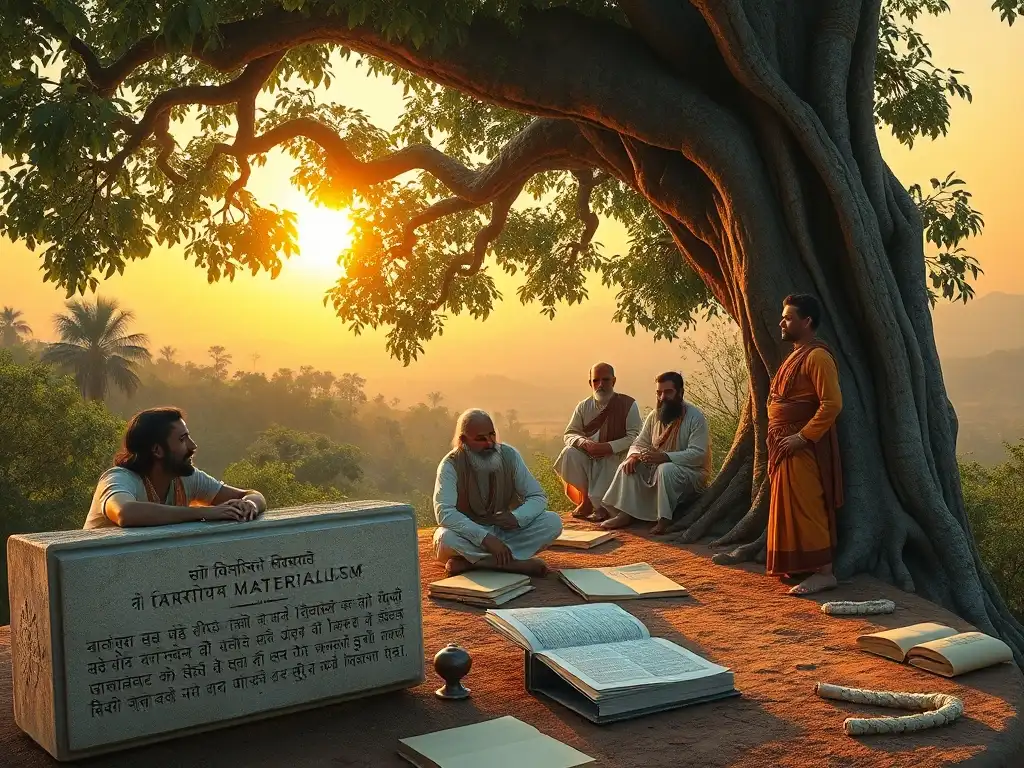
Impact on Rationalism and Critical Thinking
Charvaka materialism, often regarded as the most prominent materialist philosophy in ancient India, made significant strides in establishing a rational and empirical approach to understanding the world. Unlike other philosophical systems that relied heavily on metaphysical speculations or religious doctrines, Charvaka thinkers emphasized direct observation and sensory experience as the foundation of knowledge. This commitment to empirical evidence fostered a culture of critical thinking that encouraged questioning and skepticism.
- Direct Engagement with Reality: Charvaka philosophers posited that only what can be perceived through the senses is real. This radical assertion challenged prevailing philosophical norms, which often included abstract concepts such as the soul and the afterlife. By prioritizing tangible experiences, Charvaka materialism laid the groundwork for a more pragmatic view of existence.
- Methodological Skepticism: The Charvakas advocated for a form of skepticism, urging individuals to question the validity of doctrines that could not be substantiated through observation. This approach not only encouraged a questioning mindset but also contributed to the development of critical reasoning skills among its followers.
- Influence on Other Philosophies: The rationalist underpinnings of Charvaka materialism influenced subsequent philosophical traditions in India, including Buddhism and Jainism, which also emphasized empirical investigation and rational discourse over dogma.
Influence on Secular Ethics and Morality
The ethical framework proposed by Charvaka materialism marked a departure from the religiously oriented morality prevalent in ancient Indian society. By advocating for a secular perspective on ethics, Charvaka thinkers contributed to a more human-centered understanding of morality that was grounded in the here and now.
- Pleasure as the Ultimate Good: Charvaka philosophy asserts that the pursuit of pleasure and avoidance of pain are the primary motivators for human behavior. This hedonistic approach emphasizes the importance of individual well-being and happiness, suggesting that ethical living should focus on enhancing one’s quality of life rather than adhering to rigid moral codes dictated by religious texts.
- Rejection of Supernatural Authority: By dismissing the influence of divine commandments or supernatural entities on moral decisions, Charvaka materialism promoted a form of ethical autonomy. This shift encouraged individuals to develop their moral frameworks based on reason and social well-being rather than blind adherence to tradition.
- Social Responsibility: Despite its hedonistic inclinations, Charvaka materialism also recognized the importance of social harmony. The philosophy posited that ethical behavior should contribute to the collective happiness of society, thus bridging personal desires with social responsibility.
Legacy of Charvaka Materialism in Modern Philosophy
The intellectual legacy of Charvaka materialism extends into modern philosophical discourse, where its principles resonate with contemporary debates on materialism, empiricism, and secular ethics.
- Reinvigoration of Materialism: The revival of interest in materialist philosophy during the Enlightenment parallels the Charvaka emphasis on sensory experience and empirical observation. Modern philosophers who advocate for a materialist worldview often draw inspiration from Charvaka principles, reinforcing the idea that understanding the physical world is crucial for any meaningful inquiry into existence.
- Empirical Methodology in Science: The Charvaka rejection of unverifiable claims laid an early foundation for the scientific method, which prioritizes observation, experimentation, and falsifiability. This empirical approach remains central to contemporary scientific practice, highlighting the enduring relevance of Charvaka thought.
- Ethical Frameworks in Secular Philosophy: The secular ethical perspectives championed by Charvaka thinkers align closely with modern secular humanism and ethical frameworks that prioritize human welfare without reliance on religious dogma. This legacy fosters ongoing discussions about the role of ethics in a pluralistic society that values individual autonomy and collective well-being.
Charvaka materialism's contributions to ancient Indian thought not only shaped the philosophical landscape of its time but also laid the groundwork for enduring dialogues in modern philosophy, emphasizing the importance of rational inquiry, secular ethics, and the pursuit of knowledge based on empirical evidence.
Critiques and Challenges Faced by Charvaka Materialism
Charvaka materialism, as a philosophical school in ancient India, faced numerous critiques and challenges from its contemporaries. Rooted in a materialistic worldview, Charvaka philosophy posits that only the physical world is real, dismissing supernatural elements and metaphysical inquiries. This perspective, while revolutionary, led to several objections from other philosophical traditions.
One of the primary criticisms came from the orthodox schools of thought, such as Vedanta and Nyaya, which emphasized the existence of an immutable soul (Atman) and an ultimate reality (Brahman). These schools argued that Charvaka materialism's rejection of the soul undermines the moral and spiritual dimensions of human existence. They contended that without a belief in the soul or an ultimate purpose, ethical behavior loses its significance, leading to a nihilistic worldview.
Another significant challenge to Charvaka materialism was its stance on epistemology. Charvakas endorsed direct perception (pratyaksha) as the only valid means of knowledge, dismissing inference (anumana) and testimony (shabda). Critics argued that this narrow view limited the scope of knowledge and understanding. For instance, the Nyaya school pointed out that many truths about the universe, such as the existence of atoms or the laws of nature, cannot be directly perceived but can be inferred through reasoning.
Furthermore, Charvaka materialism was scrutinized for its seemingly hedonistic implications. Critics claimed that by prioritizing sensory experience and pleasure, Charvaka philosophy could lead to ethical relativism, where moral standards become subjective and arbitrary. This perspective raised concerns about social responsibility and the potential for moral decay in society.
While Charvaka materialism offered a radical departure from spiritual and metaphysical traditions, it faced substantial critiques regarding its ethical implications, epistemological limitations, and existential validity.
Responses to Criticisms from Contemporary Philosophers
In response to the critiques levied against Charvaka materialism, contemporary philosophers have attempted to defend its tenets by providing nuanced interpretations and addressing the concerns raised. One significant response is the argument that Charvaka materialism does not inherently lead to nihilism. Proponents assert that the focus on sensory experience and empirical evidence can foster a profound appreciation for life and existence. By embracing the tangible aspects of reality, individuals can cultivate a meaningful and ethical life grounded in the here and now.
Furthermore, defenders of Charvaka materialism argue that its epistemological framework is not as limiting as critics suggest. They highlight that the emphasis on direct perception encourages critical thinking and skepticism, fostering a scientific temperament that is essential for progress. This approach aligns with contemporary methodologies in the sciences, where empirical evidence is paramount.
Additionally, some scholars point out that ethical frameworks can still be developed within a materialistic paradigm. They argue that morality can emerge from social contracts, collective well-being, and the consequences of actions rather than relying on metaphysical foundations. This perspective allows for a dynamic and adaptable ethical system that can respond to the needs and values of society.
Overall, contemporary philosophers have sought to reinterpret Charvaka materialism, positioning it as a valid and relevant philosophical stance that encourages empirical inquiry and ethical responsibility without succumbing to nihilism.
Ongoing Relevance of Charvaka Materialism in Modern Discourse
Charvaka materialism continues to resonate in modern discourse, particularly in discussions around science, ethics, and secularism. As societies grapple with questions of existence and morality, the principles of Charvaka provide a counterpoint to dogmatic beliefs that often pervade philosophical discussions.
In the realm of science, the Charvaka emphasis on empirical evidence aligns with modern scientific methods, making it relevant in debates concerning the nature of reality and knowledge. The materialistic worldview encourages a questioning attitude that is crucial for scientific progress, prompting inquiries into the natural world without reliance on supernatural explanations.
Moreover, Charvaka materialism contributes to contemporary ethical discussions by promoting secular morality. In an increasingly pluralistic world, the absence of a singular religious framework allows for diverse moral perspectives. Charvaka philosophy supports the idea that ethical standards can be derived from human experience and social contracts, rather than divine command, fostering dialogue on moral issues across cultures.
Additionally, the rise of secularism in various parts of the world echoes the Charvaka rejection of supernaturalism. As individuals seek to navigate a world shaped by scientific advancements and cultural exchanges, Charvaka materialism offers a philosophical foundation that prioritizes rationality and human experience.
The ongoing relevance of Charvaka materialism in modern discourse highlights its significance beyond ancient Indian philosophy, providing valuable insights for contemporary debates in science, ethics, and secular thought. The principles established by this school of thought continue to influence how we understand existence, knowledge, and morality today.
Conclusion: The Enduring Legacy of Charvaka Materialism in Ancient India

Summary of Key Contributions and Insights
Charvaka materialism, a significant philosophical school in ancient India, has left an indelible mark on the discourse surrounding ethics, epistemology, and metaphysics. Central to its ideology is the rejection of transcendental theories, emphasizing a materialistic worldview grounded in empirical observation and sensory experience. This approach challenged the prevailing spiritual and ascetic traditions of the time, advocating for a philosophy that celebrated the material world as the primary source of knowledge and understanding.
One of the key contributions of Charvaka materialism was its radical skepticism towards religious doctrines and metaphysical claims. By asserting that "only the perception of the senses is reliable," Charvaka philosophers encouraged individuals to question established beliefs and seek truth through direct experience. This emphasis on empirical validation laid the groundwork for later philosophical inquiries, promoting a form of intellectual independence that resonated through subsequent Indian philosophical traditions.
Moreover, Charvaka's stance on ethics was equally revolutionary. By prioritizing human happiness and the pursuit of pleasure as the ultimate goals of life, it directly opposed the ascetic ideals prevalent in other philosophical schools. This hedonistic approach to ethics highlighted the importance of living fully in the present, advocating for a life that embraces sensory experiences rather than renouncing them. Such insights have implications not only for ancient Indian thought but also for contemporary discussions on well-being and ethical philosophy.
Future Directions for Research on Charvaka Materialism in Ancient Thought
Despite its significance, Charvaka materialism remains underexplored in modern scholarship. Future research could delve deeper into its interactions with other philosophical schools, particularly how it influenced and was influenced by the prevailing ideas of the time.
- Interdisciplinary Approaches:
- Collaborating with historians, literary scholars, and anthropologists could yield fresh perspectives on the social and cultural contexts in which Charvaka materialism thrived.
- Investigating archaeological sites associated with Charvaka thinkers could provide tangible evidence of their influence on societal norms and values.
- Comparative Analysis:
- Engaging in comparative studies between Charvaka materialism and contemporary materialist philosophies from other cultures could enhance understanding of its unique contributions.
- Examining parallels with Western philosophical traditions, particularly empiricism and skepticism, may uncover shared themes and divergent paths.
- Modern Relevance:
- Researching the implications of Charvaka materialism for contemporary debates on ethics and philosophy can invigorate discussions around secularism, rationalism, and the pursuit of happiness.
- Exploring how Charvaka's emphasis on empirical evidence can inform modern scientific inquiry and skepticism towards dogma will be crucial in the current intellectual climate.
Charvaka materialism in ancient India offers a rich tapestry of ideas that continue to resonate today. By expanding the scope of research, scholars can further illuminate its legacy and relevance in both historical and contemporary contexts.
Frequently Asked Questions
What is Charvaka materialism?
Charvaka materialism is a philosophical system in ancient India that emphasizes sensory experience and empirical evidence as the only sources of knowledge, rejecting spiritual or supernatural explanations.
How did Charvaka materialism influence ancient Indian thought?
The Charvaka school contributed to rational discourse by challenging established philosophies, promoting skepticism, and arguing for the importance of direct experience in understanding reality.
What were the main tenets of Charvaka philosophy?
Key tenets of Charvaka philosophy include the rejection of the Vedic texts, the belief in the material world as the only reality, and the assertion that happiness can be attained through sensory pleasures.
How does Charvaka materialism compare to other philosophies in ancient India?
Unlike Vedanta or Buddhism, which focus on spiritual truths and transcendence, Charvaka materialism is grounded in materialism and the here-and-now, emphasizing a pragmatic approach to life.
What legacy did Charvaka materialism leave on modern thought?
The legacy of Charvaka materialism can be seen in contemporary discussions on empiricism, rationalism, and the value of skepticism, influencing modern philosophical and scientific methodologies.
Final Reflection: Embracing the Legacy of Charvaka Materialism
In exploring the contributions of Charvaka materialism in ancient discourse, we uncover a rich tapestry of philosophical thought that remains strikingly relevant today. The emphasis on empirical evidence and sensory experience challenges us to reconsider our understanding of reality in a world often dominated by abstract beliefs and dogmas. This ancient school of thought not only invites us to question the nature of existence but also empowers us to seek knowledge through observation and reason, a principle that resonates deeply in our contemporary quest for truth.
The influence of Charvaka materialism extends beyond its historical context, shaping cultural and social dialogues around skepticism and rational inquiry. As we navigate the complexities of modern life, the Charvaka perspective encourages us to embrace a pragmatic approach to understanding our world. The Charvaka philosophy teaches us to live fully in the present, valuing the tangible over the intangible.
This enduring message serves as a reminder that our experiences and perceptions are valid sources of knowledge, urging us to cultivate a mindset that prioritizes critical thinking and personal experience in our pursuit of wisdom.
As we reflect on the lessons of Charvaka materialism, I invite you to consider how these principles can be woven into your own life. Embrace the spirit of inquiry and challenge preconceived notions that may limit your understanding. Let the legacy of Charvaka inspire you to seek knowledge through your own experiences and observations, fostering a deeper connection with the world around you. In doing so, you not only honor the teachings of ancient India but also contribute to a more thoughtful and enlightened society.
Embrace the Wisdom of Charvaka Materialism Today!
Thank you for exploring the fascinating insights of Charvaka materialism with us! You've taken a meaningful step in understanding how ancient philosophies still resonate in contemporary discourse. Now, let’s transform that knowledge into action!
Here are some empowering steps you can take:
- Dive Deeper into Ancient Texts: Seek out and read original Charvaka writings or reputable translations to enhance your understanding.
- Join a Discussion Group or Forum: Engage with others who share your interest—consider utilizing online platforms or local gatherings to exchange perspectives.
- Share Your Insights: Express your thoughts on social media or in academic settings, and ignite conversations about the relevance of materialism today.
Are you ready to challenge conventional wisdom and explore how ancient ideas can shape our present? What aspect of Charvaka materialism intrigues you the most, and how might you apply its principles in your daily life?