
How Ancient Indian Mathematicians Inspired Leonardo da Vinci

Welcome to Ancient India History, where we dive deep into the rich tapestry of ancient Indian civilizations and their remarkable contributions to our world. In this exploration, we shine a spotlight on the influence of ancient Indian mathematicians, whose groundbreaking ideas and innovations not only shaped the landscape of mathematics but also inspired iconic figures like Leonardo da Vinci. What secrets lie in the numbers and theories that crossed continents and centuries?
Join us as we unravel the fascinating connections that reveal how the brilliance of ancient minds continues to resonate today. Read on to discover the extraordinary legacy of these mathematicians and their enduring impact on the world!
- Introduction: The Legacy of Ancient Indian Mathematicians
- Ancient Indian Mathematicians and Their Innovations
- The Influence on Leonardo da Vinci
- The Cultural Exchange Between India and Europe
- Conclusion: The Lasting Impact of Ancient Indian Mathematicians
- Call to Action: Exploring More on Ancient Indian Mathematics
-
Frequently Asked Questions
- What is the significance of Ancient Indian mathematicians in history?
- How did Ancient Indian mathematicians influence Leonardo da Vinci?
- What are some key contributions of Indian mathematicians during ancient times?
- How did the cultural exchange between India and Europe affect mathematics?
- Why is the study of Ancient Indian mathematicians' influence important today?
- Final Reflection: The Enduring Influence of Ancient Indian Mathematicians
- Unveil the Power of Ancient Wisdom!
Introduction: The Legacy of Ancient Indian Mathematicians
The legacy of ancient Indian mathematicians is a fascinating tapestry woven with intricate theories, groundbreaking discoveries, and profound influences that have shaped mathematical thought across the ages. From the intricate calculations of the Indus Valley Civilization to the sophisticated theories of the Gupta Empire, the contributions of these scholars have far-reaching implications, not only within the Indian subcontinent but also beyond its borders. This article delves into the remarkable ways in which ancient Indian mathematicians inspired renowned figures such as Leonardo da Vinci, highlighting the interconnectedness of cultures and intellectual traditions.
As we explore the rich history of ancient Indian mathematics, we will uncover the key figures who laid the groundwork for significant mathematical concepts, including the decimal system, algebra, and geometry. Their work not only provided solutions to complex problems of their time but also served as a source of inspiration for later Western mathematicians. By examining these contributions, we gain insight into how ancient Indian mathematicians influenced the broader development of mathematics throughout history.
Overview of Ancient Indian Contributions to Mathematics
Ancient India is often recognized as one of the cradle lands of mathematics, producing a wealth of knowledge that continues to resonate in contemporary mathematics. The earliest evidence of mathematical activity can be traced back to the Indus Valley Civilization (around 2500 BCE), where the use of weights and measures indicated a sophisticated understanding of geometry and arithmetic.
Some notable contributions include:
- The Decimal System: Ancient Indian scholars were pivotal in developing the base-10 numeral system, including the concept of zero, which revolutionized mathematics and computation.
- Algebra: Mathematicians like Brahmagupta and Bhaskara II made significant strides in algebra, formulating rules for solving equations and understanding negative numbers.
- Trigonometry: The works of Aryabhata and later mathematicians brought forth foundational concepts in trigonometry, impacting both mathematics and astronomy.
These contributions laid the foundation for mathematical thought, influencing civilizations across the globe, including those in the Middle East and Europe.
Importance of Studying Ancient Indian Mathematicians
Understanding the influence of ancient Indian mathematicians is crucial for several reasons:
- Cultural Exchange: The study of these mathematicians highlights the cultural exchanges that have taken place throughout history. It reveals how knowledge was shared, adapted, and transformed across different civilizations.
- Modern Relevance: Many concepts developed by ancient Indian mathematicians are still relevant today, forming the backbone of various modern mathematical applications. Recognizing their contributions helps us appreciate the continuity and evolution of mathematical thought.
- Inspirational Legacy: The achievements of these mathematicians serve as a source of inspiration for contemporary scholars and students. Their innovative spirit and intellectual curiosity exemplify the pursuit of knowledge and its impact on future generations.
- Interdisciplinary Connections: The intersection of mathematics with other fields—such as astronomy, architecture, and art—illustrates the multifaceted nature of ancient Indian scholarship, enriching our understanding of the period's cultural and scientific landscape.
By exploring the significant contributions of ancient Indian mathematicians, we not only acknowledge their role in the history of mathematics but also celebrate the rich intellectual heritage that continues to influence today's mathematical practices.
Ancient Indian Mathematicians and Their Innovations
Aryabhata: The Pioneer of Mathematics
Aryabhata, born in 476 CE, is often regarded as one of the first significant mathematicians in ancient India. His work is foundational, influencing not only Indian mathematics but also the mathematical developments in the Islamic world and eventually Europe. Aryabhata's treatise, the Aryabhatiya, encompasses various topics including arithmetic, algebra, and astronomy, establishing him as a pivotal figure in the history of mathematics.
Key Contributions and Theories
Aryabhata made remarkable contributions that showcase his innovative approach to mathematics:
- Place Value System: Aryabhata utilized a decimal place value system, which was crucial for simplifying calculations. This system later influenced mathematical notation globally.
- Trigonometry: He introduced sine (known as "ardha-jya") and cosine functions, laying the groundwork for trigonometric studies.
- Approximation of Pi: Aryabhata provided an approximation for π (pi) as 3.1416, demonstrating an understanding of the mathematical constant that is essential in geometry.
- Algebraic Concepts: His work included methods for solving quadratic equations and calculating areas of geometric shapes, showcasing advanced algebraic concepts for his time.
His innovative spirit and mathematical rigor have made his work a cornerstone in the evolution of mathematics.
Influence on Later Mathematicians
The influence of Aryabhata extends well beyond his time, impacting numerous mathematicians and scholars:
- Transmission of Knowledge: His works were translated into Arabic, facilitating the spread of his ideas to the Islamic Golden Age mathematicians, such as Al-Khwarizmi, who built upon them.
- Inspiration for Scholars: Subsequent Indian mathematicians, including Brahmagupta and Bhaskara I, cited Aryabhata as an inspiration, demonstrating the continuity of mathematical thought.
- Impact on European Mathematics: The mathematical concepts introduced by Aryabhata eventually found their way into European mathematics through translations and the work of scholars during the Renaissance, including Leonardo da Vinci.
The legacy of Aryabhata illustrates the profound and lasting impact of ancient Indian mathematicians on global mathematics.
Brahmagupta: The Father of Algebra
Brahmagupta, active in the 7th century CE, is often referred to as the "Father of Algebra." His seminal work, the Brahmasphutasiddhanta, presents a comprehensive look at mathematics, particularly focusing on rules for arithmetic, geometry, and algebra.
Introduction of Zero and Its Implications
Brahmagupta's introduction of zero as a number is one of his most significant contributions:
- Conceptualization of Zero: He defined zero as a number that can be used in calculations, which was revolutionary. His rules for arithmetic operations involving zero laid the groundwork for future mathematical theories.
- Mathematical Operations: Brahmagupta provided clear rules for operations with zero:
- Any number added to zero remains unchanged.
- Any number multiplied by zero results in zero.
This conceptualization of zero allowed for the development of more complex mathematical theories and practices that are foundational in modern mathematics.
Algebraic Solutions and Their Impact
Brahmagupta's work in algebra laid the groundwork for future advancements:
- Quadratic Equations: He developed methods to solve quadratic equations, establishing rules that are still relevant today. His work included solutions for both positive and negative roots.
- Practical Applications: His algebraic rules were not merely theoretical but were designed to solve real-world problems, such as calculating areas and determining profits and losses in trade.
- Legacy in Mathematics: Brahmagupta's insights influenced later mathematicians in India and the Middle East. His work was integrated into the mathematical curriculum and inspired scholars like Al-Khwarizmi, who further developed algebra.
The contributions of Brahmagupta, particularly in the realm of algebra and the concept of zero, highlight the significant influence of ancient Indian mathematicians on the evolution of mathematics throughout history.
Bhaskara II: The Master of Calculus
Bhaskara II, also known as Bhaskara Acharya, was a prominent 12th-century Indian mathematician and astronomer whose works significantly influenced the fields of mathematics and astronomy. His most renowned text, "Lilavati," is considered a masterpiece in the world of mathematical literature. In this work, he explores various mathematical concepts such as arithmetic, geometry, and algebra, presenting them through practical problems and poetic verses, making them more accessible to readers.
Bhaskara II is particularly celebrated for his contributions to calculus, notably his methods of infinitesimals and the derivative concepts. His insights laid foundational principles that would later influence European mathematicians. For instance, he developed rules for finding the area of curved shapes and effectively addressed the calculation of instantaneous velocity, a concept that resonates with modern calculus. His work, particularly in "Vijaganita," demonstrates a keen understanding of the relationships between variables, showcasing a form of early differentiation long before it was formally established in Europe.
Advancements in Astronomy and Mathematics
In addition to his mathematical prowess, Bhaskara II made significant advancements in astronomy. He is known for his work on planetary motions and the calculation of eclipses, where he accurately described the positions of celestial bodies. His astronomical theories were grounded in mathematical principles, reflecting the close relationship between these two disciplines in ancient Indian scholarship.
One of his notable contributions is the formulation of the “Bhaskara's theorem,” which describes the relationship between the sides and angles of triangles. This theorem not only advanced mathematical understanding but also enhanced navigation and astronomical observations in ancient India. Bhaskara's methods of calculating the circumference of a circle and his approximation of pi (π) demonstrated his exceptional grasp of geometry and its practical applications.
His work also encompassed the concept of time calculations that integrated both mathematical precision and astronomical observations, allowing for accurate calendrical systems that were vital for agricultural and ceremonial purposes in ancient Indian society. The blend of mathematics and astronomy in Bhaskara's work exemplifies how ancient Indian scholars advanced scientific knowledge through interdisciplinary approaches.
The Connection to European Mathematics
The influence of Bhaskara II and his contemporaries on European mathematics is profound and often underappreciated. His texts were translated into Arabic and later into Latin, serving as a bridge for the transmission of mathematical knowledge from the East to the West. This cross-cultural exchange played a crucial role during the Renaissance, a period marked by a resurgence of interest in science and mathematics in Europe.
Bhaskara II's approach to calculus and his methods for solving equations were instrumental in shaping the mathematical landscape of Europe. For instance, his techniques for handling indeterminate equations and the use of zero as a concept were foundational to the later developments by European mathematicians like Fibonacci and Descartes. The introduction of the decimal system and the concept of negative numbers, which he adeptly utilized, were also crucial in advancing European mathematical methods.
Overall, the mathematical innovations of Bhaskara II not only enriched ancient Indian mathematics but also laid the groundwork for the evolution of mathematical thought in Europe. His legacy continues to inspire mathematicians and historians alike, highlighting the enduring impact of ancient Indian mathematicians on global mathematics.
The Influence on Leonardo da Vinci
Leonardo’s Exposure to Ancient Texts
Leonardo da Vinci, one of the foremost figures of the Renaissance, was profoundly influenced by a variety of ancient texts. His exposure to classical works, particularly those of ancient Indian mathematicians, played a crucial role in shaping his understanding of mathematics and its application in art and science. Scholars believe that the translation movement during the Renaissance brought many significant mathematical texts to Europe, including those from India, which were pivotal in the development of mathematical thought.
Throughout his life, Da Vinci engaged with a multitude of sources, often seeking knowledge beyond the conventional Greco-Roman canon. The works of ancient Indian mathematicians, such as Brahmagupta and Aryabhata, contained advanced concepts that were not only innovative but also practical. These texts introduced ideas such as the decimal system and sophisticated techniques for solving equations, which resonated with Da Vinci's insatiable curiosity for understanding the natural world mathematically.
The Role of Translations and Scholars
The transmission of ancient Indian mathematical knowledge to Europe involved several key players, including translators and scholars who played a vital role in this cultural exchange. Notably, during the 12th century, scholars in places such as Toledo, Spain, began translating Arabic texts that themselves were based on earlier Indian works. This process significantly enriched European mathematics.
For instance, the translation of Brahmagupta's Brahmasphutasiddhanta into Arabic and subsequently into Latin made his revolutionary ideas on arithmetic and algebra accessible to European thinkers. These translations were instrumental in introducing the concept of zero and the place value system to the Renaissance scholars, including Da Vinci.
The collaborative efforts of these scholars not only preserved ancient knowledge but also facilitated its integration into the burgeoning intellectual landscape of Renaissance Europe. This cultural synthesis was essential for the advancement of mathematics during this period.
Impact of Ancient Indian Mathematics on Renaissance Thinkers
The influence of ancient Indian mathematics on Renaissance thinkers was profound and far-reaching. The introduction of concepts such as algebra, geometry, and the decimal system laid the groundwork for a mathematical revolution that would enable thinkers like Da Vinci to explore new frontiers in science and art.
Renaissance mathematicians started to adopt and adapt these concepts into their work, which can be observed in various fields, including engineering, painting, and architecture. The incorporation of these advanced mathematical principles allowed Da Vinci to approach his artistic creations with a level of precision and depth that was unprecedented.
Furthermore, Da Vinci's notebooks reveal a deep engagement with mathematical principles derived from ancient texts, showcasing his innovative application of these ideas in his work. This cross-pollination of knowledge not only enriched Da Vinci’s understanding but also transformed the broader landscape of European mathematics.
Specific Mathematical Concepts Adopted by Da Vinci
Geometry and Proportions
One of the most significant contributions of ancient Indian mathematicians that influenced Leonardo da Vinci was their advanced understanding of geometry and proportions. Indian mathematicians developed intricate methods for constructing geometrical figures and understanding spatial relationships, which were crucial for artists and architects of the Renaissance.
Da Vinci's mastery of proportion is evident in his artworks, such as the Vitruvian Man, where he explores the ideal human proportions based on geometric principles. This artwork reflects the synthesis of mathematical concepts derived from ancient texts, demonstrating how Da Vinci utilized these principles to achieve balance and harmony in his creations.
The use of geometric configurations found in Indian mathematics allowed Da Vinci to innovate in composition and perspective, enhancing the realism of his paintings and drawings. The transition from theoretical knowledge to practical application exemplifies how ancient Indian geometry significantly shaped Da Vinci's artistic vision.
The Use of Zero and Place Value Systems
The introduction of the concept of zero and the place value system from ancient Indian mathematics had a monumental impact on Da Vinci’s work and the broader scope of Western mathematics. Prior to this, mathematical systems in Europe lacked a systematic way to represent large numbers and perform complex calculations efficiently.
Da Vinci utilized the place value system to develop elaborate calculations, which facilitated his work in engineering and mechanics. The ability to represent and manipulate numbers with the inclusion of zero allowed for greater complexity in his designs and mathematical explorations.
By integrating these numerical concepts into his studies, Da Vinci not only advanced his own work but also contributed to the wider acceptance and application of these ideas in European mathematics. This adoption of ancient Indian mathematical principles marked a significant turning point in the evolution of mathematical thought during the Renaissance, demonstrating the profound influence of ancient Indian mathematicians on one of history's greatest minds.
The Cultural Exchange Between India and Europe
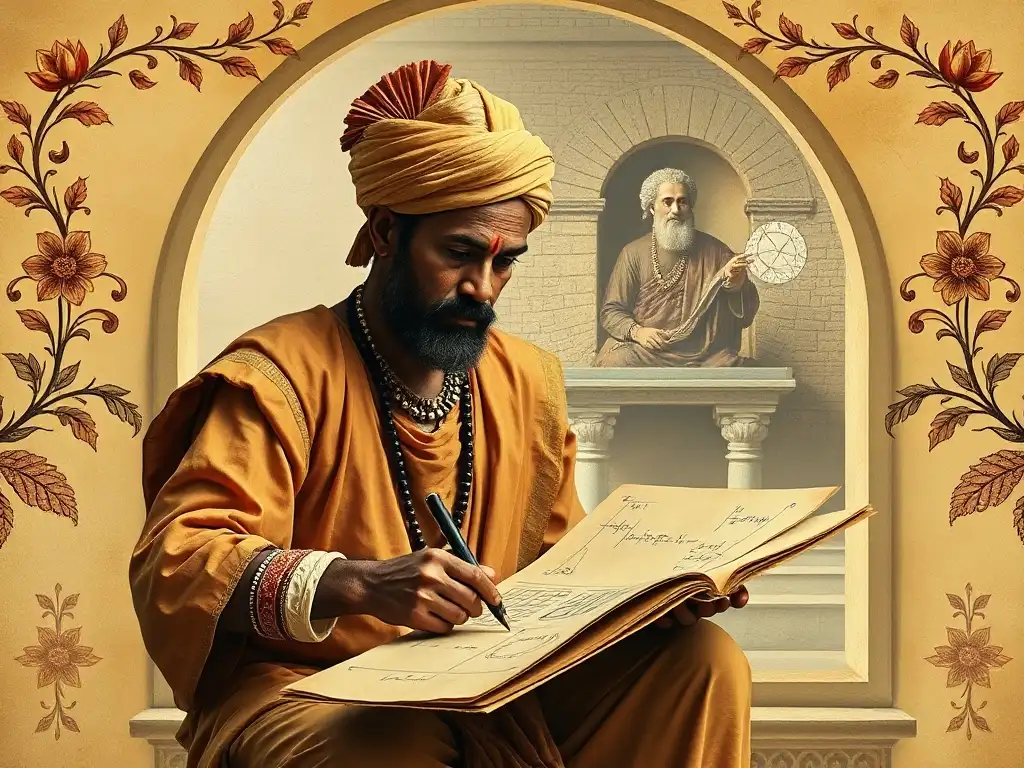
The cultural exchange between India and Europe during ancient times facilitated the flow of ideas, knowledge, and innovations, particularly in the realm of mathematics. This interaction was primarily driven by trade routes, which not only enabled the exchange of goods but also the transfer of intellectual concepts. As ancient Indian mathematicians made significant advancements, these ideas eventually reached Europe, influencing thinkers like Leonardo da Vinci.
The Silk Road: A Highway of Knowledge
The Silk Road, a network of trade routes connecting the East and West, played a crucial role in the dissemination of mathematical knowledge between ancient Indian mathematicians and European scholars. Established during the Han Dynasty around 130 BCE, this route connected China with the Mediterranean, facilitating not just commerce but also cultural and intellectual exchange.
- Key Routes: The Silk Road comprised several key routes:
- Northern Route: Linked Central Asia with the Caspian Sea, passing through territories such as Samarkand and Bukhara.
- Southern Route: Traversed through the deserts of Central Asia, connecting India to Persia and eventually to Europe.
- Exchanges Along the Silk Road:
- Mathematical Texts: Texts from ancient Indian mathematicians like Aryabhata and Brahmagupta were transmitted along these routes, introducing concepts such as the decimal system and zero to other cultures.
- Cultural Influence: The movement of scholars and traders helped bridge cultural gaps, enabling a two-way flow of knowledge. For instance, Greek mathematics influenced Indian mathematicians, who in return contributed their innovations back to Europe.
The Silk Road facilitated not just trade but also the exchange of mathematical ideas, leading to a rich tapestry of knowledge that would eventually inspire European thinkers, including Leonardo da Vinci.
The Spread of Mathematical Ideas Across Civilizations
The spread of mathematical ideas across civilizations was a gradual process, influenced by various factors, including trade, conquest, and scholarly pursuits. Ancient Indian mathematicians had made remarkable contributions that shaped mathematical thought, and these influences eventually reached Europe, particularly during the Renaissance.
- Key Contributions from Ancient Indian Mathematicians:
- Aryabhata: Known for his work "Aryabhatiya," Aryabhata introduced concepts such as the place value system and trigonometric functions.
- Brahmagupta: His seminal text "Brahmasphutasiddhanta" included rules for arithmetic operations, fractions, and solutions to quadratic equations.
- Transmission of Knowledge:
- Arab Scholars: The translations of Indian mathematical texts into Arabic during the 8th to 12th centuries acted as a conduit for the dissemination of knowledge. Scholars like Al-Khwarizmi incorporated Indian concepts into their works, which were later translated into Latin.
- Renaissance Europe: By the time of the Renaissance, European scholars were exposed to these mathematical ideas through translations of Arabic texts. This influx of knowledge inspired figures such as Leonardo da Vinci, who utilized these concepts in his own work, particularly in art and engineering.
The influence of ancient Indian mathematicians on European thought is a testament to the interconnectedness of civilizations. The mathematical innovations developed in India not only enriched their own culture but also laid the groundwork for future advancements in mathematics and science in Europe. This profound exchange highlights the importance of collaboration and learning across borders in the development of human knowledge.
Conclusion: The Lasting Impact of Ancient Indian Mathematicians
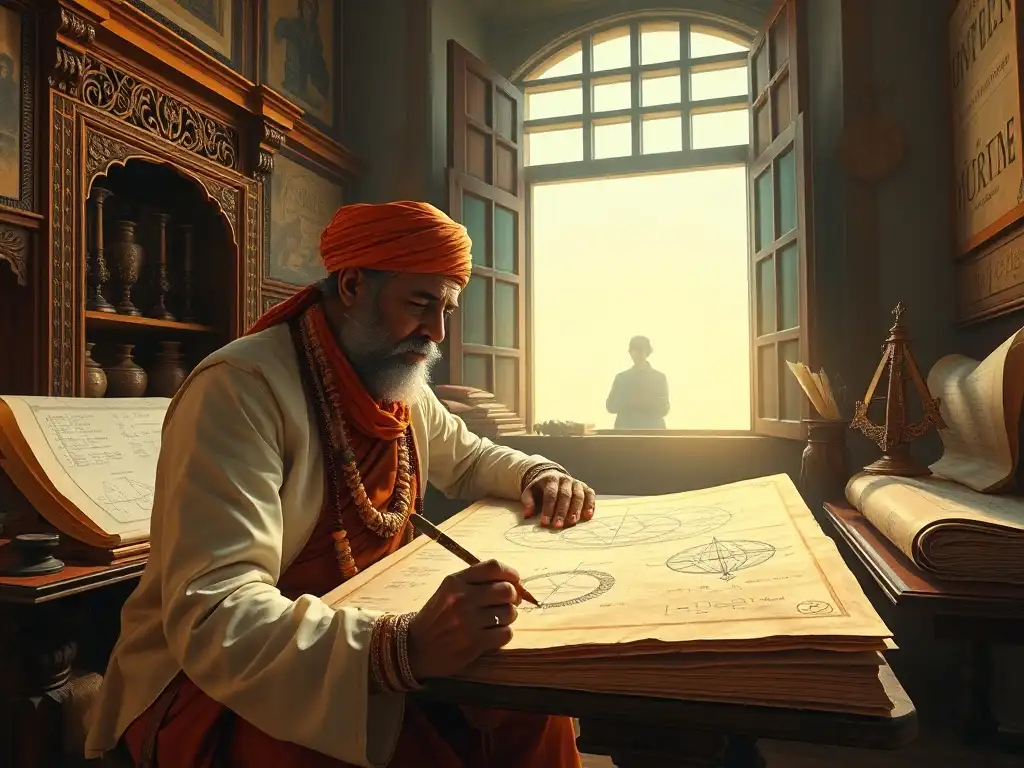
The influence of ancient Indian mathematicians extends far beyond their geographical boundaries and time period, leaving a profound mark on the evolution of mathematics throughout history. Their pioneering contributions in areas such as arithmetic, geometry, and algebra not only laid the groundwork for future generations but also inspired great minds like Leonardo da Vinci. The concepts introduced by these mathematicians, including the decimal system and the notion of zero, fundamentally transformed mathematical thought and practice.
Summary of Ancient Indian Mathematicians' Influence
Ancient Indian mathematicians, including figures like Aryabhata, Brahmagupta, and Bhaskara II, made remarkable advancements that were pivotal in shaping the field of mathematics. Their work encompassed:
- The Concept of Zero: The introduction of zero as a numeral and its role as a placeholder revolutionized numerical representation and calculations.
- Decimal System: The establishment of a base-10 system facilitated more complex calculations and laid the foundation for modern mathematics.
- Algebraic Techniques: Brahmagupta's rules for solving quadratic equations and various algebraic identities significantly advanced mathematical problem-solving.
- Trigonometry: Aryabhata's trigonometric functions provided essential tools for astronomy and navigation, influencing later European mathematicians.
These contributions not only informed mathematical practices in India but also permeated through cultural exchanges along trade routes, eventually reaching Europe and inspiring mathematicians like Leonardo da Vinci.
Reflection on the Importance of Cross-Cultural Contributions in Mathematics
The story of ancient Indian mathematicians illustrates the importance of cross-cultural influences in the development of mathematics. The sharing of knowledge across borders has been a critical driver of innovation and progress in this field.
- Cultural Exchange: The transmission of mathematical ideas through trade and intellectual discourse demonstrates how interconnected our histories are. For example, the Silk Road served as a conduit for the exchange of mathematical texts and techniques between the East and West.
- Collaborative Knowledge: The collaboration between different civilizations, such as the exchange between Indian and Arabic mathematicians, allowed for the synthesis of diverse mathematical ideas, enriching the global mathematical landscape.
The legacy of ancient Indian mathematicians is a testament to the collaborative nature of knowledge. Their influence not only shaped the mathematics of their time but also set the stage for future developments, emphasizing the value of shared intellectual heritage in the evolution of mathematics across cultures.
Call to Action: Exploring More on Ancient Indian Mathematics

The legacy of ancient Indian mathematicians is not only foundational to the field of mathematics but also significantly influenced various cultures across the globe, including the Renaissance thinkers like Leonardo da Vinci. Their pioneering work in arithmetic, algebra, and geometry laid the groundwork for many modern mathematical concepts. To delve deeper into this fascinating aspect of history, we encourage you to explore the following resources that illuminate the contributions of ancient Indian mathematicians and their lasting impact on mathematics.
Suggested Readings and Resources
- Books:
- The History of Mathematics: A Brief Course by Roger L. Cooke
- Mathematics in Ancient India by Kim Plofker
- The Legacy of Indian Mathematics by C. N. Srinivas
- Research Papers:
- "The Contributions of Indian Mathematicians to the Global Mathematics Heritage" by [Author Name]
- "Zero: The History of a Notation" by [Author Name]
- Online Courses:
- Coursera:Ancient Indian Mathematics: A Journey Through Time
- edX:Mathematics of Ancient Civilizations
- Documentaries:
- "Mathematics: The Language of the Universe" – Explore the role of ancient mathematics in shaping modern science.
- "The Great Indian Mathematicians" – A documentary highlighting key figures and their advances.
Invitation to Learn About Other Significant Mathematicians
The history of mathematics is replete with influential figures whose work has shaped the discipline as we know it today. We invite you to expand your knowledge by exploring the lives and contributions of other significant mathematicians, such as:
- Aryabhata: Renowned for his work on the place value system and for introducing the concept of zero.
- Brahmagupta: Known for his contributions to algebra and the formulation of rules for arithmetic operations involving zero.
- Bhaskara II: Famous for his work in calculus and for solving quadratic equations.
- Madhava of Sangamagrama: A pioneer of infinite series and calculus in the context of trigonometric functions.
Understanding the contributions of these scholars will provide a broader context to the mathematical advancements that emerged from ancient India and their influence on subsequent generations. Engage with their stories and the rich tapestry of knowledge they have woven into the fabric of mathematics.
Frequently Asked Questions
What is the significance of Ancient Indian mathematicians in history?
Ancient Indian mathematicians made remarkable contributions to mathematics, particularly in areas like geometry, algebra, and the concept of zero, which have influenced global mathematical thought.
How did Ancient Indian mathematicians influence Leonardo da Vinci?
Leonardo da Vinci was inspired by the mathematical principles and geometric concepts developed by ancient Indian mathematicians, which he incorporated into his art and scientific studies.
What are some key contributions of Indian mathematicians during ancient times?
Key contributions include the development of the decimal system, the concept of zero, and advancements in trigonometry and calculus, which laid the groundwork for modern mathematics.
How did the cultural exchange between India and Europe affect mathematics?
The cultural exchange facilitated the spread of mathematical knowledge from ancient Indian civilizations to Europe, particularly during the transmission of texts via trade routes, influencing European mathematicians like da Vinci.
Why is the study of Ancient Indian mathematicians' influence important today?
Understanding this influence is crucial for appreciating the global history of mathematics and recognizing how ancient knowledge shaped contemporary mathematical practices and theories.
Final Reflection: The Enduring Influence of Ancient Indian Mathematicians
The profound influence of ancient Indian mathematicians on the development of mathematical thought is not merely a historical footnote; it resonates powerfully in today's world. As we explore the intricate connections between these brilliant minds and the Renaissance genius of Leonardo da Vinci, we uncover a tapestry of knowledge that transcends time and geography. The legacy of these mathematicians continues to inspire innovation and creativity, reminding us that the pursuit of knowledge knows no boundaries.
The impact of ancient Indian mathematicians is woven into the very fabric of our cultural and social landscape. Their pioneering work in concepts such as zero, algebra, and geometry has laid the groundwork for countless advancements in science and technology. As we navigate the complexities of modern mathematics and its applications, we must acknowledge the roots from which these ideas sprang. Mathematics is the language in which God has written the universe.
– Galileo Galilei. This quote encapsulates the essence of how mathematical principles, shaped by ancient thinkers, continue to illuminate our understanding of the world around us.
As we reflect on the lessons from the past, let us embrace the spirit of curiosity and collaboration that characterized the work of ancient Indian mathematicians. I invite you to explore how their insights can inspire your own journey, whether in mathematics, art, or any field of inquiry. Remember, the pursuit of knowledge is a shared endeavor, and by honoring the contributions of those who came before us, we can forge a path toward a brighter, more interconnected future.
Unveil the Power of Ancient Wisdom!
Thank you for taking the time to explore the remarkable influence of ancient Indian mathematicians on the works of Leonardo da Vinci. By delving into this fascinating intersection of cultures, you've gained insight into how historical knowledge can shape modern thinking. Now, let's harness that inspiration and take action!
- Dive deeper: Explore additional resources about ancient Indian mathematics and its impact on various cultures. Consider reading books, watching documentaries, or enrolling in online courses to broaden your understanding.
- Share the knowledge: Spread the word by discussing this topic with friends or sharing your insights on social media. Engaging conversations can enlighten others about the brilliance of ancient thinkers!
- Join the conversation: Participate in online forums or local groups that focus on history, mathematics, or cultural studies to exchange ideas and learn from others.
What other surprising connections between ancient knowledge and modern genius have you uncovered?