
How The Concept of Zero Fostered Innovation in Ancient Indian Science


Welcome to Ancient India History, where we embark on a fascinating journey through the rich tapestry of India's past. Here, we delve into the remarkable contributions that ancient Indian civilizations made to science and mathematics, with a spotlight on the revolutionary concept of zero. This pivotal innovation not only transformed mathematical practices but also ignited a wave of scientific advancements that resonate through the ages. Are you ready to uncover how such a simple symbol sparked an intellectual revolution? Dive in and explore the profound impacts of ancient Indian science that continue to influence our world today!
- Introduction to Innovation in Ancient Indian Science
- Historical Context of the Concept of Zero
- The Role of Zero in Advancing Mathematics
- Zero and Its Influence on Scientific Thought
- Comparison of Innovation in Ancient Indian Science with Other Civilizations
- The Legacy of Zero in Modern Mathematics and Science
- Conclusion: The Lasting Impact of Zero on Innovation in Ancient Indian Science
-
Frequently Asked Questions
- What is the significance of the concept of zero in ancient Indian science?
- How did ancient Indian scientists contribute to innovation in mathematics?
- In what ways did the Gupta Empire influence scientific advancements?
- What are some examples of other scientific innovations from ancient India?
- How does the legacy of ancient Indian science impact modern science?
- Final Reflection: The Transformative Power of Zero in Ancient Indian Innovation
- Unleash the Power of Zero in Your Life!
Introduction to Innovation in Ancient Indian Science
The history of ancient India is marked by remarkable achievements that laid the groundwork for various fields, particularly in mathematics and science. Among these achievements, the conceptualization of zero stands out as a pivotal innovation that not only redefined mathematical calculations but also significantly influenced scientific advancements.
This article delves into how the concept of zero fostered innovation in ancient Indian science, highlighting its implications on various disciplines and its enduring legacy. By exploring the rich tapestry of ancient Indian contributions to science, particularly through the lens of the invention of zero, we gain a deeper understanding of how these early innovations shaped the course of human knowledge and progress.
Overview of Ancient Indian Contributions to Science
Ancient Indian civilizations were renowned for their profound contributions to multiple fields of science. From astronomy to medicine, the innovations developed during this era reflect a deep understanding of the natural world and a sophisticated approach to scientific inquiry. Some key highlights include:
- Astronomy: Ancient Indian astronomers, such as Aryabhata, formulated complex theories about planetary movements and eclipses. Aryabhata's work, Aryabhatiya, introduced concepts such as the rotation of the Earth on its axis and a heliocentric model, which were groundbreaking for their time.
- Medicine: The system of Ayurveda emerged from ancient Indian practices, emphasizing holistic health and the balance of bodily systems. Texts like the Sushruta Samhita detail surgical techniques and medicinal herbs, showcasing advanced medical knowledge.
- Mathematics: The contributions of ancient Indian mathematicians, including the development of arithmetic, geometry, and algebra, were crucial. They established the decimal system and made significant strides in solving equations, which set the foundation for future mathematical endeavors.
These contributions underscore the innovative spirit of ancient Indian societies, where knowledge was meticulously recorded and shared, often leading to further advancements.
The Importance of Zero in Indian Mathematics and Science
The invention of zero is one of the most significant milestones in the history of mathematics, and its impact on ancient Indian science cannot be overstated. The introduction of zero as a numeral transformed mathematical calculations and allowed for the development of more complex mathematical concepts. Here are some key points regarding the significance of zero:
- Placeholder Functionality: Zero served as a placeholder in the decimal system, enabling the representation of large numbers and simplifying calculations. This innovation made arithmetic operations more efficient and manageable.
- Facilitating Calculations: The ability to perform calculations involving zero allowed mathematicians to explore concepts such as negative numbers and fractions, paving the way for advancements in algebra and geometry.
- Cultural and Scientific Exchange: The concept of zero traveled beyond the Indian subcontinent, influencing mathematical thought in the Middle East and eventually reaching Europe. This cultural exchange fostered innovation in various scientific fields, illustrating the interconnectedness of human knowledge.
The concept of zero not only revolutionized mathematics in ancient India but also acted as a catalyst for broader scientific innovation, underscoring the country's pivotal role in the history of science and mathematics. The legacy of these ancient contributions continues to inspire and inform contemporary scientific endeavors.
Historical Context of the Concept of Zero

The Birth of Zero in Ancient India
The concept of zero, as both a numeral and an idea, has its roots deeply embedded in ancient Indian mathematics. Its birth can be traced back to the early centuries of the Common Era. The earliest recorded use of zero as a placeholder in the decimal system was found in the inscriptions of the Bakhshali Manuscript, dating back to the 3rd or 4th century CE. Here, zero was represented by a dot, indicating a significant leap in numerical representation that paved the way for more complex calculations.
In the context of innovation in ancient Indian science, the establishment of zero was revolutionary. It allowed mathematicians to perform calculations that were previously impossible, transforming arithmetic and algebra. The introduction of zero facilitated the development of sophisticated mathematical concepts and laid the groundwork for advancements in astronomy, engineering, and commerce.
Key Figures in the Development of Zero
In the evolution of the concept of zero, several key figures played pivotal roles:
- Aryabhata (476–550 CE):
- Aryabhata, one of the earliest mathematicians and astronomers, was instrumental in advocating the use of zero. His famous work, the Aryabhatiya, discusses mathematical calculations that incorporate zero, emphasizing its importance in astronomical computations.
- Brahmagupta (598–668 CE):
- Brahmagupta further advanced the concept of zero in his seminal text Brahmasphutasiddhanta. He defined rules for arithmetic operations involving zero, such as addition and subtraction, and elaborated on its significance in both positive and negative contexts. This marked a significant step in integrating zero into the broader mathematical framework.
- Bhaskara I (c. 600 CE):
- A disciple of Aryabhata, Bhaskara I contributed to the dissemination of zero's usage through his commentaries on Aryabhata's work. His insights helped stabilize the concept of zero within Indian mathematics and facilitated its spread across the region.
These figures not only fostered innovation in ancient Indian science but also influenced mathematical thought in other cultures, particularly through translations of Indian texts into Arabic during the medieval period.
Cultural Significance of Zero in Indian Society
The cultural implications of zero extend beyond mathematics into various aspects of Indian society. Its acceptance signified a deep philosophical understanding of nothingness and infinity, concepts that were pivotal in Indian philosophy and spirituality. This duality of zero—representing both absence and potential—echoed in various realms:
- Philosophical Thought: In schools of thought such as Buddhism and Hinduism, the idea of 'shunya' (zero) resonated with notions of void and the infinite. It encouraged a discourse on the nature of existence and the universe.
- Art and Architecture: The zero concept also influenced the artistic expressions of the time. The precision in geometry and symmetry found in ancient Indian architecture can be attributed to the advancements in mathematics that zero enabled.
- Literary References: Ancient texts reflect the cultural significance of zero, with references appearing in poetry and prose, symbolizing the idea of completeness and the cyclic nature of life.
The introduction of zero was not merely a mathematical innovation but a catalyst for broader cultural and intellectual advancements in ancient Indian society. Its influence permeated various fields, fostering a rich tapestry of knowledge that continues to inspire and inform contemporary understanding of mathematics and its philosophical underpinnings.
The Role of Zero in Advancing Mathematics

Zero, often referred to as a revolutionary concept in mathematics, emerged in ancient India and significantly transformed the landscape of mathematical thought and practice. Its introduction not only provided a symbol for nothingness but also played a crucial role in various mathematical advancements. The concept of zero allowed mathematicians to perform calculations more efficiently and systematically, paving the way for innovations in arithmetic, algebra, and geometry. This profound impact of zero is reflected in the works of ancient scholars, who used it as a foundational element in their mathematical explorations, ultimately influencing modern mathematics as we know it today.
Innovations in Arithmetic Due to Zero
The introduction of zero into arithmetic operations marked a turning point in mathematical practices. Before zero, calculations were cumbersome and less precise, as ancient mathematicians had to rely on counting systems that lacked a symbol for the absence of value. The adoption of zero facilitated several key innovations:
- Place Value System: Zero enabled the development of the place value system, where the position of a digit in a number determines its value. This system allowed for more efficient calculations and laid the groundwork for the decimal system.
- Ease of Calculations: With zero, mathematicians could easily perform addition and subtraction. For instance, the equation \(7 - 7 = 0\) illustrates how zero serves as both the result and a placeholder, making arithmetic operations more intuitive.
- Handling Large Numbers: The use of zero allowed for the representation of large numbers without confusion. For example, writing 1000 instead of 1,000, which would be cumbersome in a system lacking zero.
- Mathematical Operations: Zero also simplified multiplication and division. Multiplying any number by zero yields zero, providing a clear understanding of the concept of nullification in arithmetic.
These innovations in arithmetic due to zero not only enhanced mathematical computation but also set the stage for further developments in other branches of mathematics.
Impact on Algebra and Geometry
The influence of zero extended beyond arithmetic and played a vital role in the evolution of algebra and geometry. Its introduction allowed mathematicians to explore more complex mathematical relationships and equations. Key impacts include:
- Algebraic Equations: The use of zero in algebraic equations allowed for the formulation of equations that could represent real-world problems. For example, the equation \(x + 0 = x\) illustrates the identity property of zero, which is essential in solving linear equations.
- Coordinate Geometry: The concept of zero became foundational in coordinate geometry, where the origin (0,0) serves as a reference point for plotting points on a graph. This innovation enabled the visualization of mathematical relationships and the development of geometric proofs.
- Roots and Functions: Zero is integral in determining the roots of polynomial functions. The ability to set equations equal to zero (e.g., \(f(x) = 0\)) allows mathematicians to find solutions and understand function behavior.
- Negative Numbers: The acceptance of zero also paved the way for the acceptance of negative numbers, further enriching algebraic theories and expanding mathematical possibilities.
Through these advancements, the role of zero in algebra and geometry cannot be overstated, as it provided the tools necessary for complex mathematical analysis and problem-solving.
The Transition from Ancient to Modern Mathematics
The concept of zero not only revolutionized ancient Indian mathematics but also laid the groundwork for its transition into modern mathematical thought. The dissemination of zero across cultures marked a significant moment in the evolution of mathematics, influencing various fields:
- Cultural Exchange: As ancient Indian scholars shared their knowledge of zero with other civilizations, such as the Arabs and Europeans, the concept spread globally, becoming a fundamental aspect of mathematics. This cross-cultural exchange was pivotal in the development of modern numerical systems.
- Calculus and Advanced Mathematics: The foundations established by zero allowed for the development of calculus and other advanced mathematical theories. Concepts such as limits and derivatives owe their understanding to the principles introduced by zero.
- Technological Innovations: The innovations in ancient Indian science, fueled by the concept of zero, have had lasting effects on technology and engineering. The mathematical principles derived from zero have enabled advancements in computing, physics, and various scientific disciplines.
- Educational Frameworks: The teaching and learning of mathematics have been transformed by incorporating zero into educational curricula. This foundational concept is now taught at all levels, underscoring its importance in modern education.
The concept of zero has fostered profound innovation in ancient Indian science and mathematics, serving as a catalyst for advancements that have shaped modern mathematical practices. Its legacy continues to influence how we understand and utilize mathematics today.
Zero and Its Influence on Scientific Thought

The introduction of zero as a number represents one of the most transformative ideas in mathematics, fundamentally altering scientific thought in ancient India and beyond. Its conceptualization allowed for a more profound understanding of numerical systems, paving the way for innovations in various scientific fields. Unlike mere placeholders, ancient Indian mathematicians viewed zero as a number with its own value, enabling new dimensions of calculation and exploration. This paradigm shift not only enhanced mathematical accuracy but also stimulated innovation in ancient Indian science, affecting calculations, theories, and methodologies.
Theoretical Implications of Zero in Science
The theoretical implications of zero extend far beyond mere arithmetic; they influenced the very foundations of scientific inquiry. Zero provided a framework for understanding concepts such as limits, infinity, and the continuum of numbers.
- Mathematical Framework: The recognition of zero allowed mathematicians to develop a more sophisticated number system, leading to the formulation of algebraic equations. This laid the groundwork for advanced problem-solving techniques.
- Concept of Nothingness: Philosophically, zero introduced the idea of 'nothingness,' which resonated with various scientific disciplines. This concept encouraged thinkers to explore the nature of existence, matter, and the universe.
- Symbolic Representation: With zero, mathematicians could represent complex ideas symbolically, facilitating communication and the exchange of knowledge. This was particularly significant in the development of mathematical texts and theories.
The embrace of zero as a legitimate number encouraged a more abstract approach to mathematics, fostering critical thinking and analysis in scientific methodologies.
Zero's Contribution to Astronomy and Calculations
In the realm of astronomy, ancient Indian scholars like Aryabhata and Brahmagupta leveraged the concept of zero to enhance their astronomical models and calculations significantly.
- Astronomical Calculations: The insertion of zero into calculations enabled astronomers to perform precise calculations of planetary positions, eclipses, and the timing of celestial events. For instance, Aryabhata's work included intricate calculations that would have been impossible without the zero.
- Timekeeping Innovations: Zero also played a crucial role in timekeeping. The development of the decimal system, which includes zero, allowed for more accurate representation and measurement of time. This innovation was vital for navigation and understanding seasonal changes.
- Mathematical Notation: The introduction of zero simplified the notation of large numbers and complex calculations, making it easier for astronomers to document and share their findings.
Thus, zero was not merely a mathematical tool; it was a cornerstone of innovation in ancient Indian astronomy, enabling more sophisticated models and enhancing the accuracy of scientific observations.
Case Studies: Notable Discoveries Enabled by Zero
Several key discoveries in ancient Indian science were directly enabled by the conceptualization of zero. Below are notable case studies that illustrate zero's impact.
- Aryabhata's Astronomy:
- Aryabhata (476–550 CE) utilized zero in his astronomical calculations, including the calculation of the sidereal year and the approximation of π (pi). His work laid the foundation for future astronomical studies and innovations.
- Brahmagupta's Algebra:
- In his seminal work, "Brahmasphutasiddhanta," Brahmagupta (598–668 CE) introduced rules for arithmetic operations involving zero, including its use in solving quadratic equations. This was revolutionary and significantly advanced the field of algebra.
- The Concept of Negative Numbers:
- The development of zero also led to the acceptance of negative numbers in mathematical calculations. This broadened the scope of mathematical problems that could be addressed and solved, demonstrating a significant leap in mathematical understanding.
- Decimal System Development:
- The establishment of the decimal system, which included the use of zero, revolutionized calculations across various fields, from commerce to engineering, by simplifying the representation of large quantities and enhancing computational efficiency.
The concept of zero was instrumental in fostering innovation in ancient Indian science, serving as a catalyst for advancements in mathematics, astronomy, and beyond. Its introduction not only enhanced calculation techniques but also encouraged an exploration of new scientific theories and methodologies, solidifying ancient India's legacy as a cradle of mathematical innovation.
Comparison of Innovation in Ancient Indian Science with Other Civilizations

Innovations in Mathematics: India vs. Mesopotamia
The ancient Indian civilization is often celebrated for its groundbreaking contributions to mathematics, particularly the invention of zero and the decimal system. In contrast, Mesopotamian mathematics, which dates back to around 3000 BC, relied heavily on a base-60 numeral system, which allowed for the development of advanced calculations, but lacked the concept of zero. This fundamental difference in mathematical framework illustrates how innovation in ancient Indian science diverged from that of Mesopotamia.
Key Distinctions:
- Numerical Systems:
- India: Developed a base-10 system with the inclusion of zero, facilitating the representation of large numbers and complex calculations.
- Mesopotamia: Utilized a base-60 system, which, while effective for certain applications (like timekeeping and geometry), was less versatile for broader mathematical applications.
- Concept of Zero:
- India: The introduction of zero as a placeholder revolutionized arithmetic operations, allowing for the formulation of algebraic expressions and advanced problem-solving techniques.
- Mesopotamia: Lacked a symbol for zero, which limited their capacity for complex calculations and hindered the development of a more sophisticated mathematical framework.
The impact of India's innovations in mathematics can be seen in historical texts such as the Bakhshali Manuscript, which employs the concept of zero. This marks a significant advancement over Mesopotamian practices, demonstrating the profound influence of Indian mathematical innovation on subsequent civilizations.
Scientific Advancements: India vs. Ancient Greece
When comparing scientific advancements, ancient India and Greece both made significant contributions, yet their approaches and emphases diverged. Ancient Greece is often credited with establishing the foundations of Western science, particularly through figures like Archimedes and Pythagoras, yet Indian scientists excelled in different areas, especially astronomy and mathematics.
Contrasting Approaches:
- Astronomy:
- India: Indian astronomers, like Aryabhata, proposed heliocentric models and established methods for calculating the circumference of the Earth with remarkable accuracy. They also introduced concepts such as lunar and solar eclipses that were grounded in empirical observation.
- Greece: Greek astronomers, including Ptolemy, focused on geocentric models. While they provided substantial theoretical contributions, their reliance on geometric models often lacked the empirical rigor that characterized Indian astronomy.
- Mathematics and Calculus:
- India: The work of mathematicians such as Brahmagupta and Bhaskara II in the realms of algebra and calculus laid the groundwork for future innovations. The use of symbols and systematic algebraic methods can be traced back to these scholars.
- Greece: Greek mathematicians primarily emphasized geometry, with Euclid's Elements being a seminal work. However, the lack of a notation system limited their algebraic capabilities compared to Indian mathematicians.
India's advancements in mathematics and science not only fostered innovation in ancient Indian science but also influenced future civilizations, including the Islamic Golden Age and eventually Europe during the Renaissance.
The Unique Aspects of Indian Scientific Innovation
One of the most distinctive features of Indian scientific innovation is its holistic approach, integrating mathematics, astronomy, and philosophy. This interconnectedness allowed for a unique synthesis of ideas that propelled advancements across various fields.
Characteristics of Indian Scientific Innovation:
- Interdisciplinary Approach:
- Indian scholars did not compartmentalize knowledge into isolated disciplines. Instead, they recognized the interrelation between mathematics, astronomy, and even philosophy, leading to a richer understanding of the natural world.
- Cultural Context:
- The cultural and religious context of ancient India played a significant role in scientific innovation. Texts such as the Surya Siddhanta were not only astronomical treatises but also reflected the spiritual and philosophical inquiries of the time.
- Practical Applications:
- Indian innovations often had practical implications, such as the development of algorithms for calculating the best agricultural practices or the timing of religious festivals based on astronomical observations. This practical aspect of scientific inquiry distinguished Indian contributions from those of other civilizations.
The concept of zero and the innovations stemming from it were pivotal in fostering a culture of scientific inquiry and advancement in ancient India. These contributions not only set India apart from other civilizations but also laid the groundwork for future innovations in science and mathematics globally. As we explore the rich tapestry of ancient Indian history, it becomes clear that the unique aspects of Indian scientific innovation continue to inspire and influence contemporary thought.
The Legacy of Zero in Modern Mathematics and Science
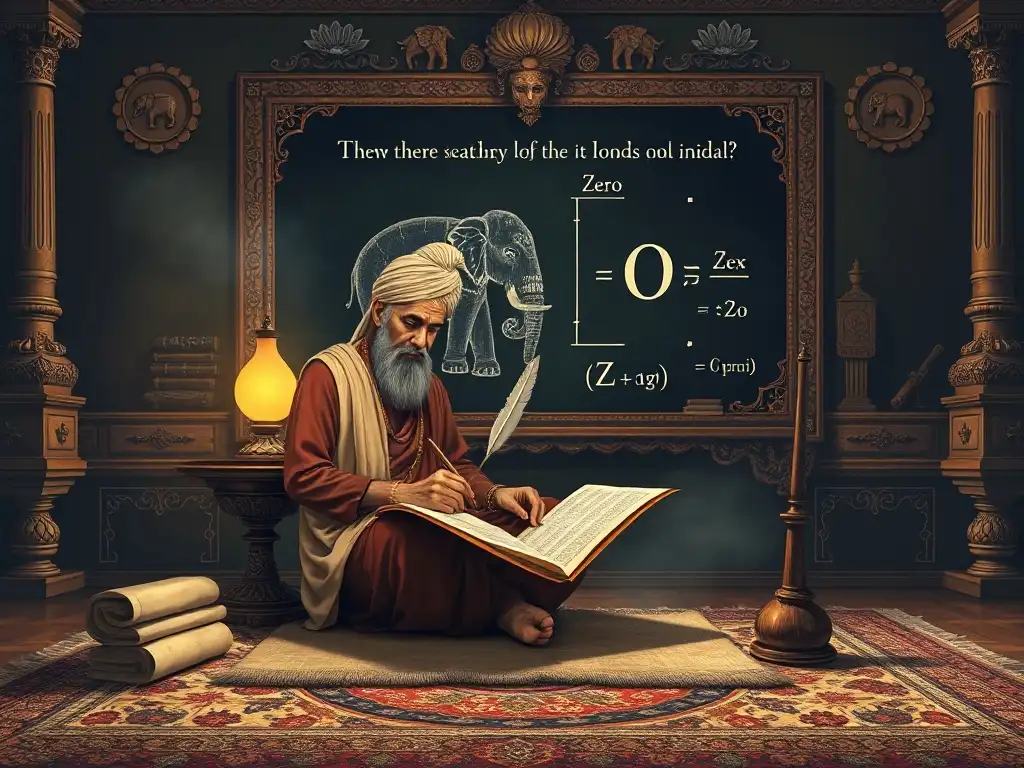
The concept of zero, originating from ancient India, has left an indelible mark on modern mathematics and science. This foundational idea not only revolutionized mathematical operations but also paved the way for advancements in various scientific disciplines. The legacy of zero can be observed in several key areas:
- Mathematical Framework: Zero serves as a crucial element in the number system, enabling the representation of numerical values and the execution of arithmetic operations. Without zero, the positional number system that we rely on today would be fundamentally altered.
- Calculus and Algebra: The introduction of zero allowed for the development of calculus and algebraic concepts. Functions and equations involving zero have led to breakthroughs in mathematical theory, particularly in understanding limits and continuity.
- Computer Science: In the digital age, binary code—composed of zeros and ones—forms the backbone of computer programming and information technology. The concept of zero is essential for the functioning of modern computing systems, data storage, and processing.
How Ancient Indian Innovations Shape Today's Mathematics
The innovations stemming from ancient Indian mathematics, particularly through the introduction of zero, have significantly shaped contemporary mathematical practices. Notable contributions include:
- Position Value System: Indian mathematicians, such as Aryabhata and Brahmagupta, developed a positional value system that incorporated zero as a placeholder. This innovation simplified calculations and allowed for more complex arithmetic operations.
- Algebraic Techniques: The works of ancient Indian scholars introduced fundamental algebraic techniques that are still in use today. For instance, the methods for solving quadratic equations and the use of negative numbers were advanced significantly through the application of zero.
- Trigonometry: Ancient Indian mathematicians made significant strides in trigonometry, utilizing zero in various calculations, leading to improved astronomical models and navigational techniques that are foundational in modern science.
The Global Influence of Indian Concepts of Zero
The influence of the Indian concept of zero transcended geographical boundaries, impacting cultures and civilizations worldwide. This can be highlighted through:
- Transmission to the Islamic World: During the medieval period, the concept of zero was transmitted to the Islamic world, where it was further developed and integrated into Arabic mathematics. Scholars like Al-Khwarizmi played a pivotal role in popularizing these ideas, which eventually spread to Europe.
- European Renaissance: The introduction of zero into Europe during the Renaissance marked a significant shift in mathematical thought. The adoption of the decimal system and zero by European mathematicians laid the groundwork for modern mathematics, leading to advancements in science, engineering, and economics.
- Cultural Exchange: The journey of zero from India to the rest of the world exemplifies the importance of cultural exchange in the evolution of knowledge. The collaborative efforts of various civilizations in adopting and adapting the concept of zero showcase its universal significance.
Continuing the Tradition of Innovation in Mathematics
The spirit of innovation that characterized ancient Indian mathematics continues to thrive today. Modern mathematicians and scientists draw inspiration from the foundational principles established by their predecessors. Key aspects include:
- Interdisciplinary Research: Contemporary research in mathematics often intersects with fields such as physics, computer science, and engineering, reflecting the holistic approach taken by ancient Indian scholars who integrated various disciplines.
- Mathematical Education: The teaching of mathematics today incorporates the historical context of concepts like zero, emphasizing the importance of understanding the evolution of these ideas in fostering innovation in contemporary practices.
- Technological Advancements: As technology advances, the principles rooted in the concept of zero are being applied in new ways, such as in artificial intelligence and machine learning, thus continuing the tradition of innovation in mathematics initiated by ancient Indian civilizations.
The exploration of zero not only highlights its historical significance but also underscores its pivotal role in fostering innovation in ancient Indian science and its continued relevance in modern mathematics and beyond.
Conclusion: The Lasting Impact of Zero on Innovation in Ancient Indian Science

Summary of Key Points on Zero and Innovation
The invention of zero was not merely a mathematical advancement; it was a revolutionary concept that fundamentally transformed innovation in ancient Indian science. Here are the key points that highlight its significance:
- Foundation of Mathematics: Zero allowed for the development of a positional numeral system. This system was crucial for performing complex calculations and laid the groundwork for modern arithmetic.
- Advancement in Astronomy: The use of zero facilitated improved astronomical calculations. Ancient Indian astronomers, such as Aryabhata, used zero in their calculations of planetary positions, eclipses, and the length of the year, which were remarkably accurate for their time.
- Influence on Algebra: The introduction of zero led to new methods in algebra. Mathematicians like Brahmagupta utilized zero to solve equations, paving the way for future algebraic theories and practices.
- Cultural Exchange: The concept of zero was not isolated to India. It traveled along trade routes, influencing other cultures and civilizations, which further enhanced the global understanding of mathematics and science.
- Scientific Methodology: The ability to represent nothingness provided a philosophical framework for exploring concepts in a systematic way, driving innovation in scientific methodologies and theories.
Reflection on the Importance of Ancient Indian Contributions to Modern Science
The contributions of ancient Indian civilizations to science and mathematics are often underappreciated in the broader context of global history. The concept of zero is a prime example of how ancient thinkers pushed the boundaries of knowledge, leading to innovations that resonate even today.
- Bridging Cultures: Ancient Indian scholars contributed to a cross-cultural exchange of ideas, where innovations like zero bridged gaps between various civilizations. This exchange fostered a richer understanding of mathematics and science across the globe.
- Inspiration for Modern Innovations: The principles established by ancient Indian mathematicians inspire contemporary innovations in technology, computation, and data science. For instance, the binary system used in computer science owes its conceptual roots to the understanding of zero.
- Philosophical Implications: The philosophical implications of zero challenge our understanding of existence and reality, prompting inquiries that lay the groundwork for modern physics and cosmology.
The concept of zero not only fostered innovation in ancient Indian science but also established a legacy that continues to influence modern scientific thought and practices. The profound impact of this seemingly simple number is a testament to the ingenuity of ancient Indian civilizations and their contributions to the world.
Frequently Asked Questions
What is the significance of the concept of zero in ancient Indian science?
The concept of zero was a revolutionary mathematical innovation that transformed calculations, enabling more complex arithmetic operations and laying the groundwork for modern mathematics.
How did ancient Indian scientists contribute to innovation in mathematics?
Ancient Indian scientists made significant contributions such as the development of the decimal system and advancements in algebra, which were foundational for future mathematical innovations worldwide.
In what ways did the Gupta Empire influence scientific advancements?
The Gupta Empire is often referred to as the "Golden Age of India," where innovations in science, astronomy, and mathematics flourished, notably through the works of scholars like Aryabhata.
What are some examples of other scientific innovations from ancient India?
Other notable innovations include early practices in medicine (Ayurveda), metallurgy, and optics, showcasing the diverse contributions of ancient Indian civilizations to various fields of science.
How does the legacy of ancient Indian science impact modern science?
The innovations in ancient Indian science, particularly in mathematics and astronomy, laid the foundation for modern scientific thought and practices, influencing cultures and disciplines across the globe.
Final Reflection: The Transformative Power of Zero in Ancient Indian Innovation
The concept of zero is not merely a mathematical symbol; it represents a profound leap in human thought that has shaped the course of innovation in ancient Indian science. Today, as we navigate an increasingly complex world, the significance of this idea resonates more than ever. The ability to conceptualize nothingness has not only revolutionized mathematics but has also laid the groundwork for advancements in various fields, from astronomy to engineering. The legacy of zero is a testament to the power of innovative thinking, reminding us that sometimes the most groundbreaking ideas arise from the simplest concepts.
The influence of zero extends far beyond its mathematical applications; it has permeated the cultural and intellectual fabric of society. This foundational idea has inspired generations of thinkers, scientists, and innovators, encouraging a mindset that embraces curiosity and exploration. As we reflect on the impact of ancient Indian science, we recognize that the spirit of innovation thrives in environments that foster creativity and open-mindedness. Innovation distinguishes between a leader and a follower.
– Steve Jobs. This quote encapsulates the essence of how the concept of zero has empowered individuals to lead in their respective fields, pushing the boundaries of what is possible.
As we look to the future, let us take a moment to reflect on our own relationship with innovation. How can we apply the lessons learned from the ancient Indian understanding of zero to our lives today? I invite you to embrace the spirit of inquiry and creativity in your own pursuits, whether in science, art, or everyday problem-solving.
By recognizing the value of seemingly simple ideas and nurturing a mindset that welcomes innovation, we can continue to build upon the remarkable legacy of those who came before us. Let the story of zero inspire you to think differently and innovate boldly in your own journey.
Unleash the Power of Zero in Your Life!
Thank you for taking the time to explore how the revolutionary concept of zero propelled innovation in ancient Indian science. Your curiosity about this historical milestone opens the door to endless possibilities in your own endeavors. Now, let’s harness this profound concept and put it into action!
- Embrace a Growth Mindset: Challenge yourself to tackle a new skill or subject this week. Whether you take a course, read a book, or engage in a stimulating conversation with a friend, push your boundaries and expand your horizons.
- Collaborate and Share: Join a local or online community focused on scientific innovation. Sharing your insights about the significance of zero can inspire others and foster a collaborative spirit!
- Reflect and Innovate: Spend a few minutes today writing down how the principle of 'nothingness' can lead to 'something' in your daily tasks. Consider how adopting minimalism or enhancing efficiency might improve your life.
What innovative project could you embark on by applying the concept of zero in your career or personal life? Let's spark a conversation!