
Decoding Zero: The Mathematical Breakthrough that Originated in Ancient India


Welcome to Ancient India History, where we embark on an exhilarating journey through the vibrant tapestry of India's past! Our exploration today centers around the fascinating world of ancient Indian mathematics history, where groundbreaking concepts formed the bedrock of modern numerical systems. In our featured article, "Decoding Zero: The Mathematical Breakthrough that Originated in Ancient India," we unravel the mysteries of how the concept of zero revolutionized mathematics and shaped civilizations.
Dive in to discover the incredible contributions of ancient Indian scholars and their lasting impact on the world of numbers. Prepare to be inspired and enlightened as you uncover the secrets of a civilization that changed the course of mathematical thought forever!
- Introduction to Ancient Indian Mathematics History
- The Historical Context of Zero in Ancient India
- The Invention of Zero: Key Figures and Texts
- Understanding the Concept of Zero in Ancient Indian Mathematics
- The Mathematical Breakthrough of Zero
- The Cultural Significance of Zero in Ancient India
- The Legacy of Ancient Indian Mathematics History
- Conclusion: The Enduring Impact of Zero on Mathematics
-
Frequently Asked Questions
- What is the significance of zero in ancient Indian mathematics?
- Who were the key figures in the development of mathematics in ancient India?
- How did ancient Indian mathematics influence the world?
- What other mathematical concepts originated in ancient India?
- How does the Gupta Empire relate to the history of mathematics in ancient India?
- Final Reflection: The Enduring Legacy of Ancient Indian Mathematics
- Unlock the Secrets of Zero: Take Action Today!
Introduction to Ancient Indian Mathematics History
The history of mathematics is a tapestry woven with contributions from various civilizations, but few have had as profound an impact as ancient India. Among its many innovations, the development of the concept of zero stands out as a groundbreaking achievement that not only transformed mathematical thought but also influenced various fields such as astronomy, science, and engineering. Ancient Indian mathematics history is a fascinating exploration of how these early mathematicians laid the groundwork for modern mathematics, and understanding this rich heritage is essential for appreciating the complexities of mathematical evolution.
From the sophisticated calculations of the Indus Valley Civilization to the elaborate theories developed during the Gupta Empire, ancient Indian mathematicians made remarkable strides that contributed significantly to the global mathematical landscape. This article delves into the monumental achievement of decoding zero, examining its origins, significance, and the lasting legacy it has left behind.
Overview of Ancient Indian Contributions to Mathematics
Ancient India was home to a plethora of mathematicians and scholars who made notable advances in various mathematical fields, including arithmetic, geometry, and algebra. The following highlights some key contributions:
- Indus Valley Civilization (c. 2500–1900 BCE): Evidence suggests that the people of this civilization engaged in advanced trade practices requiring sophisticated measurement systems. Archaeological findings indicate the use of weights and measures, hinting at an early understanding of mathematical concepts.
- Brahmagupta (598–668 CE): Often regarded as one of the greatest mathematicians of ancient India, Brahmagupta's work, Brahmasphutasiddhanta, introduced rules for calculations involving zero and negative numbers. He is credited with formalizing the use of zero in arithmetic operations.
- Aryabhata (476–550 CE): A pioneer in mathematics and astronomy, Aryabhata introduced the place-value system and the concept of zero as a placeholder. His work, Aryabhatiya, includes methods for solving quadratic equations and calculating the value of pi.
- Bhaskara II (1114–1185 CE): Known for his extensive contributions to algebra and calculus, Bhaskara II, in his treatise Lilavati, discussed the rules of arithmetic and provided solutions to various mathematical problems using the concept of zero.
These contributions illustrate the depth and breadth of mathematical knowledge in ancient India, showcasing a civilization that not only excelled in practical applications but also in theoretical advancements.
Importance of the Concept of Zero in Mathematics
The invention of zero was not merely a numerical innovation; it revolutionized mathematical thought and practice. Here’s why zero is of paramount importance:
- Placeholder Functionality: Zero serves as a crucial placeholder in the decimal system, enabling the representation of large numbers and making calculations more straightforward. For example, the difference between 205 and 25 is made possible through the use of zero to denote the absence of tens.
- Facilitating Complex Calculations: The introduction of zero allowed for more complex calculations and algebraic manipulations. It paved the way for the development of algebra as we know it today, enabling mathematicians to solve equations with greater ease.
- Philosophical Implications: Beyond its mathematical utility, the concept of zero carries deep philosophical implications. It challenges traditional notions of existence and nothingness, prompting profound discussions in various fields, including science, religion, and metaphysics.
- Influence on Global Mathematics: The concept of zero spread from India to the Arab world and subsequently to Europe, profoundly influencing the course of mathematical history. It played a pivotal role in the development of calculus, computer science, and various branches of modern mathematics.
The exploration of ancient Indian mathematics history reveals a rich landscape of intellectual achievement, with the concept of zero standing as a monumental breakthrough that has shaped the way we understand and apply mathematics today. The legacy of these ancient scholars continues to resonate in contemporary mathematical practices, highlighting the importance of their contributions to the development of global mathematics.
The Historical Context of Zero in Ancient India

Zero, as a concept, represents a significant milestone in the evolution of mathematics, particularly within ancient Indian civilization. The inception of zero is closely tied to the broader developments in mathematics that emerged in India well before it was recognized in other parts of the world. Understanding the historical context of zero requires a closer examination of the early mathematical developments that set the stage for this groundbreaking concept.
Early Mathematical Developments in Ancient India
The foundations of ancient Indian mathematics can be traced back to the Indus Valley Civilization (approximately 3300–1300 BCE), where evidence of advanced measurement systems and mathematical practices have been discovered. Archaeological findings, such as weights, measures, and seals, indicate that the inhabitants had a sophisticated understanding of geometry and trade, necessitating a rudimentary form of arithmetic.
By the time of the Vedic period (1500–500 BCE), mathematical practices began to formalize. The Sulbasutras, ancient texts that provided guidelines for constructing altars, also included geometric principles. For instance, they discussed the Pythagorean theorem long before it was formally recognized in Greece. This era laid the groundwork for mathematical thought, emphasizing practical applications intertwined with religious and ritualistic needs.
The concept of zero began to crystallize in the following centuries, particularly during the Gupta Empire (circa 320–550 CE). Mathematicians such as Aryabhata and Brahmagupta made pivotal contributions. Aryabhata's work introduced an early form of positional notation, which was essential for the integration of zero into the number system. Brahmagupta elaborated on the rules of arithmetic operations involving zero, establishing it as an integral part of calculations, including operations like addition and subtraction.
Influence of Ancient Indian Civilizations on Mathematical Thought
The influence of ancient Indian civilizations on global mathematical thought cannot be overstated. The introduction of zero had profound implications not only within Indian society but also across the world.
- Cultural Exchange: The Silk Road facilitated trade and cultural exchange, allowing Indian mathematical concepts, including zero, to spread to the Middle East and beyond. By the 7th century, Indian numerals and the concept of zero began to infiltrate Islamic mathematics, which later influenced Europe during the Renaissance.
- Philosophical Underpinnings: Ancient Indian mathematicians approached mathematics from a philosophical standpoint, viewing numbers as more than mere quantities. This perspective paved the way for abstract mathematical concepts, influencing subsequent generations of mathematicians.
- Textual Contributions: Texts such as the Aryabhatiya and Brahmasphutasiddhanta were critical in documenting the rules of arithmetic and algebra involving zero. These texts served as references for future mathematicians in both the East and West, ensuring the longevity of these mathematical principles.
- Legacy of Innovation: The innovative spirit of ancient Indian mathematicians fostered an environment of inquiry and exploration, leading to advancements in algebra, trigonometry, and calculus, all of which integrated the concept of zero in their frameworks.
The historical context of zero in ancient India is rich and intricate, rooted in early mathematical developments and an enduring influence on mathematical thought. The contributions of ancient Indian civilizations have left an indelible mark on the global landscape of mathematics, with zero serving as a cornerstone of this legacy.
The Invention of Zero: Key Figures and Texts
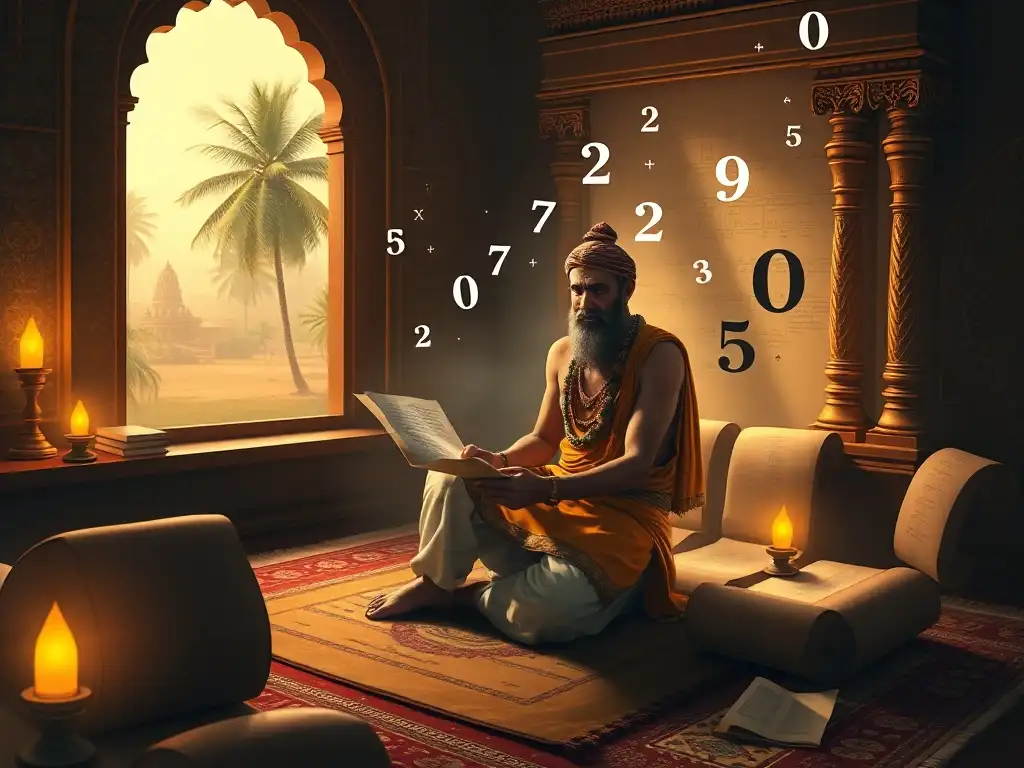
Brahmagupta and His Contributions to Zero
Brahmagupta, a prominent mathematician and astronomer in the 7th century CE, is often heralded as one of the key figures in the development of zero in ancient Indian mathematics history. His seminal work, the Brahmasphutasiddhanta, is crucial for understanding how zero was conceptualized and utilized in mathematical operations.
Brahmagupta's contributions to zero can be summarized in several significant points:
- Definition of Zero: Brahmagupta defined zero as a number that represents the absence of quantity. This was a groundbreaking conceptual leap, distinguishing zero from a mere placeholder.
- Arithmetic Operations: He was one of the first to articulate rules for arithmetic operations involving zero. For instance, he stated that adding or subtracting zero from a number leaves the number unchanged, while multiplying any number by zero results in zero.
- Negative Numbers: Brahmagupta also recognized the importance of negative numbers, providing rules for operations involving both zero and negative values. This was instrumental in advancing mathematical discourse.
Brahmagupta's work not only laid the groundwork for future mathematicians but also influenced the development of mathematics in other cultures, demonstrating the significance of ancient Indian mathematics history.
The Role of Aryabhata in Advancing Mathematical Concepts
Aryabhata, active in the 5th century CE, significantly advanced the understanding of mathematics and astronomy in ancient India. His work incorporated the concept of zero and established a framework that influenced both Indian and global mathematics.
Key aspects of Aryabhata's contributions include:
- Place Value System: Aryabhata advocated for a positional decimal system, where the value of a digit is determined by its position in a number. This innovation is fundamental to the modern understanding of numerical representation, and zero plays a vital role in this system.
- Mathematical Calculations: He introduced methods to compute square roots and cube roots, utilizing zero where necessary to simplify calculations. His methods improved computational efficiency and accuracy.
- Astronomical Calculations: Aryabhata's work in astronomy required precise calculations, where he applied the concept of zero to solve complex problems. His astronomical theories and calculations showed how zero was indispensable in advanced mathematics.
Aryabhata's influence extends beyond his time, as his works were translated and studied in various cultures, shaping the trajectory of mathematics in the medieval and modern eras.
Significant Texts: Brahmasphutasiddhanta and Aryabhatiya
Two pivotal texts in ancient Indian mathematics history are Brahmagupta's Brahmasphutasiddhanta and Aryabhata's Aryabhatiya. These texts not only documented mathematical concepts but also served as foundational references for subsequent mathematicians.
Brahmasphutasiddhanta
- Content Overview: The Brahmasphutasiddhanta covers various topics, including arithmetic, algebra, and astronomy. It contains explicit rules for the use of zero in calculations.
- Impact: This text established Brahmagupta as a mathematician of great repute and influenced later mathematicians in India and beyond. His approach to zero as a number shaped mathematical thought for centuries.
Aryabhatiya
- Content Overview: The Aryabhatiya consists of four sections, addressing arithmetic, algebra, and astronomy. It emphasizes the positional value of numbers, with zero playing a critical role in calculations.
- Legacy: Aryabhata's work inspired countless scholars, making the Aryabhatiya a cornerstone of mathematical literature. His innovative methods highlighted the importance of zero in complex calculations and established a legacy that persisted through the ages.
Both texts are essential for understanding the evolution of mathematical ideas in ancient India and underscore the significance of zero as a transformative concept in mathematics.
Understanding the Concept of Zero in Ancient Indian Mathematics

The concept of zero is one of the most significant mathematical breakthroughs in history, profoundly impacting various fields, including mathematics, science, and philosophy. In ancient India, the development of zero was not merely a numerical innovation; it represented a philosophical understanding of the void, nothingness, and the infinite. This section delves into the origins and implications of zero within the context of ancient Indian mathematics history.
The Symbolism and Representation of Zero
In ancient Indian mathematics, zero was represented by a dot or a small circle, evolving over time into the symbol we recognize today (0). The earliest known use of zero can be traced back to the 5th century CE in the work of the mathematician Aryabhata, who employed it in his calculations. However, the representation of zero as a concept can be found in the Bakhshali Manuscript, dated between the 2nd and 4th centuries CE, which features a dot that signifies the absence of a value.
The symbolism of zero in ancient Indian culture transcended mathematics. It was often associated with the concept of Shunya, meaning emptiness or void in Sanskrit. This philosophical interpretation allowed ancient Indian scholars to explore complex ideas about infinity and the nature of existence. Such profound conceptualization demonstrated that zero was more than just a numeral; it was a gateway to a broader understanding of the universe.
Zero as a Placeholder: Its Impact on Numerical Systems
The introduction of zero as a placeholder revolutionized numerical systems. In the decimal system, which is foundational to modern mathematics, zero enables the differentiation between numbers that would otherwise appear identical. For instance, without zero, the numbers 10 and 1 would be represented the same way, making calculations and numeral representation difficult.
Key Impacts of Zero as a Placeholder:
- Place Value System: The inclusion of zero allowed for a place value system, where the position of a digit determines its value. For example, in the number 205, the zero signifies that there are no tens, making it clear that the value is two hundred and five, not just twenty-five.
- Simplification of Calculations: Zero facilitates mathematical operations. For instance, addition and subtraction become more manageable when zero is used, allowing for clear and concise representations of calculations.
- Development of Algebra: The concept of zero paved the way for the development of algebraic principles. It enabled the formulation of equations, leading to advancements in mathematical theories and practices.
Conclusion
The understanding and utilization of zero in ancient Indian mathematics marked a pivotal moment in the history of mathematics. By serving not only as a numerical symbol but also as a philosophical concept, zero bridged the gap between tangible calculations and abstract thinking. This innovation laid the groundwork for the advanced mathematical systems that followed, influencing civilizations far beyond the Indian subcontinent and shaping the course of mathematical history.
The Mathematical Breakthrough of Zero

The invention of zero is often regarded as one of the most significant breakthroughs in the history of mathematics. Originating in ancient India, zero not only revolutionized mathematical calculations but also laid the foundation for modern numerical systems. This conceptual leap allowed for the development of more complex calculations and facilitated advancements in various fields, including astronomy, commerce, and engineering.
The earliest recorded use of zero can be traced back to the 5th century CE, with the work of mathematicians like Aryabhata. However, it was during the 7th century that Brahmagupta significantly contributed to the formalization of zero as a number. He defined operations involving zero, providing guidelines on how to add, subtract, multiply, and divide using this innovative numeral. Brahmagupta's work emphasized the importance of zero in the number system, marking a pivotal moment in ancient Indian mathematics history.
The concept of zero also played a crucial role in positional numeral systems, where the value of a digit is determined by its position relative to others. This is particularly evident in the decimal system, where the presence of zero is essential for differentiating between numbers such as 10 and 100.
Zero's Role in Arithmetic and Algebra
Zero's introduction into arithmetic and algebra transformed the way calculations were performed. Prior to its use, calculations were cumbersome and often required extensive verbal explanations or the use of physical tokens to represent numbers. With zero, mathematicians could represent nothingness, enabling a more efficient way to perform operations.
- Addition and Subtraction: In arithmetic, zero serves as the identity element for addition. For example:
- \(a + 0 = a\)
- \(a - a = 0\)
- Multiplication and Division: In multiplication, zero plays a crucial role:
- \(a \times 0 = 0\)
- Division by zero, however, poses unique challenges and was a topic of debate among ancient scholars.
In algebra, the existence of zero allowed for the formulation of equations that could be solved more easily, leading to advancements in algebraic theory. For instance, the ability to solve quadratic equations became more systematic with the understanding of zero as a solution.
The implications of zero extended beyond mere calculations. It enhanced mathematical communication, allowing for the representation of large numbers without the need for cumbersome notation. This innovation allowed ancient Indian mathematicians to explore complex concepts, such as infinity and negative numbers, setting the stage for future mathematical developments.
How Zero Transformed Mathematical Calculations
The transformative impact of zero on mathematical calculations can be observed through several key developments in both practical applications and theoretical explorations.
- Simplification of Calculations: Zero enabled mathematicians to simplify calculations significantly. With its introduction, operations that previously required extensive methods could now be performed swiftly and accurately. For example, the multiplication of numbers could be executed more efficiently using place value, significantly reducing the potential for errors.
- Facilitating Large Numbers: The inclusion of zero in the number system allowed for the representation of large numbers with ease. This was crucial for record-keeping, trade, and astronomy, where calculations often involved large quantities. The ability to denote numbers like 1,000 or 10,000 became straightforward, fostering advancements in commerce and scientific observation.
- Advancements in Algebraic Concepts: Zero’s role in algebra led to the exploration of new mathematical concepts, such as polynomials and equations. The ability to represent equations with zero as a solution opened up new avenues for mathematical investigation. Mathematicians like Brahmagupta and later Bhaskara II further developed these ideas, leading to a richer understanding of algebra.
- Influence on Global Mathematics: The concept of zero eventually spread beyond the Indian subcontinent, influencing mathematical thought worldwide. Through trade and cultural exchanges, the numeral system that included zero reached the Islamic world and then Europe, fundamentally altering the landscape of mathematics across civilizations.
The invention of zero was a groundbreaking advancement in ancient Indian mathematics history. It not only enhanced arithmetic and algebra but also laid the groundwork for modern mathematics as we know it today. The implications of zero continue to resonate in various fields, underscoring its profound significance in the evolution of mathematical thought.
The Cultural Significance of Zero in Ancient India
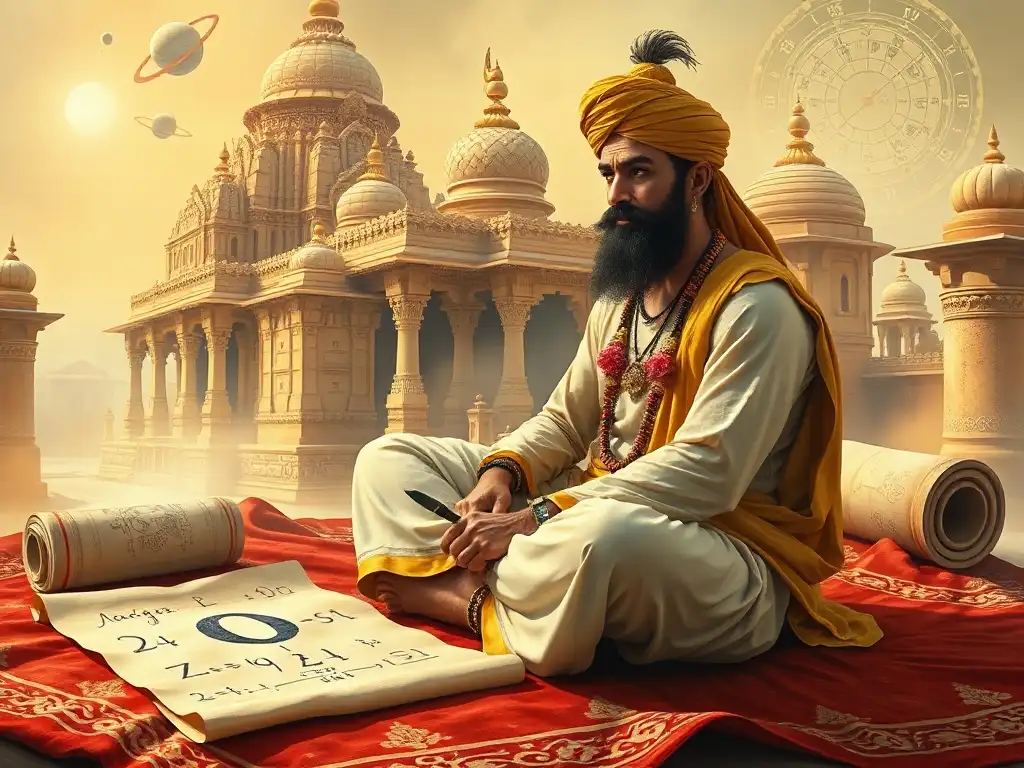
Zero in Philosophy and Cosmology
In ancient India, the concept of zero extended far beyond its mathematical significance; it permeated philosophical and cosmological thought. The idea of nothingness, or shūnyatā, was a central tenet in various Indian philosophical systems, particularly in Buddhism and Jainism. This notion of void or emptiness reflects a deeper understanding of existence and the universe, suggesting that zero was not merely a numerical placeholder but a profound representation of the universe's cyclical nature.
The early mathematicians and philosophers viewed zero as a symbol of balance between existence and non-existence. For instance, the Brahmasphutasiddhanta, written by Brahmagupta in the 7th century CE, articulated the role of zero in calculations while simultaneously acknowledging its philosophical implications. Brahmagupta proposed that the universe operates in cycles, where creation and destruction are interlinked, and zero embodies this duality.
In cosmological terms, the concept of zero helped in understanding the vastness of space and time. Ancient texts often used zero to denote the infinite, allowing scholars to explore the vast cosmic expanse through mathematical frameworks. This intersection of mathematics and philosophy positioned zero as a crucial element in ancient Indian thought, influencing subsequent developments in mathematics and science.
The Interplay Between Mathematics and Spirituality
The relationship between mathematics and spirituality in ancient India is deeply intertwined, with zero serving as a bridge between the two realms. Many scholars and mathematicians in ancient India were also spiritual seekers, and their mathematical pursuits were often viewed as a path to understanding the divine.
One of the most notable examples is the Vedic texts, which emphasized the sacred nature of numbers and their connection to the cosmos. The use of zero in calculations allowed for more complex forms of mathematics, including the development of algebraic concepts that were often employed in spiritual rituals and astronomical calculations. This blend of mathematics and spirituality is exemplified in the Sulba Sutras, ancient texts that provided rules for constructing altars for religious ceremonies, showcasing how geometry and arithmetic were integrated into the spiritual practices of the time.
Furthermore, the philosophical discourse around zero encouraged thinkers to explore the nature of reality and consciousness. The mathematical understanding of nothingness led to profound reflections on the self and the universe, fostering a unique worldview that viewed mathematics as a means to comprehend existence itself.
The interplay between mathematics and spirituality in ancient India reveals that the significance of zero transcended numerical utility. It was a vital component of a broader intellectual tradition that sought to harmonize the material and the spiritual, illustrating the rich tapestry of thought that characterized ancient Indian civilization.
The Legacy of Ancient Indian Mathematics History

How the Concept of Zero Influenced Global Mathematics
The introduction of zero as a numeral was one of the most significant contributions of ancient Indian mathematics history. The evolution of zero transformed mathematical operations and paved the way for advanced arithmetic and algebra. Before zero, the representation of numbers was limited and cumbersome, relying on various counting systems that lacked the flexibility needed for more complex calculations.
The earliest recorded use of zero dates back to the 5th century CE in the work of the Indian mathematician Aryabhata. His innovative ideas laid the groundwork for future mathematicians. The concept of zero was not merely a placeholder but represented the absence of quantity, which was revolutionary. This notion allowed for the development of positional notation, where the value of a digit was determined by its position in a number.
Global Transmission of Zero
The influence of zero extended beyond the borders of India. It traveled through trade routes and cultural exchanges, reaching the Islamic world by the 7th century. Scholars like Al-Khwarizmi, who studied Indian mathematics, incorporated zero into their own works and subsequently spread it across Europe. By the 10th century, zero had made its way to Europe, significantly impacting mathematical practices there.
This transition can be summarized as follows:
- 5th Century CE: Aryabhata introduces zero in Indian mathematics.
- 7th Century: Arab scholars embrace zero, integrating it into their mathematical systems.
- 10th Century: Zero reaches Europe, revolutionizing Western mathematics.
The acceptance of zero in Europe marked a turning point in mathematical history, leading to the development of algebra, calculus, and modern arithmetic. Without the inclusion of zero, the mathematical landscape we know today would be drastically different.
The Continuing Relevance of Ancient Indian Mathematical Principles
The principles of ancient Indian mathematics continue to resonate in contemporary mathematics and various scientific fields. The methodologies and concepts developed during this era laid the foundations for many modern practices.
Key Contributions
- Positional Notation: The base-10 positional system, which is fundamental to our current numerical framework, originated in ancient India. This system allows for efficient computation and representation of numbers.
- Algebraic Formulations: Ancient mathematicians, including Brahmagupta and Bhaskara, made significant advances in algebra, solving quadratic equations and developing rules for arithmetic operations that are still taught today.
- Trigonometry and Astronomy: Ancient Indian scholars contributed to trigonometric concepts, such as sine and cosine, which are vital in fields ranging from engineering to physics. Their astronomical calculations were remarkably accurate, influencing future navigation and timekeeping.
- Mathematical Texts: Texts such as the Bakhshali Manuscript and Lilavati offer insight into the sophisticated mathematical techniques used by ancient Indian mathematicians. These texts are still studied for their historical and educational value.
Modern Applications
The principles from ancient Indian mathematics are not confined to history; they are integral to modern-day applications:
- Computer Science: Algorithms developed from ancient mathematical principles are foundational in programming and computational theory.
- Engineering: Mathematical concepts from ancient India are utilized in structural engineering and design, emphasizing their practical relevance.
The legacy of ancient Indian mathematics history is profound. The concept of zero and the mathematical principles derived from this rich heritage continue to influence and shape contemporary mathematics, affirming the enduring impact of ancient Indian civilization on the world.
Conclusion: The Enduring Impact of Zero on Mathematics
The concept of zero, originating from ancient Indian mathematics, has profoundly transformed the landscape of mathematics as we know it today. This simple yet revolutionary numeral not only facilitated advanced calculations but also paved the way for the development of algebra, calculus, and computer science. The legacy of zero is a testament to the intellectual prowess of ancient Indian scholars and their contributions to global mathematics.
Reflection on Ancient Indian Mathematics History and Its Contributions
Ancient Indian mathematics history is characterized by innovative ideas and techniques that have significantly influenced mathematical thought worldwide. The introduction of zero as a numeral was not just about representing 'nothing'; it was about conceptualizing the void in a way that allowed mathematicians to explore complex calculations with unprecedented ease.
Historically, the earliest recorded use of zero dates back to the 5th century CE in the work of the mathematician Aryabhata. His contributions, alongside those of Brahmagupta and Bhaskara II, laid a strong foundation for arithmetic and algebra.
- Aryabhata: His seminal work, the Aryabhatiya, introduced methods for solving quadratic equations and emphasized the importance of place value, which was essential for the application of zero.
- Brahmagupta: In his Brahmasphutasiddhanta, he defined operations involving zero and negative numbers, establishing rules that are still relevant in modern mathematics.
- Bhaskara II: His work further advanced mathematical concepts, including the use of zero in calculations and the introduction of techniques that predate modern calculus.
The implications of these contributions extend far beyond ancient India. They served as a bridge between Eastern and Western mathematical traditions, influencing scholars in the Arab world and eventually reaching Europe, where they were instrumental in the Renaissance.
Future Directions for Research on Ancient Mathematical Innovations
The exploration of ancient Indian mathematics history is still in its infancy, with many opportunities for future research. Scholars are encouraged to delve deeper into the manuscripts, inscriptions, and texts that contain mathematical knowledge from this era. Some potential avenues for exploration include:
- Comparative Studies: Analyzing the development of zero and mathematical concepts in ancient India in relation to other ancient civilizations, such as the Greeks and the Chinese, could yield insights into how these ideas evolved.
- Cultural Impact: Investigating how the introduction of zero influenced various aspects of ancient Indian society, including commerce, astronomy, and architecture, can provide a comprehensive understanding of its significance.
- Mathematical Techniques: Further examination of the computational techniques and algorithms developed by ancient Indian mathematicians could enrich contemporary mathematical education and practices.
By pursuing these research directions, scholars can continue to unravel the rich tapestry of ancient Indian mathematics, ensuring that the contributions of this remarkable civilization remain recognized and celebrated in the annals of history.
Frequently Asked Questions
What is the significance of zero in ancient Indian mathematics?
The concept of zero as a number and a placeholder was a groundbreaking development in ancient Indian mathematics, allowing for more complex calculations and the advancement of the numeral system.
Who were the key figures in the development of mathematics in ancient India?
Brahmagupta and Aryabhata are among the most notable mathematicians, contributing significantly to the field with their works in algebra, geometry, and the concept of zero.
How did ancient Indian mathematics influence the world?
Ancient Indian mathematics, particularly the concept of zero and the decimal system, had a profound impact on mathematics globally, influencing cultures in Arabia and later Europe.
What other mathematical concepts originated in ancient India?
In addition to zero, ancient Indian mathematicians developed concepts such as negative numbers, algebraic equations, and methods for calculating square roots and cube roots.
How does the Gupta Empire relate to the history of mathematics in ancient India?
The Gupta Empire (circa 320-550 CE) is often regarded as the Golden Age of ancient Indian mathematics, marked by significant advancements in numerical systems, astronomy, and mathematical theories.
Final Reflection: The Enduring Legacy of Ancient Indian Mathematics
The exploration of ancient Indian mathematics history reveals a profound connection between the past and our present, demonstrating how the concept of zero has transformed not only mathematical thought but also the very fabric of modern civilization. Today, as we navigate an increasingly complex digital world, the significance of this mathematical breakthrough becomes even more pronounced. Zero is not just a number; it is a symbol of infinite possibilities.
The influence of ancient Indian mathematics extends far beyond the realm of numbers; it has shaped our cultural and intellectual landscapes. As we embrace the digital age, we must recognize the foundational ideas that have paved the way for our advancements. The wisdom of ancient mathematicians continues to inspire contemporary thinkers and innovators. Mathematics knows no races or geographic boundaries; for mathematics, the cultural world is one country.
– David Hilbert. This quote encapsulates the universal nature of mathematical discovery, reminding us that the contributions of ancient Indian scholars are part of a shared human heritage.
As we reflect on the lessons of this remarkable history, let us take a moment to appreciate the interconnectedness of knowledge across time and cultures. I invite you to consider how the principles of ancient Indian mathematics can be applied in your own life, whether in problem-solving, critical thinking, or fostering creativity. Embrace the spirit of inquiry and exploration that these ancient thinkers embodied, and let it guide you as you navigate the complexities of the modern world. Together, we can honor this legacy by continuing to learn, innovate, and inspire future generations.
Unlock the Secrets of Zero: Take Action Today!
Thank you for diving into the fascinating story of zero and its origins in ancient India! Understanding this mathematical breakthrough not only enriches your knowledge but also empowers you to share its significance with others. Let’s build on this excitement and take meaningful steps together!
- Explore deeper: Investigate ancient Indian mathematical texts to uncover more astonishing discoveries that shaped the world.
- Share your newfound knowledge: Discuss the importance of zero with friends or on social media to inspire others about its incredible impact.
- Join a community: Engage with online forums or local study groups to connect with fellow enthusiasts and explore more about ancient mathematics.
What do you believe is the most surprising impact of zero on modern mathematics and science? We invite you to share your thoughts below!