
The Contribution of Jain Mathematicians to the Field of Combinatorics


Welcome to Ancient India History, where we embark on a fascinating journey through the intricate tapestry of ancient Indian civilizations. Delve into the remarkable contributions that shaped the world of mathematics, particularly the insightful work of Jain mathematicians in combinatorics. Discover how these brilliant minds not only advanced mathematical thought but also laid the groundwork for future innovations. Are you ready to uncover the secrets of their extraordinary achievements? Let's dive deeper into this captivating story!
- Introduction to Jain Mathematicians in Combinatorics
- Historical Context of Jain Mathematicians
- Core Contributions of Jain Mathematicians to Combinatorics
- Comparison with Contemporary Mathematical Practices
- Legacy and Modern Relevance of Jain Mathematicians in Combinatorics
- Conclusion: The Enduring Contribution of Jain Mathematicians
- References
- Frequently Asked Questions
- Final Reflection: The Enduring Legacy of Jain Mathematicians in Combinatorics
- Unleash Your Curiosity: Dive Deeper into Jain Mathematics!
Introduction to Jain Mathematicians in Combinatorics
The contributions of Jain mathematicians to the field of combinatorics represent a remarkable chapter in the rich tapestry of ancient Indian mathematics. Emerging from the philosophical and religious currents of Jainism, these mathematicians not only advanced numerical concepts but also established foundational principles that would influence mathematical thought for centuries.
Their work, often intertwined with a deep understanding of ethics and cosmology, showcases an intricate blend of spirituality and scientific inquiry. As we explore the lives and contributions of these esteemed figures, we uncover a legacy that underscores the sophistication of ancient Indian civilization and its profound impact on the development of combinatorial mathematics.
Overview of Jain Mathematics and Combinatorics
Jain mathematics is characterized by its unique approach to numbers and calculations, which is often reflective of Jain philosophical principles. The Jain tradition emphasized the importance of precision and accuracy in mathematical practices, which is evident in their meticulous methodologies.
Combinatorics, a branch of mathematics dealing with the counting, arrangement, and combination of objects, found a prominent place in Jain mathematical literature. Key elements include:
- Permutations: Jain mathematicians developed systematic techniques for the arrangement of objects, which laid the groundwork for modern permutation theory.
- Combinations: They explored the selection of objects from larger sets, contributing to foundational concepts in combinatorial analysis.
The integration of these principles into their work demonstrates the depth of Jain thought and its application to mathematical problems.
Importance of Jain Mathematicians in Ancient Indian Mathematics
The significance of Jain mathematicians in ancient Indian mathematics cannot be overstated. Their contributions were pivotal in several ways:
- Innovative Techniques: Jain mathematicians developed unique algorithms and methods that advanced the field of combinatorics. Notable figures, such as Bhadrabahu and Mahavira, are credited with significant works that detail these techniques.
- Influence on Later Scholars: The principles established by Jain mathematicians influenced subsequent generations of mathematicians, both in India and beyond. Their texts became essential references for scholars engaged in mathematical exploration.
- Cultural and Philosophical Integration: Jainism's emphasis on ethical living and non-violence permeated the mathematical work of its scholars. This integration of culture and mathematics provided a holistic approach that encouraged the responsible use of mathematical knowledge.
By examining the contributions of Jain mathematicians in combinatorics, we not only appreciate their technical achievements but also recognize their role in shaping the broader landscape of ancient Indian mathematics, thereby enriching our understanding of this vibrant historical period.
Historical Context of Jain Mathematicians

The Emergence of Jain Mathematics in Ancient India
The emergence of Jain mathematics can be traced back to the flourishing of ancient Indian civilization, particularly during the period from 600 BCE to 1200 CE. Jainism, with its rich philosophical traditions and emphasis on non-violence, truth, and asceticism, created a conducive environment for intellectual pursuits, including mathematics. Jain mathematicians were prominent in the fields of arithmetic, geometry, and particularly combinatorics. The integration of mathematics into religious texts and practices further solidified the role of mathematical exploration within the Jain community.
One of the key features of Jain mathematics was its systematic approach to numbers and calculations, influenced by the Jain cosmological view, which emphasized the infinite and the cyclical nature of time. This perspective fostered an appreciation for the manipulation of numbers and their relationships, laying the groundwork for significant developments in combinatorial mathematics.
The Jain tradition also placed great importance on the study of language and logic, which paralleled their mathematical explorations. This interplay between language and mathematics is evident in the comprehensive treatises produced by Jain scholars, who documented their findings in a manner that blended philosophical inquiry with mathematical rigor.
Key Historical Figures in Jain Mathematics
Jain mathematicians made notable contributions to various branches of mathematics, particularly in combinatorics. Understanding the key figures in this domain reveals the depth of their influence and the breadth of their work.
Notable Jain Mathematicians and Their Contributions
- Bhadrabahu (circa 5th century CE):
- Renowned for his work in mathematics and astronomy, Bhadrabahu is credited with early contributions to the understanding of permutations and combinations. His treatises laid foundational concepts that would later influence mathematicians across cultures.
- Mahāvīra (circa 9th century CE):
- A prominent figure in Jain mathematics, Mahāvīra authored the Ganita Sara Sangraha, which is one of the earliest known texts systematically addressing arithmetic and geometry. He introduced various combinatorial techniques, demonstrating how to calculate permutations of objects—a pivotal moment in the development of combinatorial mathematics.
- Vijayananda (circa 11th century CE):
- Known for his contributions to combinatorial theory, Vijayananda explored the principles of counting and arrangement, further refining the work of his predecessors. His writings provided a blend of mathematical theory with practical applications, showcasing the utility of combinatorial methods in everyday life.
Cultural and Philosophical Influences on Jain Mathematics
The contributions of Jain mathematicians cannot be separated from the rich philosophical and cultural milieu of ancient India. Jainism’s core tenets—such as the belief in the multiplicity of viewpoints (anekāntavāda)—encouraged diverse mathematical explorations. This philosophical stance fostered an environment where various approaches to problem-solving were not only accepted but celebrated.
The cultural emphasis on education and scholarship within Jain communities led to the establishment of centers for learning, where mathematics flourished alongside philosophy and logic. This holistic approach ensured that mathematics was not merely a set of abstract concepts but was deeply intertwined with the ethical and philosophical dimensions of Jain thought.
Through these intertwined influences, Jain mathematicians developed sophisticated techniques in combinatorics that would later resonate through the annals of mathematical history, leaving an indelible mark that continues to inspire contemporary mathematics.
Core Contributions of Jain Mathematicians to Combinatorics
Pioneering Concepts in Combinatorial Mathematics
Introduction to Combinatorial Principles by Jain Mathematicians
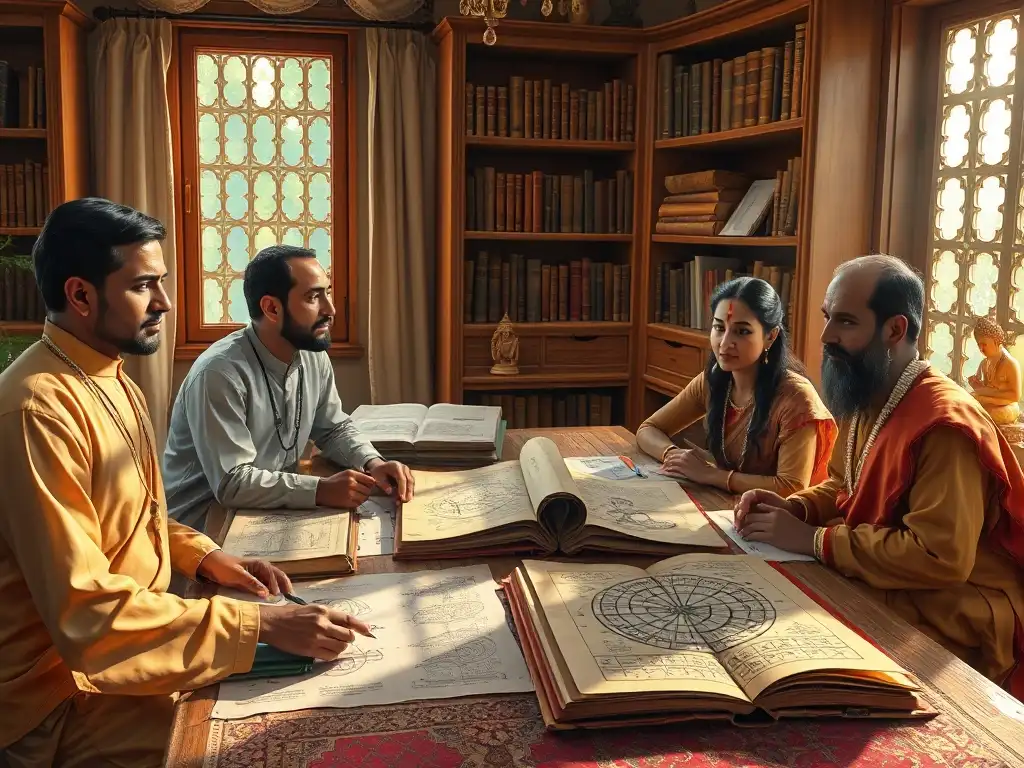
Jain mathematicians made foundational contributions to the field of combinatorics, an area that focuses on counting, arrangement, and combination of objects. The historical backdrop of Jain mathematics is rich, with scholars such as Bhadrabahu, Mahavira, and Akhara playing pivotal roles in developing early combinatorial concepts.
One of the key principles introduced by these mathematicians is permutation and combination, which forms the bedrock of combinatorial analysis. Jain scholars recognized the significance of systematic counting techniques, leading to the formulation of rules that govern the arrangement of elements. Their work laid the groundwork for understanding more complex combinatorial structures and paved the way for future explorations in the field.
Innovative Methods and Techniques Developed
Beyond the basic concepts of permutations and combinations, Jain mathematicians also innovated various techniques that advanced the study of combinatorics. They introduced recursion methods, which allowed for the calculation of combinations more efficiently by reusing previous results. This method is akin to what we now refer to as dynamic programming in modern mathematics.
Additionally, Jain scholars worked on combinatorial designs, which involve the arrangement of elements into sets that satisfy certain balance and symmetry conditions. These designs have applications in statistical experiments, error-correcting codes, and cryptography, demonstrating the long-lasting impact of Jain combinatorial techniques.
Significant Works and Texts in Jain Combinatorics
Analysis of Historical Texts and Their Impact
Several ancient texts penned by Jain mathematicians provide insights into their contributions to combinatorics. Works such as "Ganita Sara Sangraha" by Bhaskara II and "Siddhanta Shiromani" by Bhaskara I delve into combinatorial principles, illustrating the mathematical prowess of Jain scholars. These texts often contained extensive discussions on counting principles, algebraic methods, and geometric arrangements, showcasing their comprehensive understanding of mathematics.
The influence of these works extended beyond the Jain community, impacting other mathematical traditions in India and beyond. The analytical techniques and combinatorial strategies outlined in these texts were foundational, serving as reference points for later mathematicians and scholars.
Key Theorems and Formulas Established by Jain Mathematicians
Jain mathematicians are credited with establishing several key theorems and formulas in combinatorics that remain relevant today. Notable among these is the Jain's Theorem on Combinations, which provides a systematic approach to calculate combinations of objects without repetition. This theorem is critical in various fields, including probability theory and statistics.
Furthermore, Jain scholars articulated formulas that addressed sequences and series, notably the Pascal's Triangle concept, which they referred to in their texts under different names. Their work on the summation of combinations has parallels in modern combinatorial identities and has been instrumental in shaping contemporary combinatorial mathematics.
The contributions of Jain mathematicians to combinatorics are significant and multifaceted. Their pioneering concepts, innovative methods, and profound works not only enriched the field of mathematics during their time but also continue to inspire modern mathematical thought and exploration.
Comparison with Contemporary Mathematical Practices

Jain Combinatorics vs. Other Ancient Indian Mathematical Traditions
Jain mathematicians made significant strides in the development of combinatorics during a period when mathematical practices in ancient India were rich and diverse. Unlike their contemporaries, Jain scholars approached combinatorial problems with a unique philosophical perspective that intertwined mathematics with spiritual beliefs.
Key Differences:
- Philosophical Basis: Jain mathematics often emphasized the concept of "anekāntavāda" (non-absolutism), which encouraged multiple viewpoints. This philosophical underpinning led to a more holistic approach to combinatorial problems, allowing for intricate reasoning and multiple solution methods.
- Focus on Enumeration: Jain mathematicians were particularly interested in the enumeration of possible outcomes and arrangements, often applying their combinatorial techniques to solve problems related to religious rituals and social structures. This stands in contrast to other ancient traditions, such as those practiced by the Aryabhata school, which were more focused on algorithmic methods for calculation.
- Use of Unique Terms: Jain mathematicians introduced specific terminology and notation for combinatorial concepts that were distinct from those used by other mathematicians, which facilitated a different understanding and approach to the subject.
Influence of Jain Combinatorial Techniques on Later Mathematicians
The contributions of Jain mathematicians in combinatorics laid a foundation that influenced later mathematicians both within India and beyond. Their innovative techniques and methods were not only advanced for their time but also served as a bridge to later developments in mathematics.
Significant Influences:
- Adaptation of Techniques: Later mathematicians, including those from the medieval period, adapted Jain combinatorial techniques to solve increasingly complex problems. The methods of counting combinations and permutations developed by Jain scholars were incorporated into the work of mathematicians like Bhaskara II, who expanded on these concepts in the 12th century.
- Integration into Other Fields: Jain contributions to combinatorics also found applications beyond pure mathematics, influencing fields such as astronomy and astrology. The combinatorial methods were used to calculate the positions of celestial bodies, demonstrating the interdisciplinary nature of Jain mathematics.
- Cultural Exchange: The migration of Jain communities and their scholars led to the dissemination of their mathematical ideas, impacting mathematicians in neighboring regions and cultures. This exchange facilitated the integration of Jain combinatorial principles into the broader mathematical discourse of the time.
Cross-Influences with Other Cultures and Regions
The reach of Jain combinatorial techniques extended beyond the Indian subcontinent, fostering cross-cultural exchanges that enriched the global mathematical landscape.
Notable Cross-Influences:
- Interaction with Islamic Mathematics: During the medieval period, as trade routes expanded, Jain mathematicians interacted with Islamic scholars. The transfer of knowledge was mutual, with Jain combinatorial methods influencing Islamic mathematicians, who incorporated some of these techniques into their own works.
- Influence on Chinese Mathematics: There is evidence to suggest that Jain mathematical texts were translated and studied by Chinese scholars, leading to the adaptation of Jain combinatorial concepts in Chinese mathematics. This exchange highlights the interconnectedness of ancient civilizations in the pursuit of mathematical knowledge.
- Legacy in European Mathematics: As the ideas traveled through trade and scholarly exchanges, they eventually made their way to Europe, where they contributed to the burgeoning fields of combinatorial mathematics and probability during the Renaissance.
The contributions of Jain mathematicians in combinatorics not only advanced the field in ancient India but also played a crucial role in shaping the mathematical practices of later generations across diverse cultures and regions. Their legacy continues to be felt in contemporary mathematical discourse, particularly in the area of combinatorics.
Legacy and Modern Relevance of Jain Mathematicians in Combinatorics
The Lasting Impact of Jain Combinatorial Principles
Jain mathematicians, particularly during the medieval period, made significant contributions to the field of combinatorics that continue to resonate today. Their work laid foundational principles that can be seen reflected in contemporary mathematical theories and practices. One of the most notable aspects of Jain combinatorial principles is their emphasis on systematic enumeration and arrangement of objects.
- Enumeration Techniques: Jain scholars developed methods to count permutations and combinations, which were essential for various applications in both mathematics and daily life. For example, they introduced systematic approaches to calculate the number of ways to arrange a set of items, which is crucial in fields like statistics, computer science, and operations research.
- Pascal's Triangle: Although often attributed to European mathematicians, the concepts akin to Pascal's Triangle were present in Jain texts. They explored binomial coefficients and their properties, contributing to an understanding of polynomial expansions.
This rich legacy demonstrates that Jain mathematicians were not merely passive recorders of mathematical knowledge; rather, they were active contributors who shaped the course of combinatorial thought.
Modern Applications of Ancient Jain Mathematical Techniques
The techniques developed by Jain mathematicians have found practical applications in various fields, notably in computer science, logistics, and data analysis.
- Algorithm Design: The systematic approaches to combinatorial enumeration laid out by Jain scholars have influenced modern algorithm design, particularly in sorting and searching algorithms. These techniques optimize computational efficiency and are widely used in software development.
- Graph Theory: Jain contributions to combinatorics also extend to graph theory, where the principles of arrangement and connection are crucial. Their methods provide a framework for understanding complex networks, which are essential in computer networks, social network analysis, and transportation systems.
The revival of interest in ancient Indian mathematics has led to a deeper understanding of these techniques and their applicability in modern contexts.
Case Studies of Modern Use in Combinatorial Problems
- Network Optimization: Research has shown that Jain combinatorial techniques can enhance algorithms used for optimizing network flows. By applying the principles of arrangement and selection, modern engineers have improved methods for managing data traffic in communication networks, leading to increased efficiency.
- Scheduling Algorithms: In logistics and operations, the enumeration strategies developed by Jain mathematicians are utilized to create effective scheduling algorithms. These algorithms help in determining the most efficient way to allocate resources and schedule tasks, thereby reducing costs and improving productivity.
- Cryptography: The combinatorial principles from Jain mathematics have also been applied in cryptography, particularly in the development of secure communication protocols. The methods for arranging and selecting keys are foundational to ensuring data security in modern digital communications.
The enduring relevance of Jain mathematicians in combinatorics demonstrates that ancient mathematical wisdom continues to inform and enhance contemporary practices across a variety of disciplines. The exploration of these contributions not only highlights the ingenuity of ancient Indian scholars but also paves the way for future advancements in mathematics and its applications.
Conclusion: The Enduring Contribution of Jain Mathematicians
Summary of Key Contributions to Combinatorics
Jain mathematicians have played a pivotal role in the development of combinatorial mathematics, leaving a legacy that continues to influence the field today. Their work in combinatorics can be categorized into several key contributions:
- Enumeration Techniques: Jain scholars developed sophisticated methods for counting combinations and permutations that laid the groundwork for later mathematical frameworks. Their approach to tackling complex counting problems demonstrated a deep understanding of set theory and combinatorial principles.
- Graph Theory Foundations: The exploration of relationships and connections within sets by Jain mathematicians can be seen as precursors to modern graph theory. They utilized combinatorial logic to analyze the interactions between numbers, setting the stage for future developments in this area.
- Algebraic Structures: Jain mathematicians identified and defined various algebraic structures that are fundamental to combinatorial mathematics. Their work with polynomials and algebraic identities contributed significantly to the formulation of combinatorial formulas and identities.
- Innovative Algorithms: The Jain tradition included the development of algorithms for solving combinatorial problems, which not only highlighted their mathematical ingenuity but also established efficient methods that are still used in contemporary mathematics and computer science.
- Cultural Context and Education: The emphasis on mathematics within Jain philosophy, particularly the respect for knowledge and learning, fostered an environment where combinatorial concepts could flourish. This cultural backdrop encouraged the study and teaching of mathematics, facilitating the exchange of ideas and methodologies.
Final Thoughts on the Significance of Jain Mathematicians in Mathematics
The contributions of Jain mathematicians in combinatorics are emblematic of a broader tradition in ancient Indian mathematics that emphasized rigorous logical reasoning and systematic problem-solving. Their work not only enriched the field of mathematics during their time but also laid foundational concepts that would be expanded upon in later centuries.
Their influence is particularly notable in the way combinatorial methods are applied across various disciplines today, from computer science to statistics. The methodologies developed by Jain mathematicians continue to resonate, highlighting the timeless relevance of their contributions.
The legacy of Jain mathematicians in combinatorics exemplifies the profound impact of ancient Indian scholars on the global mathematical landscape. Their innovative approaches and deep understanding of combinatorial principles remain vital, ensuring that their contributions are remembered and celebrated in the study of mathematics.
References
The contributions of Jain mathematicians to the field of combinatorics are not only significant but also reflect the rich intellectual tradition of ancient India. Their innovations and methodologies laid foundational principles that have influenced various mathematical fields. Below are key references that provide deeper insights into the works and impact of Jain mathematicians in combinatorics.
Recommended Reading on Jain Mathematics and Combinatorics
-
"The Jain Tradition in Indian Mathematics"
This book explores the historical context of Jain mathematics, highlighting notable figures and their contributions to different mathematical disciplines, including combinatorics.
-
"Combinatorial Methods in Jain Mathematics"
A detailed analysis of specific combinatorial techniques developed by Jain mathematicians, with practical examples that illustrate their applications.
-
"The Role of Jain Mathematicians in Ancient Indian Science"
This work examines the broader contributions of Jain scholars to science and mathematics, providing context for their combinatorial advancements.
-
"Ancient Indian Mathematics: A Historical Perspective"
This compilation of essays discusses the evolution of mathematical thought in ancient India, with chapters dedicated to the contributions of Jain mathematicians.
-
"Combinatorics in Ancient Indian Texts"
An academic article that reviews ancient texts for combinatorial concepts and methods, shedding light on the contributions of Jain mathematicians.
Sources for Further Research on Ancient Indian Mathematicians
-
Journal of Indian Mathematics and Mathematical Sciences
This journal publishes research articles focused on various aspects of Indian mathematics, including historical studies on Jain mathematicians.
-
"History of Mathematics in India" Database
An online resource that compiles articles, papers, and books related to the history of Indian mathematics, with sections dedicated to Jain contributions.
-
Conference Proceedings on Indian Mathematical Heritage
Proceedings from conferences that gather scholars to discuss the historical and cultural significance of Indian mathematics, often featuring studies on Jain mathematicians.
-
Digital Library of Indian Mathematics
A repository that offers access to historical texts, manuscripts, and modern interpretations of ancient Indian mathematical works, including those by Jain authors.
-
"Mathematics in Ancient India"
A comprehensive text that provides a broad overview of mathematical developments in ancient India, with specific references to Jain mathematicians and their combinatorial innovations.
These resources will greatly enhance your understanding of the pivotal role Jain mathematicians played in the development of combinatorics and the broader mathematical landscape of ancient India.
Frequently Asked Questions
What are the main contributions of Jain mathematicians in combinatorics?
Jain mathematicians made significant contributions to combinatorics, particularly in areas such as permutations, combinations, and the development of mathematical theories that laid the groundwork for future studies.
How did Jain philosophy influence mathematics?
The philosophical principles of Jainism, emphasizing non-violence and truth, encouraged a meticulous approach to mathematics, fostering a culture that valued precision and logical reasoning.
Who are some notable Jain mathematicians?
Prominent Jain mathematicians include Bhaskara I, Brahmagupta, and Mahavira, who not only advanced combinatorial mathematics but also contributed to algebra and geometry.
What is the historical significance of Jain contributions to mathematics?
The work of Jain mathematicians is central to the development of mathematics in ancient India, influencing both Indian and global mathematical traditions, and is often regarded as a precursor to modern mathematical concepts.
How did the Gupta Empire affect the study of combinatorics?
During the Gupta Empire, there was a flourishing of arts and sciences, including mathematics. Jain mathematicians thrived in this environment, promoting combinatorial studies that influenced later mathematicians and scholars.
Final Reflection: The Enduring Legacy of Jain Mathematicians in Combinatorics
The contributions of Jain mathematicians to the field of combinatorics remain profoundly relevant today, as they not only laid the groundwork for modern mathematical thought but also exemplified the intersection of culture and science. In an era where interdisciplinary approaches are celebrated, the pioneering work of these scholars serves as a reminder of the rich tapestry of knowledge that transcends geographical and temporal boundaries. Their innovative techniques and insights continue to inspire contemporary mathematicians, proving that the seeds of intellectual curiosity sown centuries ago still bear fruit in our current understanding of combinatorial principles.
The influence of Jain mathematicians on the cultural and social landscape of mathematics is undeniable, as their work has fostered a deeper appreciation for the role of diverse perspectives in problem-solving. Their contributions have not only enriched the field of combinatorics but have also encouraged a broader dialogue about the importance of inclusivity in academia. As mathematician and philosopher Alfred North Whitehead once said, The art of progress is to preserve order amid change and to preserve change amid order.
This quote encapsulates the essence of how Jain mathematicians navigated the complexities of their time, allowing their ideas to flourish and evolve while maintaining a coherent mathematical framework.
As we reflect on the remarkable legacy of Jain mathematicians in combinatorics, I invite you to consider how their innovative spirit can inspire your own journey in mathematics or any field you pursue. Embrace the lessons of collaboration, creativity, and cultural appreciation that these scholars embodied. Let their story motivate you to explore new ideas, challenge existing paradigms, and contribute to the ongoing dialogue of knowledge that shapes our world. The future of mathematics—and indeed all disciplines—depends on our willingness to learn from the past and to forge new paths forward.
Unleash Your Curiosity: Dive Deeper into Jain Mathematics!
Thank you for joining us on this journey through the fascinating contributions of Jain mathematicians to combinatorics. Your interest in this rich mathematical heritage will inspire you to explore more about the profound wisdom of ancient scholars. Now, it’s time to take the next step and expand your understanding!
Here’s how you can engage further:
- Continue your journey by exploring the insights of other ancient cultures in mathematics and how they compare to the contributions of Jain scholars.
- Share your thoughts with friends or on social media about the influence of Jain mathematicians on modern combinatorics. Use the hashtag #JainMathematics to spark conversation!
- Participate in online forums or local study groups focused on ancient Indian mathematics to deepen your knowledge and connect with fellow enthusiasts.
What aspect of Jain mathematics intrigues you the most, and how do you believe it has shaped contemporary mathematical concepts?