
The Influence of Zero on Modern Mathematics: Tracing Its Indian Origins


Welcome to Ancient India History, where we embark on a fascinating journey through the rich tapestry of India's past. Today, we dive into a remarkable story that reshaped the world of mathematics: the Indian origins of zero. Discover how this humble numeral not only revolutionized ancient calculations but also laid the groundwork for modern mathematics as we know it. Are you ready to uncover the secrets behind this profound contribution? Join us as we trace the influence of zero from the ancient civilizations of India to its pivotal role in contemporary math. Your exploration begins now!
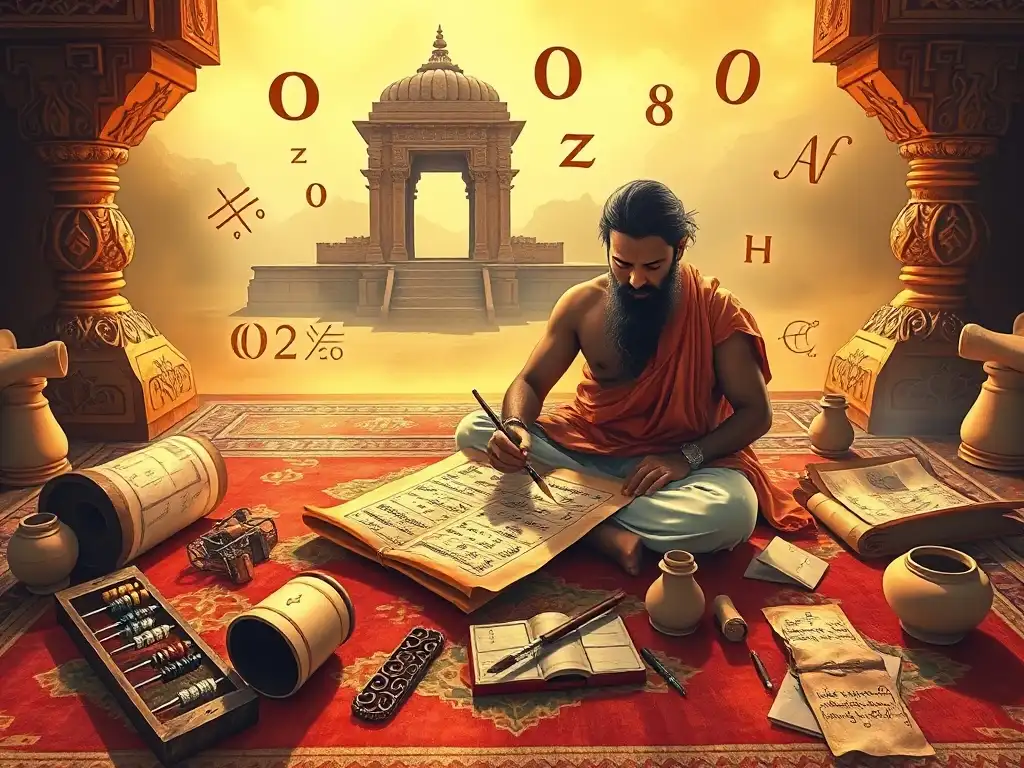
The concept of zero is one of the most profound contributions to mathematics, with its origins deeply rooted in ancient Indian civilization. The journey of zero from a mere placeholder to a fundamental element of modern mathematics illustrates not only the intellectual advancements of Indian scholars but also the transformative impact this concept has had on global mathematics.
Understanding the Indian origins of zero allows us to appreciate how this simple yet revolutionary idea has shaped mathematical thought and practice through the ages. In this article, we will explore the significance of zero, its historical context within ancient India, and the key figures who contributed to its development.
Introduction to the Concept of Zero
Zero is more than just a number; it represents the absence of quantity and plays a crucial role in the numeric system. The introduction of zero as a concept marked a turning point in mathematics, enabling the development of algebra, calculus, and various branches of mathematical science. This section delves into the nature of zero and its revolutionary impact on the field of mathematics.
Understanding Zero: A Mathematical Revolution
The introduction of zero transformed mathematical operations by allowing the representation of empty sets and the facilitation of complex calculations. Here are some key points about zero's revolutionary nature:
- Placeholder Function: Zero serves as a placeholder in positional numeral systems, making it easier to distinguish between numbers like 10 and 100.
- Facilitating Calculations: The ability to use zero in calculations allows for the execution of addition, subtraction, multiplication, and division seamlessly.
- Algebraic Foundations: The concept of zero laid the groundwork for algebra, enabling mathematicians to formulate equations and solve for unknowns.
The Importance of Zero in Mathematics Today
In contemporary mathematics, zero is indispensable across various domains. It serves critical functions in:
- Computer Science: Binary code, the foundation of computer programming, relies heavily on the concept of zero.
- Calculus: The concept of limits and derivatives often involves the use of zero, crucial for understanding rates of change.
- Physics and Engineering: Zero plays a vital role in equations representing equilibrium and balance in physical systems.
The Historical Context of Zero in Ancient India
To truly grasp the influence of zero on modern mathematics, it is essential to understand its historical context, particularly its emergence in ancient India. This section will explore how zero came to be recognized as a number and its significance in Indian mathematical tradition.
The Emergence of Zero in Indian Mathematics
The earliest recorded use of zero in an Indian mathematical text dates back to the 5th century CE. This period saw the development of a decimal system that included zero as a number. Key developments include:
- Bakhshali Manuscript: An ancient Indian document that contains an early use of zero as a placeholder and as a number in its own right.
- Aryabhata's Contributions: Aryabhata, one of the most renowned mathematicians from ancient India, made significant advancements in mathematics and astronomy, including the use of zero.
Key Texts and Scholars Contributing to the Concept of Zero
Several texts and scholars played pivotal roles in the propagation of zero in ancient Indian mathematics:
- Brahmagupta: A 7th-century mathematician who wrote rules for arithmetic operations involving zero, laying the foundation for its use in calculations.
- The Siddhanta Shiromani: A work by Bhaskara II that elaborated on the mathematical principles involving zero and its applications.
Through these historical insights, we can appreciate the monumental role that Indian scholars played in shaping the concept of zero and its profound implications on the mathematical world.
The Indian Origins of Zero
The concept of zero as a number, rather than merely a placeholder, traces its roots back to ancient India. This revolutionary idea emerged during a time when Indian mathematicians were already exploring complex calculations and number systems. The first recorded use of zero in its modern sense occurred in the 5th century CE, attributed to the mathematician Aryabhata, who recognized zero as a separate entity, thus paving the way for its incorporation into arithmetic and algebra.
The term "shunya," meaning empty or void, was utilized in ancient Indian texts to denote zero. This philosophical concept not only represented the absence of quantity but also held significant mathematical implications. The introduction of zero fundamentally transformed mathematical reasoning, allowing for the development of advanced calculations and the formulation of mathematical theories.
The Invention of Zero: From Placeholder to Number
Initially, zero served as a placeholder in the Indian numeral system, enabling the distinction between numbers like 10 and 100. This was crucial for the positional value of digits, making calculations more manageable. Over time, Indian mathematicians established zero as a standalone numeral, which allowed for operations such as addition, subtraction, multiplication, and division without ambiguity.
The transition from a simple placeholder to an independent number was significant in the development of mathematics. This redefined mathematical operations, allowing for more complex equations and the eventual formation of algebra. The recognition of zero as a number also facilitated the representation of negative values, further enriching mathematical discourse.
Contributions of Indian Mathematicians: Aryabhata and Brahmagupta

Two prominent figures in the history of mathematics, Aryabhata and Brahmagupta, played pivotal roles in the evolution of zero. Aryabhata, in his seminal work "Aryabhatiya," not only utilized zero but also provided rules for arithmetic operations involving zero. He demonstrated how zero can be used in calculations, paving the way for future mathematicians.
Brahmagupta further developed these ideas in his treatise "Brahmasphutasiddhanta." He explicitly defined the rules for arithmetic with zero, establishing principles that are still taught in modern mathematics. His contributions included the operations of addition and subtraction involving zero, as well as the concept of dividing by zero, which opened new avenues for mathematical exploration.
The Journey of Zero: From India to the World
The journey of zero from its Indian origins to the rest of the world is a fascinating tale of cultural exchange and intellectual growth. As Indian mathematicians shared their knowledge with neighboring civilizations, the concept of zero gradually spread beyond the subcontinent.
The Spread of Zero Through Trade Routes
The Silk Road played a crucial role in the dissemination of mathematical concepts, including zero. As traders and scholars traveled between India, the Middle East, and Europe, they exchanged ideas and knowledge. The introduction of the Indian numeral system, which included zero, into Islamic mathematics marked a significant turning point. Islamic scholars translated and expanded upon Indian texts, incorporating zero into their mathematical frameworks, which eventually influenced European mathematics during the Renaissance.
The Influence of Indian Mathematics on Islamic Scholars

Islamic mathematicians such as Al-Khwarizmi and Al-Kindi were instrumental in further developing and popularizing the Indian numeral system, including zero. Their works laid the foundation for what would become modern arithmetic and algebra. The adoption of zero in Islamic mathematics facilitated complex calculations and contributed to advancements in various fields, including astronomy, engineering, and commerce. The interplay between Indian and Islamic mathematics ultimately paved the way for the mathematical revolution in Europe, highlighting the profound and lasting influence of the Indian origins of zero on global mathematics.
The Impact of Zero on Modern Mathematics
The concept of zero, originating from ancient Indian civilization, has profoundly transformed modern mathematics. It serves as a foundational element in various mathematical constructs, enabling the development of advanced calculations and theories. The introduction of zero not only facilitated arithmetic operations but also paved the way for the exploration of algebra and calculus, essential fields in contemporary mathematics. Zero acts as a placeholder in positional number systems, allowing for the representation of large numbers efficiently. Without zero, the mathematical frameworks that underpin modern technology, finance, and scientific endeavors would be vastly different and far less effective.
Zero's Role in Number Systems and Calculations
Zero's introduction into number systems marked a significant turning point in mathematical history. In the decimal system, zero is crucial as it distinguishes between numbers such as 10 and 100. This ability to use zero as a placeholder enhances numerical clarity and precision.
- Positional Value: Zero allows for the positioning of numbers, enabling the expression of values in a compact form. For example, in the number 205, zero indicates that there are no tens, which is essential for understanding its value.
- Arithmetic Operations: Zero is integral to basic arithmetic operations. It has unique properties:
- Addition: Adding zero to any number leaves it unchanged (e.g., \( a + 0 = a \)).
- Multiplication: Any number multiplied by zero results in zero (e.g., \( a \times 0 = 0 \)).
- Subtraction: Subtracting zero does not change the value (e.g., \( a - 0 = a \)).
- Division: Division by zero is undefined, highlighting its unique role in mathematics.
The ability to manipulate numbers efficiently using zero has made calculations simpler and more intuitive, allowing mathematicians to focus on more complex concepts and theories.
The Significance of Zero in Algebra and Calculus
Zero plays a pivotal role in both algebra and calculus, serving as a fundamental concept that supports various mathematical theories and applications.
- Algebra: In algebra, zero helps define the concept of roots and solutions to equations. For example, finding the roots of polynomial equations often involves setting the equation equal to zero and solving for the variable. The zero-product property states that if the product of two numbers is zero, at least one of the factors must be zero. This principle is crucial in solving quadratic equations and understanding functions.
- Calculus: In calculus, zero is instrumental in the formulation of limits, derivatives, and integrals. The concept of limits often involves approaching zero, which is essential for defining continuity and differentiability. Derivatives measure the rate of change of functions, and many derivative rules involve evaluating functions at points approaching zero. Additionally, integrals frequently require the evaluation of areas under curves, which can involve summing infinitesimally small values approaching zero.
Conclusion: The Legacy of Zero in Mathematics
The legacy of zero is indelibly marked in the world of mathematics, stemming from its Indian origins. The introduction of zero has not only provided a functional utility in numerical computations but has also inspired a vast realm of mathematical inquiry and innovation.
Reflecting on the Indian Origins of Zero
The Indian origins of zero can be traced back to ancient mathematicians such as Brahmagupta and Aryabhata, who recognized zero's potential as a number in its own right, rather than merely a symbol for absence. Their work laid the groundwork for the concept of zero as both a numeral and a mathematical entity. The numeral system developed in India, which incorporated zero, spread to the Islamic world and eventually to Europe, revolutionizing mathematics worldwide. This legacy emphasizes the importance of cultural exchange in the advancement of mathematical thought.
The Continuing Influence of Zero in Contemporary Mathematics
Today, zero remains a cornerstone of mathematics and its applications. It is essential in computer science, where binary systems rely on zero and one to process information. In economics, zero plays a critical role in concepts like break-even analysis and marginal costs. The influence of zero continues to permeate various fields, highlighting its critical importance in the ongoing evolution of mathematical understanding and its applications in everyday life. The Indian origins of zero are not merely a historical footnote; they represent a profound contribution to the fabric of modern mathematics that continues to inspire and innovate.
- Introduction to the Concept of Zero
- The Historical Context of Zero in Ancient India
- The Indian Origins of Zero
- The Invention of Zero: From Placeholder to Number
- Contributions of Indian Mathematicians: Aryabhata and Brahmagupta
- The Journey of Zero: From India to the World
- The Spread of Zero Through Trade Routes
- The Influence of Indian Mathematics on Islamic Scholars
- The Impact of Zero on Modern Mathematics
- Conclusion: The Legacy of Zero in Mathematics
- What is the significance of the Indian origins of zero?
- How did the concept of zero evolve in ancient India?
- Who were the key figures in the development of zero in Indian mathematics?
- In what ways did zero influence modern mathematics?
- How did the concept of zero spread from India to the rest of the world?
Frequently Asked Questions
What is the significance of the Indian origins of zero?
The Indian origins of zero are crucial as they introduced the concept of a numerical placeholder and facilitated the development of modern mathematics.
How did the concept of zero evolve in ancient India?
In ancient India, zero was conceptualized as a number and a placeholder, leading to its formalization in the decimal system by mathematicians like Brahmagupta.
Who were the key figures in the development of zero in Indian mathematics?
Key figures include Brahmagupta, who wrote about zero's use in calculations, and Aryabhata, who incorporated it into his astronomical calculations, highlighting its importance.
In what ways did zero influence modern mathematics?
Zero's introduction allowed for the development of algebra, calculus, and computational mathematics, making complex calculations simpler and more efficient.
How did the concept of zero spread from India to the rest of the world?
The concept of zero spread through trade routes and scholarly exchanges, influencing Islamic mathematicians and eventually reaching Europe, transforming global mathematical practices.
Final Reflection: The Transformative Power of Zero in Mathematics and Beyond
The journey of zero from its Indian origins to its pivotal role in modern mathematics is a testament to the profound impact of cultural exchange on intellectual progress. Today, as we navigate a world increasingly defined by data and technology, the significance of zero transcends mere numerical representation; it embodies the very essence of innovation and possibility. The story of zero is not just about a number; it is about how a single concept can reshape entire fields of study and influence countless aspects of our lives.
The influence of zero has permeated our cultural and social landscape, reminding us of the interconnectedness of knowledge across borders. From the ancient scholars of India who first conceptualized this revolutionary idea to its adoption in various mathematical systems worldwide, zero has become a symbol of intellectual collaboration. As mathematician Carl Friedrich Gauss once said, "> Mathematics is the queen of the sciences and number theory is its crown jewel." This quote encapsulates how the introduction of zero has elevated mathematics to new heights, fostering a deeper understanding of the universe and our place within it.
As we reflect on the legacy of zero, let us embrace the lessons it imparts about innovation, collaboration, and the importance of recognizing our shared intellectual heritage. I invite you to consider how the concept of zero can inspire you in your own pursuits. Whether in mathematics, science, or everyday problem-solving, let the story of zero remind you that even the smallest ideas can have the most profound impact. Embrace the power of zero in your life, and be open to the possibilities that arise when we dare to think differently.
Unleash the Power of Zero: Take Action Today!
Thank you for exploring the fascinating influence of zero in modern mathematics with us! We hope you discovered the depth of its origins and the transformative role it plays in our world today. Now, it's time to put that knowledge into action!
Here are a few practical steps you can take to further engage with this remarkable topic:
- Dive deeper: Investigate the significant contributions of ancient Indian mathematicians and discover how their innovations have shaped contemporary science and technology.
- Share your insights: Engage in discussions with friends or share your thoughts on social media to help raise awareness about the incredible legacy of Indian mathematics.
- Join the conversation: Get involved in online forums or local history groups to connect with others who share a passion for the history of mathematics and its global impact.
What aspect of zero's influence do you find most intriguing, and how do you believe it has shaped our understanding of mathematics today?