
The Lost Works of Varahamihira: Astrology Meets Mathematics

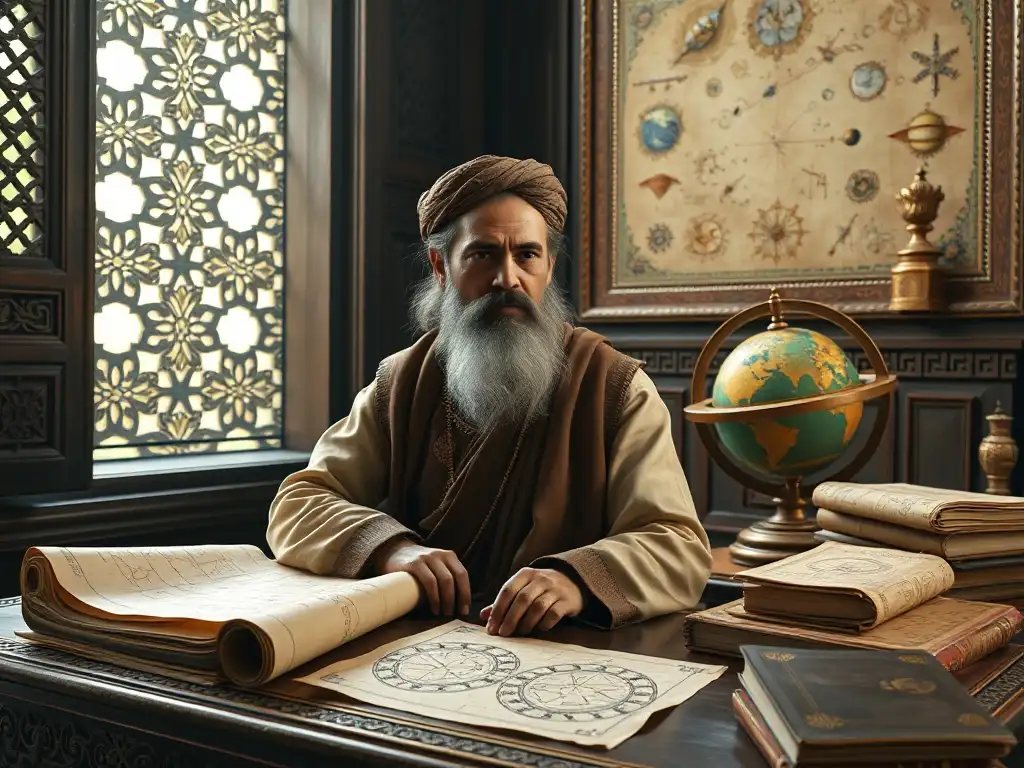
Welcome to Ancient India History, where we unravel the fascinating tapestry of one of the world's oldest civilizations. In this journey, we invite you to delve into the remarkable contributions of ancient Indian scholars, particularly the brilliant Varahamihira. Known for his profound insights, Varahamihira seamlessly intertwined astrology and mathematics, leaving behind lost works that continue to inspire awe. Are you ready to discover how this ancient genius shaped our understanding of the cosmos and numerical science? Join us as we explore the enduring legacy of his contributions and the mysteries that still await revelation!

Introduction to Varahamihira
The legacy of Varahamihira is a captivating chapter in the annals of ancient Indian history, where astrology intertwines with mathematics to create a rich tapestry of knowledge that continues to influence modern practices. Known primarily for his profound contributions to astrology, Varahamihira was also a mathematician whose works reflected the intricate relationships between celestial phenomena and mathematical principles.
His writings not only provided insights into the cosmos but also served as foundational texts for future scholars and practitioners in both fields. This article delves into the life of Varahamihira, the historical context in which he thrived, and the significant contributions he made to the realms of astrology and mathematics.
Who was Varahamihira?
Varahamihira, born around 505 CE in Ujjain, was a prominent figure in ancient Indian science, especially known for his expertise in astrology, astronomy, and mathematics. He was one of the nine jewels (Navaratnas) at the court of King Vikramaditya, a testament to his scholarly reputation. His most notable works include the Brihat Samhita, an encyclopedic text that encompasses a wide range of subjects, including astrology, meteorology, and architecture. Varahamihira’s approach combined empirical observation with mathematical precision, making him a pivotal figure in the development of astrological sciences.
Historical Context of Varahamihira’s Life
To fully appreciate Varahamihira’s contributions, it is essential to understand the historical context of his life. The Gupta period, often regarded as a golden age of science and culture in India, was marked by significant advancements in various fields, including mathematics and astronomy. During this era, scholars like Varahamihira were instrumental in synthesizing knowledge from earlier traditions, particularly the Vedic texts and Hellenistic influences. The cultural and intellectual environment of Ujjain, a major center of learning, provided Varahamihira with the resources and support necessary to flourish as a mathematician and astrologer.
The Intersection of Varahamihira’s Astrology and Mathematics
Varahamihira’s work exemplifies the profound connection between astrology and mathematics in ancient India. His writings reflect a sophisticated understanding of how numerical calculations could be applied to astrological phenomena, illustrating the integral role of mathematics in interpreting celestial events.
Understanding Astrology in Ancient India
Astrology in ancient India was not merely a mystical practice but a complex science grounded in mathematical principles. It involved the study of celestial bodies and their movements, which were believed to influence human affairs and natural events. Astrologers like Varahamihira utilized geometric calculations and astronomical observations to create horoscopes and predict future events, underscoring the scientific basis of their craft.
The Role of Mathematics in Astrology
Mathematics served as the backbone of astrological practices in ancient India. It provided the tools necessary for calculating planetary positions, timing of eclipses, and other celestial phenomena. Varahamihira’s works included tables of sine and cosine, which were crucial for determining the angles and distances between celestial bodies. His integration of mathematical concepts into astrology laid the groundwork for future developments in both fields.
Varahamihira’s Contributions to Mathematical Astrology
Varahamihira’s contributions to mathematical astrology are manifold. His Brihat Samhita contains numerous mathematical formulas and techniques that enable astrologers to make accurate predictions. Notably, he introduced methods for calculating the positions of planets using mathematical equations, a practice that significantly advanced the field of astrology. His pioneering work in this area not only enriched the astrological tradition but also influenced later mathematicians and astronomers, cementing his legacy as a key figure in the history of both astrology and mathematics.
Key Texts and Works of Varahamihira
Varahamihira, a significant figure in the realms of astrology and mathematics during ancient India, is best known for his extensive contributions that intertwine these two fields. His works reflect a profound understanding of the cosmos, timekeeping, and mathematical principles, making him a pivotal character in the history of Indian science. His writings are characterized by their systematic approach and incorporation of observational data, which laid the groundwork for future advancements in both astrology and mathematics.
Overview of Varahamihira's Major Works
Varahamihira's major works include a variety of texts that cover not only astrological theories but also practical applications of mathematics. His most influential texts are the Brihat Samhita and the Pancha Siddhantika. Each of these works serves a distinct purpose, yet they both emphasize the importance of accurate mathematical calculations in astrological predictions.
The Brihat Samhita is an encyclopedic work that addresses various aspects of astrology, architecture, and even medicine, showcasing the interdisciplinary nature of ancient Indian scholarship. Meanwhile, the Pancha Siddhantika serves as a critical compilation of the five main astrological systems existing during Varahamihira's time. Through these texts, Varahamihira established a coherent framework that combined astrology with robust mathematical techniques.
The Brihat Samhita: A Comprehensive Guide to Astrology and Mathematics
The Brihat Samhita stands as one of Varahamihira's most prominent contributions, spanning over 106 chapters that delve into diverse topics, including astrology, meteorology, and gemology. This work is significant for its systematic methodology in applying mathematical principles to astrological predictions, revealing how celestial phenomena can be understood through numbers.
One of the notable features of the Brihat Samhita is its emphasis on predictive astrology. Varahamihira meticulously outlines how to interpret the positions of celestial bodies, using mathematical calculations to enhance the precision of these predictions. Additionally, the text includes guidelines for constructing horoscopes and provides extensive descriptions of various astrological phenomena, making it a vital resource for scholars and practitioners alike.
The Pancha Siddhantika: The Mathematical Foundations of Astrology
In the Pancha Siddhantika, Varahamihira consolidates the knowledge of five astrological schools, which were pivotal in shaping the understanding of astronomy and astrology in ancient India. This work serves as a reference point for the mathematical foundations underlying astrological practices, showcasing Varahamihira's commitment to integrating rigorous mathematics with celestial observations.
The text comprises detailed methodologies for calculating planetary positions, eclipses, and other astronomical events. Varahamihira's systematic approach to these calculations involved leveraging existing mathematical principles, including geometry and arithmetic, to ensure accuracy in astrological forecasts. His work in the Pancha Siddhantika not only preserved valuable knowledge from various traditions but also contributed to the evolution of astronomical calculations in Indian mathematics.
The Mathematical Techniques Used by Varahamihira
Varahamihira's integration of mathematics into astrology is exemplified through several key techniques he developed and utilized. His works demonstrate a rigorous application of mathematical principles to enhance the reliability of astrological practices.
Calculation of Planetary Positions
One of the core mathematical techniques employed by Varahamihira involves the calculation of planetary positions. He introduced methods for determining the longitude and latitude of celestial bodies, using precise mathematical formulas. This ability to accurately calculate planetary positions was essential for practitioners aiming to make astrological predictions based on the movement of planets.
Varahamihira's calculations often included adjustments for various astronomical phenomena, such as retrogression and conjunctions, which further enhanced the accuracy of his astrological readings. By employing these mathematical techniques, Varahamihira laid the groundwork for future astronomers and astrologers to refine their practices.
Use of Trigonometry in Astrology
Trigonometry played a vital role in Varahamihira's work, especially in the context of astrology. He utilized trigonometric functions to calculate the angles and distances between celestial bodies, which are crucial for creating precise astrological charts.
His application of trigonometry allowed for a deeper understanding of celestial movements and their implications for earthly events. By incorporating these mathematical principles, Varahamihira elevated the field of astrology, transforming it into a more systematic and scientifically grounded discipline.
Innovations in Calendar Systems and Timekeeping
Another significant contribution of Varahamihira was his work on calendar systems and timekeeping. He recognized the importance of accurate time measurement in astrology, leading him to develop sophisticated methods for calculating time intervals based on celestial movements.
Varahamihira's innovations included the introduction of new calendars that accounted for the lunar and solar cycles, which were essential for astrological predictions. His contributions to timekeeping not only improved the accuracy of astrological practices but also influenced the development of calendar systems in subsequent Indian civilizations, showcasing the enduring impact of his mathematical techniques on the field of astrology.
The Legacy of Varahamihira in Astrology and Mathematics

Varahamihira, an eminent figure of ancient Indian mathematics and astrology, made significant contributions that bridged these two disciplines. His works, particularly the "Brihat Samhita," represent a synthesis of astrological knowledge and mathematical precision. Varahamihira's approach to astrology was not merely speculative; he integrated mathematical calculations to predict celestial events and their impacts on human affairs. This combination of astrology and mathematics laid the groundwork for future scholars, establishing a tradition that valued empirical observation and quantitative analysis in understanding the universe.
His contributions to mathematics included advancements in arithmetic and geometry, notably in the areas of trigonometry and algebraic equations. Varahamihira's use of systematic methods for solving problems was pioneering, influencing not only astrology but also the broader field of mathematics in ancient India. His legacy endures in various mathematical techniques that continue to be relevant today.
Influence on Subsequent Scholars and Mathematicians
The influence of Varahamihira on subsequent scholars and mathematicians cannot be overstated. He served as a pivotal reference point for later astronomers and astrologers, such as Brahmagupta and Bhaskara I. These scholars built on Varahamihira's foundational work, further developing mathematical theories and astrological practices.
Varahamihira's emphasis on observational data and empirical validation established a rigorous standard for future mathematicians. His methodologies laid the groundwork for a more scientific approach to astrology, which was later adopted and refined by scholars in both India and the Islamic world. As a result, his teachings fostered an environment where mathematics and astrology could coexist and evolve together, influencing a multitude of disciplines, including astronomy, physics, and philosophy.
The Impact on Indian Astrology Practices
Varahamihira's impact on Indian astrology practices is profound, as he introduced systematic methods for interpreting celestial phenomena. His works provided astrologers with essential tools for making accurate astrological predictions based on mathematical calculations. The "Brihat Samhita," in particular, served as a comprehensive guide that encompassed various aspects of astrology, from horoscopy to the influence of planetary movements on human life.
His teachings emphasized the need for precise observations and calculations, which refined the practices of astrology in India. This integration of mathematics into astrology not only enhanced its credibility but also made it a respected field of study among scholars. As a result, Varahamihira's influence can be seen in the continued evolution of Indian astrology, which remains a vital part of cultural and spiritual life in India today.
Varahamihira’s Relevance in Modern Astrology and Mathematics
Even in contemporary times, Varahamihira's contributions resonate within the domains of astrology and mathematics. Modern astrologers and mathematicians often reference his works when exploring historical methodologies or seeking to understand the mathematical foundations of astrological predictions. His integration of mathematical principles into astrology paved the way for a more analytical approach to the discipline.
Moreover, the mathematical techniques he developed, particularly in trigonometry, continue to be relevant in modern mathematics. The principles of celestial mechanics and orbital dynamics owe a debt to the foundational work laid by Varahamihira and his contemporaries. Thus, his legacy serves as a bridge between ancient and modern practices, illustrating the enduring relevance of his contributions to both fields.
Conclusion
Summary of Varahamihira’s Contributions
Varahamihira's contributions to astrology and mathematics represent a remarkable fusion of these two fields. His legacy is characterized by a commitment to empirical observation, mathematical precision, and the systematic application of knowledge. Through works such as the "Brihat Samhita," he not only advanced astrological practices but also laid the groundwork for future mathematical developments in India.
The Importance of Preserving Ancient Knowledge
The preservation of ancient knowledge, such as that of Varahamihira, is crucial for understanding the evolution of mathematics and astrology. By studying these historical figures, we gain insights into the methodologies and philosophies that shaped these disciplines. Moreover, preserving ancient texts and traditions allows modern scholars to draw connections between past and present practices, ensuring that the wisdom of ancient civilizations continues to inform contemporary thought and innovation. This connection to history enriches our understanding of the world and underscores the importance of interdisciplinary approaches in both mathematics and astrology.
Further Reading on Varahamihira and His Works
Varahamihira was not only a prominent figure in the realm of astrology but also made significant contributions to mathematics, particularly in the context of ancient Indian scholarship. For those interested in exploring his works and the broader implications of his contributions, a variety of resources are available. These resources provide insights into his methodologies, the historical context of his work, and how his ideas influenced both astrology and mathematics.
Recommended Books and Articles on Varahamihira
-
"Brahmasphutasiddhanta" by Brahmagupta
This foundational text includes references to Varahamihira's work and provides a broader context of Indian mathematics during Varahamihira's time.
-
"The History of Indian Mathematics" by C. V. D. Narasimhaiah
This book discusses the evolution of mathematical thought in India and includes significant sections on Varahamihira's contributions to both astrology and mathematics.
-
"Varahamihira: The Man and His Works" by D. P. Chattopadhyaya
A comprehensive study that delves into Varahamihira's life, his major works, and his influence on later scholars in both astrology and mathematics.
-
"Astrology and Mathematics: The Interconnectedness in Ancient India" by R. S. Yadav
This article explores the intertwining of astrology and mathematics in Varahamihira's work and presents a detailed analysis of his methodologies.
-
"Ancient Indian Astronomy and Astrology" by S. Balachandra Rao
This text provides an overview of the developments in Indian astronomy and astrology, highlighting Varahamihira's significant role in these fields.
Online Resources for Exploring Ancient Indian Mathematics and Astrology
-
Digital Library of India
This extensive repository contains digitized versions of historical texts, including works related to Varahamihira and ancient Indian mathematics. It is an invaluable resource for researchers and enthusiasts alike.
-
Indian Science Congress Association
Their website often features research papers and articles on ancient Indian mathematicians, including Varahamihira. This is a great platform for finding contemporary studies that reference his work.
-
Internet Archive
The Internet Archive houses several texts and articles related to Varahamihira, offering free access to a wealth of information on ancient Indian astrology and mathematics.
-
Academia.edu
A platform where scholars publish their research papers. Searching for Varahamihira on this site yields numerous articles that discuss his contributions to astrology and mathematics.
-
YouTube Educational Channels
Several channels focus on ancient Indian history and mathematics, providing video lectures and discussions that can help visualize Varahamihira's contributions and the context in which he worked.
These resources are an excellent starting point for anyone interested in delving deeper into the life and works of Varahamihira, as well as the rich tradition of mathematics and astrology in ancient India. Whether through books, scholarly articles, or online platforms, the exploration of Varahamihira's legacy continues to inspire and educate.
- Introduction to Varahamihira
- The Intersection of Varahamihira’s Astrology and Mathematics
- Key Texts and Works of Varahamihira
- The Mathematical Techniques Used by Varahamihira
- The Legacy of Varahamihira in Astrology and Mathematics
- Conclusion
- Further Reading on Varahamihira and His Works
- What contributions did Varahamihira make to astrology?
- How did Varahamihira influence mathematics in ancient India?
- What is the Brihat Samhita and its importance?
- Can you explain Varahamihira's method of predicting events?
- Why is Varahamihira considered a significant figure in ancient Indian history?
Frequently Asked Questions
What contributions did Varahamihira make to astrology?
Varahamihira is known for his significant contributions to astrology, particularly through his work, the Brihat Samhita, which combines astrological principles with mathematics.
How did Varahamihira influence mathematics in ancient India?
He played a crucial role in the development of mathematics by integrating astrological calculations with mathematical concepts, thereby enhancing the scientific approach to astrology.
What is the Brihat Samhita and its importance?
The Brihat Samhita is a comprehensive text written by Varahamihira that covers various fields including astrology, mathematics, and natural phenomena, showcasing the interconnectedness of these disciplines.
Can you explain Varahamihira's method of predicting events?
Varahamihira utilized a combination of astrological charts and mathematical calculations to predict events, demonstrating the sophisticated techniques used in ancient Indian astrology.
Why is Varahamihira considered a significant figure in ancient Indian history?
Varahamihira is celebrated for blending astrology and mathematics, which not only influenced his contemporaries but also laid the groundwork for future scholars in both fields, highlighting the rich legacy of ancient Indian civilization.
Final Reflection: Rediscovering Varahamihira's Legacy in Astrology and Mathematics
The intersection of astrology and mathematics, as exemplified by Varahamihira's lost works, remains profoundly relevant today. In an era where data and analytics dominate decision-making, the ancient wisdom of Varahamihira reminds us of the intricate relationship between the cosmos and our lives. His pioneering contributions challenge us to reconsider how we perceive the universe and our place within it, revealing that the quest for knowledge transcends time and discipline.
The influence of Varahamihira's work continues to resonate within both cultural and scientific realms. As we delve into the depths of his astrological insights and mathematical principles, we uncover a rich tapestry of knowledge that has shaped the foundations of modern astrology and astronomy. His assertion that "the stars can guide us, but it is our understanding that leads us," underscores the importance of integrating ancient wisdom with contemporary thought. Astrology is a bridge between the heavens and the earth, a language that speaks to the soul of humanity.
As we reflect on the lessons from Varahamihira's legacy, I invite you to explore how these timeless principles can enrich your own life. Consider how the balance of astrology and mathematics can inform your decisions, inspire your creativity, and deepen your understanding of the world around you. Embrace the opportunity to learn from the past, allowing the wisdom of Varahamihira to guide you on your journey toward enlightenment and self-discovery.
Unveil the Wonders of Ancient Wisdom
Thank you for diving into the incredible world of Varahamihira, where astrology and mathematics intertwine to reveal profound insights about our universe. You've taken a step towards understanding the lost masterpieces that shaped ancient Indian thought.
Now, it's time to take action! Here’s how you can further engage with this fascinating topic:
- Explore Varahamihira’s writings: Seek out translations or commentaries on his texts to deepen your knowledge and appreciation of his contributions.
- Join a community: Connect with fellow enthusiasts and scholars discussing astrology and mathematics by participating in online forums or local groups.
- Share your insights: Write a short post on social media or a blog about what you found inspiring in Varahamihira's work.
What aspect of Varahamihira's integration of astrology and mathematics resonates with you the most, and how might it influence your understanding of these fields today?