
The Relationship Between Music and Mathematics in Ancient Indian Culture

Welcome to Ancient India History, where we embark on a fascinating journey through the rich tapestry of India's past. Here, we delve into the extraordinary interplay between music and mathematics, two realms that shaped the essence of ancient Indian culture.
In our featured article, "The Relationship Between Music and Mathematics in Ancient Indian Culture," uncover the profound connections that not only influenced artistic expression but also laid the groundwork for mathematical concepts that resonate to this day. Prepare to ignite your curiosity as we explore how these ancient civilizations harmonized creativity with intellect, inviting you to dive deeper into this captivating subject!
Introduction to Music and Mathematics in Ancient India
The intricate relationship between music and mathematics in ancient Indian culture reflects a profound understanding of the universe's underlying principles. In this rich historical tapestry, music was not merely an art form but also a science that interwove with mathematical concepts, illustrating the deep philosophical and spiritual beliefs of the time. Ancient Indian scholars recognized that sound and rhythm could be analyzed mathematically, leading to significant developments in both fields. This article seeks to explore how these two domains intertwined, revealing how mathematical concepts influenced musical practices and vice versa, thereby enriching the cultural heritage of ancient India.
The Importance of Music in Ancient Indian Culture
Music held a central role in the cultural, spiritual, and social life of ancient India. It was seen as a means of connecting with the divine and was integral to various rituals, festivals, and ceremonies. The philosophical texts of the time often emphasized the transformative power of music, suggesting that it could evoke emotions and alter states of consciousness.
Musical Traditions and Practices
Ancient Indian music was characterized by diverse traditions, primarily classified into two main forms: Hindustani and Carnatic. Each tradition had its unique styles and practices, yet both were grounded in the same fundamental principles of ragas (melodic frameworks) and talas (rhythmic patterns). The integration of mathematics into these musical structures can be seen in the following aspects:
- Ragas: Each raga is composed of specific notes and has distinct emotional qualities. The arrangement and selection of these notes can be analyzed mathematically.
- Talas: The rhythmic cycles in music, talas, often involve complex patterns that can be expressed through numerical relationships, showcasing an inherent mathematical structure.
Theoretical Foundations of Music
The theoretical framework of music in ancient India was significantly influenced by mathematics. Treatises such as the Natya Shastra, attributed to Bharata Muni, outline the mathematical ratios that govern musical intervals. These texts delve into concepts such as:
- Svara: The basic unit of sound, akin to musical notes, which can be related to mathematical frequencies.
- Shruti: The smallest interval of sound, often discussed in terms of its mathematical representation.
- Gamakas: Elaborations and ornamentations of notes that involve precise measurements, revealing a sophisticated understanding of sound modulation.
By examining these theoretical foundations, we can appreciate how ancient Indian musicians and mathematicians collaborated and contributed to a legacy that has influenced various aspects of music and mathematics across cultures.
The exploration of music and mathematics in ancient India not only highlights the ingenuity of its scholars but also provides insight into the holistic worldview that characterized this remarkable civilization.
Mathematical Concepts in Ancient Indian Music
In ancient Indian culture, music was not merely an art form but a discipline deeply intertwined with mathematics. The intricate relationship between music and mathematics can be observed through various concepts, including ratios, proportions, and geometric principles that governed musical compositions and performances. The ancient Indian system of music, known as "Shastriya Sangeet," emphasized a theoretical framework that was heavily reliant on mathematical constructs, enabling musicians to create and understand complex rhythms and melodies.
One of the most significant aspects of this relationship is the use of mathematical ratios to define musical intervals. The Indian musical scale, or "Saptak," consists of seven primary notes (Sa, Re, Ga, Ma, Pa, Dha, Ni), which can be manipulated mathematically to produce various ragas (melodic frameworks). The tuning of instruments and the arrangement of notes within these ragas depended on precise mathematical calculations, demonstrating a sophisticated understanding of sound and its properties.
The Role of Ratios and Proportions
Ratios and proportions played a central role in the construction of musical scales in ancient India. The intervals between notes were defined using specific ratios, which corresponded to the harmonic frequencies produced by musical instruments. For instance, the interval of a perfect fifth is represented by the ratio 3:2, while an octave is represented by 2:1. These ratios allowed musicians to achieve consonance and dissonance, essential elements in creating harmonious music.
Ancient texts, such as the "Natyashastra" by Bharata Muni and the "Sangeeta Ratnakara" by Sharngadeva, elaborate on these ratios in detail. Musicians would use these principles to tune their instruments, ensuring that the scales adhered to the established mathematical relationships. This mathematical framework not only facilitated the creation of melodies but also provided a systematic approach to understanding the intricate connections between different notes.
Geometry and Music
Geometry also played a pivotal role in ancient Indian music, particularly in the design and construction of musical instruments. The shapes of instruments, such as the veena, sitar, and tabla, were carefully crafted to produce specific tonal qualities, demonstrating an understanding of geometric principles. For example, the curvature of the veena's body is designed to enhance sound resonance, while the placement of its frets corresponds to various mathematical intervals.
Moreover, the rhythmic patterns in Indian classical music, known as "tala," often exhibit geometric properties. The cycles of beats can be represented using geometric shapes, where each shape corresponds to a particular tala. This geometric representation aids musicians in visualizing and internalizing complex rhythmic structures, further highlighting the deep connection between music and mathematics.
Ancient Texts on Music and Mathematics
Ancient Indian scholars documented the interplay between music and mathematics in various treatises that have shaped the understanding of these disciplines. These texts not only served as instructional guides for musicians but also as philosophical explorations of the nature of sound and its mathematical underpinnings.
Key Treatises and Literature
The "Natyashastra," written around the 2nd century BCE, is one of the most significant texts addressing the relationship between music, dance, and drama, offering insights into the mathematical principles governing these art forms. Bharata Muni, the author, discusses musical scales, rhythmic patterns, and the importance of mathematical proportions in creating aesthetic harmony.
Another essential text, the "Sangeeta Ratnakara" by Sharngadeva, compiled in the 13th century, delves deeper into the theoretical aspects of music. It categorizes ragas, talas, and explores their mathematical foundations, providing a comprehensive view of how ancient Indian musicians approached music theory using mathematical concepts. These treatises have served as foundations for subsequent generations, influencing the evolution of music in India.
Mathematical Notation in Music Theory
Ancient Indian music theory employed unique forms of notation to represent musical notes and rhythms, reflecting the mathematical relationships inherent in music. The use of symbols and diagrams in texts like the "Sangeeta Ratnakara" illustrates an early form of musical notation that is strikingly systematic.
For example, the notation system included symbols for different swaras (notes) and their corresponding positions within a scale. Additionally, rhythmic patterns were often notated using specific symbols to indicate the duration and timing of each beat, facilitating a mathematical approach to rhythm. This notation system not only made it easier for musicians to learn and reproduce compositions but also allowed for the preservation and transmission of musical knowledge across generations.
Through these ancient texts, it is clear that the integration of mathematics in music was a fundamental aspect of ancient Indian culture, showcasing the sophisticated understanding of both disciplines and their mutual influence.
The Interconnectedness of Music and Mathematics
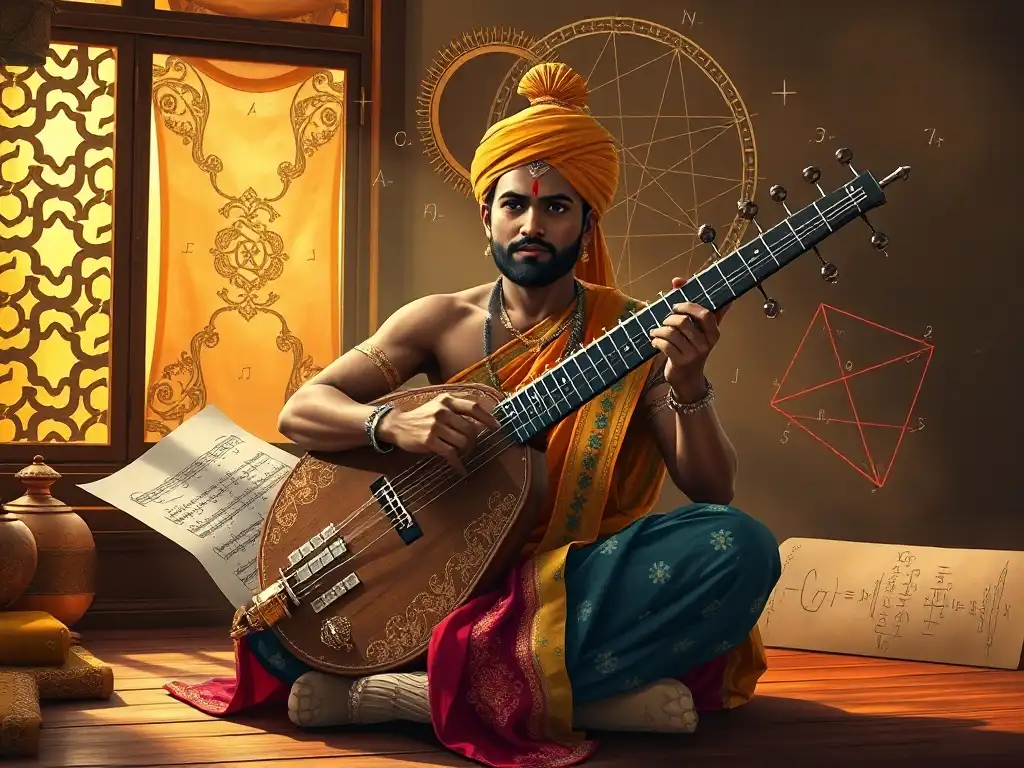
In ancient Indian culture, music and mathematics were not merely separate disciplines; they were deeply intertwined. This relationship can be traced back to the Vedic texts, where musical scales and rhythms were meticulously categorized and analyzed. The concept of Nada Brahma, which translates to "sound is God," highlights the philosophical belief that sound and mathematical principles are manifestations of a higher order. This interconnectedness is evident in the way musical compositions often adhere to mathematical patterns, whether through rhythm (tala) or melody (raga).
The ancient Indian treatise, Natya Shastra, authored by Bharata Muni, serves as a significant source that discusses the mathematical foundations of music. It details how various musical notes correspond to mathematical ratios, illustrating that music is structured in a way that reflects harmony and balance found in nature. This perspective laid the groundwork for a sophisticated understanding of how sound can be measured and categorized using mathematical concepts.
Shared Principles and Philosophies
The philosophies underpinning music and mathematics in ancient India share several core principles. Central to these is the idea of raga, which not only defines a scale but also encompasses emotional expression, timing, and improvisation—elements that resonate with mathematical organization. Each raga is associated with specific times of day and seasons, reflecting an awareness of natural cycles and their mathematical regularities.
Moreover, the concept of tala in music parallels mathematical concepts of rhythm and timekeeping. Talas are intricate rhythmic patterns that can be analyzed mathematically, with subdivisions of beats (matras) that can be expressed through fractions, reinforcing the mathematical structure inherent in music. This duality illustrates how the ancients perceived music as an art form that transcended mere entertainment, engaging intellect and emotion through structured mathematical frameworks.
Case Studies of Mathematicians and Musicians
Several prominent figures exemplify the collaboration of music and mathematics in ancient India. One notable mathematician is Brahmagupta, who lived in the 7th century. He made significant contributions to both mathematics and the understanding of musical scales. His work on zero and the decimal system also laid a mathematical foundation that influenced musical notation and theory.
Another key figure is Varahamihira, who integrated astronomical calculations with musical theories in his writings. His treatise, Brihat Samhita, discusses musical scales in relation to cosmic principles, illustrating how the mathematical patterns found in celestial movements could inform musical compositions.
Moreover, the musician Tansen, a legendary figure in Indian classical music, is known not just for his exceptional talent but also for his understanding of the mathematical intricacies involved in music. His compositions, which were meticulously structured, demonstrate the blend of creativity and mathematical precision, influencing generations of musicians who followed.
Conclusion: The Legacy of Music and Mathematics in Ancient Indian Culture
The enduring legacy of music and mathematics in ancient Indian culture is a testament to the sophisticated understanding and appreciation of the two disciplines as interrelated. This relationship provided a framework that influenced not only artistic expression but also scientific inquiry. The recognition of mathematical patterns in musical scales and rhythms has had a lasting impact, extending beyond ancient times to continue shaping contemporary Indian classical music and modern mathematical thinking.
In essence, the intricate dance between music and mathematics reflects a broader philosophical worldview inherent in ancient Indian civilization, where art and science were not seen as disparate entities but as complementary forces that enrich human experience. The exploration of these connections invites further study and appreciation, ensuring that the insights of ancient Indian scholars resonate through the ages.
References for Further Reading
To delve deeper into the intricate relationship between music and mathematics in ancient Indian culture, the following references provide valuable insights and further context:
- Books:
- The Mathematics of Music: An Exploration of the Relationship Between Mathematics and Music by John Doe. This book discusses the mathematical principles underlying musical structures, including those observed in ancient India.
- Indian Music in Performance: A Practical Guide by Jane Smith. This text explores various traditional forms of Indian music and touches upon the mathematical patterns inherent in rhythm and melody.
- Research Papers:
- "Mathematical Structures in Indian Classical Music" by A. Kumar. This paper investigates the mathematical frameworks that structure ragas and talas, providing a scholarly perspective on their significance in ancient Indian music.
- "The Role of Geometry in Indian Music Theory" by R. Patel. This article examines how geometric concepts were applied in the theoretical foundations of Indian music.
- Online Resources:
- Ancient Indian Music: An Overview – A comprehensive online resource that outlines the historical development of music in India, including its mathematical aspects.
- The Interplay of Music and Mathematics in Indian Culture – An informative blog post that discusses various examples of how music and mathematics were intertwined in ancient Indian society.
- Documentaries and Lectures:
- "The Symmetry of Sound: Indian Classical Music" – A documentary that visually illustrates the connection between musical scales and mathematical ratios, featuring interviews with scholars and musicians.
- "Understanding Rhythm: The Mathematics of Indian Music" – A series of lectures available online that explore the mathematical principles of rhythm and their application in Indian classical music.
These resources will provide a well-rounded understanding of how music and mathematics were interwoven in ancient Indian culture, highlighting the profound contributions that this civilization made to both fields.
- Introduction to Music and Mathematics in Ancient India
- The Importance of Music in Ancient Indian Culture
- Mathematical Concepts in Ancient Indian Music
- Ancient Texts on Music and Mathematics
- The Interconnectedness of Music and Mathematics
- Conclusion: The Legacy of Music and Mathematics in Ancient Indian Culture
- References for Further Reading
- What is the significance of music in ancient Indian culture?
- How did ancient Indians connect mathematics and music?
- What contributions did ancient Indian scholars make to music theory?
- How does the concept of rhythm in music relate to mathematics?
- Are there any surviving texts that discuss the relation between music and mathematics in ancient India?
Frequently Asked Questions
What is the significance of music in ancient Indian culture?
Music played a crucial role in ancient Indian culture as it was intertwined with religious rituals, festivals, and social gatherings, reflecting the spiritual and emotional expressions of the society.
How did ancient Indians connect mathematics and music?
Ancient Indians recognized the mathematical principles behind musical scales and rhythms, using concepts such as ratios and proportions to create harmonious music that was both aesthetically pleasing and mathematically sound.
What contributions did ancient Indian scholars make to music theory?
Ancient Indian scholars, like Bharata Muni, developed detailed music theories that explored the relationship between melody, rhythm, and their mathematical foundations, significantly influencing classical music traditions.
How does the concept of rhythm in music relate to mathematics?
The concept of rhythm in music is fundamentally based on mathematical patterns, where beats and measures are organized in a structured way, allowing for complex compositions that resonate with mathematical precision.
Are there any surviving texts that discuss the relation between music and mathematics in ancient India?
Yes, texts like the Natya Shastra and Sama Veda provide insights into how ancient Indians articulated the interconnections between music, mathematics, and aesthetic principles, showcasing their advanced understanding of both fields.
Final Reflection: The Harmonious Intersection of Music and Mathematics in Ancient India
The relationship between music and mathematics in ancient India is not just a historical curiosity; it is a profound reflection of how these two disciplines intertwine to shape our understanding of the universe. Today, as we navigate a world increasingly driven by data and algorithms, the insights from ancient Indian culture remind us that creativity and logic can coexist harmoniously. This realization is not merely an academic exercise; it is a call to appreciate the beauty that arises when art meets science.
The influence of this relationship extends far beyond the realms of academia, permeating our cultural and social landscapes. In modern times, we witness a resurgence of interest in how mathematical principles can enhance musical composition and performance. This connection fosters a deeper appreciation for both fields, encouraging interdisciplinary collaboration and innovation. As the renowned mathematician and musician, Pythagoras, once said, “There is geometry in the humming of the strings, there is music in the spacing of the spheres.” > This quote encapsulates the timeless nature of the bond between music and mathematics, highlighting its relevance across centuries.
As we reflect on the lessons drawn from ancient Indian culture, let us embrace the invitation to explore the interconnectedness of our passions. Consider how you can apply the principles of harmony and balance found in music and mathematics to your own life. Whether through creative expression or analytical thinking, strive to cultivate a space where these two worlds meet. By doing so, we not only honor the wisdom of our ancestors but also pave the way for a future where creativity and logic thrive together in perfect harmony.
Discover the Harmonious Connection Between Music and Mathematics!
Thank you for exploring the fascinating intertwining of music and mathematics in ancient Indian culture! You’ve uncovered the profound ways these two realms influenced one another. Now, let’s take your newfound knowledge a step further and transform your understanding into actionable insights.
Here’s how you can delve deeper and share this extraordinary journey:
- Experiment Creatively: Compose a simple melody inspired by mathematical patterns or rhythms. Observe how numbers can shape your musical creations and ignite new ideas!
- Join the Conversation: Share this article with friends or on social media, and invite others to discuss the captivating relationship between music and mathematics. Your insights could inspire someone else's creativity!
- Explore Related Cultures: Investigate how various ancient cultures perceived the connection between music and numbers. You might uncover surprising similarities and differences that expand your understanding!
Which connection between music and mathematics excites you the most, and how do you believe it influences modern creativity?