
How Sanskrit Influenced Global Languages: A Cultural Legacy


Welcome to Ancient India History, where we embark on a fascinating journey through the rich tapestry of ancient Indian civilizations. Dive into the profound impact of Sanskrit, a language that not only shaped the cultural landscape of India but also left an indelible mark on global languages. In our featured article, "How Sanskrit Influenced Global Languages: A Cultural Legacy," you'll uncover the intricate connections between Sanskrit and various languages around the world.
Prepare to be captivated as we explore this timeless legacy that continues to resonate through centuries. Join us in unraveling the mysteries of language and culture—your adventure awaits!
- Introduction to Sanskrit Influence on Languages
- The Roots of Sanskrit and Its Linguistic Family
- Direct Influence of Sanskrit on Global Languages
- Cultural Legacy of Sanskrit in Language Evolution
- Comparative Analysis: Sanskrit and Other Ancient Languages
- Conclusion: The Lasting Legacy of Sanskrit Influence on Global Languages
- Further Reading and Resources
- Frequently Asked Questions
- Final Reflection: The Enduring Legacy of Sanskrit's Influence on Languages
- Embrace the Legacy: Unleash the Power of Sanskrit Today!
Introduction to Sanskrit Influence on Languages
Sanskrit, one of the oldest languages in the world, holds a significant place in the tapestry of human civilization. Its profound influence extends beyond the borders of ancient India, shaping the linguistic, cultural, and intellectual frameworks of numerous languages across the globe.
As we explore the Sanskrit influence on languages, we uncover a rich legacy that not only reveals the historical connections between cultures but also highlights the enduring impact of Sanskrit on modern linguistic developments. This article delves into the intricate relationship between Sanskrit and its global linguistic descendants, providing insights into its role as a classical language and the historical context of its evolution.
Understanding Sanskrit as a Classical Language
Sanskrit is often revered as the mother of many languages, especially within the Indo-European family. This classical language is characterized by its phonetic precision, grammatical complexity, and rich vocabulary. Its literary and philosophical texts, such as the Vedas, Upanishads, and epics like the Mahabharata and Ramayana, have contributed significantly to various fields, including philosophy, science, and literature.
-
Phonetics and Grammar:
Sanskrit's systematic approach to phonetics and grammar has influenced many modern languages. Its intricate rules regarding pronunciation and syntax set a precedent for linguistic structure, which is mirrored in languages like Hindi, Bengali, and even some Western languages.
-
Lexical Contributions:
The extensive vocabulary of Sanskrit has led to the adoption of numerous words and roots in languages such as English, German, and Russian. Terms related to science, mathematics, and spirituality often trace their origins back to Sanskrit.
-
Cultural Transmission:
The transmission of Sanskrit texts through trade, pilgrimage, and conquests facilitated cultural exchanges that enriched various regions. The spread of Buddhism and Hinduism played a crucial role in disseminating Sanskrit terms into Tibetan, Chinese, and other Asian languages.
The Historical Context of Sanskrit's Development
The evolution of Sanskrit is not merely a linguistic phenomenon; it is deeply intertwined with the history and culture of ancient India. Understanding this context allows us to appreciate how Sanskrit became a linguistic bridge connecting diverse cultures.
-
Origins and Evolution:
Sanskrit is believed to have originated around 1500 BCE, evolving from earlier linguistic forms. Its classical form emerged around the 4th century BCE, primarily due to the work of grammarians like Panini, who systematized its grammar in the Ashtadhyayi.
-
Cultural Flourishments:
During the Vedic and post-Vedic periods, Sanskrit flourished as a language of scholarship and ritual. The establishment of universities like Nalanda and Takshashila further promoted its study and dissemination, leading to a rich tradition of literature and philosophy.
-
Regional Variations:
The influence of Sanskrit is evident in various regional languages, particularly in the Indian subcontinent. Languages such as Kannada, Telugu, and Malayalam have incorporated Sanskrit vocabulary and grammatical structures, showcasing the language's adaptability and resilience.
The Sanskrit influence on languages is a testament to its enduring legacy, impacting linguistic development across cultures and epochs. The exploration of this influence not only enriches our understanding of language evolution but also highlights the interconnectedness of human civilization through shared linguistic heritage.
The Roots of Sanskrit and Its Linguistic Family
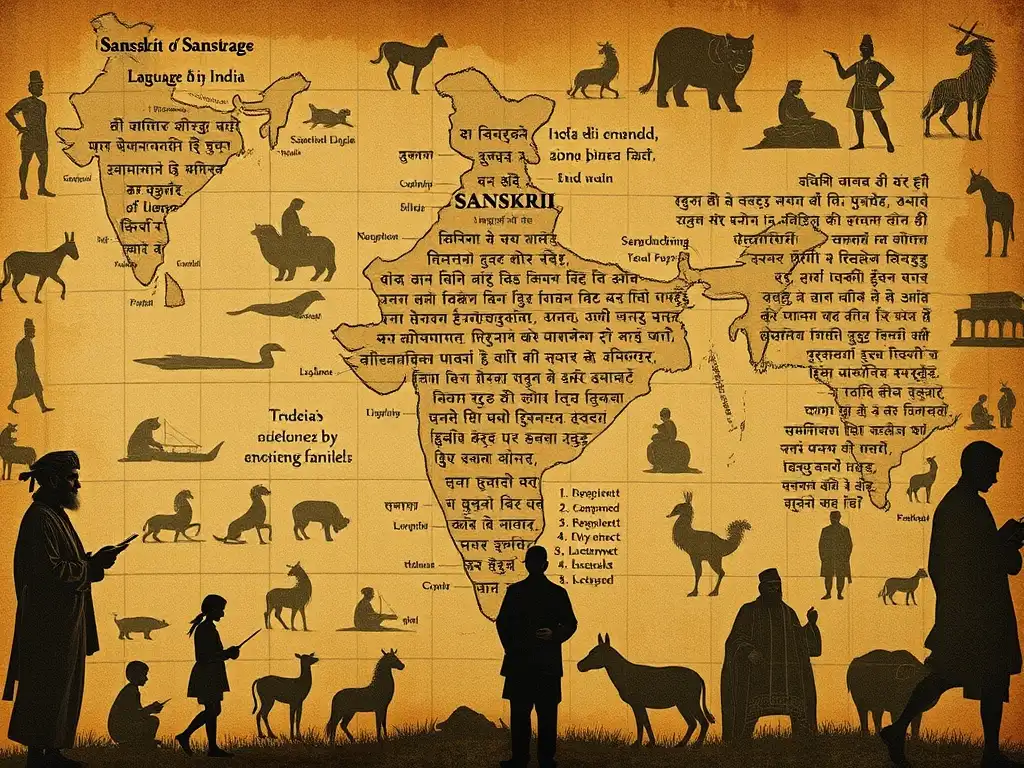
Sanskrit, one of the oldest known languages in the world, serves as a foundational pillar for many languages spoken today. Originating around 1500 BCE, this classical language of India has a rich heritage that extends far beyond its geographical confines. Understanding the roots of Sanskrit involves delving into its connections with other languages and its unique characteristics that have influenced linguistic evolution across cultures.
Sanskrit as part of the Indo-European Language Family
Sanskrit is a key member of the Indo-European language family, which encompasses a wide range of languages spoken across Europe and parts of Asia. This family includes well-known languages such as Latin, Greek, and the Germanic languages, as well as modern languages like French, Spanish, and Hindi.
-
Common Ancestry: Linguists propose that these languages share a common ancestor known as Proto-Indo-European (PIE). The relationship can be observed through cognates—words that have a common etymological origin. For instance, the Sanskrit word "pitar" (father) is related to the Latin "pater" and the English "father."
-
Cognate Examples: Here are some examples showcasing the cognate relationships between Sanskrit and other Indo-European languages:
Sanskrit Latin Greek English mātar mater mētēr mother bhrātṛ frater phrātēr brother dvi duo dyo two
These relationships indicate that Sanskrit not only shares a linguistic lineage but also has influenced the evolution of many modern languages.
Key Characteristics of Sanskrit Phonetics and Grammar
Sanskrit is renowned for its sophisticated phonetic and grammatical structure, which has significantly influenced the development of languages in South Asia and beyond.
- Phonetics: One of the standout features of Sanskrit is its systematic sound structure. The language employs a comprehensive set of consonants and vowels, organized systematically in the Sanskrit alphabet. It includes 14 vowels and 33 consonants, allowing for precise pronunciation and linguistic expression. This phonetic richness has influenced the sound systems of several languages in the Indian subcontinent.
- Grammar: Sanskrit grammar is characterized by its complexity and precision. Here are some key elements:
- Declensions: Sanskrit nouns undergo declension, changing form based on their grammatical case, number, and gender. There are eight grammatical cases, which determine the function of the noun in a sentence. For example:
- Nominative (subject)
- Accusative (object)
- Instrumental (means or agent)
- Conjugations: Verbs in Sanskrit are conjugated based on tense, mood, voice, person, and number. This level of conjugation allows for nuanced expression of time and aspect in verbs.
- Compound Formation: Sanskrit is also known for its ability to create compound words (samasa), where two or more words combine to form a new meaning. This feature enables the language to convey complex ideas succinctly.
- Declensions: Sanskrit nouns undergo declension, changing form based on their grammatical case, number, and gender. There are eight grammatical cases, which determine the function of the noun in a sentence. For example:
The intricate phonetic and grammatical structures of Sanskrit have not only contributed to its historical significance but have also laid the groundwork for the language's influence on many global languages, enriching them with its linguistic legacy.
Direct Influence of Sanskrit on Global Languages
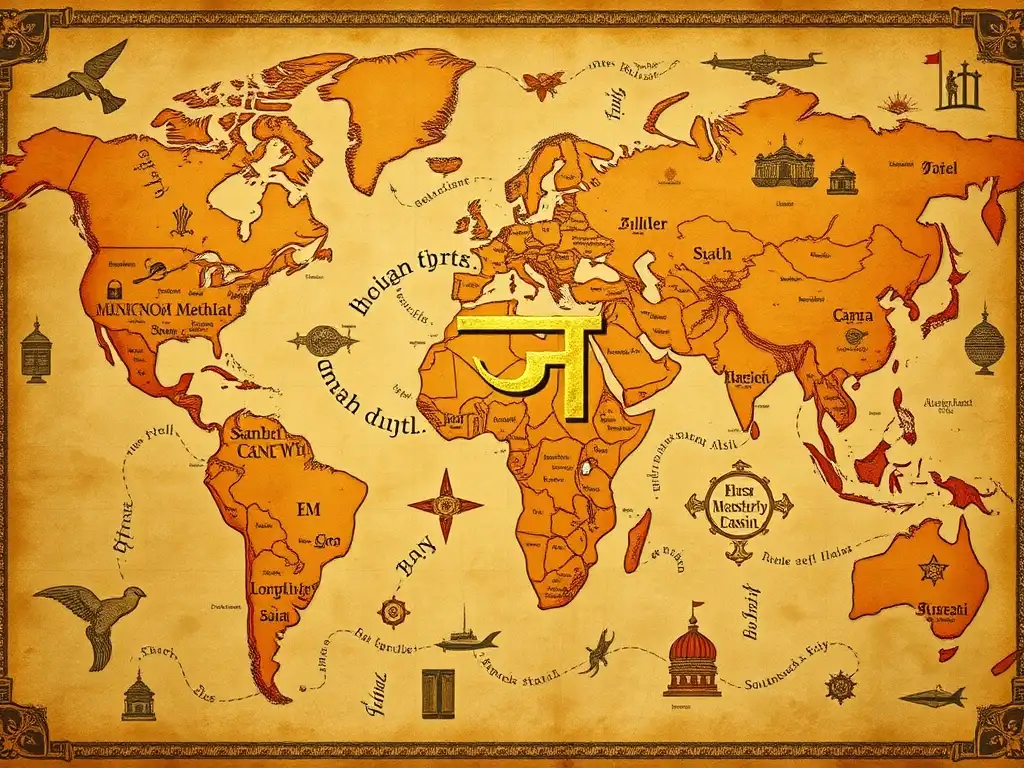
Sanskrit Loanwords in Modern Languages
Sanskrit, the ancient liturgical language of Hinduism and a key element of Indian cultural heritage, has significantly influenced many modern languages across the globe. Loanwords from Sanskrit have been absorbed into various languages due to trade, cultural exchanges, and the spread of religion. The presence of Sanskrit vocabulary can be observed not only in languages directly descended from it but also in languages that have had contact with Indian culture.
Influence on Indo-Aryan Languages
Indo-Aryan languages, a branch of the larger Indo-European language family, have been deeply influenced by Sanskrit. Languages such as Hindi, Bengali, Punjabi, and Marathi exhibit a substantial number of Sanskrit-derived words.
- Hindi: Approximately 30% of Hindi vocabulary is derived from Sanskrit, including words like "शक्ति" (shakti, meaning power) and "ज्ञान" (jnana, meaning knowledge).
- Bengali: In Bengali, Sanskrit has contributed to literary and scholarly vocabulary. Words like "গণন" (ganana, meaning calculation) and "বিদ্যা" (bidya, meaning knowledge) are of Sanskrit origin.
- Punjabi: Punjabi incorporates many Sanskrit words, particularly in religious and philosophical contexts. For example, "ਕ੍ਰਿਪਾ" (kripa, meaning grace) showcases this influence.
Influence on Dravidian Languages
Dravidian languages, primarily spoken in southern India, have also been influenced by Sanskrit, particularly in their lexicons and phonetic structures.
- Tamil: Although Tamil has a rich linguistic heritage of its own, Sanskrit has contributed numerous loanwords, especially in literary and religious contexts. Examples include "அர்ச்சனை" (archanai, meaning worship) and "தெய்வம்" (deivam, meaning god).
- Telugu: Telugu has a significant Sanskrit influence, with about 20% of its vocabulary coming from Sanskrit. Words like "సంకల్పం" (sankalpam, meaning resolution) illustrate this connection.
- Kannada: Kannada, too, has absorbed many Sanskrit terms, particularly in literature and formal speech. Words such as "ಜ್ಞಾನ" (jnana, meaning knowledge) and "ಶಕ್ತಿ" (shakti, meaning power) are prevalent.
The Impact of Sanskrit on Southeast Asian Languages
The influence of Sanskrit extends far beyond the Indian subcontinent, reaching Southeast Asia where it played a crucial role in the development of local languages and cultures. This impact is particularly evident in languages influenced by Hinduism and Buddhism.
Examples from Thai, Khmer, and Malay
- Thai: The Thai language has incorporated many loanwords from Sanskrit, particularly in terms related to religion, philosophy, and royal culture. Words like "ธรรม" (dharma, meaning law) and "อักษร" (aksorn, meaning letter) illustrate this influence.
- Khmer: In Khmer, the impact of Sanskrit is profound, with a significant portion of its vocabulary derived from it. Terms like "ព្រះ" (preah, meaning holy) and "វេជ្ជ" (vech, meaning physician) are direct borrowings from Sanskrit, reflecting cultural and religious concepts.
- Malay: The Malay language has also absorbed a variety of Sanskrit words, especially in formal and literary contexts. Words such as "kota" (from "कोटि" - koti, meaning fort) and "agama" (from "धर्म" - dharma, meaning religion) showcase this linguistic exchange.
The influence of Sanskrit on global languages, particularly those in the Indo-Aryan, Dravidian, and Southeast Asian families, is a testament to its rich cultural legacy. Its contributions to vocabulary and linguistic structure continue to resonate, illustrating the enduring nature of this ancient language.
Sanskrit's Role in the Development of English Vocabulary
Sanskrit, one of the oldest languages in the world, has had a profound influence on many global languages, including English. While the direct borrowing of words is less common than with languages such as Latin or French, the impact of Sanskrit on English vocabulary is noteworthy, particularly through its connections to Indo-European languages. The shared linguistic heritage can be traced back thousands of years, revealing that many English words have roots in ancient Sanskrit.
One of the most significant ways that Sanskrit has influenced English is through its role in the development of vocabulary related to spirituality, philosophy, and science. Terms such as "karma," "yoga," and "dharma" have entered the English lexicon, often retaining their original meanings from Sanskrit. This incorporation reflects a growing interest in Eastern philosophies and practices, particularly in the 20th century when globalization increased cross-cultural exchanges.
Additionally, academic fields such as linguistics, anthropology, and comparative mythology have seen Sanskrit terms integrated into English as scholars sought to describe concepts unique to Indian culture. These borrowings highlight the importance of Sanskrit not only as a language of ancient texts but as a vital component of modern academic discourse.
Borrowed Terms and Academic Language
The influence of Sanskrit on English vocabulary can be particularly observed in specialized academic language where certain terms have been adopted to convey complex ideas rooted in Indian philosophy and culture. Here are some notable borrowed terms:
- Karma: Refers to the concept of cause and effect in moral actions, widely discussed in philosophical debates.
- Yoga: A term that describes both a physical and spiritual practice, now commonly used in health and wellness contexts.
- Dharma: Represents duty, morality, and law in Indian philosophy, frequently referenced in discussions of ethics.
- Mantra: Originally a sacred utterance in Sanskrit, it has found its way into English as a term for a repeated phrase or slogan.
In addition to direct borrowings, the study of Sanskrit has also enriched academic language through the creation of hybrid terms. Linguists often use the term "Sanskritization" to describe the process by which local customs and practices are assimilated into the broader cultural framework inspired by Sanskrit texts. This term reflects the language's influence on cultural dynamics within South Asia and beyond.
Moreover, the exploration of Sanskrit in comparative linguistics has led to the development of terminologies that describe linguistic phenomena, such as Proto-Indo-European, the hypothetical ancestor of many modern languages, including English. The recognition of Sanskrit's structural and grammatical similarities to other Indo-European languages has played a crucial role in historical linguistics, further underscoring its significance in the study of language development.
While the direct influence of Sanskrit on English may not be as pronounced as with other languages, its contributions to vocabulary, especially in specialized fields, illustrate a rich cultural legacy that continues to shape global discourse.
Cultural Legacy of Sanskrit in Language Evolution

Sanskrit is not merely a language; it is a cultural treasure that has significantly influenced the evolution of various global languages. Its intricate grammatical structure, rich vocabulary, and philosophical depth have left an indelible mark on many modern tongues, especially those in South Asia. This legacy is evident in the way Sanskrit has shaped linguistic, literary, and cultural norms across the centuries.
The preservation of ancient texts in Sanskrit has ensured that not only the language but also the ideas, values, and knowledge of ancient Indian civilizations have been transmitted through generations. As a result, Sanskrit serves as a vital link between the past and the present, illustrating its profound impact on language development and evolution.
Preservation of Ancient Texts and Their Linguistic Impact
The preservation of ancient texts in Sanskrit has played a crucial role in maintaining the linguistic nuances and cultural identity of the Indian subcontinent. Key texts, such as the Vedas, Upanishads, and epics like the Mahabharata and Ramayana, have been meticulously copied and studied over millennia. This preservation has not only kept the language alive but has also provided a rich repository of vocabulary, syntax, and semantics that continue to influence modern languages.
- Linguistic Preservation: Sanskrit's grammatical precision, defined by its systematized rules, has influenced the syntax and morphology of many languages. For example, the structure of certain Indo-European languages can trace its roots back to Sanskrit's complex grammatical frameworks.
- Lexical Borrowings: Many languages, particularly those in the Indo-Aryan family, have borrowed extensively from Sanskrit. For instance, Hindi, Bengali, and Punjabi incorporate a significant number of words derived from Sanskrit, contributing to their richness and expressiveness.
- Cultural Transmission: The themes and narratives found in Sanskrit literature have shaped the cultural and linguistic landscapes of South Asia. Concepts such as dharma (duty/righteousness) and karma (action) have transcended linguistic boundaries, influencing the moral and philosophical discourse in various cultures.
The Role of Sanskrit in Religion and Philosophy
Sanskrit's influence extends beyond linguistics; it plays a pivotal role in the religious and philosophical traditions of India. The language is the medium through which profound spiritual and philosophical ideas were articulated, and it remains integral to the practices of Hinduism, Buddhism, and Jainism.
- Philosophical Texts: The Upanishads and other philosophical writings in Sanskrit explore complex concepts of existence, consciousness, and the universe. These texts have influenced not only Indian thought but have also attracted the interest of scholars worldwide, contributing to philosophical discourse in various cultures.
- Religious Liturgies: Sanskrit is still used in religious ceremonies and rituals. Its phonetic qualities are believed to enhance spiritual experiences, leading to its continued use in chanting and prayers among practitioners of Hinduism and Buddhism.
Influence on Buddhist and Hindu Texts
The impact of Sanskrit on Buddhist and Hindu texts is profound and far-reaching. Both traditions have utilized Sanskrit to convey their teachings, making it a cornerstone of their respective literatures.
- Buddhism: The spread of Buddhism saw the translation of many Sanskrit texts into other languages, such as Tibetan, Chinese, and Mongolian. Important works like the Sutra of Golden Light and Lotus Sutra were originally composed in Sanskrit, and their translations have influenced various Buddhist practices and philosophies globally.
- Hinduism: The vast corpus of Sanskrit literature within Hinduism, spanning scriptures, poetry, and philosophy, has shaped not only religious practices but also linguistic development in regions where Hindu culture has thrived. The influence of texts like the Bhagavad Gita extends beyond India, inspiring countless translations and interpretations in various languages.
The cultural legacy of Sanskrit in language evolution is significant and multifaceted. Its preservation through ancient texts, its role in shaping religious and philosophical thought, and its continuing influence on modern languages underscore the enduring impact of this ancient language on global linguistic landscapes.
Sanskrit's Contribution to Scientific and Mathematical Terminology
Sanskrit has made significant contributions to various fields, especially in science and mathematics, influencing not only the Indian subcontinent but also extending its reach to various global languages. The precision and richness of Sanskrit vocabulary allowed for the articulation of complex scientific concepts, many of which have been adopted and adapted by other languages over centuries.
Ancient Texts and Scientific Concepts
The ancient Indian texts, such as the Aryabhatiya by Aryabhata and the Siddhanta Shiromani by Bhaskara II, are prime examples where Sanskrit is used to describe advanced scientific and mathematical concepts. Aryabhata introduced the concept of zero and positional notation in his works, which laid the foundation for modern arithmetic. These texts were not only pivotal in shaping Indian mathematics but also influenced scholars in the Arab world and beyond, leading to the incorporation of these ideas into European mathematical traditions during the Renaissance.
- Zero and Place Value: The term for zero in Sanskrit, "शून्य" (śūnya), highlights its profound conceptual significance. The adoption of zero in various languages has roots in this ancient term.
- Trigonometry: The Sanskrit word "ज्या" (jya), which translates to "chord," is the precursor to the modern term "sine." This influence can be seen in the development of trigonometric functions in many languages, stemming from the early works of Indian mathematicians.
Influence on Modern Scientific Vocabulary
Sanskrit has also influenced modern scientific terminology across various disciplines. Many scientific terms have their origins in Sanskrit, showcasing its lasting impact on language evolution. For instance:
- Chemistry: The term "रस" (rasa), meaning "essence" or "taste," is found in the naming of chemical elements and compounds in various languages.
- Medicine: In the field of Ayurveda, terms like "आयुर्वेद" (Ayurveda) and "संजीवनी" (Sanjivani) have transcended linguistic boundaries, being used in medical terminology globally.
Global Adoption and Linguistic Legacy
The influence of Sanskrit on global languages is evident in the way scientific and mathematical terminology has been adopted and adapted. Scholars from various cultures translated Sanskrit works, often preserving the original terminology or creating derivatives that reflect the concepts articulated in the source texts.
- Latin and Arabic Translations: Many Sanskrit texts were translated into Arabic, and subsequently into Latin, during the medieval period. This not only facilitated the transfer of knowledge but also influenced the vocabulary of European languages. For example, the Arabic term "صفر" (sifr) for zero is derived from the Sanskrit "śūnya."
The contributions of Sanskrit to scientific and mathematical terminology are profound, with its concepts and vocabulary influencing a myriad of languages globally. This linguistic legacy highlights the importance of Sanskrit in the evolution of language and underscores its role as a foundational pillar in the development of scientific thought across cultures.
Comparative Analysis: Sanskrit and Other Ancient Languages

Comparison with Latin and Greek
Sanskrit, Latin, and Greek are three foundational languages that have significantly shaped their respective linguistic families and cultures. Each of these languages has a rich history and has contributed to the development of numerous modern languages.
- Roots and Evolution:
- Sanskrit: Belonging to the Indo-European family, Sanskrit is one of the oldest known languages, with roots traced back to approximately 1500 BCE. It evolved through various phases, including Vedic and Classical Sanskrit, influencing many modern languages in the Indian subcontinent.
- Latin: Originating around the 6th century BCE, Latin was the language of the Roman Empire and has given rise to the Romance languages (e.g., Spanish, French, Italian).
- Greek: With its earliest records dating back to the 9th century BCE, Greek has influenced many modern languages and remains significant in academic, scientific, and philosophical discourse.
- Cultural Significance:
- Sanskrit: It is not only a literary language with a vast corpus of texts in philosophy, science, and religion but also a cultural touchstone for Hinduism and Buddhism.
- Latin: Latin was the lingua franca of medieval Europe and is still used in legal, scientific, and ecclesiastical contexts.
- Greek: Its significance lies in its contributions to Western philosophy, literature, and the sciences, with many terms in these fields having Greek origins.
- Influence on Modern Languages:
- Sanskrit Influence: Languages like Hindi, Bengali, and many others in India have directly descended from or been influenced by Sanskrit.
- Latin Influence: Romance languages evolved directly from Latin, and many English words have Latin roots.
- Greek Influence: English has absorbed a substantial number of Greek words, especially in the fields of science and medicine.
Similarities and Differences in Linguistic Structures
Understanding the structural similarities and differences among Sanskrit, Latin, and Greek enhances the appreciation of their linguistic intricacies.
- Grammar:
- Sanskrit: Known for its complex grammatical structure, Sanskrit features an extensive system of inflections, with eight cases, three genders, and three numbers. Its syntax allows for flexibility, often emphasizing the meaning through word order.
- Latin: Similarly inflected, Latin also employs cases (six in total) and has a rich verb conjugation system. The sentence structure is relatively rigid compared to Sanskrit.
- Greek: Greek grammar includes cases (five in total) and is renowned for its participles and moods, adding layers of meaning that can alter a sentence's nuance.
- Vocabulary:
- Sanskrit: Rich in synonyms and nuanced meanings, Sanskrit vocabulary reflects its philosophical and spiritual heritage. Many words have multiple meanings depending on context.
- Latin: Vocabulary often reflects Roman culture, law, and governance, with many terms still used today in legal contexts.
- Greek: Known for its scientific and philosophical terminology, Greek has given rise to many technical terms in modern disciplines.
- Phonetics:
- Sanskrit: Characterized by a system of sounds that can be precisely articulated, Sanskrit phonetics includes retroflex consonants, which are not common in Latin or Greek.
- Latin and Greek: Both languages have a more straightforward phonetic inventory, which influenced the development of the Romance languages and emphasized vowel sounds.
The Global Reach of Ancient Indian Linguistic Traditions
The influence of Sanskrit extends far beyond the Indian subcontinent, showcasing its global reach through cultural exchanges, trade, and the spread of religions.
- Cultural Exchange through Trade:
- Ancient Indian traders and scholars traveled extensively, bringing Sanskrit texts and linguistic traditions to regions such as Southeast Asia, where they influenced local languages, literature, and culture. For instance, the spread of Hinduism and Buddhism brought Sanskrit to Indonesia, Thailand, and Cambodia, where it left a lasting imprint.
- Influence on Southeast Asian Languages:
- Languages such as Thai, Malay, and various forms of Indonesian have incorporated Sanskrit vocabulary and influences. The presence of Sanskrit-derived words in these languages reflects the cultural and religious exchanges that took place over centuries.
- Revival and Modern Influence:
- In modern times, there has been a resurgence of interest in Sanskrit, with scholars and linguists exploring its ties to comparative linguistics. Its systematic structure and rich literature continue to inspire linguistic studies and contribute to the understanding of language development globally.
In summation, the Sanskrit influence on languages is not merely historical; it continues to resonate in various linguistic traditions around the world, demonstrating the enduring legacy of this ancient language.
Conclusion: The Lasting Legacy of Sanskrit Influence on Global Languages

The profound impact of Sanskrit on global languages is a testament to its historical and cultural significance. As one of the oldest languages in the world, Sanskrit has not only shaped the linguistic landscape of the Indian subcontinent but has also left an indelible mark on various languages across Asia and beyond. This section aims to encapsulate the essence of Sanskrit's contributions and the necessity of preserving this rich linguistic heritage.
Summary of Key Contributions
Sanskrit has influenced numerous languages through its extensive vocabulary, grammatical structure, and phonetics. Here are some key contributions:
- Vocabulary Enrichment: Many modern languages, including Hindi, Bengali, and Nepali, have borrowed extensively from Sanskrit. For instance, over 40% of Hindi's vocabulary is derived from Sanskrit, with words like sanskriti (culture) and vidya (knowledge) being integral to everyday use.
- Grammatical Structures: The grammatical precision of Sanskrit has inspired the development of grammatical frameworks in several languages. For example, the rules of syntax and morphology in languages like Thai and Khmer show traces of Sanskrit influence.
- Phonetic Systems: The phonetic richness of Sanskrit has impacted the sound systems of various South Asian languages. The use of retroflex sounds in languages such as Tamil and Telugu can be traced back to Sanskrit phonetics, showcasing the language's auditory legacy.
- Cultural and Literary Influence: Sanskrit literature, including epics like the Mahabharata and Ramayana, has inspired countless works across different cultures. Its narratives and themes are evident in the storytelling traditions of Southeast Asia, influencing local folklore and literature.
The Importance of Preserving Linguistic Heritage
Preserving the linguistic heritage of Sanskrit is crucial for several reasons:
- Cultural Identity: Languages are key carriers of culture. By preserving Sanskrit, we safeguard the cultural identities and traditions of various communities that have historically relied on this language for expression and communication.
- Linguistic Diversity: In an increasingly globalized world, the preservation of diverse languages fosters a rich tapestry of human expression. Sanskrit’s unique features contribute significantly to this diversity, and efforts to maintain it can enhance our understanding of human language evolution.
- Educational Value: Understanding Sanskrit opens up access to a wealth of ancient texts and wisdom. It provides insights into philosophy, science, and art that have shaped not only Indian civilization but have also influenced global thought.
- Interdisciplinary Connections: The study of Sanskrit has implications across various fields such as linguistics, anthropology, and history. Preserving this language enables interdisciplinary research and a deeper understanding of the connections between cultures.
The influence of Sanskrit on global languages is a remarkable legacy that continues to resonate today. Recognizing and preserving this legacy not only honors the past but also enriches our present and future. The ongoing efforts to promote Sanskrit studies and its relevance in modern education are vital for ensuring that this linguistic treasure remains a part of our cultural heritage for generations to come.
Further Reading and Resources

Recommended Books on Sanskrit and Linguistics
For those interested in delving deeper into the influence of Sanskrit on languages, a selection of insightful books can illuminate various aspects of this ancient language. Here are some recommended titles:
- "Sanskrit: An Introduction to the Classical Language" by Charles Philip Brown
- This book serves as a comprehensive introduction to Sanskrit, covering grammar, vocabulary, and syntax. It highlights the historical context of the language and its evolution.
- "The Power of Sanskrit: A Study of Language and Culture" by David G. S. Lutz
- Lutz explores the cultural significance of Sanskrit and its profound impact on other languages, emphasizing its role in shaping linguistic traditions across Asia.
- "Sanskrit and the World's Languages" by R. S. G. Gupta
- This book provides a comparative analysis of Sanskrit and various global languages, illustrating the linguistic connections and influences that span continents.
- "Comparative Grammar of the Indo-European Languages" by Karl Brugmann
- While not exclusively about Sanskrit, this classic work offers insights into the Indo-European language family, detailing the connections between Sanskrit and its relatives.
- "The Sanskrit Language: An Introductory Grammar" by Arthur Anthony Macdonell
- Macdonell’s book is a seminal text that introduces readers to the fundamental aspects of Sanskrit grammar, making it accessible for beginners.
Online Courses and Lectures on Sanskrit Language and Influence
In addition to books, online resources provide a wealth of information regarding Sanskrit and its influence on languages. Here are some notable courses and lectures to consider:
- Coursera: "Sanskrit Language: Introduction"
- This course offers foundational knowledge of Sanskrit, focusing on its grammar and vocabulary. It is suitable for beginners and those interested in linguistic studies.
- edX: "The Influence of Sanskrit on Modern Languages"
- This course examines how Sanskrit has shaped several modern languages, exploring its historical context and linguistic features.
- YouTube Channels: "Sanskrit with Subhash"
- A series of engaging lectures that provide insights into Sanskrit language structure, its usage, and its impact on other languages.
- Open Culture: Free Sanskrit Resources
- This platform aggregates various free resources, including audio recordings and PDFs, aimed at learners interested in the Sanskrit language and its global influence.
- Harvard University: "Sanskrit: An Overview" Lecture Series
- A collection of recorded lectures from leading scholars discussing the significance of Sanskrit in historical linguistics and its cultural ramifications.
By exploring these resources, readers can gain a comprehensive understanding of the Sanskrit influence on languages and appreciate the rich legacy of this ancient language.
Frequently Asked Questions
What is Sanskrit and why is it significant?
Sanskrit is an ancient Indo-Aryan language that has profoundly influenced many modern languages. Its significance lies in its role as the liturgical language of Hinduism and its contributions to philosophy, literature, and science.
How has Sanskrit influenced modern languages?
Sanskrit has left a lasting impact on several Indo-European languages, notably in vocabulary and grammar. Many words and grammatical structures in languages like Hindi, Bengali, and even some European languages trace their roots back to Sanskrit.
What are some examples of Sanskrit words in other languages?
Examples include the word "guru," which means teacher in Sanskrit and is used in various languages, and "sutra," which refers to a rule or guideline, appearing in both English and other languages.
How did the spread of Sanskrit occur historically?
Sanskrit spread through trade, migration, and cultural exchanges during ancient times. The establishment of empires, such as the Maurya and Gupta, facilitated the dissemination of Sanskrit literature and scholarly works across Asia.
Why is the study of Sanskrit important today?
Studying Sanskrit is crucial for understanding the cultural heritage of ancient civilizations. It helps linguists and historians trace the evolution of languages and can provide insights into the cultural exchanges that shaped human history.
Final Reflection: The Enduring Legacy of Sanskrit's Influence on Languages
Sanskrit's impact on global languages is not merely a historical footnote; it is a vibrant thread woven into the fabric of modern communication. As we navigate an increasingly interconnected world, the echoes of Sanskrit resonate through the lexicons of countless languages, reminding us of our shared cultural heritage. This ancient language has not only shaped the linguistic landscape but has also fostered a deeper understanding of the interconnectedness of human expression.
Culturally, the influence of Sanskrit extends beyond mere vocabulary; it has enriched the philosophical and spiritual dimensions of societies worldwide. The principles and concepts embedded in Sanskrit have inspired thinkers, writers, and artists across generations, creating a tapestry of ideas that transcend geographical boundaries. As Mahatma Gandhi once said, A language is something infinitely greater than grammar and philology. It is the poetic testament of the genius of a race and culture, and the living embodiment of the thoughts and fancies that have moulded them.
This observation underscores the profound significance of Sanskrit in shaping not only languages but also the very essence of cultural identity.
As we reflect on the legacy of Sanskrit, let us embrace the opportunity to explore and celebrate the linguistic diversity that enriches our lives. I invite you to delve into the languages around you, to recognize the threads of Sanskrit that may be woven into your own linguistic experiences. By appreciating this cultural legacy, we can foster a greater sense of unity and understanding in our global community, ensuring that the influence of Sanskrit continues to inspire future generations.
Embrace the Legacy: Unleash the Power of Sanskrit Today!
Thank you for diving into the fascinating world of Sanskrit and its profound influence on global languages! Your curiosity is the first step toward appreciating the cultural richness this ancient language offers. Now that you've unearthed its impact, it’s time to take action and explore further!
Here are some engaging suggestions to deepen your connection with Sanskrit:
- Start learning a few Sanskrit words and phrases by using fun and interactive apps or enrolling in online courses that cater to beginners.
- Share your favorite insights from this article on social media or with friends; let’s work together to spread the knowledge we’ve gained!
- Join a local or online community of enthusiasts eager to study Sanskrit or explore its applications in contemporary linguistics.
How has learning about Sanskrit influenced your perspective on language and culture in your life?